REVIEW 4 major objections 5 minor 54 references
AdaDexGrasp: Adaptive Dexterous Grasping via 3D Visuo-Tactile Representation Fusion
T0 review · 4 major / 5 minor · reviewed 2026-08-11 · deepseek-v4-flash
Pith's one-line read A visuo-tactile representation that binds touch to finger identities lifts dexterous grasp success to 91% in simulation and 90% on a real robot.
desk verdict Interesting simulation results and a clean ablation, but the real-world numbers are not connected to the described method because of an unexplained 22-to-11 DoF hand mismatch. read the letter →
The pith
A machine-rendered reading of the paper's core claim, the machinery that carries it, and where it could break.
The reading
What carries the argument
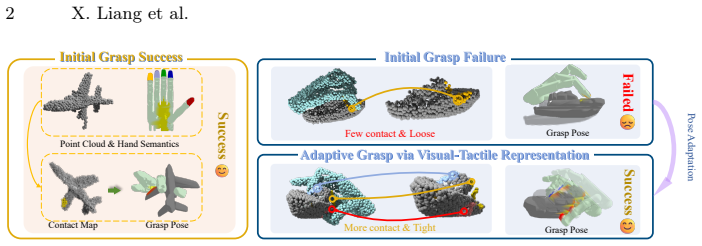
The central mechanism is the tactile-mapped point cloud $\mathcal{P}_{vt}$, which is the object point cloud annotated per point with RGB color, a scalar contact state $k_i$, a six-channel tactile intensity vector $c_i$, and a categorical contact ID that identifies the specific finger or palm in contact. This fused representation is the unified input to all three models: a contact-driven generator that first predicts a semantic contact map $M$ and then a grasp pose, a grasp success classifier $f_\theta$, and a closed-loop adaptation model $g_\phi$ that produces corrective pose updates. The contact ID is what binds vision to touch: it tells the network not just that contact happened but which hand part made it, which enables fine-grained finger-object reasoning during both planning and refinement.
What would settle it
Run the same closed-loop policy on the real 11-joint hand after simply ignoring or remapping the 11 extra simulated joints; if grasp success then falls to the level of the vision-only baselines, the claimed sim-to-real transfer of the tactile-guided framework is refuted.
Extended reading notes
Core claim
The paper's central claim is that a unified visuo-tactile representation, in which tactile signals are bound to finger and palm identities, enables a single pipeline to generate contact-aware initial grasps, predict whether they will succeed, and iteratively correct unsuccessful ones after contact. The reported results are 91% success on seen objects, 82% on unseen objects, and 83% on unseen categories in simulation, and 90%, 87%, and 81% respectively on a real robot. The authors attribute the gains to the semantic binding of contact to hand parts: removing that binding in generation drops seen-object success from 91% to 79%, and disabling the adaptation module drops unseen-category success from 83% to 59%. This leads them to conclude that post-contact tactile feedback, not just better visual planning, is the decisive factor for generalizable dexterous grasping.
Load-bearing premise
The load-bearing premise is that the 22-dimensional joint state and contact patterns learned in simulation transfer to the real 11-joint hand, since the paper defines the state in 22 joints but evaluates on an 11-joint hand without describing a kinematic alignment or retraining step.
Editorial extensions
If this is right
- Enabling the adaptation module raises unseen-category success in simulation from 59% to 83%, so tactile-guided correction is the main source of generalization.
- Removing finger/palm identity from the contact map during generation drops seen-object success from 91% to 79%; the semantic binding is load-bearing.
- On a dataset with more than 15,000 objects, the framework retains 87% success, suggesting the representation scales beyond the 50-object training set.
- In practice, refinement is triggered in about 30% of trials and over 90% of those converge within three iterations, so the closed loop is fast enough for real-time use.
- Real-world results track simulation trends, supporting the view that the same visuo-tactile representation works outside the simulator.
Reading between the lines
- A testable extension is to apply the same contact-ID binding to a two-finger gripper, since the mechanism does not depend on five-finger dexterity.
- The paper's own failure analysis points to slippage and size-limit cases; adding explicit slip detection or pre-grasp size estimation could be a direct next step.
- The 22-joint training state versus the 11-joint real hand leaves the sim-to-real transfer under-specified; I would expect retraining on the real hand's kinematics to change the reported real-world numbers.
Editorial analysis
A structured set of objections, weighed in public.
Referee Report
Summary. The paper proposes AdaDexGrasp, a dexterous grasping framework that fuses visual point clouds with tactile feedback. The system comprises three learned components: a contact-driven grasp pose generator that predicts a per-point contact map carrying finger/palm identities (Section 3.3); a grasp feasibility classifier that operates on a tactile-mapped point cloud (Section 3.4); and a diffusion-based pose adaptation model that refines suboptimal poses (Section 3.5). These components are combined into a closed-loop refinement procedure (Section 3.6, Eqs. 12-14) that iterates until the classifier predicts success or a maximum iteration count is reached. Training data are collected from PPO rollouts in an IsaacGym environment with a 22-DoF ShadowHand (Section 3.7). Experiments report 91%/82%/83% success on seen, unseen-object, and unseen-category sets in simulation (Table 1) and 90%/87%/81% on a real 11-DoF Psibot SynHand-6 across 26 objects (Table 3), with ablations in Table 2 and additional quantitative analysis in the supplementary material.
Significance. If the reported results are reproducible, the framework advances the state of the art on an important and under-addressed problem: tactile-guided closed-loop dexterous grasping. Strengths include the integration of grasp generation, feasibility prediction, and adaptive refinement in one pipeline; a semantically labeled contact map that ties tactile signals to finger identities; consistent ablations showing that both contact IDs and adaptation matter (Table 2); a new IsaacGym tactile environment; and real-world experiments with a disclosed protocol (260 trials per method, supplementary Section E). The supplementary also provides honest quantitative ablations of the intermediate contact map, the pairing metric, and the tactile representation choice. The empirical claims are, however, limited by the issues in the major comments, in particular the unexplained 22-to-11 degree-of-freedom transfer between the simulated hand and the real hand, which disconnects Table 3 from the method as specified, and the absence of variance or significance reporting.
major comments (4)
- [§3.1, §3.5, §4.4, Eq. (8)] The real-world results in Table 3 cannot be attributed to the method as specified. Section 3.1 defines the hand state j as a 22-dimensional joint vector, Eq. (8) computes the adaptation pairing distance on that 22-dimensional joint space, and all components are trained with the 22-DoF ShadowHand described in Section 4.1. The real platform in Section 4.4 and Figure 6 is an 11-DoF Psibot SynHand-6. The only cross-embodiment statement, Section 3.3 ('training data ... can be adapted to different dexterous hands by training the policy on the corresponding hand models'), does not describe a kinematic mapping from 22 to 11 joints, a retraining protocol for the SynHand, an architecture change for the output dimension of Gpose or the adapter, or a SynHand simulation environment. The supplementary's left-arm/right-arm validation concerns mirror symmetry of a kinematic chain and does not address joint-space dimensionality. The authors must disclose how the Table 3 numbers were produced: either a separately trained SynHand model (whose training and simulation setup must then be documented) or an explicit joint mapping (which requires revising Eq. (8) and the pose-output layers, and re-verifying the pairing and adaptation losses). Without this disclosure, the real-world success rates do not support the central claim of real-world validity and generalization.
- [Tables 1–3; abstract] All success rates are reported as single point estimates without error bars, number of simulation trials or seeds, or significance tests. The supplementary (Section E) discloses 260 real-world trials per method, but no analogous count is given for simulation, and none of the tables report variance. This matters for the paper's headline claim ('significantly enhances grasp success rates', abstract) because several decisive margins in Table 2 are small (e.g., 84% vs 91% on seen objects for 'w/o contact id in adaptation'; 72% vs 74% on unseen objects between 'Object-only' and 'w/o PC'). The authors should report per-split trial counts, at least three seeds for the main simulation comparisons, confidence intervals, and a significance test for the principal comparisons in Tables 1 and 2.
- [§4.1] The simulation asset description is internally inconsistent. The text states 'including 50 objects from 6 categories. Among them, 20 objects are used for training and 30 unseen-category objects for testing', which implies the 50 objects are partitioned into 20 training and 30 unseen-category test objects, leaving no test objects from seen categories. Yet Tables 1 and 2 report a separate 'Unseen Objects' column defined in Section 4.1 as 'objects from the same categories but unseen in training'. As written, the 'Unseen Objects' column has no defined test set. The authors should specify the exact number of objects in each of the three splits and how the 6 categories are partitioned.
- [§3.5–§3.6, Eq. (11), supplementary Section B] The closed-loop stopping rule in Eq. (13) uses the classifier's own prediction with threshold τ_succ = 0.5, and the adapter's loss in Eq. (11) contains the term λ(1 − f_θ(...)), which encourages refined poses to score highly on that same classifier. The paper does not report whether classifier confidence is calibrated against physical stability (the physics-based success metric defined in Section 4.1), nor whether the classifier is retrained after the adapter is trained. If the classifier is biased, the adapter can exploit that bias, and the supplementary's statement that 'over 90% converge to a successful grasp within fewer than 3 refinement iterations' is ambiguous as to whether convergence is judged by the classifier or by physical lift stability. Please report classifier-versus-physics agreement on the simulation test sets and clarify the arbiter behind the convergence statistic.
minor comments (5)
- [§4.2] The claim 'gains also persist at scale: ... our method still reaches 87%' on the DexGraspAnything dataset lacks a baseline number and a split definition; please specify what 87% refers to and compare against a baseline at the same scale.
- [§3.3] The sentence 'This estimates 0 serves as an initial grasp pose' contains a typo ('This estimates 0' should be 'This estimate s(0)' or similar).
- [§4.1 vs §4.4] The success criterion differs between simulation (stable for 1 second) and real world (3 seconds); please state the rationale so readers can gauge comparability.
- [Fig. 7] 'Avg. TIF' is used without definition; the text should define the averaged tactile intensity feature and its normalization.
- [§4.2 baselines] Several baselines are named without citations or precise configuration details (e.g., Robot Synesthesia, Intuitive Closed-Loop, DexGraspVLA); please add references or definitions so the comparisons are reproducible.
Circularity Check
No circularity: success labels and adaptation targets are external physics/RL outcomes, not re-statements of the model's own outputs.
full rationale
The derivation chain is self-contained against external outcomes. The grasp-success label y in Eq. (1) is defined physically: 'A grasp is considered successful if the object remains stable without slippage for at least 1 second after lift-off' (Sec. 4.1), and the classifier is trained with binary cross-entropy (Eq. (7)) on these external labels from PPO rollouts in Sec. 3.7. The adaptation model's target in Eq. (8) is a successful state s_s paired to the failed state s_f by an explicit SE(3)-plus-22-joint distance; Eq. (11) combines regression to that external target with a learned-stability term lambda*(1 - f_theta(...)). Using f_theta as a critic in the adaptation loss is a standard learned-reward pattern, not a definitional loop, because f_theta itself was fit to physical success/failure labels and the rollout pairing distance does not contain f_theta. The contact map M is an intermediate supervised by cross-entropy (Eq. (4)) from tactile-force-derived labels, not a renamed success prediction. No uniqueness theorem or load-bearing self-citation is invoked; the RL data-collection reference to UniDexGrasp is a training-setup citation, and even if some authors overlap, the physics simulator and success criterion are external. The paper does contain an evidentiary gap that is a correctness/transfer risk rather than circularity: Sec. 3.1 defines j in R^22, while Sec. 4.4 reports real results on an 11-DoF Psibot SynHand-6, and the only bridging sentence is 'can be adapted to different dexterous hands by training the policy on the corresponding hand models' (Sec. 3.3). The supplement's claim that left-versus-right arm results validate 'agnostic to ... kinematic configuration' addresses mirroring, not the 22-to-11 DoF mismatch. These gaps weaken the real-world generalization evidence but do not make any reported number equal to its own input, so the circularity score is 0.
Assumptions & free parameters
free parameters (5)
- Contact force threshold for tactile labeling =
0.01 N
- Success threshold tau_succ =
0.5
- Maximum refinement iterations K =
5
- Distance metric weighting in adaptation pairing =
10
- Adaptation loss weight lambda =
not specified
assumptions (4)
- domain assumption The object point cloud from an RGB-D camera captures sufficient geometric detail for stable grasping.
- domain assumption Contact forces in IsaacGym faithfully represent real tactile signals.
- domain assumption PPO rollouts following the UniDexGrasp first stage yield a diverse enough set of grasp states to train the classifier and adapter.
- domain assumption Every failed grasp state has a successful counterpart close under the distance in Eq. (8).
Cite this review
Pith. "Pith review of AdaDexGrasp: Adaptive Dexterous Grasping via 3D Visuo-Tactile Representation Fusion." pith.science (2026). https://pith.science/paper/E6DXKQDZ
@misc{pith2026260807600,
  author       = {Pith},
  title        = {Pith review of: AdaDexGrasp: Adaptive Dexterous Grasping via 3D Visuo-Tactile Representation Fusion},
  year         = {2026},
  howpublished = {\url{https://pith.science/paper/E6DXKQDZ}},
  note         = {Machine review of arXiv:2608.07600}
}
read the original abstract
Humans achieve stable and adaptive grasps by seamlessly integrating visual perception and tactile feedback, a capability that remains challenging to replicate in robotic systems. Existing robotic grasping approaches predominantly rely on visual inputs and lack mechanisms for tactile-guided adaptation after contact, limiting robustness and generalization. To address this challenge, we propose a unified visuo-tactile-fusion grasping framework that integrates grasp generation, feasibility prediction, and adaptive refinement. At its core, our method introduces an efficient visuo-tactile representation that tightly fuses object geometry with tactile feedback by associating tactile signals with finger identities. This unified representation supports contact-aware grasp pose generation during planning and tactile-guided refinement after contact, enabling the system to reason about fine-grained finger-object interactions and adjust grasps dynamically. Comprehensive experiments in both simulation and real-world environments demonstrate that our approach significantly enhances grasp success rates and generalization across diverse objects.
Figures


Figures from the paper (8 more)


Reference graph
Works this paper leans on
-
[1]
Alessi, C., Vasile, F., Ceola, F., Pasquale, G., Boccardo, N., Natale, L.: Hannesim- itation: Grasping with the hannes prosthetic hand via imitation learning (2025), https://arxiv.org/abs/2508.00491
work page Pith review arXiv 2025
-
[2]
Chen, S., Bohg, J., Liu, C.K.: Springgrasp: Synthesizing compliant, dexterous grasps under shape uncertainty (2024),https://arxiv.org/abs/2404.13532
arXiv 2024
-
[3]
Chen, Y., Sipos, A., der Merwe, M.V., Fazeli, N.: Visuo-tactile transformers for manipulation (2022),https://arxiv.org/abs/2210.00121
arXiv 2022
-
[4]
In: 2014 IEEE International Conference on Robotics and Automation (ICRA)
Dafle, N.C., Rodriguez, A., Paolini, R., Tang, B., Srinivasa, S.S., Erdmann, M., Mason, M.T., Lundberg, I., Staab, H., Fuhlbrigge, T.: Extrinsic dexterity: In-hand manipulation with external forces. In: 2014 IEEE International Conference on Robotics and Automation (ICRA). pp. 1578–1585. IEEE (2014)
work page 2014
-
[5]
Dave, V., Lygerakis, F., Rueckert, E.: Multimodal visual-tactile representation learning through self-supervised contrastive pre-training (2024),https://arxiv. org/abs/2401.12024
arXiv 2024
-
[6]
In: 2010 IEEE/RSJ International Conference on Intelligent Robots and Systems
Dogar, M.R., Srinivasa, S.S.: Push-grasping with dexterous hands: Mechanics and a method. In: 2010 IEEE/RSJ International Conference on Intelligent Robots and Systems. pp. 2123–2130. IEEE (2010)
work page 2010
-
[7]
Frontiers in Neu- rorobotics15, 658280 (2021)
Duan, H., Wang, P., Huang, Y., Xu, G., Wei, W., Shen, X.: Robotics dexterous grasping: The methods based on point cloud and deep learning. Frontiers in Neu- rorobotics15, 658280 (2021)
work page 2021
-
[8]
Fang, H.S., Yan, H., Tang, Z., Fang, H., Wang, C., Lu, C.: Anydexgrasp: General dexterous grasping for different hands with human-level learning efficiency (2025), https://arxiv.org/abs/2502.16420
arXiv 2025
Show all 54 references
-
[9]
George, A., Gano, S., Katragadda, P., Farimani, A.B.: Vital pretraining: Visuo- tactile pretraining for tactile and non-tactile manipulation policies (2024),https: //arxiv.org/abs/2403.11898
2024 arXiv
-
[10]
org/abs/2303.12076
Guzey, I., Evans, B., Chintala, S., Pinto, L.: Dexterity from touch: Self-supervised pre-training of tactile representations with robotic play (2023),https://arxiv. org/abs/2303.12076
2023 arXiv
-
[11]
Huang, B., Wang, Y., Yang, X., Luo, Y., Li, Y.: 3d-vitac: Learning fine-grained manipulation with visuo-tactile sensing (2025),https://arxiv.org/abs/2410. 24091
2025
-
[12]
Kerr, J., Huang, H., Wilcox, A., Hoque, R., Ichnowski, J., Calandra, R., Goldberg, K.: Self-supervised visuo-tactile pretraining to locate and follow garment features (2023),https://arxiv.org/abs/2209.13042
2023 arXiv
-
[13]
IEEE Robotics and Automation Letters 9(12), 10772–10779 (Dec 2024).https://doi.org/10.1109/lra.2024.3478571, http://dx.doi.org/10.1109/LRA.2024.3478571
Lee, K.W., Qin, Y., Wang, X., Lim, S.C.: Dextouch: Learning to seek and ma- nipulate objects with tactile dexterity. IEEE Robotics and Automation Letters 9(12), 10772–10779 (Dec 2024).https://doi.org/10.1109/lra.2024.3478571, http://dx.doi.org/10.1109/LRA.2024.3478571
2024
-
[14]
Lee, M.A., Zhu, Y., Srinivasan, K., Shah, P., Savarese, S., Fei-Fei, L., Garg, A., Bohg, J.: Making sense of vision and touch: Self-supervised learning of multimodal representationsforcontact-richtasks(2019),https://arxiv.org/abs/1810.10191
2019 arXiv
-
[15]
Li, J., Wu, T., Zhang, J., Chen, Z., Jin, H., Wu, M., Shen, Y., Yang, Y., Dong, H.: Adaptive visuo-tactile fusion with predictive force attention for dexterous manip- ulation (2025),https://arxiv.org/abs/2505.13982
2025 arXiv
-
[16]
Robotics and Autonomous Systems75, 352–364 (2016) AdaDexGrasp 17
Li, M., Hang, K., Kragic, D., Billard, A.: Dexterous grasping under shape uncer- tainty. Robotics and Autonomous Systems75, 352–364 (2016) AdaDexGrasp 17
2016
-
[17]
Proceedings of the 32nd ACM International Conference on Multimedia (2024),https://api
Li, P., Wang, Z., Liu, M., Liu, H., Chen, C.: Clickdiff: Click to induce semantic contact map for controllable grasp generation with diffusion models. Proceedings of the 32nd ACM International Conference on Multimedia (2024),https://api. semanticscholar.org/CorpusID:271533543
2024
-
[18]
Li, Y., Zhu, J.Y., Tedrake, R., Torralba, A.: Connecting touch and vision via cross- modal prediction (2019),https://arxiv.org/abs/1906.06322
2019 arXiv
-
[19]
In: 2024 IEEE International Conference on Robotics and Automation (ICRA)
Liu, Q., Ye, Q., Sun, Z., Cui, Y., Li, G., Chen, J.: Masked visual-tactile pre-training for robot manipulation. In: 2024 IEEE International Conference on Robotics and Automation (ICRA). pp. 13859–13875 (2024).https://doi.org/10.1109/ ICRA57147.2024.10610933
2024
-
[20]
Liu, Z., Chi, C., Cousineau, E., Kuppuswamy, N., Burchfiel, B., Song, S.: Maniwav: Learning robot manipulation from in-the-wild audio-visual data (2024),https: //arxiv.org/abs/2406.19464
2024 arXiv
-
[21]
Lu, J., Kang, H., Li, H., Liu, B., Yang, Y., Huang, Q., Hua, G.: Ugg: Unified generative grasping (2023)
2023
-
[22]
Mechatronics48, 54–67 (2017)
Luo, S., Bimbo, J., Dahiya, R., Liu, H.: Robotic tactile perception of object prop- erties: A review. Mechatronics48, 54–67 (2017)
2017
-
[23]
org/abs/2108.10470
Makoviychuk, V., Wawrzyniak, L., Guo, Y., Lu, M., Storey, K., Macklin, M., Hoeller, D., Rudin, N., Allshire, A., Handa, A., State, G.: Isaac gym: High per- formance gpu-based physics simulation for robot learning (2021),https://arxiv. org/abs/2108.10470
2021 arXiv
-
[24]
In: 2021 IEEE international conference on robotics and automation (ICRA)
Mandikal, P., Grauman, K.: Learning dexterous grasping with object-centric visual affordances. In: 2021 IEEE international conference on robotics and automation (ICRA). pp. 6169–6176. IEEE (2021)
2021
-
[25]
In: Conference on Robot Learning
Mandikal,P.,Grauman,K.:Dexvip:Learningdexterousgraspingwithhumanhand pose priors from video. In: Conference on Robot Learning. pp. 651–661. PMLR (2022)
2022
-
[26]
In: 2022 International Joint Conference on Neural Networks (IJCNN)
Martinez-Gonzalez, P., Mulero-Perez, D., Oprea, S., Benavent-Lledo, M., Orts- Escolano, S., Garcia-Rodriguez, J.: Synthetic contact maps to predict grasp regions on objects. In: 2022 International Joint Conference on Neural Networks (IJCNN). pp. 1–6 (2022).https://doi.org/10.1...
2022
-
[27]
In: Conference on robot learning
Nagabandi, A., Konolige, K., Levine, S., Kumar, V.: Deep dynamics models for learning dexterous manipulation. In: Conference on robot learning. pp. 1101–1112. PMLR (2020)
2020
-
[28]
In: Proceedings 2000 ICRA
Okamura, A.M., Smaby, N., Cutkosky, M.R.: An overview of dexterous ma- nipulation. In: Proceedings 2000 ICRA. Millennium Conference. IEEE Interna- tional Conference on Robotics and Automation. Symposia Proceedings (Cat. No. 00CH37065). vol. 1, pp. 255–262. IEEE (2000)
2000
-
[29]
Pokhariya, C., Shah, I.N., Xing, A., Li, Z., Chen, K., Sharma, A., Sridhar, S.: Manus: Markerless grasp capture using articulated 3d gaussians (2024),https: //arxiv.org/abs/2312.02137
2024 arXiv
-
[30]
arXiv preprint arXiv:1709.10087 (2017)
Rajeswaran, A., Kumar, V., Gupta, A., Vezzani, G., Schulman, J., Todorov, E., Levine, S.: Learning complex dexterous manipulation with deep reinforcement learning and demonstrations. arXiv preprint arXiv:1709.10087 (2017)
2017 arXiv
-
[31]
Schulman, J., Wolski, F., Dhariwal, P., Radford, A., Klimov, O.: Proximal policy optimization algorithms (2017),https://arxiv.org/abs/1707.06347
2017 arXiv
-
[32]
Singh, R., Wyk, K.V., Abbeel, P., Malik, J., Ratliff, N., Handa, A.: End-to-end rl improves dexterous grasping policies (2025),https://arxiv.org/abs/2509.16434
2025
-
[33]
Liang et al
Wan, W., Geng, H., Liu, Y., Shan, Z., Yang, Y., Yi, L., Wang, H.: Unidex- grasp++: Improving dexterous grasping policy learning via geometry-aware cur- 18 X. Liang et al. riculum and iterative generalist-specialist learning (2023),https://arxiv.org/ abs/2304.00464
2023 arXiv
-
[34]
Wang, K., Lu, B., Cheng, Z., Zhang, H., Song, L.: D3grasp: Diverse and deformable dexterous grasping for general objects (2025),https://arxiv.org/abs/2509. 19892
2025
-
[35]
Wang, Y., Wu, R., Chen, Y., Wang, J., Liang, J., Zhu, Z., Geng, H., Malik, J., Abbeel, P., Dong, H.: Dexgarmentlab: Dexterous garment manipulation environ- ment with generalizable policy (2025),https://arxiv.org/abs/2505.11032
2025
-
[36]
Wang, Z., Chen, J., Chen, Z., Xie, P., Chen, R., Yi, L.: Genh2r: Learning gen- eralizable human-to-robot handover via scalable simulation, demonstration, and imitation (2024),https://arxiv.org/abs/2401.00929
2024 arXiv
-
[37]
Wei, D., Xu, H.: A wearable robotic hand for hand-over-hand imitation learning (2023),https://arxiv.org/abs/2309.14860
2023 arXiv
-
[38]
arXiv preprint arXiv:2410.01702 (2024)
Wei, Z., Xu, Z., Guo, J., Hou, Y., Gao, C., Cai, Z., Luo, J., Shao, L.: D (r, o) grasp: A unified representation of robot and object interaction for cross-embodiment dex- terous grasping. arXiv preprint arXiv:2410.01702 (2024)
2024 arXiv
-
[39]
Weng, Z., Lu, H., Kragic, D., Lundell, J.: Dexdiffuser: Generating dexterous grasps with diffusion models (2024),https://arxiv.org/abs/2402.02989
2024 arXiv
-
[40]
Wu, T., Li, J., Zhang, J., Wu, M., Dong, H.: Canonical representation and force- based pretraining of 3d tactile for dexterous visuo-tactile policy learning (2025), https://arxiv.org/abs/2409.17549
2025 arXiv
-
[41]
In: Conference on Robot Learning
Wu, Y.H., Wang, J., Wang, X.: Learning generalizable dexterous manipulation from human grasp affordance. In: Conference on Robot Learning. pp. 618–629. PMLR (2023)
2023
-
[42]
org/abs/2507.06822
Xu, W., Zhao, Y., Guo, W., Sheng, X.: Hierarchical reinforcement learning for articulated tool manipulation with multifingered hand (2025),https://arxiv. org/abs/2507.06822
2025 arXiv
-
[43]
Xu, Y., Wan, W., Zhang, J., Liu, H., Shan, Z., Shen, H., Wang, R., Geng, H., Weng, Y., Chen, J., Liu, T., Yi, L., Wang, H.: Unidexgrasp: Universal robotic dexterous grasping via learning diverse proposal generation and goal-conditioned policy (2023),https://arxiv.org/abs/2303.00938
2023 arXiv
-
[44]
Xue, H., Ren, J., Chen, W., Zhang, G., Fang, Y., Gu, G., Xu, H., Lu, C.: Reactive diffusion policy: Slow-fast visual-tactile policy learning for contact-rich manipula- tion (2025),https://arxiv.org/abs/2503.02881
2025 arXiv
-
[45]
In: Robotics: Science and Systems (RSS) (2025)
Ye, J., Wang, K., Yuan, C., Yang, R., Li, Y., Zhu, J., Qin, Y., Zou, X., Wang, X.: Dex1b: Learning with 1b demonstrations for dexterous manipulation. In: Robotics: Science and Systems (RSS) (2025)
2025
-
[46]
Yin, J., Qi, H., Malik, J., Pikul, J., Yim, M., Hellebrekers, T.: Learning in-hand translation using tactile skin with shear and normal force sensing (2025),https: //arxiv.org/abs/2407.07885
2025 arXiv
-
[47]
Yin, Z.H., Huang, B., Qin, Y., Chen, Q., Wang, X.: Rotating without seeing: Towards in-hand dexterity through touch (2023),https://arxiv.org/abs/2303. 10880
2023
-
[48]
IEEE Transactions on Cybernetics55(2), 840–853 (2025).https://doi.org/10.1109/ TCYB.2024.3518975
Zhang, H., Lyu, J., Zhou, C., Liang, H., Tu, Y., Sun, F., Zhang, J.: Adg-net: A sim2real multimodal learning framework for adaptive dexterous grasping. IEEE Transactions on Cybernetics55(2), 840–853 (2025).https://doi.org/10.1109/ TCYB.2024.3518975
2025
-
[49]
Zhang, H., Wu, Z., Huang, L., Christen, S., Song, J.: Robustdexgrasp: Robust dexterous grasping of general objects (2025),https://arxiv.org/abs/2504.05287 AdaDexGrasp 19
2025 arXiv
-
[50]
Zhang,J.,Liu,H.,Li,D.,Yu,X.,Geng,H.,Ding,Y.,Chen,J.,Wang,H.:Dexgrasp- net 2.0: Learning generative dexterous grasping in large-scale synthetic cluttered scenes (2024),https://arxiv.org/abs/2410.23004
2024 arXiv
-
[51]
Zhang, L., Bai, K., Huang, G., Bing, Z., Chen, Z., Knoll, A., Zhang, J.: Contact- dexnet: Multi-fingered robotic hand grasping in cluttered environments through hand-object contact semantic mapping (2025),https://arxiv.org/abs/2404. 08844
2025
-
[52]
Zhao, F., Tsetserukou, D., Liu, Q.: Graingrasp: Dexterous grasp generation with fine-grained contact guidance (2024),https://arxiv.org/abs/2405.09310
2024 arXiv
-
[53]
Zhong, Y., Huang, X., Li, R., Zhang, C., Chen, Z., Guan, T., Zeng, F., Lui, K.N., Ye, Y., Liang, Y., Yang, Y., Chen, Y.: Dexgraspvla: A vision-language-action framework towards general dexterous grasping (2025),https://arxiv.org/abs/ 2502.20900
2025
-
[54]
08257 20 X
Zhong, Y., Jiang, Q., Yu, J., Ma, Y.: Dexgrasp anything: Towards universal robotic dexterous grasping with physics awareness (2025),https://arxiv.org/abs/2503. 08257 20 X. Liang et al. Supplementary Material To further demonstrate the robustness and generalization capabilities...
2025
Reviewed August 11, 2026 · model on record in the stance chip above.
Discussion (0). Continue with ORCID to comment.