REVIEW 4 major objections 5 minor 43 references
HannesImitation: Grasping with the Hannes Prosthetic Hand via Imitation Learning
T0 review · 4 major / 5 minor · reviewed 2026-08-06 · deepseek-v4-flash
Pith's one-line read Imitation learning drives a prosthetic hand to 79.3% grasp success across 450 trials.
desk verdict Solid empirical IL-for-prosthetics paper with a useful dataset; the core feasibility claim holds, but the evaluation doesn't isolate the policy from the user and the baseline comparison is not apples-to-apples. read the letter →
The pith
A machine-rendered reading of the paper's core claim, the machinery that carries it, and where it could break.
The reading
What carries the argument
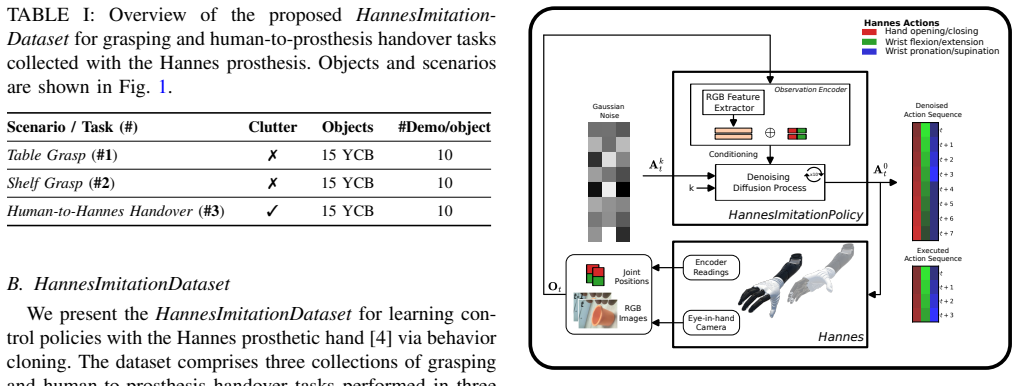
The load-bearing object is the diffusion policy: a visuomotor policy that generates actions by iteratively denoising random noise conditioned on the current observation. Here it is trained with the standard denoising-diffusion objective, predicting the noise added to ground-truth action sequences, on a new dataset of 450 keyboard-driven demonstrations of the Hannes hand grasping 15 YCB objects in three scenarios. The observation encoder combines a ResNet-18 trained from scratch on palm-camera images with proprioceptive encoder readings, while the action decoder is a compact 1D temporal convolutional U-Net, and inference runs 10 denoising iterations per control step. This generative formulation is what lets one policy represent several valid approach and wrist behaviors for the same object while remaining stable to train, which is the mechanism that carries the generalization claim.
What would settle it
Run the same 10-trials-per-object protocol with trans-radial amputee users operating the Hannes hand through their customary socket and myoelectric interface; if their aggregate success falls to the level of a fixed-wrist baseline that simply closes the hand on approach, the claim that imitation learning enables practical prosthetic grasping would be refuted.
Extended reading notes
Core claim
On the paper's own terms, the discovery is that a single diffusion policy, adapted to the three actuated degrees of freedom of the Hannes hand, can act as the grasping controller across varied objects and environments. The policy takes the latest two palm-camera frames plus encoder readings for hand opening and wrist flexion, and outputs an eight-step action sequence covering hand open/close, wrist flexion/extension, and wrist pronation/supination; the hand executes four steps and then replans, running at about 35 Hz. In physical deployment it reaches 80.6% success for table grasps, 68% for shelf grasps, and 89.3% for human-to-Hannes handovers, a combined 79.3% over 450 trials, and 76% over 150 trials on objects never seen in training. On the handover scenario it clearly beats a segmentation-based visual servo controller, which confuses the object with the person's body; this is offered as evidence that demonstration learning generalizes better than manually labeled vision pipelines in unconstrained settings.
Load-bearing premise
The load-bearing premise is that grasp performance measured with the research team operating the prosthesis transfers to actual amputee users, whose residual-limb control, arm kinematics, and cognitive load differ from the non-amputee, keyboard-demonstrated setup evaluated here.
Editorial extensions
If this is right
- A single trained policy can take over both wrist orientation and finger closure during a grasp, so the user no longer has to command each joint separately, which is the shared-autonomy benefit the paper aims at.
- The small drop from 79.3% on trained objects to 76% on five unseen objects suggests the demonstration set and diffusion formulation transfer to novel objects without fine-tuning.
- Grasping an object held by another person is learnable from demonstrations and is more robust than segmentation-based visual servoing in that scenario, because the policy does not need to separate the object from the person's body.
- One policy, rather than per-object or per-scenario controllers, covers table, shelf, and handover contexts, and the released dataset allows other groups to reproduce or extend the result.
- The roughly 35 Hz inference rate on a laptop GPU is compatible with closed-loop prosthetic use, making the approach feasible outside a dedicated robotics lab.
Reading between the lines
- If the approach transfers to amputee users, the keyboard-driven demonstration pipeline could make data collection much cheaper than teleoperation, since demonstrations are recorded directly on the prosthesis without extra robot hardware.
- The handover result hints that the same imitation-learning stack could be extended to socially contingent actions, such as waiting for the other person's grip to relax or releasing the object on cue, by adding demonstrations of those transitions, something the paper does not attempt.
- A testable extension would be to perturb the object's pose or the user's approach velocity during deployment; the paper randomizes initial poses at data-collection time, so its robustness to larger perturbations remains unmeasured.
- The wrist pronation/supination joint is velocity-controlled and lacks a position encoder, and the paper reports slightly higher action error for it; adding position feedback to that joint is a concrete candidate for closing the gap between shelf-grasp success (68%) and the other two scenarios.
Editorial analysis
A structured set of objections, weighed in public.
Referee Report
Summary. The paper presents HannesImitation, an imitation-learning pipeline for the Hannes prosthetic hand. It introduces a dataset of 450 demonstrations (15 YCB objects, three scenarios: table grasp, shelf grasp, and human-to-prosthesis handover) collected with keyboard teleoperation, and adapts Diffusion Policy to predict wrist flexion/extension, wrist pronation/supination, and hand open/close from an eye-in-hand camera and joint encoders. The policy is deployed on the physical Hannes hand, and the authors report a 79.3% success rate over 450 trials on trained objects and 76% on five unseen YCB objects. They also compare with a visual-servo wrist controller [19] and claim an average improvement of 13.8%. The paper further states that the HannesImitationDataset is released to foster imitation-learning research for prosthetics.
Significance. The work has several genuine strengths: it involves physical deployment with a substantial number of real-robot trials (450 in-distribution plus 150 unseen-object trials), uses standard YCB objects across multiple scenarios, and appears to be the first application of a diffusion policy to a prosthetic hand with eye-in-hand vision. The claimed dataset release is a useful community contribution. If the results are robust, the paper is a meaningful step toward reducing cognitive load in prosthetic grasping. However, the central claim is currently underdetermined because the online success metric includes the human operator’s arm-level positioning, the statistical evidence lacks confidence intervals and significance tests, and the baseline comparison uses a different success criterion. These issues are substantive but addressable, and I believe they can be fixed with additional experiments and analysis.
major comments (4)
- [§IV-B, Table II] The success metric is defined as 'the user approaches, grasps, and lifts the object within 10 seconds,' so the reported 79.3% and 76% rates measure a joint human-policy system rather than the policy alone. The user can compensate for poor or delayed wrist predictions by repositioning the whole arm, and the paper provides no control condition that removes or perturbs the policy’s contribution, nor any analysis linking offline action errors (Fig. 3) to online outcomes. I recommend adding a no-policy baseline (e.g., the user directly controls all three DoFs), an ablation with wrist or hand predictions disabled, or a per-trial analysis correlating predicted action quality with success; without such an attribution check, the central claim that 'a single diffusion policy' controls the prosthesis is not established by the deployment experiments.
- [§IV-A–IV-D, Tables II and III] All success rates are proportions from 10 trials per object with no confidence intervals, error bars, or significance tests. For example, in Table II the 044 flat screwdriver achieves 1/10 and the 065-g cups achieve 2/10 in the Shelf Grasp, yet the aggregate comparison treats 68% versus 80.6% as meaningful. Likewise, the headline claim that HannesImitation outperforms the visual servo by 13.8% in Table IV is based on averages with no statistical test, and per scenario the visual servo is better in two of the three tasks. Please report binomial confidence intervals (e.g., Clopper–Pearson) and appropriate tests (e.g., Fisher’s exact or a permutation test) for the key comparisons.
- [§IV-D, Table IV] The comparison with the visual-servo baseline is not apples-to-apples. For the visual servo [19], success is defined as correct segmentation and tracking plus correct final wrist configuration, not as actually grasping and lifting the object, whereas HannesImitation success requires a physical grasp-and-lift. Additionally, in the baseline the user triggers the prediction and closes the fingers via EMG, while HannesImitation controls finger closure automatically, and the segmentation model in [19] was trained on the five test objects. These differing success criteria and unequal conditions make the statement 'our method outperforms [19] by 13.8%' unsupported as stated. I suggest re-evaluating [19] with the same grasp-and-lift criterion, or clearly labeling the comparison as a component-level measure rather than a task-level comparison.
- [§IV-B and §V] The deployment is performed by operators whose characteristics are not described, and the conclusion explicitly lists 'conducting user studies to assess real-world usability and impact' as future work. Since the human operator is part of the evaluated loop and the target population is trans-radial amputees, the current experiments cannot substantiate claims about practical prosthetic use or cognitive-load reduction. This is not necessarily a fatal flaw for a feasibility study, but the abstract and conclusion should scope the claims to the tested operator population, and this limitation should be stated in the main text rather than only in the future-work section.
minor comments (5)
- [§IV-B] Typo: 'obtaines' should be 'obtains' in the sentence reporting the overall success rate.
- [§III-B] The paper states that the HannesImitationDataset is released, but no download link or availability statement appears in the manuscript; please add one.
- [Fig. 3] The box plots would be easier to interpret if the caption defined the box and whisker elements and stated the exact normalization range used for the absolute action error.
- [Table IV] The average success rates for both methods (76% and 62.6%) appear only in the text; adding them to the table would improve clarity.
- [§III-B and §IV-B.3] The handover experiments mention five subjects, but the manuscript gives no demographic or procedural details about these participants or about the operators who drove the prosthesis during data collection and testing.
Circularity Check
No circularity found: the central claim rests on held-out physical trials, not on fitted inputs, self-citation, or definitional reductions.
full rationale
The paper's main result is an empirical measurement. HannesImitationPolicy is trained with the standard Diffusion Policy objective (Eq. 1) and evaluated on physical trials, reporting 79.3% success over 450 trials and 76% over 150 unseen-object trials. No parameter is fitted to the success metric and then reported as a prediction; the offline action errors are computed on a held-out validation split. The only self-citation with overlapping authors is [19], used as a visual-servoing baseline in Sec. IV-D. It is not an input to the policy, and the paper even discloses that the baseline was trained on the five test objects, so the comparison does not function as self-supporting justification. The success definition includes the user's approach and lifting, which is a construct-validity limitation because it does not isolate the policy's contribution, and the comparison uses different success criteria for the two methods; these are evaluation-validity concerns, not circularity patterns. No equation reduces the claimed result to its inputs.
Assumptions & free parameters
free parameters (4)
- denoising iterations k (inference) =
10
- executed action horizon =
4 of 8 predicted steps
- U-Net filter sizes =
32 and 64, kernel 3
- training epochs / batch size / learning rate =
100 / 256 / 1e-4
assumptions (4)
- domain assumption Diffusion Policy (DP) as a DDPM can represent the multi-modal grasping action distribution for this task
- domain assumption The 450 demonstrations collected with keyboard control by a small number of operators are representative of natural human grasping behavior
- domain assumption The eye-in-hand RGB camera provides sufficient visual information for grasp planning, including in handover scenarios with occlusions
- domain assumption Wrist P/S can be controlled adequately via velocity commands without position feedback
Cite this review
Pith. "Pith review of HannesImitation: Grasping with the Hannes Prosthetic Hand via Imitation Learning." pith.science (2026). https://pith.science/paper/KYJCNREN
@misc{pith2026250800491,
  author       = {Pith},
  title        = {Pith review of: HannesImitation: Grasping with the Hannes Prosthetic Hand via Imitation Learning},
  year         = {2026},
  howpublished = {\url{https://pith.science/paper/KYJCNREN}},
  note         = {Machine review of arXiv:2508.00491}
}
read the original abstract
Recent advancements in control of prosthetic hands have focused on increasing autonomy through the use of cameras and other sensory inputs. These systems aim to reduce the cognitive load on the user by automatically controlling certain degrees of freedom. In robotics, imitation learning has emerged as a promising approach for learning grasping and complex manipulation tasks while simplifying data collection. Its application to the control of prosthetic hands remains, however, largely unexplored. Bridging this gap could enhance dexterity restoration and enable prosthetic devices to operate in more unconstrained scenarios, where tasks are learned from demonstrations rather than relying on manually annotated sequences. To this end, we present HannesImitationPolicy, an imitation learning-based method to control the Hannes prosthetic hand, enabling object grasping in unstructured environments. Moreover, we introduce the HannesImitationDataset comprising grasping demonstrations in table, shelf, and human-to-prosthesis handover scenarios. We leverage such data to train a single diffusion policy and deploy it on the prosthetic hand to predict the wrist orientation and hand closure for grasping. Experimental evaluation demonstrates successful grasps across diverse objects and conditions. Finally, we show that the policy outperforms a segmentation-based visual servo controller in unstructured scenarios. Additional material is provided on our project page: https://hsp-iit.github.io/HannesImitation
Figures


Figures from the paper (3 more)


Reference graph
Works this paper leans on
-
[19]
Continuous wrist control on the hannes prosthesis: a vision-based shared autonomy framework,
F. Vasile, E. Maiettini, G. Pasquale, N. Boccardo, and L. Natale, “Continuous wrist control on the hannes prosthesis: a vision-based shared autonomy framework,” arXiv preprint arXiv:2502.17265, 2025
-
[1]
How to train your robot with deep reinforcement learning: lessons we have learned,
J. Ibarz, J. Tan, C. Finn, M. Kalakrishnan, P. Pastor, and S. Levine, “How to train your robot with deep reinforcement learning: lessons we have learned,” The International Journal of Robotics Research , vol. 40, no. 4-5, pp. 698–721, 2021
2021
-
[2]
Learning controllers for continuum soft manipulators: Impact of modeling and looming challenges,
E. Falotico, E. Donato, C. Alessi, E. Setti, M. S. Nazeer, C. Agabiti, D. Caradonna, D. Bianchi, F. Piqu ´e, Y . T. Ansari et al. , “Learning controllers for continuum soft manipulators: Impact of modeling and looming challenges,” Advanced Intelligent Systems, p. 2400344, 2024
work page 2024
-
[3]
A narrative review: current upper limb prosthetic options and design,
L. Trent, M. Intintoli, P. Prigge, C. Bollinger, L. S. Walters, D. Cony- ers, J. Miguelez, and T. Ryan, “A narrative review: current upper limb prosthetic options and design,” Disability and Rehabilitation: Assistive Technology, 2020
work page 2020
-
[4]
The hannes hand prosthesis replicates the key biological properties of the human hand,
M. Laffranchi, N. Boccardo, S. Traverso, L. Lombardi, M. Canepa, A. Lince, M. Semprini, J. A. Saglia, A. Naceri, R. Sacchetti et al. , “The hannes hand prosthesis replicates the key biological properties of the human hand,” Science robotics , vol. 5, no. 46, p. eabb0467, 2020
work page 2020
-
[5]
Myoelectric control systems—a survey,
M. A. Oskoei and H. Hu, “Myoelectric control systems—a survey,” Biomedical signal processing and control , vol. 2, no. 4, pp. 275–294, 2007
work page 2007
-
[6]
A review of myoelectric control for prosthetic hand manipulation,
Z. Chen, H. Min, D. Wang, Z. Xia, F. Sun, and B. Fang, “A review of myoelectric control for prosthetic hand manipulation,” Biomimetics, vol. 8, no. 3, p. 328, 2023
work page 2023
-
[7]
Extending mode switching to multiple degrees of freedom in hand prosthesis control is not efficient,
S. Amsuess, P. Goebel, B. Graimann, and D. Farina, “Extending mode switching to multiple degrees of freedom in hand prosthesis control is not efficient,” in 2014 36th Annual International Conference of the IEEE Engineering in Medicine and Biology Society . IEEE, 2014, pp. 658–661
work page 2014
Show all 43 references
-
[8]
Upper-limb prosthetics: critical factors in device abandonment,
E. Biddiss and T. Chau, “Upper-limb prosthetics: critical factors in device abandonment,” American journal of physical medicine & rehabilitation, vol. 86, no. 12, pp. 977–987, 2007
2007
-
[9]
Hannes prosthesis control based on regression machine learning algorithms,
D. Di Domenico, A. Marinelli, N. Boccardo, M. Semprini, L. Lom- bardi, M. Canepa, S. Stedman, A. D. Bellingegni, M. Chiappalone, E. Gruppioni et al. , “Hannes prosthesis control based on regression machine learning algorithms,” in 2021 IEEE/RSJ International Con- ference on In...
2021
-
[10]
Preliminary Assess- ment of Two Simultaneous and Proportional Myocontrol Methods for 3-DoFs Prostheses Using Incremental Learning,
F. Egle, D. Di Domenico, A. Marinelli, N. Boccardo, M. Canepa, M. Laffranchi, L. De Michieli, and C. Castellini, “Preliminary Assess- ment of Two Simultaneous and Proportional Myocontrol Methods for 3-DoFs Prostheses Using Incremental Learning,” in 2023 International Conferenc...
2023
-
[11]
Electromyogram pattern recognition for control of powered upper-limb prostheses: state of the art and challenges for clinical use
E. Scheme and K. Englehart, “Electromyogram pattern recognition for control of powered upper-limb prostheses: state of the art and challenges for clinical use.” Journal of Rehabilitation Research & Development, vol. 48, no. 6, 2011
2011
-
[12]
Causes of performance degradation in non-invasive electromyographic pattern recognition in upper limb prostheses,
I. Kyranou, S. Vijayakumar, and M. S. Erden, “Causes of performance degradation in non-invasive electromyographic pattern recognition in upper limb prostheses,” Frontiers in neurorobotics , vol. 12, p. 58, 2018
2018
-
[13]
Active upper limb prostheses: A review on current state and upcoming breakthroughs,
A. Marinelli, N. Boccardo, F. Tessari, D. Di Domenico, G. Caserta, M. Canepa, G. Gini, G. Barresi, M. Laffranchi, L. De Michieli et al., “Active upper limb prostheses: A review on current state and upcoming breakthroughs,” Progress in Biomedical Engineering , vol. 5, no. 1, p....
2023
-
[14]
Shared human–robot proportional control of a dexterous myoelectric prosthesis,
K. Z. Zhuang, N. Sommer, V . Mendez, S. Aryan, E. Formento, E. D’Anna, F. Artoni, F. Petrini, G. Granata, G. Cannaviello et al. , “Shared human–robot proportional control of a dexterous myoelectric prosthesis,” Nature Machine Intelligence , vol. 1, no. 9, pp. 400–411, 2019
2019
-
[15]
A multimodal intention detection sensor suite for shared autonomy of upper-limb robotic prostheses,
M. Gardner, C. S. Mancero Castillo, S. Wilson, D. Farina, E. Burdet, B. C. Khoo, S. F. Atashzar, and R. Vaidyanathan, “A multimodal intention detection sensor suite for shared autonomy of upper-limb robotic prostheses,” Sensors, vol. 20, no. 21, p. 6097, 2020
2020
-
[16]
Toward human-in-the-loop shared control for upper-limb prostheses: a sys- tematic analysis of state-of-the-art technologies,
W. Guo, W. Xu, Y . Zhao, X. Shi, X. Sheng, and X. Zhu, “Toward human-in-the-loop shared control for upper-limb prostheses: a sys- tematic analysis of state-of-the-art technologies,” IEEE transactions on Medical Robotics and Bionics , vol. 5, no. 3, pp. 563–579, 2023
2023
-
[17]
Semi-autonomous control of prosthetic hands based on multimodal sensing, human grasp demonstration and user intention,
J. Starke, P. Weiner, M. Crell, and T. Asfour, “Semi-autonomous control of prosthetic hands based on multimodal sensing, human grasp demonstration and user intention,” Robotics and Autonomous Systems, vol. 154, p. 104123, 2022
2022
-
[18]
Continuous semi-autonomous prosthesis control using a depth sensor on the hand,
M. N. Castro and S. Dosen, “Continuous semi-autonomous prosthesis control using a depth sensor on the hand,” Frontiers in Neurorobotics, vol. 16, p. 814973, 2022
2022
-
[20]
Diffusion policy: Visuomotor policy learning via action diffusion,
C. Chi, S. Feng, Y . Du, Z. Xu, E. Cousineau, B. Burchfiel, and S. Song, “Diffusion policy: Visuomotor policy learning via action diffusion,” in Proceedings of Robotics: Science and Systems (RSS) , 2023
2023
-
[21]
Rt-2: Vision-language-action models transfer web knowledge to robotic control,
B. Zitkovich, T. Yu, S. Xu, P. Xu, T. Xiao, F. Xia, J. Wu, P. Wohlhart, S. Welker, A. Wahid et al. , “Rt-2: Vision-language-action models transfer web knowledge to robotic control,” in Conference on Robot Learning. PMLR, 2023, pp. 2165–2183
2023
-
[22]
Open x-embodiment: Robotic learning datasets and rt-x models,
O. X.-E. Collaboration, “Open x-embodiment: Robotic learning datasets and rt-x models,” in 2024 IEEE International Conference on Robotics and Automation (ICRA) , 2024, pp. 6892–6903
2024
-
[23]
Open- VLA: An open-source vision-language-action model,
M. J. Kim, K. Pertsch, S. Karamcheti, T. Xiao, A. Balakrishna, S. Nair, R. Rafailov, E. Foster, G. Lam, P. Sanketi et al. , “Open- VLA: An open-source vision-language-action model,” arXiv preprint arXiv:2406.09246, 2024
2024 arXiv
-
[24]
π0: A vision- language-action flow model for general robot control,
K. Black, N. Brown, D. Driess, A. Esmail, M. Equi, C. Finn, N. Fusai, L. Groom, K. Hausman, B. Ichter et al. , “ π0: A vision- language-action flow model for general robot control,” arXiv preprint arXiv:2410.24164, 2024
2024 arXiv
-
[25]
Affordance-based robot manipulation with flow matching,
F. Zhang and M. Gienger, “Affordance-based robot manipulation with flow matching,” arXiv preprint arXiv:2409.01083 , 2024
2024
-
[26]
Denoising diffusion probabilistic models,
J. Ho, A. Jain, and P. Abbeel, “Denoising diffusion probabilistic models,” Advances in neural information processing systems , vol. 33, pp. 6840–6851, 2020
2020
-
[27]
Deep imitation learning for complex manipulation tasks from virtual reality teleoperation,
T. Zhang, Z. McCarthy, O. Jow, D. Lee, X. Chen, K. Goldberg, and P. Abbeel, “Deep imitation learning for complex manipulation tasks from virtual reality teleoperation,” in 2018 IEEE international conference on robotics and automation (ICRA). Ieee, 2018, pp. 5628– 5635
2018
-
[28]
On bringing robots home,
N. M. M. Shafiullah, A. Rai, H. Etukuru, Y . Liu, I. Misra, S. Chin- tala, and L. Pinto, “On bringing robots home,” arXiv preprint arXiv:2311.16098, 2023
2023 arXiv
-
[29]
Universal manipulation interface: In-the-wild robot teaching without in-the-wild robots,
C. Chi, Z. Xu, C. Pan, E. Cousineau, B. Burchfiel, S. Feng, R. Tedrake, and S. Song, “Universal manipulation interface: In-the-wild robot teaching without in-the-wild robots,”arXiv preprint arXiv:2402.10329, 2024
2024 arXiv
-
[30]
Cognitive vision system for control of dexterous pros- thetic hands: experimental evaluation,
S. Do ˇsen, C. Cipriani, M. Kosti ´c, M. Controzzi, M. C. Carrozza, and D. B. Popovi´c, “Cognitive vision system for control of dexterous pros- thetic hands: experimental evaluation,” Journal of neuroengineering and rehabilitation, vol. 7, pp. 1–14, 2010
2010
-
[31]
Sensor fusion and computer vision for context-aware control of a multi degree-of-freedom prosthesis,
M. Markovic, S. Dosen, D. Popovic, B. Graimann, and D. Farina, “Sensor fusion and computer vision for context-aware control of a multi degree-of-freedom prosthesis,” Journal of neural engineering , vol. 12, no. 6, p. 066022, 2015
2015
-
[32]
A semiau- tonomous control strategy based on computer vision for a hand–wrist prosthesis,
G. Cirelli, C. Tamantini, L. P. Cordella, and F. Cordella, “A semiau- tonomous control strategy based on computer vision for a hand–wrist prosthesis,” Robotics, vol. 12, no. 6, p. 152, 2023
2023
-
[33]
Affordance seg- mentation using tiny networks for sensing systems in wearable robotic devices,
E. Ragusa, S. Dosen, R. Zunino, and P. Gastaldo, “Affordance seg- mentation using tiny networks for sensing systems in wearable robotic devices,” IEEE Sensors Journal , vol. 23, no. 19, pp. 23 916–23 926, 2023
2023
-
[34]
Grasp pre-shape selection by synthetic training: Eye-in- hand shared control on the hannes prosthesis,
F. Vasile, E. Maiettini, G. Pasquale, A. Florio, N. Boccardo, and L. Natale, “Grasp pre-shape selection by synthetic training: Eye-in- hand shared control on the hannes prosthesis,” in 2022 IEEE/RSJ International Conference on Intelligent Robots and Systems (IROS) . IEEE, 2022...
2022
-
[35]
Incorporation of the intended task into a vision-based grasp type predictor for multi-fingered robotic grasping,
N. Kleer, O. Keil, M. Feick, A. Gomaa, T. Schwartz, and M. Feld, “Incorporation of the intended task into a vision-based grasp type predictor for multi-fingered robotic grasping,” in 2024 33rd IEEE International Conference on Robot and Human Interactive Commu- nication (ROMAN)...
2024
-
[36]
Towards creating a deployable grasp type probability estimator for a prosthetic hand,
M. Zandigohar, M. Han, D. Erdo ˘gmus ¸, and G. Schirner, “Towards creating a deployable grasp type probability estimator for a prosthetic hand,” in International Workshop on Design, Modeling, and Evalua- tion of Cyber Physical Systems . Springer, 2019, pp. 44–58
2019
-
[37]
Grasping with humanoid hands based on in-hand vision and hardware-accelerated cnns,
F. Hundhausen, S. Hubschneider, and T. Asfour, “Grasping with humanoid hands based on in-hand vision and hardware-accelerated cnns,” in 2023 IEEE-RAS 22nd International Conference on Humanoid Robots (Humanoids), 2023, pp. 1–7
2023
-
[38]
Viiat- hand: A reach-and-grasp restoration system integrating voice interac- tion, computer vision, auditory and tactile feedback for non-sighted amputees,
C. Peng, D. Yang, D. Zhao, M. Cheng, J. Dai, and L. Jiang, “Viiat- hand: A reach-and-grasp restoration system integrating voice interac- tion, computer vision, auditory and tactile feedback for non-sighted amputees,” IEEE Robotics and Automation Letters , vol. 9, no. 10, pp. 8...
2024
-
[39]
Mul- timodal fusion of emg and vision for human grasp intent inference in prosthetic hand control,
M. Zandigohar, M. Han, M. Sharif, S. Y . G ¨unay, M. P. Furmanek, M. Yarossi, P. Bonato, C. Onal, T. Padır, D. Erdo ˘gmus ¸et al. , “Mul- timodal fusion of emg and vision for human grasp intent inference in prosthetic hand control,” Frontiers in Robotics and AI , vol. 11, p. 1...
2024
-
[40]
Bring your own grasp generator: Leveraging robot grasp generation for prosthetic grasping,
G. Stracquadanio, F. Vasile, E. Maiettini, N. Boccardo, and L. Natale, “Bring your own grasp generator: Leveraging robot grasp generation for prosthetic grasping,” arXiv preprint arXiv:2503.00466 , 2025
2025 arXiv
-
[41]
Development of a 2-dofs actuated wrist for enhancing the dexterity of myoelectric hands,
N. Boccardo, M. Canepa, S. Stedman, L. Lombardi, A. Marinelli, D. Di Domenico, R. Galviati, E. Gruppioni, L. De Michieli, and M. Laffranchi, “Development of a 2-dofs actuated wrist for enhancing the dexterity of myoelectric hands,” IEEE Transactions on Medical Robotics and Bio...
2023
-
[42]
Benchmarking in manipulation research: Using the yale- cmu-berkeley object and model set,
B. Calli, A. Walsman, A. Singh, S. Srinivasa, P. Abbeel, and A. M. Dollar, “Benchmarking in manipulation research: Using the yale- cmu-berkeley object and model set,” IEEE Robotics & Automation Magazine, vol. 22, no. 3, pp. 36–52, 2015
2015
-
[43]
Deep residual learning for image recognition,
K. He, X. Zhang, S. Ren, and J. Sun, “Deep residual learning for image recognition,” in Proceedings of the IEEE conference on computer vision and pattern recognition , 2016, pp. 770–778
2016
Reviewed August 6, 2026 · model on record in the stance chip above.
Discussion (0). Sign in to comment.