REVIEW 2 major objections 6 minor 1 cited by
Ultrafast dynamics in monolayer TMDCs: the interplay of dark excitons, phonons and intervalley Coulomb exchange
T0 review · 2 major / 6 minor · reviewed 2026-08-14 · deepseek-v4-flash
Pith's one-line read This paper identifies a joint intervalley-exchange and phonon-scattering mechanism that explains why pumping the A exciton in monolayer TMDCs bleaches the B transition without creating B excitons.
desk verdict Genuinely new pathway for B bleaching via exchange-driven dark momentum-indirect excitons, with an unearned 'dominating mechanism' claim and a missing comparative rate calculation. read the letter →
The pith
A machine-rendered reading of the paper's core claim, the machinery that carries it, and where it could break.
The reading
What carries the argument
The argument is carried by the excitonic equations of motion in the Heisenberg picture, written for exciton operators carrying compound valley–spin indices (e.g., (K↑,K↑)); the two central objects are the intervalley Coulomb exchange coupling, which couples A-exciton amplitudes in opposite valleys when the center-of-mass momentum is nonzero, and the exciton-phonon scattering that redistributes weight into momentum-indirect states. Equations (1) and (2) show how the probe response at the A and B transitions is controlled by Pauli-blocking form factors $\Xi$ arising from the co-bosonic commutation relations of excitons; these form factors select which intervalley excitons contribute to each bleach. The paper evaluates the bleaching as $B^\xi = \sum_{K,\xi_h,\xi_e} \Xi^{\xi,(\xi_h,\xi_e)}_K N^{\xi_h,\xi_e}_K$, summing over the populated incoherent exciton densities $N$.
What would settle it
A helicity-resolved pump-probe measurement on MoSe2 at several temperatures should show the unpumped-valley B-bleaching rising much faster than the pumped-valley signal (about 120 fs vs 700 fs at 77 K); finding comparable or reversed rise times, or observing B bleaching at temperatures where phonon-mediated momentum scattering is frozen out, would contradict the proposed pathway. A direct first-principles calculation of the momentum-dependent intervalley exchange coupling would also settle whether the stepwise exchange-then-phonon route can dominate.
Extended reading notes
Core claim
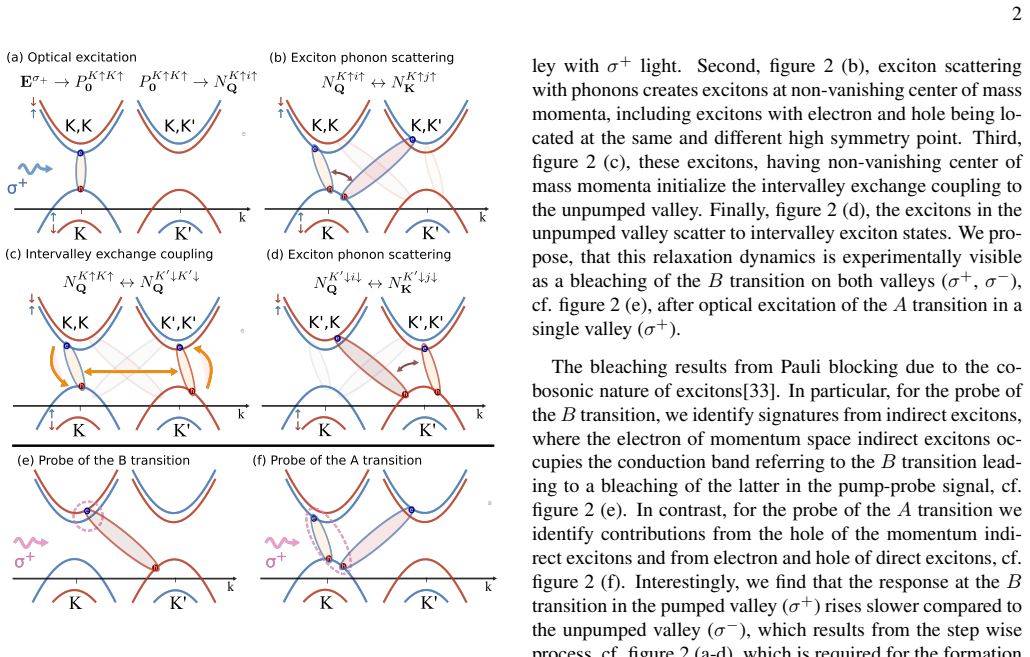
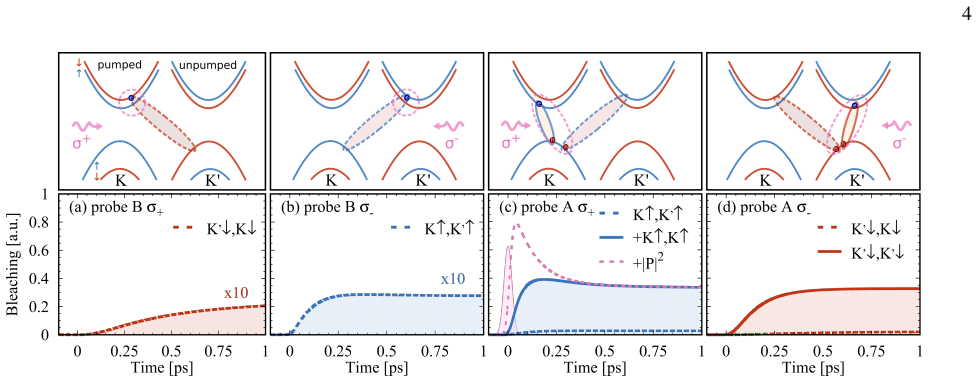
The central discovery is that the off-resonant bleaching of the B exciton after resonant A excitation in monolayer TMDCs arises from the electrons of momentum-indirect excitons occupying the conduction band that belongs to the B transition, not from a population of B excitons. The paper identifies the dominating mechanism as the combined action of intervalley Coulomb exchange between A excitons in the two valleys and phonon-mediated scattering into states with electron and hole at opposite K points of the Brillouin zone. Within this mechanism, the faster rise of the B-bleaching signal in the unpumped valley (about 120 fs in MoSe2 at 77 K) compared with the pumped valley (about 700 fs) follows naturally: the unpumped-valley signal comes from excitons (K↑,K′↑) formed directly by intervalley phonon scattering from the pumped bright state, whereas the pumped-valley signal requires a stepwise process—phonon scattering, then intervalley exchange, then another phonon scattering—to build the (K′↓,K↓) states whose electrons block the B transition. The paper confirms the mechanism by numerically solving the coupled coherence and density equations for MoSe2 and extracting the predicted rise times and their temperature dependence.
Load-bearing premise
The quantitative rise times and their temperature dependence rest on intervalley-exchange and exciton-phonon coupling strengths imported from earlier publications rather than computed from first principles in this paper.
Editorial extensions
If this is right
- Off-resonant B-bleaching after A-pumping is Pauli blocking by electrons of momentum-indirect excitons, not B-exciton population, so no energy pile-up at the B transition is required.
- The unpumped-valley B signal rises faster than the pumped-valley signal (120 fs vs 700 fs in MoSe2 at 77 K) because the former forms through one phonon scattering step while the latter needs exchange plus phonon steps.
- Rise times of the dark intervalley states decrease with temperature (e.g., (K↑,K′↑) from 90 fs at 50 K to 40 fs at room temperature) as exchange grows with momentum while coherence damping counteracts.
- The mechanism simultaneously explains ultrafast intervalley A transfer, B bleaching after A excitation, and the temporal ordering of rise times, unifying three experimental signatures.
- The qualitative behavior should transfer to other monolayer TMDCs, with material-specific rise times and temperature dependence.
Reading between the lines
- The same electron-occupation pathway could contribute to valley polarization decay and to the suppression of B-exciton photoluminescence under A-excitation, effects the paper does not analyze explicitly.
- A testable extension is to vary the pump energy and fluence: the mechanism predicts that B bleaching should track the population of finite-momentum states, so off-resonant or higher-fluence pumping should change the rise-time ordering.
- If the intervalley exchange strength is the true bottleneck, alloy or strain engineering that modifies the exciton momentum distribution should measurably shift the 120 fs vs 700 fs gap.
- Extending the calculation to include spin-flip processes (neglected here) could show whether the spin-flip channel dominates in specific materials, as the paper notes experiments indicate spin flips also contribute to B bleaching.
Signed reviews
Editorial analysis
A structured set of objections, weighed in public.
Referee Report
Summary. The paper proposes a microscopic mechanism for the ultrafast bleaching of the B exciton transition in monolayer TMDCs after resonant pumping of the lower A transition. The mechanism combines intervalley Coulomb exchange between A excitons in the K and K' valleys with phonon-assisted scattering into intervalley (dark) excitons whose electron and hole are located at opposite valleys; the electron of such a (K'↓,K↓) exciton Pauli-blocks the B transition, so no population of the B exciton is required. Using a co-bosonic exciton model, the authors compute the time-resolved A and B bleaching in MoSe2 at 77 K, finding the B response in the unpumped valley rising in about 120 fs and in the pumped valley in about 700 fs, thereby reproducing the experimentally observed temporal ordering in WS2. The paper explicitly limits its scope to the bleaching signal, notes that it does not explain B photoluminescence, and states that spin-flip processes also contribute to the B bleaching.
Significance. If the mechanism is correct, it offers a unified explanation for three experimental signatures—ultrafast intervalley transfer between A excitons, off-resonant B-bleaching after A-pumping, and the ordering of rise times—without invoking B exciton population. The model is built on established co-bosonic exciton equations, and the parameters are taken from microscopic calculations rather than fitted to the target B-bleaching data, which keeps circularity low. The prediction that the B bleaching is mediated by electrons of momentum-indirect excitons is concrete and falsifiable. The main weakness is that the paper does not quantitatively compare the proposed channel with the competing mechanisms (a)-(d) that it itself enumerates, so the "dominating mechanism" claim in the Introduction is stronger than what is demonstrated; the Conclusion correctly retreats to "significantly contributes."
major comments (2)
- [Introduction, p. 2 ("As the dominating mechanism...")] The claim that the exchange-plus-phonon channel is the dominating mechanism is not supported by any rate comparison. The paper lists competing processes (a) intravalley spin flip, (b) Dexter-like intervalley coupling, and (c) intravalley A-B exchange mixing, but it does not compute their rates or upper bounds; it states that only rough estimates are available for (b) and (c) and concedes in the final paragraph that "spin-flip processes have been found to contribute to the bleaching of the B transition." This matters especially for the pumped-valley B signal, which the model assigns to a slow (~700 fs) stepwise channel while reference 21 attributes the same feature to intravalley spin flip. If that spin-flip rate is comparable to or faster than 700 fs, the proposed channel need not be dominant. The Introduction's "dominating" claim should either be backed by comparative rate calculations or replaced by the weaker, and internally consistent, claim of "significant contribution" used in the Conclusion.
- [Results, Figs. 3-4 and parameter paragraph (p. 4)] The quantitative predictions—120 fs and 700 fs rise times at 77 K and their temperature dependence—are obtained with intervalley exchange and exciton-phonon couplings imported from earlier publications. No first-principles calculation of the intervalley exchange strength or its momentum dependence appears in this manuscript, and no sensitivity analysis is reported. Since the dominance of the mechanism over spin-flip and Dexter channels may depend on the ratio of these coupling strengths, the reader cannot judge how robust the temporal ordering and the factor-of-six separation between the two B rise times are. The comparison to experiment is also cross-material (MoSe2 calculation versus WS2 data with about 200 fs rise), and the text itself acknowledges that other TMDCs may deviate. A parameter-sensitivity check (for example, varying the exchange and phonon couplings within plausible ranges) or a direct calculation for WS2 would substantially strengthen the central claims.
minor comments (6)
- [p. 2, mechanism (b) description] The word "avilable" should be spelled "available."
- [Eq. (1), third line] The summation index "Kie" appears to be a typesetting artifact; it should be written as "K, i_e" (or similar) to match the notation used in the text.
- [p. 4, Results opening] "optical exciation" should be "optical excitation."
- [p. 4, discussion of Fig. 3(a)] "step wise process" should be "stepwise process."
- [Supplementary references] The main text relies on the supplementary material for the derivations of Eqs. (1)-(3) and for Eqs. S5, S6, S8, S10, S13, and S14, but the supplementary material is not included in the arXiv posting; a journal submission should ensure that it is available to referees and readers.
- [Fig. 4 caption] Clarify how the rise times are extracted from the computed dynamics, in particular the window used for the exponential fit, since the reported values are a central quantitative result.
Circularity Check
No significant circularity: the predicted B-bleaching rise times follow from a microscopic multi-channel dynamics with parameters stated to be microscopic coupling elements, not from fitting the target experimental signal.
full rationale
The paper's central quantity, the B-transition bleaching, is computed through Eq. (3) as a sum over exciton occupations weighted by Pauli-blocking form factors, with the occupations obtained from the coupled equations of motion (Eqs. S10, S13, S14 in the supplementary). The manuscript states that 'all parameters are determined by microscopic coupling elements,' and nothing in the main text indicates that any parameter was adjusted to reproduce the experimental B-bleaching rise times. The quantitative comparison to the ~200 fs WS2 value is explicitly after-the-fact and is acknowledged as a material-to-material comparison ('We are aware that in other TMDCs the excitonic landscape deviates from the situation in MoSe2'). The self-citations that do appear (e.g., refs. 6, 13, 32, 33) supply exciton-phonon, intervalley-exchange, and dephasing matrix elements from earlier microscopic calculations; those prior results do not presuppose the present B-bleaching conclusion and therefore constitute independent input rather than a circular reduction. The model's temporal ordering (unpumped valley rises faster than pumped valley) follows from the assumed stepwise exchange-plus-phonon pathway, which is a mechanism hypothesis, not a parameter fit; a theory output following from its assumptions is not circular. The strongest potential concern—that the dominance over spin-flip and Dexter channels is asserted without a comparative rate calculation—is a completeness and correctness issue, not a circularity, because no competing-channel rate is silently redefined as a prediction of the model. Accordingly, no circular step can be exhibited from the text, and the circularity score is 0.
Assumptions & free parameters
free parameters (3)
- Intervalley exchange coupling strength and momentum dependence
- Exciton-phonon coupling matrix elements for MoSe2
- Exciton dephasing rates gamma
assumptions (4)
- domain assumption The co-bosonic commutation relations of excitons and the resulting Pauli-blocking form factors Xi correctly represent the bleaching of A and B transitions.
- domain assumption The intervalley exchange coupling and exciton-phonon coupling parameters imported from previous publications are accurate for MoSe2 in the 50-300 K range.
- ad hoc to paper Neglected processes (spin-flip scattering, B-exciton population, energy renormalization, and excitation-power-dependent scattering) do not change the qualitative conclusion that the exchange-plus-phonon channel dominates.
- domain assumption The low-density incoherent chi(3) limit applies, so nonlinear exciton-exciton scattering is negligible.
Cite this review
Pith. "Pith review of Ultrafast dynamics in monolayer TMDCs: the interplay of dark excitons, phonons and intervalley Coulomb exchange." pith.science (2026). https://pith.science/paper/FTVKYZW2
@misc{pith2026190810080,
  author       = {Pith},
  title        = {Pith review of: Ultrafast dynamics in monolayer TMDCs: the interplay of dark excitons, phonons and intervalley Coulomb exchange},
  year         = {2026},
  howpublished = {\url{https://pith.science/paper/FTVKYZW2}},
  note         = {Machine review of arXiv:1908.10080}
}
abstract
Understanding the ultrafast coupling and relaxation mechanisms between valleys in transition metal dichalcogenide semiconductors is of crucial interest for future valleytronic devices. Recent ultrafast pump-probe experiments showed an unintuitive significant bleaching at the excitonic $B$ transition after optical excitation of the energetically lower excitonic $A$ transition. Here, we present a possible microscopic explanation for this surprising effect. It is based on the joint action of exchange coupling and phonon-mediated thermalization into dark exciton states and does not involve a population of the B exciton. Our work demonstrates how intra- and intervalley coupling on a femtosecond timescale governs the optical valley response of 2D semiconductors.
Figures

Figures from the paper (1 more)

Forward citations
Cited by 1 Pith paper
-
Quenching of Intervalley Exchange Coupling in the Presence of Momentum-Dark States in TMDCs
In WSe2, phonon scattering moves excitons into momentum-dark states that do not couple valleys, quenching intervalley exchange coupling and extending valley lifetimes to nanoseconds, unlike in MoSe2 where lifetimes ar...
Reference graph
Works this paper leans on
-
[1]
Berkelbach, T. C., Hybertsen, M. S. & Reichman, D. R. Theory of neutral and charged excitons in monolayer transition metal dichalcogenides. Phys. Rev. B 88, 045318 (2013)
work page 2013
-
[2]
Li, Y . et al. Measurement of the optical dielectric function of monolayer transition-metal dichalcogenides: MoS2, MoSe2, WS2, and WSe2. Phys. Rev. B 90, 205422 (2014)
work page 2014
-
[3]
Arora, A., Nogajewski, K., Molas, M., Koperski, M. & Potem- ski, M. Exciton band structure in layeredMoSe2: from a mono- layer to the bulk limit. Nanoscale 7, 20769–20775 (2015)
work page 2015
-
[4]
Qiu, D. Y ., Cao, T. & Louie, S. G. Nonanalyticity, valley quan- tum phases, and lightlike exciton dispersion in monolayer tran- sition metal dichalcogenides: Theory and first-principles calcu- lations. Phys. Rev. Lett. 115, 176801 (2015)
work page 2015
-
[5]
Wu, F., Qu, F. & MacDonald, A. H. Exciton band structure of monolayer mos2. Phys. Rev. B 91, 075310 (2015)
work page 2015
-
[6]
Selig, M. et al. Excitonic linewidth and coherence lifetime in monolayer transition metal dichalcogenides. Nature Communi- cations 7, 13279 (2016)
work page 2016
-
[7]
Steinhoff, A. et al. Exciton fission in monolayer transition metal dichalcogenide semiconductors. Nature Communications 8, 1166 (2017)
work page 2017
-
[8]
Steinhoff, A., R ¨osner, M., Jahnke, F., Wehling, T. O. & Gies, C. Influence of excited carriers on the optical and electronic properties of mos2. Nano Letters 14, 3743–3748 (2014)
work page 2014
Show all 37 references
-
[9]
Kormanyos, A. et al. k p theory for two-dimensional transition metal dichalcogenide semiconductors. 2D Materials 2, 022001 (2015)
2015
-
[10]
Cao, T. et al. Valley-selective circular dichroism of monolayer molybdenum disulphide. Nat Commun 3, 887 (2012)
2012
-
[11]
Wang, Q. et al. Valley carrier dynamics in monolayer molyb- denum disulfide from helicity-resolved ultrafast pump-probe spectroscopy. ACS Nano 7, 11087–11093 (2013)
2013
-
[12]
Dal Conte, S. et al. Ultrafast valley relaxation dynamics in monolayer mos2 probed by nonequilibrium optical techniques. Phys. Rev. B 92, 235425 (2015)
2015
-
[13]
Schmidt, R. et al. Ultrafast coulomb-induced intervalley cou- pling in atomically thin ws2. Nano Letters 16, 2945–2950 (2016)
2016
-
[14]
Moody, G., Schaibley, J. & Xu, X. Exciton dynamics in mono- layer transition metal dichalcogenides. J. Opt. Soc. Am. B 33, C39–C49 (2016)
2016
-
[15]
Smole ´nski, T. et al. Tuning valley polarization in awse2 mono- layer with a tiny magnetic field. Phys. Rev. X 6, 021024 (2016)
2016
-
[16]
Trion fine structure and coupled spin– valley dynamics in monolayer tungsten disulfide
Plechinger, Gerd et al. Trion fine structure and coupled spin– valley dynamics in monolayer tungsten disulfide. Nature Com- munications 7, 12715 (2016)
2016
-
[17]
& Maultzsch, J
Tornatzky, H., Kaulitz, A.-M. & Maultzsch, J. Resonance pro- files of valley polarization in single-layer mos2 and mose2. Phys. Rev. Lett. 121, 167401 (2018)
2018
-
[18]
Pogna, E. A. A. et al. Photo-induced bandgap renormalization governs the ultrafast response of single-layer mos2. ACS Nano 10, 1182–1188 (2016). PMID: 26691058
2016
-
[19]
Bernal-Villamil, I. et al. Exciton broadening and band renor- malization due to dexter-like intervalley coupling. 2D Materi- als 5, 025011 (2018)
2018
-
[20]
Inverted valley polarization in opti- cally excited transition metal dichalcogenides
Bergh ¨auser Gunnar et al. Inverted valley polarization in opti- cally excited transition metal dichalcogenides. Nature Commu- nications 9, 971 (2018)
2018
-
[21]
Wang, Z. et al. Intravalley spinflip relaxation dynamics in single-layer ws2. Nano Letters 18, 6882–6891 (2018)
2018
-
[22]
Exchange-driven intravalley mixing of ex- citons in monolayer transition metal dichalcogenides
Guo Liang et al. Exchange-driven intravalley mixing of ex- citons in monolayer transition metal dichalcogenides. Nature Physics 1745–2481 (2018)
2018
-
[23]
Manca M. et al. Enabling valley selective exciton scattering in monolayer WSe2 through upconversion. Nature Communica- tions 8, 14927 (2017)
2017
-
[24]
& Yao, W
Xiao, D., Liu, G.-B., Feng, W., Xu, X. & Yao, W. Coupled spin and valley physics in monolayers of mos2 and other group-vi dichalcogenides. Phys. Rev. Lett. 108, 196802 (2012)
2012
-
[25]
Wang, L. & Wu, M. Intrinsic electron spin relaxation due to the d’yakonov-perel mechanism in monolayer mos2. Physics Letters A 378, 1336 – 1340 (2014)
2014
-
[26]
Wang, L. & Wu, M. W. Electron spin relaxation due to d’yakonov-perel’ and elliot-yafet mechanisms in monolayer mos2: Role of intravalley and intervalley processes. Phys. Rev. B 89, 115302 (2014)
2014
-
[27]
Z., de Andrada e Silva, E
Maialle, M. Z., de Andrada e Silva, E. A. & Sham, L. J. Exciton spin dynamics in quantum wells.Phys. Rev. B 47, 15776–15788 (1993)
1993
-
[28]
Vinattieri, A. et al. Exciton dynamics in gaas quantum wells un- der resonant excitation. Phys. Rev. B 50, 10868–10879 (1994)
1994
-
[29]
Glazov, M. M. et al. Exciton fine structure and spin decoher- ence in monolayers of transition metal dichalcogenides. Phys. Rev. B 89, 201302 (2014)
2014
-
[30]
Yu, T. & Wu, M. W. Valley depolarization due to intervalley and intravalley electron-hole exchange interactions in mono- layer mos2. Phys. Rev. B 89, 205303 (2014)
2014
-
[31]
& Song, Y
Dery, H. & Song, Y . Polarization analysis of excitons in mono- layer and bilayer transition-metal dichalcogenides. Phys. Rev. B 92, 125431 (2015)
2015
-
[32]
Selig, M. et al. Dark and bright exciton formation, thermal- ization, and photoluminescence in monolayer transition metal dichalcogenides. 2D Materials 5, 035017 (2018). 6
2018
-
[33]
& Knorr, A
Katsch, F., Selig, M., Carmele, A. & Knorr, A. Theory of exciton-exciton interactions in monolayer transition metal dichalcogenides. physica status solidi (b) 255, 1800185 (2018)
2018
-
[34]
Ivanov, A. L. & Haug, H. Self-consistent theory of the biexciton optical nonlinearity. Phys. Rev. B 48, 1490–1504 (1993)
1993
-
[35]
& Koch, S
Haug, H. & Koch, S. W. Quantum Theory of the Optical and Electronic Properties of Semiconductors (5th ed. (World Scien- tific Publishing Co. Pre. Ltd., Singapore, 2004).)
2004
-
[36]
Christiansen, D. et al. Phonon sidebands in monolayer tran- sition metal dichalcogenides. Phys. Rev. Lett. 119, 187402 (2017)
2017
-
[37]
Raja, A. et al. Enhancement of exciton-phonon scattering from monolayer to bilayer ws2. Nano Letters 18, 6135–6143 (2018)
2018
Reviewed August 14, 2026 · model on record in the stance chip above.
Discussion (0). Continue with ORCID to comment.