REVIEW 3 major objections 4 minor 28 references
Four-phonon scattering diminishes the optical phonon contribution and isotope effect to thermal conductivity of III-V semiconductors
T0 review · 3 major / 4 minor · reviewed 2026-08-14 · deepseek-v4-flash
Pith's one-line read Adding four-phonon scattering cuts AlSb heat flow in half
desk verdict AlSb's four-phonon effect is real and matches experiment, but the RTA justification is only shown at 1000 K and convergence/data are missing; still deserves refereeing. read the letter →
The pith
A machine-rendered reading of the paper's core claim, the machinery that carries it, and where it could break.
The reading
What carries the argument
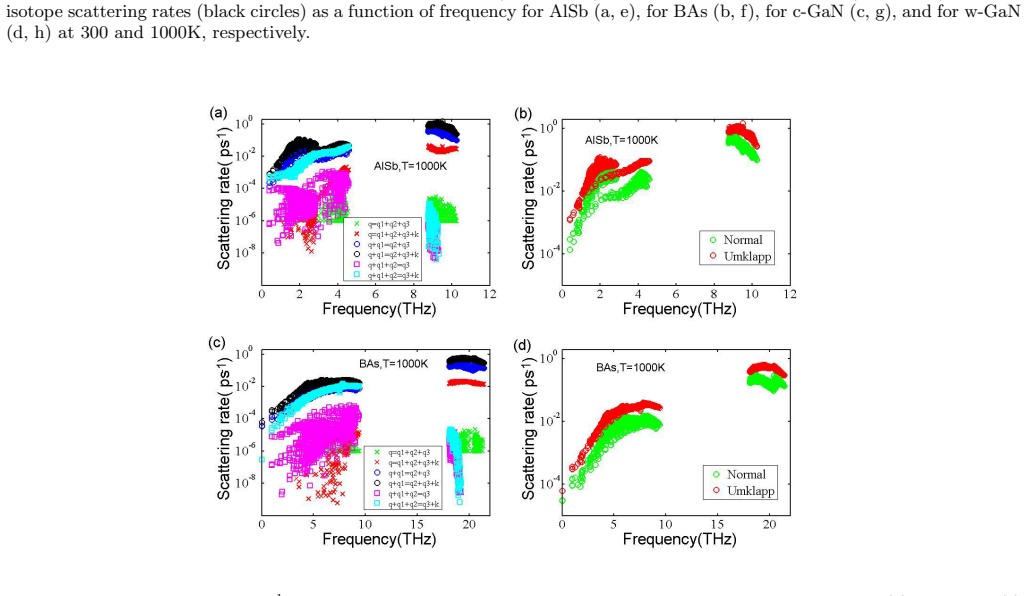
The central object is the four-phonon scattering rate $\tau_4^{-1}$ computed from fourth-order interatomic force constants and perturbation theory, inserted into the phonon Boltzmann transport equation at the relaxation-time-approximation level while three-phonon scattering is handled iteratively. The mechanism that carries the argument is the recombination channel $q + q_1 \rightarrow q_2 + q_3$ plus a reciprocal lattice vector, which dominates $\tau_4^{-1}$ and is not suppressed by the acoustic-optical gap. The paper verifies that Umklapp processes dominate this rate, which justifies the relaxation-time treatment, and uses the flat optical branches and the normalized acoustic-optical gap to explain why four-phonon scattering matters most in AlSb, then BAs, then GaN.
What would settle it
Measure the room-temperature thermal conductivity of isotopically pure AlSb: three-phonon-only theory predicts about 181 W/mK, while the paper's four-phonon result predicts about 51 W/mK, so a measured value near 181 W/mK would overturn the central claim.
Extended reading notes
Core claim
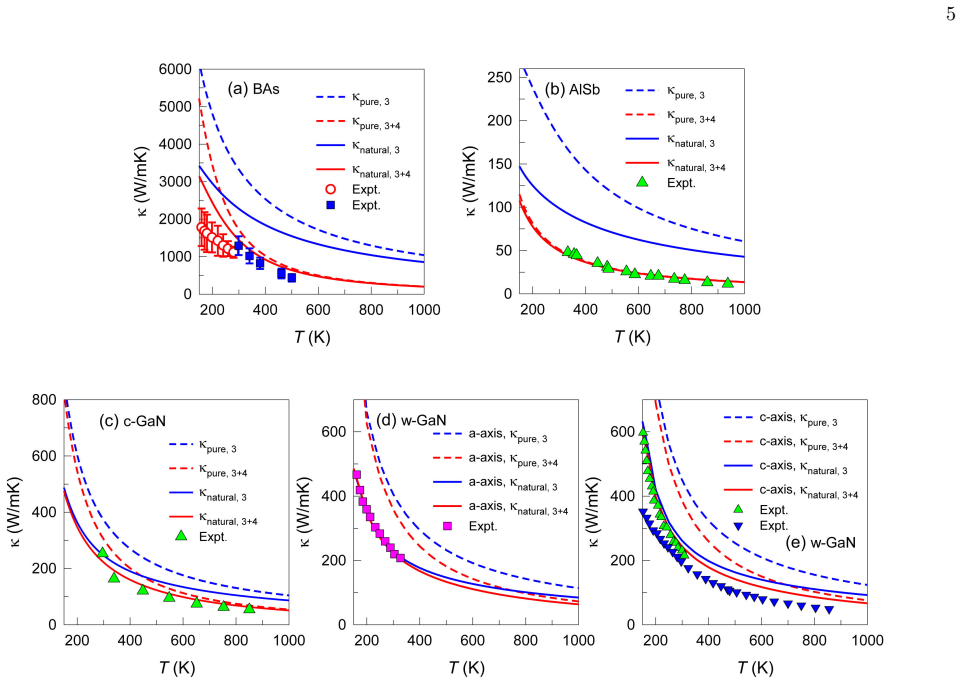
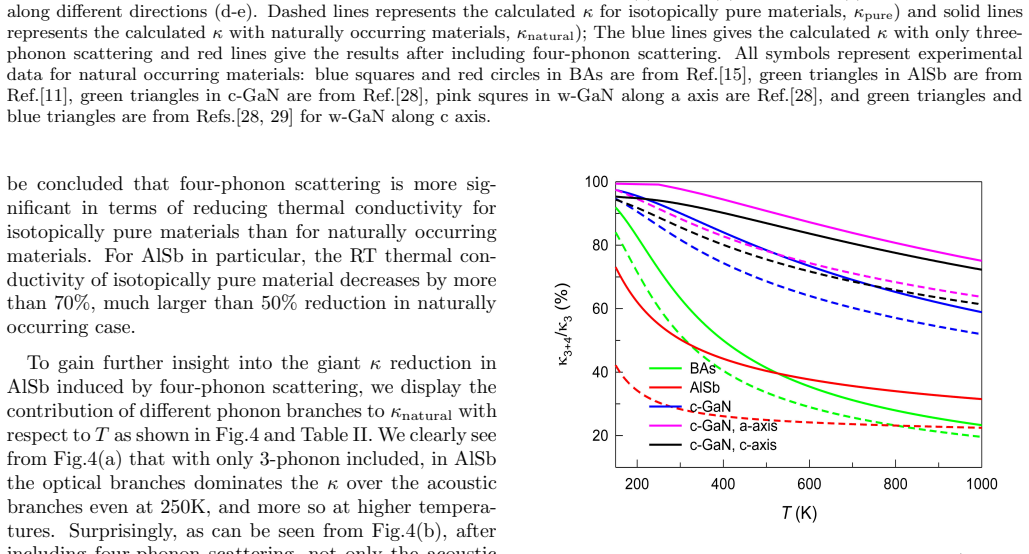
The central discovery is that in AlSb the optical phonon branches, which carry nearly half of the heat current in three-phonon theory, are almost completely silenced by four-phonon scattering. The authors show that recombination processes involving four phonons easily satisfy energy and momentum conservation even where three-phonon processes are forbidden by the large acoustic-optical gap, so optical phonon lifetimes collapse. After including four-phonon scattering, optical modes contribute only 3.6% of the thermal conductivity at 300 K instead of 48.9%, and the total room-temperature conductivity of natural AlSb falls by about half to 50 W/mK, matching experiment where the three-phonon-only value of 99 W/mK did not. The same mechanism weakens the isotope effect: in AlSb the percentage difference between isotopically pure and natural samples drops from 83.3% to 3.2% at room temperature because four-phonon scattering adds an intrinsic resistance that swamps the mass-disorder scattering.
Load-bearing premise
The load-bearing premise is that four-phonon scattering can be added to the Boltzmann equation at the relaxation-time-approximation level, valid only because the computed four-phonon rates are dominated by Umklapp processes; if Normal processes were significant, the predicted 50% reduction in AlSb conductivity could change.
Editorial extensions
If this is right
- In AlSb, optical phonons should no longer be treated as significant heat carriers: acoustic modes carry 96.4% of the room-temperature conductivity once four-phonon scattering is included.
- Isotope purification of AlSb will not produce the large conductivity gain predicted by three-phonon theory; the expected room-temperature isotope effect shrinks from 83.3% to 3.2%.
- Predictive models of other III-V semiconductors with large acoustic-optical gaps and flat optical branches should include four-phonon scattering or they will overestimate room-temperature thermal conductivity.
- For cubic and wurtzite GaN, four-phonon effects are smaller at room temperature but grow with temperature, bringing calculated conductivities into better agreement with measurements above 400 K.
- The normalized acoustic-optical gap $E_g/\omega_{LA}$ gives a rough ranking of how strongly four-phonon scattering will reduce thermal conductivity across materials.
Reading between the lines
- The results imply that phonon-isotope engineering, which works for diamond and some other crystals, is unlikely to boost AlSb heat conduction because the intrinsic four-phonon resistance dominates; a direct measurement on isotopically enriched AlSb would test this prediction.
- Any material whose optical phonons have long three-phonon lifetimes because selection rules are suppressed by band structure should be re-examined: reported conductivities and isotope effects may be overestimates if four-phonon scattering was omitted.
- If future measurements showed that Normal four-phonon processes are not negligible, the relaxation-time approximation used here would need to be replaced by a fully iterative four-phonon solution, and the predicted optical-mode suppression could change in magnitude.
Signed reviews
Editorial analysis
A structured set of objections, weighed in public.
Referee Report
Summary. This manuscript reports first-principles phonon Boltzmann transport equation (BTE) calculations of lattice thermal conductivity and isotope effects in BAs, AlSb, cubic GaN, and wurtzite GaN, including fourth-order anharmonicity and four-phonon scattering. The central claim is that four-phonon scattering is qualitatively important in AlSb: it reduces the room-temperature thermal conductivity of naturally occurring AlSb from 99 to 50 W/mK and of isotopically pure AlSb from 181 to 51 W/mK, and it reduces the optical phonon contribution to the total conductivity from 48.9% to 3.6% at 300 K. The paper also argues that four-phonon scattering weakens the isotope effect, with the room-temperature isotope effect in AlSb falling from 83.3% to 3.2%. Similar but smaller reductions are reported for c-GaN and w-GaN. The calculations use harmonic and anharmonic interatomic force constants from DFT, and four-phonon scattering rates are included at the relaxation-time-approximation (RTA) level within an otherwise iterative BTE solution.
Significance. If the central results hold, the paper would establish a new regime for four-phonon scattering: a material in which four-phonon processes dominate over three-phonon processes in suppressing the optical phonon contribution, and in which they substantially reduce the isotope effect. This goes beyond prior studies focused on acoustic-phonon-dominated materials and provides concrete guidance for III-V thermal management. The paper also benefits from a previously validated four-phonon formalism and shows good overall agreement with available experiments for AlSb and c-GaN over a wide temperature range. The main significance is therefore the quantitative and qualitative prediction for AlSb, provided the methodological assumptions are verified.
major comments (3)
- [Methods (after Eq. 1) and Fig. 7] The RTA treatment of four-phonon scattering is justified in the text by the statement that four-phonon scattering is dominated by Umklapp processes, with Fig. 7 cited in support. However, Fig. 7 is computed only at 1000 K. At 300 K, the phonon population is confined to a smaller region of the Brillouin zone, and Normal (momentum-conserving) processes are expected to be relatively more important than at 1000 K. Because the headline quantitative results—the 50% reduction in natural AlSb conductivity and the collapse of the optical contribution to 3.6%—depend on the magnitude of four-phonon scattering rates at room temperature, this missing verification is load-bearing. Please provide the Normal/Umklapp decomposition at 300 K, or otherwise demonstrate quantitatively that RTA-level inclusion of four-phonon scattering does not overestimate the reduction in thermal conductivity at 300 K.
- [Eq. (1) and the iterative solution paragraph] Equation (1) is a single-mode RTA expression for thermal conductivity in which each phonon mode contributes independently with a lifetime. The text, however, states that an iterative scheme is used to solve the phonon BTE and that four-phonon scattering is inserted at the RTA level. It is not specified how the iterative BTE solution is reconciled with Eq. (1), nor whether Eq. (1) is the formula actually used after iteration. Please present the full linearized BTE with the four-phonon scattering matrix elements, state clearly how the RTA approximation is applied to the four-phonon term, and explain how Eq. (1) follows from the iterative solution. This is needed to assess whether the four-phonon rates are being double-counted or incorrectly treated as diagonal-only resistance.
- [Methods: IFC truncation and q-mesh] The fourth-order IFCs are truncated at second nearest neighbors and the BTE is solved on a 16x16x16 q-mesh, but the manuscript reports no convergence tests for either parameter. The central quantitative predictions—for example, AlSb κnatural,3+4 = 50 W/mK and κpure,3+4 = 51 W/mK—depend on the accuracy of the four-phonon scattering phase space and therefore on these cutoffs. Please provide convergence data with respect to the fourth-order IFC interaction range and the q-mesh density for at least AlSb and one other material.
minor comments (4)
- [Table I and Fig. 5 discussion] The isotope effect values in Table I are not consistent with the rounded conductivities: for AlSb, 181/99 - 1 = 82.8%, not 83.3%, and 51/50 - 1 = 2.0%, not 3.2%. The text states P decreases to 3.2% for AlSb. Please reconcile the quoted P values with the listed κ values or state that the table entries are rounded from unrounded data.
- [Results for c-GaN, paragraph after Fig. 2] In the sentence reporting the c-GaN four-phonon results, 'κpure,3=304 W/mK' should presumably read 'κpure,3+4=304 W/mK'. As written, it incorrectly labels the four-phonon result as a three-phonon value.
- [Throughout] There are several typographical errors, including 'unqiue' for 'unique', 'acousitc' for 'acoustic', 'effect' appears in the title and text, and 'sove' for 'solve'. A careful proofreading pass is recommended.
- [Fig. 4 and Table II] The y-axis labels and legend in Fig. 4 are somewhat small and the acoustic/optical decomposition would be easier to verify if the numerical values in Table II were also shown graphically for AlSb at 300 K. This is a presentation issue, not a technical error.
Circularity Check
No significant circularity: the predicted kappa reductions for AlSb and GaN are first-principles outputs, not fitted to the experimental values they are compared against.
full rationale
The paper's derivation chain is: DFT-computed harmonic and anharmonic IFCs -> iterative solution of the phonon BTE with three-phonon scattering, plus four-phonon scattering rates included at the RTA level -> phonon lifetimes -> kappa via Eq. (1). No parameter is fitted to the experimental kappa values used for comparison; the experimental data are invoked only after the calculations are complete. The four-phonon formalism is taken from the authors' prior works (refs 12-14), but that formalism is a published computational derivation and the BAs prediction was subsequently confirmed by independent experiments (refs 15-17), which is external validation rather than circular self-support. The use of RTA for four-phonon scattering is a modeling assumption justified by ref 13 and by the paper's own Fig. 7, which shows Umklapp dominance at 1000 K. Even if the 300 K validity of this assumption is not fully established, that is a correctness or validation concern, not circularity: the RTA level of approximation does not define the predicted kappa reduction, and the optical-branch contribution dropping from 48.9% to 3.6% is a computed consequence of the calculated four-phonon rates, not a restatement of an input. No equation in the paper reduces another equation to its own inputs by construction, and no fitted parameter is renamed as a prediction. The central claims are therefore self-contained rather than circular.
Assumptions & free parameters
assumptions (5)
- domain assumption DFT within the LDA yields accurate harmonic and anharmonic interatomic force constants for AlSb, BAs, and GaN.
- domain assumption Third-order IFCs up to fifth nearest neighbors and fourth-order IFCs up to second nearest neighbors are sufficient for converged scattering rates.
- domain assumption Four-phonon scattering can be included at the RTA level and combined with the iteratively solved three-phonon BTE.
- domain assumption The phonon-isotope scattering model used is adequate for isotope effects.
- standard math Standard perturbation theory of anharmonic interactions is valid for four-phonon processes.
Cite this review
Pith. "Pith review of Four-phonon scattering diminishes the optical phonon contribution and isotope effect to thermal conductivity of III-V semiconductors." pith.science (2026). https://pith.science/paper/FU4IBSYO
@misc{pith2026190805400,
  author       = {Pith},
  title        = {Pith review of: Four-phonon scattering diminishes the optical phonon contribution and isotope effect to thermal conductivity of III-V semiconductors},
  year         = {2026},
  howpublished = {\url{https://pith.science/paper/FU4IBSYO}},
  note         = {Machine review of arXiv:1908.05400}
}
abstract
Recent studies reveal that four-phonon scattering is generally important in determining thermal conductivities of solids. However, these studies have been focused on materials where thermal conductivity $\kappa$ is dominated by acoustic phonons, and the impact of four phonon scattering, although significant, is still generally smaller than three-phonon scattering. In this work, taking AlSb as example, we demonstrated that four-phonon scattering is even more critical to three-phonon scattering as it diminishes optical phonon thermal transport, and therefore significantly reduces the thermal conductivities of materials in which optical branches have long three-phonon lifetimes. Also, our calculations show that four-phonon scattering can play an extremely important role in weakening the isotope effect on $\kappa$. Specifically, four-phonon scattering reduces the room-temperature $\kappa$ of the isotopically pure and natural-occurring AlSb by 70$\%$ and 50$\%$, respectively. The reduction for isotopically pure and natural-occurring c-GaN is about 34$\%$ and 27$\%$, respectively. For isotopically-pure w-GaN, the reduction is about 13$\%$ at room temperature and 25$\%$ at 400 K. These results provided important guidance for experimentalists for achieving high thermal conductivities in III-V compounds for applications in semiconductor industry.
Figures

Figures from the paper (4 more)


Reference graph
Works this paper leans on
-
[1]
× 100%, versus temperature for AlSb(red), BAs (blue), c- GaN(pink), and w-GaN (green). Dashed lines give the results with only three-phonon scattering, and solid lines give the results after including four-phonon scattering. volving a-o coupling, and thus the more important four- phonon scattering, as demonstrated previously [13]. At T = θD, however, κ3+4...
-
[2]
D. A. Broido, M. Malorny, G. Birner, N. Mingo, and D. A. Stewart, Applied Physics Letters 91, 231922 (2007), https://doi.org/10.1063/1.2822891, URL https: //doi.org/10.1063/1.2822891
-
[3]
J. Garg, N. Bonini, B. Kozinsky, and N. Marzari, Physi- cal Review Letters 106, 045901 (2011). 9 FIG. 6: Calculated intrinsic three-phonon scattering rates (blue circles), four-phonon scattering rates (red circles), and the isotope scattering rates (black circles) as a function of frequency for AlSb (a, e), for BAs (b, f), for c-GaN (c, g), and for w-GaN ...
work page 2011
-
[4]
A. Ward, D. A. Broido, D. A. Stewart, and G. Deinzer, PRB 80, 125203 (2009), URL https://link.aps.org/ doi/10.1103/PhysRevB.80.125203
-
[5]
W. Li, N. Mingo, L. Lindsay, D. A. Broido, D. A. Stewart, and N. A. Katcho, Phys. Rev. B 85, 195436 (2012), URL https://link.aps.org/doi/10. 1103/PhysRevB.85.195436
work page 2012
-
[6]
Z. Tian, J. Garg, K. Esfarjani, T. Shiga, J. Shiomi, and G. Chen, Phys.rev.b 85, 45 (2012)
work page 2012
-
[7]
X. Yang, J. Carrete, and Z. Wang, Appl. Phys. Lett.108, 113901 (2019), ISSN 0003-6951, URL https://doi.org/ 10.1063/1.4943791
-
[8]
W. Li, L. Lindsay, D. A. Broido, D. A. Stewart, and N. Mingo, Phys. Rev. B 86, 174307 (2012), URL https: //link.aps.org/doi/10.1103/PhysRevB.86.174307
Show all 28 references
-
[9]
Lindsay, D
L. Lindsay, D. A. Broido, and T. L. Reinecke, Physical Review B 87, 165201 (2013)
2013
-
[10]
Lindsay, D
L. Lindsay, D. A. Broido, and T. L. Reinecke, Phys. Rev. Lett. 109, 095901 (2012), URL https://link.aps.org/ doi/10.1103/PhysRevLett.109.095901
2012 doi
-
[11]
Lindsay, D
L. Lindsay, D. A. Broido, and T. L. Reinecke, Physical Review Letters 111, 025901 (2013)
2013
-
[12]
E. F. Steigmeier and I. Kudman, Physical Review 141, 767 (1966)
1966
-
[14]
T. Feng, L. Lindsay, and X. Ruan, Phys. Rev. B 96, 161201(R) (2017), URL https://link.aps.org/doi/ 10.1103/PhysRevB.96.161201
2017 doi
-
[16]
F. Tian, B. Song, X. Chen, N. K. Ravichandran, Y. Lv, K. Chen, S. Sullivan, J. Kim, Y. Zhou, T.-H. Liu, et al., Science (2018), ISSN 0036-8075, http://science.sciencemag.org/content/early/2018/07/03/science.aat7932.full.pdf, URL http://science.sciencemag.org/content/ early/201...
2018
-
[17]
S. Li, Q. Zheng, Y. Lv, X. Liu, X. Wang, P. Y. Huang, D. G. Cahill, and B. Lv, Science (2018), ISSN 0036-8075, http://science.sciencemag.org/content/early/2018/07/03/science.aat8982.full.pdf, URL http://science.sciencemag.org/content/ early/2018/07/03/science.aat8982
2018
-
[18]
J. S. Kang, M. Li, H. Wu, H. Nguyen, and Y. Hu, Science p. eaat5522 (2018), URL http: //science.sciencemag.org/content/early/2018/07/ 03/science.aat5522.abstract
2018
-
[19]
N. K. Ravichandran and D. Broido, Nature Communi- cations 10, 827 (2019), ISSN 2041-1723, URL https: //doi.org/10.1038/s41467-019-08713-0
2019 doi
-
[20]
D. A. Broido, L. Lindsay, and A. Ward, Physical Review B 86, 115203 (2012)
2012
-
[21]
A. Ward, D. A. Broido, and D. A. Stewart, Applied Physics Letters 91, 231922 (2007)
2007
-
[22]
Esfarjani, G
K. Esfarjani, G. Chen, and H. T. Stokes, Phys. Rev. B 84, 085204 (2011), URL https://link.aps.org/doi/ 10.1103/PhysRevB.84.085204
2011 doi
-
[23]
Kresse and J
G. Kresse and J. Hafner, Phys. Rev. B 47, 558 (1993), URL https://link.aps.org/doi/10.1103/PhysRevB. 47.558
1993 doi
-
[24]
Kresse and J
G. Kresse and J. Furthmller, Computational Ma- terials Science 6, 15 (1996), ISSN 0927-0256, URL http://www.sciencedirect.com/science/article/ pii/0927025696000080
1996
-
[25]
Kresse and J
G. Kresse and J. Furthmuller, Phys. Rev. B 54, 11169 (1996), URL https://link.aps.org/doi/10. 1103/PhysRevB.54.11169
1996
-
[26]
A. Togo, F. Oba, and I. Tanaka, Phys. Rev. B 78, 134106 (2008), URL https://link.aps.org/doi/10. 1103/PhysRevB.78.134106
2008
-
[27]
W. Li, J. Carrete, N. A. Katcho, and N. Mingo, Computer Physics Communications 185, 1747 (2014), ISSN 0010-4655, URL http://www.sciencedirect.com/ science/article/pii/S0010465514000484
2014
-
[28]
Accessed 2018-12-26, URL https://doi.org/10.1007/ 10551045_69
2018
-
[29]
Jeowski, P
A. Jeowski, P. Stachowiak, T. Plackowski, T. Suski, S. Krukowski, M. Bokowski, I. Grzegory, B. Danilchenko, and T. Paszkiewicz, phys. stat. sol. (b) 240, 447 (2003), ISSN 0370-1972, URL https://doi.org/10.1002/pssb. 200303341
2003 doi
-
[30]
Zheng, C
Q. Zheng, C. Li, A. Rai, J. H. Leach, D. A. Broido, and D. G. Cahill, PRMATERIALS 3, 014601 (2019), URL https://link.aps.org/doi/10. 1103/PhysRevMaterials.3.014601
2019
Reviewed August 14, 2026 · model on record in the stance chip above.
Discussion (0). Continue with ORCID to comment.