REVIEW 31 references
Learning High-dimensional Ionic Model Dynamics Using Fourier Neural Operators
T0 review · reviewed 2026-08-07 · deepseek-v4-flash
Pith's one-line read A single Fourier Neural Operator can learn the full state dynamics of stiff ionic models up to 41 variables with roughly 2% relative L2 test error.
The pith
A machine-rendered reading of the paper's core claim, the machinery that carries it, and where it could break.
The reading
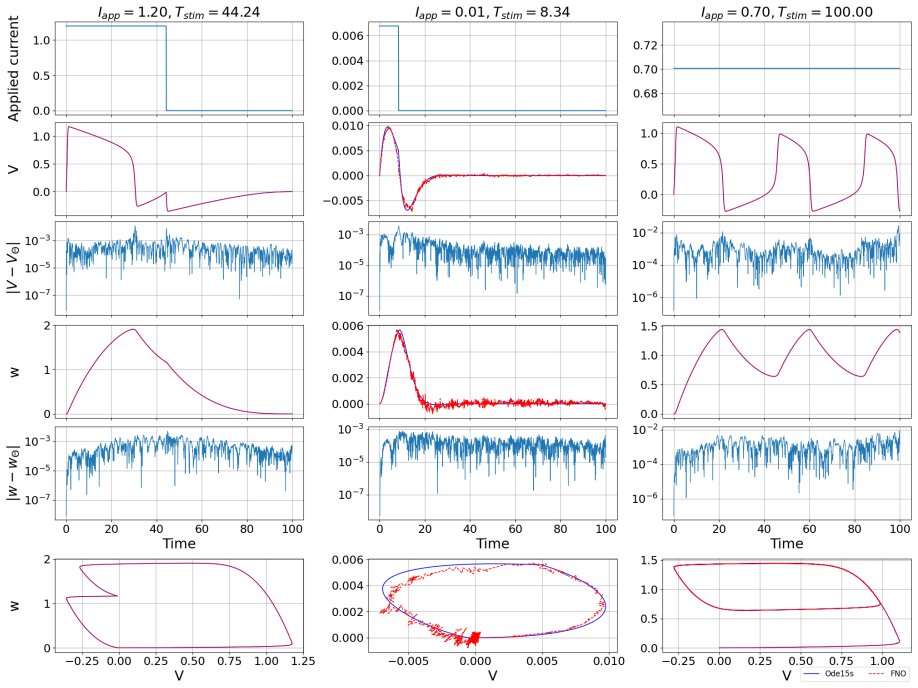
The results show held-out test errors of about 0.9% for FitzHugh-Nagumo and 2.2 to 2.7% for the Hodgkin-Huxley and O'Hara-Rudy models, with errors spread relatively evenly across variables. The authors also compare two hyperparameter tuning strategies: unconstrained and constrained to about 500,000 parameters, finding similar accuracy but faster convergence for the unconstrained network. They interpret the results as evidence that FNOs scale to high-dimensional stiff systems.
The main caveats are that the input space is only two-dimensional, the ground truth relies on an unspecified stiff ODE solver, and no code or data is currently available. The comparison to other operator learning methods is also missing, so the paper establishes capability more than superiority.
Extended reading notes
Core claim
The central claim is that FNO parameters and relative errors are bounded independently of the state dimension, and that a single FNO can learn the full solution operator of stiff ionic models including the 41-variable O'Hara-Rudy model with about 2% relative L2 test error. If correct, FNOs are a viable surrogate for high-dimensional ionic dynamics.
Load-bearing premise
The applied current input is restricted to a two-parameter family of piecewise constant functions (amplitude i and stimulus duration Tstim), defined in Section 2. The paper's success on this low-dimensional input family is taken as evidence that the learned operator generalizes to arbitrary applied currents; if FNOs fail on richer input waveforms, the central capability claim is overstated.
Editorial analysis
A structured set of objections, weighed in public.
Assumptions & free parameters
assumptions (4)
- domain assumption System (1) admits a unique solution for the chosen parameter ranges.
- domain assumption The O'Hara-Rudy model equations and parameters from [24] are correctly implemented in the data generation.
- domain assumption The reference stiff ODE solver produces accurate ground truth.
- standard math FNO universality and mesh-independence properties from cited works hold for the present setting.
Cite this review
Pith. "Pith review of Learning High-dimensional Ionic Model Dynamics Using Fourier Neural Operators." pith.science (2026). https://pith.science/paper/FU7MZFBM
@misc{pith2026250514039,
  author       = {Pith},
  title        = {Pith review of: Learning High-dimensional Ionic Model Dynamics Using Fourier Neural Operators},
  year         = {2026},
  howpublished = {\url{https://pith.science/paper/FU7MZFBM}},
  note         = {Machine review of arXiv:2505.14039}
}
read the original abstract
Ionic models, described by systems of stiff ordinary differential equations, are fundamental tools for simulating the complex dynamics of excitable cells in both Computational Neuroscience and Cardiology. Approximating these models using Artificial Neural Networks poses significant challenges due to their inherent stiffness, multiscale nonlinearities, and the wide range of dynamical behaviors they exhibit, including multiple equilibrium points, limit cycles, and intricate interactions. While in previous studies the dynamics of the transmembrane potential has been predicted in low dimensionality settings, in the present study we extend these results by investigating whether Fourier Neural Operators can effectively learn the evolution of all the state variables within these dynamical systems in higher dimensions. We demonstrate the effectiveness of this approach by accurately learning the dynamics of three well-established ionic models with increasing dimensionality: the two-variable FitzHugh-Nagumo model, the four-variable Hodgkin-Huxley model, and the forty-one-variable O'Hara-Rudy model. To ensure the selection of near-optimal configurations for the Fourier Neural Operator, we conducted automatic hyperparameter tuning under two scenarios: an unconstrained setting, where the number of trainable parameters is not limited, and a constrained case with a fixed number of trainable parameters. Both constrained and unconstrained architectures achieve comparable results in terms of accuracy across all the models considered. However, the unconstrained architecture required approximately half the number of training epochs to achieve similar error levels, as evidenced by the loss function values recorded during training. These results underline the capabilities of Fourier Neural Operators to accurately capture complex multiscale dynamics, even in high-dimensional dynamical systems.
Figures


Figures from the paper (9 more)


Reference graph
Works this paper leans on
-
[1]
Neural operators for accelerating scientific simulations and design, Nature Reviews Physics 6, no
Kamyar Azizzadenesheli, Nikola , Zongyi Li, Miguel Liu-Schiaffini, Jean Kossaifi, Anima Anandkumar. Neural operators for accelerating scientific simulations and design, Nature Reviews Physics 6, no. 5 : 320-328, 2024
work page 2024
-
[2]
Francesca Bartolucci, Emmanuel de B´ ezenac, Bogdan Raoni´ c, Roberto Molinaro, Siddhartha Mishra, Rima Alaifari,Are neural operators really neural operators? frame theory meets operator learning, SAM Research Report, volume 2023, 2023
work page 2023
-
[3]
James Bergstra, R´ emi Bardenet, Yoshua Bengio, Bal´ azs K´ egl,Algorithms for hyper-parameter optimization, Advances in Neural Information Processing Systems, volume 24, 2011
work page 2011
-
[4]
Edoardo Calvello, Nikola B. Kovachki, Matthew E. Levine, Andrew M. Stuart,Continuum attention for neural operators, arXiv preprint arXiv:2406.06486, 2024
arXiv 2024
-
[5]
Daniel Cebr ´ ıan-Lacasa, Pedro Parra-Rivas, Daniel Ruiz-Reyn´ es, Lendert Gelens,Six decades of the FitzHugh-Nagumo model: A guide through its spatio-temporal dynamics and influence across disciplines, arXiv preprint arXiv:2404.11403, 2024
work page Pith review arXiv 2024
-
[6]
Edoardo Centofanti, Massimiliano Ghiotto, Luca F. Pavarino,Learning the Hodgkin–Huxley model with operator learning techniques, Computer Methods in Applied Mechanics and Engineering, volume 432, page 117381, 2024
work page 2024
-
[7]
CINECA Supercomputing Centre, SuperComputing Applications and Innovation Department, LEONARDO: A Pan-European Pre-Exascale Supercomputer for HPC and AI applications, Journal of Large-Scale Research Facilities, 8, A186, 2024
work page 2024
-
[8]
Salvatore Cuomo, Vincenzo S. Di Cola, Fabio Giampaolo, Gianluigi Rozza, Maziar Raissi, Francesco Piccialli,Scientific machine learning through physics–informed neural networks: Where we are and what’s next, Journal of Scientific Computing, 92, 3, 88, 2022
work page 2022
Show all 31 references
-
[9]
Richard FitzHugh,Impulses and physiological states in theoretical models of nerve membrane, Bio- physical Journal, 1, 6, 445–466, 1961. 20
1961
-
[10]
Franzone, Luca F
Piero C. Franzone, Luca F. Pavarino, Simone Scacchi,Mathematical Cardiac Electrophysiology, 13, Springer, 2014
2014
-
[11]
Massimiliano Ghiotto,HyperNOs: Automated and Parallel Library for Neural Operators Research, arXiv preprint arXiv:2503.18087, 2025
2025
-
[12]
Karniadakis,Physics-informed deep neural operator networks, Machine Learning in Modeling and Simulation: Methods and Applications, 219–254, 2023
Somdatta Goswami, Aniruddha Bora, Yue Yu, George E. Karniadakis,Physics-informed deep neural operator networks, Machine Learning in Modeling and Simulation: Methods and Applications, 219–254, 2023
2023
-
[13]
Hodgkin, Andrew F
Alan L. Hodgkin, Andrew F. Huxley,A quantitative description of membrane current and its application to conduction and excitation in nerve, The Journal of Physiology, 117, 4, 500, 1952
1952
-
[14]
Izhikevich,Dynamical Systems in Neuroscience, MIT press, 2007
Eugene M. Izhikevich,Dynamical Systems in Neuroscience, MIT press, 2007
2007
-
[15]
James Keener, James Sneyd,Mathematical Physiology: II: Systems physiology, Springer, 2009
2009
-
[16]
Nikola Kovachki, Zongyi Li, Burigede Liu, Kamyar Azizzadenesheli, Kaushik Bhattacharya, Andrew Stuart, Anima Anandkumar,Neural operator: Learning maps between function spaces with applications to pdes, Journal of Machine Learning Research, 24, 89, 1–97, 2023
2023
-
[17]
Stuart,Nonlocality and nonlinearity implies universality in operator learning, arXiv preprint arXiv:2304.13221, 2023
Samuel Lanthaler, Zongyi Li, Andrew M. Stuart,Nonlocality and nonlinearity implies universality in operator learning, arXiv preprint arXiv:2304.13221, 2023
2023 arXiv
-
[18]
Liam Li, Kevin Jamieson, Afshin Rostamizadeh, Ekaterina Gonina, Jonathan Ben-Tzur, Moritz Hardt, Benjamin Recht, and Ameet Talwalkar.A system for massively parallel hyperparameter tuning, Proceedings of machine learning and systems 2: 230-246 2020
2020
-
[19]
Farimani,Transformer for partial differential equations’ operator learning, arXiv preprint arXiv:2205.13671, 2022
Zijie Li, Kazem Meidani, Amir B. Farimani,Transformer for partial differential equations’ operator learning, arXiv preprint arXiv:2205.13671, 2022
2022 arXiv
-
[20]
Stuart, Anima Anandkumar,Fourier neural operator for parametric partial differential equations, arXiv preprint arXiv:2010.08895, 2020
Zongyi Li, Nikola Kovachki, Kamyar Azizzadenesheli, Burigede Liu, Kaushik Bhattacharya, Andrew M. Stuart, Anima Anandkumar,Fourier neural operator for parametric partial differential equations, arXiv preprint arXiv:2010.08895, 2020
2010 arXiv
-
[21]
Gonzalez, Ion Stoica,Tune: A Research Platform for Distributed Model Selection and Training, arXiv preprint arXiv:1807.05118, 2018
Richard Liaw, Eric Liang, Robert Nishihara, Philipp Moritz, Joseph E. Gonzalez, Ion Stoica,Tune: A Research Platform for Distributed Model Selection and Training, arXiv preprint arXiv:1807.05118, 2018
2018 arXiv
-
[22]
Ilya Loshchilov, Frank Hutter,Decoupled weight decay regularization, arXiv preprint arXiv:1711.05101, 2017
2017 arXiv
-
[23]
Karniadakis,Learning nonlinear operators via DeepONet based on the universal approximation theorem of operators, Nature Machine Intelligence, 3, 3, 218–229, 2021
Lu Lu, Pengzhan Jin, Guofei Pang, Zhongqiang Zhang, George E. Karniadakis,Learning nonlinear operators via DeepONet based on the universal approximation theorem of operators, Nature Machine Intelligence, 3, 3, 218–229, 2021
2021
-
[24]
Thomas O’Hara, L´ aszl´ o Vir´ ag, Andr´ as Varr´ o, Yoram Rudy,Simulation of the undiseased human cardiac ventricular action potential: model formulation and experimental validation, PLoS Computational Biology, 7, 5, e1002061, 2011
2011
-
[25]
Maziar Raissi, Paris Perdikaris, George E. Karniadakis,Physics-informed neural networks: A deep learning framework for solving forward and inverse problems involving nonlinear partial differential equations,Journal of Computational Physics, 378, 686-707, 2019
2019
-
[26]
Bogdan Raonic, Roberto Molinaro, Tobias Rohner, Siddhartha Mishra, Emmanuel de Bezenac, Convolutional neural operators, ICLR 2023 Workshop on Physics for Machine Learning, 2023
2023
-
[27]
Francesco Regazzoni, Stefano Pagani, Matteo Salvador, Luca Dede’, Alfio Quarteroni,Learning the intrinsic dynamics of spatio-temporal processes through Latent Dynamics Networks, Nature Communications, 15, 1, 1834, 2024. 21
2024
-
[28]
Shampine, Mark W
Lawrence F. Shampine, Mark W. Reichelt, Jacek A. Kierzenka,Solving index-1 DAEs in MATLAB and Simulink, SIAM Review, 41, 3, 538–552, 1999
1999
-
[29]
Simin Shekarpaz, Fanhai Zeng, George E. Karniadakis,Splitting Physics-Informed Neural Networks for Inferring the Dynamics of Integer-and Fractional-Order Neuron Models, Communications in Computational Physics, 35, 1, 1–37, 2024
2024
-
[30]
Tapas Tripura, Souvik Chakraborty,Wavelet neural operator for solving parametric partial differential equations in computational mechanics problems, Computer Methods in Applied Mechanics and Engineering, 404, 115783, 2023
2023
-
[31]
Haixu Wu, Huakun Luo, Haowen Wang, Jianmin Wang, Mingsheng Long,Transolver: A fast transformer solver for PDEs on general geometries, arXiv preprint arXiv:2402.02366, 2024. 22
2024 arXiv
Reviewed August 7, 2026 · model on record in the stance chip above.
Discussion (0). Sign in to comment.