REVIEW 4 major objections 6 minor 59 references
A Mixture-Based Framework for Guiding Diffusion Models
T0 review · 4 major / 6 minor · reviewed 2026-08-09 · deepseek-v4-flash
Pith's one-line read A weighted mixture of likelihood components, sampled with a Gibbs scheme, lets a single pretrained diffusion prior beat most training-free inverse-problem samplers and match a supervised audio model with more Gibbs steps.
desk verdict Solid, incremental algorithm paper with a clean derivation and broad experiments, but the 'principled' claim outruns what R=1 Gibbs steps actually deliver. read the letter →
The pith
A machine-rendered reading of the paper's core claim, the machinery that carries it, and where it could break.
The reading
What carries the argument
The load-bearing object is the data-augmented Gibbs sampler targeting $\pi^y_{0,s,t}(x_0,x_s,x_t)\propto p_{0|s}(x_0|x_s)\hat g_s(y|x_s)p_{s|t}(x_s|x_t)p_t(x_t)$, whose $x_t$-marginal equals the mixture component $\hat\pi_s^t$. The observation enters only through the conditional $\pi^y_{s|0,t}(x_s|x_0,x_t)\propto\hat g_s(y|x_s)q_{s|0,t}(x_s|x_0,x_t)$, which the algorithm samples by fitting a Gaussian variational approximation; the other two conditionals are an exact noising step using $q_{t|s}$ and a denoising step using the pretrained diffusion model via $p_{0|s}$. This decomposition lets a single pretrained denoiser transport prior information while the observation is injected through a tractable conditional, and it converts the intractable score of the mixture into repeated tractable Gibbs rounds.
What would settle it
On a small inverse problem with a Gaussian likelihood and a dimension low enough that the true posterior under the pretrained prior can be integrated numerically, run MGDM with R=1 and with R large; if the R=1 output distribution differs from the R approach infinity distribution by more than the denoiser's approximation error, the single-sweep stationarity assumption is the limiting factor.
Extended reading notes
Core claim
The paper's central claim is that each smoothed posterior $\pi_t^y$ of a diffusion model can be approximated by a weighted mixture $\hat\pi_t^y(x_t)=\sum_{s=1}^{t-1}\omega_s^t\hat\pi_s^t(x_t)$, where each component $\hat\pi_s^t$ is built from the likelihood approximation $\hat g_s(y|x_s)$ transported forward to time $t$ through the backward transition $p_{s|t}$. Because the scores of these components are intractable, the paper shows that $\hat\pi_s^t$ is exactly the $x_t$-marginal of an augmented joint distribution $\pi^y_{0,s,t}$, and that this joint distribution has simple full conditionals: one Gaussian-updated observation step, one exact noising step $q_{t|s}$, and one denoising step $p_{0|s}$. The practical sampler, MGDM, targets these mixtures sequentially, using a Gaussian variational routine for the observation conditional and a pretrained diffusion model for the denoising conditional, with the number of Gibbs rounds $R$ as a tunable inference-time compute knob. The claim, supported by experiments on ten image tasks and musical source separation, is that this construction is more robust and often more accurate than existing guidance methods, and that its outputs improve monotonically as $R$ grows.
Load-bearing premise
The practical algorithm assumes that one Gibbs sweep (R=1 in the image experiments) already brings the augmented chain close to its stationary distribution, even though the exact-marginal guarantee in the paper only holds in the limit of infinitely many sweeps.
Editorial extensions
If this is right
- Training-free posterior sampling with a pretrained diffusion prior can reach or exceed the performance of task-specific supervised methods on at least one audio benchmark when inference-time compute is scaled, as demonstrated against DEMUCS512 on source separation.
- The same algorithm, with no task-specific modifications, applies to pixel-space and latent-space image priors and to audio priors; the paper reports it ranks first on most of the ten image inverse problems and remains robust on the rest.
- Reconstruction quality improves monotonically with the number of Gibbs steps while memory use stays fixed, so users can trade runtime for accuracy, as shown on phase retrieval and source separation.
- The mixture-of-likelihoods view reduces the need for hand-tuned guidance weights per task; guidance emerges from the Gibbs sweep over several earlier noise levels rather than from a single corrected score.
Reading between the lines
- Editorial inference: the near-stationarity of a single Gibbs round in the image experiments suggests that the sampler's output quality is not actually bottlenecked by mixing; tracking the autocorrelation of $\hat X_0^*$ across rounds would tell whether R=1 is a convergence accident or a structural property of the backward chain.
- Editorial inference: the mixture identity only needs the backward densities $p_{s|t}$, not the particular DDPM discretization, so the same construction could be ported to ODE/DDIM samplers by replacing the denoising step with an ODE integrator; the authors leave this as a limitation.
- Editorial inference: the weight sequence $\omega_s^t$ is currently a fixed heuristic, and the alternative augmentation in the appendix that resamples the mixture index from the data suggests a path to adaptive weights, which might close the reported gap between pixel-space and latent-space performance.
- Editorial inference: because the Gibbs updates only evaluate $\hat g_s$, a cheaper surrogate for the vector-Jacobian product could be swapped in to remove the memory overhead, preserving the mixture structure at some fidelity cost.
Editorial analysis
A structured set of objections, weighed in public.
Referee Report
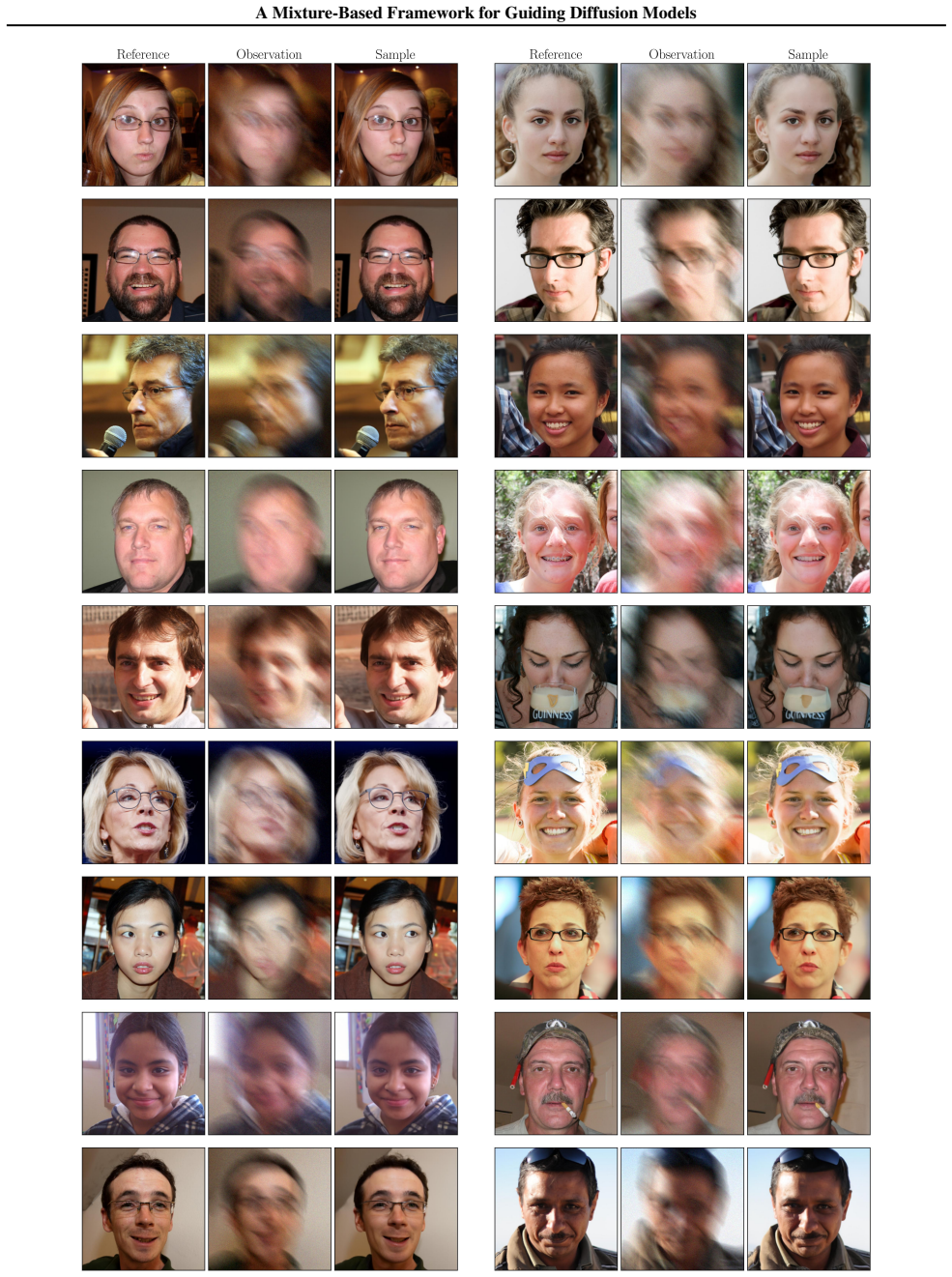
Summary. This paper proposes MGDM, a training-free guidance method for diffusion-model-based Bayesian inverse problems. The key idea is to approximate each smoothed posterior π_t^y by a mixture over intermediate timesteps s of likelihood-guided densities, and to sample from these mixtures with a data-augmented Gibbs sampler whose full conditionals are derived in Appendix A.2. A practical implementation (Algorithm 2) combines a Gaussian variational approximation (Gauss_VI), DDPM denoising steps, and a running estimate of x_0. The authors evaluate on ten image inverse problems with pixel- and latent-space priors and on musical source separation, reporting competitive LPIPS/PSNR/SSIM and SI-SDRI numbers, including performance close to the supervised Demucs baseline on source separation.
Significance. The construction is elegant: identity (10) is exact, the data augmentation (13) defines a genuine joint target, and the full conditionals in Appendix A.2 are derived cleanly. If the practical sampler were close to its target, the paper would provide a useful compute-scalable alternative to SMC and gradient-based guidance, with a broad and carefully assembled experimental suite and public code. The main weakness is the gap between the exact stationary-distribution statement and the implemented R=1 approximate Gibbs sweep; this is the central issue that, in my view, prevents the paper from being accepted in its current form.
major comments (4)
- [§3.2, Algorithm 2, §5] The exact-marginal guarantee in Section 3.2 is a property of the Gibbs chain targeting π^y_{0,s,t} at stationarity. Algorithm 2 as evaluated in the image experiments performs R=1 Gibbs sweep per outer iteration, re-initializes the chain from the previous timestep's running output (Algorithm 2, lines 6–7 and 13), draws x_s from a Gaussian variational approximation fitted with G=5 or 20 gradient steps (Algorithm 3, Table 5), and draws x_0 from an approximate DDPM denoiser with M=20 steps. None of these operations is an exact draw from the full conditionals, so the output distribution of Algorithm 2 is not covered by the stationarity theorem. Figure 3 provides direct evidence that R=1 is far from stationarity: increasing R from 1 to 6 changes phase-retrieval LPIPS by roughly a factor of three. Consequently, the competitive numbers in Tables 1–2 cannot be attributed to sampling from the mixture target, and the 'principled' part of the central claim is unsupported for the evaluated configuration. The authors should either report results for settings where the chain is demonstrably closer to stationarity (e.g., larger R with diagnostics) or explicitly reframe the algorithm as a heuristic approximation whose exactness holds only in an idealized limit.
- [§5, Tables 1–3] The headline comparisons are based on single mean values without error bars, standard deviations, or any measure of run-to-run variability. For phase retrieval, the paper reports the best of four samples per image and notes that competitors use a similar strategy; however, 'robust performance across all tasks' cannot be read off point estimates, particularly for a metric that is highly sensitive to R (Figure 3). Please provide per-sample statistics or confidence intervals, apply the same best-of-k protocol explicitly to every method, and state the number of random seeds/initializations used for each table entry. Without this, the claims that MGDM 'ranks first on most tasks' and is 'the only approach to maintain robust performance' are not supported.
- [§3.3, Appendix A.2] The argument that the final output \hat{X}_0^* is an approximate sample from π^y_0 relies on the approximation ∫ \hat{g}_1(y|x_1) q_{1|0}(x_1|x_0) dx_1 ≈ g_0(y|x_0), justified by the small variance of q_{1|0} and \hat{g}_1 ≈ g_0. This is an uncontrolled smoothing/approximation step that is separate from the stationarity guarantee, and it is not quantified. Since the algorithm's output is precisely this x0-coordinate, the paper should state the status of this approximation (e.g., a heuristic with a bound under regularity conditions, or an empirical validation of the smoothing error).
- [§5, Appendix B.1–B.2] The index-sampling distribution μ_i^* (Eq. 21), the threshold τ=10, the ramp in gradient steps, and the learning-rate schedule in Table 5 are all chosen based on empirical performance on the evaluation tasks. This is acceptable practice, but it means the 'principled' construction in Section 3.2 does not by itself determine the algorithm actually run: the mixture weights \omega_t^s are effectively replaced by a hand-tuned categorical distribution that varies over the diffusion trajectory. The paper should clarify which components are prescribed by the mixture model and which are heuristic tuning, and should report sensitivity of the main tables to these choices (e.g., uniform weights over all s vs. μ_i^*).
minor comments (6)
- [Abstract and B.5] The abstract states that the code is available at github, while Appendix B.5 says 'Our code will be made available upon acceptance of the paper'; please align these statements.
- [§5] The text says MGDM is compared against 'eight competitors' but lists only seven in the sentence (DPS, PGDM, DDNM, DIFFPIR, REDDIFF, DAPS, PNP-DM); add the missing method or correct the count.
- [Eq. (9)] Equation (9) writes g(y|D^θ_t(x_t)) although the likelihood was denoted g_0(y|x_0) earlier; use consistent notation.
- [Throughout] Several typos and formatting artifacts should be fixed: 'πy_t ()' after Eq. (12), 'there values' in B.4, 'acceptange' in B.5, and the 'tx' placeholders in the Table 1 caption/body.
- [Figure 3] The left panel label reads 'SI-SDR I'; the paper's metric is SI-SDRI (scale-invariant SDR improvement); make the label consistent with Section 5.
- [References] The reference 'Daras et al.' is incomplete (no authors, year, or venue); add a full citation.
Circularity Check
No significant circularity: the mixture identity and Gibbs conditionals are derived from definitions, and the experimental claims are benchmarked externally.
full rationale
The central derivation is self-contained. The decomposition g_t(y|x_t) = ∫ g_s(y|x_s) p_{s|t}(x_s|x_t) dx_s follows from the backward-chain identity (2) and the definition of g_t in (7), so Eq. (10) is an exact identity rather than a fitted output. The approximate densities in (11)-(12) and the augmented target (13) are defined so that the x_t-marginal of (13) is exactly the component π̂_s^t, and the three full conditionals in Section 3.2 (with proof in Appendix A.2) are calculated from this joint density; the Gibbs sampler is therefore a genuine algorithm for the proposed target at stationarity, not a renamed input. The Gauss_VI step is attributed to Moufad et al. (2024), whose author list overlaps with the present paper, but it is a component reused for conditional sampling, and its KL objective is re-derived in Appendix A.3; the citation does not supply the mixture identity, the data augmentation, or the stationarity claim. No fitted parameter is relabeled as a prediction: weights, timestep subsampling, and R are chosen empirically and reported as hyperparameters (Section 5, Table 5), while quality is measured against external baselines on FFHQ, ImageNet, and slakh2100. The practical gap that Algorithm 2 uses R=1 short Gibbs sweeps, so the exact-marginal theorem of Section 3.2 applies only at stationarity, is a correctness/compute limitation and not a circular dependence; Figure 3 even exposes this through the R-sensitivity. Thus no circular step can be exhibited.
Assumptions & free parameters
free parameters (4)
- Mixture index distribution (ω_t weights) =
Uniform[10, t_i-1] during first 75% of steps; s=t_i-1 for final 25%
- Number of Gibbs repetitions R =
1 for images, 6 for audio
- Gradient steps G and learning rate η in Gauss_VI =
G=5/20 (ramped), η=0.01/0.03; audio G=3/20/90, η=0.005
- Noise smoothing for noiseless source separation =
σ_y=10^-4
assumptions (5)
- domain assumption The plug-in likelihood ^g_s(y|x_s) = g(y|D^θ_s(x_s)) is a sufficiently accurate surrogate for the intractable g_s(y|x_s).
- domain assumption The learned denoisers D^θ_t are close enough to the true conditional means D_t for Tweedie identities and bridge kernels.
- ad hoc to paper A Gaussian variational family is adequate for the conditional π^y_{s|0,t}.
- ad hoc to paper The Gibbs chain is near stationarity after R iterations from the previous timestep's state.
- domain assumption The x0-marginal of π^y_{0,1,2} approximates the desired posterior because q_{1|0} has small variance and ^g_1 ≈ g0.
Cite this review
Pith. "Pith review of A Mixture-Based Framework for Guiding Diffusion Models." pith.science (2026). https://pith.science/paper/FUF2MRXY
@misc{pith2026250203332,
  author       = {Pith},
  title        = {Pith review of: A Mixture-Based Framework for Guiding Diffusion Models},
  year         = {2026},
  howpublished = {\url{https://pith.science/paper/FUF2MRXY}},
  note         = {Machine review of arXiv:2502.03332}
}
read the original abstract
Denoising diffusion models have driven significant progress in the field of Bayesian inverse problems. Recent approaches use pre-trained diffusion models as priors to solve a wide range of such problems, only leveraging inference-time compute and thereby eliminating the need to retrain task-specific models on the same dataset. To approximate the posterior of a Bayesian inverse problem, a diffusion model samples from a sequence of intermediate posterior distributions, each with an intractable likelihood function. This work proposes a novel mixture approximation of these intermediate distributions. Since direct gradient-based sampling of these mixtures is infeasible due to intractable terms, we propose a practical method based on Gibbs sampling. We validate our approach through extensive experiments on image inverse problems, utilizing both pixel- and latent-space diffusion priors, as well as on source separation with an audio diffusion model. The code is available at https://www.github.com/badr-moufad/mgdm
Figures


Figures from the paper (24 more)




Reference graph
Works this paper leans on
-
[1]
write newline
" write newline "" before.all 'output.state := FUNCTION n.dashify 't := "" t empty not t #1 #1 substring "-" = t #1 #2 substring "--" = not "--" * t #2 global.max substring 't := t #1 #1 substring "-" = "-" * t #2 global.max substring 't := while if t #1 #1 substring * t #2 global.max substring 't := if while FUNCTION format.date year duplicate empty "emp...
-
[2]
Boys, B., Girolami, M., Pidstrigach, J., Reich, S., Mosca, A., and Akyildiz, O. D. Tweedie moment projected diffusions for inverse problems. arXiv preprint arXiv:2310.06721, 2023
arXiv 2023
-
[3]
Cardoso, G., el idrissi, Y. J., Corff, S. L., and Moulines, E. Monte carlo guided denoising diffusion models for bayesian linear inverse problems. In The Twelfth International Conference on Learning Representations, 2024. URL https://openreview.net/forum?id=nHESwXvxWK
work page 2024
-
[4]
Casella, G. and George, E. I. Explaining the gibbs sampler. The American Statistician, 46 0 (3): 0 167--174, 1992
work page 1992
-
[5]
Ilvr: Conditioning method for denoising diffusion probabilistic models
Choi, J., Kim, S., Jeong, Y., Gwon, Y., and Yoon, S. Ilvr: Conditioning method for denoising diffusion probabilistic models. in 2021 ieee. In CVF international conference on computer vision (ICCV), volume 1, pp.\ 2, 2021
work page 2021
-
[6]
T., Klasky, M
Chung, H., Kim, J., Mccann, M. T., Klasky, M. L., and Ye, J. C. Diffusion posterior sampling for general noisy inverse problems. In The Eleventh International Conference on Learning Representations, 2023. URL https://openreview.net/forum?id=OnD9zGAGT0k
2023
-
[7]
Corenflos, A., Zhao, Z., S \"a rkk \"a , S., Sj \"o lund, J., and Sch \"o n, T. B. Conditioning diffusion models by explicit forward-backward bridging. arXiv preprint arXiv:2405.13794, 2024
arXiv 2024
-
[8]
Daras, G., Chung, H., Lai, C.-H., Mitsufuji, Y., Milanfar, P., Dimakis, A. G., Ye, C., and Delbracio, M. A survey on diffusion models for inverse problems. 2024. URL https://giannisdaras. github. io/publications/diffusion\_survey. pdf
work page 2024
Show all 59 references
-
[9]
Music source separation in the waveform domain
D \'e fossez, A., Usunier, N., Bottou, L., and Bach, F. Music source separation in the waveform domain. arXiv preprint arXiv:1911.13254, 2019
1911 arXiv
-
[10]
and Nichol, A
Dhariwal, P. and Nichol, A. Diffusion models beat gans on image synthesis. Advances in neural information processing systems, 34: 0 8780--8794, 2021
2021
-
[11]
C., He, K., and Tang, X
Dong, C., Loy, C. C., He, K., and Tang, X. Image super-resolution using deep convolutional networks. IEEE transactions on pattern analysis and machine intelligence, 38 0 (2): 0 295--307, 2015
2015
-
[12]
and Song, Y
Dou, Z. and Song, Y. Diffusion posterior sampling for linear inverse problem solving: A filtering perspective. In The Twelfth International Conference on Learning Representations, 2024. URL https://openreview.net/forum?id=tplXNcHZs1
2024
-
[13]
A., Boral, A., Wilson, A
Finzi, M. A., Boral, A., Wilson, A. G., Sha, F., and Zepeda-N \'u \ n ez, L. User-defined event sampling and uncertainty quantification in diffusion models for physical dynamical systems. In International Conference on Machine Learning, pp.\ 10136--10152. PMLR, 2023
2023
-
[14]
Gelfand, A. E. Gibbs sampling. Journal of the American statistical Association, 95 0 (452): 0 1300--1304, 2000
2000
-
[15]
and Geman, D
Geman, S. and Geman, D. Stochastic relaxation, gibbs distributions, and the bayesian restoration of images. IEEE Transactions on pattern analysis and machine intelligence, 0 (6): 0 721--741, 1984
1984
-
[16]
Denoising diffusion probabilistic models
Ho, J., Jain, A., and Abbeel, P. Denoising diffusion probabilistic models. Advances in Neural Information Processing Systems, 33: 0 6840--6851, 2020
2020
-
[17]
Ho, J., Salimans, T., Gritsenko, A., Chan, W., Norouzi, M., and Fleet, D. J. Video diffusion models. Advances in Neural Information Processing Systems, 35: 0 8633--8646, 2022
2022
-
[18]
Isola, P., Zhu, J.-Y., Zhou, T., and Efros, A. A. Image-to-image translation with conditional adversarial networks. In Proceedings of the IEEE conference on computer vision and pattern recognition, pp.\ 1125--1134, 2017
2017
-
[19]
Motiondiffuser: Controllable multi-agent motion prediction using diffusion
Jiang, C., Cornman, A., Park, C., Sapp, B., Zhou, Y., Anguelov, D., et al. Motiondiffuser: Controllable multi-agent motion prediction using diffusion. In Proceedings of the IEEE/CVF Conference on Computer Vision and Pattern Recognition, pp.\ 9644--9653, 2023
2023
-
[20]
and Simoncelli, E
Kadkhodaie, Z. and Simoncelli, E. P. Solving linear inverse problems using the prior implicit in a denoiser. arXiv preprint arXiv:2007.13640, 2020
2007 arXiv
-
[21]
Snips: Solving noisy inverse problems stochastically
Kawar, B., Vaksman, G., and Elad, M. Snips: Solving noisy inverse problems stochastically. Advances in Neural Information Processing Systems, 34: 0 21757--21769, 2021
2021
-
[22]
Denoising diffusion restoration models
Kawar, B., Elad, M., Ermon, S., and Song, J. Denoising diffusion restoration models. Advances in Neural Information Processing Systems, 35: 0 23593--23606, 2022
2022
-
[23]
Kingma, D. P. and Welling, M. Auto-encoding variational bayes. arXiv preprint arXiv:1312.6114, 2013
2013 arXiv
-
[24]
Photo-realistic single image super-resolution using a generative adversarial network
Ledig, C., Theis, L., Husz \'a r, F., Caballero, J., Cunningham, A., Acosta, A., Aitken, A., Tejani, A., Totz, J., Wang, Z., et al. Photo-realistic single image super-resolution using a generative adversarial network. In Proceedings of the IEEE conference on computer vision an...
2017
-
[25]
Derivative-free guidance in continuous and discrete diffusion models with soft value-based decoding
Li, X., Zhao, Y., Wang, C., Scalia, G., Eraslan, G., Nair, S., Biancalani, T., Ji, S., Regev, A., Levine, S., et al. Derivative-free guidance in continuous and discrete diffusion models with soft value-based decoding. arXiv preprint arXiv:2408.08252, 2024
2024 arXiv
-
[26]
Repaint: Inpainting using denoising diffusion probabilistic models
Lugmayr, A., Danelljan, M., Romero, A., Yu, F., Timofte, R., and Van Gool, L. Repaint: Inpainting using denoising diffusion probabilistic models. In Proceedings of the IEEE/CVF Conference on Computer Vision and Pattern Recognition, pp.\ 11461--11471, 2022
2022
-
[27]
Cutting music source separation some slakh: A dataset to study the impact of training data quality and quantity
Manilow, E., Wichern, G., Seetharaman, P., and Le Roux, J. Cutting music source separation some slakh: A dataset to study the impact of training data quality and quantity. In 2019 IEEE Workshop on Applications of Signal Processing to Audio and Acoustics (WASPAA), pp.\ 45--49, ...
2019
-
[28]
A., Pardo, B., and Engel, J
Manilow, E., Hawthorne, C., Huang, C.-Z. A., Pardo, B., and Engel, J. Improving source separation by explicitly modeling dependencies between sources. In ICASSP 2022-2022 IEEE International Conference on Acoustics, Speech and Signal Processing (ICASSP), pp.\ 291--295. IEEE, 2022
2022
-
[29]
A variational perspective on solving inverse problems with diffusion models
Mardani, M., Song, J., Kautz, J., and Vahdat, A. A variational perspective on solving inverse problems with diffusion models. In The Twelfth International Conference on Learning Representations, 2024. URL https://openreview.net/forum?id=1YO4EE3SPB
2024
-
[30]
Multi-source diffusion models for simultaneous music generation and separation
Mariani, G., Tallini, I., Postolache, E., Mancusi, M., Cosmo, L., and Rodol \`a , E. Multi-source diffusion models for simultaneous music generation and separation. arXiv preprint arXiv:2302.02257, 2023
2023 arXiv
-
[31]
Estimating high order gradients of the data distribution by denoising
Meng, C., Song, Y., Li, W., and Ermon, S. Estimating high order gradients of the data distribution by denoising. Advances in Neural Information Processing Systems, 34: 0 25359--25369, 2021
2021
-
[32]
Variational diffusion posterior sampling with midpoint guidance
Moufad, B., Janati, Y., Bedin, L., Durmus, A., Douc, R., Moulines, E., and Olsson, J. Variational diffusion posterior sampling with midpoint guidance. arXiv preprint arXiv:2410.09945, 2024
2024 arXiv
-
[33]
Robbins, H. E. An empirical bayes approach to statistics. In Proceedings of the Third Berkeley Symposium on Mathematical Statistics and Probability, Volume 1: Contributions to the Theory of Statistics, 1956. URL https://api.semanticscholar.org/CorpusID:26161481
1956
-
[34]
Roberts, G. O. and Smith, A. F. Simple conditions for the convergence of the gibbs sampler and metropolis-hastings algorithms. Stochastic processes and their applications, 49 0 (2): 0 207--216, 1994
1994
-
[35]
High-resolution image synthesis with latent diffusion models
Rombach, R., Blattmann, A., Lorenz, D., Esser, P., and Ommer, B. High-resolution image synthesis with latent diffusion models. In Proceedings of the IEEE/CVF Conference on Computer Vision and Pattern Recognition, pp.\ 10684--10695, 2022
2022
-
[36]
Solving linear inverse problems provably via posterior sampling with latent diffusion models
Rout, L., Raoof, N., Daras, G., Caramanis, C., Dimakis, A., and Shakkottai, S. Solving linear inverse problems provably via posterior sampling with latent diffusion models. Advances in Neural Information Processing Systems, 36, 2024
2024
-
[37]
L., Wisdom, S., Erdogan, H., and Hershey, J
Roux, J. L., Wisdom, S., Erdogan, H., and Hershey, J. R. Sdr – half-baked or well done? In ICASSP 2019 - 2019 IEEE International Conference on Acoustics, Speech and Signal Processing (ICASSP), pp.\ 626--630, 2019. doi:10.1109/ICASSP.2019.8683855
2019
-
[38]
and Louppe, G
Rozet, F. and Louppe, G. Score-based data assimilation. Advances in Neural Information Processing Systems, 36: 0 40521--40541, 2023
2023
-
[39]
Learning diffusion priors from observations by expectation maximization
Rozet, F., Andry, G., Lanusse, F., and Louppe, G. Learning diffusion priors from observations by expectation maximization. In The Thirty-eighth Annual Conference on Neural Information Processing Systems, 2024. URL https://openreview.net/forum?id=7v88Fh6iSM
2024
-
[40]
Musai: text-to-music generation with long-context latent diffusion
Schneider, F., Kamal, O., Jin, Z., and Sch \"o lkopf, B. Musai: text-to-music generation with long-context latent diffusion. arxiv preprint. arXiv preprint arXiv:2301.11757, 2023
2023 arXiv
-
[41]
and Song, D
Shin, R. and Song, D. Jpeg-resistant adversarial images. In NIPS 2017 workshop on machine learning and computer security, volume 1, pp.\ 8, 2017
2017
-
[42]
Deep unsupervised learning using nonequilibrium thermodynamics
Sohl-Dickstein, J., Weiss, E., Maheswaranathan, N., and Ganguli, S. Deep unsupervised learning using nonequilibrium thermodynamics. In International Conference on Machine Learning, pp.\ 2256--2265. PMLR, 2015
2015
-
[43]
M., Zhang, Z., Hu, X., Qu, Q., and Shen, L
Song, B., Kwon, S. M., Zhang, Z., Hu, X., Qu, Q., and Shen, L. Solving inverse problems with latent diffusion models via hard data consistency. In The Twelfth International Conference on Learning Representations, 2024. URL https://openreview.net/forum?id=j8hdRqOUhN
2024
-
[44]
Pseudoinverse-guided diffusion models for inverse problems
Song, J., Vahdat, A., Mardani, M., and Kautz, J. Pseudoinverse-guided diffusion models for inverse problems. In International Conference on Learning Representations, 2023 a . URL https://openreview.net/forum?id=9_gsMA8MRKQ
2023
-
[45]
Loss-guided diffusion models for plug-and-play controllable generation
Song, J., Zhang, Q., Yin, H., Mardani, M., Liu, M.-Y., Kautz, J., Chen, Y., and Vahdat, A. Loss-guided diffusion models for plug-and-play controllable generation. In International Conference on Machine Learning, pp.\ 32483--32498. PMLR, 2023 b
2023
-
[46]
and Ermon, S
Song, Y. and Ermon, S. Generative modeling by estimating gradients of the data distribution. Advances in neural information processing systems, 32, 2019
2019
-
[47]
P., Kumar, A., Ermon, S., and Poole, B
Song, Y., Sohl-Dickstein, J., Kingma, D. P., Kumar, A., Ermon, S., and Poole, B. Score-based generative modeling through stochastic differential equations. In International Conference on Learning Representations, 2021
2021
-
[48]
S., van Gorp, H., Meral, F
Stevens, T. S., van Gorp, H., Meral, F. C., Shin, J., Yu, J., Robert, J.-L., and van Sloun, R. J. Removing structured noise with diffusion models. arXiv preprint arXiv:2302.05290, 2023
2023 arXiv
-
[49]
T., Phung, Q., and Hoai, M
Tran, P., Tran, A. T., Phung, Q., and Hoai, M. Explore image deblurring via encoded blur kernel space. In Proceedings of the IEEE/CVF conference on computer vision and pattern recognition, pp.\ 11956--11965, 2021
2021
-
[50]
L., Yim, J., Tischer, D., Baker, D., Broderick, T., Barzilay, R., and Jaakkola, T
Trippe, B. L., Yim, J., Tischer, D., Baker, D., Broderick, T., Barzilay, R., and Jaakkola, T. S. Diffusion probabilistic modeling of protein backbones in 3d for the motif-scaffolding problem. In The Eleventh International Conference on Learning Representations, 2023. URL https...
2023
-
[51]
Zero-shot image restoration using denoising diffusion null-space model
Wang, Y., Yu, J., and Zhang, J. Zero-shot image restoration using denoising diffusion null-space model. In The Eleventh International Conference on Learning Representations, 2023. URL https://openreview.net/forum?id=mRieQgMtNTQ
2023
-
[52]
L., Naesseth, C
Wu, L., Trippe, B. L., Naesseth, C. A., Cunningham, J. P., and Blei, D. Practical and asymptotically exact conditional sampling in diffusion models. In Thirty-seventh Conference on Neural Information Processing Systems, 2023. URL https://openreview.net/forum?id=eWKqr1zcRv
2023
-
[54]
Wu, Z., Sun, Y., Chen, Y., Zhang, B., Yue, Y., and Bouman, K. L. Principled probabilistic imaging using diffusion models as plug-and-play priors. arXiv preprint arXiv:2405.18782, 2024 b
2024 arXiv
-
[55]
Gan inversion: A survey
Xia, W., Zhang, Y., Yang, Y., Xue, J.-H., Zhou, B., and Yang, M.-H. Gan inversion: A survey. IEEE transactions on pattern analysis and machine intelligence, 45 0 (3): 0 3121--3138, 2022
2022
-
[56]
and Chi, Y
Xu, X. and Chi, Y. Provably robust score-based diffusion posterior sampling for plug-and-play image reconstruction. In The Thirty-eighth Annual Conference on Neural Information Processing Systems, 2024. URL https://openreview.net/forum?id=SLnsoaY4u1
2024
-
[57]
Freedom: Training-free energy-guided conditional diffusion model
Yu, J., Wang, Y., Zhao, C., Ghanem, B., and Zhang, J. Freedom: Training-free energy-guided conditional diffusion model. In Proceedings of the IEEE/CVF International Conference on Computer Vision, pp.\ 23174--23184, 2023
2023
-
[59]
Improving diffusion inverse problem solving with decoupled noise annealing
Zhang, B., Chu, W., Berner, J., Meng, C., Anandkumar, A., and Song, Y. Improving diffusion inverse problem solving with decoupled noise annealing. arXiv preprint arXiv:2407.01521, 2024 b
2024 arXiv
-
[60]
A., Shechtman, E., and Wang, O
Zhang, R., Isola, P., Efros, A. A., Shechtman, E., and Wang, O. The unreasonable effectiveness of deep features as a perceptual metric. In Proceedings of the IEEE conference on computer vision and pattern recognition, pp.\ 586--595, 2018
2018
-
[61]
Denoising diffusion models for plug-and-play image restoration
Zhu, Y., Zhang, K., Liang, J., Cao, J., Wen, B., Timofte, R., and Van Gool, L. Denoising diffusion models for plug-and-play image restoration. In Proceedings of the IEEE/CVF Conference on Computer Vision and Pattern Recognition, pp.\ 1219--1229, 2023
2023
Reviewed August 9, 2026 · model on record in the stance chip above.
Discussion (0). Continue with ORCID to comment.