Measuring High-Energy Cosmic Particles with the SKA
Pith reviewed 2026-06-29 02:45 UTC · model grok-4.3
The pith
SKA-Low will reconstruct the depth of cosmic-ray air showers to better than 8 g/cm² using its dense core and broad bandwidth.
A machine-rendered reading of the paper's core claim, the machinery that carries it, and where it could break.
Core claim
SKA-Low's densely instrumented core and broad bandwidth enable measurements of individual air showers with unmatched detail, including depth of shower maximum reconstruction to better than 8 g/cm², full shower reconstruction down to PeV energies, photon-hadron separation, and studies of anomalous showers from high-energy hadronic interactions.
What carries the argument
SKA-Low's densely instrumented core and broad bandwidth for radio detection of air showers.
If this is right
- Composition measurements become possible across the Galactic-to-extragalactic transition region.
- New interferometric techniques allow full air-shower reconstruction over a wide energy range.
- Anomalous air showers provide a channel to study high-energy hadronic interactions.
- PeV gamma-ray air showers from Galactic sources may be detectable via photon-hadron separation.
- Lightning imaging becomes feasible as a related application.
Where Pith is reading between the lines
- If the resolution holds, SKA-Low data could directly test models of cosmic-ray acceleration sites by linking shower mass to arrival direction and energy spectra.
- The commensal operation with regular observations implies that cosmic-ray science requires no dedicated telescope time beyond the particle array trigger.
- Success at PeV energies would create overlap with ground-based gamma-ray telescopes, allowing cross-checks on hadronic versus electromagnetic shower discrimination.
Load-bearing premise
SKA-Low will reach its design sensitivity, bandwidth, and calibration accuracy, and the reconstruction methods will deliver the stated resolution on real data rather than only in simulations.
What would settle it
Actual observations with the completed SKA-Low showing a depth of shower maximum resolution no better than existing detectors would falsify the central performance claim.
Figures
read the original abstract
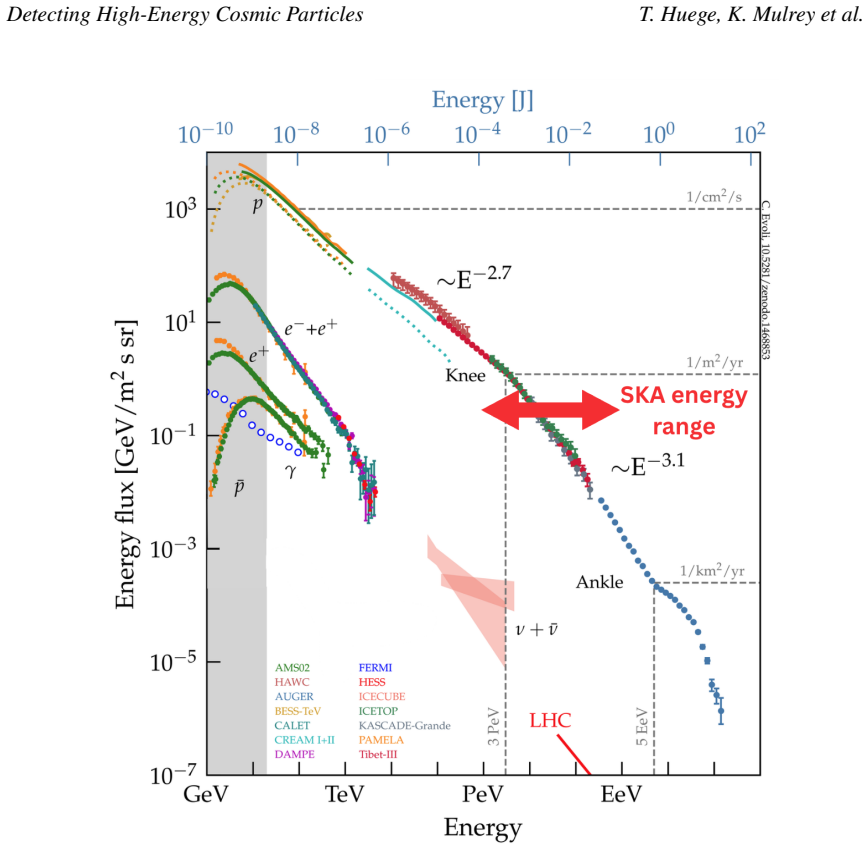
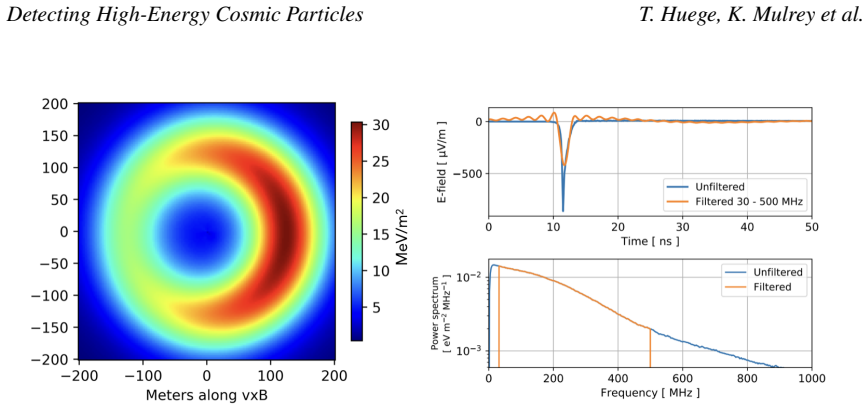
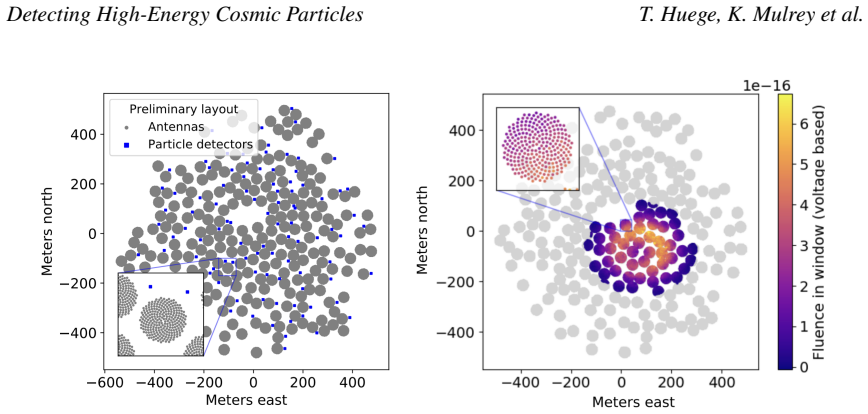
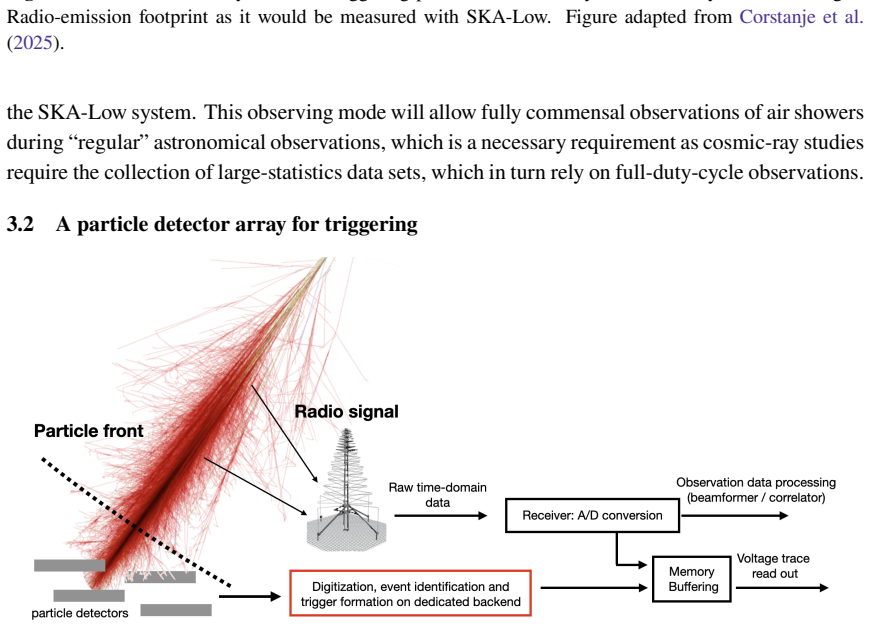
The origin of high-energy cosmic rays remain one of astrophysics' greatest unsolved mysteries. SKA-Low will be able to measure air showers initiated by cosmic rays with unprecedented precision in the PeV - EeV energy range, covering the critical transition region between Galactic and extragalactic sources. SKA-Low's densely instrumented core and broad bandwidth will allow for measurements of individual air showers with a level of detail unmatched by any existing or planned detector. The depth of shower maximum, the primary mass-sensitive observable, will be reconstructed with a resolution of better than 8~g/cm$^2$, a significant improvement over existing methods. Additionally, new reconstruction methods are expected to enable full air shower reconstruction across a wide energy range, down to PeV levels. At these energies, efficient photon/hadron separation may offer an opportunity to measure PeV gamma-ray air showers. Furthermore, SKA-Low opens a window into studying high-energy hadronic interactions, including via the unique channel of anomalous air showers. This combination of measurements provides a unique opportunity to investigate the origins and physics of high-energy cosmic rays. A dedicated particle detector array will provide triggered readout of raw antenna-level voltage buffers, enabling fully commensal cosmic-ray observations alongside regular operations. We outline our science case and discuss the observational strategy, signal properties and detector design underpinning these measurements. We also summarize the accompanying book chapters, which address composition measurements in the Galactic-to-extragalactic transition region, next-generation interferometric reconstruction techniques, hadronic interaction physics through anomalous air showers, the prospects for detecting PeV gamma-rays from Galactic sources, and the related project of imaging lightning using SKA-Low.
Editorial analysis
A structured set of objections, weighed in public.
Referee Report
Summary. The manuscript presents a science case for cosmic-ray air-shower observations with SKA-Low in the PeV–EeV range. It claims that the telescope’s dense core and bandwidth will enable unmatched detail on individual showers, including Xmax reconstruction to better than 8 g/cm², full shower reconstruction down to PeV energies, efficient photon/hadron separation, and studies of hadronic interactions via anomalous showers. The text outlines the observational strategy, signal properties, detector design, and summarizes accompanying book chapters on composition, interferometric methods, and related topics.
Significance. If the stated performance is achieved, the work would open a distinctive window on the Galactic-to-extragalactic transition with mass-sensitive observables at a precision not available to existing or planned arrays, while also providing new channels for hadronic-interaction tests and PeV gamma-ray searches.
major comments (2)
- [Abstract] Abstract: The headline claim that Xmax will be reconstructed with resolution better than 8 g/cm² is presented without any derivation, simulation results, error budget, or reference to the specific reconstruction algorithm or calibration requirements inside this manuscript. Because this number is load-bearing for the central assertion of “unmatched” precision, its basis must be supplied or explicitly cited.
- [Abstract] Abstract and § on detector design: The statements that “new reconstruction methods are expected to enable full air shower reconstruction across a wide energy range, down to PeV levels” and that “efficient photon/hadron separation may offer an opportunity” rest on design specifications and untested assumptions about real-data performance; no propagation of RFI, calibration, or bandwidth uncertainties is shown to support these expectations.
minor comments (1)
- [Abstract] The manuscript repeatedly uses future-tense phrasing (“will be able,” “will allow”) for performance claims; a short paragraph distinguishing design goals from demonstrated simulation results would improve clarity.
Simulated Author's Rebuttal
We thank the referee for the constructive comments, which help clarify the presentation of our science case. This manuscript is an overview that summarizes results from accompanying book chapters; we address the points below by adding explicit references and clarifications.
read point-by-point responses
-
Referee: [Abstract] Abstract: The headline claim that Xmax will be reconstructed with resolution better than 8 g/cm² is presented without any derivation, simulation results, error budget, or reference to the specific reconstruction algorithm or calibration requirements inside this manuscript. Because this number is load-bearing for the central assertion of “unmatched” precision, its basis must be supplied or explicitly cited.
Authors: We agree the basis must be supplied. The <8 g/cm² Xmax resolution is obtained from detailed Monte Carlo simulations and interferometric reconstruction algorithms described in the accompanying book chapters on composition measurements and next-generation interferometric reconstruction techniques. We will revise the abstract and introduction to include explicit citations to those chapters together with a short statement of the simulation framework and assumed calibration precision. revision: yes
-
Referee: [Abstract] Abstract and § on detector design: The statements that “new reconstruction methods are expected to enable full air shower reconstruction across a wide energy range, down to PeV levels” and that “efficient photon/hadron separation may offer an opportunity” rest on design specifications and untested assumptions about real-data performance; no propagation of RFI, calibration, or bandwidth uncertainties is shown to support these expectations.
Authors: These statements are prospective and rest on SKA-Low design specifications and preliminary simulations presented in the chapters on interferometric methods and PeV gamma-ray prospects. A complete propagation of RFI, calibration and bandwidth uncertainties is ongoing work and lies outside the scope of this overview paper. We will add a clarifying sentence noting the assumptions and directing readers to the detailed chapters for the underlying simulation studies. revision: partial
Circularity Check
No circularity: forward-looking science case with no derivations or self-referential fits
full rationale
The manuscript is a prospective science case paper. It states expected performance figures (e.g., Xmax resolution <8 g/cm²) as design goals based on SKA-Low specifications and external reconstruction techniques, without presenting equations, parameter fits, or derivations that could reduce to the paper's own inputs. No load-bearing steps invoke self-citations as uniqueness theorems or rename fitted quantities as predictions. The text is self-contained against external benchmarks and contains no internal derivation chain to inspect.
Axiom & Free-Parameter Ledger
axioms (1)
- domain assumption SKA-Low will achieve its specified sensitivity, bandwidth, and calibration performance in the relevant frequency range.
Reference graph
Works this paper leans on
-
[1]
2019 , eprint=
Anticipated Performance of the Square Kilometre Array -- Phase 1 (SKA1) , author=. 2019 , eprint=
2019
-
[2]
2015 , publisher=
Advancing Astrophysics with the Square Kilometre Array (AASKA14) , author=. 2015 , publisher=
2015
-
[3]
Carmelo Evoli , title =
-
[4]
Hillas, A. M. The Origin of Ultrahigh-Energy Cosmic Rays. Ann. Rev. Astron. Astrophys. 1984. doi:10.1146/annurev.aa.22.090184.002233
-
[5]
Radio detection of cosmic ray air showers in the digital era
Huege, T. Radio detection of cosmic ray air showers in the digital era. Phys. Rept. 2016. doi:10.1016/j.physrep.2016.02.001. arXiv:1601.07426
work page internal anchor Pith review Pith/arXiv arXiv doi:10.1016/j.physrep.2016.02.001 2016
-
[6]
van Haarlem, M. P. and others. LOFAR: The LOw-Frequency ARray. Astron. Astrophys. 2013. doi:10.1051/0004-6361/201220873. arXiv:1305.3550
work page internal anchor Pith review Pith/arXiv arXiv doi:10.1051/0004-6361/201220873 2013
-
[7]
Macroscopic Geo-Magnetic Radiation Model; Polarization effects and finite volume calculations
de Vries, Krijn D. and Scholten, Olaf and Werner, Klaus. Macroscopic Geo-Magnetic Radiation Model: Polarization effects and finite volume calculations. Nucl. Instrum. Meth. A. 2012. doi:10.1016/j.nima.2010.10.127. arXiv:1010.5364
work page internal anchor Pith review Pith/arXiv arXiv doi:10.1016/j.nima.2010.10.127 2012
-
[8]
Brancus, I. M. and others. The cosmic ray experiment KASCADE-Grande. Carpathian Summer School of Physics 2005: Exotic Nuclei and Nuclear / Particle Astrophysics. 2005. doi:10.1142/9789812772862_0028
-
[9]
The Pierre Auger Cosmic Ray Observatory
Aab, Alexander and others. The Pierre Auger Cosmic Ray Observatory. Nucl. Instrum. Meth. A. 2015. doi:10.1016/j.nima.2015.06.058. arXiv:1502.01323
work page internal anchor Pith review Pith/arXiv arXiv doi:10.1016/j.nima.2015.06.058 2015
-
[10]
The Muon Puzzle in cosmic-ray induced air showers and its connection to the Large Hadron Collider
Albrecht, Johannes and others. The Muon Puzzle in cosmic-ray induced air showers and its connection to the Large Hadron Collider. Astrophys. Space Sci. 2022. doi:10.1007/s10509-022-04054-5. arXiv:2105.06148
-
[11]
Precision measurements of cosmic ray air showers with the SKA
Huege, Tim and others. Precision measurements of cosmic ray air showers with the SKA. PoS. 2015. doi:10.22323/1.215.0148. arXiv:1408.5288
work page internal anchor Pith review Pith/arXiv arXiv doi:10.22323/1.215.0148 2015
-
[12]
High-precision measurements of extensive air showers with the SKA
Huege, Tim and others. High-precision measurements of extensive air showers with the SKA. PoS. 2016. doi:10.22323/1.236.0309. arXiv:1508.03465
work page internal anchor Pith review Pith/arXiv arXiv doi:10.22323/1.236.0309 2016
- [13]
-
[14]
Bray, J. D. and others. The SKA Particle Array Prototype: The First Particle Detector at the Murchison Radio-astronomy Observatory. Nucl. Instrum. Meth. A. 2020. doi:10.1016/j.nima.2020.164168. arXiv:2005.07273
-
[15]
Hare and others ,title =
Brian M. Hare and others ,title =. 2026 ,publisher =
2026
-
[16]
2026 ,publisher =
Stijn Buitink and Vital De Henau and others , title =. 2026 ,publisher =
2026
-
[17]
2026 ,publisher =
Keito Watanabe and Karen Terveer and others , title =. 2026 ,publisher =
2026
-
[18]
2026 , publisher =
Arthur Corstanje and Subhadip Saha and others , title =. 2026 , publisher =
2026
-
[19]
2026 , publisher =
Anna Nelles and Philipp Laub and Haoning He and others , title =. 2026 , publisher =
2026
-
[20]
D'Ettorre Piazzoli, Benedetto and Liu, Si-Ming and della Volpe, Domenico and Cao, Zhen and others , title =. Chinese Physics C , volume =. 2022 , publisher =. doi:10.1088/1674-1137/ac3faa , note =
-
[21]
Nuclear Instruments and Methods in Physics Research A , volume =
The. Nuclear Instruments and Methods in Physics Research A , volume =. 2015 , doi =
2015
-
[22]
and others , collaboration =
Abu-Zayyad, T. and others , collaboration =. The surface detector array of the. Nuclear Instruments and Methods in Physics Research A , volume =. 2012 , doi =
2012
-
[23]
and others , collaboration =
Tokuno, H. and others , collaboration =. New air fluorescence detectors employed in the. Nuclear Instruments and Methods in Physics Research A , volume =. 2012 , doi =
2012
-
[24]
Corstanje, A. and others. A high-precision interpolation method for pulsed radio signals from cosmic-ray air showers. JINST. 2023. doi:10.1088/1748-0221/18/09/P09005. arXiv:2306.13514
-
[25]
, title =
Schoorlemmer, H. , title =
-
[26]
de Vries, K. D. and Scholten, O. and Werner, K. , title =. Nuclear Instruments and Methods in Physics Research A , volume =. 2012 , doi =
2012
-
[27]
Corstanje, A. and others. LOFAR-style reconstruction of cosmic-ray air showers with SKA-Low. Phys. Rev. D. 2025. doi:10.1103/l8mt-994v. arXiv:2504.16873
-
[28]
Desmet, Mitja and Buitink, Stijn and Huege, Tim and Watanabe, Keito. SMIET: Fast and accurate synthesis of radio pulses from extensive air shower using simulated templates. Astropart. Phys. 2026. doi:10.1016/j.astropartphys.2025.103182. arXiv:2505.10459
-
[29]
Template synthesis approach for radio emission from extensive air showers
Desmet, Mitja and Buitink, Stijn and Butler, David and Huege, Tim and others. Template synthesis approach for radio emission from extensive air showers. PoS. 2023. doi:10.22323/1.424.0052. arXiv:2409.12782
-
[30]
J. R. Dwyer and M. A. Uman. Physics Reports. 2014. doi:10.1016/j.physrep.2013.09.004
-
[31]
Griffiths, R. F. and Phelps, C. T. , title =. Journal of Geophysical Research (1896-1977) , volume =. doi:https://doi.org/10.1029/JC081i021p03671 , abstract =
-
[32]
Trinh, T. N. G. and others , journal =. 2016 , publisher =
2016
-
[33]
and others , title =
Prosin, V.V. and others , title =. Nucl. Instrum. Meth. A , volume =. 2014 , doi =
2014
-
[34]
and Knapp, J
Heck, D. and Knapp, J. and Capdevielle, J.N. and Schatz, G. and Thouw, T. , title =
-
[35]
and Ludwig, M
Huege, T. and Ludwig, M. and James, C.W. , title =. AIP Conf. Proc. , volume =. 2013 , eprint =
2013
-
[36]
Carmelo Evoli , title =. 2018 , publisher =. doi:10.5281/zenodo.2360277 , url =
discussion (0)
Sign in with ORCID, Apple, or X to comment. Anyone can read and Pith papers without signing in.