REVIEW 4 major objections 6 minor 59 references
Federated Unlearning Over Wireless Networks
T0 review · 4 major / 6 minor · reviewed 2026-08-11 · deepseek-v4-flash
Pith's one-line read This paper shows that the delay of federated unlearning over wireless links can be minimized by jointly choosing bandwidth, transmit power, CPU frequency, and local accuracy, and it gives a polynomial-time algorithm that finds…
desk verdict A credible first physical-layer-aware resource allocation framework for federated unlearning, but the delay gains are analytical predictions under unverified convexity constants, so the paper needs referee scrutiny before the numbers are trusted. read the letter →
The pith
A machine-rendered reading of the paper's core claim, the machinery that carries it, and where it could break.
The reading
What carries the argument
The load-bearing object is the global-round bound $J(\eta)=\frac{a}{(\gamma-L\xi\beta)(\sqrt{\gamma}-\sqrt{\eta L})^2+(1-\eta)\gamma^2}$, with $a=\frac{2L^2\ln(1/\epsilon_0)}{\xi\beta}$, which states how many global calibration rounds are needed for the unlearning algorithm to reach the target accuracy $\epsilon_0$ when local problems are solved to accuracy $\eta$. That bound, combined with the local iteration count $v\log_2(1/\eta)$, yields the per-round computation time and energy, and with the robust transmission rate it yields the per-user delay $T_k$. The algorithmic machinery is the hierarchy of monotone searches that exploit this structure: a golden-section search finds the transmission time minimizing each user's total energy, a bisection finds the minimum bandwidth that keeps a user feasible, an outer bisection finds the minimal delay for fixed $\eta$, and a uniform scan over $\eta$ selects the best local accuracy. This decomposition is what turns the non-convex joint problem into a polynomial-logarithmic procedure $O\left(MK\log(1/\epsilon_T)\log(1/\epsilon_b)\log(1/\epsilon_t)\right)$.
What would settle it
Run the paper's unlearning procedure on the blog feedback dataset with its stated parameters, record the actual number of global calibration rounds needed to reach $\epsilon_0 = 10^{-3}$ for a grid of $\eta$ values, and compare with $J(\eta)$; if the measured round counts fall below the bound by a large margin or if the per-user total energy $E_{\mathrm{total}}(t)$ is not convex in $t$, then the predicted delay, the optimal allocation, and the claimed gain all shift.
Extended reading notes
Core claim
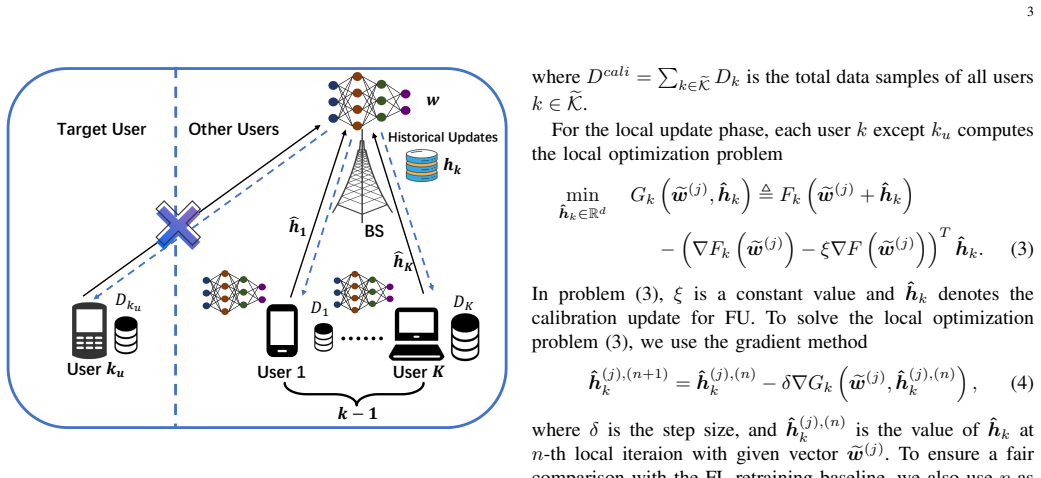
The paper's central claim is that federated unlearning delay over wireless networks can be minimized by jointly optimizing bandwidth, transmit power, CPU frequency, and local accuracy, and that the resulting non-convex problem decomposes into a hierarchy of monotone feasibility checks. Lemma 1 gives a closed-form lower bound $J(\eta)$ on the number of global calibration rounds as a function of local accuracy $\eta$, and Lemma 2 fixes the local iteration count; together they convert the unlearning process into a per-round cost that depends on $\eta$. The algorithm scans $\eta$ over a uniform grid, and for each $\eta$ uses bisection over the total delay $T$, bisection over each user's bandwidth, and a golden-section search over transmission time to find the minimum feasible delay. Numerical experiments on the blog feedback dataset report consistent reductions in completion time relative to equal-bandwidth, fixed-accuracy, and retraining baselines, with reductions around 10 percent at moderate power, bandwidth, and energy levels.
Load-bearing premise
The entire delay model assumes the number of calibration rounds is exactly the convergence bound $J(\eta)$, which requires the local loss functions to be $\gamma$-strongly convex and $L$-smooth with known $\gamma$ and $L$, and requires the historical-to-calibration update norms to fall within the known bounds $\alpha$ and $\beta$; the paper never measures these constants on the blog feedback dataset, and the monotonicity proof needed for the delay-bisection step is deferred to reference [56].
Editorial extensions
If this is right
- Wireless operators can compute near-optimal unlearning resource allocations in polynomial-logarithmic time, using only channel estimates, error bounds, and energy budgets.
- Joint tuning of communication and computation resources is the source of the gain: at moderate transmit power the proposed scheme is about 10.7 percent faster than retraining, 4.1 percent faster than equal-bandwidth allocation, and 5.0 percent faster than fixed-accuracy allocation.
- The optimal local accuracy is not a fixed constant: it shifts with channel and energy conditions, so a system that tunes it can outperform one that hard-codes it.
- The performance curves saturate at high power, bandwidth, and energy budgets, meaning the bottleneck moves from communication to computation; the algorithm still finds the best feasible point in that regime.
Reading between the lines
- Beyond the paper, the same decomposition should apply to other iterative calibration-based unlearning methods that share the convergence structure, not just the FedEraser/DANE combination used here.
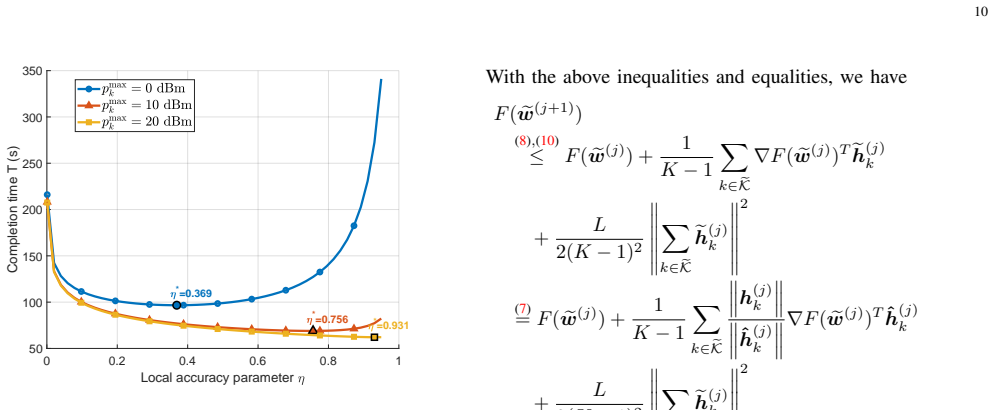
- The uniform grid over $\eta$ could likely be replaced by a golden-section or bisection search if the delay-versus-$\eta$ curve is unimodal; the paper's own Fig. 8 suggests such a shape but the paper does not claim it.
- A direct empirical test is to measure $\gamma$, $L$, $\alpha$, and $\beta$ on the blog feedback data; if those constants are estimated rather than assumed, the predicted $J(\eta)$ can be validated and the robustness claims made quantitative.
- Extending the model to multiple simultaneous unlearning requests, which the paper lists as future work, would change the bandwidth and energy coupling and is a natural test of the framework's scalability.
Signed reviews
Editorial analysis
A structured set of objections, weighed in public.
Referee Report
Summary. The paper studies delay minimization for federated unlearning (FU) over a wireless edge network, where the remaining clients calibrate the global model through a DANE-type algorithm while uploading updates under bounded CSI uncertainty. The authors derive a closed-form lower bound J(η) on the number of calibration rounds (Lemma 1), combine it with per-round computation and worst-case transmission models, and formulate a non-convex min-max delay problem. They propose an algorithm that scans the local accuracy parameter η on a grid and uses nested bisection and golden-section searches for per-user feasibility, minimum bandwidth, and minimum delay. Numerical results compare the proposed scheme with equal-bandwidth, fixed-accuracy, and retraining baselines.
Significance. The problem is timely and the decomposition strategy is well structured. The complexity analysis is transparent, and the paper identifies a relevant coupling between FU convergence rounds and wireless resource allocation. If the round bound J(η) were validated on an actual FU calibration run and the required constants were measured or certified, the framework would be a useful contribution to the emerging FU-over-wireless literature. The main weakness is that the numerical results currently validate the authors' analytical model rather than the underlying unlearning process, and the theorem's operating assumptions are not checked in simulation.
major comments (4)
- [Section IV and Lemma 1] Section IV sets δ=0.1 and ξ=0.1 but never reports γ, L, or β for the blog feedback dataset, and Lemma 1 (Eq. (11)) is valid only if γ−Lξβ>0 (Eq. (A.17)). Without these constants, the reader cannot check whether the simulated operating point lies in the theorem's valid regime. In addition, β in Eq. (9) is defined as max_{k,j} ||h_k^{(j)}||/||hat h_k^{(j)}||, which is an output of the FU calibration run rather than a known system parameter; the optimization therefore assumes a quantity that is not available before the allocation is executed. Please report measured constants (or a verifiable upper bound on β) and confirm the condition, or revise the convergence bound accordingly.
- [Eq. (18) and Section IV] Eq. (18) uses J(η) as the number of global rounds in the delay expression, but Lemma 1 gives only a sufficient round count for the required accuracy; the actual stopping time of Algorithm 1 may be smaller. More importantly, the simulations in Section IV compute T through the same analytical J(η) rather than running the federated unlearning calibration on the blog feedback data. The reported delay reductions therefore compare resource allocation schemes inside the authors' own model and are not an independently measured evaluation of the unlearning delay. An experiment that records the actual convergence of Algorithm 1 (or FedEraser) and compares the resulting delay against the optimized allocation is needed.
- [Lemma 1 / Eq. (A.17)] Lemma 1 states the condition as 0<ξ≤γ/(Lβ), but the proof at (A.17) requires γ−Lξβ>0. If equality holds, the coefficient in (A.18) is zero, the contraction bound collapses, and the exponential bound in (A.19) is invalid. The statement should use 0<ξ<γ/(Lβ), and the simulations must respect this strict inequality.
- [Section III-E, Eq. (29)] Algorithm 5 returns η* as the minimizer over a fixed grid of M points, not over the continuous interval [10^{-3}, 0.99]. The abstract and conclusion refer to 'optimal delay, bandwidth, power, and computation frequency' without this qualification. Please state that the result is grid-optimal or near-optimal, or provide an argument that the true optimum lies on the grid.
minor comments (6)
- [Problem (20)] Constraint (20d) sums b_k over k∈K, but the optimization variables exclude the leaving user k_u; the sum should be over the set \tilde K.
- [Algorithm 4] Line 1 of Algorithm 4 says to compute J(η) from Eq. (10); the correct reference is Eq. (11).
- [Fig. 8] The caption of Fig. 8 says 'Completion time versus maximum average transmit power of each user,' but the x-axis is the local accuracy parameter η; the caption should describe the plotted trade-off.
- [Algorithm 2] Line 8 of Algorithm 2 uses 0.382(b−a) and 0.618(b−a) with undefined a and b; the interval endpoints should be t_a and t_b.
- [Lemma 5] The proof of Lemma 5 is cited to 'Appendix E in [56]', which is a prior FL paper and not an FU setting; either give the direct proof (the same feasible tuple remains feasible for larger T) or remove the external citation.
- [Eq. (10)] The phrase 'L-Lipschitz continuous' in the sentence before Eq. (10) should be 'L-smooth (Lipschitz continuous gradient)', since the displayed condition is on the Hessian.
Circularity Check
Load-bearing monotonicity lemma is outsourced to the authors' own prior paper; the resource-allocation core is otherwise independent.
-
self citation load bearing
[Section III-D, Lemma 5 (proof deferred to [56])]
"Lemma 5: The feasibility of problem (20) exhibits a strict monotonic structure with respect to T. If problem (20) is feasible for a given T, then it remains feasible for any T′>T. Conversely, if it is infeasible for T, then it is also infeasible for any T′<T. Proof: See Appendix E in [56]."
Algorithm 4's bisection on T and hence Algorithm 5's claimed minimal delay rest entirely on Lemma 5. The lemma's proof is not given in the paper; it is imported from [56], a prior paper co-authored by Z. Yang and M. Chen, two of the present authors. No derivation is shown that the assumptions of Appendix E of [56] carry over to the FU-specific feasibility set with J(η), robust CSI constraints, and the energy budget constraints. At this load-bearing step, the optimality claim therefore reduces to a self-citation rather than to a proof contained in the present paper.
full rationale
The paper does not fit parameters to data: Lemma 1 is derived in Appendix A, and the simulation uses the same analytical J(η) that appears in the optimization, so the reported gains are model-based rather than empirically validated, but that is not circularity by construction. The only genuinely load-bearing self-citation is Lemma 5, whose proof is deferred to the authors' own prior work [56]; this lemma is what licenses the bisection over T and therefore the optimal delay returned by Algorithm 5. Because the proof is not reproduced or adapted to the FUN-specific constraints, the optimality claim partially rests on a self-citation. The unmeasured γ, L, and β constants, and the fact that β in Eq. (9) is defined over the FU calibration rounds, are correctness and reproducibility risks, but they do not make the derivation equivalent to its inputs. The resource-allocation and complexity results retain independent content, so a score of 4 is appropriate rather than 6 or higher.
Assumptions & free parameters
free parameters (6)
- beta (calibration ratio upper bound)
- gamma (strong convexity constant)
- L (Lipschitz constant)
- xi (regularization constant) =
0.1
- delta (local step size) =
0.1
- M (number of accuracy grid points) =
not specified
assumptions (5)
- domain assumption The local loss functions F_k are γ-strongly convex and L-smooth for all remaining users (Eq. 10).
- ad hoc to paper There exist positive α and β bounding the norm ratios ||h_k^(j)||/||ĥ_k^(j)|| for all k and j (Eq. 9).
- domain assumption Channel estimation errors are bounded by known constants ε_k (Eq. 14).
- domain assumption The convergence conditions ξ ≤ γ/(Lβ) and δ < 2/L hold.
- domain assumption Downlink broadcast time and energy are negligible, and the BS has stored all historical updates h_k^(j).
Cite this review
Pith. "Pith review of Federated Unlearning Over Wireless Networks." pith.science (2026). https://pith.science/paper/FV46E7ZY
@misc{pith2026260809090,
  author       = {Pith},
  title        = {Pith review of: Federated Unlearning Over Wireless Networks},
  year         = {2026},
  howpublished = {\url{https://pith.science/paper/FV46E7ZY}},
  note         = {Machine review of arXiv:2608.09090}
}
read the original abstract
To comply with stringent data privacy regulations, federated unlearning (FU) has emerged as a critical paradigm. However, its implementation over wireless networks introduces severe communication latency and reliability challenges due to iterative calibration requirements and physical-layer channel uncertainties. In this paper, we investigate the problem of delay minimization for federated unlearning networks (FUN). Specifically, we establish a comprehensive system model that jointly incorporates the convergence behavior of the FUN algorithm, local device computation dynamics, and a worst-case robust transmission model operating under bounded channel state information (CSI) error. To solve the resulting non-convex joint resource allocation problem, we propose an efficient iterative algorithm. By exploiting the monotonicity and convexity properties of the system constraints, the problem is decomposed via a uniform scan over the local accuracy parameter, within which the optimal delay, bandwidth, power, and computation frequency are determined utilizing nested bisection and golden-section searches. Both theoretical analysis and extensive numerical results demonstrate that the proposed algorithm achieves polynomial complexity and significantly reduces the overall unlearning completion time compared to conventional baseline schemes.
Figures


Figures from the paper (3 more)


Reference graph
Works this paper leans on
-
[56]
Energy efficient federated learning over wireless communication networks,
Z. Yang, M. Chen, W. Saad, C. S. Hong, and M. Shikh-Bahaei, “Energy efficient federated learning over wireless communication networks,” IEEE Trans. Wireless Commun., vol. 20, no. 3, pp. 1935–1949, Mar. 2021
work page 1935
-
[1]
A survey on federated learning: Challenges and applications,
J. Wen, Z. Zhang, Y . Lan, Z. Cui, J. Cai, and W. Zhang, “A survey on federated learning: Challenges and applications,”Int. J. Mach. Learn. Cybern., vol. 14, no. 2, pp. 513–535, 2023
work page 2023
-
[2]
Federated learning for Internet of Things: A comprehensive survey,
D. C. Nguyen, M. Ding, P. N. Pathirana, A. Seneviratne, J. Li, and H. V . Poor, “Federated learning for Internet of Things: A comprehensive survey,”IEEE Commun. Surv. Tutorials, vol. 23, no. 3, pp. 1622–1658, 2021
work page 2021
-
[3]
Decentralized federated learning: A survey and perspective,
L. Yuan, Z. Wang, L. Sun, P. S. Yu, and C. G. Brinton, “Decentralized federated learning: A survey and perspective,”IEEE Internet Things J., vol. 11, no. 21, pp. 34617–34638, 2024
work page 2024
-
[4]
Federated learning in mobile edge networks: A comprehensive survey,
W. Y . B. Lim, N. C. Luong, D. T. Hoang, Y . Jiao, Y .-C. Liang, Q. Yang, D. Niyato, and C. Miao, “Federated learning in mobile edge networks: A comprehensive survey,”IEEE Commun. Surv. Tutorials, vol. 22, no. 3, pp. 2031–2063, 2020
work page 2020
-
[5]
Advances and open problems in federated learning,
P. Kairouz, H. B. McMahan, B. Avent, A. Bellet, M. Bennis, A. N. Bhagoji, K. Bonawitz, Z. Charles, G. Cormode, R. Cummingset al., “Advances and open problems in federated learning,”F ound. Trends Mach. Learn., vol. 14, no. 1–2, pp. 1–210, 2021
work page 2021
-
[6]
Communication-efficient learning of deep networks from decentralized data,
B. McMahan, E. Moore, D. Ramage, S. Hampson, and B. A. y. Arcas, “Communication-efficient learning of deep networks from decentralized data,” inProc. AISTATS, 2017, pp. 1273–1282
work page 2017
-
[7]
Federated learning for mobile keyboard prediction,
A. Hard, K. Rao, R. Mathews, S. Ramaswamy, F. Beaufays, S. Augen- stein, H. Eichner, C. Kiddon, and D. Ramage, “Federated learning for mobile keyboard prediction,”arXiv preprint arXiv:1811.03604, 2019
arXiv 2019
Show all 59 references
-
[8]
Federated learning for healthcare applications,
A. Chaddad, Y . Wu, and C. Desrosiers, “Federated learning for healthcare applications,”IEEE Internet Things J., vol. 11, no. 5, pp. 7339–7358, 2024
2024
-
[9]
Federated learning for predicting clinical outcomes in patients with COVID-19,
I. Dayanet al., “Federated learning for predicting clinical outcomes in patients with COVID-19,”Nat. Med., vol. 27, no. 10, pp. 1735–1743, 2021
2021
-
[10]
Federated learning for open banking,
G. Long, Y . Tan, J. Jiang, and C. Zhang, “Federated learning for open banking,” inFederated Learning. Springer, 2020, pp. 240–254
2020
-
[11]
An efficient and reliable asynchronous federated learning scheme for smart public transportation,
C. Xu, Y . Qu, T. H. Luan, P. W. Eklund, Y . Xiang, and L. Gao, “An efficient and reliable asynchronous federated learning scheme for smart public transportation,”IEEE Trans. V eh. Technol., vol. 72, no. 5, pp. 6584–6598, 2023
2023
-
[12]
Custers, A
B. Custers, A. M. Sears, F. Dechesne, I. Georgieva, T. Tani, and S. van der Hof,EU Personal Data Protection in Policy and Practice. T.M.C. Asser Press, 2019
2019
-
[13]
Artificial Intelligence Risk Management Framework (AI RMF 1.0),
E. Tabassi, “Artificial Intelligence Risk Management Framework (AI RMF 1.0),” 2023
2023
-
[14]
The EU Artificial Intelligence Act,
EU AI Act, “The EU Artificial Intelligence Act,” 2024
2024
-
[15]
Towards making systems forget with machine unlearning,
Y . Cao and J. Yang, “Towards making systems forget with machine unlearning,” inProc. IEEE Symp. Security Privacy, 2015, pp. 463–480
2015
-
[16]
Machine unlearning,
L. Bourtoule, V . Chandrasekaran, C. A. Choquette-Choo, H. Jia, A. Travers, B. Zhang, D. Lie, and N. Papernot, “Machine unlearning,” in Proc. IEEE Symp. Security Privacy, 2021, pp. 141–159
2021
-
[17]
Exploring the landscape of machine unlearning: A comprehensive survey and taxonomy,
T. Shaik, X. Tao, H. Xie, L. Li, X. Zhu, and Q. Li, “Exploring the landscape of machine unlearning: A comprehensive survey and taxonomy,”IEEE Trans. Neural Netw. Learn. Syst., vol. 36, no. 7, pp. 11676–11696, 2025
2025
-
[18]
Threats, attacks, and defenses in machine unlearning: A survey,
Z. Liu, H. Ye, C. Chen, Y . Zheng, and K.-Y . Lam, “Threats, attacks, and defenses in machine unlearning: A survey,”IEEE Open J. Comput. Soc., vol. 6, pp. 413–425, 2025
2025
-
[19]
Machine unlearning: Taxonomy, metrics, applications, challenges, and prospects,
N. Li, C. Zhou, Y . Gao, H. Chen, Z. Zhang, B. Kuang, and A. Fu, “Machine unlearning: Taxonomy, metrics, applications, challenges, and prospects,”IEEE Trans. Neural Netw. Learn. Syst., vol. 36, no. 8, pp. 13709–13729, 2025
2025
-
[20]
Federated unlearning and its privacy threats,
F. Wang, B. Li, and B. Li, “Federated unlearning and its privacy threats,” IEEE Network, vol. 38, no. 2, pp. 294–300, 2024
2024
-
[21]
Emerging challenges and future directions in federated unlearning,
G. Brahmani, K. Haritha, M. Bhuvaneswari, M. Bharathi, and T. A. S. Srinivas, “Emerging challenges and future directions in federated unlearning,”J. Comput. Syst. Virtualization Lang., vol. 1, pp. 7–14, Dec. 2024. 13
2024
-
[22]
Toward verifiable federated unlearning: Framework, challenges, and the road ahead,
T. L. Nguyen, M. T. de Oliveira, A. Braeken, A. Y . Ding, and Q.-V . Pham, “Toward verifiable federated unlearning: Framework, challenges, and the road ahead,”IEEE Internet Comput., vol. 30, no. 1, pp. 60-70, 2026
2026
-
[23]
Machine unlearning for random forests,
J. Brophy and D. Lowd, “Machine unlearning for random forests,” in Proc. ICML, 2021, pp. 1092–1104
2021
-
[24]
DeltaGrad: Rapid retraining of machine learning models,
Y . Wu, E. Dobriban, and S. Davidson, “DeltaGrad: Rapid retraining of machine learning models,” inProc. ICML, 2020, pp. 10355–10366
2020
-
[25]
Exact-Fun: An exact and efficient federated unlearning approach,
Z. Xiong, W. Li, Y . Li, and Z. Cai, “Exact-Fun: An exact and efficient federated unlearning approach,” inProc. ICDM, 2023, pp. 1439–1444
2023
-
[26]
Fast yet effective machine unlearning,
A. K. Tarun, V . S. Chundawat, M. Mandal, and M. Kankanhalli, “Fast yet effective machine unlearning,”IEEE Trans. Neural Netw. Learn. Syst., vol. 35, no. 9, pp. 13046–13055, 2024
2024
-
[27]
Fast federated machine unlearning with nonlinear functional theory,
T. Che, Y . Zhou, Z. Zhang, L. Lyu, J. Liu, D. Yan, D. Dou, and J. Huan, “Fast federated machine unlearning with nonlinear functional theory,” in Proc. ICML, 2023, vol. 202, pp. 4241–4268
2023
-
[28]
Federated unlearning with knowledge distillation,
C. Wu, S. Zhu, and P. Mitra, “Federated unlearning with knowledge distillation,”arXiv preprint arXiv:2201.09441, 2022
2022 arXiv
-
[29]
Federated unlearning for on-device recommendation,
W. Yuan, H. Yin, F. Wu, S. Zhang, T. He, and H. Wang, “Federated unlearning for on-device recommendation,” inProc. WSDM, 2023, pp. 393–401
2023
-
[30]
Heterogeneous federated knowledge graph embedding learning and unlearning,
X. Zhu, G. Li, and W. Hu, “Heterogeneous federated knowledge graph embedding learning and unlearning,” inProc. WWW, 2023, pp. 2444–2454
2023
-
[31]
Certified data removal from machine learning models,
C. Guo, T. Goldstein, A. Hannun, and L. Van Der Maaten, “Certified data removal from machine learning models,” inProc. ICML, 2020, pp. 3832–3842
2020
-
[32]
Eternal sunshine of the spotless net: Selective forgetting in deep networks,
A. Golatkar, A. Achille, and S. Soatto, “Eternal sunshine of the spotless net: Selective forgetting in deep networks,” inProc. CVPR, 2020
2020
-
[33]
FedEraser: Enabling efficient client-level data removal from federated learning models,
G. Liu, X. Ma, Y . Yang, C. Wang, and J. Liu, “FedEraser: Enabling efficient client-level data removal from federated learning models,” in Proc. IWQoS, 2021, pp. 1–10
2021
-
[34]
The right to be forgotten in federated learning: An efficient realization with rapid retraining,
Y . Liu, L. Xu, X. Yuan, C. Wang, and B. Li, “The right to be forgotten in federated learning: An efficient realization with rapid retraining,” in Proc. INFOCOM, 2022, pp. 1749–1758
2022
-
[35]
Federated unlearning via class- discriminative pruning,
J. Wang, S. Guo, X. Xie, and H. Qi, “Federated unlearning via class- discriminative pruning,” inProc. WWW, 2022, pp. 622–632
2022
-
[36]
Federated unlearning with momentum degradation,
Y . Zhao, P. Wang, H. Qi, J. Huang, Z. Wei, and Q. Zhang, “Federated unlearning with momentum degradation,”IEEE Internet Things J., vol. 11, no. 5, pp. 8860–8870, 2024
2024
-
[37]
FU-PA: Federated unlearning via parameters adjustment,
W. Zeng, S. Chen, X. Li, and S. Chen, “FU-PA: Federated unlearning via parameters adjustment,”IEEE Trans. Emerg. Top. Comput. Intell., 2025
2025
-
[38]
NoT: Federated unlearning via weight negation,
Y . H. Khalil, L. Brunswic, S. Lamghari, X. Li, M. Beitollahi, and X. Chen, “NoT: Federated unlearning via weight negation,” inProc. CVPR, 2025, pp. 25759–25769
2025
-
[39]
FedWiper: Federated unlearning via universal adapter,
S. Zhao, J. Zhang, X. Ma, Q. Jiang, Z. Ma, S. Gao, Z. Ying, and J. Ma, “FedWiper: Federated unlearning via universal adapter,”IEEE Trans. Inf. F orensics Security, 2025
2025
-
[40]
Asynchronous federated unlearning,
N. Su and B. Li, “Asynchronous federated unlearning,” inProc. INFO- COM, 2023, pp. 1–10
2023
-
[41]
Com- munication efficient and provable federated unlearning,
Y . Tao, C.-L. Wang, M. Pan, D. Yu, X. Cheng, and D. Wang, “Com- munication efficient and provable federated unlearning,”Proc. VLDB Endow., vol. 17, pp. 1119–1131, Jan. 2024
2024
-
[42]
Forgettable federated linear learning with certified data unlearning,
R. Jin, M. Chen, Q. Zhang, and X. Li, “Forgettable federated linear learning with certified data unlearning,” 2024
2024
-
[43]
SIFU: Sequential informed federated unlearning for efficient and provable client unlearning,
Y . Fraboni, M. Van Waerebeke, K. Scaman, R. Vidal, L. Kameni, and M. Lorenzi, “SIFU: Sequential informed federated unlearning for efficient and provable client unlearning,” inProc. AISTATS, 2024, pp. 3457–3465
2024
-
[44]
Client-free federated unlearning via training reconstruction with anchor subspace calibration,
C. Fu, W. Jia, and N. Ruan, “Client-free federated unlearning via training reconstruction with anchor subspace calibration,” inProc. ICASSP, 2024, pp. 9281–9285
2024
-
[45]
Forget-SVGD: Particle- based Bayesian federated unlearning,
J. Gong, J. Kang, O. Simeone, and R. Kassab, “Forget-SVGD: Particle- based Bayesian federated unlearning,” inProc. DSLW, 2022, pp. 1–6
2022
-
[46]
QuickDrop: Efficient federated unlearning via synthetic data generation,
A. Dhasade, Y . Ding, S. Guo, A.-M. Kermarrec, M. de V os, and L. Wu, “QuickDrop: Efficient federated unlearning via synthetic data generation,” inProc. Middleware, 2024, pp. 266–278
2024
-
[47]
FedCIO: Efficient exact federated unlearning with clustering, isolation, and one-shot aggrega- tion,
H. Qiu, Y . Wang, Y . Xu, L. Cui, and Z. Shen, “FedCIO: Efficient exact federated unlearning with clustering, isolation, and one-shot aggrega- tion,” inProc. IEEE BigData, 2023, pp. 5559–5568
2023
-
[48]
A survey on federated unlearning: Challenges, methods, and future directions,
Z. Liu, Y . Jiang, J. Shen, M. Peng, K.-Y . Lam, X. Yuan, and X. Liu, “A survey on federated unlearning: Challenges, methods, and future directions,”ACM Comput. Surv., vol. 57, Oct. 2024
2024
-
[49]
Federated unlearning: A survey on methods, design guidelines, and evaluation metrics,
N. Romandini, A. Mora, C. Mazzocca, R. Montanari, and P. Bellavista, “Federated unlearning: A survey on methods, design guidelines, and evaluation metrics,”IEEE Trans. Neural Netw. Learn. Syst., vol. 36, no. 7, pp. 11697–11717, 2025
2025
-
[50]
SoK: Federated learning and unlearning for medical image analysis,
K. ElBedoui, W. Barhoumi, and J. Cho, “SoK: Federated learning and unlearning for medical image analysis,”Expert Syst., vol. 42, no. 6, p. e70063, 2025
2025
-
[51]
Exploring federated unlearning: Review, comparison, and insights,
Y . Zhao, J. Yang, Y . Tao, L. Wang, X. Li, D. Niyato, and H. V . Poor, “Exploring federated unlearning: Review, comparison, and insights,” arXiv preprint arXiv:2310.19218, 2025
2025 arXiv
-
[52]
Com- munication efficient and provable federated unlearning,
Y . Tao, C.-L. Wang, M. Pan, D. Yu, X. Cheng, and D. Wang, “Com- munication efficient and provable federated unlearning,”Proc. VLDB Endow., vol. 17, no. 5, pp. 1119–1131, Jan. 2024
2024
-
[53]
Compressed particle-based federated Bayesian learning and unlearning,
J. Gong, O. Simeone, and J. Kang, “Compressed particle-based federated Bayesian learning and unlearning,”IEEE Commun. Lett., vol. 27, no. 2, pp. 556–560, Feb. 2023
2023
-
[54]
Incentive and dynamic client selection for federated unlearning,
Y . Lin, Z. Gao, H. Du, D. Niyato, J. Kang, and X. Liu, “Incentive and dynamic client selection for federated unlearning,” inProc. ACM Web Conf. (WWW), Singapore, May 2024, pp. 2936–2944
2024
-
[55]
Hier- FUN: Hierarchical federated learning and unlearning in heterogeneous edge computing,
Z. Ma, H. Tu, L. Zhou, X. Yan, H. Xu, Z. Wang, and S. Chen, “Hier- FUN: Hierarchical federated learning and unlearning in heterogeneous edge computing,”IEEE Internet Things J., vol. 12, no. 7, pp. 8653–8668, Apr. 2025
2025
-
[57]
Dynamic computation offloading for mobile-edge computing with energy harvesting devices,
M. Sheng, D. Yue, Y . Dai, and X. Lu, “Dynamic computation offloading for mobile-edge computing with energy harvesting devices,”IEEE Wireless Commun. Lett., vol. 5, no. 4, pp. 368–371, Aug. 2016
2016
-
[58]
Robust resource allocation for secrecy wireless powered communication networks,
Y . Wu, X. Chen, C. Yuen, and C. Zhong, “Robust resource allocation for secrecy wireless powered communication networks,” inIEEE Com- munications Letters, vol. 20, no. 12, pp. 2430–2433, Dec. 2016
2016
-
[59]
Feedback prediction for blogs,
K. Buza, “Feedback prediction for blogs,” inProc. Data Anal., Mach. Learn. Knowl. Discovery, Cham, Switzerland: Springer, 2014, pp. 145–152
2014
Reviewed August 11, 2026 · model on record in the stance chip above.
Discussion (0). Continue with ORCID to comment.