Experimental Investigation of Surface Passivation Chemistries for Optical Nanotweezers
Pith reviewed 2026-06-26 15:53 UTC · model grok-4.3
The pith
Poly(sodium styrene sulphate) exhibits better anti-fouling than MUA against polystyrene nanoparticles in nanotweezers.
A machine-rendered reading of the paper's core claim, the machinery that carries it, and where it could break.
Core claim
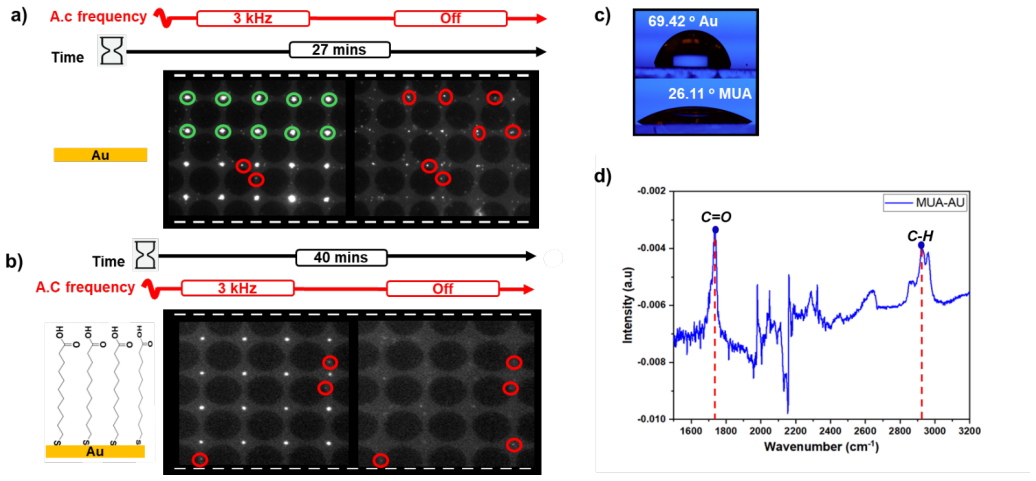
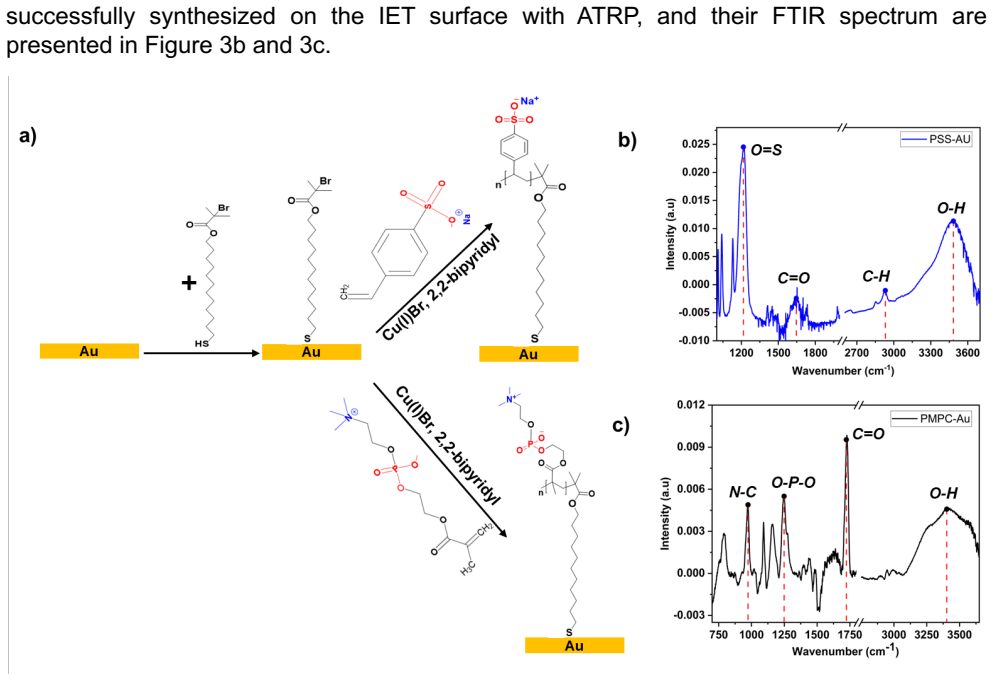
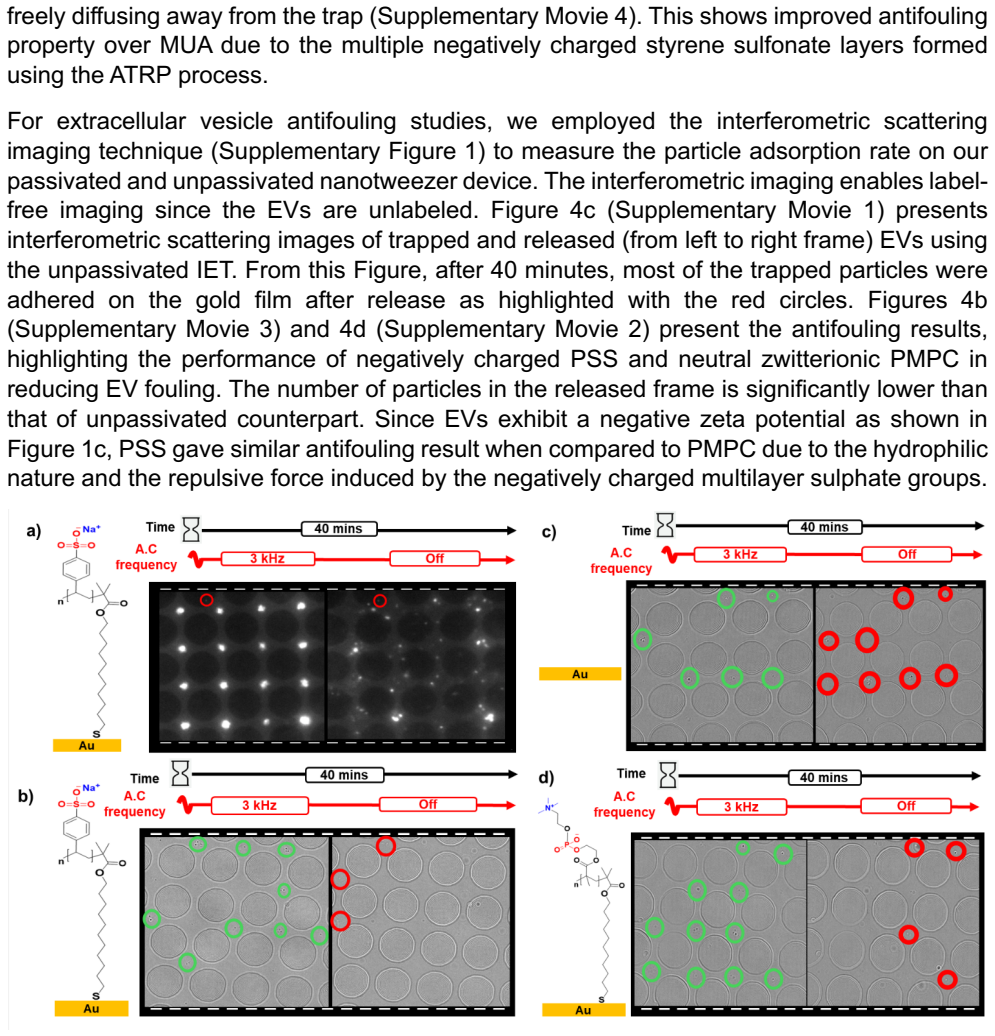
The results show that PSS exhibits superior anti-fouling performance against polystyrene nanoparticles when compared to 11-mercaptoundecanoic acid. By comparing the antifouling properties of PSS and zwitterionic poly(methacryloyloxyethyl phosphorylcholine) in preventing extracellular vesicle adhesion, we found that both exhibited similar performance. Overall, the ATRP technique is broadly applicable across nanotweezer substrates with appropriately chosen initiators.
What carries the argument
Surface passivation layer of poly(sodium styrene sulphate) grown by atom transfer radical polymerization on the interferometric electrohydrodynamic tweezers, monitored for adhesion via fluorescence and ISCAT imaging.
If this is right
- PSS enables more reliable reversible trapping and release of polystyrene nanoparticles than MUA.
- PSS and PMPC offer comparable protection against extracellular vesicle adhesion on the device surface.
- ATRP-based passivation can be transferred to other nanotweezer substrates by selecting compatible initiators.
Where Pith is reading between the lines
- These passivation layers could extend device usability in longer biological experiments by reducing surface contamination over time.
- The imaging methods used here could be combined with automated feedback to adjust trapping parameters in real time.
- Similar chemistries might be tested on non-gold substrates to broaden the range of compatible nanotweezer designs.
Load-bearing premise
Observed differences in trapping performance and particle adhesion arise from the passivation chemistry itself rather than from variations in device fabrication, imaging conditions, or nanoparticle preparation.
What would settle it
Recording equivalent fouling rates and trapping behavior when the same passivation chemistry is applied but fabrication batches or imaging parameters are deliberately varied.
Figures
read the original abstract
Nanotweezers are actively investigated as a powerful means to reversibly trap and characterize nanoparticles with profound biological and environmental importance. To ensure that these particles can be reversibly trapped and released, surface passivation is essential. To mitigate the issue of fouling, we investigated the antifouling properties of poly(sodium styrene sulphate) (PSS) synthesized using the Atom Transfer Radical Polymerization (ATRP) technique on our previously reported gold-based Interferometric Electrohydrodynamic Tweezers (IET) device. Fluorescence and interferometric scattering (ISCAT) imaging were used to record trapping performance and study the antifouling properties of our passivated nanotweezer device. The results show that PSS exhibits superior anti-fouling performance against polystyrene nanoparticles when compared to 11-mercaptoundecanoic acid (MUA). By comparing the antifouling properties of PSS and zwitterionic poly(methacryloyloxyethyl phosphorylcholine) (PMPC) in preventing extracellular vesicle adhesion, we found that both exhibited similar performance. Overall, the ATRP technique is broadly applicable across nanotweezer substrates with appropriately chosen initiators.
Editorial analysis
A structured set of objections, weighed in public.
Referee Report
Summary. The manuscript experimentally investigates surface passivation chemistries for gold-based Interferometric Electrohydrodynamic Tweezers (IET) nanotweezers. It synthesizes poly(sodium styrene sulphate) (PSS) via Atom Transfer Radical Polymerization (ATRP) and compares its anti-fouling performance against 11-mercaptoundecanoic acid (MUA) for polystyrene nanoparticles and against zwitterionic poly(methacryloyloxyethyl phosphorylcholine) (PMPC) for extracellular vesicles, using fluorescence and interferometric scattering (ISCAT) imaging to assess trapping and adhesion.
Significance. If the central experimental claims hold after addressing controls and quantification, the work would provide practical guidance on passivation strategies that reduce fouling in optical nanotweezers, enabling more reliable reversible trapping of biologically relevant nanoparticles. The use of ATRP on existing IET substrates is a straightforward extension that could be broadly applicable if the performance differences are robustly demonstrated.
major comments (3)
- [Abstract] Abstract: The central comparative claims (PSS superior to MUA; PSS equivalent to PMPC) are stated without any quantitative metrics, error bars, sample sizes, number of independent devices, or statistical analysis, preventing assessment of whether observed differences exceed device-to-device or run-to-run variation.
- [Abstract] Experimental design (implied in Abstract and Methods): The attribution of anti-fouling differences directly to passivation chemistry (PSS vs MUA) is load-bearing for the main claim, yet no information is given on controls for confounders such as gold substrate roughness, ATRP grafting uniformity, nanoparticle batch variation, or whether the same physical device was re-functionalized across chemistries; without this, the performance gap cannot be securely assigned to surface chemistry.
- [Abstract] Results (implied): The equivalence claim between PSS and PMPC for extracellular vesicle adhesion similarly lacks reported metrics or controls for imaging condition variations between fluorescence and ISCAT modalities.
Simulated Author's Rebuttal
We thank the referee for their constructive comments, which highlight opportunities to strengthen the clarity and robustness of our claims. We address each major point below and will revise the manuscript accordingly.
read point-by-point responses
-
Referee: [Abstract] Abstract: The central comparative claims (PSS superior to MUA; PSS equivalent to PMPC) are stated without any quantitative metrics, error bars, sample sizes, number of independent devices, or statistical analysis, preventing assessment of whether observed differences exceed device-to-device or run-to-run variation.
Authors: We agree that the abstract would benefit from quantitative support. In revision we will add specific metrics (e.g., mean adhesion fractions with standard deviations), sample sizes, number of independent devices, and any statistical tests performed for both the PSS–MUA and PSS–PMPC comparisons. revision: yes
-
Referee: [Abstract] Experimental design (implied in Abstract and Methods): The attribution of anti-fouling differences directly to passivation chemistry (PSS vs MUA) is load-bearing for the main claim, yet no information is given on controls for confounders such as gold substrate roughness, ATRP grafting uniformity, nanoparticle batch variation, or whether the same physical device was re-functionalized across chemistries; without this, the performance gap cannot be securely assigned to surface chemistry.
Authors: We acknowledge that explicit discussion of these controls is currently absent. Our protocol used matched substrate batches and the same nanoparticle stocks for paired comparisons; we will expand the Methods section to report AFM roughness data, grafting-density estimates (XPS/ellipsometry), batch details, and whether devices were reused or prepared in parallel. If any control was not performed, we will state this limitation transparently. revision: partial
-
Referee: [Abstract] Results (implied): The equivalence claim between PSS and PMPC for extracellular vesicle adhesion similarly lacks reported metrics or controls for imaging condition variations between fluorescence and ISCAT modalities.
Authors: We will revise both the abstract and main text to include quantitative metrics (adhesion rates, error bars, replicate counts) for the PSS–PMPC comparison. We will also add a brief description of imaging parameters and any cross-modality normalization or controls used to support the equivalence statement. revision: yes
Circularity Check
No circularity: experimental comparisons rest on direct imaging data
full rationale
The paper reports experimental measurements of particle adhesion via fluorescence and ISCAT imaging on devices passivated with PSS, MUA, and PMPC. No equations, models, or predictions are presented that reduce any result to fitted inputs or prior self-citations by construction. The reference to the authors' earlier IET device is purely contextual and does not carry the central claims about relative antifouling performance. The work is self-contained against external benchmarks (imaging of adhesion events) with no load-bearing self-citation chain or self-definitional steps.
Axiom & Free-Parameter Ledger
Reference graph
Works this paper leans on
-
[1]
Effect of surfactants on the binding properties of a molecularly imprinted polymer
Hong, I., Hong, C., Anyika, T., Zhu, G., Ugwu, M., Higginbotham, J. N., ... & Ndukaife, J. C. Rapid trapping and label-free optical characterization of single nanoscale extracellular vesicles and nanoparticles in solution. Light: Science & Applications, 2023 15(1), 180. 13. Testa, Valentina, et al. "Effect of surfactants on the binding properties of a mol...
2023
-
[2]
G., Ostuni, E., Takayama, S., Holmlin, R
Chapman, R. G., Ostuni, E., Takayama, S., Holmlin, R. E., Yan, L., & Whitesides, G. M. Surveying for surfaces that resist the adsorption of proteins. Journal of the American Chemical Society 2000, 122(34), 8303-8304. 24. Herrwerth, S., Eck, W., Reinhardt, S., & Grunze, M. Factors that determine the protein resistance of oligoether self-assembled monolayer...
2000
-
[3]
F., Grams, E
Feyzizarnagh, H., Haushalter, E. F., Grams, E. K., Cameron, B. D., Yoon, D. Y., & Kim, D. S. Protein sensing with aptamer immobilized on an antifouling binary self-assembled monolayer. Industrial & Engineering Chemistry Research 2015, 54(16), 4072-4077. 34. Lukose, J., Shetty, V., Ballal, M., Chidangil, S., & Sinha, R. K. Real-time and rapid detection of ...
2015
discussion (0)
Sign in with ORCID, Apple, or X to comment. Anyone can read and Pith papers without signing in.