REVIEW 4 major objections 7 minor 1 cited by
Time2Lang: Bridging Time-Series Foundation Models and Large Language Models for Health Sensing Beyond Prompting
T0 review · 4 major / 7 minor · reviewed 2026-08-08 · deepseek-v4-flash
Pith's one-line read Time2Lang claims a small adapter can translate frozen time-series model features into a frozen LLM's embedding space, replacing text prompting for mental-health sensing and keeping inference time constant.
desk verdict Solid adapter engineering and honest ablations, but the LLM's contribution is unproven and the gains over Chronos are within noise. read the letter →
The pith
A machine-rendered reading of the paper's core claim, the machinery that carries it, and where it could break.
The reading
What carries the argument
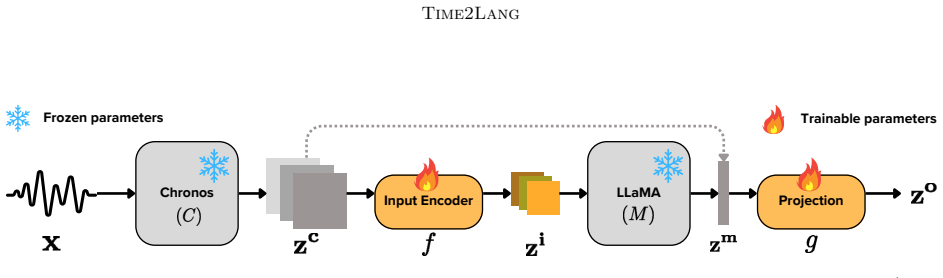
The load-bearing piece is the adapter pair (f, g): a 1D ResNet-style input encoder f that compresses Chronos's fixed-size features and injects them into LLaMA's input embedding layer, plus a two-layer projection g that maps the mean-pooled LLM output back to a task representation, with a residual connection from Chronos features used only during training. The pretext objective is a six-class periodicity classification on synthetic Gaussian-process time series built from composed kernels with an exponential sine-squared periodic component; this single self-supervised task is what teaches the LLM to interpret TFM features. At evaluation the residual is removed, so downstream performance depends entirely on what the LLM has learned through the adapter.
What would settle it
Run Time2Lang on a real longitudinal sensor dataset whose signals are non-periodic or heavily missing, such as event-driven phone logs, with the residual connection removed at evaluation; if downstream AUROC falls to the Chronos+LLaMA no-mapping baseline, that would show the periodicity pretext does not generalize and that the reported gains depend on the residual.
Extended reading notes
Core claim
The paper's central claim is that two frozen foundation models can be bridged by a lightweight adapter that maps Chronos features into LLaMA's embedding layer, bypassing tokenization, and that this bridge preserves enough temporal information to support downstream classification. Training the adapter to classify synthetic signals by their periodicity teaches it to align the two embedding spaces; after training, the residual connection from Chronos is removed and the penultimate-layer embedding is used to train a simple logistic regression or random forest classifier. Time2Lang reports AUROC/AUPRC of 0.57/0.73 for depression and 0.71/0.74 for flourishing, matching or slightly exceeding Chronos and outperforming prompting approaches, and the LLM outputs correlate with the autocorrelation function of the original signals.
Load-bearing premise
The load-bearing premise is that training the adapter to predict exact periodicity on synthetic, noise-free repeated patterns transfers to real-world longitudinal health data with missingness, noise, and no exact periodicity; if the pretext does not align the two embedding spaces, removing the residual connection would leave the downstream classifier with little usable signal.
Editorial extensions
If this is right
- Text prompting becomes unnecessary for long sensor streams: Time2Lang feeds fixed-size embeddings into the LLM, avoiding both the token explosion and the accuracy drop that come from serializing thousands of numeric values.
- Inference time stays nearly constant from 256 to 4096 input points, whereas LLaMA prompting grows roughly linearly, which makes the approach viable for continuous wearable monitoring.
- The synthetic periodicity pretext transfers to real longitudinal data, and the resulting embeddings retain autocorrelation structure, so the LLM output is not just a compressed copy of the input.
- Because only the adapters are trained (about 0.03% and 0.17% of LLaMA's parameters) and both foundation models stay frozen, the framework can be re-applied to new tasks and larger models without retraining the large networks.
Reading between the lines
- A natural stress test is to replace the periodicity pretext with a different self-supervised objective, such as forecasting or contrastive alignment, and see whether downstream health classification changes; the paper only tests periodicity, so the necessity of that particular task is not established.
- The residual connection is removed at evaluation, meaning the reported gains are attributed entirely to the distilled LLM embeddings; an ablation that freezes or permutes LLaMA's weights while keeping f and g would quantify how much the language model itself contributes versus the adapter's compression.
- The same reprogramming recipe could generalize to other sensor modalities and LLMs, since only f and g need to be retrained; the paper's own results with Gemma and OLMo suggest compatibility is not automatic, so encoder-LLM pairing deserves systematic study.
- If the transfer holds across populations and devices, this would reduce the domain-expertise barrier to building LLM-based health monitors, since no prompt engineering or text conversion step is required.
Editorial analysis
A structured set of objections, weighed in public.
Referee Report
Summary. The paper proposes Time2Lang, a framework that trains a lightweight adapter (an input encoder f and a projection g) to map frozen Chronos time-series embeddings into frozen LLaMA embeddings, using a self-supervised pretext task of periodicity prediction on synthetic Gaussian-process data. Downstream, the LLM's output embedding—with the residual connection from Chronos removed—is used to train logistic regression or random forest classifiers for two mental-health sensing tasks: daily depression prediction from step counts (17,251 person-days from 256 participants) and flourishing classification from conversation duration (46 students over 10 weeks). The authors report marginal AUROC/AUPRC improvements over the Chronos baseline, large improvements over text-prompting baselines, near-constant inference time across input lengths, and positive correlations between the learned embeddings and the autocorrelation function of the input time series.
Significance. The idea of bypassing text conversion and reprogramming a frozen LLM with a frozen time-series foundation model via a small trainable adapter is timely and potentially valuable for long health-sensing time series. Strengths of the manuscript include a clearly described pipeline, code availability for the public StudentLife dataset, evaluation on two real longitudinal datasets, a thoughtful efficiency analysis, and ablations over pretraining scale, periodicity classes, architectural choices, and LLM backbones. The ACF-embedding case study is a useful post-hoc diagnostic. However, the significance is conditional: the manuscript does not demonstrate that the frozen LLaMA contributes beyond the trainable f/g projection, and most performance differences are within one standard deviation of the baselines. If the missing control experiments establish the LLM's role, the framework would be a solid contribution; without them, the claims of 'bridging TFMs and LLMs' are not yet supported.
major comments (4)
- [4.2, Table 1] The baseline set lacks a control where the frozen LLaMA is replaced by an equivalent-capacity non-LLM transformation (e.g., identity, a frozen random MLP, or a trainable MLP) while f, g, the periodicity pretext, and the downstream probe are held fixed. Without this control, the reported gains over Chronos—depression AUROC 0.57 vs 0.56 with SD 0.01, flourishing AUROC 0.71 vs 0.70 with SD 0.10/0.15—could be fully explained by the trainable projection applied to Chronos features, making the frozen LLM a needless bottleneck. This control is load-bearing for the paper's central claim of integrating a TFM and an LLM.
- [Table 10] The architecture ablation shows that small changes in f and g cause flourishing AUROC to range from 0.31 to 0.80 across configurations, with several configurations falling below the Chronos upper bound (0.70) and even below random (0.50). This instability contradicts the paper's claim of consistent positive transfer and suggests that the headline result depends on a specific configuration. The authors should report stability across multiple seeds, justify their configuration choice without test-set selection, or provide a principled selection criterion.
- [5.1] No statistical significance tests are reported for any comparison. All 'outperforms' claims rest on point estimates within one standard deviation (e.g., depression AUPRC 0.73 vs 0.72 with SD 0.00/0.01; flourishing AUPRC 0.74 vs 0.69 with SD 0.11/0.14). Since results are averaged over five shuffled splits, paired significance tests (e.g., Wilcoxon signed-rank or bootstrap) with confidence intervals should be provided for the key comparisons against Chronos and against the proposed non-LLM control.
- [3.1, 5.5] The pretext task is trained on synthetic GP series that exactly repeat with periods in {30,...,180}, whereas the real datasets have missingness, noise, and no exact periodicity; additionally, the residual connection is removed at evaluation, so the learned mapping must generalize on its own. The ACF correlation analysis in Section 5.5 is a post-hoc external check and does not establish that periodicity pretraining aligns the LLM embedding space. The authors should test transfer under realistic corruptions (missing segments, noise, non-periodic trends) and show how downstream performance tracks pretext accuracy, or otherwise justify the transfer.
minor comments (7)
- [3.2.1] The notation for zi is ambiguous: zi is defined as being in R^{d×c} with d=65 and c=64, but then zi^T is passed into LLaMA's input embedding layer; please clarify the exact tensor shapes and the role of the transpose.
- [Title page] The first page header contains 'LEA VE UNSET', which appears to be a formatting artifact from the proceedings template; please correct this.
- [Throughout] The paper uses both 'LLaMA' and 'LlaMA' spellings; please unify to the official casing.
- [Figure 6] The heatmaps in Figure 6 would benefit from a displayed color-bar scale and more readable lag-axis tick labels; currently the quantitative correlation values are difficult to read.
- [Appendix G] The comparison to task-specific ResNets is framed as 'unfair' because Time2Lang is not trained on downstream data, but since the supervised models outperform Time2Lang in three of four metrics, the discussion should more carefully qualify the practical value of the transfer approach.
- [6.3, Appendix I] The novelty claim of being 'the first to integrate a TFM and an LLM for health' should be reconciled with JOLT (Cai et al., 2024), which is cited in Appendix I and also learns joint representations of time series and text for clinical tasks; please explain the specific differences.
- [Table 10] The column headers in Table 10 appear to contain a stray 'T F' before 'parameters'; please reformat the table headers.
Circularity Check
No significant circularity: the periodicity pretext is a fit to synthetic labels, downstream health labels are external, and no self-citation is load-bearing.
full rationale
The derivation chain is not circular. The adapter (f, g) is trained on synthetic Gaussian-process data with the known periodicity label y as the supervisory signal; this is a standard pretext-task fit, not a prediction of the downstream target. The downstream mental-health results are evaluated on external real-world labels (PHQ-9 for the MDD dataset and the Flourishing Scale for StudentLife) that are never used to train f or g, so no fitted parameter is renamed as a prediction. The residual connection is used only during training and is removed at evaluation, so it is not a concealed conduit of the TFM features into the reported embeddings. The ACF analysis is a post-hoc correlation check between the frozen embeddings and the input series; ACF is not a training target and is not predicted from the embeddings. The cited Chronos and LLaMA models, the KernelSynth generator, and the prompting recipes are external to the authors; the few self-citations (Nepal et al. 2024; Price et al. 2023; Pillai et al. 2024; Spathis and Kawsar 2024) appear only as background, dataset motivation, or future-work suggestions and do not carry the load of the central claim. The main weaknesses—the absence of a non-LLM adapter control and the fact that some reported gains over Chronos are within one standard deviation—are threats to the strength of the empirical contribution, not circularity: they leave the LLM's specific role underdetermined rather than forcing a result by construction.
Assumptions & free parameters
free parameters (6)
- Periodicity classes set =
{30, 60, 90, 120, 150, 180}
- Pre-training dataset size =
200K synthetic samples
- Adapter embedding dimensions =
d=65, c=64
- Zero-padding length =
2048
- Residual connection =
enabled during training
- Time2Lang-L architecture =
64 base filters, 512 embedding size
assumptions (6)
- domain assumption Gaussian-process kernel composition can generate synthetic time series representative of real health sensing data.
- ad hoc to paper Periodicity prediction is a sufficient pretext task for learning transferable temporal representations.
- domain assumption Frozen LLaMA's input embedding space is a suitable target space for reprogrammed time-series features.
- standard math Chronos produces fixed-size embeddings that preserve task-relevant information across input lengths.
- domain assumption Zero-filling missing sensor data below a 25% threshold is a valid imputation for this analysis.
- standard math Subject-wise 80/20 splits with five shuffled seeds give a reliable performance estimate.
Cite this review
Pith. "Pith review of Time2Lang: Bridging Time-Series Foundation Models and Large Language Models for Health Sensing Beyond Prompting." pith.science (2026). https://pith.science/paper/FVANSPRA
@misc{pith2026250207608,
  author       = {Pith},
  title        = {Pith review of: Time2Lang: Bridging Time-Series Foundation Models and Large Language Models for Health Sensing Beyond Prompting},
  year         = {2026},
  howpublished = {\url{https://pith.science/paper/FVANSPRA}},
  note         = {Machine review of arXiv:2502.07608}
}
read the original abstract
Large language models (LLMs) show promise for health applications when combined with behavioral sensing data. Traditional approaches convert sensor data into text prompts, but this process is prone to errors, computationally expensive, and requires domain expertise. These challenges are particularly acute when processing extended time series data. While time series foundation models (TFMs) have recently emerged as powerful tools for learning representations from temporal data, bridging TFMs and LLMs remains challenging. Here, we present Time2Lang, a framework that directly maps TFM outputs to LLM representations without intermediate text conversion. Our approach first trains on synthetic data using periodicity prediction as a pretext task, followed by evaluation on mental health classification tasks. We validate Time2Lang on two longitudinal wearable and mobile sensing datasets: daily depression prediction using step count data (17,251 days from 256 participants) and flourishing classification based on conversation duration (46 participants over 10 weeks). Time2Lang maintains near constant inference times regardless of input length, unlike traditional prompting methods. The generated embeddings preserve essential time-series characteristics such as auto-correlation. Our results demonstrate that TFMs and LLMs can be effectively integrated while minimizing information loss and enabling performance transfer across these distinct modeling paradigms. To our knowledge, we are the first to integrate a TFM and an LLM for health, thus establishing a foundation for future research combining general-purpose large models for complex healthcare tasks.
Figures


Figures from the paper (4 more)


Forward citations
Cited by 1 Pith paper
-
TSRouter: Dynamic Modality-Model Selection for Time Series Reasoning
A heterogeneous-graph router jointly selects the optimal modality (text, vision, or both) and model per time series query, beating prior routing baselines and generalizing to unseen models and tasks.
Reference graph
Works this paper leans on
-
[1]
Chronos: Learning the language of time series
Abdul Fatir Ansari, Lorenzo Stella, Caner Turkmen, Xiyuan Zhang, Pedro Mercado, Huibin Shen, Oleksandr Shchur, Syama Sundar Rangapuram, Sebastian Pineda Arango, Shubham Kapoor, et al. Chronos: Learning the language of time series. arXiv preprint arXiv:2403.07815, 2024
arXiv 2024
-
[2]
Multimodal llms for health grounded in individual-specific data
Anastasiya Belyaeva, Justin Cosentino, Farhad Hormozdiari, Krish Eswaran, Shravya Shetty, Greg Corrado, Andrew Carroll, Cory Y McLean, and Nicholas A Furlotte. Multimodal llms for health grounded in individual-specific data. In Workshop on Machine Learning for Multimodal Healthcare Data, pages 86--102. Springer, 2023
work page 2023
-
[3]
Sohini Bhattacharya, Rahul Majethia, Akshat Choube, and Varun Mishra. Imputation strategies for longitudinal behavioral studies: Predicting depression using globem datasets. In Companion of the 2024 on ACM International Joint Conference on Pervasive and Ubiquitous Computing, pages 736--742, 2024
work page 2024
-
[4]
Daily step count and depression in adults: A systematic review and meta-analysis
Bruno Bizzozero-Peroni, Valentina D \' az-Go \ n i, Estela Jim \'e nez-L \'o pez, Eva Rodr \' guez-Guti \'e rrez, Irene Sequ \' -Dom \' nguez, Sergio N \'u \ n ez de Arenas-Arroyo, Jos \'e Francisco L \'o pez-Gil, Vicente Mart \' nez-Vizca \' no, and Arthur Eumann Mesas. Daily step count and depression in adults: A systematic review and meta-analysis. JAM...
work page 2024
-
[5]
On the opportunities and risks of foundation models
Rishi Bommasani, Drew A Hudson, Ehsan Adeli, Russ Altman, Simran Arora, Sydney von Arx, Michael S Bernstein, Jeannette Bohg, Antoine Bosselut, Emma Brunskill, et al. On the opportunities and risks of foundation models. arXiv preprint arXiv:2108.07258, 2021
arXiv 2021
-
[6]
Yifu Cai, Arvind Srinivasan, Mononito Goswami, Arjun Choudhry, and Artur Dubrawski. Jolt: jointly learned representations of language and time-series for clinical time-series interpretation (student abstract). In Proceedings of the AAAI Conference on Artificial Intelligence, volume 38, pages 23447--23448, 2024
work page 2024
-
[7]
Model reprogramming: Resource-efficient cross-domain machine learning
Pin-Yu Chen. Model reprogramming: Resource-efficient cross-domain machine learning. In Proceedings of the AAAI Conference on Artificial Intelligence, volume 38, pages 22584--22591, 2024
work page 2024
-
[8]
Towards automated circuit discovery for mechanistic interpretability
Arthur Conmy, Augustine Mavor-Parker, Aengus Lynch, Stefan Heimersheim, and Adri \`a Garriga-Alonso. Towards automated circuit discovery for mechanistic interpretability. Advances in Neural Information Processing Systems, 36: 0 16318--16352, 2023
2023
Show all 50 references
-
[9]
Towards a personal health large language model
Justin Cosentino, Anastasiya Belyaeva, Xin Liu, Nicholas A Furlotte, Zhun Yang, Chace Lee, Erik Schenck, Yojan Patel, Jian Cui, Logan Douglas Schneider, et al. Towards a personal health large language model. arXiv preprint arXiv:2406.06474, 2024
2024 arXiv
-
[10]
The intra-day dynamics of affect, self-esteem, tiredness, and suicidality in major depression
Eimear Crowe, Michael Daly, Liam Delaney, Susan Carroll, and Kevin M Malone. The intra-day dynamics of affect, self-esteem, tiredness, and suicidality in major depression. Psychiatry Research, 279: 0 98--108, 2019
2019
-
[11]
Crossl: Cross-modal self-supervised learning for time-series through latent masking
Shohreh Deldari, Dimitris Spathis, Mohammad Malekzadeh, Fahim Kawsar, Flora D Salim, and Akhil Mathur. Crossl: Cross-modal self-supervised learning for time-series through latent masking. In Proceedings of the 17th ACM International Conference on Web Search and Data Mining, pa...
2024
-
[12]
New well-being measures: Short scales to assess flourishing and positive and negative feelings
Ed Diener, Derrick Wirtz, William Tov, Chu Kim-Prieto, Dong-won Choi, Shigehiro Oishi, and Robert Biswas-Diener. New well-being measures: Short scales to assess flourishing and positive and negative feelings. Social indicators research, 97: 0 143--156, 2010
2010
-
[13]
A survey on in-context learning
Qingxiu Dong, Lei Li, Damai Dai, Ce Zheng, Jingyuan Ma, Rui Li, Heming Xia, Jingjing Xu, Zhiyong Wu, Tianyu Liu, et al. A survey on in-context learning. arXiv preprint arXiv:2301.00234, 2022
2022 arXiv
-
[14]
The llama 3 herd of models
Abhimanyu Dubey, Abhinav Jauhri, Abhinav Pandey, Abhishek Kadian, Ahmad Al-Dahle, Aiesha Letman, Akhil Mathur, Alan Schelten, Amy Yang, Angela Fan, et al. The llama 3 herd of models. arXiv preprint arXiv:2407.21783, 2024
2024 arXiv
-
[15]
Gama: A large audio-language model with advanced audio understanding and complex reasoning abilities
Sreyan Ghosh, Sonal Kumar, Ashish Seth, Chandra Kiran Reddy Evuru, Utkarsh Tyagi, S Sakshi, Oriol Nieto, Ramani Duraiswami, and Dinesh Manocha. Gama: A large audio-language model with advanced audio understanding and complex reasoning abilities. arXiv preprint arXiv:2406.11768, 2024
2024 arXiv
-
[16]
Imagebind: One embedding space to bind them all
Rohit Girdhar, Alaaeldin El-Nouby, Zhuang Liu, Mannat Singh, Kalyan Vasudev Alwala, Armand Joulin, and Ishan Misra. Imagebind: One embedding space to bind them all. In Proceedings of the IEEE/CVF Conference on Computer Vision and Pattern Recognition, pages 15180--15190, 2023
2023
-
[17]
Moment: A family of open time-series foundation models
Mononito Goswami, Konrad Szafer, Arjun Choudhry, Yifu Cai, Shuo Li, and Artur Dubrawski. Moment: A family of open time-series foundation models. arXiv preprint arXiv:2402.03885, 2024
2024 arXiv
-
[18]
Olmo: Accelerating the science of language models
Dirk Groeneveld, Iz Beltagy, Pete Walsh, Akshita Bhagia, Rodney Kinney, Oyvind Tafjord, Ananya Harsh Jha, Hamish Ivison, Ian Magnusson, Yizhong Wang, et al. Olmo: Accelerating the science of language models. arXiv preprint arXiv:2402.00838, 2024
2024 arXiv
-
[19]
Large language models are zero-shot time series forecasters
Nate Gruver, Marc Finzi, Shikai Qiu, and Andrew G Wilson. Large language models are zero-shot time series forecasters. Advances in Neural Information Processing Systems, 36, 2024
2024
-
[20]
Home-based physical therapy with an interactive computer vision system
Yiwen Gu, Shreya Pandit, Elham Saraee, Timothy Nordahl, Terry Ellis, and Margrit Betke. Home-based physical therapy with an interactive computer vision system. In Proceedings of the IEEE/CVF International Conference on Computer Vision Workshops, pages 0--0, 2019
2019
-
[21]
Medalpaca--an open-source collection of medical conversational ai models and training data
Tianyu Han, Lisa C Adams, Jens-Michalis Papaioannou, Paul Grundmann, Tom Oberhauser, Alexander L \"o ser, Daniel Truhn, and Keno K Bressem. Medalpaca--an open-source collection of medical conversational ai models and training data. arXiv preprint arXiv:2304.08247, 2023
2023 arXiv
-
[22]
A survey of large language models for healthcare: from data, technology, and applications to accountability and ethics
Kai He, Rui Mao, Qika Lin, Yucheng Ruan, Xiang Lan, Mengling Feng, and Erik Cambria. A survey of large language models for healthcare: from data, technology, and applications to accountability and ethics. arXiv preprint arXiv:2310.05694, 2023
-
[23]
Scaling laws for neural language models
Jared Kaplan, Sam McCandlish, Tom Henighan, Tom B Brown, Benjamin Chess, Rewon Child, Scott Gray, Alec Radford, Jeffrey Wu, and Dario Amodei. Scaling laws for neural language models. arXiv preprint arXiv:2001.08361, 2020
2001 arXiv
-
[24]
Health-llm: Large language models for health prediction via wearable sensor data
Yubin Kim, Xuhai Xu, Daniel McDuff, Cynthia Breazeal, and Hae Won Park. Health-llm: Large language models for health prediction via wearable sensor data. arXiv preprint arXiv:2401.06866, 2024
2024 arXiv
-
[25]
The phq-9: validity of a brief depression severity measure
Kurt Kroenke, Robert L Spitzer, and Janet BW Williams. The phq-9: validity of a brief depression severity measure. Journal of general internal medicine, 16 0 (9): 0 606--613, 2001
2001
-
[26]
Prevalence of depression in the community from 30 countries between 1994 and 2014
Grace Y Lim, Wilson W Tam, Yanxia Lu, Cyrus S Ho, Melvyn W Zhang, and Roger C Ho. Prevalence of depression in the community from 30 countries between 1994 and 2014. Scientific reports, 8 0 (1): 0 2861, 2018
1994
-
[27]
Pre-train, prompt, and predict: A systematic survey of prompting methods in natural language processing
Pengfei Liu, Weizhe Yuan, Jinlan Fu, Zhengbao Jiang, Hiroaki Hayashi, and Graham Neubig. Pre-train, prompt, and predict: A systematic survey of prompting methods in natural language processing. ACM Computing Surveys, 55 0 (9): 0 1--35, 2023 a
2023
-
[28]
A generalist medical language model for disease diagnosis assistance
Xiaohong Liu, Hao Liu, Guoxing Yang, Zeyu Jiang, Shuguang Cui, Zhaoze Zhang, Huan Wang, Liyuan Tao, Yongchang Sun, Zhu Song, et al. A generalist medical language model for disease diagnosis assistance. Nature Medicine, pages 1--11, 2025
2025
-
[29]
Large language models are few-shot health learners
Xin Liu, Daniel McDuff, Geza Kovacs, Isaac Galatzer-Levy, Jacob Sunshine, Jiening Zhan, Ming-Zher Poh, Shun Liao, Paolo Di Achille, and Shwetak Patel. Large language models are few-shot health learners. arXiv preprint arXiv:2305.15525, 2023 b
2023 arXiv
-
[30]
Anymal: An efficient and scalable any-modality augmented language model
Seungwhan Moon, Andrea Madotto, Zhaojiang Lin, Tushar Nagarajan, Matt Smith, Shashank Jain, Chun-Fu Yeh, Prakash Murugesan, Peyman Heidari, Yue Liu, et al. Anymal: An efficient and scalable any-modality augmented language model. In Proceedings of the 2024 Conference on Empiric...
2024
-
[31]
Cross-modal adversarial reprogramming
Paarth Neekhara, Shehzeen Hussain, Jinglong Du, Shlomo Dubnov, Farinaz Koushanfar, and Julian McAuley. Cross-modal adversarial reprogramming. In Proceedings of the IEEE/CVF Winter Conference on Applications of Computer Vision, pages 2427--2435, 2022
2022
-
[32]
Capturing the college experience: A four-year mobile sensing study of mental health, resilience and behavior of college students during the pandemic
Subigya Nepal, Wenjun Liu, Arvind Pillai, Weichen Wang, Vlado Vojdanovski, Jeremy F Huckins, Courtney Rogers, Meghan L Meyer, and Andrew T Campbell. Capturing the college experience: A four-year mobile sensing study of mental health, resilience and behavior of college students...
2024
-
[33]
Papagei: Open foundation models for optical physiological signals
Arvind Pillai, Dimitris Spathis, Fahim Kawsar, and Mohammad Malekzadeh. Papagei: Open foundation models for optical physiological signals. arXiv preprint arXiv:2410.20542, 2024
2024 arXiv
-
[34]
Predicting weekly variability in depressive symptoms among individuals diagnosed with major depressive disorder using deep learning and passively gathered movement data
George Price, Anna Langener, Michael V Heinz, Daniel Mackin, Matthew D Nemesure, Amanda C Collins, Tess Griffin, Arvind Pillai, Subigya Nepal, Damien Lekkas, et al. Predicting weekly variability in depressive symptoms among individuals diagnosed with major depressive disorder ...
2023
-
[35]
Learning transferable visual models from natural language supervision
Alec Radford, Jong Wook Kim, Chris Hallacy, Aditya Ramesh, Gabriel Goh, Sandhini Agarwal, Girish Sastry, Amanda Askell, Pamela Mishkin, Jack Clark, et al. Learning transferable visual models from natural language supervision. In International conference on machine learning, pa...
2021
-
[36]
A tutorial on gaussian process regression: Modelling, exploring, and exploiting functions
Eric Schulz, Maarten Speekenbrink, and Andreas Krause. A tutorial on gaussian process regression: Modelling, exploring, and exploiting functions. Journal of mathematical psychology, 85: 0 1--16, 2018
2018
-
[37]
Toward expert-level medical question answering with large language models
Karan Singhal, Tao Tu, Juraj Gottweis, Rory Sayres, Ellery Wulczyn, Mohamed Amin, Le Hou, Kevin Clark, Stephen R Pfohl, Heather Cole-Lewis, et al. Toward expert-level medical question answering with large language models. Nature Medicine, pages 1--8, 2025
2025
-
[38]
The first step is the hardest: Pitfalls of representing and tokenizing temporal data for large language models
Dimitris Spathis and Fahim Kawsar. The first step is the hardest: Pitfalls of representing and tokenizing temporal data for large language models. Journal of the American Medical Informatics Association, 31 0 (9): 0 2151--2158, 2024
2024
-
[39]
Gemma 3 technical report
Gemma Team, Aishwarya Kamath, Johan Ferret, Shreya Pathak, Nino Vieillard, Ramona Merhej, Sarah Perrin, Tatiana Matejovicova, Alexandre Ram \'e , Morgane Rivi \`e re, et al. Gemma 3 technical report. arXiv preprint arXiv:2503.19786, 2025
2025 arXiv
-
[40]
Reprogramming pretrained language models for protein sequence representation learning
Ria Vinod, Pin-Yu Chen, and Payel Das. Reprogramming pretrained language models for protein sequence representation learning. arXiv preprint arXiv:2301.02120, 2023
2023 arXiv
-
[41]
Studentlife: assessing mental health, academic performance and behavioral trends of college students using smartphones
Rui Wang, Fanglin Chen, Zhenyu Chen, Tianxing Li, Gabriella Harari, Stefanie Tignor, Xia Zhou, Dror Ben-Zeev, and Andrew T Campbell. Studentlife: assessing mental health, academic performance and behavioral trends of college students using smartphones. In Proceedings of the 20...
2014
-
[42]
Me-llama: Medical foundation large language models for comprehensive text analysis and beyond
Qianqian Xie, Qingyu Chen, Aokun Chen, Cheng Peng, Yan Hu, Fongci Lin, Xueqing Peng, Jimin Huang, Jeffrey Zhang, Vipina Keloth, et al. Me-llama: Medical foundation large language models for comprehensive text analysis and beyond. 2024
2024
-
[43]
Penetrative ai: Making llms comprehend the physical world
Huatao Xu, Liying Han, Qirui Yang, Mo Li, and Mani Srivastava. Penetrative ai: Making llms comprehend the physical world. In Proceedings of the 25th International Workshop on Mobile Computing Systems and Applications, pages 1--7, 2024 a
2024
-
[44]
Globem: cross-dataset generalization of longitudinal human behavior modeling
Xuhai Xu, Xin Liu, Han Zhang, Weichen Wang, Subigya Nepal, Yasaman Sefidgar, Woosuk Seo, Kevin S Kuehn, Jeremy F Huckins, Margaret E Morris, et al. Globem: cross-dataset generalization of longitudinal human behavior modeling. Proceedings of the ACM on Interactive, Mobile, Wear...
2023
-
[45]
Mental-llm: Leveraging large language models for mental health prediction via online text data
Xuhai Xu, Bingsheng Yao, Yuanzhe Dong, Saadia Gabriel, Hong Yu, James Hendler, Marzyeh Ghassemi, Anind K Dey, and Dakuo Wang. Mental-llm: Leveraging large language models for mental health prediction via online text data. Proceedings of the ACM on Interactive, Mobile, Wearable...
2024
-
[46]
Promptcast: A new prompt-based learning paradigm for time series forecasting
Hao Xue and Flora D Salim. Promptcast: A new prompt-based learning paradigm for time series forecasting. IEEE Transactions on Knowledge and Data Engineering, 2023
2023
-
[47]
Voice2series: Reprogramming acoustic models for time series classification
Chao-Han Huck Yang, Yun-Yun Tsai, and Pin-Yu Chen. Voice2series: Reprogramming acoustic models for time series classification. In International conference on machine learning, pages 11808--11819. PMLR, 2021
2021
-
[48]
Simper: Simple self-supervised learning of periodic targets
Yuzhe Yang, Xin Liu, Jiang Wu, Silviu Borac, Dina Katabi, Ming-Zher Poh, and Daniel McDuff. Simper: Simple self-supervised learning of periodic targets. arXiv preprint arXiv:2210.03115, 2022
2022 arXiv
-
[49]
By my eyes: Grounding multimodal large language models with sensor data via visual prompting
Hyungjun Yoon, Biniyam Aschalew Tolera, Taesik Gong, Kimin Lee, and Sung-Ju Lee. By my eyes: Grounding multimodal large language models with sensor data via visual prompting. arXiv preprint arXiv:2407.10385, 2024
2024 arXiv
-
[50]
Why johnny can’t prompt: how non-ai experts try (and fail) to design llm prompts
JD Zamfirescu-Pereira, Richmond Y Wong, Bjoern Hartmann, and Qian Yang. Why johnny can’t prompt: how non-ai experts try (and fail) to design llm prompts. In Proceedings of the 2023 CHI Conference on Human Factors in Computing Systems, pages 1--21, 2023
2023
Reviewed August 8, 2026 · model on record in the stance chip above.
Discussion (0). Continue with ORCID to comment.