Comparing Scalar Objective Functions for Multi-Criteria Engineering Optimization
Pith reviewed 2026-06-30 01:03 UTC · model grok-4.3
The pith
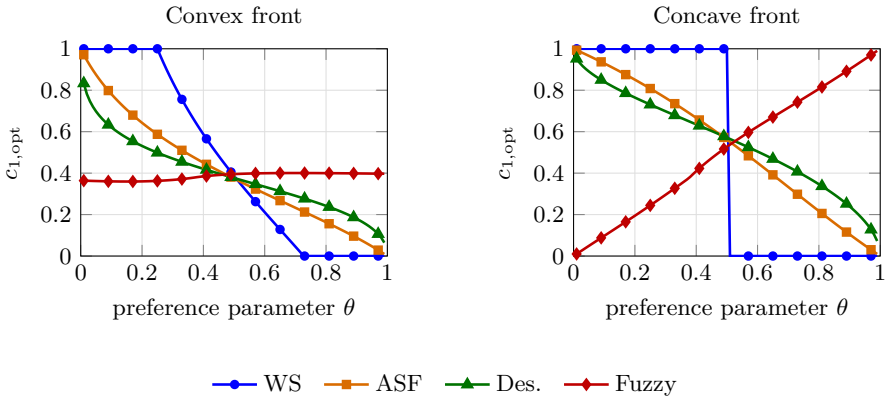
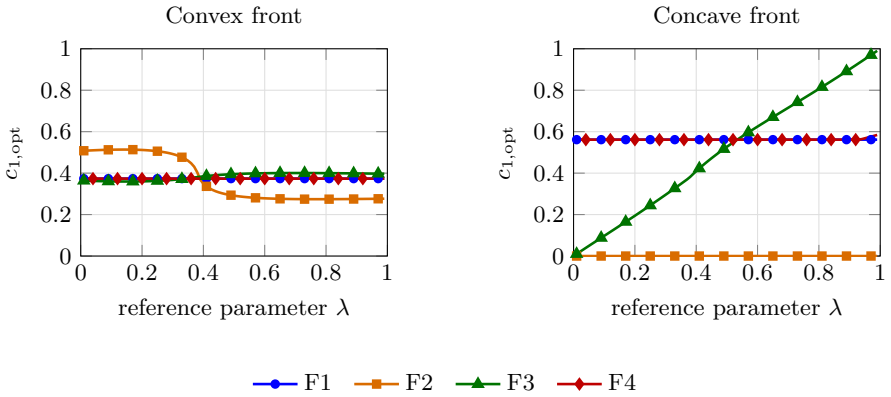
Different scalar objective functions reach different parts of the Pareto front, with weighted sums structurally unable to access non-supported points on concave fronts.
A machine-rendered reading of the paper's core claim, the machinery that carries it, and where it could break.
Core claim
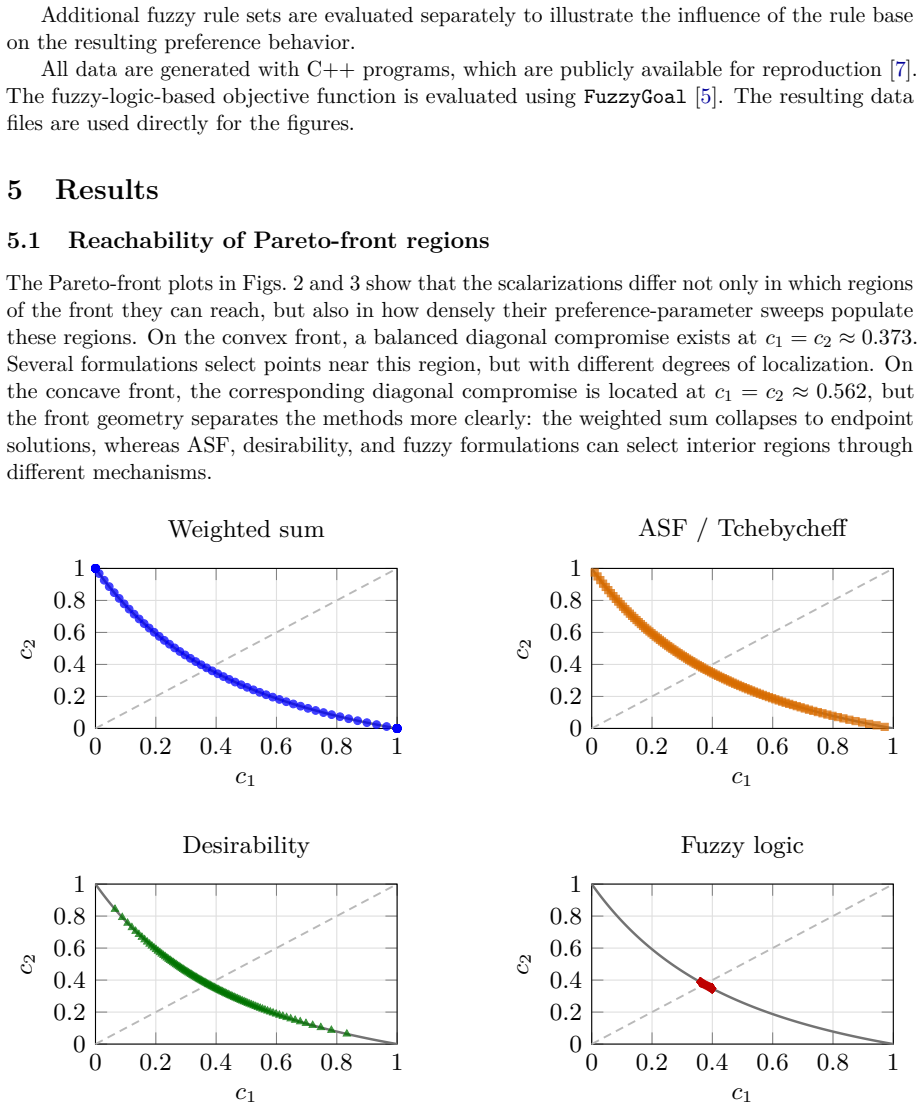
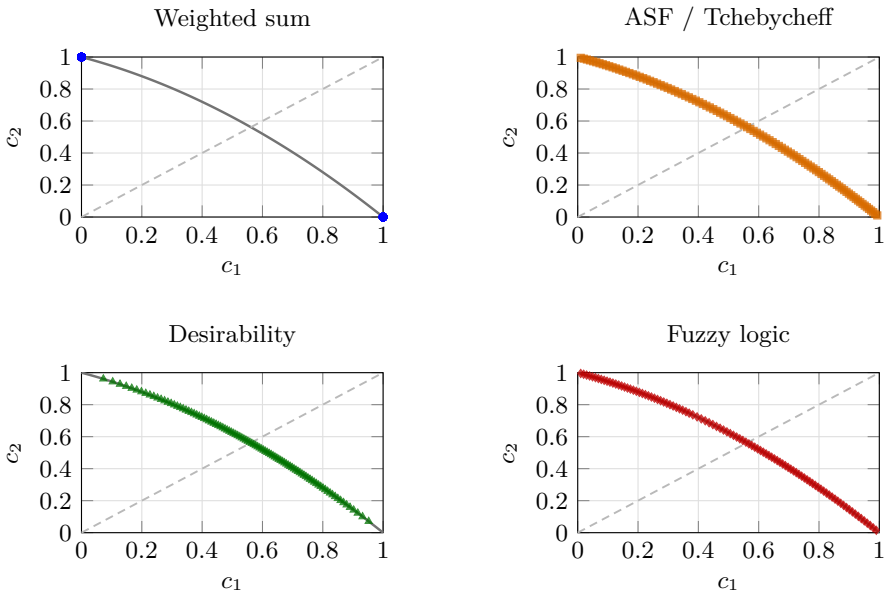
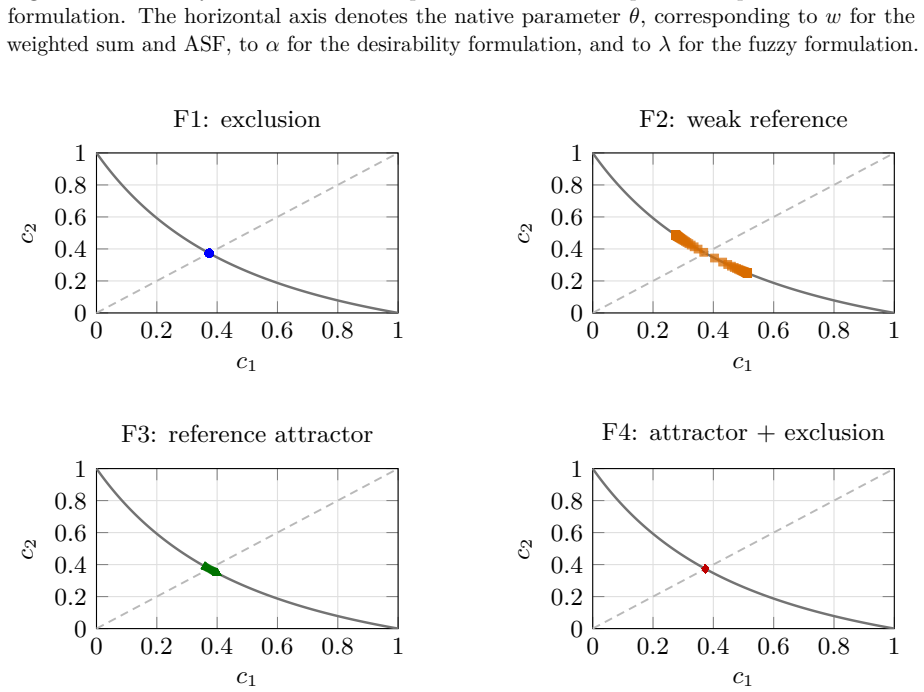
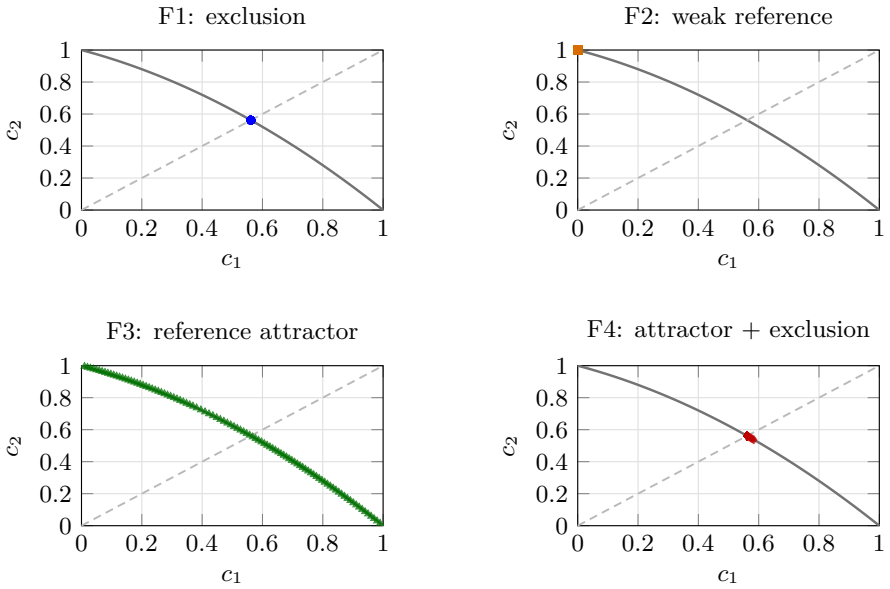
Using analytically defined convex and concave Pareto fronts isolates the scalarization effect and shows that weighted sums are limited to supported points on concave fronts, while achievement scalarizing functions, desirability functions, and fuzzy formulations reach interior non-supported regions; desirability functions do so via nonlinear single-criterion preference mappings and fuzzy rules do so by expressing nonseparable, reference-dependent preferences.
What carries the argument
Analytically defined convex and concave Pareto fronts that isolate the scalar objective formulation from optimizer behavior.
If this is right
- Weighted sums cannot reach non-supported regions on concave fronts.
- Achievement scalarizing functions reach interior regions via reference-point mechanisms.
- Desirability functions reach non-supported areas through nonlinear single-criterion mappings.
- Fuzzy formulations reach them by expressing nonseparable and reference-dependent preferences.
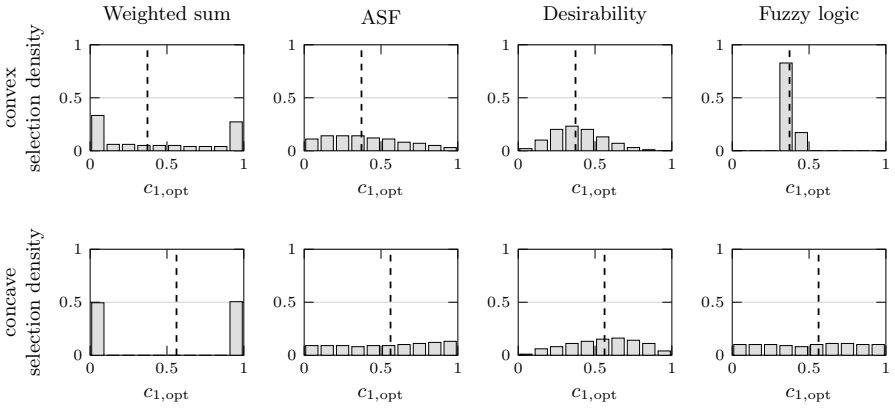
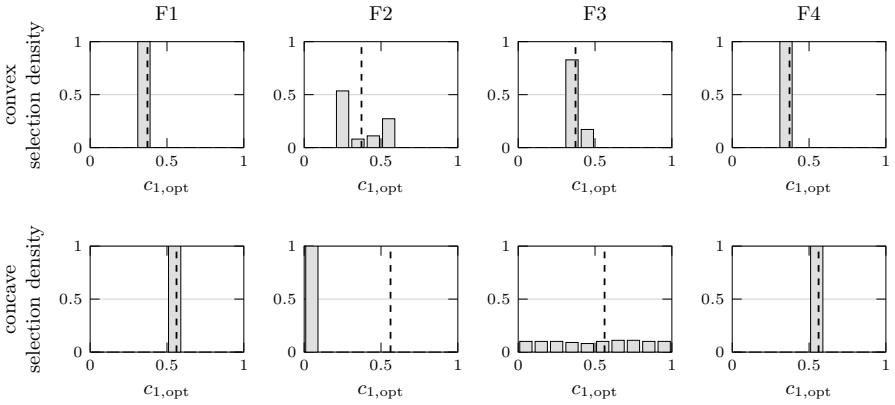
- Each formulation produces different densities of selected points depending on its parameters.
Where Pith is reading between the lines
- Engineers working with concave trade-off surfaces should test scalarizations beyond weighted sums to avoid missing preferred designs.
- The interpretability differences suggest fuzzy rules when engineering preferences involve interactions between criteria.
- Real optimization runs with unknown front curvature may benefit from running multiple scalarizations in parallel.
- The comparison framework could be extended to fronts with discontinuities or higher numbers of criteria.
Load-bearing premise
The two analytically defined Pareto fronts capture the structural differences that determine which scalarizations can reach which points in actual engineering problems.
What would settle it
If a weighted-sum formulation applied to the analytic concave front selects a non-supported interior point, the claimed structural limitation would be falsified.
Figures
read the original abstract
Scalar objective functions are required when a multi-criteria optimization problem must yield a single preferred design rather than only a Pareto set. The choice of scalarization influences which compromise is selected, how preference parameters are interpreted, and whether non-supported Pareto regions can be reached. This paper compares four formulations for normalized bi-criteria minimization: weighted sums, achievement scalarizing functions, desirability functions, and a fuzzy-logic-based formulation. Two analytically defined Pareto fronts, one convex and one concave, isolate the effect of the objective formulation from numerical optimizer behavior. The comparison focuses on reachable Pareto regions, parameter-induced selection density, compensation between criteria, sensitivity, and interpretability. Results show that weighted sums are simple but structurally limited on concave fronts, while achievement, desirability, and fuzzy formulations reach interior non-supported regions through different mechanisms. Desirability functions introduce nonlinear single-criterion preference mappings, whereas fuzzy rules express nonseparable and reference-dependent engineering preferences.
Editorial analysis
A structured set of objections, weighed in public.
Referee Report
Summary. The manuscript compares four scalarizations for normalized bi-criteria minimization—weighted sums, achievement scalarizing functions, desirability functions, and a fuzzy-logic formulation—on two analytically defined Pareto fronts (one convex, one concave). The comparison isolates formulation effects from optimizer behavior and evaluates reachable Pareto regions, parameter-induced selection density, compensation, sensitivity, and interpretability. Results indicate weighted sums are limited on concave fronts while the other three reach interior non-supported points via distinct nonlinear or rule-based mechanisms.
Significance. If the analytical isolation and reported reachable sets hold, the work supplies a concrete, reproducible demonstration of how each scalarization encodes preferences and which regions of the front remain inaccessible under each choice. The use of exact, analytically defined fronts (rather than numerical optimization) is a methodological strength that directly supports the central claim about formulation effects.
minor comments (3)
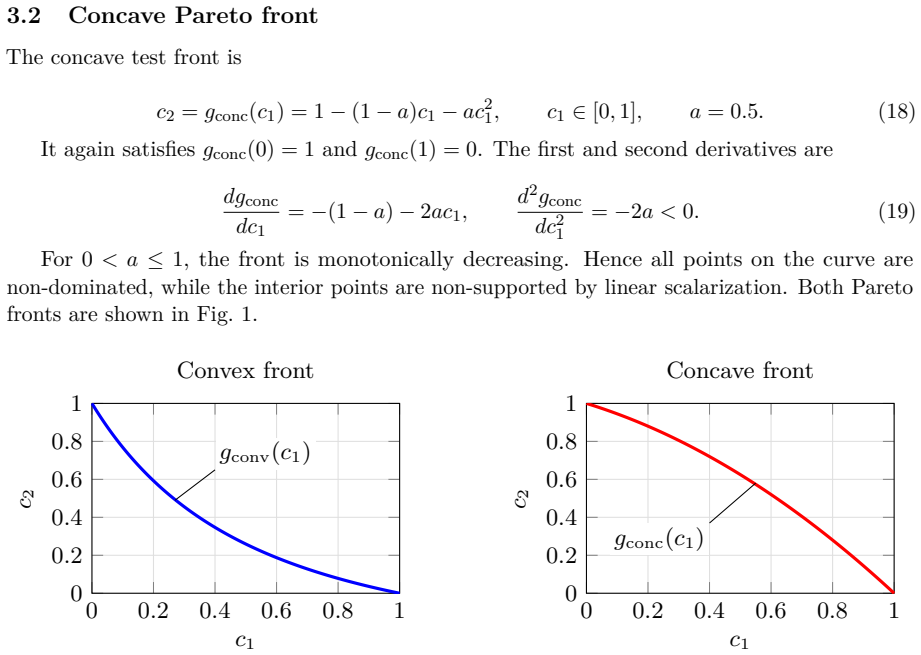
- The abstract states that the fronts are 'analytically defined' but does not give their explicit functional forms; adding the equations (or a short appendix) would allow readers to reproduce the level-set evaluations without ambiguity.
- Parameter ranges and the exact normalization procedure applied to the criteria before scalarization are not stated in the abstract; these details are needed to interpret the reported selection densities.
- The fuzzy-logic formulation is described only at the level of 'rules'; a compact listing of the membership functions and inference rules used would improve clarity and reproducibility.
Simulated Author's Rebuttal
We thank the referee for the constructive and positive assessment of the manuscript, including recognition of the methodological value of analytically defined Pareto fronts for isolating scalarization effects. No major comments were raised in the report.
Circularity Check
No significant circularity
full rationale
The paper is a comparative evaluation of four scalarization formulations on two analytically defined Pareto fronts (convex and concave). No derivation chain, fitted parameters, or predictions are present that reduce to the paper's own inputs by construction. The isolation of formulation effects follows directly from minimizing each scalar function exactly over the known front curves, and the weighted-sum limitation on concave fronts is the standard supporting-hyperplane property. No self-citations are load-bearing for the central claims.
Axiom & Free-Parameter Ledger
Reference graph
Works this paper leans on
-
[1]
Decision-Making in a Fuzzy Environment
Richard E. Bellman and Lotfi A. Zadeh. “Decision-Making in a Fuzzy Environment”. In: Management Science17.4 (1970), B141–B164.doi: 10.1287/mnsc.17.4.B141
-
[2]
A Closer Look at Drawbacks of Minimizing Weighted Sums of Objectives for Pareto Set Generation in Multicriteria Optimization Problems
Indraneel Das and John E. Dennis. “A Closer Look at Drawbacks of Minimizing Weighted Sums of Objectives for Pareto Set Generation in Multicriteria Optimization Problems”. In: Structural and Multidisciplinary Optimization14 (1997), pp. 63–69.doi: 10.1007/ BF01197559
1997
-
[3]
Simultaneous Optimization of Several Response Variables
George Derringer and Ronald Suich. “Simultaneous Optimization of Several Response Variables”. In:Journal of Quality Technology12.4 (1980), pp. 214–219.doi: 10.1080/ 00224065.1980.11980968
arXiv 1980
-
[4]
Multicriteria Optimization
Matthias Ehrgott. Multicriteria Optimization. 2nd ed. Springer, 2005
2005
-
[5]
Olaf Frommann.FuzzyGoal: A C++ Library for Fuzzy-Logic-Based Objective Functions. Version 1.1.0. 2026.doi: 10.5281/zenodo.20593012. url: https://github.com/of33/ FuzzyGoal. 16
-
[6]
Technical Report
Olaf Frommann.Objective Functions in Multi-Criteria Optimization: Weighting, Fuzzy Logic, and Solution-Space Topography. Technical Report. Version 1.0. Hochschule Bremen,
-
[7]
5281 / zenodo
doi: 10 . 5281 / zenodo . 20585380. url: https : / / doi . org / 10 . 5281 / zenodo . 20585380
-
[8]
Comparing Scalar Objective Functions for Multi-Criteria Engineering Optimization
Olaf Frommann.Reproducibility package for “Comparing Scalar Objective Functions for Multi-Criteria Engineering Optimization”. Version 1.0.0. 2026. doi: 10 . 5281 / zenodo . 20737015. url: https://doi.org/10.5281/zenodo.20737015
-
[9]
The Desirability Function
E. C. Harrington. “The Desirability Function”. In:Industrial Quality Control21.10 (1965), pp. 494–498
1965
-
[10]
Fuzzy Multi-Objective Programming: A Systematic Literature Review
N. Karimi et al. “Fuzzy Multi-Objective Programming: A Systematic Literature Review”. In: Expert Systems with Applications192 (2022), p. 116663.doi: 10.1016/j.eswa.2022. 116663
-
[11]
The Weighted Sum Method for Multi-Objective Optimization: New Insights
R. Timothy Marler and Jasbir S. Arora. “The Weighted Sum Method for Multi-Objective Optimization: New Insights”. In:Structural and Multidisciplinary Optimization41 (2010), pp. 853–862.doi: 10.1007/s00158-009-0460-7
-
[12]
Springer Nature, 1998/2012.doi: 10.1007/978-1-4615-5563-6
Kaisa Miettinen.Nonlinear Multiobjective Optimization. Springer Nature, 1998/2012.doi: 10.1007/978-1-4615-5563-6
-
[13]
Andrzej P. Wierzbicki. “On the Completeness and Constructiveness of Parametric Char- acterizations to Vector Optimization Problems”. In:Multiple Criteria Decision Making Theory and Application. Vol. 8. 1986, pp. 73–87.doi: 10.1007/BF01719738
-
[14]
Lotfi A. Zadeh. “Fuzzy Sets”. In:Information and Control8.3 (1965), pp. 338–353.doi: 10.1016/S0019-9958(65)90241-X
-
[15]
Fuzzy Programming and Linear Programming with Several Objective Functions
H.-J. Zimmermann. “Fuzzy Programming and Linear Programming with Several Objective Functions”. In:Fuzzy Sets and Systems 1.1 (1978), pp. 45–55.doi: 10 . 1016 / 0165 - 0114(78)90031-3. 17
1978
discussion (0)
Sign in with ORCID, Apple, or X to comment. Anyone can read and Pith papers without signing in.