REVIEW 2 major objections 5 minor 55 references
LHSDet: High-Resolution AI-Generated Image Detection via Visual Question Answering
T0 review · 2 major / 5 minor · reviewed 2026-08-12 · deepseek-v4-flash
Pith's one-line read LHSDet claims that high-resolution AI-generated image detection is best done by a triple-branch visual question answering system that fuses low-level texture, high-level global, and semantic caption features, achieving 95–96% accuracy…
desk verdict Useful engineering result with a real 9-point cross-model gap, but the claimed trainable BLIP-2 caption branch is not trainable as described; fix that before trusting the ablation. read the letter →
The pith
A machine-rendered reading of the paper's core claim, the machinery that carries it, and where it could break.
The reading
What carries the argument
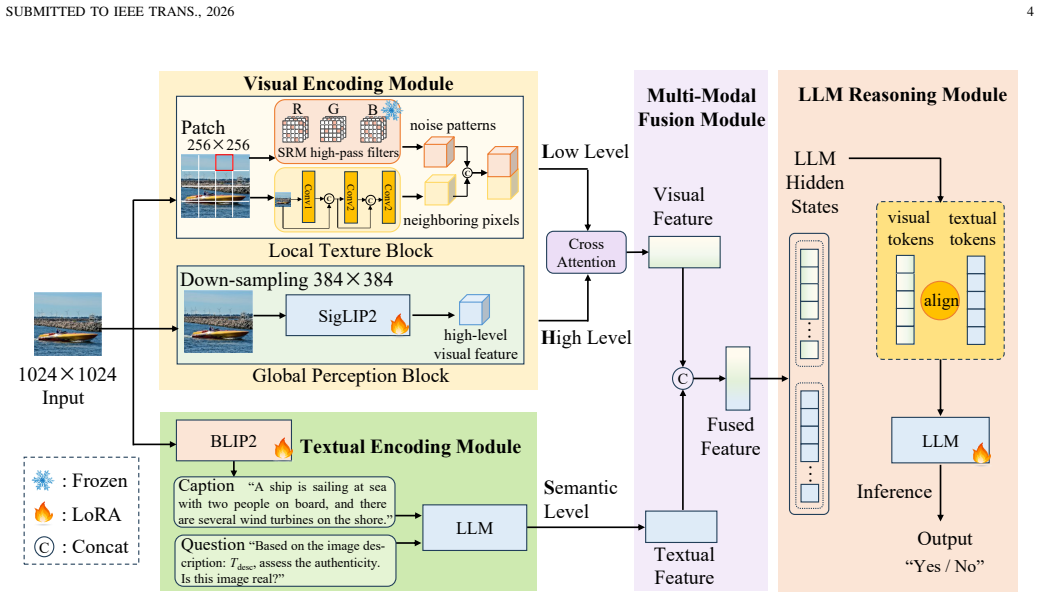
The central mechanism is the triple-branch VQA architecture: a local texture branch using non-overlapping patch aggregation with SRM noise filters and neighboring-pixel convolutions, a global perception branch using LoRA-fine-tuned SigLIP2, and a semantic branch producing BLIP-2 captions; these are fused through cross-attention, projected into a Phi-3-mini LLM, and answered as 'Yes' or 'No'. The cross-attention fusion, which uses global features as the query and local features as key and value, is the load-bearing integration step that lets high-level semantics be enriched by fine texture detail.
What would settle it
Re-run the Flickr2K and DIV2K experiments under the exact protocol but with multiple random train/test splits, or enlarge each test set to several thousand samples, and check whether the 9–11 point gap over AEROBLADE and AntifakePrompt persists; a gap that collapses under resampling would falsify the claim of state-of-the-art generalization.
Extended reading notes
Core claim
LHSDet's core claim is that high-resolution AI-generated image detection is best served by a triple-branch, multi-modal design rather than a single visual encoder. A low-level branch aggregates non-overlapping image patches and computes SRM high-pass noise maps plus neighboring-pixel inconsistency features to capture texture artifacts; a high-level branch uses the SigLIP2 visual encoder, fine-tuned with LoRA, for global semantic inconsistencies; and a semantic-level branch generates a caption with BLIP-2, which is concatenated with a fixed authenticity question. The two visual streams are fused via cross-attention, projected into the Phi-3-mini LLM embedding space, and the LLM outputs a 'Yes' or 'No' answer. The paper reports state-of-the-art accuracy of 95–96% across diffusion models (SDv3, SDXL, Playground, DALL·E 3, MidJourney v5/v6, IF), the autoregressive model Infinity, and the WildRF real-world benchmark, outperforming the second-best baseline by more than 9%.
Load-bearing premise
The reported accuracy margins rest on test sets of 300, 100, or 50 images per category, evaluated once without repeated trials or confidence intervals; if those small splits are noisy or unrepresentative, the claimed 9-percentage-point lead over the second-best baseline could shrink.
Editorial extensions
If this is right
- If LHSDet is right, high-resolution detectors no longer need to downsample inputs; the patch-aggregation branch preserves texture cues at 1024×1024 resolution, and the same architecture should extend to 2K/4K images without modification.
- The VQA reformulation means detection inherits the few-shot and reasoning abilities of modern vision-language models; training on only 4,000 images for two epochs suffices, so detectors can be rapidly retargeted to newly emerged generative models.
- The 9–11 percentage point accuracy margin over reconstruction-based baselines suggests that learned multi-modal features transfer across unseen generators more reliably than reconstruction-error heuristics.
- The robustness results, with an average accuracy drop of about 3.5% under blur, JPEG compression, noise, rotation, brightness, and contrast changes, indicate that the method tolerates common post-processing that degrades CNN-based detectors by tens of points.
- The improvement over AntifakePrompt, which also uses a VQA formulation, attributes the gain to the redesigned visual encoder and the added low-level texture branch, implying that visual encoder design matters more than the prompting strategy alone.
Reading between the lines
- If the small-test-set issue is resolved by larger evaluation, the cross-attention fusion between local and global branches could be reused as a plug-in visual encoder for other forensic tasks, such as deepfake video frame detection or face forgery localization.
- The semantic caption branch is not trained for detection, yet it supplies context that helps the LLM reason about implausible content; a testable hypothesis is that swapping in a captioning model with stronger world knowledge would further improve detection of semantically inconsistent images with no change to the visual branches.
- The paper does not test against adversarial post-processing such as semantic inpainting or model-specific artifact removal; a natural next experiment is whether the texture branch remains discriminative when artifacts are explicitly minimized.
- Since the reported gains are computed against a fixed set of baselines on narrow test sets, an independent benchmark with larger and more diverse splits would clarify whether the 9-point margin is a property of the architecture or an artifact of the evaluation protocol.
Editorial analysis
A structured set of objections, weighed in public.
Referee Report
Summary. This manuscript proposes LHSDet, a triple-branch detector for high-resolution AI-generated images. The low-level branch aggregates non-overlapping patches with SRM filters and convolutions to capture texture artifacts; the high-level branch uses a SigLIP2 encoder with LoRA; the semantic branch generates captions with BLIP-2; and the combined multi-modal features are fed to a Phi-3-mini LLM that outputs a binary real/fake answer in a VQA format. The paper reports state-of-the-art accuracy of 95–96% on eleven datasets spanning diffusion models, an autoregressive model (Infinity), and the WildRF social-media benchmark, claiming a >9% margin over the second-best baseline, plus strong robustness to post-processing. The training protocol uses BCE loss on the LLM's final-token hidden state, with LoRA applied to SigLIP2, BLIP-2, and the LLM.
Significance. If the results hold, the paper makes a useful contribution to AI-generated image detection by combining low-level texture cues with high-level semantic and textual cues in a high-resolution VQA framework, and by evaluating on genuinely held-out generators rather than only on training-domain data. The ablation study (Table V) and robustness experiments (Tables III–IV) are informative. However, the current manuscript contains a load-bearing inconsistency about how BLIP-2 is fine-tuned, and the comparison against two CLIP-based baselines is unequal because they are evaluated with official pretrained checkpoints rather than retrained under the same few-shot protocol. The central accuracy claims are likely to survive a corrected comparison given the large margins, but the paper as written does not yet establish the proposed training procedure or the claimed SOTA in a sound manner.
major comments (2)
- [Tables I and II, footnote †] The table captions claim that 'All methods were trained on Flickr2K and SDv3,' yet UnivFD and Fatformer are evaluated using their official pretrained checkpoints, as indicated by the † footnote. This is not a like-for-like comparison under the few-shot training protocol used for the other baselines and for LHSDet. A method that has never seen the training distribution is at a substantial disadvantage, and this asymmetry directly undermines the headline claim that LHSDet surpasses the second-best baseline by more than 9%. The authors should either retrain these baselines on the same training splits (Flickr2K/DIV2K plus SDv3) or explicitly remove the 'all methods trained' claim and qualify the performance comparison as a mixed-protocol benchmark.
- [Sec. IV-C, Tables I–IV] No error bars, confidence intervals, repeated runs, or significance tests are reported, and the test sets contain only 300, 100, or 50 samples per category. In Table IV, with 50 samples per class, a single misclassification changes the reported accuracy by 1%, so the listed differences (e.g., LHSDet 95.33% vs. Antifake 81.17%) are noisy estimates of the true performance gap. The large observed margins make the central conclusions plausible, but the paper should report the variance across multiple random splits or repeated training runs, and should specify the split procedure and any fixed seed, in order to support the claimed margins and the robustness conclusions.
minor comments (5)
- [Sec. III-A.1, Eq. (1)] The two convolutions in Eq. (1) are both named Conv2, which is confusing; they should be distinguished (e.g., Conv2 and Conv3), and the patch size h×w used for the non-overlapping patch aggregation is never specified, so the local texture block is under-specified for replication.
- [Sec. IV-A.3, Tables I and II] The comparison would be strengthened by including recent high-resolution or training-free detectors beyond the listed ones (e.g., LARE², RIGID, or other 2024–2025 methods) to substantiate the 'state-of-the-art' claim, especially since the paper targets 1024×1024 inputs.
- [Sec. IV-D] The robustness protocol is asymmetric: blur, JPEG, and noise are applied after downsampling to 256×256, while brightness, contrast, and rotation are applied at 1024×1024. This is a reasonable design choice, but the motivation for the asymmetry should be stated explicitly in the text.
- [Sec. III-A.2] The sentence 'By default, SigLIP2 processes 1024×1024 images at 384×384 resolution' is confusing; it should be rewritten to say that SigLIP2 is designed for high-resolution inputs but is applied here at 384×384 resolution, or similar.
- [Throughout] The manuscript contains numerous typos (e.g., 'evolved' as 'evoled', 'characteristic' as 'characterstic', 'another' as 'anothor', 'Illustation' in the Fig. 3 caption, 'neighboring' as 'neiboring') and a few redundant words; a careful proofreading pass is needed.
Circularity Check
No circularity: the accuracy claim is measured on held-out generators and no load-bearing derivation reduces to its inputs.
full rationale
The central detection claim is empirical, not derived: LHSDet is trained on SDv3 plus Flickr2K/DIV2K and evaluated on held-out generators (SDXL, DALL·E 3, MidJourney, IF, Infinity, WildRF) that the paper states 'are not used for training, and directly employed for testing' (Sec. IV-A-1). The semantic branch takes the input image itself and produces a caption via Eq. (7), then concatenates it into the question (Sec. III-B); this is a feature-extraction step, not a label-derived construction, and no equation defines the label or the reported accuracy in terms of the caption or the training labels. The LoRA and VQA ingredients are standard external techniques cited to public prior work, with no self-citation chain or author-imported uniqueness theorem used to force the architecture. The 'more than 9%' advantage is an empirical difference in Tables I-II against external baselines, several of which are evaluated from published checkpoints. The only in-scope manuscript-level concern is an omitted proof rather than circularity: Sec. III-E states 'SigLIP2, BLIP2, and LLM are fine-tuned using Low-Rank Adaptation (LoRA)', but Sec. IV-E refers to 'pre-generated captions', and with discrete tokenization (Eq. (9)) and the BCE loss on the LLM's final hidden state (Eq. (14)), gradients cannot flow back to BLIP-2's LoRA parameters. This internal inconsistency needs clarification (either captions are regenerated per epoch or BLIP-2 is frozen), but it does not make the detection result equivalent to its inputs and therefore does not raise the circularity score.
Assumptions & free parameters
free parameters (5)
- LoRA rank r =
8
- LoRA scaling alpha =
16
- Learning rate =
1e-5
- Number of training epochs =
2
- Batch size =
1
assumptions (4)
- domain assumption High-resolution inputs preserve detectable low-level artifacts that are lost by downsampling.
- domain assumption BLIP-2 generated captions provide complementary semantic cues that improve detection.
- domain assumption The test sets (300, 100, or 50 samples per class) are large enough to support the claimed accuracy differences without error bars.
- domain assumption Evaluating UnivFD and Fatformer with official pretrained checkpoints, rather than fine-tuning on the training set, yields valid baselines.
Cite this review
Pith. "Pith review of LHSDet: High-Resolution AI-Generated Image Detection via Visual Question Answering." pith.science (2026). https://pith.science/paper/FVQGORL7
@misc{pith2026260807863,
  author       = {Pith},
  title        = {Pith review of: LHSDet: High-Resolution AI-Generated Image Detection via Visual Question Answering},
  year         = {2026},
  howpublished = {\url{https://pith.science/paper/FVQGORL7}},
  note         = {Machine review of arXiv:2608.07863}
}
read the original abstract
Driven by advances in diffusion models and autoregressive models, the fidelity and resolution of AI-generated images now rival those of real images. However, existing AI-generated image detection methods often downsample the images, inevitably overlooking critical low-level texture details in high-resolution AI-generated images, therefore limiting their detection performance. In addition, the ceaseless emergence of unknown generative models makes large-scale pre-training datasets inaccessible. To address these challenges, we propose a novel high-resolution AI-generated image detector, termed LHSDet. Specifically, we formulate the AI-generated image detection task as a Visual Question Answering problem, leveraging a fine-tuned vision-language framework to fully exploit the complementary information between visual and textual modalities. Recognizing that the default visual encoder of existing vision-language models is not tailored for AI-generated image detection, we redesign a visual encoder to better capture both the low-level and high-level artifacts inherent in AI-generated images. Furthermore, we incorporate a semantic-level textual branch to enable multi-modal feature fusion and detection. Consequently, LHSDet employs a triple-branch architecture to extract complementary multi-modal features: a low-level visual branch that aggregates non-overlapping patches for local texture cues, a high-level visual branch based on SigLIP2 for global perception feature extraction, and a semantic-level textual branch that generates captions using BLIP-2. Extensive experimental results demonstrate that LHSDet achieves high detection accuracy and robust performance across diverse generative models, including both diffusion and autoregressive models.
Figures


Figures from the paper (3 more)


Reference graph
Works this paper leans on
-
[1]
Generative adversarial net- works,
I. Goodfellow, J. Pouget-Abadieet al., “Generative adversarial net- works,”Communications of the ACM, vol. 63, no. 11, pp. 139–144, 2020
work page 2020
-
[2]
Auto-encoding variational bayes,
D. P. Kingma, M. Wellinget al., “Auto-encoding variational bayes,” 2013
2013
-
[3]
Denoising diffusion probabilistic models,
J. Ho, A. Jain, and P. Abbeel, “Denoising diffusion probabilistic models,” Advances in neural information processing systems, vol. 33, pp. 6840– 6851, 2020
2020
-
[4]
Diffusion models beat gans on image synthesis,
P. Dhariwal and A. Nichol, “Diffusion models beat gans on image synthesis,”Advances in neural information processing systems, vol. 34, pp. 8780–8794, 2021
2021
-
[5]
Vector quantized diffusion model for text-to-image synthesis,
S. Gu, D. Chen, J. Bao, F. Wen, B. Zhang, D. Chen, L. Yuan, and B. Guo, “Vector quantized diffusion model for text-to-image synthesis,” inProceedings of the IEEE/CVF conference on computer vision and pattern recognition, 2022, pp. 10 696–10 706
2022
-
[6]
Pseudo numerical methods for diffusion models on manifolds,
L. Liu, Y . Renet al., “Pseudo numerical methods for diffusion models on manifolds,”arXiv preprint arXiv:2202.09778, 2022
arXiv 2022
-
[7]
Photorealistic text-to-image diffusion models with deep language understanding,
C. Saharia, W. Chan, S. Saxena, L. Li, J. Whang, E. L. Denton, K. Ghasemipour, R. Gontijo Lopes, B. Karagol Ayan, T. Salimans et al., “Photorealistic text-to-image diffusion models with deep language understanding,”Advances in neural information processing systems, vol. 35, pp. 36 479–36 494, 2022
2022
-
[8]
High-resolution image synthesis with latent diffusion models,
R. Rombach, A. Blattmannet al., “High-resolution image synthesis with latent diffusion models,” inProceedings of the IEEE/CVF conference on computer vision and pattern recognition (CVPR), 2022, pp. 10 684– 10 695
work page 2022
Show all 55 references
-
[9]
Hierarchical text-conditional image generation with clip latents,
A. Ramesh, P. Dhariwalet al., “Hierarchical text-conditional image generation with clip latents,”arXiv preprint arXiv:2204.06125, vol. 1, no. 2, p. 3, 2022
2022 arXiv
-
[10]
Pixart-σ: Weak-to-strong training of diffusion transformer for 4k text-to-image generation,
J. Chen, C. Ge, E. Xie, Y . Wu, L. Yao, X. Ren, Z. Wang, P. Luo, H. Lu, and Z. Li, “Pixart-σ: Weak-to-strong training of diffusion transformer for 4k text-to-image generation,” inEuropean Conference on Computer Vision. Springer, 2024, pp. 74–91
2024
-
[11]
Sana: Efficient high-resolution image synthesis with linear diffusion transformers,
E. Xie, J. Chen, J. Chen, H. Cai, H. Tang, Y . Lin, Z. Zhang, M. Li, L. Zhu, Y . Luet al., “Sana: Efficient high-resolution image synthesis with linear diffusion transformers,”arXiv preprint arXiv:2410.10629, 2024
2024 arXiv
-
[12]
Ultrapixel: Advancing ultra high-resolution image synthesis to new peaks,
J. Ren, W. Li, H. Chen, R. Pei, B. Shao, Y . Guo, L. Peng, F. Song, and L. Zhu, “Ultrapixel: Advancing ultra high-resolution image synthesis to new peaks,”Advances in Neural Information Processing Systems, vol. 37, pp. 111 131–111 171, 2024
2024
-
[13]
Rethinking the up-sampling operations in cnn-based generative network for generalizable deepfake detection,
C. Tan, Y . Zhaoet al., “Rethinking the up-sampling operations in cnn-based generative network for generalizable deepfake detection,” inProceedings of the IEEE/CVF conference on computer vision and pattern recognition (CVPR), 2024, pp. 28 130–28 139
2024
-
[14]
Learning on gradients: Generalized artifacts representation for gan-generated images detection,
C. Tan, Y . Zhao, S. Wei, G. Gu, and Y . Wei, “Learning on gradients: Generalized artifacts representation for gan-generated images detection,” inProceedings of the IEEE/CVF Conference on Computer Vision and Pattern Recognition (CVPR), 2023, pp. 12 105–12 114
2023
-
[15]
Ai-generated image detection using a cross- attention enhanced dual-stream network,
Z. Xi, W. Huanget al., “Ai-generated image detection using a cross- attention enhanced dual-stream network,” in2023 Asia Pacific Signal and Information Processing Association Annual Summit and Conference (APSIPA ASC). IEEE, 2023, pp. 1463–1470
2023
-
[16]
Thinking in frequency: Face forgery detection by mining frequency-aware clues,
Y . Qian, G. Yinet al., “Thinking in frequency: Face forgery detection by mining frequency-aware clues,” inEuropean Conference on Computer Vision (ECCV). Springer, 2020, pp. 86–103
2020
-
[17]
On the detection of synthetic images gen- erated by diffusion models,
R. Corvi, D. Cozzolinoet al., “On the detection of synthetic images gen- erated by diffusion models,” inICASSP 2023-2023 IEEE International Conference on Acoustics, Speech and Signal Processing (ICASSP). IEEE, 2023, pp. 1–5
2023
-
[18]
Dire for diffusion-generated image detection,
Z. Wang, J. Baoet al., “Dire for diffusion-generated image detection,” inProceedings of the IEEE/CVF International Conference on Computer Vision (ICCV), 2023, pp. 22 445–22 455
2023
-
[19]
Aeroblade: Training-free detection of latent diffusion images using autoencoder reconstruction error,
J. Ricker, D. Lukovnikov, and A. Fischer, “Aeroblade: Training-free detection of latent diffusion images using autoencoder reconstruction error,” inCVPR, 2024, pp. 9130–9140
2024
-
[20]
Drct: Diffusion reconstruction contrastive training towards universal detection of diffusion generated images,
B. Chen, J. Zenget al., “Drct: Diffusion reconstruction contrastive training towards universal detection of diffusion generated images,” in Forty-first International Conference on Machine Learning (ICML), 2024
2024
-
[21]
Fakeinversion: Learning to detect images from unseen text-to-image models by inverting stable diffusion,
G. Cazenavette, A. Sudet al., “Fakeinversion: Learning to detect images from unseen text-to-image models by inverting stable diffusion,” in Proceedings of the IEEE/CVF Conference on Computer Vision and Pattern Recognition (CVPR), 2024, pp. 10 759–10 769
2024
-
[22]
Where did i come from? origin attribution of ai-generated images,
Z. Wang, C. Chen, Y . Zeng, L. Lyu, and S. Ma, “Where did i come from? origin attribution of ai-generated images,”Advances in neural information processing systems, vol. 36, pp. 74 478–74 500, 2023
2023
-
[23]
Lareˆ 2: Latent reconstruction error based method for diffusion-generated image detection,
Y . Luo, J. Du, K. Yan, and S. Ding, “Lareˆ 2: Latent reconstruction error based method for diffusion-generated image detection,” inPro- ceedings of the IEEE/CVF Conference on Computer Vision and Pattern Recognition, 2024, pp. 17 006–17 015
2024
-
[24]
Zerofake: Zero-shot detection of fake images generated and edited by text-to-image genera- tion models,
Z. Sha, Y . Tan, M. Li, M. Backes, and Y . Zhang, “Zerofake: Zero-shot detection of fake images generated and edited by text-to-image genera- tion models,” inProceedings of the 2024 on ACM SIGSAC Conference on Computer and Communications Security, 2024, pp. 4852–4866
2024
-
[25]
Learning transferable visual models from natural language supervision,
A. Radford, J. W. Kim, C. Hallacy, A. Ramesh, G. Goh, S. Agarwal, G. Sastry, A. Askell, P. Mishkin, J. Clarket al., “Learning transferable visual models from natural language supervision,” inInternational conference on machine learning. PmLR, 2021, pp. 8748–8763
2021
-
[26]
Towards universal fake image detec- tors that generalize across generative models,
U. Ojha, Y . Li, and Y . J. Lee, “Towards universal fake image detec- tors that generalize across generative models,” inProceedings of the IEEE/CVF Conference on Computer Vision and Pattern Recognition (CVPR), 2023, pp. 24 480–24 489
2023
-
[27]
De-fake: Detection and attribution of fake images generated by text-to-image generation models,
Z. Sha, Z. Li, N. Yu, and Y . Zhang, “De-fake: Detection and attribution of fake images generated by text-to-image generation models,” in Proceedings of the 2023 ACM SIGSAC conference on computer and communications security, 2023, pp. 3418–3432
2023
-
[28]
Forgery- aware adaptive transformer for generalizable synthetic image detection,
H. Liu, Z. Tan, C. Tan, Y . Wei, J. Wang, and Y . Zhao, “Forgery- aware adaptive transformer for generalizable synthetic image detection,” inProceedings of the IEEE/CVF Conference on Computer Vision and Pattern Recognition, 2024, pp. 10 770–10 780
2024
-
[29]
C2p-clip: Injecting category common prompt in clip to enhance generalization in deepfake detection,
C. Tan, R. Tao, H. Liu, G. Gu, B. Wu, Y . Zhao, and Y . Wei, “C2p-clip: Injecting category common prompt in clip to enhance generalization in deepfake detection,” inProceedings of the AAAI Conference on Artificial Intelligence, vol. 39, no. 7, 2025, pp. 7184–7192
2025
-
[30]
A sanity check for ai-generated image detection,
S. Yan, O. Li, J. Cai, Y . Hao, X. Jiang, Y . Hu, and W. Xie, “A sanity check for ai-generated image detection,”arXiv preprint arXiv:2406.19435, 2024
2024 arXiv
-
[31]
Blip: Bootstrapping language-image pre-training for unified vision-language understanding and generation,
J. Li, D. Li, C. Xiong, and S. Hoi, “Blip: Bootstrapping language-image pre-training for unified vision-language understanding and generation,” inInternational conference on machine learning. PMLR, 2022, pp. 12 888–12 900
2022
-
[32]
Antifakeprompt: Prompt- tuned vision-language models are fake image detectors,
Y .-M. Chang, C. Yeh, W.-C. Chiu, and N. Yu, “Antifakeprompt: Prompt- tuned vision-language models are fake image detectors,”arXiv preprint arXiv:2310.17419, 2023
2023 arXiv
-
[33]
Cnn- generated images are surprisingly easy to spot... for now,
S.-Y . Wang, O. Wang, R. Zhang, A. Owens, and A. A. Efros, “Cnn- generated images are surprisingly easy to spot... for now,” inProceedings of the IEEE/CVF conference on computer vision and pattern recognition (CVPR), 2020, pp. 8695–8704
2020
-
[34]
Shadows don’t lie and lines can’t bend! generative models don’t know projective geometry... for now,
A. Sarkar, H. Mai, A. Mahapatra, S. Lazebnik, D. A. Forsyth, and A. Bhattad, “Shadows don’t lie and lines can’t bend! generative models don’t know projective geometry... for now,” inProceedings of the IEEE/CVF conference on computer vision and pattern recognition, 2024, pp. 28...
2024
-
[35]
Denoising diffusion implicit models,
J. Song, C. Meng, and S. Ermon, “Denoising diffusion implicit models,” arXiv preprint arXiv:2010.02502, 2020. SUBMITTED TO IEEE TRANS., 2026 13
2010 arXiv
-
[36]
Towards extensible detection of ai-generated images via content-agnostic adapter- based category-aware incremental learning,
S. Tang, P. He, H. Li, W. Wang, X. Jiang, and Y . Zhao, “Towards extensible detection of ai-generated images via content-agnostic adapter- based category-aware incremental learning,”IEEE Transactions on In- formation Forensics and Security, 2025
2025
-
[37]
Harnessing the power of large vision language models for synthetic image detection,
M. Keita, W. Hamidouche, H. Bougueffa, A. Hadid, and A. Taleb- Ahmed, “Harnessing the power of large vision language models for synthetic image detection,”arXiv preprint arXiv:2404.02726, 2024
2024 arXiv
-
[38]
Instructblip: Towards general-purpose vision-language models with instruction tuning,
W. Dai, J. Li, D. Li, A. Tiong, J. Zhao, W. Wang, B. Li, P. N. Fung, and S. Hoi, “Instructblip: Towards general-purpose vision-language models with instruction tuning,”Advances in neural information processing systems, vol. 36, pp. 49 250–49 267, 2023
2023
-
[39]
Siglip 2: Multilingual vision-language encoders with improved semantic understanding, localization, and dense features,
M. Tschannen, A. Gritsenko, X. Wang, M. F. Naeem, I. Alabdul- mohsin, N. Parthasarathy, T. Evans, L. Beyer, Y . Xia, B. Mustafa et al., “Siglip 2: Multilingual vision-language encoders with improved semantic understanding, localization, and dense features,”arXiv preprint arXiv...
2025 arXiv
-
[40]
Breaking semantic artifacts for generalized ai-generated image detec- tion,
C. Zheng, C. Lin, Z. Zhao, H. Wang, X. Guo, S. Liu, and C. Shen, “Breaking semantic artifacts for generalized ai-generated image detec- tion,”Advances in Neural Information Processing Systems, vol. 37, pp. 59 570–59 596, 2024
2024
-
[41]
Rich model for steganalysis of color images,
M. Goljan, J. Fridrich, and R. Cogranne, “Rich model for steganalysis of color images,” in2014 IEEE International workshop on information forensics and security (WIFS). IEEE, 2014, pp. 185–190
2014
-
[42]
Phi-3 technical report: A highly capable language model locally on your phone,
Microsoft, “Phi-3 technical report: A highly capable language model locally on your phone,”arXiv preprint arXiv:2404.14219, 2024
2024 arXiv
-
[43]
Mixtral of experts,
A. Q. Jiang, A. Sablayrolles, A. Roux, A. Mensch, B. Savary, C. Bam- ford, D. S. Chaplot, D. d. l. Casas, E. B. Hanna, F. Bressandet al., “Mixtral of experts,”arXiv preprint arXiv:2401.04088, 2024
2024 arXiv
-
[44]
Language mod- els are few-shot learners,
T. Brown, B. Mann, N. Ryder, M. Subbiah, J. D. Kaplan, P. Dhariwal, A. Neelakantan, P. Shyam, G. Sastry, A. Askellet al., “Language mod- els are few-shot learners,”Advances in neural information processing systems, vol. 33, pp. 1877–1901, 2020
1901
-
[45]
Lora: Low-rank adaptation of large language models
E. J. Hu, Y . Shen, P. Wallis, Z. Allen-Zhu, Y . Li, S. Wang, L. Wang, W. Chenet al., “Lora: Low-rank adaptation of large language models.” ICLR, vol. 1, no. 2, p. 3, 2022
2022
-
[46]
Enhanced deep residual networks for single image super-resolution,
B. Lim, S. Son, H. Kim, S. Nah, and K. Mu Lee, “Enhanced deep residual networks for single image super-resolution,” inProceedings of the IEEE conference on computer vision and pattern recognition workshops, 2017, pp. 136–144
2017
-
[47]
Ntire 2017 challenge on single image super-resolution: Dataset and study,
E. Agustsson and R. Timofte, “Ntire 2017 challenge on single image super-resolution: Dataset and study,” inProceedings of the IEEE con- ference on computer vision and pattern recognition workshops, 2017, pp. 126–135
2017
-
[48]
Scaling rectified flow transformers for high-resolution image synthesis,
P. Esser, S. Kulal, A. Blattmann, R. Entezari, J. M ¨uller, H. Saini, Y . Levi, D. Lorenz, A. Sauer, F. Boeselet al., “Scaling rectified flow transformers for high-resolution image synthesis,” inForty-first international conference on machine learning, 2024
2024
-
[49]
Sdxl: Improving latent diffusion models for high-resolution image synthesis,
D. Podell, Z. English, K. Lacey, A. Blattmann, T. Dockhorn, J. M ¨uller, J. Penna, and R. Rombach, “Sdxl: Improving latent diffusion models for high-resolution image synthesis,”arXiv preprint arXiv:2307.01952, 2023
2023 arXiv
-
[50]
Play- ground v2. 5: Three insights towards enhancing aesthetic quality in text- to-image generation,
D. Li, A. Kamko, E. Akhgari, A. Sabet, L. Xu, and S. Doshi, “Play- ground v2. 5: Three insights towards enhancing aesthetic quality in text- to-image generation,”arXiv preprint arXiv:2402.17245, 2024
2024 arXiv
-
[51]
Improving image generation with better captions,
J. Betker, G. Goh, L. Jing, T. Brooks, J. Wang, L. Li, L. Ouyang, J. Zhuang, J. Lee, Y . Guoet al., “Improving image generation with better captions,”Computer Science. https://cdn. openai. com/papers/dall-e-3. pdf, vol. 2, no. 3, p. 8, 2023
2023
-
[52]
Deepfloyd if,
StabilityAI, “Deepfloyd if,” 2023
2023
-
[53]
Infinity: Scaling bitwise autoregressive modeling for high-resolution image synthesis,
J. Han, J. Liu, Y . Jiang, B. Yan, Y . Zhang, Z. Yuan, B. Peng, and X. Liu, “Infinity: Scaling bitwise autoregressive modeling for high-resolution image synthesis,” inProceedings of the Computer Vision and Pattern Recognition Conference (CVPR), 2025, pp. 15 733–15 744
2025
-
[54]
Real-time deepfake detection in the real-world,
B. Cavia, E. Horwitz, T. Reiss, and Y . Hoshen, “Real-time deepfake detection in the real-world,”arXiv preprint arXiv:2406.09398, 2024
2024 arXiv
-
[55]
Deep residual learning for image recognition,
K. He, X. Zhanget al., “Deep residual learning for image recognition,” inProceedings of the IEEE/CVF conference on computer vision and pattern recognition (CVPR), 2016, pp. 770–778
2016
Reviewed August 12, 2026 · model on record in the stance chip above.
Discussion (0). Continue with ORCID to comment.