REVIEW 4 major objections 4 minor 45 references
Exciton-Exciton Annihilation Mediated by Many-Body Coulomb and Phonon Interactions: An Ab Initio Study
T0 review · 4 major / 4 minor · reviewed 2026-08-07 · deepseek-v4-flash
Pith's one-line read This paper derives an ab initio GW-BSE framework for exciton-exciton annihilation and applies it to monolayer WSe2, finding that cross-peak A-B channels dominate and EEA generates unbound electron-hole pairs on hundreds-of-picosecond…
desk verdict A genuinely new GW-BSE framework for exciton-exciton annihilation in TMDs, but the claim of unbound-pair dominance overreaches and the rates lean on tuned broadenings. read the letter →
The pith
A machine-rendered reading of the paper's core claim, the machinery that carries it, and where it could break.
The reading
What carries the argument
The load-bearing object is the eight-diagram EEA coupling element $V_{\mathrm{EEA}}^{S_1;S_2}(v,c,k)$, built from products of BSE exciton amplitudes $A^{S,Q}_{v,c,k}$ and screened Coulomb matrix elements $\hat{W}$, summed over direct-like and exchange-like recombination of an electron-hole pair from one exciton with an electron or hole from the other. Rates follow from Fermi's golden rule with a momentum-conservation delta replaced by a Gaussian broadening for the discrete k-grid, and phonon-assisted EEA is added as a second-order process in which an exciton first scatters to an intermediate exciton via a phonon (with a damping parameter in the energy denominator) and then annihilates. This machinery converts band structure, phonons, and GW-BSE exciton wavefunctions into scattering times without empirical EEA parameters.
What would settle it
A two-color pump-probe experiment on monolayer WSe2 at low temperature would settle the cross-peak claim: when the B exciton is excited and the A exciton population is probed, the A population should decay with an extra hundreds-of-picosecond channel that is absent under A-only excitation, if the predicted A–B annihilation dominates. Detecting the final-state carriers spectrally at the predicted high-momentum, near-band-edge energies (visible as unbound electron-hole contributions in transient absorption) would test the unbound-pair rather than bound high-exciton outcome.
Extended reading notes
Core claim
On the paper's own terms, the discovery is that EEA in monolayer WSe2 is a many-body process whose rate and final-state character follow from the fully momentum-resolved GW-BSE amplitudes of the interacting excitons, with no empirical annihilation parameter. The key computed finding is a large and unexpected coupling between A-peak and B-peak excitons, mediated by screened Coulomb interactions and energy-conserving scattering into free electron-hole pairs across the Brillouin zone, with final states near K–Λ and M–Γ rather than at the K valleys. Phonon-assisted second-order processes relax the valley and spin restrictions through an intermediate scattered exciton, opening inter-valley and dark-state channels whose rates rise with temperature. The paper concludes that EEA in WSe2 typically produces dissociated carriers and that the process operates on hundreds-of-picosecond timescales.
Load-bearing premise
The computed timescales rest on choosing the energy-conservation broadening (40 meV for Coulomb, 10 meV for phonon-assisted channels) and a 10–20 meV intermediate-state damping from numerical stabilization, without a first-principles derivation of these physical widths.
Editorial extensions
If this is right
- Monolayer WSe2 excited by an A- or B-resonant pulse should show EEA-limited decay on hundreds of picoseconds, with the rate increasing at higher temperature through phonon-activated inter-valley channels.
- Annihilation between A- and B-peak excitons is a significant loss channel, so models of WSe2 exciton dynamics that treat A and B manifolds independently will miss a dominant decay route.
- EEA in WSe2 mostly yields unbound electron-hole pairs rather than high-energy bound excitons, which changes how transient absorption signatures of annihilation should be interpreted.
- The same GW-BSE-with-phonon machinery can produce EEA rates for other layered semiconductors directly from band-structure and exciton calculations, replacing material-specific empirical parameters.
Reading between the lines
- The authors' finding that final states are momentum-distributed free carriers suggests EEA efficiency in other TMDs may be controlled by the availability of high-energy band pairs obeying energy conservation, not simply by exciton binding energy or valley overlap.
- Because single-phonon processes do not allow dark-dark annihilation for a photoexcited population, extending the framework to two-phonon intermediate states could change the predicted low-temperature rates for dark exciton populations.
- The predicted A–B dominance could be tested by pump-probe schemes that excite the B resonance and monitor the A population decay, a measurement the authors do not report.
- If the Gaussian broadening needed for convergence (40 meV Coulomb, 10 meV phonon-assisted) reflects intrinsic linewidth scales, analogous calculations in other materials will need material-specific broadening rather than a universal value.
Editorial analysis
A structured set of objections, weighed in public.
Referee Report
Summary. The paper develops an ab initio framework for exciton-exciton annihilation (EEA) in monolayer WSe2, combining GW-BSE exciton wavefunctions with screened Coulomb interaction terms (eight diagrams) and phonon-assisted second-order processes computed with DFPT couplings. It reports Coulomb-driven and phonon-assisted EEA rates for A- and B-peak exciton manifolds, finding picosecond-scale annihilation channels, a notable A-B cross-peak contribution, and phonon-activated intervalley processes. The paper concludes that EEA occurs on hundreds-of-picosecond timescales and predominantly generates unbound electron-hole pairs. The Supplemental Material documents computational parameters and the dependence of the rates on broadening and damping choices.
Significance. If the underlying approximations are accepted, this is a valuable step toward a predictive first-principles description of EEA: the framework explicitly evaluates many-body Coulomb and phonon-assisted channels from GW-BSE eigenstates and DFPT couplings rather than fitting EEA data, and it provides a microscopic picture of final-state band and momentum distributions. The transparent derivation, the explicit treatment of eight Coulomb diagrams, and the inclusion of phonon-assisted intervalley processes are genuine strengths. However, the quantitative claims rest on two currently under-justified choices: the restriction of final states to noninteracting electron-hole pairs, and the numerical broadening/damping parameters that set the absolute rates. The paper also contains an internal inconsistency about dark-dark phonon-assisted channels. These issues are load-bearing for the headline conclusions, so the present version is not yet ready for publication.
major comments (4)
- [Eq. (5), Fig. 1, final paragraph] The conclusion that EEA 'predominantly leads to the generation of unbound electron-hole pairs' is an input restriction rather than a computed result. Equation (5) sums over single-particle (v,c,k) final states with energy conservation enforced against the bare quasiparticle difference eps_c,k - eps_v,k+Q1+Q2, and no BSE kernel is applied in the final-state channel. Bound high-energy exciton final states are therefore excluded by construction, as the text itself acknowledges when it says high-energy excitonic final states are 'not ruled out.' The stronger claim that unbound pairs are 'more common' requires comparing both channels. Because WSe2 excitons have large binding energies, final-state electron-hole attraction could substantially renormalize the final density of states and the matrix elements, potentially shifting the A-B and B-B rates and the inferred timescales. Please either include excitonic final states in the calculation or restrict the conclusion to the free-carrier manifold actually computed.
- [Supplemental Material Section III, Eq. (15), Fig. 5; Eq. (5)] The absolute rates depend on the widths chosen for the energy-conservation Gaussian and for the intermediate-state damping, and these widths are not derived from a microscopic model. The Coulomb-driven rate uses sigma = 40 meV, the phonon-assisted rate uses 10 meV for energy conservation and eta = 10-20 meV for the denominator; Figure 5 shows that the AD-AD channel only stabilizes at broadenings above 40 meV and that the phonon-assisted rates are sensitive to eta. Since the reported 'hundreds of picoseconds' timescales inherit this arbitrary scale, the central quantitative claim is not yet robust. The manuscript should either determine these broadenings from a physical mechanism (e.g., self-energy lifetimes or phonon linewidths) or present the final rates as functions of sigma and eta with a clear uncertainty estimate.
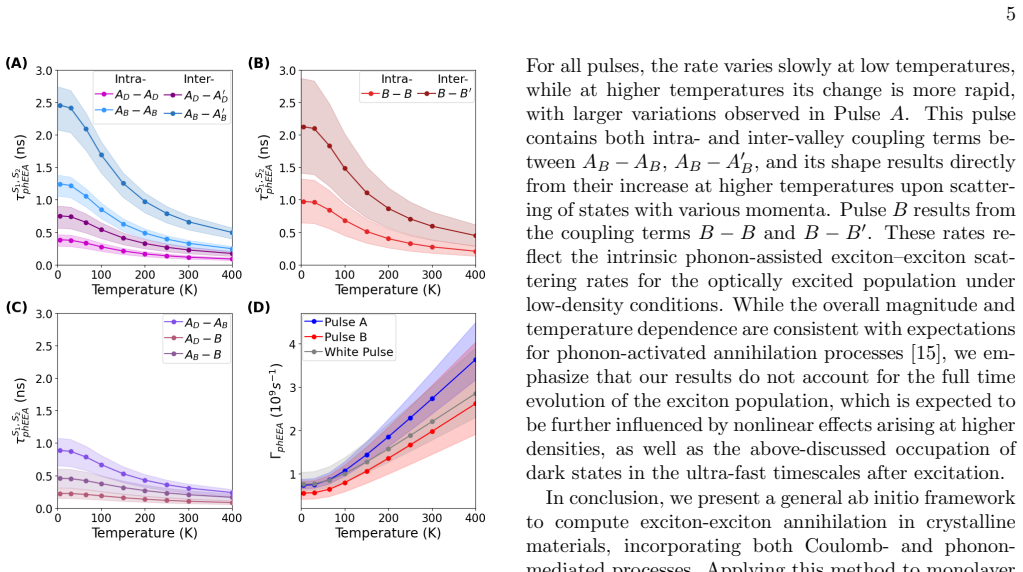
- [Fig. 4A-B and Eq. (7)] The temperature dependence of the phonon-assisted rates is not robust to the damping eta. The shaded regions in Fig. 4A-B show a large variation between eta = 10 and 20 meV, and SI Fig. 5B indicates that the denominator dominates the temperature and energy dependence. This weakens the attribution of the temperature-activated intervalley channels to the phonon Bose-Einstein population: the same trend could partly arise from the ad hoc damping parameter. The authors should separate the physical phonon-population effect from the artificial broadening and quantify how the reported temperature slopes change over the eta range.
- [Fig. 4C and concluding paragraph] There is an internal inconsistency about dark-dark phonon-assisted channels. In the paragraph describing Fig. 4, the paper states that single-phonon processes 'do not allow the dark-dark annihilation pathway for photoexcited excitons,' yet the concluding paragraph claims that the phonon-assisted process activates 'inter-valley, dark-dark, and dark-bright annihilation channels.' If the dark-dark pathway is not included in the calculation, the conclusion should be revised to say 'dark-bright' and 'inter-valley' only, or the calculation should be extended to two-phonon processes and the limitations updated accordingly.
minor comments (4)
- [Main text, exciton characterization paragraph] There are typos and spacing issues, e.g., 'exciotns 1,2' and inconsistent 'WSe 2' spacing; a careful proofreading pass is needed.
- [Eq. (2) vs Supplemental Material Eq. (13)] The sign convention in Eq. (2) uses alternating signs for the four diagram classes, whereas SI Eq. (13) writes all eight terms with explicit plus signs; the relationship between these presentations should be clarified for readers.
- [Reference list] The bibliography entries in the main text are not numbered in order of appearance (e.g., Quantum Espresso and BerkeleyGW citations appear as [1]-[3], [6], [7], [9] after [38]), and the Supplemental Material has its own separate numbering; the merged list should be renumbered consistently.
- [Abstract and conclusion] The abstract says 'picosecond-scale annihilation' while the conclusion says 'hundreds of picoseconds'; these are consistent only if different channels are meant, and the paper should state explicitly which processes are picosecond-scale and which are hundreds of picoseconds.
Circularity Check
The 'predominantly unbound electron-hole pairs' conclusion is fixed by the final-state basis of Eq. (5) rather than computed; the EEA rates themselves are not fit to experimental data.
-
self definitional
[Eqs. (5)-(6), Abstract/Conclusion, SI Section IV]
"Next, we compute the EEA scattering times: τ^{S1,S2}_{EEA}^{-1} = 2π/(ℏ N_k) Σ_{v,c,k} |V^{S1,S2}_{EEA}(v,c,k)|^2 ρ(ΔE) ... ΔE = (ϵ_{c,k} − ϵ_{v,k+Q1+Q2}) − (Ω_{S1,Q1} + Ω_{S2,Q2}) ... EEA occurs on timescales of hundreds of picoseconds and predominantly leads to the generation of unbound electron-hole pairs."
Equation (5) defines the EEA rate as a sum over noninteracting single-particle final states (v,c,k), with energy conservation enforced against the bare quasiparticle difference. No BSE kernel is applied to the final state, so bound high-energy exciton final states are absent from ρ(ΔE) by construction. The claim that EEA 'predominantly leads to the generation of unbound electron-hole pairs' is thus not a comparative prediction but a restatement of the chosen final-state basis; the paper also concedes it does not rule out high-lying excitonic final states. Because only free electron-hole pair final states are enumerated, the conclusion that unbound pairs are more common is forced by the definition of the rate, not by a calculation that includes both channels.
full rationale
The core EEA rates and couplings are computed from GW-BSE wavefunctions and DFPT phonon couplings rather than fitted to experimental EEA data, and no load-bearing self-citation chain appears: the cited methodological papers are independent computational tools. The broadening and damping parameters are manually chosen and the rates are sensitive to them, especially the 10–20 meV intermediate-state damping and the 40 meV energy-conservation broadening, but the paper reports convergence checks rather than presenting those parameters as predictions, so this is a parameter-sensitivity/correctness concern rather than circularity. The one construction-level circularity is the headline claim about unbound final states: Eq. (5) sums only over single-particle (v,c,k) final states, so the conclusion that EEA predominantly generates unbound electron-hole pairs is imposed by the final-state basis, not established against the alternative bound-exciton channel. For that central interpretive claim, the reduction is direct and by construction, giving a partial circularity score of 6.
Assumptions & free parameters
free parameters (4)
- Coulomb EEA broadening sigma =
40 meV
- Phonon-assisted energy-conservation broadening =
10 meV
- Intermediate-state damping eta =
10-20 meV
- Scissor shift =
unspecified
assumptions (5)
- domain assumption GW-BSE provides accurate exciton wavefunctions and energies
- domain assumption Tamm-Dancoff approximation is valid for the EEA matrix elements
- domain assumption Fermi's golden rule with a broadened delta function gives the EEA rate
- domain assumption Single-phonon processes dominate phonon-assisted EEA
- standard math DFT-PBE and G0W0 bandstructure are adequate starting points
Cite this review
Pith. "Pith review of Exciton-Exciton Annihilation Mediated by Many-Body Coulomb and Phonon Interactions: An Ab Initio Study." pith.science (2026). https://pith.science/paper/FWKFXW2A
@misc{pith2026250605223,
  author       = {Pith},
  title        = {Pith review of: Exciton-Exciton Annihilation Mediated by Many-Body Coulomb and Phonon Interactions: An Ab Initio Study},
  year         = {2026},
  howpublished = {\url{https://pith.science/paper/FWKFXW2A}},
  note         = {Machine review of arXiv:2506.05223}
}
abstract
Exciton-exciton annihilation (EEA), in which two excitons interact to generate high-energy excitations, is an important non-radiative channel in light-induced excited-state relaxation. When efficient, this process offers an alternative route to exciton emission, potentially allowing extended energetically excited particles' lifetime and coherence. These properties are significant in designing and understanding materials-based quantum devices, particularly for low-dimensional semiconductors. Here, we present a first-principles framework to compute EEA mechanisms and rates using many-body perturbation theory within the GW and Bethe-Salpeter Equation (GW-BSE) formalism. Our method explicitly accounts for Coulomb-driven and phonon-assisted exciton-exciton scattering by explicitly evaluating the interaction channels between the constituent electrons and holes composing the BSE excitons. We apply this framework to monolayer WSe$_2$ and explore the $A$, $B$ excitation manifolds, finding picosecond-scale annihilation between bright and dark states, cross valleys, and cross peak manifolds. These channels become allowed due to scattering into free electron-hole pairs across the Brillouin zone. Our results supply new insights into non-radiative exciton relaxation mechanisms in two-dimensional materials, providing a predictive and general tool for modeling these interactions in excitonic materials.
Figures


Figures from the paper (3 more)


Reference graph
Works this paper leans on
-
[1]
M. L. Cohen and S. G. Louie, Fundamentals of condensed matter physics (Cambridge University Press, 2016)
work page 2016
-
[2]
M. A. Nielsen and I. L. Chuang, Quantum computation and quantum information (Cambridge university press, 2010)
2010
-
[3]
S. Z. Butler, S. M. Hollen, L. Cao, Y. Cui, J. A. Gupta, H. R. Guti´ errez, T. F. Heinz, S. S. Hong, J. Huang, A. F. Ismach, et al., ACS nano 7, 2898 (2013)
work page 2013
-
[4]
G. Wang, A. Chernikov, M. M. Glazov, T. F. Heinz, X. Marie, T. Amand, and B. Urbaszek, Reviews of Mod- ern Physics 90, 021001 (2018)
work page 2018
-
[5]
J. R. Schaibley, H. Yu, G. Clark, P. Rivera, J. S. Ross, K. L. Seyler, W. Yao, and X. Xu, Nature Reviews Mate- rials 1, 1 (2016). 6
work page 2016
-
[6]
P. Cudazzo, I. V. Tokatly, and A. Rubio, Physical Review B—Condensed Matter and Materials Physics 84, 085406 (2011)
work page 2011
-
[7]
D. Y. Qiu, F. H. Da Jornada, and S. G. Louie, Physical Review B 93, 235435 (2016)
work page 2016
-
[8]
A. Chernikov, T. C. Berkelbach, H. M. Hill, A. Rigosi, Y. Li, B. Aslan, D. R. Reichman, M. S. Hybertsen, and T. F. Heinz, Physical review letters 113, 076802 (2014)
work page 2014
Show all 45 references
-
[9]
P. B. Deotare and Z. Mi, 2D Excitonic Materials and Devices, Vol. 112 (Elsevier, 2023)
2023
-
[10]
Moody, J
G. Moody, J. Schaibley, and X. Xu, Journal of the Optical Society of America B 33, C39 (2016)
2016
-
[11]
H.-Y. Chen, V. A. Jhalani, M. Palummo, and M. Bernardi, Physical Review B 100, 075135 (2019)
2019
-
[12]
N. S. Ginsberg and W. A. Tisdale, Annual review of phys- ical chemistry 71, 1 (2020)
2020
-
[13]
Linardy, D
E. Linardy, D. Yadav, D. Vella, I. A. Verzhbitskiy, K. Watanabe, T. Taniguchi, F. Pauly, M. Trushin, and G. Eda, Nano Letters 20, 1647 (2020)
2020
-
[14]
K.-Q. Lin, C. S. Ong, S. Bange, P. E. Faria Junior, B. Peng, J. D. Ziegler, J. Zipfel, C. B¨ auml, N. Paradiso, K. Watanabe, et al., Nature communications 12, 5500 (2021)
2021
-
[15]
Erkensten, S
D. Erkensten, S. Brem, K. Wagner, R. Gillen, R. Perea- Caus ´ ın, J. D. Ziegler, T. Taniguchi, K. Watanabe, J. Maultzsch, A. Chernikov, et al., Physical Review B 104, L241406 (2021)
2021
-
[16]
Steinhoff, F
A. Steinhoff, F. Jahnke, and M. Florian, Physical Review B 104, 155416 (2021)
2021
-
[17]
V. I. Klimov, A. A. Mikhailovsky, D. McBranch, C. A. Leatherdale, and M. G. Bawendi, Science 287, 1011 (2000)
2000
-
[18]
F. Wang, G. Dukovic, E. Knoesel, L. E. Brus, and T. F. Heinz, Physical Review B—Condensed Matter and Ma- terials Physics 70, 241403 (2004)
2004
-
[19]
Surrente, A
A. Surrente, A. Mitioglu, K. Galkowski, L. Klopotowski, W. Tabis, B. Vignolle, D. K. Maude, and P. Plochocka, Physical Review B 94, 075425 (2016)
2016
-
[20]
Plaud, L
A. Plaud, L. Schu´ e, K. Watanabe, T. Taniguchi, F. Fos- sard, F. Ducastelle, A. Loiseau, and J. Barjon, Applied Physics Letters 114 (2019)
2019
-
[21]
D. Sun, Y. Rao, G. A. Reider, G. Chen, Y. You, L. Br´ ezin, A. R. Harutyunyan, and T. F. Heinz, Nano letters 14, 5625 (2014)
2014
-
[22]
Kumar, Q
N. Kumar, Q. Cui, F. Ceballos, D. He, Y. Wang, and H. Zhao, Physical Review B 89, 125427 (2014)
2014
-
[23]
Mouri, Y
S. Mouri, Y. Miyauchi, M. Toh, W. Zhao, G. Eda, and K. Matsuda, Physical Review B 90, 155449 (2014)
2014
-
[24]
Xiao, G.-B
D. Xiao, G.-B. Liu, W. Feng, X. Xu, and W. Yao, Phys- ical review letters 108, 196802 (2012)
2012
-
[25]
Konabe and S
S. Konabe and S. Okada, Physical Review B 90, 155304 (2014)
2014
-
[26]
Chatterjee, D
E. Chatterjee, D. B. Soh, C. Rogers, D. J. Gray, and H. Mabuchi, Physical Review B 100, 155405 (2019)
2019
-
[27]
Deilmann, M
T. Deilmann, M. Dr¨ uppel, and M. Rohlfing, Physical Re- view Letters 116, 196804 (2016)
2016
-
[28]
Biswas, A
S. Biswas, A. Champagne, J. B. Haber, S. Pokawan- vit, J. Wong, H. Akbari, S. Krylyuk, K. Watanabe, T. Taniguchi, A. V. Davydov, et al., ACS nano 17, 7685 (2023)
2023
-
[29]
Torche and G
A. Torche and G. Bester, Communications Physics 4, 67 (2021)
2021
-
[31]
Giannozzi, S
P. Giannozzi, S. Baroni, N. Bonini, M. Calandra, R. Car, C. Cavazzoni, D. Ceresoli, G. L. Chiarotti, M. Cococ- cioni, I. Dabo, et al., Journal of physics: Condensed mat- ter 21, 395502 (2009)
2009
-
[35]
Deslippe, G
J. Deslippe, G. Samsonidze, D. A. Strubbe, M. Jain, M. L. Cohen, and S. G. Louie, Computer Physics Com- munications 183, 1269 (2012)
2012
-
[36]
D. Y. Qiu, T. Cao, and S. G. Louie, Physical review letters 115, 176801 (2015)
2015
-
[37]
H.-Y. Chen, D. Sangalli, and M. Bernardi, Physical Re- view Letters 125, 107401 (2020)
2020
-
[38]
Antonius and S
G. Antonius and S. G. Louie, Physical Review B 105, 085111 (2022). 7 Supplemental Material: Exciton-Exciton Annihilation Mediated by Many-Body Coulomb and Phonon Interactions: An Ab Initio Study Guy Vosco1 and Sivan Refaely-Abramson1 1 Department of Molecular Chemistry and Mat...
2022
-
[39]
Giannozzi, O
P. Giannozzi, O. Andreussi, T. Brumme, O. Bunau, M. B. Nardelli, M. Calandra, R. Car, C. Cavazzoni, D. Ceresoli, M. Cococcioni, et al., Journal of physics: Condensed matter 29, 465901 (2017)
2017
-
[40]
Giannozzi, S
P. Giannozzi, S. Baroni, N. Bonini, M. Calandra, R. Car, C. Cavazzoni, D. Ceresoli, G. L. Chiarotti, M. Cococcioni, I. Dabo, et al., Journal of physics: Condensed matter 21, 395502 (2009)
2009
-
[41]
Giannozzi, O
P. Giannozzi, O. Baseggio, P. Bonf` a, D. Brunato, R. Car, I. Carnimeo, C. Cavazzoni, S. De Gironcoli, P. Delugas, F. Ferrari Ruffino, et al., The Journal of chemical physics 152 (2020)
2020
-
[42]
J. P. Perdew, K. Burke, and M. Ernzerhof, Physical review letters 77, 3865 (1996)
1996
-
[43]
M. J. Van Setten, M. Giantomassi, E. Bousquet, M. J. Verstraete, D. R. Hamann, X. Gonze, and G.-M. Rignanese, Computer Physics Communications 226, 39 (2018)
2018
-
[44]
Deslippe, G
J. Deslippe, G. Samsonidze, D. A. Strubbe, M. Jain, M. L. Cohen, and S. G. Louie, Computer Physics Communications 183, 1269 (2012)
2012
-
[45]
M. S. Hybertsen and S. G. Louie, Physical Review B 34, 5390 (1986)
1986
-
[46]
F. H. da Jornada, D. Y. Qiu, and S. G. Louie, Physical Review B 95, 035109 (2017)
2017
-
[47]
Rohlfing and S
M. Rohlfing and S. G. Louie, Physical Review B 62, 4927 (2000)
2000
-
[48]
Giustino, Reviews of Modern Physics 89, 015003 (2017)
F. Giustino, Reviews of Modern Physics 89, 015003 (2017)
2017
-
[49]
Ponc´ e, E
S. Ponc´ e, E. R. Margine, C. Verdi, and F. Giustino, Computer Physics Communications 209, 116 (2016)
2016
Reviewed August 7, 2026 · model on record in the stance chip above.
Discussion (0). Sign in to comment.