REVIEW 3 major objections 5 minor 86 references
PHD: Personalized 3D Human Body Fitting with Point Diffusion
T0 review · 3 major / 5 minor · reviewed 2026-08-05 · deepseek-v4-flash
Pith's one-line read PHD's personalized shape prior plus point diffusion improves 3D pose from video, cutting MPJPE by up to 44 mm on EMDB1.
desk verdict A strong, well-engineered fitting pipeline with a new point-diffusion prior and personalized shape conditioning, but the absolute-pose SOTA claim is conditional on known focal length and a small benchmark. read the letter →
The pith
A machine-rendered reading of the paper's core claim, the machinery that carries it, and where it could break.
The reading
What carries the argument
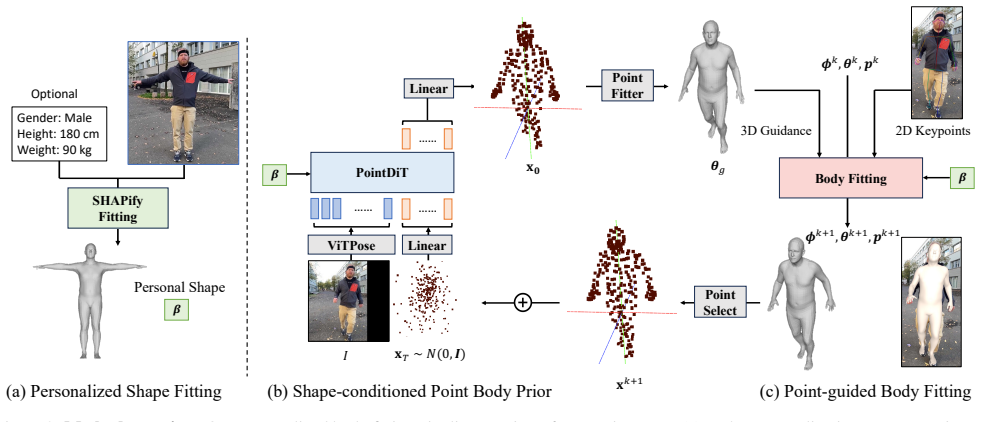
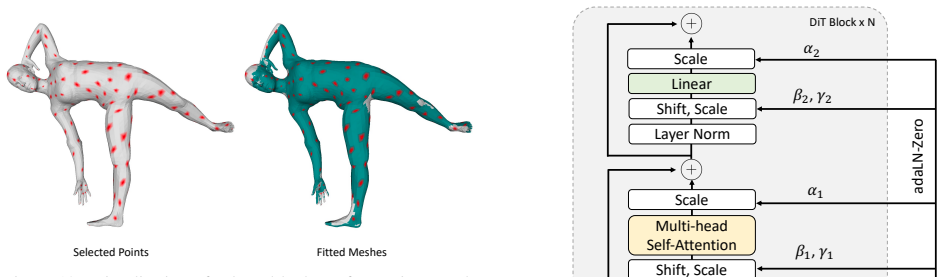
PointDiT is a rectified-flow diffusion transformer that denoises a point cloud of 238 SMPL surface vertices and 45 SMPL joints, conditioned on ViTPose image tokens and on the calibrated shape parameters, and trained only on the synthetic BEDLAM dataset. The Point Distillation Sampling loss converts each sampled point cloud back into SMPL pose parameters via the Point Fitter and back into 3D points via linear blend skinning, then penalizes disagreement with the current fit. SHAPify provides the personalized shape by optimizing rest-pose keypoints plus optional height and weight measurements. Together these pieces decouple shape estimation from pose fitting, which is what lets the 2D alignment
What would settle it
Evaluate PHD on sequences where the focal length is withheld or deliberately miscalibrated, comparing C-MPJPE and pelvis error against the same methods run with ground-truth focal length; if the absolute-pose gains shrink to the previous baseline level, the paper's headline absolute-pose claim fails. A second check is to run fitting with intentionally wrong shape parameters and observe whether the C-MPJPE advantage is lost.
Extended reading notes
Core claim
The central discovery is that a personalized, point-based 3D pose prior makes "regress-then-refine" body fitting robust to bad initializations and to the shape-versus-pose ambiguity that 2D-only fitting suffers from. Concretely, PHD conditions a diffusion prior on the calibrated body shape and image features, samples 283 SMPL body points instead of angular joint rotations, and uses the sampled points both to seed and to guide pose optimization via Point Distillation Sampling. The paper reports that on EMDB1 this reduces MPJPE by 44.0 mm over HMR2.0b initializations (73.2 vs 117.2) and by 7.8 mm over CameraHMR (62.5 vs 70.3), while the closest score-based baseline degrades CameraHMR by +4.6 m
Load-bearing premise
Absolute pose results assume the camera focal length is known and provided as input; the method estimates neither the focal length nor its variation, so if the focal length is unknown or miscalibrated the absolute pose advantage could disappear.
Editorial extensions
If this is right
- The same point-based prior, trained only on synthetic data, can replace angular pose priors in existing regress-then-refine pipelines and correct implausible poses that show almost no 2D error.
- Because shape is fixed per subject, pelvis position in camera coordinates becomes better determined, improving absolute pose metrics such as C-MPJPE and pelvis error alongside local metrics.
- The point-cloud representation of pose generalizes better to uncommon poses than 6D joint-rotation representations.
- The method runs at about 1 frame per second with 5 denoising steps, compared with about 3 seconds per frame for the closest score-guided baseline.
- Applying PHD on top of existing strong regressors such as HMR2.0b and CameraHMR improves their outputs without retraining them.
Reading between the lines
- A natural extension is to remove the known-focal-length assumption: if absolute pose gains persist when the focal length is estimated jointly from the image or sequence, the C-MPJPE result becomes much more broadly applicable.
- The shape-decoupling idea likely transfers to whole-body SMPL-X fitting, where a calibrated face and hand shape could similarly separate identity from articulation.
- The same point-distillation mechanism could be applied to other articulated objects, such as hands, animals, or robots, where surface points correlate with pose more directly than joint rotations.
- The paper's per-frame evaluation leaves temporal consistency open; extending PointDiT into a temporal model with motion conditioning is the obvious next step but would require more data than BEDLAM provides.
Editorial analysis
A structured set of objections, weighed in public.
Referee Report
Summary. The paper proposes PHD, a two-stage personalized 3D human mesh recovery pipeline. Stage one, SHAPify, calibrates a subject-specific SMPL shape from a single rest-pose image and optional height/weight measurements. Stage two uses a shape-conditioned point-cloud diffusion transformer, PointDiT, trained on synthetic BEDLAM data, as a 3D pose prior. A fitting loop alternately optimizes SMPL pose and pelvis parameters against a 2D reprojection objective and a Point Distillation Sampling loss derived from the diffusion prior. On the EMDB1 benchmark, the method reports large improvements over ScoreHMR and existing regressors, particularly in absolute pose metrics (C-MPJPE, Pelvis Err.), and claims a new state of the art on EMDB for both pelvis-aligned and absolute pose accuracy. Supplementary experiments on 3DPW show smaller, sometimes marginal, gains.
Significance. If the results hold, the paper makes a valuable contribution: decoupling personal shape from pose estimation is a sensible and under-explored direction; the point-cloud representation for a body prior is a clear innovation relative to angular representations; and the plug-and-play nature with off-the-shelf regressors is practically useful. The method is data-efficient, trained only on synthetic BEDLAM, and the authors provide code and models. The claimed improvements in absolute pose accuracy, if robust, would be significant for AR/VR and performance capture. However, the headline claims currently rest on a small evaluation set and on a controlled camera-calibration assumption, which tempers the significance until those conditions are examined.
major comments (3)
- [Sec. 4.1 / Eq. (10) / Tables 2] All absolute pose results (C-MPJPE, Pelvis Err.) in Table 2 are obtained under the protocol of Sec. 4.1, which gives the ground-truth camera focal length to every method. The fitting objective in Eq. (10) projects joints through this focal length, and the method has no module to estimate or refine f (Sec. 3.3 and Supp. 6.3). Since depth is recovered via perspective projection, a small multiplicative error in f translates into a proportional error in pelvis depth. The paper's headline differentiator is exactly this absolute-pose accuracy, and the Limitations section (Sec. 8.3) does not mention the dependence on known intrinsics. I request a sensitivity analysis (e.g., perturb f by ±2%, ±5% and report C-MPJPE) or a clear statement that the method targets applications with calibrated cameras.
- [Sec. 4.2 / Table 1 (Sample init.) / Table 4] The 'Sample init.' comparison between ScoreHMR and PHD is not controlled for body shape. In Table 1, the ScoreHMR row is not marked with the * used elsewhere for 're-run with the same shape and focal length', while PHD uses SHAPify's calibrated shape. Table 5 shows that replacing the shape can change C-MPJPE by more than 50 mm (e.g., 170.8 → 115.8). Thus the large margin in the sample-init rows and in Table 4 may reflect the shape prior rather than the advantage of the point-cloud representation. Please provide a controlled comparison (ScoreHMR/Sample init. using the SHAPify shape) and, if available, the angular-representation variant with the same shape conditioning.
- [Sec. 4.1 / Tables 1–3] Sec. 4.1 states that all experiments and ablations use the EMDB1 split, which has 10 subjects. The central claims of a new state of the art (Sec. 4.2, Tables 1 and 2) therefore rest on a small population. The supplementary 3DPW results (Table 7) show smaller and sometimes negative gains (e.g., MPJPE -1.2 mm for HMR2.0b init. vs. EMDB -44.0 mm). I ask for per-subject breakdowns or confidence intervals on EMDB1, and a discussion of how representative this population is for the claimed generality of personalized fitting.
minor comments (5)
- [Supp. Sec. 6.2] Typo: 'PointDit' should be 'PointDiT'.
- [Table 1 and Table 2] The notation '(±x.x)' for improvements is not consistently defined; clarify in the caption whether parentheses indicate change relative to the initialization row.
- [Sec. 4.2] The phrase 'identical inputs' for the ScoreHMR comparison is not precise about whether the SHAPify shape was used; the * marker is only defined in table captions and not in the main text.
- [Sec. 4.1 / Supp. 6.4] The paper says 'we extract 2D keypoints using Sapiens' in the supplementary, but Sec. 4.1 does not specify which detector was used for the main results; make the evaluation setup self-contained.
- [Sec. 8.3] The Limitations section does not mention the need for a calibration frame in a rest pose, although the personalization stage (Sec. 3.1) explicitly assumes one. Please add this to the discussion.
Circularity Check
No significant circularity: PHD's reported gains are tied to external benchmarks and independently specified training objectives, not to a fitted or renamed version of the evaluation metric.
full rationale
The derivation chain is self-contained against external evidence. PointDiT is trained with the conditional flow-matching objective Eq. (6) on BEDLAM ground-truth meshes; SHAPify is an optimization over Eq. (1)-(3) using 2D keypoints and body measurements; and the fitting objective Eq. (9)-(10) combines a 2D reprojection term with the sampled point-cloud prior. The EMDB ground-truth SMPL poses/shapes are used only for evaluation, not for training or for fitting the loss weights or the point set. The comparison against ScoreHMR uses identical inputs and the same focal length (Sec. 4.1: "we provide all methods with the ground-truth camera focal length"), so the reported C-MPJPE improvements are conditional on that calibration assumption, but this is an external-validity limitation, not a circular reduction: the focal length is an input given to all methods, not a parameter fitted to EMDB errors. The 238-vertex/45-joint point representation was chosen for the accuracy of the NLF Point Fitter, an external module; choosing a representation that a fixed external fitter can invert is a design choice, not a prediction that reduces to its own input. The paper's self-citations (EMDB, Vid2Avatar) provide datasets and related-work context, not uniqueness theorems or unverified premises. No equation or metric is defined in terms of the method's own output, and no fitted parameter is renamed as a prediction. Sec. 8.3 lists other limitations (2D keypoint errors, temporal smoothness, speed) but omits the focal-length dependence; that omission is a completeness issue for the C-MPJPE claim, but it does not make the derivation circular. The central SOTA claim therefore has independent content.
Assumptions & free parameters
free parameters (5)
- SHAPify regularization weights (lambda_beta, lambda_h, lambda_w) =
0.1/100/10 with measurements, 1/1/1 without
- Fitting hyperparameters (lambda_data=1.0, lambda_prior=100, lambda_p=0.1, lambda_phi=0.1, lambda_theta=1.0) =
set in Supp. 6.3
- Optimization schedule (100 iterations, resample every 10 iterations, noise level t/T=0.75) =
stated in Sec. 3.3 and Supp. 6.3
- Point cloud composition (238 vertices + 45 joints) =
chosen by Point Fitter accuracy in NLF [61]
- SHAPify pelvis depth initialization Z = f * SW_SMPL / SW_kp =
formula in Supp. 6.1
assumptions (5)
- domain assumption SMPL is an adequate body model and its LBS function is differentiable and accurate enough for point-to-pose conversion.
- domain assumption The camera focal length is known and provided as ground truth during evaluation.
- domain assumption 2D keypoints from Sapiens are accurate enough that remaining error can be corrected by the prior.
- domain assumption BEDLAM synthetic data covers the pose and shape distribution needed for real test distributions.
- standard math Rectified flow / SD3 training recipes transfer from image diffusion to point-cloud generation.
invented entities (3)
-
PointDiT / PoseDiT (shape-conditioned point diffusion prior)
independent evidence
-
SHAPify (personalized shape calibration)
independent evidence
-
Point Distillation Sampling loss
Cite this review
Pith. "Pith review of PHD: Personalized 3D Human Body Fitting with Point Diffusion." pith.science (2026). https://pith.science/paper/FWTHLWUG
@misc{pith2026250821257,
  author       = {Pith},
  title        = {Pith review of: PHD: Personalized 3D Human Body Fitting with Point Diffusion},
  year         = {2026},
  howpublished = {\url{https://pith.science/paper/FWTHLWUG}},
  note         = {Machine review of arXiv:2508.21257}
}
read the original abstract
We introduce PHD, a novel approach for personalized 3D human mesh recovery (HMR) and body fitting that leverages user-specific shape information to improve pose estimation accuracy from videos. Traditional HMR methods are designed to be user-agnostic and optimized for generalization. While these methods often refine poses using constraints derived from the 2D image to improve alignment, this process compromises 3D accuracy by failing to jointly account for person-specific body shapes and the plausibility of 3D poses. In contrast, our pipeline decouples this process by first calibrating the user's body shape and then employing a personalized pose fitting process conditioned on that shape. To achieve this, we develop a body shape-conditioned 3D pose prior, implemented as a Point Diffusion Transformer, which iteratively guides the pose fitting via a Point Distillation Sampling loss. This learned 3D pose prior effectively mitigates errors arising from an over-reliance on 2D constraints. Consequently, our approach improves not only pelvis-aligned pose accuracy but also absolute pose accuracy -- an important metric often overlooked by prior work. Furthermore, our method is highly data-efficient, requiring only synthetic data for training, and serves as a versatile plug-and-play module that can be seamlessly integrated with existing 3D pose estimators to enhance their performance. Project page: https://phd-pose.github.io/
Figures


Figures from the paper (12 more)






Reference graph
Works this paper leans on
-
[1]
Pose-conditioned joint an- gle limits for 3d human pose reconstruction
Ijaz Akhter and Michael J Black. Pose-conditioned joint an- gle limits for 3d human pose reconstruction. In Proceed- ings of the IEEE Conference on Computer Vision and Pattern Recognition (CVPR), pages 1446–1455, 2015. 3
2015
-
[2]
Black, Priyanka Patel, Joachim Tesch, and Jin- long Yang
Michael J. Black, Priyanka Patel, Joachim Tesch, and Jin- long Yang. BEDLAM: A synthetic dataset of bodies exhibit- ing detailed lifelike animated motion. In Proceedings of the IEEE Conference on Computer Vision and Pattern Recogni- tion (CVPR), pages 8726–8737, 2023. 2, 5, 6, 14
2023
-
[3]
Federica Bogo, Angjoo Kanazawa, Christoph Lassner, Peter Gehler, Javier Romero, and Michael J. Black. Keep it SMPL: Automatic estimation of 3D human pose and shape from a single image. In Proceedings of the European Conference on Computer Vision (ECCV), 2016. 2, 3, 4, 7, 15
2016
-
[4]
SMPLer-X: Scaling up expressive human pose and shape estimation
Zhongang Cai, Wanqi Yin, Ailing Zeng, Chen Wei, Qing- ping Sun, Wang Yanjun, Hui En Pang, Haiyi Mei, Mingyuan Zhang, Lei Zhang, Chen Change Loy, Lei Yang, and Zi- wei Liu. SMPLer-X: Scaling up expressive human pose and shape estimation. In Advances in Neural Information Pro- cessing Systems (NeurIPS), 2023. 3
2023
-
[5]
Generative approach for probabilistic human mesh recovery using diffusion models
Hanbyel Cho and Junmo Kim. Generative approach for probabilistic human mesh recovery using diffusion models. In Proceedings of the IEEE/CVF International Conference on Computer Vision (ICCV) Workshops , pages 4183–4188,
-
[6]
Cross- attention of disentangled modalities for 3d human mesh re- covery with transformers
Junhyeong Cho, Kim Youwang, and Tae-Hyun Oh. Cross- attention of disentangled modalities for 3d human mesh re- covery with transformers. In Proceedings of the European Conference on Computer Vision (ECCV) , pages 342–359. Springer, 2022. 3
2022
-
[7]
Accurate 3d body shape regression using metric and semantic attributes
Vasileios Choutas, Lea M ¨uller, Chun-Hao P Huang, Siyu Tang, Dimitrios Tzionas, and Michael J Black. Accurate 3d body shape regression using metric and semantic attributes. In Proceedings of the IEEE Conference on Computer Vision and Pattern Recognition (CVPR) , pages 2718–2728, 2022. 4, 7, 15
work page 2022
-
[8]
Learned vertex descent: A new direction for 3d human model fitting
Enric Corona, Gerard Pons-Moll, Guillem Aleny `a, and Francesc Moreno-Noguer. Learned vertex descent: A new direction for 3d human model fitting. In Proceedings of the IEEE Conference on Computer Vision and Pattern Recogni- tion (CVPR), 2022. 3, 18
work page 2022
Show all 86 references
-
[9]
An image is worth 16x16 words: Transformers for image recognition at scale
Alexey Dosovitskiy, Lucas Beyer, Alexander Kolesnikov, Dirk Weissenborn, Xiaohua Zhai, Thomas Unterthiner, Mostafa Dehghani, Matthias Minderer, Georg Heigold, Syl- vain Gelly, Jakob Uszkoreit, and Neil Houlsby. An image is worth 16x16 words: Transformers for image recognition ...
2021
-
[10]
Sai Kumar Dwivedi, Nikos Athanasiou, Muhammed Ko- cabas, and Michael J. Black. Learning to regress bodies from images using differentiable semantic rendering. In Proceed- ings of the IEEE International Conference on Computer Vi- sion (ICCV), pages 11230–11239, 2021. 3
2021
-
[11]
Poco: 3d pose and shape estimation with confidence
Sai Kumar Dwivedi, Cordelia Schmid, Hongwei Yi, Michael J Black, and Dimitrios Tzionas. Poco: 3d pose and shape estimation with confidence. In International Confer- ence on 3D Vision (3DV), pages 85–95. IEEE, 2024. 3
2024
-
[12]
Sai Kumar Dwivedi, Yu Sun, Priyanka Patel, Yao Feng, and Michael J. Black. TokenHMR: Advancing human mesh re- covery with a tokenized pose representation. In Proceed- ings of the IEEE Conference on Computer Vision and Pattern Recognition (CVPR), 2024. 3, 7, 14, 16
2024
-
[13]
Scaling recti- fied flow transformers for high-resolution image synthesis
Patrick Esser, Sumith Kulal, Andreas Blattmann, Rahim Entezari, Jonas M ¨uller, Harry Saini, Yam Levi, Dominik Lorenz, Axel Sauer, Frederic Boesel, et al. Scaling recti- fied flow transformers for high-resolution image synthesis. In International Conference on Machine Learning...
-
[14]
Hierarchical kine- matic human mesh recovery
Georgios Georgakis, Ren Li, Srikrishna Karanam, Terrence Chen, Jana Ko ˇseck´a, and Ziyan Wu. Hierarchical kine- matic human mesh recovery. In Proceedings of the Euro- pean Conference on Computer Vision (ECCV) , pages 768–
-
[15]
Humans in 4D: Reconstructing and tracking humans with transformers
Shubham Goel, Georgios Pavlakos, Jathushan Rajasegaran, Angjoo Kanazawa*, and Jitendra Malik*. Humans in 4D: Reconstructing and tracking humans with transformers. In Proceedings of the IEEE International Conference on Com- puter Vision (ICCV), 2023. 2, 3, 7, 15, 16
2023
-
[16]
Densepose: Dense human pose estimation in the wild
Rıza Alp G ¨uler, Natalia Neverova, and Iasonas Kokkinos. Densepose: Dense human pose estimation in the wild. In Proceedings of the IEEE Conference on Computer Vision and Pattern Recognition (CVPR), 2018. 3
2018
-
[17]
Vid2avatar: 3d avatar reconstruction from videos in the wild via self-supervised scene decomposition
Chen Guo, Tianjian Jiang, Xu Chen, Jie Song, and Otmar Hilliges. Vid2avatar: 3d avatar reconstruction from videos in the wild via self-supervised scene decomposition. In Pro- ceedings of the IEEE Conference on Computer Vision and Pattern Recognition (CVPR), 2023. 2, 8, 17
2023
-
[18]
Vid2avatar-pro: Authentic avatar from videos in the wild via universal prior
Chen Guo, Junxuan Li, Yash Kant, Yaser Sheikh, Shunsuke Saito, and Chen Cao. Vid2avatar-pro: Authentic avatar from videos in the wild via universal prior. In Proceedings of the IEEE Conference on Computer Vision and Pattern Recogni- tion (CVPR), 2025. 2, 17
2025
-
[19]
Livecap: Real-time human performance capture from monocular video
Marc Habermann, Weipeng Xu, Michael Zollh ¨ofer, Gerard Pons-Moll, and Christian Theobalt. Livecap: Real-time human performance capture from monocular video. ACM Transactions on Graphics (TOG) , 38(2):14:1–14:17, 2019. 3
2019
-
[20]
Nrdf: Neural riemannian distance fields for learning articulated pose priors
Yannan He, Garvita Tiwari, Tolga Birdal, Jan Eric Lenssen, and Gerard Pons-Moll. Nrdf: Neural riemannian distance fields for learning articulated pose priors. In Proceedings of the IEEE Conference on Computer Vision and Pattern Recognition (CVPR), 2024. 3
2024
-
[21]
Ren- der in-between: Motion guided video synthesis for action interpolation
Hsuan-I Ho, Xu Chen, Jie Song, and Otmar Hilliges. Ren- der in-between: Motion guided video synthesis for action interpolation. In Proceedings of the British Machine Vision Conference (BMVC), 2021. 3
2021
-
[22]
Denoising dif- fusion probabilistic models
Jonathan Ho, Ajay Jain, and Pieter Abbeel. Denoising dif- fusion probabilistic models. In Advances in Neural Informa- tion Processing Systems (NeurIPS), pages 6840–6851. Cur- ran Associates, Inc., 2020. 4
2020
-
[23]
Human3.6m: Large scale datasets and predic- tive methods for 3d human sensing in natural environments
Catalin Ionescu, Dragos Papava, Vlad Olaru, and Cristian Sminchisescu. Human3.6m: Large scale datasets and predic- tive methods for 3d human sensing in natural environments. 9 IEEE Transactions on Pattern Analysis and Machine Intelli- gence (TPAMI), 2014. 16
2014
-
[24]
In- stantavatar: Learning avatars from monocular video in 60 seconds
Tianjian Jiang, Xu Chen, Jie Song, and Otmar Hilliges. In- stantavatar: Learning avatars from monocular video in 60 seconds. Proceedings of the IEEE Conference on Computer Vision and Pattern Recognition (CVPR), 2023. 2
2023
-
[25]
Worldpose: A world cup dataset for global 3d human pose estimation
Tianjian Jiang, Johsan Billingham, Sebastian M ¨uksch, Juan Zarate, Nicolas Evans, Martin Oswald, Marc Pollefeys, Ot- mar Hilliges, Manuel Kaufmann, and Jie Song. Worldpose: A world cup dataset for global 3d human pose estimation. Proceedings of the European Conference on Comp...
2024
-
[26]
Total cap- ture: A 3d deformation model for tracking faces, hands, and bodies
Hanbyul Joo, Tomas Simon, and Yaser Sheikh. Total cap- ture: A 3d deformation model for tracking faces, hands, and bodies. In Proceedings of the IEEE Conference on Computer Vision and Pattern Recognition (CVPR), 2018. 3
2018
-
[27]
Exem- plar fine-tuning for 3d human model fitting towards in-the- wild 3d human pose estimation
Hanbyul Joo, Natalia Neverova, and Andrea Vedaldi. Exem- plar fine-tuning for 3d human model fitting towards in-the- wild 3d human pose estimation. In International Conference on 3D Vision (3DV), pages 42–52, 2021. 3
2021
-
[28]
End-to-end recovery of human shape and pose
Angjoo Kanazawa, Michael J Black, David W Jacobs, and Jitendra Malik. End-to-end recovery of human shape and pose. In Proceedings of the IEEE Conference on Computer Vision and Pattern Recognition (CVPR) , pages 7122–7131,
-
[29]
Learning 3d human dynamics from video
Angjoo Kanazawa, Jason Y Zhang, Panna Felsen, and Jiten- dra Malik. Learning 3d human dynamics from video. InPro- ceedings of the IEEE Conference on Computer Vision and Pattern Recognition (CVPR), pages 5614–5623, 2019. 3
2019
-
[30]
Convolutional autoen- coders for human motion infilling
Manuel Kaufmann, Emre Aksan, Jie Song, Fabrizio Pece, Remo Ziegler, and Otmar Hilliges. Convolutional autoen- coders for human motion infilling. In International Confer- ence on 3D Vision (3DV). IEEE, 2020. 3
2020
-
[31]
EMDB: The Electromagnetic Database of Global 3D Human Pose and Shape in the Wild
Manuel Kaufmann, Jie Song, Chen Guo, Kaiyue Shen, Tian- jian Jiang, Chengcheng Tang, Juan Jos ´e Z ´arate, and Otmar Hilliges. EMDB: The Electromagnetic Database of Global 3D Human Pose and Shape in the Wild. InProceedings of the IEEE International Conference on Computer Visio...
-
[32]
Sapiens: Foundation for human vision mod- els
Rawal Khirodkar, Timur Bagautdinov, Julieta Martinez, Su Zhaoen, Austin James, Peter Selednik, Stuart Anderson, and Shunsuke Saito. Sapiens: Foundation for human vision mod- els. In Proceedings of the European Conference on Com- puter Vision (ECCV), pages 206–228. Springer, 2024. 14
2024
-
[33]
Muhammed Kocabas, Nikos Athanasiou, and Michael J. Black. Vibe: Video inference for human body pose and shape estimation. In Proceedings of the IEEE Conference on Computer Vision and Pattern Recognition (CVPR), 2020. 2, 3
2020
-
[34]
Huang, Otmar Hilliges, and Michael J
Muhammed Kocabas, Chun-Hao P. Huang, Otmar Hilliges, and Michael J. Black. PARE: Part attention regressor for 3D human body estimation. In Proceedings of the IEEE In- ternational Conference on Computer Vision (ICCV) , pages 11127–11137. IEEE, 2021. 3, 8, 16
2021
-
[35]
Huang, Joachim Tesch, Lea M ¨uller, Otmar Hilliges, and Michael J
Muhammed Kocabas, Chun-Hao P. Huang, Joachim Tesch, Lea M ¨uller, Otmar Hilliges, and Michael J. Black. SPEC: Seeing people in the wild with an estimated camera. In Pro- ceedings of the IEEE International Conference on Computer Vision (ICCV), pages 11035–11045. IEEE, 2021. 6
2021
-
[36]
Learning to reconstruct 3d human pose and shape via model-fitting in the loop
Nikos Kolotouros, Georgios Pavlakos, Michael J Black, and Kostas Daniilidis. Learning to reconstruct 3d human pose and shape via model-fitting in the loop. InProceedings of the IEEE International Conference on Computer Vision (ICCV),
-
[37]
Convolutional mesh regression for single-image hu- man shape reconstruction
Nikos Kolotouros, Georgios Pavlakos, and Kostas Dani- ilidis. Convolutional mesh regression for single-image hu- man shape reconstruction. In Proceedings of the IEEE Conference on Computer Vision and Pattern Recognition (CVPR), pages 4501–4510, 2019. 3
2019
-
[38]
Probabilistic modeling for human mesh recovery
Nikos Kolotouros, Georgios Pavlakos, Dinesh Jayaraman, and Kostas Daniilidis. Probabilistic modeling for human mesh recovery. In Proceedings of the IEEE International Conference on Computer Vision (ICCV), 2021. 2, 3, 5
2021
-
[39]
Unite the peo- ple: Closing the loop between 3d and 2d human representa- tions
Christoph Lassner, Javier Romero, Martin Kiefel, Federica Bogo, Michael J Black, and Peter V Gehler. Unite the peo- ple: Closing the loop between 3d and 2d human representa- tions. In Proceedings of the IEEE Conference on Computer Vision and Pattern Recognition (CVPR) , pages ...
-
[40]
Hybrik: A hybrid analytical-neural inverse kinematics solution for 3d human pose and shape estimation
Jiefeng Li, Chao Xu, Zhicun Chen, Siyuan Bian, Lixin Yang, and Cewu Lu. Hybrik: A hybrid analytical-neural inverse kinematics solution for 3d human pose and shape estimation. In Proceedings of the IEEE Conference on Computer Vision and Pattern Recognition (CVPR), pages 3383–33...
2021
-
[41]
Cliff: Carrying location information in full frames into human pose and shape estimation
Zhihao Li, Jianzhuang Liu, Zhensong Zhang, Songcen Xu, and Youliang Yan. Cliff: Carrying location information in full frames into human pose and shape estimation. In Pro- ceedings of the European Conference on Computer Vision (ECCV), pages 590–606. Springer, 2022. 3
2022
-
[42]
One-stage 3d whole-body mesh recovery with compo- nent aware transformer
Jing Lin, Ailing Zeng, Haoqian Wang, Lei Zhang, and Yu Li. One-stage 3d whole-body mesh recovery with compo- nent aware transformer. In Proceedings of the IEEE Confer- ence on Computer Vision and Pattern Recognition (CVPR) , pages 21159–21168, 2023. 3
2023
-
[43]
Mesh graphormer
Kevin Lin, Lijuan Wang, and Zicheng Liu. Mesh graphormer. In Proceedings of the IEEE International Con- ference on Computer Vision (ICCV) , pages 12939–12948,
-
[44]
Flow straight and fast: Learning to generate and transfer data with rectified flow
Xingchao Liu, Chengyue Gong, and Qiang Liu. Flow straight and fast: Learning to generate and transfer data with rectified flow. Proceedings of the International Conference on Learning Representations (ICLR), 2023. 4, 14
2023
-
[45]
Matthew Loper, Naureen Mahmood, Javier Romero, Gerard Pons-Moll, and Michael J. Black. SMPL: A skinned multi- person linear model. ACM Transactions on Graphics (TOG), 34(6):248:1–248:16, 2015. 3
2015
-
[46]
Avatarpose: Avatar-guided 3d pose estimation of close hu- man interaction from sparse multi-view videos
Feichi Lu, Zijian Dong, Jie Song, and Otmar Hilliges. Avatarpose: Avatar-guided 3d pose estimation of close hu- man interaction from sparse multi-view videos. In Pro- ceedings of the European Conference on Computer Vision (ECCV), 2024. 17
2024
-
[47]
Dposer: Diffusion model as robust 3d human pose prior
Junzhe Lu, Jing Lin, Hongkun Dou, Ailing Zeng, Yue Deng, Yulun Zhang, and Haoqian Wang. Dposer: Diffusion model as robust 3d human pose prior. arxiv:2312.05541, 2023. 3 10
2023 arXiv
-
[48]
Leveraging anthropometric measurements to improve human mesh estimation and ensure consistent body shapes
Katja Ludwig, Julian Lorenz, Daniel Kienzle, Tuan Bui, and Rainer Lienhart. Leveraging anthropometric measurements to improve human mesh estimation and ensure consistent body shapes. arXiv preprint arXiv:2409.17671 , 2024. 3, 15
2024 arXiv
-
[49]
Monocular 3d human pose estimation in the wild using improved cnn supervision
Dushyant Mehta, Helge Rhodin, Dan Casas, Pascal Fua, Oleksandr Sotnychenko, Weipeng Xu, and Christian Theobalt. Monocular 3d human pose estimation in the wild using improved cnn supervision. In International Confer- ence on 3D Vision (3DV). IEEE, 2017. 16
2017
-
[50]
Neuralannot: Neural annotator for 3d human mesh training sets
Gyeongsik Moon, Hongsuk Choi, and Kyoung Mu Lee. Neuralannot: Neural annotator for 3d human mesh training sets. In Proceedings of the IEEE Conference on Computer Vision and Pattern Recognition (CVPR) , pages 2299–2307,
-
[51]
Expressive whole-body 3D gaussian avatar
Gyeongsik Moon, Takaaki Shiratori, and Shunsuke Saito. Expressive whole-body 3D gaussian avatar. In Proceedings of the European Conference on Computer Vision (ECCV) ,
-
[52]
Neural body fitting: Unifying deep learning and model based human pose and shape es- timation
Mohamed Omran, Christoph Lassner, Gerard Pons-Moll, Pe- ter Gehler, and Bernt Schiele. Neural body fitting: Unifying deep learning and model based human pose and shape es- timation. In International Conference on 3D Vision (3DV) , pages 484–494. IEEE, 2018. 3
2018
-
[53]
Maxime Oquab, Timoth ´ee Darcet, Th´eo Moutakanni, Huy V . V o, Marc Szafraniec, Vasil Khalidov, Pierre Fernandez, Daniel HAZIZA, Francisco Massa, Alaaeldin El-Nouby, Mido Assran, Nicolas Ballas, Wojciech Galuba, Russell Howes, Po-Yao Huang, Shang-Wen Li, Ishan Misra, Michael ...
2024
-
[54]
Camerahmr: Aligning people with perspective
Priyanka Patel and Michael J Black. Camerahmr: Aligning people with perspective. In International Conference on 3D Vision (3DV), 2025. 2, 3, 7, 15, 16
2025
-
[55]
Expressive body capture: 3d hands, face, and body from a single image
Georgios Pavlakos, Vasileios Choutas, Nima Ghorbani, Timo Bolkart, Ahmed AA Osman, Dimitrios Tzionas, and Michael J Black. Expressive body capture: 3d hands, face, and body from a single image. In Proceedings of the IEEE Conference on Computer Vision and Pattern Recognition (C...
2019
-
[56]
Scalable diffusion models with transformers
William Peebles and Saining Xie. Scalable diffusion models with transformers. In Proceedings of the IEEE International Conference on Computer Vision (ICCV), pages 4195–4205,
-
[57]
Barron, and Ben Milden- hall
Ben Poole, Ajay Jain, Jonathan T. Barron, and Ben Milden- hall. Dreamfusion: Text-to-3d using 2d diffusion. Proceed- ings of the International Conference on Learning Represen- tations (ICLR), 2023. 5
2023
-
[58]
Davis Rempe, Tolga Birdal, Aaron Hertzmann, Jimei Yang, Srinath Sridhar, and Leonidas J. Guibas. Humor: 3d human motion model for robust pose estimation. In Proceedings of the IEEE International Conference on Computer Vision (ICCV), 2021. 3
2021
-
[59]
Model-based outdoor perfor- mance capture
Nadia Robertini, Dan Casas, Helge Rhodin, Hans-Peter Sei- del, and Christian Theobalt. Model-based outdoor perfor- mance capture. In International Conference on 3D Vision (3DV), 2016. 3
2016
-
[60]
Genhmr: Generative human mesh recovery, 2024
Muhammad Usama Saleem, Ekkasit Pinyoanuntapong, Pu Wang, Hongfei Xue, Srijan Das, and Chen Chen. Genhmr: Generative human mesh recovery, 2024. 3
2024
-
[61]
Neural localizer fields for continuous 3d human pose and shape estimation
Istv ´an S´ar´andi and Gerard Pons-Moll. Neural localizer fields for continuous 3d human pose and shape estimation. In Ad- vances in Neural Information Processing Systems (NeurIPS),
-
[62]
Metric-scale truncation-robust heatmaps for 3d hu- man pose estimation
Istv ´an S ´ar´andi, Timm Linder, Kai O Arras, and Bastian Leibe. Metric-scale truncation-robust heatmaps for 3d hu- man pose estimation. In 2020 15th IEEE International Con- ference on Automatic Face and Gesture Recognition (FG 2020), pages 407–414. IEEE, 2020. 3
2020
-
[63]
Hu- maniflow: Ancestor-conditioned normalising flows on so (3) manifolds for human pose and shape distribution estimation
Akash Sengupta, Ignas Budvytis, and Roberto Cipolla. Hu- maniflow: Ancestor-conditioned normalising flows on so (3) manifolds for human pose and shape distribution estimation. In Proceedings of the IEEE Conference on Computer Vision and Pattern Recognition (CVPR), pages 4779–4...
2023
-
[64]
World-grounded human motion recovery via gravity-view coordinates
Zehong Shen, Huaijin Pi, Yan Xia, Zhi Cen, Sida Peng, Zechen Hu, Hujun Bao, Ruizhen Hu, and Xiaowei Zhou. World-grounded human motion recovery via gravity-view coordinates. In SIGGRAPH Asia Conference Proceedings ,
-
[65]
Soyong Shin, Juyong Kim, Eni Halilaj, and Michael J. Black. Wham: Reconstructing world-grounded humans with accu- rate 3d motion. In Proceedings of the IEEE Conference on Computer Vision and Pattern Recognition (CVPR), 2024. 3, 8, 15, 16, 17
2024
-
[66]
Human body model fitting by learned gradient descent
Jie Song, Xu Chen, and Otmar Hilliges. Human body model fitting by learned gradient descent. In Proceedings of the European Conference on Computer Vision (ECCV), 2020. 2, 3, 16, 18
2020
-
[67]
Score-guided diffusion for 3d human recovery
Anastasis Stathopoulos, Ligong Han, and Dimitris Metaxas. Score-guided diffusion for 3d human recovery. In Proceed- ings of the IEEE Conference on Computer Vision and Pattern Recognition (CVPR), 2024. 2, 3, 5, 6, 7, 8, 14, 15, 16, 17
2024
-
[68]
Aios: All-in-one-stage expressive human pose and shape estimation
Qingping Sun, Yanjun Wang, Ailing Zeng, Wanqi Yin, Chen Wei, Wenjia Wang, Haiyi Mei, Chi-Sing Leung, Ziwei Liu, Lei Yang, et al. Aios: All-in-one-stage expressive human pose and shape estimation. In Proceedings of the IEEE Conference on Computer Vision and Pattern Recognition ...
2024
-
[69]
Monocular, One-stage, Regression of Multiple 3D People
Yu Sun, Qian Bao, Wu Liu, Yili Fu, Black Michael J., and Tao Mei. Monocular, One-stage, Regression of Multiple 3D People. In Proceedings of the IEEE International Confer- ence on Computer Vision (ICCV), 2021
2021
-
[70]
Putting People in their Place: Monocular Regression of 3D People in Depth
Yu Sun, Wu Liu, Qian Bao, Yili Fu, Tao Mei, and Michael J Black. Putting People in their Place: Monocular Regression of 3D People in Depth. In Proceedings of the IEEE Confer- ence on Computer Vision and Pattern Recognition (CVPR) ,
-
[71]
Yu Sun, Qian Bao, Wu Liu, Tao Mei, and Michael J. Black. TRACE: 5D Temporal Regression of Avatars with Dynamic Cameras in 3D Environments. In Proceedings of the IEEE Conference on Computer Vision and Pattern Recognition (CVPR), 2023. 3 11
2023
-
[72]
Pose-ndf: Modeling human pose manifolds with neural distance fields
Garvita Tiwari, Dimitrije Antic, Jan Eric Lenssen, Nikolaos Sarafianos, Tony Tung, and Gerard Pons-Moll. Pose-ndf: Modeling human pose manifolds with neural distance fields. In Proceedings of the European Conference on Computer Vi- sion (ECCV), 2022. 3
2022
-
[73]
Recovering ac- curate 3d human pose in the wild using imus and a mov- ing camera
Timo V on Marcard, Roberto Henschel, Michael J Black, Bodo Rosenhahn, and Gerard Pons-Moll. Recovering ac- curate 3d human pose in the wild using imus and a mov- ing camera. In Proceedings of the European Conference on Computer Vision (ECCV), pages 601–617, 2018. 6, 15, 16
2018
-
[74]
Refit: Recurrent fitting network for 3d human recovery
Yufu Wang and Kostas Daniilidis. Refit: Recurrent fitting network for 3d human recovery. In Proceedings of the IEEE International Conference on Computer Vision (ICCV), 2023. 3, 16
2023
-
[75]
Freeman, Rahul Sukthankar, and Cristian Smin- chisescu
Hongyi Xu, Eduard Gabriel Bazavan, Andrei Zanfir, William T. Freeman, Rahul Sukthankar, and Cristian Smin- chisescu. Ghum & ghuml: Generative 3d human shape and articulated pose models. In Proceedings of the IEEE Confer- ence on Computer Vision and Pattern Recognition (CVPR) ,
-
[76]
Monoperfcap: Human performance capture from monocular video
Weipeng Xu, Avishek Chatterjee, Michael Zollh ¨ofer, Helge Rhodin, Dushyant Mehta, Hans-Peter Seidel, and Christian Theobalt. Monoperfcap: Human performance capture from monocular video. ACM Transactions on Graphics (TOG), 37 (2):27:1–27:15, 2018. 3, 17
2018
-
[77]
ViTPose: Simple vision transformer baselines for human pose estimation
Yufei Xu, Jing Zhang, Qiming Zhang, and Dacheng Tao. ViTPose: Simple vision transformer baselines for human pose estimation. In Advances in Neural Information Pro- cessing Systems (NeurIPS), 2022. 3, 5, 13
2022
-
[78]
Decoupling human and camera motion from videos in the wild
Vickie Ye, Georgios Pavlakos, Jitendra Malik, and Angjoo Kanazawa. Decoupling human and camera motion from videos in the wild. In Proceedings of the IEEE Conference on Computer Vision and Pattern Recognition (CVPR), 2023. 17
2023
-
[79]
Glamr: Global occlusion-aware human mesh re- covery with dynamic cameras
Ye Yuan, Umar Iqbal, Pavlo Molchanov, Kris Kitani, and Jan Kautz. Glamr: Global occlusion-aware human mesh re- covery with dynamic cameras. In Proceedings of the IEEE Conference on Computer Vision and Pattern Recognition (CVPR), 2022. 17
2022
-
[80]
Black, and Siyu Tang
Yan Zhang, Michael J. Black, and Siyu Tang. We are more than our joints: Predicting how 3D bodies move. InProceed- ings of the IEEE Conference on Computer Vision and Pattern Recognition (CVPR), 2021. 3
2021
-
[81]
Sparsefu- sion: Dynamic human avatar modeling from sparse rgbd im- ages
Xinxin Zuo, Sen Wang, Jiangbin Zheng, Weiwei Yu, Minglun Gong, Ruigang Yang, and Li Cheng. Sparsefu- sion: Dynamic human avatar modeling from sparse rgbd im- ages. IEEE Transactions Multimedia (TMM), 23:1617–1629,
-
[84]
Implementation Details 6.1. SHAPify Details In the optimization of SHAPify, we initialize the pose pa- rameters θ as the rest pose (T-/I-pose) and the pelvis posi- tion p to: p = [ xp − cx f Z, yp − cy f Z, Z], (11) where f is the camera focal length and(xp, yp), (cx, cy) are ...
-
[85]
Shape Estimation We visualize the results of SHAPify against existing meth- ods on EMDB in Fig
More Experimental Results 7.1. Shape Estimation We visualize the results of SHAPify against existing meth- ods on EMDB in Fig. 9. Even on a simple T-pose image, existing methods predict shapes with significant errors, par- ticularly when subjects wear loose-fitting clothing, s...
-
[86]
Applications Our method is beneficial for in-the-wild avatar reconstruc- tion [17, 18, 51, 76]
Discussion 8.1. Applications Our method is beneficial for in-the-wild avatar reconstruc- tion [17, 18, 51, 76]. Existing avatar reconstruction methods all require accurate pose fitting as a starting point, with the most common practice being to use the averaged shape from a re...
-
[2021]
Importance of weight regularization
15 12 PHD: Personalized 3D Human Body Fitting with Point Diffusion Supplementary Material ShapeFitting𝜆!=0ShapeFitting𝜆!=1 Figure 7. Importance of weight regularization. While the body height is correct, without weight regularization, the fitting is prone to converge at high B...
-
[2024]
2, 3, 5, 7, 14, 15, 16
Reviewed August 5, 2026 · model on record in the stance chip above.
Discussion (0). Sign in to comment.