REVIEW 3 major objections 4 minor 1 cited by
The Affine Tamari Lattice
T0 review · 3 major / 4 minor · reviewed 2026-08-08 · deepseek-v4-flash
Pith's one-line read New Tamari lattices in affine type have Catalan-counted elements
desk verdict A substantial new family of finite lattices with a real but patchable proof gap in the semidistributivity of the affine member. read the letter →
The pith
A machine-rendered reading of the paper's core claim, the machinery that carries it, and where it could break.
The reading
What carries the argument
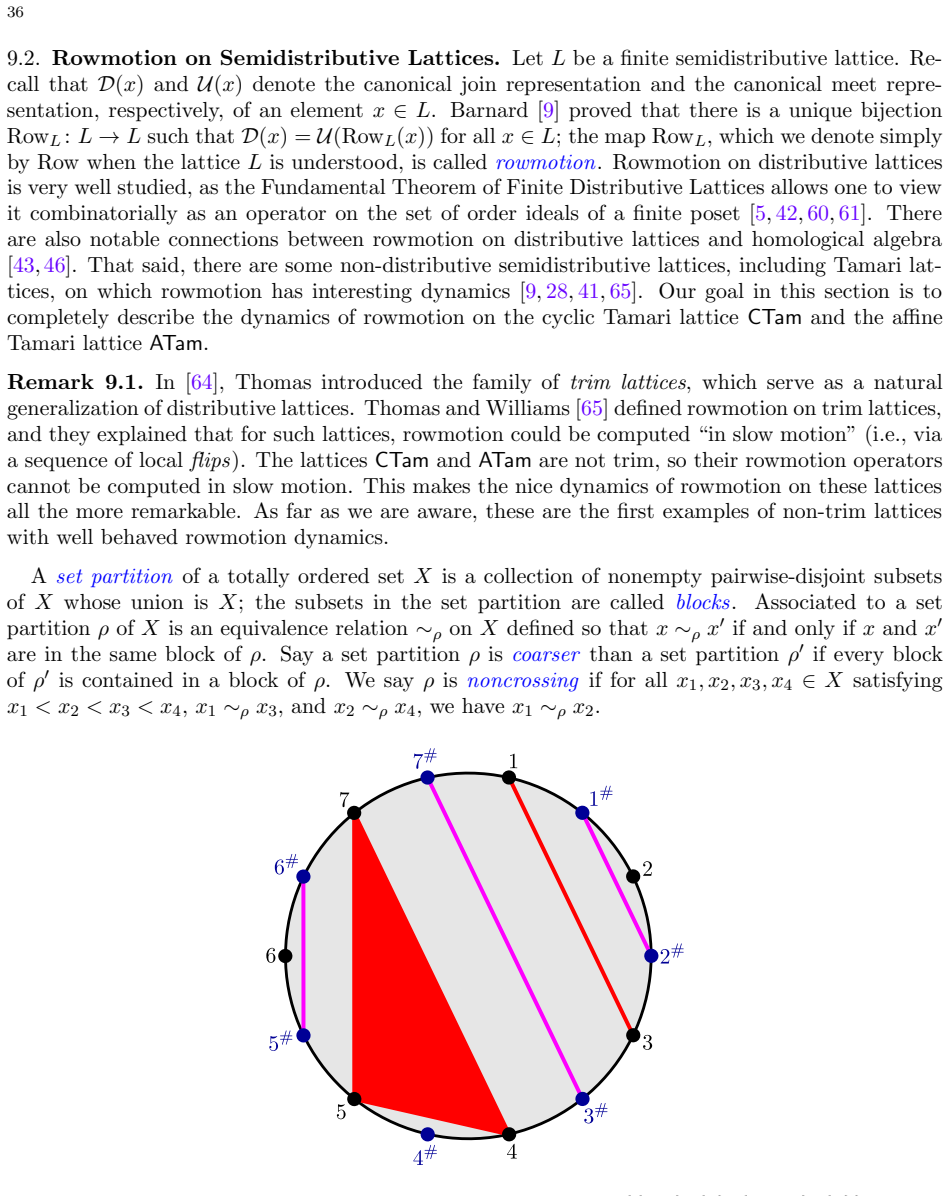
The central objects are translation-invariant total orders (TITOs): total orders $\preceq$ on $\mathbb{Z}$ with $a \preceq b$ iff $a+n \preceq b+n$. Their inversion sets $\mathrm{Inv}(\preceq)$, taken up to simultaneous translation, are ordered by inclusion to form the cyclic Dyer lattice $\mathrm{CDyer}$; the real TITOs, in which every singleton block is waxing, form the Dyer lattice. The argument is carried by the restriction to 312-avoiding TITOs, which are compact and therefore governed by their noncrossing arc diagrams of lower walls; the companion theorem that each compact TITO is uniquely determined by its diagram yields the Catalan counts. Alongside this, translation-invariant binary in-ordered trees (TIBITs) provide the mechanism for the lattice structure: the map sending a TITO to its binary insertion tree defines the cyclic sylvester congruence, under which $\mathrm{CTam}$ is the quotient, while the spine-flip maps realize $\mathrm{ATam}$ as a quotient of $\mathrm{CTam}$.
What would settle it
Enumerate the real 312-avoiding translation-invariant total orders for $n=4$; the paper predicts exactly $\frac{3n-2}{n}\binom{2n-2}{n-1}=50$ elements, so any other count—or a pair of distinct such orders with the same noncrossing lower-wall diagram—would refute the central bijection behind the lattice sizes.
Extended reading notes
Core claim
The paper's central claim is that the cyclic Dyer lattice—the poset of all translation-invariant total orders on $\mathbb{Z}$ ordered by containment of inversion sets—contains a finite 312-avoiding sublattice $\mathrm{CTam}$, and that its real part contains a further quotient $\mathrm{ATam}$; both are genuine lattices with rich structure. The construction deliberately uses the Dyer order rather than the affine weak order, because the 312-avoiding affine permutations do not form a lattice. The authors prove that $\mathrm{CTam}$ is both a sublattice and a quotient of the cyclic Dyer lattice, that $\mathrm{ATam}$ is a quotient of $\mathrm{CTam}$ and of the Dyer lattice, and that both lattices are self-dual and semidistributive. They establish the cardinalities $\mathrm{Cat}_{B_n}$ and $\mathrm{Cat}_{D_n}$ through a bijection between 312-avoiding TITOs and noncrossing arc diagrams in an annulus, and they identify the Hasse diagram of $\mathrm{ATam}$ with the type-$D_n$ cluster exchange graph. They further show that rowmotion on these lattices has orbit structure governed by Kreweras complement and cyclic sieving, and that maximal green sequences for the associated algebras have exactly the predicted length intervals.
Load-bearing premise
The whole construction rests on the companion theorem, quoted rather than proved, that a compact translation-invariant total order is uniquely determined by the noncrossing picture of its downward cover relations; if that uniqueness failed, the Catalan counts and the rowmotion identification would lose their foundation.
Editorial extensions
If this is right
- $\mathrm{CTam}$ and $\mathrm{ATam}$ are finite lattice quotients of the infinite cyclic Dyer lattice, so the otherwise-infinite affine Dyer order has finite 312-avoiding cores with Catalan cardinalities.
- The Hasse diagram of $\mathrm{ATam}$ is isomorphic to the type-$D_n$ cluster exchange graph via triangulations of a punctured $n$-gon; consequently, cover relations in $\mathrm{ATam}$ are cluster mutations.
- The lengths of maximal green sequences for the completed path algebra of the oriented $n$-cycle are exactly $[2n-1,\binom{n+1}{2}]$, and for the affine Tamari algebra exactly $[2n-2,\binom{n+1}{2}-1]$.
- Rowmotion on $\mathrm{CTam}$ is dynamically equivalent to Kreweras complement on type-$B$ noncrossing partitions, exhibiting cyclic sieving with $\mathrm{Cat}_{B_n}(q)$; on $\mathrm{ATam}$ the orbit structure is likewise governed by an explicit cyclic sieving polynomial.
- Both lattices are self-dual, semidistributive, and have $n$-regular Hasse diagrams, and their canonical join-and-meet decompositions are described explicitly by relations on annular arcs.
Reading between the lines
- The same 312-avoiding TITO recipe might produce finite lattice quotients for other affine Coxeter types, since the Dyer-order framework is not specific to type $\widetilde{A}_{n-1}$; the obstruction is finding the right analogue of the compact-TITO bijection.
- The maximal-green-sequence interval for $\mathrm{CQ}$ likely transfers to every finite-dimensional quotient of the oriented-cycle path algebra whose brick set coincides with that of $\mathrm{CQ}$, which would give a broader class of Nakayama algebras with known sequence lengths.
- Because $\mathrm{CTam}$ and $\mathrm{ATam}$ are examples of non-trim semidistributive lattices with well-behaved rowmotion, their ornamentation and arc models are natural testing grounds for pop-stack operators and shard intersection orders, questions the authors list as future work.
- The dynamical equivalence between rowmotion and Kreweras complement suggests that rowmotion on other semidistributive quotients of affine Dyer lattices could be analyzed through noncrossing partition dynamics, potentially yielding further cyclic sieving instances.
Editorial analysis
A structured set of objections, weighed in public.
Referee Report
Summary. The paper introduces two new finite lattices, the cyclic Tamari lattice CTam and the affine Tamari lattice ATam, defined as subposets of the cyclic Dyer lattice and the Dyer lattice of translation-invariant total orders (TITOs). It establishes that their cardinalities are the type B_n and type D_n Catalan numbers, that they are self-dual, and that they admit numerous combinatorial models: TIBITs, noncrossing arc diagrams, torsion classes of two Nakayama algebras, and type D triangulations. It also describes their FTFSDL factorizations, proves that the lengths of maximal chains are exactly the stated intervals, and analyzes rowmotion via the cyclic sieving phenomenon.
Significance. The paper proposes a natural affine analogue of the Tamari lattice, with rich incarnations and strong structural results. The main strengths are the explicit bijections between combinatorial models, the use of the Dyer lattice as a unifying framework, and the derived cyclic sieving results. If the central claims are correct, these lattices constitute new and interesting examples in the study of semidistributive lattices and their dynamics. The paper is generally well organized and the combinatorial constructions are presented with care, including several detailed examples (e.g., Example 3.2, Figure 6, Example 7.17). However, one load-bearing point in the proof of semidistributivity of ATam is not justified, and a key bijection is imported from an unpublished companion preprint, so the present version is not fully self-contained.
major comments (3)
- [Section 1; Theorem 4.15] The only stated justification for the semidistributivity of ATam is the sentence 'Because the cyclic Dyer lattice is semidistributive, we deduce that the cyclic and affine Tamari lattices are as well.' For CTam this is valid, since Theorem 4.13 proves that CTam is a sublattice of CDyer and semidistributivity is inherited by sublattices. However, for ATam the paper provides only Theorem 4.15, which makes ATam a lattice quotient of CTam. Homomorphic images of semidistributive lattices need not be semidistributive; for example, the diamond M3 fails semidistributivity but is a quotient of a free lattice. The paper offers no special property of the spine congruence to rule this out. This gap is load-bearing: Section 5 defines the map κ and the FTFSDL factorization of ATam before Theorem 5.5, and Section 9 defines rowmotion on ATam via Barnard's theorem, both of which require ATam to be semidistributive.
- [Section 6, Proposition 6.3] The proof of Proposition 6.3 does not establish the isomorphism between ATamTors and ATam312 independently. The proof provided for CTamTors relies on Theorem 5.5, whose statement for ATam already presupposes the unproved semidistributivity of ATam. The paper does not state or prove the affine analogue of Proposition 6.4 (the bijection between affine arc torsion classes and torsion classes for AQ), which is the natural way to obtain an independent proof. Therefore, Proposition 6.3 cannot serve as an alternative justification of semidistributivity. The authors should either prove directly that the spine congruence quotient preserves semidistributivity, or prove the bijection between ATam and ATamTors using the arc torsion class description from Remark 5.10 together with an affine version of Proposition 6.4, and then deduce semidistributivity from Lemma 6.2.
- [Section 5, Proposition 5.1] The bijection between 312-avoiding TITOs and noncrossing arc diagrams, which underlies the cardinality computation in Corollary 5.2 and the transfer of Kreweras-complement dynamics to rowmotion, is quoted from the companion preprint [6, Theorem 4.12] and is not proved in the present paper. The paper explicitly defers to [6] in the proof of Proposition 5.1. Since the companion is unpublished (though available on arXiv), the reader cannot verify this foundational step from the present manuscript alone. The authors should state the exact theorem from [6] that is being used and ideally summarize its proof, or at minimum clarify the status of [6] relative to this paper.
minor comments (4)
- [Section 3.2] In the paragraph defining pattern avoidance, the sentence 'We say ⪯ is 312-avoiding (respectively, 312-avoiding) if no three integers form a 312-pattern (respectively, a 312-pattern) in ⪯' appears garbled; the two displayed terms are likely meant to be different (e.g., '312-avoiding' and '132-avoiding'), and the intended distinction should be clarified.
- [Section 3.2, Lemma 3.7] The phrase 'any small enough a ∈ I2' is vague; it would be clearer to state that one selects a ∈ I2 with c−n < a < c, which exists because blocks have no minimal or maximal elements.
- [Section 9.4] The formula Row_{π↓≡(L)} = π↓≡ ∘ Row_L is stated without proof or reference. Since this formula is used to compute rowmotion on ATam from that on CTam, a proof or a precise citation to Barnard's work would help the reader.
- [Section 9.3, Proposition 9.2] The proof uses the fact that the Hasse diagram of CTam is n-regular (Proposition 4.14) to conclude |D(⪯)| + |D(Row(⪯))| = n. The argument is correct once one recalls that D(Row(⪯)) = U(Row(⪯)) by the definition of rowmotion, but this equality is not repeated here; a one-line clarification would improve readability.
Circularity Check
No circular derivation; the paper's new lattice constructions and rowmotion results are proved from definitions, with foundational TITO facts imported from the authors' companion papers as independent support.
full rationale
The central claims—that the 312-avoiding TITOs form the cyclic and affine Tamari lattices, that these are sublattices and quotients of the cyclic Dyer lattice, that the TIBIT and arc-diagram models are isomorphic, and that rowmotion satisfies the stated cyclic sieving results—are derived in the text from explicit definitions and internal lemmas. The main external inputs are results from the authors' own prior work: Proposition 3.4 ([6]) gives semidistributivity of CDyer and Dyer, Proposition 3.5 ([6,7]) gives the cover-flip characterization, and Proposition 5.1 imports [6, Theorem 4.12] to assert that a compact TITO is uniquely determined by its noncrossing arc diagram. These are parameter-free theorems whose assumptions do not include the present paper's target conclusions, so under the stated rules they count as genuine evidence rather than circular reductions. One non-circular rigor gap should be noted: Section 1 states 'Because the cyclic Dyer lattice is semidistributive, we deduce that the cyclic and affine Tamari lattices are as well'; the affine part does not follow, since ATam is only a lattice quotient of CTam (Theorem 4.15) and quotients of semidistributive lattices need not be semidistributive. This leaves the FTFSDL and rowmotion results for ATam less rigorously supported, but this is a missing-proof/correctness concern, not a circularity. No fitted parameter is relabeled as a prediction, and no known pattern is merely renamed.
Assumptions & free parameters
assumptions (8)
- standard math An equivalence relation on a complete lattice is a complete congruence iff its classes are intervals and the two projection maps are order-preserving (Proposition 2.1, from [54]).
- domain assumption CDyer and Dyer are completely semidistributive lattices, and the map pi_down_Dyer is a surjective complete lattice homomorphism (Proposition 3.4, quoted from [6]).
- domain assumption Every cover in the Dyer or cyclic Dyer lattice is realized by a unique wall flip (Proposition 3.5, from [6,7]).
- domain assumption Every compact TITO is uniquely determined by its noncrossing arc diagram ([6, Theorem 4.12]).
- standard math The Fundamental Theorem of Finite Semidistributive Lattices: a finite semidistributive lattice is determined by its join-irreducibles and the relations ->, ->, -> ([57]).
- standard math For a finite-dimensional algebra of finite representation type, the torsion classes form a semidistributive lattice whose join-irreducibles are the bricks (Lemma 6.2, from [57]).
- domain assumption The algebras CQ and AQ are Nakayama algebras with finite representation type, and their indecomposable modules are exactly the string modules Ma,b ([1,11]).
- domain assumption The Armstrong-Stump-Thomas theorem: the type B noncrossing partitions under Kreweras complement exhibit cyclic sieving with CatBn(q) ([5]).
Cite this review
Pith. "Pith review of The Affine Tamari Lattice." pith.science (2026). https://pith.science/paper/FX53P2AD
@misc{pith2026250207198,
  author       = {Pith},
  title        = {Pith review of: The Affine Tamari Lattice},
  year         = {2026},
  howpublished = {\url{https://pith.science/paper/FX53P2AD}},
  note         = {Machine review of arXiv:2502.07198}
}
abstract
Given a fixed integer $n\geq 2$, we construct two new finite lattices that we call the cyclic Tamari lattice and the affine Tamari lattice. The cyclic Tamari lattice is a sublattice and a quotient lattice of the cyclic Dyer lattice, which is the infinite lattice of translation-invariant total orders under containment of inversion sets. The affine Tamari lattice is a quotient of the Dyer lattice, which in turn is a quotient of the cyclic Dyer lattice and is isomorphic to the collection of biclosed sets of the root system of type $\widetilde{A}_{n-1}$ under inclusion. We provide numerous combinatorial and algebraic descriptions of these lattices using translation-invariant total orders, translation-invariant binary in-ordered trees, noncrossing arc diagrams, torsion classes, triangulations, and translation-invariant noncrossing partitions. The cardinalities of the cyclic and affine Tamari lattices are the Catalan numbers of types $B_n$ and $D_n$, respectively. We show that these lattices are self-dual and semidistributive, and we describe their decompositions coming from the Fundamental Theorem of Finite Semidistributive Lattices. We also show that the rowmotion operators on these lattices have well-behaved orbit structures, which we describe via the cyclic sieving phenomenon. Our new combinatorial framework allows us to prove that the lengths of maximal green sequences for the completed path algebra of the oriented $n$-cycle are precisely the integers in the interval $[2n-1,\binom{n+1}{2}]$.
Figures


Figures from the paper (15 more)




Forward citations
Cited by 1 Pith paper
-
Computing Tools for Translation-Invariant Total Orders
TITO_Explore implements canonical window normalization, inversion-set computation, O(n^{2}) weak-order comparison by residue-class partitions, and join via a weighted digraph transitive-closure procedure for period-n TITOs.
Reference graph
Works this paper leans on
-
[6]
G. T. Barkley. Extended weak order for the affine symmetric group. Preprint arXiv:2502.05875
-
[1]
T. Adachi. The classification of τ -tilting modules over Nakayama algebras. J. Algebra, 452 (2016), 227–262
work page 2016
- [2]
-
[3]
K. Ajran and C. Defant. The pop-stack operator on ornamentation lattices. Preprint: arXiv:2501.10311
-
[4]
P.J. Apruzzese and K. Igusa. Stability conditions for affine type A. Algebr. Represent. Theory, 23 (2020), 2079– 2111
work page 2020
-
[5]
D. Armstrong, C. Stump, and H. Thomas. A uniform bijection between nonnesting and noncrossing partitions. Trans. Amer. Math. Soc. , 365 (2013), 4121–4151
work page 2013
-
[7]
G. T. Barkley and D. E. Speyer. Combinatorial descriptions of biclosed sets in affine type. Comb. Theory , 4 (2024)
work page 2024
-
[8]
G. T. Barkley and D. E. Speyer. Affine extended weak order is a lattice. Preprint arXiv:2311.05737
Show all 63 references
-
[9]
E. Barnard. The canonical join complex. Electron. J. Combin. , 26 (2019)
2019
-
[10]
Barnard, C
E. Barnard, C. Defant, and E. J. Hanson. Pop-stack operators for torsion classes and Cambrian lattices. Preprint arXiv:2312.03959
-
[11]
Baur and R
K. Baur and R. Coelho Sim˜ oes. A geometric model for the module category of a string algebra. Preprint arXiv:2403.07810
-
[14]
Bousquet-M´ elou, E
M. Bousquet-M´ elou, E. Fusy, and L.-F. Pr´ eville-Ratelle. The number of intervals in the m-Tamari lattices. Electron. J. Combin. , 18 (2011)
2011
-
[15]
Br¨ ustle, D
T. Br¨ ustle, D. Smith, and H. Treffinger. Wall and chamber structure for finite-dimensional algebras.Adv. Math., 354 (2019)
2019
-
[16]
Br¨ ustle and D
T. Br¨ ustle and D. Yang. Ordered exchange graphs, in Advances in representation theory of algebras , 135–193, EMS Ser. Congr. Rep., Eur. Math. Soc., Z¨ urich
-
[17]
von Bell, R
M. von Bell, R. S. Gonz´ alez D’Le´ on, F. A. Mayorga Cetina, and M. Yip. A unifying framework for theν-Tamari lattice and principal order ideals in Young’s lattice. Combinatorica, 43 (2023), 479–504
2023
-
[18]
Bousquet-M´ elou, G
M. Bousquet-M´ elou, G. Chapuy, and L.-F. Pr´ eville-Ratelle. The representation of the symmetric group on m- Tamari intervals. Adv. Math., 247 (2013), 309–342
2013
-
[19]
Ceballos and C
C. Ceballos and C. Chenevi` ere. On linear intervals in the alt ν-Tamari lattices. Comb. Theory, 4 (2024)
2024
-
[20]
Ceballos, A
C. Ceballos, A. Padrol, and C. Sarmiento. Geometry of ν-Tamari lattices in types A and B. Trans. Amer. Math. Soc., 371 (2019), 2575–2622
2019
-
[21]
Ceballos and V
C. Ceballos and V. Pilaud. The diameter of type D associahedra and the non-leaving-face property. European J. Combin. , 51 (2016), 109–124
2016
-
[22]
Chapoton, S
F. Chapoton, S. Fomin, and A. Zelevinsky. Polytopal realizations of generalized associahedra. Canad. Math. Bull., 45 (2002), 537–566
2002
-
[23]
Chenevi` ere
C. Chenevi` ere. Linear intervals in the Tamari and the Dyck lattices and in the alt-Tamari posets. Preprint arXiv:2209.00418
-
[24]
Choi and N
Y. Choi and N. Sun. The image of the Pop operator on various lattices. Adv. Appl. Math. , 154 (2024)
2024
-
[25]
A. Crites. Enumerating pattern avoidance for affine permutations. Electron. J. Combin. , 17 (2010)
2010
-
[26]
C. Defant. Pop-stack-sorting for Coxeter groups. Comb. Theory, 2 (2022)
2022
-
[27]
C. Defant. Meeting covered elements in ν-Tamari lattices. Adv. Appl. Math. , 134 (2022)
2022
-
[28]
Defant and J
C. Defant and J. Lin, Rowmotion on m-Tamari and biCambrian lattices. Comb. Theory, 4 (2024)
2024
- [29]
-
[30]
Defant and N
C. Defant and N. Williams. Semidistrim lattices. Forum Math. Sigma , 11 (2023)
2023
-
[31]
Demonet, O
L. Demonet, O. Iyama, N. Reading, I. Reiten, H. Thomas. Lattice theory of torsion classes: beyond τ -tilting theory. Trans. Amer. Math. Soc. Ser. B , 10 (2023), 542–612
2023
-
[32]
M. Dyer. Quotients of twisted Bruhat orders. J. Algebra, 163 (1994), 861–879
1994
-
[33]
M. Dyer. On the weak order of Coxeter groups. Canad. J. Math. , 71 (2019), 299–336
2019
-
[34]
J. Fei. Tropical F -polynomials and general presentations. J. Lond. Math. Soc. , 107 (2023), 2079–2120
2023
-
[35]
Fomin, L
S. Fomin, L. Williams, and A. Zelevinsky. Introduction to cluster algebras. Chapters 4-5. Preprint arXiv:1707.07190
-
[36]
Freese, J
R. Freese, J. Jeˇ zek, and J. B. Nation. Free lattices, volume 42 of Mathematical Surveys and Monographs. American Mathematical Society, Providence, RI, 1995
1995
-
[37]
Garver and T
A. Garver and T. McConville. Lattice properties of oriented exchange graphs and torsion classes. Algebr. Rep- resent. Theory, 22 (2019), 43–78. 45
2019
-
[38]
Garver, T
A. Garver, T. McConville, and K. Serhiyenko. Minimal length maximal green sequences. Adv. in Appl. Math. , 96 (2018), 76–138
2018
-
[39]
Gorsky and N
M. Gorsky and N. J. Williams. A structural view of maximal green sequences. Preprint: arXiv:2301.08681
-
[40]
L. Hong. The pop-stack-sorting operator on Tamari lattices. Adv. Appl. Math. , 139 (2022)
2022
-
[41]
S. Hopkins. The CDE property for skew vexillary permutations. J. Combin. Theory, Ser. A , 168 (2019)
2019
-
[42]
S. Hopkins. Order polynomial product formulas and poset dynamics. In: Open Problems in Algebraic Combina- torics, Proceedings of Symposia in Pure Mathematics, 110, 2024
2024
-
[43]
Iyama and R
O. Iyama and R. Marczinzik. Distributive lattices and Auslander regular algebras. Adv. Math., 398 (2022)
2022
-
[44]
Keller and L
B. Keller and L. Demonet. A survey on maximal green sequences, in Representation theory and beyond, 267–286, Contemp. Math., 758, Amer. Math. Soc., RI
-
[45]
R. Laking. String algebras in representation theory, Ph.D. Thesis, University of Manchester, 2016
2016
-
[46]
Marczinzik, H
R. Marczinzik, H. Thomas, and E. Yıldırım. On the interaction of the Coxeter transformation and the rowmotion bijection. J. Comb. Algebra , 8 (2024), 359–374
2024
-
[47]
H. M¨ uhle. The core label order of a congruence-uniform lattice. Algebra Universalis, 80 (2019)
2019
-
[48]
Muller-Hoissen, J
F. Muller-Hoissen, J. M. Pallo, and J. Stasheff, editors. Associahedra, Tamari Lattices and Related Structures. Tamari Memorial Festschrift, volume 299 of Progress in Mathematics. Springer, New York, 2012
2012
-
[49]
Nakanishi and A
T. Nakanishi and A. V. Zelevinsky, On tropical dualities in cluster algebras, in Algebraic groups and quantum groups, 217–226, Contemp. Math., 565, Amer. Math. Soc., Providence, RI
-
[50]
Padrol, V
A. Padrol, V. Pilaud, and J. Ritter. Shard polytopes. Int. Math. Res. Not. IMRN , 2023 (2023), 7686–7796
2023
-
[51]
Pilaud and Y
V. Pilaud and Y. Palu. Non-kissing complexes and tau-tilting theory for gentle algebras. Mem. Amer. Math. Soc., 274 (2021)
2021
-
[52]
Pr´ eville-Ratelle and X
L.-F. Pr´ eville-Ratelle and X. Viennot. An extension of Tamari lattices. Trans. Amer. Math. Soc. 369 (2017), 5219–5239
2017
-
[53]
N. Reading. Cambrian lattices. Adv. Math., 205 (2006), 313–353
2006
-
[54]
N. Reading. Lattice theory of the poset of regions, in Lattice Theory: Special Topics and Applications, vol. 2 . Birkh¨ auser, 2016
2016
-
[55]
N. Reading. Noncrossing arc diagrams and canonical join representations. SIAM J. Discrete Math. , 29 (2015)
2015
-
[56]
N. Reading. Noncrossing partitions and the shard intersection order. J. Algebraic Combin. , 33 (2011), 483–530
2011
-
[57]
Reading, D
N. Reading, D. E. Speyer, and H. Thomas. The fundamental theorem of finite semidistributive lattices. Selecta Math., 27 (2021)
2021
-
[58]
Rognerud
B. Rognerud. The bounded derived categories of the Tamari lattices are fractionally Calabi–Yau. Adv. Math. , 389 (2021)
2021
-
[59]
Schiffler
R. Schiffler. A geometric model for cluster categories of type Dn. J. Algebraic. Combin. , 27 (2008), 1–21
2008
-
[60]
J. Striker. Dynamical algebraic combinatorics: promotion, rowmotion, and resonance. Notices Amer. Math. Soc., 64 (2017), 543–549
2017
-
[61]
Striker and N
J. Striker and N. Williams. Promotion and rowmotion. European J. Combin., 33 (2012), 1919–1942
2012
-
[62]
Stump, H
C. Stump, H. Thomas, and N. Williams. Cataland: Why the Fuß? To appear in Mem. Amer. Math. Soc
-
[63]
D. Tamari. The algebra of bracketings and their enumeration. Nieuw Archief voor Wiskunde, 10 (1962), 131–146
1962
-
[64]
H. Thomas. An analogue of distributivity for ungraded lattices. Order 23 (2006), 249–269
2006
-
[65]
Thomas and N
H. Thomas and N. Williams. Rowmotion in slow motion. Proc. Lond. Math. Soc. , 119 (2019), 1149–1178. Department of Mathematics, Harvard University, Cambridge, MA 02138, USA Email address : gbarkley@math.harvard.edu Department of Mathematics, Harvard University, Cambridge, MA 0...
2019
Reviewed August 8, 2026 · model on record in the stance chip above.
Discussion (0). Continue with ORCID to comment.