Simulations of dislocation dynamics on an atomic lattice: the effect of collision rules
Pith reviewed 2026-06-28 22:20 UTC · model grok-4.3
The pith
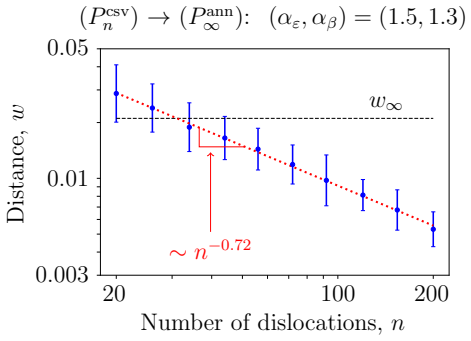
Simulations indicate that annihilation collision rules in discrete dislocation models lead to a density PDE accounting for annihilation, while absence of rules produces inconsistent limits.
A machine-rendered reading of the paper's core claim, the machinery that carries it, and where it could break.
Core claim
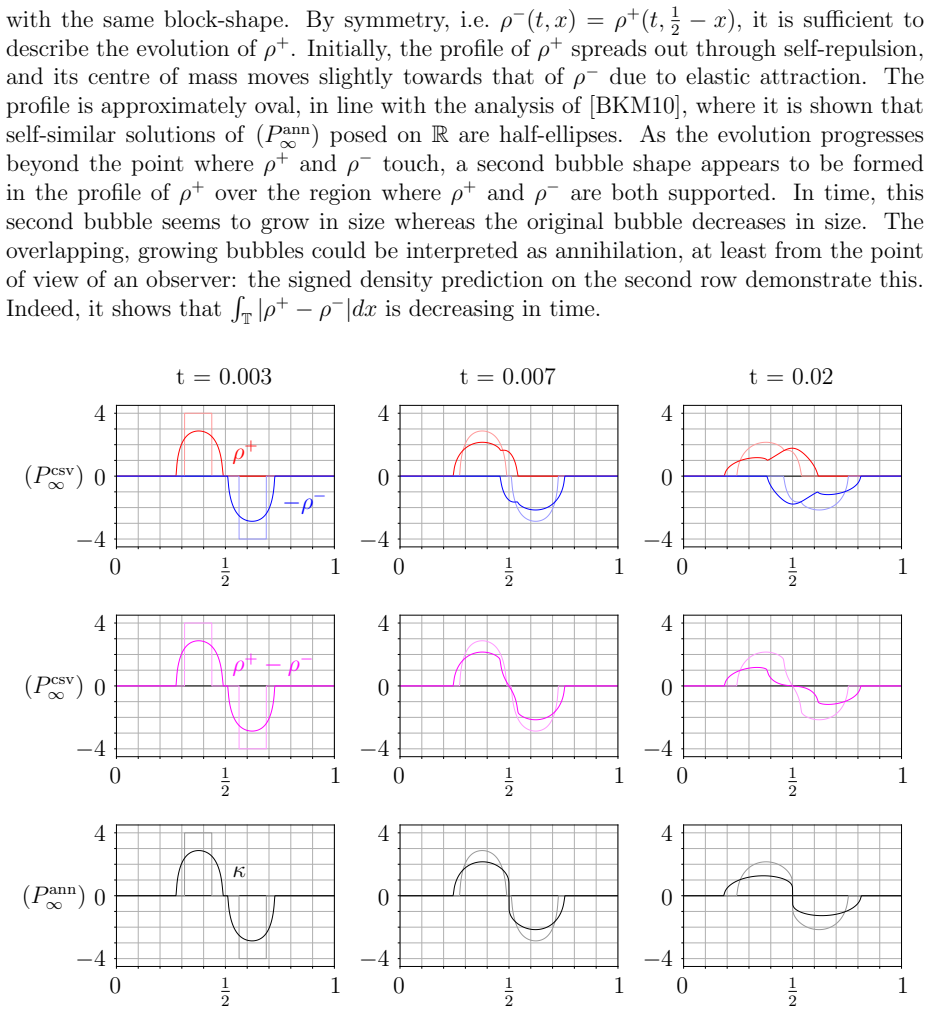
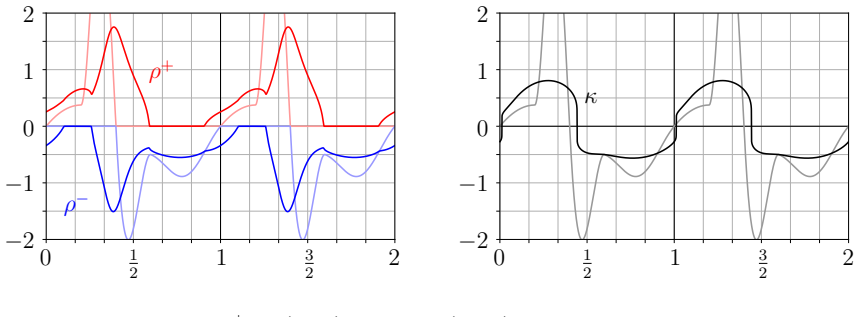
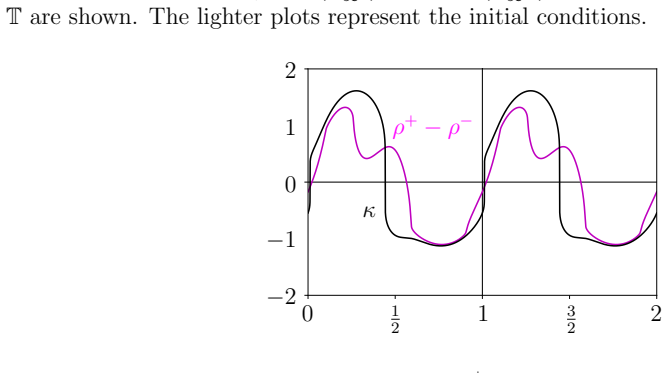
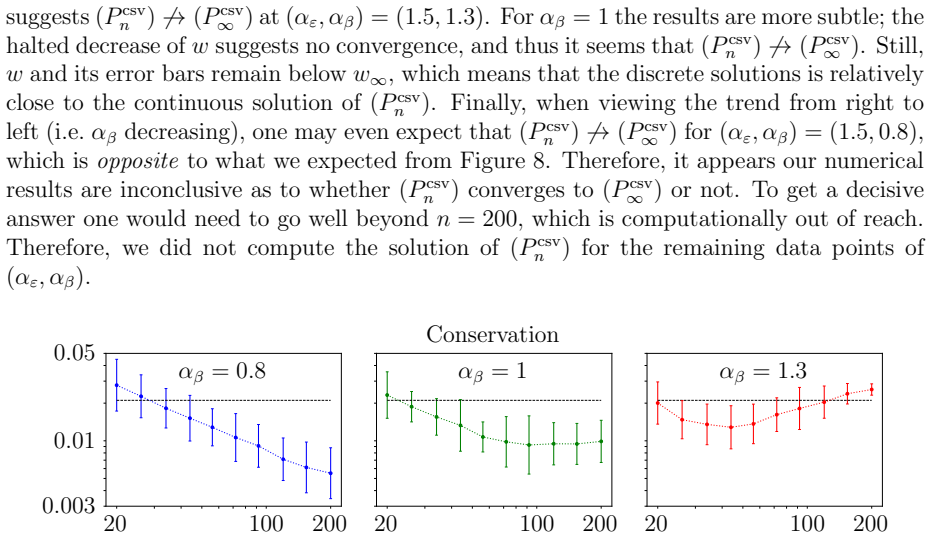
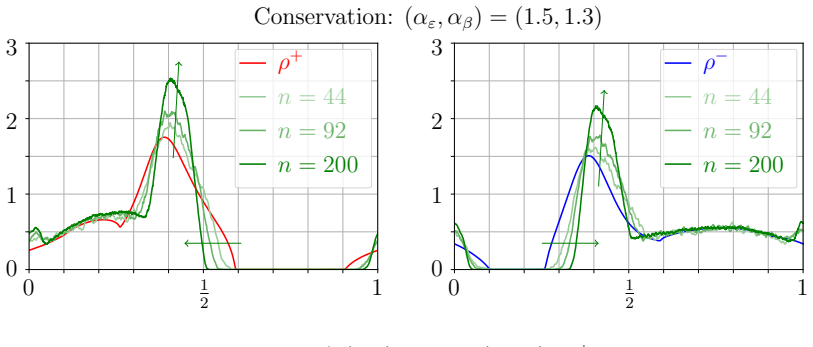
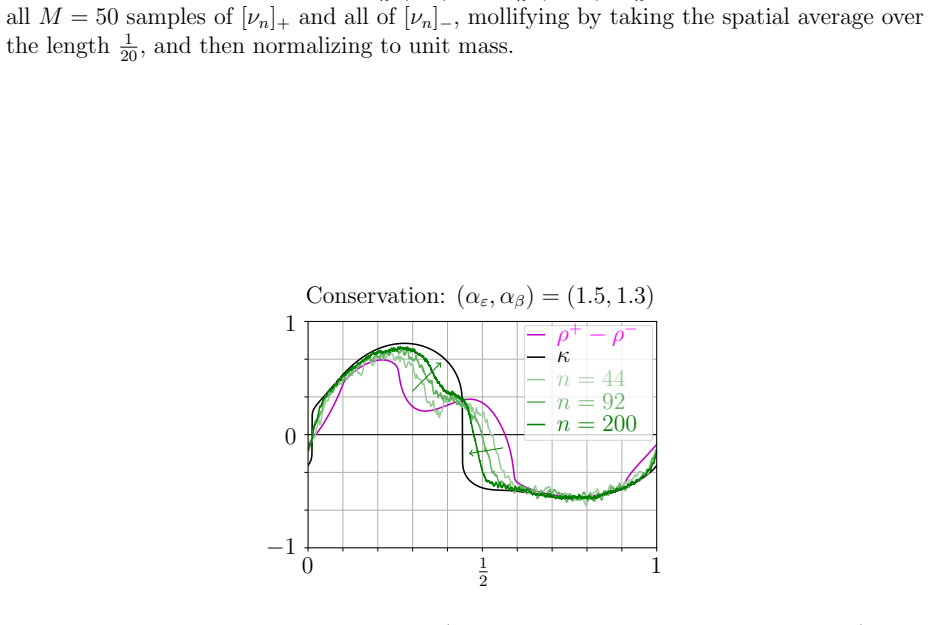
The paper establishes through simulations that the discrete model with annihilation tends to a PDE for the dislocation density that accounts for annihilation. The discrete model without a collision rule does not appear to exhibit consistent convergence behaviour; instead, it appears that the expected PDE with conserved dislocation density appears in the limit for some parameters, but that for other parameters the density appears to follow to the evolution of the PDE with annihilation. These findings provide evidence that a careful treatment of dislocation collisions is important in discrete dislocation dynamics models.
What carries the argument
Numerical simulations comparing the asymptotic density evolution in annihilating and non-annihilating discrete dislocation models on a lattice to candidate continuum PDEs.
If this is right
- The annihilating discrete model can be used to approximate continuum descriptions that include density reduction due to annihilation.
- Without collision rules, the limiting behavior depends on specific parameters, requiring case-by-case analysis.
- Discrete dislocation dynamics models benefit from explicit rules to achieve reliable macroscopic limits.
- The choice of collision rule affects whether total dislocation density is conserved or decreases over time.
Where Pith is reading between the lines
- In real materials, dislocation annihilation might be modeled similarly to ensure accurate density predictions at scale.
- The observed inconsistency without rules could imply that some implicit interaction is occurring in the simulations for certain parameters.
- Extending these 1D lattice results to 2D or 3D lattices might reveal similar sensitivities to collision handling.
- Parameter ranges where the no-rule model switches behavior could be mapped to identify critical thresholds.
Load-bearing premise
The numerical simulations are assumed to be sufficient to determine the limiting PDE behavior as the number of dislocations increases, without reported details on the number of realizations, statistical measures of convergence, or the precise parameter ranges tested.
What would settle it
Simulations with a systematically increasing number of dislocations, repeated over multiple random realizations, that track whether the density follows the annihilating or conserved PDE for the no-collision model across varied parameters would test the inconsistency claim.
Figures
read the original abstract
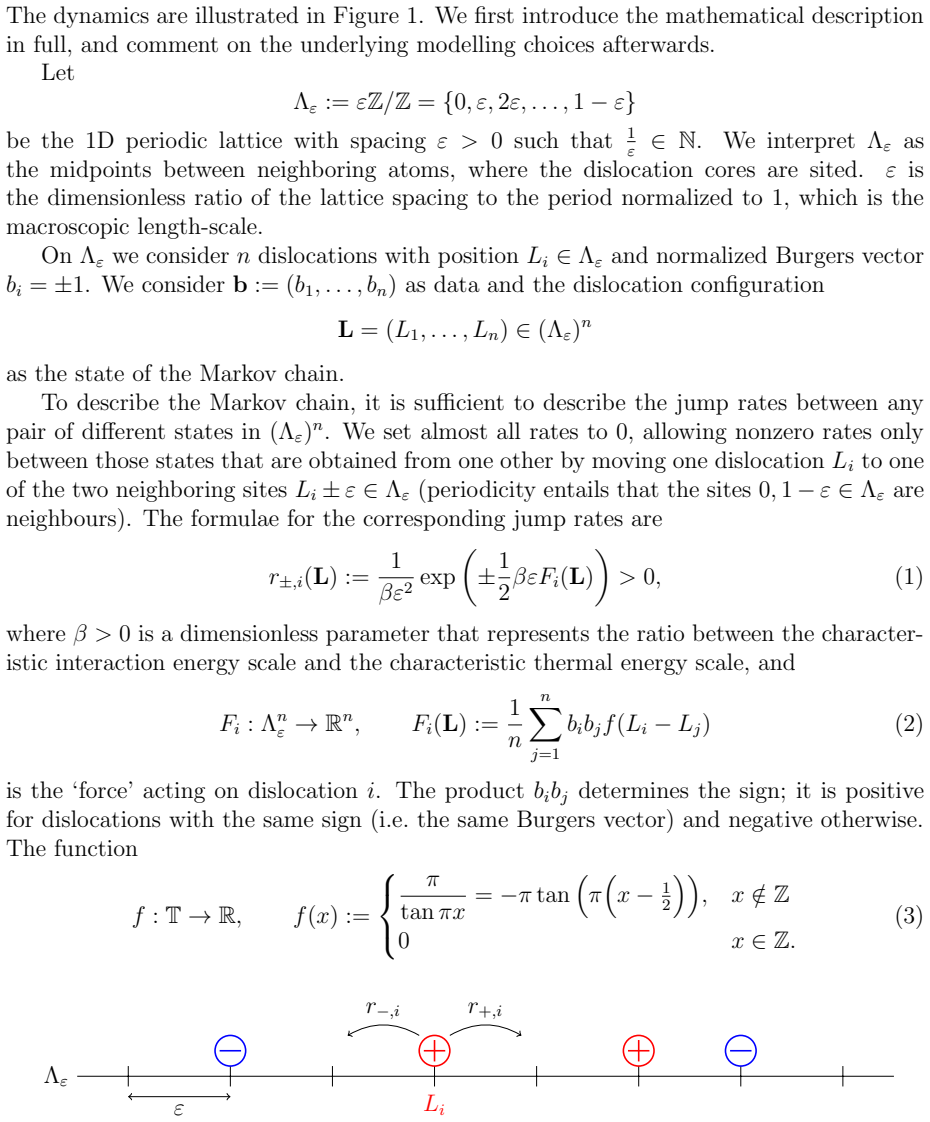
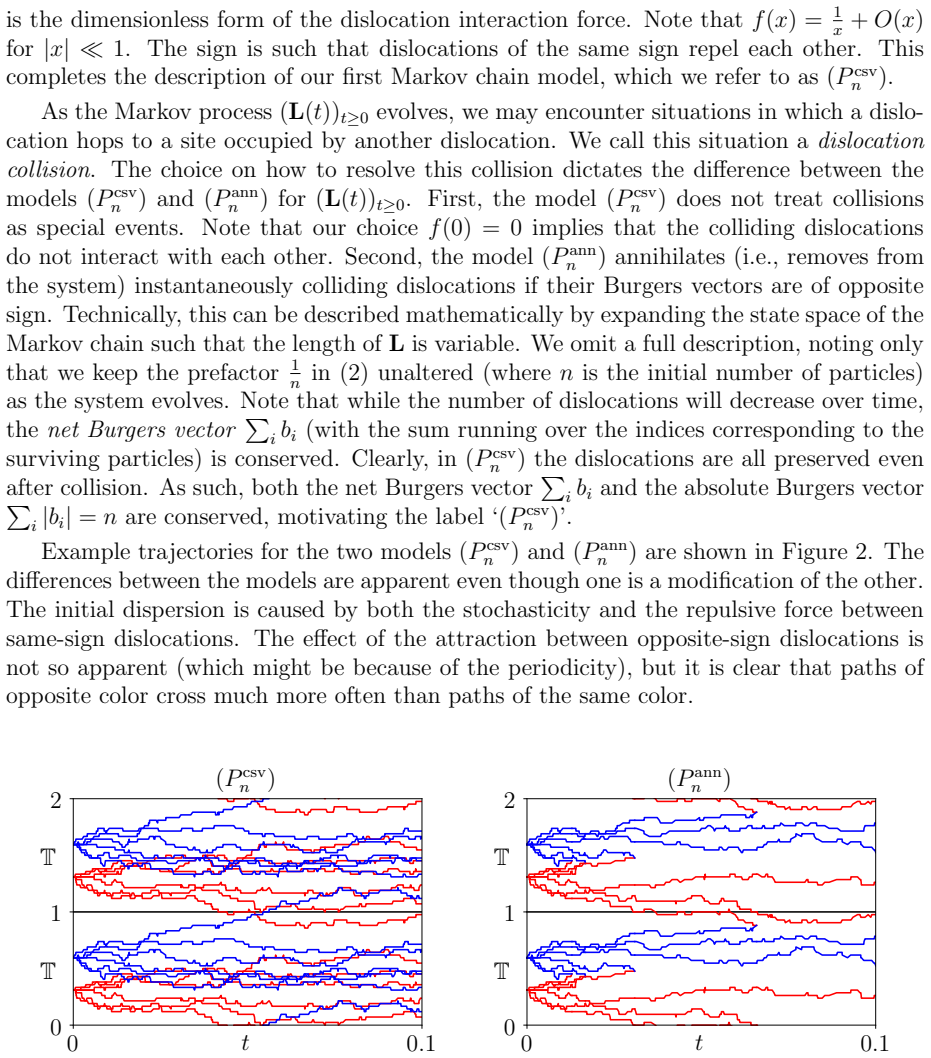
The stochastic dynamics of dislocations on a one-dimensional periodic lattice domain are considered. Two models are studied: one without a collision rule, and one which annihilates colliding dislocations if they have opposite orientation. The behaviour of both models is investigated by means of a series of numerical simulations exploring the asymptotic behaviour of these models as the number of dislocations increases. From these simulations, evidence is obtained that the discrete model with annihilation tends to a PDE for the dislocation density that accounts for annihilation. However, the discrete model without a collision rule does not appear to exhibit consistent convergence behaviour; instead, it appears that the expected PDE with conserved dislocation density appears in the limit for some parameters, but that for other parameters the density appears to follow to the evolution of the PDE with annihilation. These findings provide evidence that a careful treatment of dislocation collisions is important in discrete dislocation dynamics models.
Editorial analysis
A structured set of objections, weighed in public.
Referee Report
Summary. The manuscript studies the stochastic dynamics of dislocations on a one-dimensional periodic lattice in two variants: a model without collision rules and a model that annihilates oppositely oriented dislocations upon collision. Through a series of numerical simulations, the authors claim that the annihilating discrete model converges, as the number of dislocations grows, to a continuum PDE that incorporates annihilation, while the no-collision model displays inconsistent limiting behavior—recovering the expected conserved-density PDE for some parameter choices but the annihilating PDE for others.
Significance. If the reported limiting behaviors can be placed on a statistically sound footing, the work would establish that the treatment of collisions is a load-bearing ingredient in the passage from discrete dislocation dynamics to continuum density equations, with direct implications for the fidelity of large-scale materials simulations.
major comments (2)
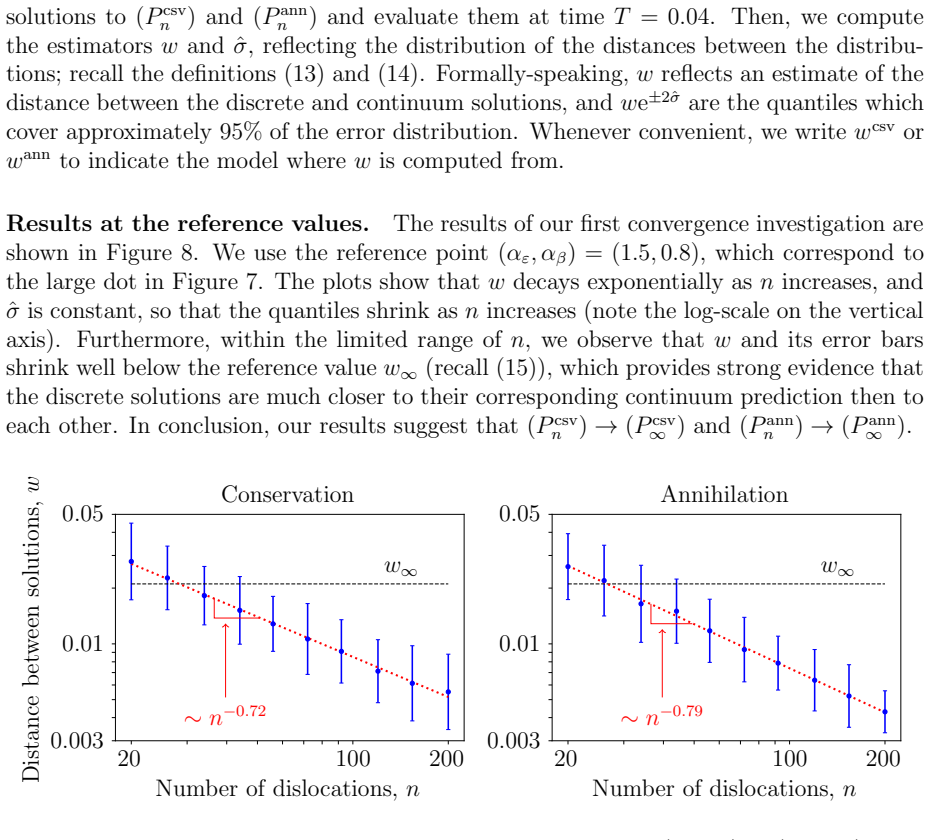
- [Numerical Simulations / Results] The simulation protocol (abstract and results description) supplies no information on the number of independent realizations, variance across runs, or quantitative discrepancy measures (e.g., integrated squared error to each candidate PDE solution) used to diagnose convergence as dislocation number N o∞. Without these diagnostics the claimed parameter-dependent switch in limiting PDE for the no-collision model cannot be distinguished from finite-N transients or sampling variability.
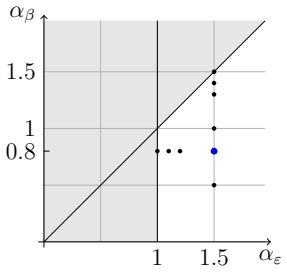
- [Numerical Simulations / Results] The ranges of parameters (initial density, mobility ratios, lattice size) at which the no-collision model is reported to switch between conserved and annihilating continuum limits are not stated, preventing assessment of whether the inconsistency is robust or confined to a narrow, possibly singular regime.
minor comments (1)
- Notation for the two discrete models and the two target PDEs should be introduced with explicit labels (e.g., Model A/B, PDE C/D) to improve readability when the limiting behaviors are contrasted.
Simulated Author's Rebuttal
We thank the referee for their careful reading and constructive comments, which highlight important aspects of the numerical evidence. We address each major comment below.
read point-by-point responses
-
Referee: [Numerical Simulations / Results] The simulation protocol (abstract and results description) supplies no information on the number of independent realizations, variance across runs, or quantitative discrepancy measures (e.g., integrated squared error to each candidate PDE solution) used to diagnose convergence as dislocation number N→∞. Without these diagnostics the claimed parameter-dependent switch in limiting PDE for the no-collision model cannot be distinguished from finite-N transients or sampling variability.
Authors: We agree that the current description of the simulation protocol lacks sufficient statistical detail. In the revised manuscript we will specify the number of independent realizations performed for each parameter combination, report variance or standard-error measures across runs (e.g., via error bars on the averaged density profiles), and include quantitative discrepancy metrics such as integrated squared differences between the simulated densities and the solutions of the candidate PDEs. These additions will allow readers to assess the robustness of the observed limiting behaviors. revision: yes
-
Referee: [Numerical Simulations / Results] The ranges of parameters (initial density, mobility ratios, lattice size) at which the no-collision model is reported to switch between conserved and annihilating continuum limits are not stated, preventing assessment of whether the inconsistency is robust or confined to a narrow, possibly singular regime.
Authors: We acknowledge that explicit statement of the explored parameter ranges is necessary for evaluating the generality of the reported switch. The revised manuscript will include a clear enumeration of the ranges of initial densities, mobility ratios, and lattice sizes that were simulated, together with the specific values at which the transition between the two continuum limits was observed. This information will enable assessment of whether the inconsistency appears only in a narrow regime or more broadly. revision: yes
Circularity Check
No circularity: simulations compared to independently known PDEs
full rationale
The paper performs numerical simulations of two discrete dislocation models (with and without annihilation rule) on a 1D lattice and observes their density evolution as dislocation number grows. It reports that the annihilating model appears to approach a known annihilating PDE while the non-annihilating model shows parameter-dependent behavior (sometimes conserved-density PDE, sometimes annihilating). No derivation chain is presented that reduces a claimed result to its own inputs by construction, no parameters are fitted and then relabeled as predictions, and no self-citations are invoked as load-bearing uniqueness theorems. The work is purely empirical comparison against externally stated continuum equations.
Axiom & Free-Parameter Ledger
Reference graph
Works this paper leans on
-
[1]
Alicandro, L
R. Alicandro, L. De Luca, A. Garroni, and M. Ponsiglione. Dynamics of discrete screw dislocations on glide directions. Journal of the Mechanics and Physics of Solids , 92:87--104, 2016
2016
-
[2]
Apisornpanich and P
L. Apisornpanich and P. van Meurs. A simple, accurate scheme for the flow of an electric charge distribution. Science Reports of Kanazawa University , 66:1--16, 2023
2023
-
[3]
Computer simulations of dislocations , volume 3
Vasily V Bulatov and Wei Cai. Computer simulations of dislocations , volume 3. Oxford University Press, 2006
2006
-
[4]
G. A. Bonaschi, J. A. Carrillo, M. Di F rancesco, and M. A. Peletier. Equivalence of gradient flows and entropy solutions for singular nonlocal interaction equations in 1D . ESAIM: Control, Optimisation and Calculus of Variations , 21(2):414--441, 2015
2015
-
[5]
Biler, G
P. Biler, G. Karch, and R. Monneau. Nonlinear diffusion of dislocation density and self-similar solutions. Communications in Mathematical Physics , 294(1):145--168, 2010
2010
-
[6]
G. A. Bonaschi and M. A. Peletier. Quadratic and rate-independent limits for a large-deviations functional. Contin. Mech. Thermodyn. , 28(4):1191--1219, 2016
2016
-
[7]
M. Buze. Atomistic modelling of near-crack-tip plasticity. Nonlinearity , 34(7):4503--4542, June 2021
2021
-
[8]
Forcadel, C
N. Forcadel, C. Imbert, and R. Monneau. Homogenization of the dislocation dynamics and of some particle systems with two-body interactions. Discrete and Continuous Dynamical Systems A , 23(3):785--826, 2009
2009
-
[9]
Groma and P
I. Groma and P. Balogh. Investigation of dislocation pattern formation in a two-dimensional self-consistent field approximation. Acta Materialia , 47(13):3647--3654, 1999
1999
-
[10]
Garroni, P
A. Garroni, P. v an Meurs, M. A. Peletier, and L. Scardia. Convergence and non-convergence of many-particle evolutions with multiple signs. Archive for Rational Mechanics and Analysis , 235(1):3--49, 2020
2020
-
[11]
A.K. Head. Dislocation group dynamics III . S imilarity solutions of the continuum approximation. Philosophical Magazine , 26(1):65--72, 1972
1972
-
[12]
C. R. Harris, K. J. Millman, S. J. van der Walt, R. Gommers, P. Virtanen, D. Cournapeau, E. Wieser, J. Taylor, S. Berg, N. J. Smith, R. Kern, M. Picus, S. Hoyer, M. H. van Kerkwijk, M. Brett, A. Haldane, J. Fern \' a ndez del R \' i o, M. Wiebe, P. Peterson, P. G \' e rard-Marchant, K. Sheppard, T. Reddy, W. Weckesser, H. Abbasi, C. Gohlke, and T. E. Olip...
2020
-
[13]
Reaction-rate theory: fifty years after kramers
Peter H\"anggi, Peter Talkner, and Michal Borkovec. Reaction-rate theory: fifty years after kramers. Rev. Mod. Phys. , 62:251--341, Apr 1990
1990
-
[14]
T. Hudson. Upscaling a model for the thermally-driven motion of screw dislocations. Archive for Rational Mechanics and Analysis , 224(1):291--352, 2017
2017
-
[15]
Hudson, P
T. Hudson, P. van Meurs, and M.A. Peletier. Atomistic origins of continuum dislocation dynamics. Mathematical Models and Methods in Applied Sciences , 30(13):2557--2618, 2020
2020
-
[16]
Imbert, R
C. Imbert, R. Monneau, and E. Rouy. Homogenization of first order equations with (u/ )-periodic H amiltonians P art II : A pplication to dislocations dynamics. Communications in Partial Differential Equations , 33(3):479--516, 2008
2008
-
[17]
H. A. Kramers. Brownian motion in a field of force and the diffusion model of chemical reactions. Physica , 7(4):284--304, 1940
1940
-
[18]
E. Mainini. A description of transport cost for signed measures. Journal of Mathematical Sciences , 181:837--855, 2012
2012
-
[19]
Masmoudi and P
N. Masmoudi and P. Zhang. Global solutions to vortex density equations arising from sup-conductivity. Annales de l'Institut Henri Poincar\'e , 22(4):441--458, 2005
2005
-
[20]
Patrizi and T
S. Patrizi and T. Sangsawang. Derivation of the 1- D G roma-- B alogh equations from the P eierls-- N abarro model. Calculus of Variations and Partial Differential Equations , 62(9):242, 2023
2023
-
[21]
Patrizi and E
S. Patrizi and E. Valdinoci. Crystal dislocations with different orientations and collisions. Archive for Rational Mechanics and Analysis , 217(1):231--261, 2015
2015
-
[22]
Rabin, J
J. Rabin, J. Delon, and Y. Gousseau. Transportation distances on the circle. Journal of Mathematical Imaging and Vision , 41(1):147--167, 2011
2011
-
[23]
C. Villani. T opics in O ptimal T ransportation . American Mathematical Society, Providence Rhode Island, 2003
2003
-
[24]
van Meurs and M
P. van Meurs and M. Morandotti. Discrete-to-continuum limits of particles with an annihilation rule. SIAM Journal on Applied Mathematics , 79(5):1940--1966, 2019
1940
-
[25]
van Meurs and S
P. van Meurs and S. Patrizi. Discrete dislocations dynamics with annihilation as the limit of the P eierls- N abarro model in one dimension. SIAM Journal on Mathematical Analysis , 56(1):197--233, 2024
2024
-
[26]
v an Meurs, M
P. v an Meurs, M. A. Peletier, and N. Po z \'a r. Discrete-to-continuum convergence of charged particles in 1 D with annihilation. Archive for Rational Mechanics and Analysis , 246(1):241--297, 2022
2022
-
[27]
van Meurs, M
P. van Meurs, M. A. Peletier, and T. Slangen. Global existence and mean--field limit for a stochastic interacting particle system of signed C oulomb charges. Potential Analysis , 63(4):1699--1733, 2025
2025
-
[28]
van M eurs and Y
P. van M eurs and Y. Tardy. Existence and uniqueness for a stochastic interacting particle system of signed Coulomb charges with an annihilation rule . in preparation , 2026
2026
-
[29]
A. F. Voter. Introduction to the Kinetic Monte Carlo Method . In K. E. Sickafus, E. A. Kotomin, and B. P. Uberuaga, editors, Radiation Effects in Solids , pages 1--23. Springer, 2007
2007
discussion (0)
Sign in with ORCID, Apple, or X to comment. Anyone can read and Pith papers without signing in.