Breaking the Reasoning Horizon in Entity Alignment Foundation Models
Pith reviewed 2026-05-16 10:07 UTC · model grok-4.3
The pith
A parallel encoding strategy lets entity alignment foundation models generalize directly to unseen knowledge graphs.
A machine-rendered reading of the paper's core claim, the machinery that carries it, and where it could break.
Core claim
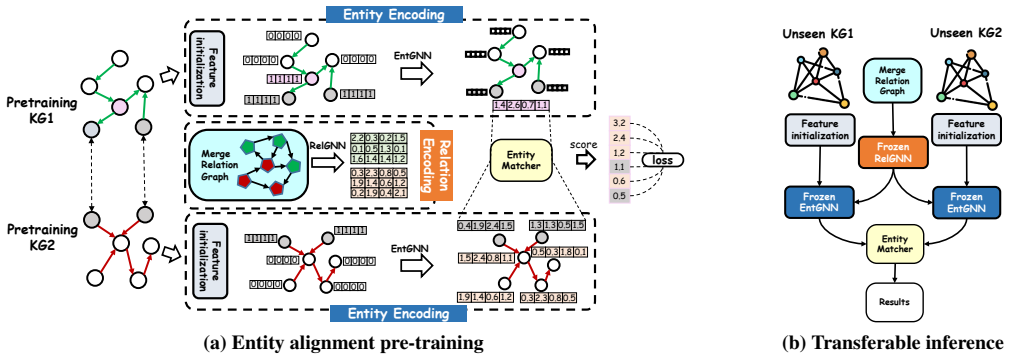
We propose an entity alignment foundation model driven by a parallel encoding strategy. Seed EA pairs serve as local anchors to initialize and encode two parallel streams simultaneously. This produces anchor-conditioned message passing that shortens the inference trajectory by leveraging local structural proximity instead of global search. A merged relation graph models global dependencies and a learnable interaction module supports precise matching, enabling effective alignment on previously unseen KGs.
What carries the argument
Parallel encoding strategy that uses seed EA pairs as local anchors to initialize and condition simultaneous message passing across two knowledge graph streams.
If this is right
- The model can align entities across entirely new KGs without any retraining step.
- Inference becomes shorter and more efficient by substituting local proximity around anchors for full global traversal.
- Combined local anchoring and merged relation modeling improves handling of sparse heterogeneous graph structures.
- Strong generalizability to unseen KGs is achieved as shown by experiments across multiple datasets.
Where Pith is reading between the lines
- The anchoring technique could extend to other graph correspondence tasks where a small set of seed matches can be supplied.
- When seed pairs are limited or noisy the method might benefit from adding unsupervised pre-alignment to bootstrap the anchors.
- The merged relation graph construction suggests a general pattern for injecting global structure into otherwise local message-passing foundation models.
- Testing the approach on very large or dynamically changing KGs would reveal how far the local-proximity shortcut can scale.
Load-bearing premise
Reliable seed entity alignment pairs are always available to serve as local anchors that guide the parallel streams and capture necessary dependencies.
What would settle it
Running the model on a pair of new KGs supplied with no seed EA pairs and measuring whether alignment accuracy collapses relative to runs that include anchors.
Figures

read the original abstract
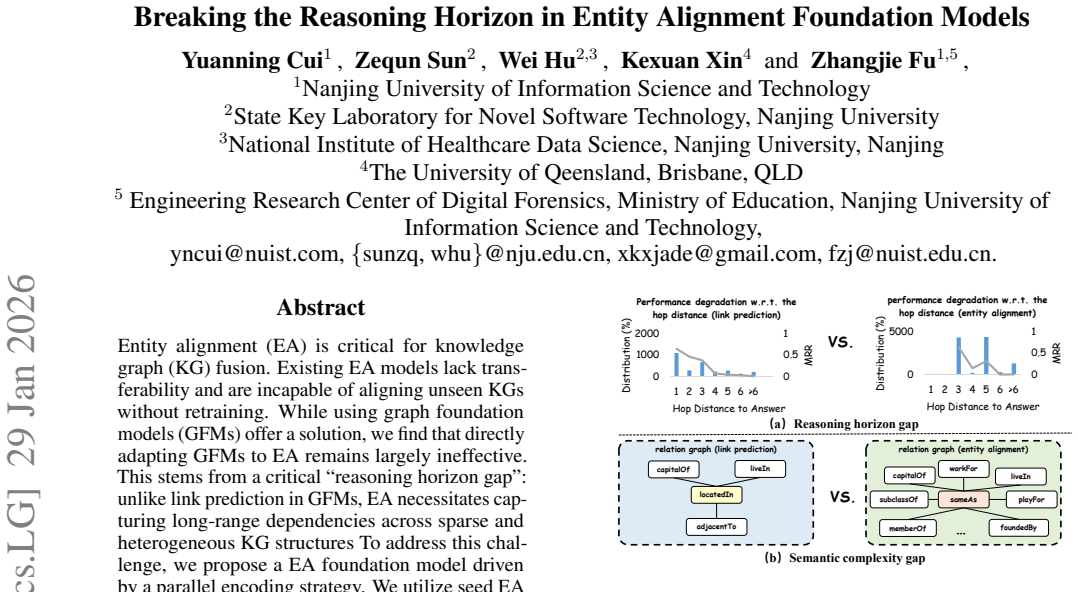
Entity alignment (EA) is critical for knowledge graph (KG) fusion. Existing EA models lack transferability and are incapable of aligning unseen KGs without retraining. While using graph foundation models (GFMs) offer a solution, we find that directly adapting GFMs to EA remains largely ineffective. This stems from a critical "reasoning horizon gap": unlike link prediction in GFMs, EA necessitates capturing long-range dependencies across sparse and heterogeneous KG structuresTo address this challenge, we propose a EA foundation model driven by a parallel encoding strategy. We utilize seed EA pairs as local anchors to guide the information flow, initializing and encoding two parallel streams simultaneously. This facilitates anchor-conditioned message passing and significantly shortens the inference trajectory by leveraging local structural proximity instead of global search. Additionally, we incorporate a merged relation graph to model global dependencies and a learnable interaction module for precise matching. Extensive experiments verify the effectiveness of our framework, highlighting its strong generalizability to unseen KGs.
Editorial analysis
A structured set of objections, weighed in public.
Referee Report
Summary. The paper claims that existing entity alignment (EA) models lack transferability to unseen KGs and that direct adaptation of graph foundation models (GFMs) fails due to a 'reasoning horizon gap' in capturing long-range dependencies across sparse heterogeneous structures. It proposes an EA foundation model using a parallel encoding strategy that initializes two streams from seed EA pairs as local anchors for anchor-conditioned message passing, combined with a merged relation graph to model global dependencies and a learnable interaction module for matching; this shortens inference trajectories via local proximity. Extensive experiments are said to verify effectiveness and strong generalizability to unseen KGs without retraining.
Significance. If the central claims hold, the work would be significant for enabling transferable EA foundation models, addressing a practical limitation in KG fusion where retraining per pair of KGs is costly. The architectural response to the reasoning horizon via local anchors and parallel streams offers a concrete way to reduce global search costs, with potential impact on scalable KG integration if the seed-pair assumption and dependency capture prove robust.
major comments (2)
- [§3.2] §3.2 (Parallel Encoding and Anchor-Conditioned Message Passing): The claim that local structural proximity via seed anchors fully substitutes for global search without loss of critical long-range dependencies is load-bearing for the reasoning horizon gap resolution, yet the manuscript provides no formal bound or information-flow analysis showing that the merged relation graph compensates for sparsity-induced information loss in heterogeneous KGs.
- [§4.3] §4.3 (Generalizability Experiments): The reported results on unseen KGs demonstrate gains, but the evaluation does not include ablations or stress tests with limited/noisy seed EA pairs; this undermines the foundation-model claim of reliable performance without retraining, as seed availability is a core assumption flagged in the method.
minor comments (2)
- [§3.3] The notation for the learnable interaction module is introduced in §3.3 without an explicit equation or diagram clarifying its input/output dimensions relative to the parallel streams.
- [Introduction] Introduction lacks a direct citation to the specific GFM baselines that were found ineffective, making the motivation for the parallel strategy harder to trace.
Simulated Author's Rebuttal
We thank the referee for the constructive comments. Below we provide point-by-point responses to the major comments and indicate the planned revisions.
read point-by-point responses
-
Referee: [§3.2] §3.2 (Parallel Encoding and Anchor-Conditioned Message Passing): The claim that local structural proximity via seed anchors fully substitutes for global search without loss of critical long-range dependencies is load-bearing for the reasoning horizon gap resolution, yet the manuscript provides no formal bound or information-flow analysis showing that the merged relation graph compensates for sparsity-induced information loss in heterogeneous KGs.
Authors: We agree that a formal analysis would provide stronger theoretical support. However, deriving tight bounds on information flow in heterogeneous graph structures is challenging due to the variability in KG topologies. Our approach is motivated by the empirical observation that local anchors significantly reduce the effective path lengths needed for alignment. In the revision, we will add an information-flow analysis section discussing how the parallel streams and merged relation graph preserve critical dependencies, including visualizations of message passing paths and quantitative measures of dependency capture in experiments. revision: partial
-
Referee: [§4.3] §4.3 (Generalizability Experiments): The reported results on unseen KGs demonstrate gains, but the evaluation does not include ablations or stress tests with limited/noisy seed EA pairs; this undermines the foundation-model claim of reliable performance without retraining, as seed availability is a core assumption flagged in the method.
Authors: This is a valid concern. To address it, we will conduct additional experiments in the revised manuscript that vary the number of seed pairs (e.g., 10%, 50%, 100% of available seeds) and introduce controlled noise to the seed alignments. These ablations will demonstrate the model's robustness and support the foundation model claim under realistic seed conditions. revision: yes
Circularity Check
No significant circularity detected
full rationale
The paper proposes an architectural framework using parallel encoding streams initialized from seed EA pairs as local anchors, combined with a merged relation graph and learnable interaction module. No equations or derivations are shown that reduce by construction to fitted inputs, self-definitions, or self-citation chains. The central claim (shortened inference via local proximity) is presented as an empirical architectural choice rather than a mathematical reduction to prior results or parameters. The approach remains self-contained against external benchmarks with no load-bearing self-referential steps.
Axiom & Free-Parameter Ledger
axioms (2)
- domain assumption Seed EA pairs provide reliable local anchors that guide information flow without introducing bias in heterogeneous KGs.
- domain assumption Local structural proximity can substitute for global search to capture long-range dependencies.
invented entities (3)
-
Parallel encoding streams
no independent evidence
-
Merged relation graph
no independent evidence
-
Learnable interaction module
no independent evidence
Lean theorems connected to this paper
-
IndisputableMonolith/Cost/FunctionalEquation.leanwashburn_uniqueness_aczel unclear?
unclearRelation between the paper passage and the cited Recognition theorem.
anchor-conditioned message passing... shortens the inference trajectory by leveraging local structural proximity instead of global search
What do these tags mean?
- matches
- The paper's claim is directly supported by a theorem in the formal canon.
- supports
- The theorem supports part of the paper's argument, but the paper may add assumptions or extra steps.
- extends
- The paper goes beyond the formal theorem; the theorem is a base layer rather than the whole result.
- uses
- The paper appears to rely on the theorem as machinery.
- contradicts
- The paper's claim conflicts with a theorem or certificate in the canon.
- unclear
- Pith found a possible connection, but the passage is too broad, indirect, or ambiguous to say the theorem truly supports the claim.
Reference graph
Works this paper leans on
-
[1]
Bronstein, ˙Ismail ˙Ilkan Ceylan, Mikhail Galkin, Juan L
[andw2 Pablo Barcel´oet al., 2025 ] Xingyue Huang andw2 Pablo Barcel´o, Michael M. Bronstein, ˙Ismail ˙Ilkan Ceylan, Mikhail Galkin, Juan L. Reutter, and Miguel A. Romero Orth. How expressive are knowledge graph foundation models? InICML. OpenReview.net,
work page 2025
-
[2]
Translating embeddings for modeling multi-relational data
[Bordeset al., 2013 ] Antoine Bordes, Nicolas Usunier, Al- berto Garc´ıa-Dur´an, Jason Weston, and Oksana Yakhnenko. Translating embeddings for modeling multi-relational data. InNIPS, pages 2787–2795,
work page 2013
-
[3]
Neusymea: Neuro-symbolic entity alignment via varia- tional inference
[Chenet al., ] Shengyuan Chen, Zheng Yuan, Qinggang Zhang, Wen Hua, Jiannong Cao, and Xiao Huang. Neusymea: Neuro-symbolic entity alignment via varia- tional inference. InThe Thirty-ninth Annual Conference on Neural Information Processing Systems. [Chenet al., 2017 ] Muhao Chen, Yingtao Tian, Mohan Yang, and Carlo Zaniolo. Multilingual knowledge graph emb...
work page 2017
-
[4]
ijcai.org. [Chenet al., 2025 ] Zerui Chen, Huiming Fan, Qianyu Wang, Tao He, Ming Liu, Heng Chang, Weijiang Yu, Ze Li, and Bing Qin. How do language models reshape entity align- ment? a survey of lm-driven ea methods: Advances, bench- marks, and future. InProceedings of the 2025 Conference on Empirical Methods in Natural Language Processing, pages 23230–23245,
work page 2025
-
[5]
A prompt-based knowledge graph foundation model for uni- versal in-context reasoning
[Cuiet al., 2024 ] Yuanning Cui, Zequn Sun, and Wei Hu. A prompt-based knowledge graph foundation model for uni- versal in-context reasoning. InNeurIPS,
work page 2024
-
[6]
[Dinget al., 2025 ] Linlin Ding, Mengjunyao Si, and Mo Li. Rsgea: Relationship structure line graph for semi- supervised entity alignment based on edge weight adjust- ment. InProceedings of the 48th International ACM SIGIR Conference on Research and Development in Information Retrieval, pages 3070–3074,
work page 2025
-
[7]
Towards foun- dation models for knowledge graph reasoning
[Galkinet al., 2024 ] Mikhail Galkin, Xinyu Yuan, Hesham Mostafa, Jian Tang, and Zhaocheng Zhu. Towards foun- dation models for knowledge graph reasoning. InICLR, Vienna, Austria,
work page 2024
-
[8]
Learning to exploit long-term relational dependencies in knowledge graphs
[Guoet al., 2019 ] Lingbing Guo, Zequn Sun, and Wei Hu. Learning to exploit long-term relational dependencies in knowledge graphs. InProceedings of the 36th International Conference on Machine Learning, pages 2505–2514,
work page 2019
-
[9]
[Jiet al., 2022 ] Shaoxiong Ji, Shirui Pan, Erik Cambria, Pekka Marttinen, and Philip S. Yu. A survey on knowl- edge graphs: Representation, acquisition, and applications. TNNLS, 33(2):494–514,
work page 2022
-
[10]
Relational reflection entity alignment
[Maoet al., 2020 ] Xin Mao, Wenting Wang, Huimin Xu, Yuanbin Wu, and Man Lan. Relational reflection entity alignment. InProceedings of the 29th ACM International Conference on Information and Knowledge Management, pages 1095–1104,
work page 2020
-
[11]
[Maoet al., 2021 ] Xin Mao, Wenting Wang, Yuanbin Wu, and Man Lan. Boosting the speed of entity alignment 10×: Dual attention matching network with normalized hard sample mining. InWWW, pages 821–832,
work page 2021
-
[12]
Unifying large language models and knowledge graphs: A roadmap
[Panet al., 2024 ] Shirui Pan, Linhao Luo, Yufei Wang, Chen Chen, Jiapu Wang, and Xindong Wu. Unifying large language models and knowledge graphs: A roadmap. IEEE Transactions on Knowledge and Data Engineering, 36(7):3580–3599,
work page 2024
-
[13]
Semi-supervised entity alignment via knowledge graph embedding with awareness of degree difference
[Peiet al., 2019 ] Shichao Pei, Lu Yu, Robert Hoehndorf, and Xiangliang Zhang. Semi-supervised entity alignment via knowledge graph embedding with awareness of degree difference. InThe world wide web conference, pages 3130– 3136,
work page 2019
-
[14]
Cross-lingual entity alignment via joint attribute-preserving embedding
[Sunet al., 2017 ] Zequn Sun, Wei Hu, and Chengkai Li. Cross-lingual entity alignment via joint attribute-preserving embedding. InISWC, pages 628–644,
work page 2017
-
[15]
Bootstrapping entity alignment with knowl- edge graph embedding
[Sunet al., 2018 ] Zequn Sun, Wei Hu, Qingheng Zhang, and Yuzhong Qu. Bootstrapping entity alignment with knowl- edge graph embedding. InIJCAI, pages 4396–4402, Stock- holm, Sweden,
work page 2018
-
[16]
[Wanget al., 2018 ] Zhichun Wang, Qingsong Lv, Xiaohan Lan, and Yu Zhang
ACM. [Wanget al., 2018 ] Zhichun Wang, Qingsong Lv, Xiaohan Lan, and Yu Zhang. Cross-lingual knowledge graph align- ment via graph convolutional networks. InEMNLP, pages 349–357, Brussels, Belgium,
work page 2018
-
[17]
ACL. [Wanget al., 2022 ] Yuxin Wang, Yuanning Cui, Wenqiang Liu, Zequn Sun, Yiqiao Jiang, Kexin Han, and Wei Hu. Facing changes: Continual entity alignment for growing knowledge graphs. InISWC, volume 13489 ofLecture Notes in Computer Science, pages 196–213,
work page 2022
-
[18]
Rethinking smoothness for fast and adaptable en- tity alignment decoding
[Wanget al., 2025 ] Yuanyi Wang, Han Li, Haifeng Sun, Lei Zhang, Bo He, Wei Tang, Tianhao Yan, Qi Qi, and Jingyu Wang. Rethinking smoothness for fast and adaptable en- tity alignment decoding. InFindings of the Association for Computational Linguistics: NAACL 2025, pages 4521– 4535,
work page 2025
-
[19]
Informed multi-context entity alignment
[Xinet al., 2022 ] Kexuan Xin, Zequn Sun, Wen Hua, Wei Hu, and Xiaofang Zhou. Informed multi-context entity alignment. InWSDM, pages 1197–1205,
work page 2022
-
[20]
A comprehensive survey of entity alignment for knowledge graphs.AI Open, 2:1–13,
[Zenget al., 2021 ] Kaisheng Zeng, Chengjiang Li, Lei Hou, Juanzi Li, and Ling Feng. A comprehensive survey of entity alignment for knowledge graphs.AI Open, 2:1–13,
work page 2021
-
[21]
Knowledge graph reasoning with relational digraph
[Zhang and Yao, 2022] Yongqi Zhang and Quanming Yao. Knowledge graph reasoning with relational digraph. In WWW, pages 912–924,
work page 2022
-
[22]
[Zhanget al., 2022 ] Rui Zhang, Bayu Distiawan Trisedya, Miao Li, Yong Jiang, and Jianzhong Qi. A benchmark and comprehensive survey on knowledge graph entity align- ment via representation learning.The VLDB Journal, 31(5):1143–1168,
work page 2022
-
[23]
[Zhanget al., 2025 ] Yucheng Zhang, Beatrice Bevilacqua, Mikhail Galkin, and Bruno Ribeiro. TRIX: A more ex- pressive model for zero-shot domain transfer in knowledge graphs.CoRR, abs/2502.19512,
-
[24]
Iterative entity alignment via joint knowl- edge embeddings
[Zhuet al., 2017 ] Hao Zhu, Ruobing Xie, Zhiyuan Liu, and Maosong Sun. Iterative entity alignment via joint knowl- edge embeddings. InIJCAI, pages 4258–4264, Melbourne, Australia,
work page 2017
-
[25]
[Zhuet al., 2021 ] Zhaocheng Zhu, Zuobai Zhang, Louis- Pascal A
ijcai.org. [Zhuet al., 2021 ] Zhaocheng Zhu, Zuobai Zhang, Louis- Pascal A. C. Xhonneux, and Jian Tang. Neural bellman-ford networks: A general graph neural network framework for link prediction. InNeurIPS, pages 29476–29490,
work page 2021
discussion (0)
Sign in with ORCID, Apple, or X to comment. Anyone can read and Pith papers without signing in.