REVIEW 3 minor 49 references
Reviewed by Pith at T0; open to challenge.
T0 means a machine referee read the full paper against a public rubric. The mark states how deep the mechanical check went, never who wrote it. the ladder, T0–T4 →
T0 review · grok-4.3
A consensus measure of similar-node edges captures the macro dynamics of homophily-driven network rewiring.
2026-06-25 19:25 UTC pith:FYC67I4W
load-bearing objection They identify a consensus measure on edges as the effective collective variable for homophily rewiring and derive its closed-form dynamics via graphons.
Collective variables for homophily-driven network rewiring dynamics
The pith
A machine-rendered reading of the paper's core claim, the machinery that carries it, and where it could break.
Core claim
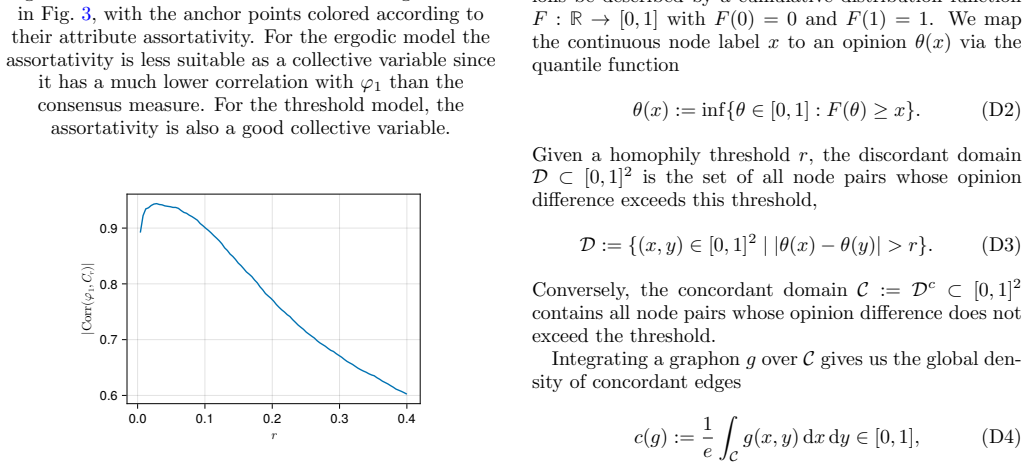
For homophily-driven rewiring models, the optimal collective variable is a consensus measure quantifying the fraction of edges whose incident nodes differ by less than a certain threshold. This identification comes from the data-driven transition manifold approach, and the variable is validated by building reduced models that include a closed-form evolution equation derived analytically using graphons.
What carries the argument
Consensus measure: the fraction of edges connecting nodes whose attributes differ by less than a threshold, serving as the low-dimensional collective variable that tracks the network's macroscopic state.
Load-bearing premise
The data-driven transition manifold approach accurately extracts the dominant slow dynamics from the full high-dimensional rewiring process in these models.
What would settle it
Simulate the original stochastic rewiring model and test whether the time series of the proposed consensus measure follows the closed-form graphon-derived equation; systematic deviation would falsify the identification of this CV.
If this is right
- The full network dynamics reduce to the evolution of this single consensus measure.
- Data-driven sparse regression yields effective macroscopic equations from observed trajectories.
- Graphon analysis supplies an exact closed-form differential equation for the consensus measure.
- The reduced models apply directly to the two representative homophily rewiring processes studied.
Where Pith is reading between the lines
- The same consensus variable may serve as an order parameter in related adaptive-network models such as opinion dynamics.
- Applying the transition-manifold method to rewiring rules other than homophily could uncover analogous low-dimensional reductions.
- The analytic validation suggests the approach can be used to derive macroscopic equations for other edge-rewiring mechanisms.
Editorial analysis
A structured set of objections, weighed in public.
Referee Report
Summary. The paper applies the data-driven transition manifold approach to identify low-dimensional collective variables (CVs) for two homophily-driven stochastic network rewiring models. It reports that the optimal CV is a consensus measure (fraction of edges whose incident nodes differ by less than a threshold), then constructs reduced-order models via sparse regression on this CV and derives a closed-form evolution equation analytically using graphons, which independently validates the identified CV.
Significance. If the analytical graphon derivation holds independently of the data-driven steps, the work provides a concrete, low-dimensional macroscopic description of adaptive network dynamics that could enable reduced-order modeling across applications in social dynamics and neuroscience. The dual validation route (data-driven identification plus analytical closure) is a strength when the graphon equation is shown to be non-circular.
minor comments (3)
- §3.2: the threshold parameter in the consensus measure definition is introduced without explicit justification for its selection across the two models; a brief sensitivity check or derivation of its value from the attribute distribution would clarify reproducibility.
- Figure 4: the comparison between the sparse-regression reduced model and the graphon-derived equation would benefit from an overlay of both trajectories on the same panel with error bands, rather than separate subplots, to facilitate direct visual assessment of agreement.
- Notation: the symbol for the consensus measure is reused in both the data-driven and graphon sections without a clarifying remark that the same functional form is recovered; a short sentence in §4.1 would prevent reader confusion.
Simulated Author's Rebuttal
We thank the referee for their supportive summary, recognition of the work's significance, and recommendation for minor revision. No specific major comments were enumerated in the report, so we have no individual points requiring point-by-point rebuttal or revision at this stage. We will of course address any additional comments that may arise.
Circularity Check
No significant circularity; derivation is self-contained
full rationale
The paper applies a data-driven transition manifold method to identify the consensus measure CV from simulation data of two rewiring models, then separately constructs reduced models via sparse regression on that CV and derives a closed-form evolution equation analytically using graphons. The analytical step is presented as an independent validation route that produces an equation for the identified CV rather than re-deriving the CV itself from fitted parameters or self-citations. No load-bearing step reduces by construction to its inputs, no self-citation chain is invoked for uniqueness or ansatz, and the central claim rests on the separation between data-driven discovery and graphon-based analysis, which are externally falsifiable. This is the normal non-circular outcome for a paper whose macroscopic reduction is benchmarked against an independent analytical route.
Axiom & Free-Parameter Ledger
read the original abstract
Stochastic network rewiring processes, in which edges dynamically rewire based on fixed node attributes, are widely used in applications ranging from social dynamics to neuroscience and form an important component of adaptive network modelling. In this paper, we identify low-dimensional collective variables (CVs) that capture the essential macroscopic behavior of such time-evolving networks and enable reduced-order descriptions of their dynamics. To this end, we apply the data-driven transition manifold approach to homophily-driven rewiring models, in which edges preferentially connect nodes with similar attributes. For two representative models, we find that the optimal CV is a consensus measure quantifying the fraction of edges whose incident nodes differ by less than a certain threshold. Building on the learned CV, we construct reduced macroscopic models using a data-driven approach based on sparse regression and through an analytical derivation using graphons. The latter yields a closed-form evolution equation for the consensus measure and analytically validates the identified CV.
Figures




Reference graph
Works this paper leans on
-
[1]
Pick a nodeiuniformly at random
-
[2]
Select a neighborjof nodeiuniformly at random
-
[3]
Sample a potential new neighborj ∗ according to the rewiring probabilitiesp i→j∗ defined in Equa- tion (1)
-
[4]
Otherwise, this replacement is performed anyway with probabilityp∈(0,1)
Ifj ∗ is closer toiin opinion thanj, i.e.,|θ i −θ j∗ | ≤ |θi −θ j|, the edge (i, j ∗) replaces the edge (i, j). Otherwise, this replacement is performed anyway with probabilityp∈(0,1). We model the rewiring dynamics in continuous-time from an agent-based perspective. We assume that each node executes steps 2–4 after exponentially distributed wait- ing tim...
-
[5]
Select a discordant edge (i, j) uniformly at random from all discordant edges
-
[6]
Without loss of generality, assume that nodejis selected
Pick one of the incident nodesiorjuniformly at random for rewiring. Without loss of generality, assume that nodejis selected
-
[7]
Sample a new neighborj ∗ to replacejaccording to the rewiring probabilitiesp i→j∗ defined in Equa- tion (1)
-
[8]
Again, the continuous-time network dynamicsA(t) is driven by a Poisson process with an event rateλby con- ducting the above edge update at each event
Replace the edge (i, j) with the edge (i, j ∗). Again, the continuous-time network dynamicsA(t) is driven by a Poisson process with an event rateλby con- ducting the above edge update at each event. LetA c :={A∈A| ∀i, j:A ij = 1⇒ |θ i −θ j| ≤r}be the set of adjacency matrices containing only concordant edges. Note thatA c is also the set of absorbing stat...
-
[9]
SampleA∈Auniformly at random using the Erd˝ os–R´ enyi random graph model
-
[10]
Sample a timetuniformly at random from the in- terval [0, T]
-
[11]
crowding
Sample the anchor as the stateA(t) obtained from the trajectory started atA(0) =A. Here,Tshould be chosen large enough so that, for any initial condition,A(T) has approximately reached the stationary distribution. This method creates diverse an- chor points since it uses an unbiased uniform sample of the state spaceAand then integrates the system forward ...
2000
-
[12]
The projected dynamics are captured well by the ODE in Equation (D32), in both the sparse and the dense regime, as can be seen in Figures 5 and 6 in the main text
This yields the maximal stagnation factor S(α(c max)) = 1,(D36) resulting in a regular fixed point of the consensus dynam- ics atc= |C| e , which is approached from below. The projected dynamics are captured well by the ODE in Equation (D32), in both the sparse and the dense regime, as can be seen in Figures 5 and 6 in the main text. In the limit of very ...
-
[13]
Berner, T
R. Berner, T. Gross, C. Kuehn, J. Kurths, and S. Yanchuk, Adaptive dynamical networks, Phys. Rep. 1031, 1 (2023)
2023
-
[14]
Sayama, I
H. Sayama, I. Pestov, J. Schmidt, B. J. Bush, C. Wong, J. Yamanoi, and T. Gross, Modeling complex systems with adaptive networks, Comput. Math. Appl.65, 1645 (2013)
2013
-
[15]
Zschaler, Adaptive-network models of collective dy- namics, Eur
G. Zschaler, Adaptive-network models of collective dy- namics, Eur. Phys. J. Spec. Top.211, 1 (2012)
2012
-
[16]
U. Kan, M. Feng, and M. A. Porter, An adaptive bounded-confidence model of opinion dynamics on net- works, J. Complex Netw.11, 415 (2023)
2023
-
[17]
Kozma and A
B. Kozma and A. Barrat, Consensus formation on adap- tive networks, Phys. Rev. E77, 016102 (2008)
2008
-
[18]
Vazquez, V
F. Vazquez, V. M. Egu´ ıluz, and M. S. Miguel, Generic Absorbing Transition in Coevolution Dynamics, Phys. Rev. Lett.100, 108702 (2008)
2008
-
[19]
Y. Peng, Y. Zhao, J. Dong, and J. Hu, Adaptive opin- ion dynamics over community networks when agents can- not express opinions freely, Neurocomputing618, 129123 (2025)
2025
-
[20]
J. Su, B. Liu, Q. Li, and H. Ma, Coevolution of opinions and directed adaptive networks in a social group, Journal of Artificial Societies and Social Simulation17, 4 (2014)
2014
-
[21]
H. P. Maia, S. C. Ferreira, and M. L. Martins, Adap- tive network approach for emergence of societal bubbles, Physica A572, 125588 (2021)
2021
-
[22]
Holme and M
P. Holme and M. E. J. Newman, Nonequilibrium phase transition in the coevolution of networks and opinions, Phys. Rev. E74, 056108 (2006)
2006
-
[23]
Gross, C
T. Gross, C. J. D. D’Lima, and B. Blasius, Epidemic dynamics on an adaptive network, Phys. Rev. Lett.96, 208701 (2006)
2006
-
[24]
Topping, F
J. Topping, F. Di Giovanni, B. P. Chamberlain, X. Dong, and M. M. Bronstein, Understanding over-squashing and bottlenecks on graphs via curvature, inInt. Conf. Learn. Represent.(2022)
2022
-
[25]
Rubinov, O
M. Rubinov, O. Sporns, C. van Leeuwen, and M. Breaks- pear, Symbiotic relationship between brain structure and dynamics, BMC Neurosci.10, 55 (2009)
2009
-
[26]
P. P. A. Staniczenko, O. T. Lewis, N. S. Jones, and F. Reed-Tsochas, Structural dynamics and robustness of food webs, Ecol. Lett.13, 891 (2010)
2010
-
[27]
Fialkowski, S
J. Fialkowski, S. Yanchuk, I. M. Sokolov, E. Sch¨ oll, G. A. Gottwald, and R. Berner, Heterogeneous Nu- cleation in Finite-Size Adaptive Dynamical Networks, Phys.Rev.Lett.130, 067402 (2023)
2023
-
[28]
Nagel, J
S. Nagel, J. Heitzig, and E. Sch¨ oll, Macroscopic stochas- tic model for economic cycle dynamics, Phys. Rev. Lett. 134, 047402 (2025)
2025
-
[29]
Djurdjevac Conrad, N
N. Djurdjevac Conrad, N. Quang Vu, and S. Nagel, Co- evolving networks for opinion and social dynamics in agent-based models, Chaos34, 093116 (2024)
2024
-
[30]
Gubela, H.-y
N. Gubela, H.-y. Kim, N. Lunchenkov, D. Stern, J. Michel, A. Nitsche, A. J. Schmidt, U. Marcus, and M. Von Kleist, Behavior change and infection induced immunity led to the decline of the 2022 mpox outbreak in berlin, Commun. Med.6, 81 (2026). 16
2022
-
[31]
Rogal, Reaction coordinates in complex systems-a per- spective, Eur
J. Rogal, Reaction coordinates in complex systems-a per- spective, Eur. Phys. J. B94, 223 (2021)
2021
-
[32]
L¨ ucke,Concentration effects and collective variables in dynamical systems on networks, Ph.D
M. L¨ ucke,Concentration effects and collective variables in dynamical systems on networks, Ph.D. thesis, Freie Universit¨ at Berlin (2024)
2024
-
[33]
Bittracher, P
A. Bittracher, P. Koltai, S. Klus, R. Banisch, M. Dell- nitz, and C. Sch¨ utte, Transition Manifolds of Complex Metastable Systems: Theory and Data-Driven Compu- tation of Effective Dynamics, J. Nonlinear Sci.28, 471 (2018)
2018
-
[34]
L¨ ucke, S
M. L¨ ucke, S. Winkelmann, J. Heitzig, N. Molkenthin, and P. Koltai, Learning interpretable collective variables for spreading processes on networks, Phys. Rev. E109, L022301 (2024)
2024
-
[35]
K. Z. Khanam, G. Srivastava, and V. Mago, The ho- mophily principle in social network analysis: A survey, Multimed. Tools Appl.82, 8811 (2023)
2023
-
[36]
S. L. Brunton, J. L. Proctor, and J. N. Kutz, Discovering governing equations from data by sparse identification of nonlinear dynamical systems, Proc. Nat. Acad. Sci.113, 3932 (2016)
2016
-
[37]
Annals of Statistics51(2023).doi: 10.1214/22- AOS2253 45
E. Bayraktar, S. Chakraborty, and R. Wu, Graphon mean field systems, Ann. Appl. Probab.33, 10.1214/22- aap1901 (2023)
work page doi:10.1214/22- 2023
-
[38]
Hegselmann and U
R. Hegselmann and U. Krause, Opinion dynamics and bounded confidence: models, analysis and simulation, J. Artif. Soc. Soc. Simul.5(2002)
2002
-
[39]
Bittracher, S
A. Bittracher, S. Klus, B. Hamzi, P. Koltai, and C. Sch¨ utte, Dimensionality Reduction of Complex Metastable Systems via Kernel Embeddings of Transi- tion Manifolds, J. Nonlinear Sci.31, 3 (2020)
2020
-
[40]
R. R. Coifman and S. Lafon, Diffusion maps, Appl. Com- put. Harmon. Anal. Special Issue: Diffusion Maps and Wavelets,21, 5 (2006)
2006
-
[41]
N. M. Kriege, F. D. Johansson, and C. Morris, A survey on graph kernels, Appl. Netw. Sci.5, 1 (2020)
2020
-
[42]
Morris, N
C. Morris, N. M. Kriege, K. Kersting, and P. Mutzel, Faster kernels for graphs with continuous attributes via hashing, inIEEE 16th Int. Conf. Data Min. (ICDM) (2016) pp. 1095–1100
2016
-
[43]
D. J. Watts and S. H. Strogatz, Collective dynamics of ‘small-world’ networks, Nature393, 440 (1998)
1998
-
[44]
Demirel, F
G. Demirel, F. Vazquez, G. A. B¨ ohme, and T. Gross, Moment-closure approximations for discrete adaptive networks, Physica D Evolving Dynamical Networks,267, 68 (2014)
2014
-
[45]
S. Song, Y. Feng, W. Xu, H.-J. Li, and Z. Wang, Evo- lutionary prisoner’s dilemma game on signed networks based on structural balance theory, Chaos Solitons Frac- tals164, 112706 (2022)
2022
-
[46]
I. Z. Kiss, J. C. Miller, and P. L. Simon,Mathematics of Epidemics on Networks, Interdisciplinary Applied Math- ematics, Vol. 46 (Cham, 2017)
2017
-
[47]
M. A. Gkogkas and C. Kuehn, Graphop mean-field limits for kuramoto-type models, SIAM J. Appl. Dyn. Sys.21, 248 (2022)
2022
-
[48]
Lov´ asz and B
L. Lov´ asz and B. Szegedy, Limits of dense graph se- quences, J. Comb. Theory Ser. B96, 933 (2006)
2006
-
[49]
Borgs, J
C. Borgs, J. T. Chayes, L. Lov´ asz, V. T. S´ os, and K. Vesztergombi, Convergent sequences of dense graphs II. Multiway cuts and statistical physics, Ann. Math. 176, 151 (2012)
2012
discussion (0)
Sign in with ORCID, Apple, or X to comment. Anyone can read and Pith papers without signing in.