REVIEW 3 major objections 5 minor 24 references
HiFuzz: Hierarchical Reinforcement Learning for Semantic-Aware and Adaptive CPU Fuzzing
T0 review · 3 major / 5 minor · reviewed 2026-07-11 · grok-4.5
Pith's one-line read A two-level RL generator builds valid RISC-V tests that reach deeper processor states and find more bugs than mutation-based fuzzers.
desk verdict Solid hierarchical constructive RL fuzzer with real multi-DUT gains; the design is the contribution, but the +48.9% headline rests on single-run 24h curves. read the letter →
The pith
A machine-rendered reading of the paper's core claim, the machinery that carries it, and where it could break.
The reading
What carries the argument
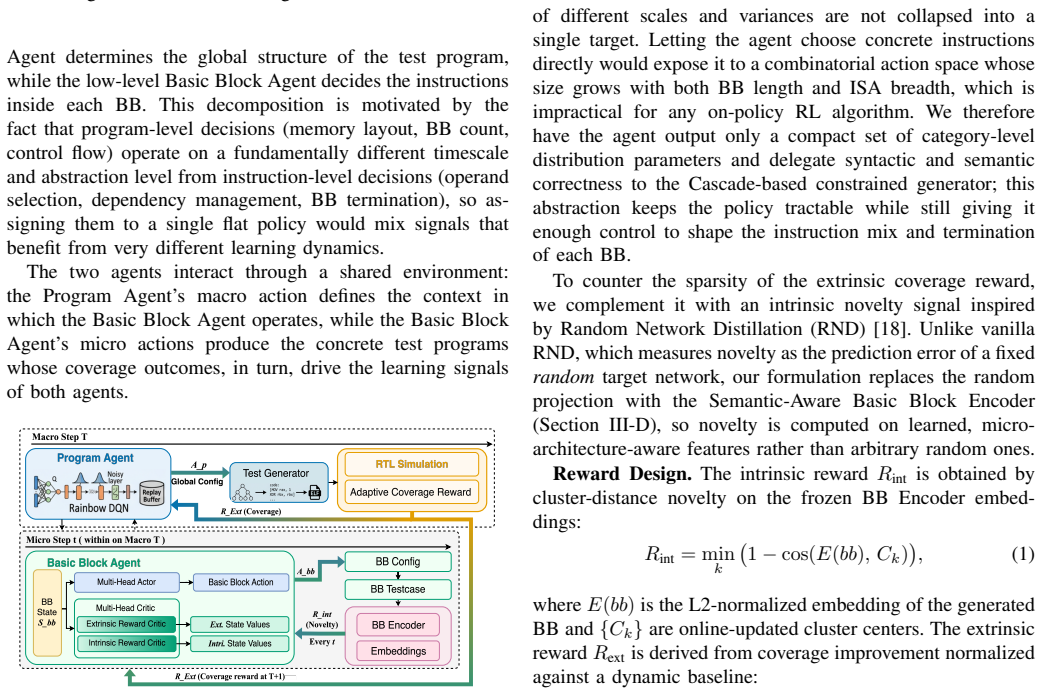
Dual-agent hierarchy (Program Agent + Basic Block Agent) closed by a Semantic-Aware Basic Block Encoder that supplies intrinsic novelty rewards and an Adaptive Coverage Reward Mechanism that reweights module-level coverage gains.
What would settle it
Re-run the same 24-hour Rocket/BOOM/CVA6 campaigns with multiple random seeds and report mean control-register coverage and Encarsia detection rates with error bars; if HiFuzz no longer leads Cascade, the central claim fails.
Extended reading notes
Core claim
HiFuzz shows that constructive CPU fuzzing can be cast as a hierarchical RL problem whose two agents, guided by a DUT-agnostic basic-block novelty encoder and a UCB-style module-coverage reward, generate denser, higher-prevalence RISC-V programs that reach deeper architectural states and find more bugs than mutation-based or purely random constructive baselines.
Load-bearing premise
That one 24-hour run per fuzzer and DUT, plus access to module-level coverage, is enough to claim consistent superiority.
Editorial extensions
If this is right
- Constructive fuzzers can drop blind mutation once hierarchical RL plus semantic intrinsic rewards keep programs valid and informative.
- Module-aware adaptive rewards can reduce the masking effect that hides under-covered units behind aggregate coverage scores.
- A single DUT-agnostic basic-block encoder can transfer across Rocket, BOOM and CVA6 without retraining.
- Longer dependency chains and higher instruction prevalence become practical targets for RL program generators.
Reading between the lines
- The same two-level split could be reused for other structured generation tasks (e.g., constrained random testbenches) where global layout and local filling have different timescales.
- If only global coverage is available, ACRM collapses and the advantage may shrink to the hierarchical generator alone.
- Extending the Program Agent to multi-hart layouts would be a direct next step for memory-ordering bugs currently out of scope.
Signed reviews
Editorial analysis
A structured set of objections, weighed in public.
Referee Report
Summary. HiFuzz proposes a hierarchical reinforcement-learning framework for constructive RISC-V CPU fuzzing that replaces mutation with a two-level generator: a Rainbow-DQN Program Agent that chooses global program layout (memory footprint, BB count, length/privilege mix) and a PPO Basic Block Agent that outputs category-level instruction distributions and termination modes, with a constrained generator enforcing validity. To address sparse and biased rewards, the system adds (i) a DUT-agnostic Semantic-Aware Basic Block Encoder (structured tokenizer + Bi-LSTM, trained by MLM then BB-Sim contrastive alignment) that supplies intrinsic novelty rewards without RTL simulation, and (ii) an Adaptive Coverage Reward Mechanism that reweights module-level coverage gains via a UCB-style bandit. Evaluations on Rocket, BOOM, and CVA6 under 24-hour wall-clock budgets report large gains over DifuzzRTL, ProcessorFuzz, and Cascade on control-register and related coverage, higher program prevalence and dependency-chain length, and improved Encarsia bug detection (30/60 vs Cascade 26), with ablations attributing substantial gains to the encoder and ACRM.
Significance. If the reported gains hold under stronger statistical controls, this is a meaningful step for hardware fuzzing: it shows that constructive generation can be productively factored into hierarchical RL actions while preserving program validity, and that dense semantic intrinsic feedback plus module-aware extrinsic reweighting can mitigate the sparsity and masking problems that limit both mutation-based and random constructive fuzzers. Strengths include multi-DUT evaluation (including a SystemVerilog core outside the Rocket ecosystem), component ablations isolating the BB Encoder and ACRM, explicit program-quality metrics (prevalence, dependency length, ISA coverage), and an Encarsia bug campaign with per-bug tables. The hierarchical generator and frozen DUT-agnostic encoder are reusable design ideas beyond the specific cores studied.
major comments (3)
- The central claim of substantial superiority under identical 24-hour budgets (Table II: Rocket Control Register Coverage 1,102,343 vs Cascade 740,329, +48.9%, 3.3× coverage/test; Fig. 7–11; Encarsia Table IV) rests on single full campaigns per fuzzer/DUT. §VI states that curves are not averaged over random seeds and flags multi-seed mean/std as future work. Rainbow DQN, PPO with dual critics, online cluster centers for R_int (Eq. 1), and UCB module weights (Eqs. 5–7) are all stochastic; Cascade is constructive-random. Without seed replicates or error bars, the magnitude of the headline gap cannot be distinguished from a favorable exploration trajectory. At minimum, report multi-seed means and variance for the primary Rocket control-register metric and the Fig. 11 ablations, or substantially qualify the strength of the “significantly outperforms” claim.
- §III-D and Fig. 12 present the BB Encoder as micro-architecture-aware because embeddings track the hand-designed BB-Sim metric (Algorithm 1). Fig. 12 only shows that cosine similarity correlates with BB-Sim (Pearson r=0.876), not that BB-Sim (or embedding novelty) correlates with measured microarchitectural stress (e.g., issue-queue pressure, ROB occupancy, unit utilization). The “hardware stress patterns” claim is therefore stronger than the evidence. Either validate BB-Sim/novelty against DUT-side microarch counters on a held-out set, or reframe the encoder as a structural/ISA-semantic novelty prior whose utility is established empirically by the ablation (+34% in Fig. 11) rather than by microarchitectural grounding.
- §V-A and Table I treat Control Register Coverage as the primary efficiency metric on Rocket, while CVA6 uses summed Line+Toggle (Fig. 8) because Control Register instrumentation is unavailable. The paper correctly notes that Line/Toggle can saturate and that MUX/Control Register are closer to verification intent, yet the cross-DUT “generality” claim mixes non-comparable metrics. Please either instrument a common processor-relevant metric on all three DUTs where possible, or more carefully separate “same-metric Rocket/BOOM comparison” from “transfer evidence on CVA6 under a coarser metric,” so the 7.2% CVA6 gain is not read as commensurate with the Rocket control-register result.
minor comments (5)
- §V-B5 and related text avoid a direct GenHuzz coverage comparison for good backend/model-release reasons; still, a short table of structural differences (action interface, validity mechanism, reward source) would make the contrast easier to cite without implying a coverage ranking.
- Appendix A lists many free parameters (α_int/α_ext, γ, τ, β schedule, BB-Sim scoring constants). A brief sensitivity note—or a statement that defaults were fixed before the final 24-hour campaigns—would help readers assess robustness.
- Fig. 9’s dual coverage/weight panels are informative but dense; labeling which modules are “easy” vs “hard” in the caption would help readers connect ACRM weight drops to the masking-effect narrative in §III-E.
- Typographical inconsistencies appear in core names (CV A6 / CVA6) and occasional spacing in math (e.g., R int vs R_int). Normalize throughout.
- §VI correctly scopes out multi-hart/A-extension concurrency bugs; a one-sentence forward pointer in the introduction would set expectations earlier for readers focused on memory-ordering verification.
Circularity Check
No circularity: empirical RL optimization paper whose coverage/bug claims rest on external DUT simulation, not on self-definitional or fitted-as-prediction reductions.
full rationale
HiFuzz is an engineering/empirical systems paper, not a first-principles derivation. Its load-bearing claims (Table II Control-Register Coverage 1,102,343 vs Cascade 740,329; Encarsia 30/60 bugs; ablations in Fig. 11; CVA6 Total Coverage) are measured by running generated programs on independent RTL simulators (Verilator) and Spike reference models under fixed 24 h wall-clock budgets. The dual-agent hierarchy, Semantic-Aware BB Encoder (two-stage MLM + contrastive alignment to hand-designed BB-Sim), and UCB-based ACRM are design choices that produce denser intrinsic/extrinsic rewards; they do not redefine the evaluation metrics. The encoder is trained offline once on Cascade programs and frozen, so novelty R_int is not fitted to the same coverage numbers later reported as results. No uniqueness theorems, self-citation chains, or ansatz-smuggling appear; citations to Rainbow DQN, PPO, RND, Cascade, etc. are standard external tools. Single-run variance is a statistical-support issue (noted by the authors in §VI), not circularity. The derivation chain therefore does not reduce any claimed result to its own inputs by construction.
Assumptions & free parameters
free parameters (6)
- α_int, α_ext (intrinsic/extrinsic actor weights)
- extrinsic baseline diminishing factor γ
- Program/BB agent learning rates
- UCB temperature τ and dynamic β schedule
- BB-Sim match/dependency scoring constants (B_exact, α discount, β_bonus, window W)
- Encoder embedding/hidden sizes and training corpus size
assumptions (5)
- domain assumption Control-register, MUX, line, and toggle coverage are useful proxies for verification progress and correlate with bug-finding power.
- ad hoc to paper Program generation can be productively factored into global structural actions and per-BB category distributions without needing instruction-level RL actions.
- ad hoc to paper BB-Sim structural similarity reflects microarchitectural stress similarity well enough that embedding novelty is a useful intrinsic reward.
- domain assumption Module-level coverage instrumentation is available and modules can be treated as independent bandit arms.
- domain assumption Rainbow DQN and PPO with dual critics are appropriate learners for the discrete macro and continuous micro action spaces.
invented entities (3)
-
Semantic-Aware Basic Block Encoder (Bi-LSTM + BB-Sim curriculum)
-
Adaptive Coverage Reward Mechanism (UCB module reweighting)
-
Dual-agent hierarchical constructive fuzzer (Program Agent + Basic Block Agent)
Cite this review
Pith. "Pith review of HiFuzz: Hierarchical Reinforcement Learning for Semantic-Aware and Adaptive CPU Fuzzing." pith.science (2026). https://pith.science/paper/FYJQYRQO
@misc{pith2026260706619,
  author       = {Pith},
  title        = {Pith review of: HiFuzz: Hierarchical Reinforcement Learning for Semantic-Aware and Adaptive CPU Fuzzing},
  year         = {2026},
  howpublished = {\url{https://pith.science/paper/FYJQYRQO}},
  note         = {Machine review of arXiv:2607.06619}
}
read the original abstract
Modern processor verification struggles to reach deep architectural states due to the inefficiencies of traditional mutation-based fuzzing. We propose HiFuzz, a novel hierarchical reinforcement learning framework that replaces mutation with a structured, two-layer generation process: a Program Agent for global layout and a Basic Block Agent for precise instruction filling. To overcome reward sparsity, HiFuzz integrates an adaptive coverage reward mechanism and a semantic-aware basic block encoder providing intrinsic feedback. Extensive evaluations on three real-world RISC-V cores demonstrate that HiFuzz significantly outperforms state-of-the-art fuzzers in coverage and bug detection.
Figures


Figures from the paper (8 more)


Reference graph
Works this paper leans on
-
[1]
Meltdown: Reading kernel memory from user space,
M. Lipp, M. Schwarz, D. Gruss, T. Prescher, W. Haas, A. Fogh, J. Horn, S. Mangard, P. Kocher, D. Genkin, Y . Yarom, and M. Hamburg, “Meltdown: Reading kernel memory from user space,” in27th USENIX Security Symposium (USENIX Security 18), 2018, pp. 973–990
work page 2018
-
[2]
Spectre attacks: Exploiting speculative execution,
P. Kocher, J. Horn, A. Fogh, D. Genkin, D. Gruss, W. Haas, M. Hamburg, M. Lipp, S. Mangard, T. Prescher, and Y . Yarom, “Spectre attacks: Exploiting speculative execution,” in2019 IEEE Symposium on Security and Privacy (S&P), 2019, pp. 1–19
work page 2019
-
[3]
Bergeron,Writing Testbenches: Functional Verification of HDL Models, 2nd ed
J. Bergeron,Writing Testbenches: Functional Verification of HDL Models, 2nd ed. Springer, 2003
work page 2003
-
[4]
E. M. Clarke, T. A. Henzinger, H. Veith, and R. Bloem, Eds.,Handbook of Model Checking. Springer, 2018
work page 2018
-
[5]
Rfuzz: Coverage-directed fuzz testing of RTL on FP- GAs,
K. Laeufer, J. Koenig, D. Kim, J. Bachrach, and K. Sen, “Rfuzz: Coverage-directed fuzz testing of RTL on FP- GAs,” in2018 IEEE/ACM International Conference on Computer-Aided Design (ICCAD). IEEE, 2018, pp. 1–8
work page 2018
-
[6]
Difuzzrtl: Differential fuzz testing to find cpu bugs,
J. Hur, S. Song, D. Kwon, E. Baek, J. Kim, and B. Lee, “Difuzzrtl: Differential fuzz testing to find cpu bugs,” in 2021 IEEE Symposium on Security and Privacy (SP). IEEE, 2021, pp. 1286–1303
work page 2021
-
[7]
Cascade: CPU fuzzing via intricate program generation,
F. Solt, K. Ceesay-Seitz, and K. Razavi, “Cascade: CPU fuzzing via intricate program generation,” in33rd USENIX Security Symposium (USENIX Security 24), 2024, pp. 5341–5358
work page 2024
-
[8]
Processorfuzz: Processor fuzzing with control and status registers guidance,
S. Canakci, C. Rajapaksha, L. Delshadtehrani, A. Nataraja, M. B. Taylor, M. Egele, and A. Joshi, “Processorfuzz: Processor fuzzing with control and status registers guidance,” in2023 IEEE International Symposium on Hardware Oriented Security and Trust (HOST). IEEE, 2023, pp. 1–12
work page 2023
Show all 24 references
-
[9]
Beyond random inputs: A novel ml-based hardware fuzzing,
M. Rostami, M. Chilese, S. Zeitouni, R. Kande, J. Ra- jendran, and A. R. Sadeghi, “Beyond random inputs: A novel ml-based hardware fuzzing,” in2024 Design, Automation & Test in Europe Conference & Exhibition (DATE), 2024, pp. 1–6
2024
-
[10]
{GenHuzz}: An efficient generative hardware fuzzer,
L. Wu, M. Rostami, H. Li, J. Rajendran, and A.-R. Sadeghi, “{GenHuzz}: An efficient generative hardware fuzzer,” in34th USENIX Security Symposium (USENIX Security 25), 2025, pp. 1787–1805
2025
-
[11]
Chisel: Constructing hardware in a scala embedded language,
J. Bachrach, H. V o, B. Richards, Y . Lee, A. Waterman, R. Avizienis, J. Wawrzynek, and K. Asanovi ´c, “Chisel: Constructing hardware in a scala embedded language,” inDAC Design Automation Conference. IEEE, 2012, pp. 1212–1221
2012
-
[12]
The Rocket chip generator,
K. Asanovi ´cet al., “The Rocket chip generator,”Techni- cal Report UCB/EECS-2016-17, EECS Department, UC Berkeley, 2016
2016
-
[13]
BOOM: An open-source out-of-order risc-v core,
C. Celio, D. A. Patterson, and K. Asanovi ´c, “BOOM: An open-source out-of-order risc-v core,” inFirst Work- shop on Computer Architecture Research with RISC-V (CARRV), 2017
2017
-
[14]
Simulator independent coverage for RTL hardware languages,
K. Laeufer, V . Iyer, D. Biancolin, J. Bachrach, B. Nikoli´c, and K. Sen, “Simulator independent coverage for RTL hardware languages,” inProceedings of the 28th ACM International Conference on Architectural Support for Programming Languages and Operating Systems, Volume 3, 202...
2023
-
[15]
Between MDPs and semi-MDPs: A framework for temporal abstraction in reinforcement learning,
R. S. Sutton, D. Precup, and S. Singh, “Between MDPs and semi-MDPs: A framework for temporal abstraction in reinforcement learning,”Artificial Intelligence, vol. 112, no. 1–2, pp. 181–211, 1999
1999
-
[16]
Rainbow: Combining improvements in deep reinforcement learning,
M. Hessel, J. Modayil, H. Van Hasselt, T. Schaul, G. Os- trovski, W. Dabney, D. Horgan, B. Piot, M. Azar, and D. Silver, “Rainbow: Combining improvements in deep reinforcement learning,” inAAAI Conference on Artificial Intelligence, 2018
2018
-
[17]
Proximal policy optimization algorithms,
J. Schulman, F. Wolski, P. Dhariwal, A. Radford, and O. Klimov, “Proximal policy optimization algorithms,” arXiv preprint arXiv:1707.06347, 2017
2017 arXiv
-
[18]
Ex- ploration by random network distillation,
Y . Burda, H. Edwards, A. Storkey, and O. Klimov, “Ex- ploration by random network distillation,”International Conference on Learning Representations (ICLR), 2019
2019
-
[19]
High-dimensional continuous control us- ing generalized advantage estimation,
J. Schulman, P. Moritz, S. Levine, M. Jordan, and P. Abbeel, “High-dimensional continuous control us- ing generalized advantage estimation,”arXiv preprint arXiv:1506.02438, 2015
2015 arXiv
-
[20]
BinSe- quence: Fast, accurate and scalable binary code reuse 10 detection,
H. Huang, A. M. Youssef, and M. Debbabi, “BinSe- quence: Fast, accurate and scalable binary code reuse 10 detection,” inProceedings of the 2017 ACM on Asia Conference on Computer and Communications Security (ASIA CCS), 2017, pp. 155–166
2017
-
[21]
Finite-time analysis of the multiarmed bandit problem,
P. Auer, N. Cesa-Bianchi, and P. Fischer, “Finite-time analysis of the multiarmed bandit problem,”Machine Learning, vol. 47, no. 2–3, pp. 235–256, 2002
2002
-
[22]
Verilator: The Fastest Verilog/SystemVerilog Simulator,
CHIPS Alliance under The Linux Foundation, “Verilator: The Fastest Verilog/SystemVerilog Simulator,” https:// github.com/verilator/verilator, 2024, (2024)
2024
-
[23]
The cost of application-class processing: Energy and performance analysis of a Linux- ready 1.7-GHz 64-bit RISC-V core in 22-nm FDSOI technology,
F. Zaruba and L. Benini, “The cost of application-class processing: Energy and performance analysis of a Linux- ready 1.7-GHz 64-bit RISC-V core in 22-nm FDSOI technology,” inIEEE Transactions on Very Large Scale Integration (VLSI) Systems, vol. 27, no. 11. IEEE, 2019, pp. 2629–2640
2019
-
[24]
Encarsia: Evaluating cpu fuzzers via automatic bug injection,
M. B ¨olcskei, F. Solt, K. Ceesay-Seitz, and K. Razavi, “Encarsia: Evaluating cpu fuzzers via automatic bug injection,” in34th USENIX Security Symposium, 2025. APPENDIXA IMPLEMENTATIONCONFIGURATIONDETAILS This appendix complements Section IV with the full state/action schemas,...
2025
Reviewed July 11, 2026 · model on record in the stance chip above.
Discussion (0). Continue with ORCID to comment.