REVIEW 5 major objections 5 minor 32 references
The Noise Collector for sparse recovery in high dimensions
T0 review · 5 major / 5 minor · reviewed 2026-08-14 · deepseek-v4-flash
Pith's one-line read The paper shows that adding a random Noise Collector matrix to l1 minimization yields zero false discovery rate for any noise level, with probability tending to one as the data dimension grows.
desk verdict A promising idea for tuning-free sparse recovery, but the headline zero-FDR claim outruns the proofs, which only cover rotationally invariant noise. read the letter →
The pith
A machine-rendered reading of the paper's core claim, the machinery that carries it, and where it could break.
The reading
What carries the argument
The central object is the Noise Collector matrix $C$, an $N \times \Sigma$ matrix with $\Sigma = N^\beta$ ($\beta>1$) columns drawn uniformly and independently on the unit sphere, arranged as circulant blocks so that multiplication by $C$ and $C^*$ can be done by FFT. The key mechanism is the dual-certificate bound: for a typical noise direction, the dual certificate $z$ of the optimal $(0,\eta)$ solution is uniformly distributed on the sphere, so the probability that any column $a_j$ of $A$ aligns with $z$ beyond $\tau$ is exponentially small; this forces $\rho_\tau$ to have no false discoveries. The geometric picture is that the $\ell^1$ ball of radius $O(\sqrt{N})$ intersects the unit sphere in a region of small area, so a random direction $e$ is almost surely explained by the noise collector rather than by the signal columns.
What would settle it
Take $N=10^4$, build $A$ from random unit vectors, set $b_0=0$, and choose the noise vector $e$ to point exactly along a fixed column of $A$ (so $e/\|e\|$ is deterministic, not uniform on the sphere). Solve the augmented $\ell^1$ problem with $\tau = 0.8\sqrt{\ln N}$. Theorem 1 predicts $\rho_\tau = 0$ with high probability, but the isotropy assumption fails, so any nonzero recovered coefficient would falsify the claim that the zero-false-discovery rate holds for any noise.
Extended reading notes
Core claim
On the paper's own terms, the central discovery is that adding a random Noise Collector matrix $C$ of polynomially many columns to the measurement system, and minimizing $\tau\|\rho\|_{\ell^1} + \|\eta\|_{\ell^1}$ subject to $A\rho + C\eta = b_0 + e$, separates signal from noise purely by $\ell^1$ geometry. The paper proves three theorems: (1) with pure noise ($b_0=0$), the recovered signal $\rho_\tau$ is zero with high probability; (2) with an $M$-sparse signal and incoherent columns of $A$, the support of $\rho_\tau$ is contained in the true support; and (3) if the noise-to-signal ratio is below $c_2/\sqrt{\ln N}$, the supports coincide exactly. The weight $\tau$ is chosen on the order of $\sqrt{\ln N}$, and the noise collector columns are drawn uniformly on the unit sphere, making the construction parameter-free apart from universal constants.
Load-bearing premise
The proofs require that the noise direction $e/\|e\|$ be uniformly distributed on the unit sphere, and that the noise collector columns also be drawn uniformly at random; if the noise is correlated or anisotropic, the zero-false-discovery guarantee has no support in the paper.
Editorial extensions
If this is right
- No parameter estimation is needed: the method does not require the noise level or a tuning parameter $\lambda$; the weight $\tau$ is set from universal constants and $N$ alone.
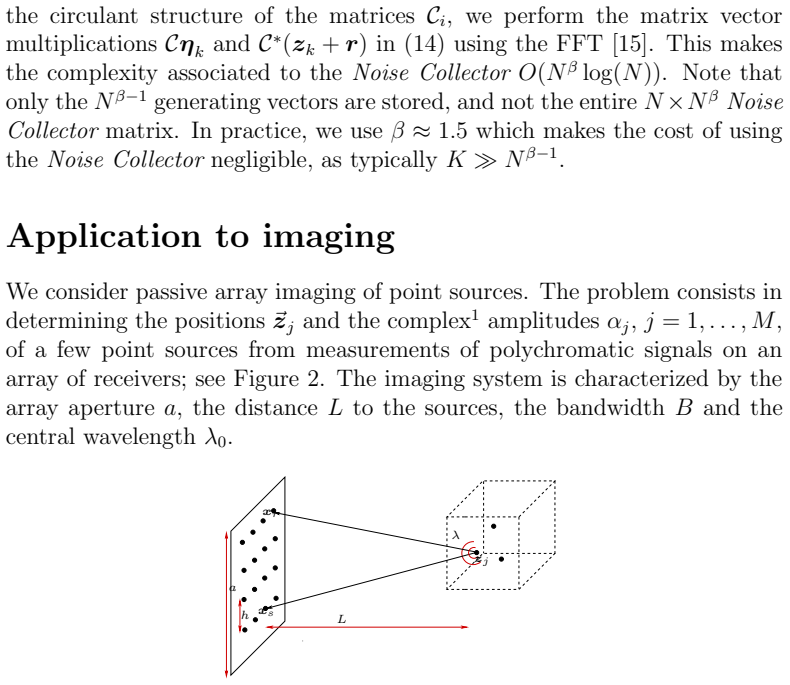
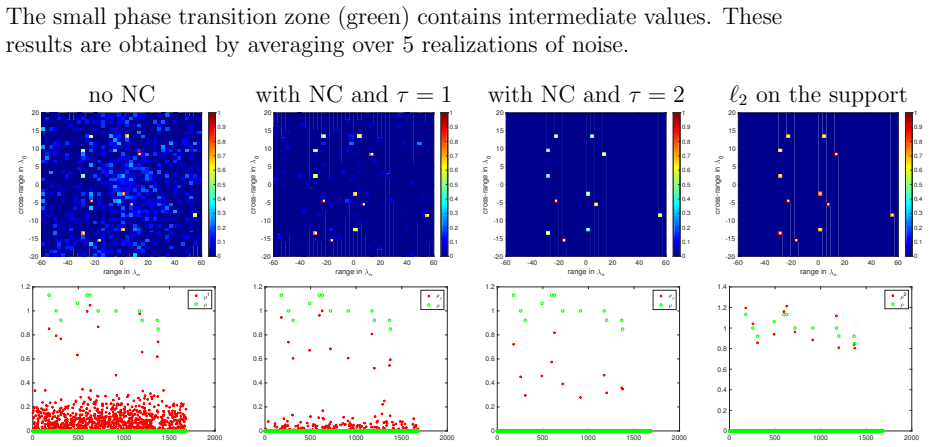
- Zero false discovery rate holds for any noise level, so the true support can be detected even at SNR near 1, as demonstrated in passive array imaging with signal-to-noise ratio equal to 1.
- When the noise is moderate ($\|e\|/\|b_0\| \le c_2/\sqrt{\ln N}$), exact support recovery holds, so after support detection a classical $\ell^2$ solve on the support gives full amplitude recovery.
- The computational cost is comparable to solving the original $\ell^1$ problem, because the circulant structure makes noise collector multiplications $O(N^\beta \log N)$ and only the generating vectors need to be stored.
Reading between the lines
- If the isotropy assumption is relaxed, the zero-false-discovery claim likely degrades; anisotropic noise aligned with columns of $A$ could be mistaken for signal, so practical applications may need to whiten the noise first or check robustness empirically.
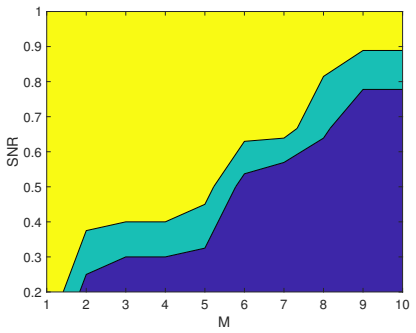
- The phase transition shown in the paper's Figure 5 suggests the method tolerates sparsity up to a threshold; a possible extension is to derive a sharp phase-transition curve for the augmented system analogous to compressed sensing.
- The same augmented approach could apply to matrix completion or robust PCA where noise is dense rather than sparse, provided a suitable incoherent 'noise dictionary' can be constructed.
- For finite $N$, the probability bounds have constants depending on $\kappa$ and $\beta$; calibrating $\tau$ by running the algorithm on pure noise (as the paper suggests) may be a practical alternative to the theoretical constant.
Signed reviews
Editorial analysis
A structured set of objections, weighed in public.
Referee Report
Summary. The paper proposes a method for sparse recovery from noisy measurements by augmenting the dictionary A with a randomly constructed Noise Collector matrix C and solving the weighted l1-minimization problem (4), with weight tau = c0 sqrt(ln N) on the signal coefficients. The authors claim that, with high probability as N grows, the solution has zero false discovery rate for any level of noise, that exact support recovery occurs when the noise is not too large, and that a circulant-based Fast Noise Collector Algorithm achieves this at computational cost comparable to the original problem. Numerical experiments on passive array imaging illustrate the claimed behavior. The theoretical results are stated as Theorems 1-3, with proofs sketched in a final section.
Significance. If the central claim were correct as stated, the paper would make a valuable practical contribution: false-discovery control in high-dimensional sparse recovery without estimating the noise level is a genuinely useful property. The idea of introducing a random dictionary dedicated to absorbing noise is elegant, and Lemma 1, which quantifies the incoherence of the augmented system and the covering property of the noise collector, is a sound starting point. The numerical imaging results are suggestive. However, the paper's central claims currently outrun its proofs: the zero-FDR statement is made for arbitrary noise while the theorems require isotropy, the fast circulant construction is not covered by the theory, and a key proof step in Theorem 3 is an unjustified reduction. These issues are load-bearing and need to be resolved or the claims weakened before the paper can be accepted.
major comments (5)
- [Abstract and Theorem 1] The abstract states that the l1-minimal solution of the augmented system has zero false discovery rate 'for any level of noise', but Theorem 1 assumes that e/||e|| is uniformly distributed on the unit sphere S^{N-1}. This assumption is essential, not technical. If e = a_j for a column of A, then by estimate (8) representing e with C costs at least sqrt(N)/(c0 sqrt(ln N)), while representing it with rho_j costs tau = c0 sqrt(ln N); for large N the l1 minimizer will set rho_j = 1 and eta = 0, producing a false discovery. Thus the zero-FDR claim fails for anisotropic or adversarial noise. The abstract and the application claims must be scoped to isotropic noise, or the theorems must be extended to non-isotropic noise.
- [Proof of Theorem 3] The proof begins with 'It suffices to prove the result for 1-sparse rho' and then analyzes only rho = (1,0,...,0). This reduction is not justified. For an M-sparse signal, the constraint C eta = e + a_1(1-rho_1) is replaced by a sum over the support, and the l1 cost of the coupled system does not decouple linearly. The paper does not show that control of a single coefficient implies control of all M coefficients simultaneously. Without a rigorous reduction, exact support recovery for M>1 is not established by the given argument.
- [Fast Noise Collector Algorithm] The fast algorithm uses a circulant construction: N^{beta-1} random generating vectors are drawn and each is used to form an N x N circulant matrix, so the columns of C are cyclic shifts of one another. Lemma 1 and Theorems 1-3, by contrast, assume that the Sigma = N^beta columns of C are drawn independently and uniformly on S^{N-1}. The columns of a circulant matrix are highly dependent, so the probabilistic estimates (6) and (7) do not apply to the implemented C. The paper does not provide any theorem or argument covering the circulant construction; the numerical experiments therefore demonstrate a heuristic algorithm, not the object analyzed in the theory.
- [Fast Noise Collector Algorithm and 'no tuning parameters' claim] The abstract and the 'Main Results' section claim that the method has no tuning parameters and does not require parameter estimation, but the paper later states: 'For optimal results, one can calibrate c0 to be the smallest constant such that Theorem 1 holds, that is, we see no phantom signals when the algorithm is fed with pure noise.' This is a data-dependent calibration of a free parameter, explicitly tuned to the null distribution of the noise. This contradicts the no-parameter-estimation claim. Either a universal choice of c0 must be proven sufficient, or the claim must be softened to say that the method avoids estimating the noise level, not that it is parameter-free.
- [Proof of Theorem 2] The proof of support inclusion for general A does not fully construct a dual certificate for the augmented problem with b0 != 0. It reuses the certificate z from the pure-noise map Phi_C(e) and bounds <a_i^v,z>, but the optimality conditions for (4) with signal present require a certificate that simultaneously controls the A- and C-columns for the actual solution with nonzero rho. The sentence 'Applying the previous arguments to z_w... we conclude rho_w_tau = 0' is only a sketch, and the decomposition step assumes bounds on <a_k,z> for support columns that have not been established for the signal-present problem. Theorem 2 needs a rigorous certificate argument before the zero-FDR claim is supported.
minor comments (5)
- [Proof of Theorem 1] The proof states 'we assume that both c_i and -c_i are in C' and then works with the convex hull H. The theorem statement and the algorithm do not construct antipodal pairs; the reduction to a symmetric convex hull should be stated explicitly, since for real-valued eta the feasible set is the symmetric convex hull of the columns, but this equivalence is not discussed.
- [Proof of Lemma 1] In the proof of part (ii), the constant alpha is required to satisfy alpha < 4 sqrt(2 pi)/4 in one line, but the text does not explain the numerical value or the role of the factor; the choice of N sets of distinct indices and the resulting probability bound should be made more precise.
- [Proof of Theorem 1] Equation (22) contains the phrase 'for all i = j,...,K', which appears to be a typo for 'for all j = 1,...,K'. The notation should be corrected.
- [Figures and captions] In Figure 4 the caption describes tau = 2 as 'the correct tau' in (14). Since the theory allows any tau = c0 sqrt(ln N) with sufficiently large c0, the word 'correct' is misleading without specifying the calibration criterion used.
- [Complex data] The footnote says the results hold for complex data, but the proofs and optimization statements are written for real variables. A short justification or reference for the complex case would improve clarity.
Circularity Check
No circular derivation: the theorems are proved from explicit random-model assumptions; self-citations and a practical c0-calibration remark are not load-bearing.
full rationale
Walking the derivation chain, I find no step in which a claimed prediction reduces to its input by construction. Theorems 1–3 are proved in the paper from explicit assumptions: the columns of C are i.i.d. uniform on S^{N-1}, the noise direction e/||e|| is uniform on S^{N-1}, and the columns of A satisfy an incoherence bound. The dual-certificate argument, the geometric estimates in Lemma 1 (bounds (6)–(8)), and the high-dimensional probability estimates are self-contained. The only sentence that could look circular is the practical suggestion in the Fast Noise Collector Algorithm section: 'For optimal results, one can calibrate c0 to be the smallest constant such that Theorem 1 holds, that is, we see no phantom signals when the algorithm is fed with pure noise.' This is a parameter-selection heuristic for choosing the universal constant c0, not a step in the proof of Theorem 1; the numerical experiments fix tau = 0.8*sqrt(ln N) before running the tests. The paper also cites its own prior work [20] for the original Noise Collector construction and [21] for the GeLMA solver, but the central theorems here are proved with standard arguments and do not import unverified claims from those papers. The abstract's unconditional phrase 'zero false discovery rate for any level of noise' omits the uniform-sphere condition on e/||e|| that the theorems require; that is an overstatement and a correctness caveat, but not a circular reduction. The modest score of 2 reflects only the presence of minor, non-load-bearing self-citations.
Assumptions & free parameters
free parameters (4)
- beta (exponent for the number of noise collector columns) =
1.5 in experiments; any beta > 1 in theory
- c0 (constant in tau = c0 sqrt(ln N)) =
0.8 in experiments (tau = 2 for N = 625)
- alpha (constant in Lemma 1 covering bound) =
between 1/2 and 0.63
- lambda (regularization parameter in the variational algorithm) =
1 in the example
assumptions (5)
- domain assumption The noise direction e/||e|| is uniformly distributed on the unit sphere.
- domain assumption The columns of A are normalized and mutually incoherent with |<a_i,a_j>| <= 1/(3M).
- standard math The joint distribution of (C, e) is rotationally invariant, and the dual certificate map Phi_C is equivariant.
- standard math The Kabatjanskii-Levenstein bound limits the number of nearly orthogonal vectors to N^{alpha^2}.
- ad hoc to paper The circulant construction of C yields columns with the same statistical properties as independent uniform vectors on the sphere.
invented entities (1)
-
Noise Collector matrix C
independent evidence
Cite this review
Pith. "Pith review of The Noise Collector for sparse recovery in high dimensions." pith.science (2026). https://pith.science/paper/FYJVOIYN
@misc{pith2026190804412,
  author       = {Pith},
  title        = {Pith review of: The Noise Collector for sparse recovery in high dimensions},
  year         = {2026},
  howpublished = {\url{https://pith.science/paper/FYJVOIYN}},
  note         = {Machine review of arXiv:1908.04412}
}
abstract
The ability to detect sparse signals from noisy high-dimensional data is a top priority in modern science and engineering. A sparse solution of the linear system $A \rho = b_0$ can be found efficiently with an $l_1$-norm minimization approach if the data is noiseless. Detection of the signal's support from data corrupted by noise is still a challenging problem, especially if the level of noise must be estimated. We propose a new efficient approach that does not require any parameter estimation. We introduce the Noise Collector (NC) matrix $C$ and solve an augmented system $A \rho + C \eta = b_0 + e$, where $ e$ is the noise. We show that the $l_1$-norm minimal solution of the augmented system has zero false discovery rate for any level of noise and with probability that tends to one as the dimension of $ b_0$ increases to infinity. We also obtain exact support recovery if the noise is not too large, and develop a Fast Noise Collector Algorithm which makes the computational cost of solving the augmented system comparable to that of the original one. Finally, we demonstrate the effectiveness of the method in applications to passive array imaging.
Figures


Figures from the paper (2 more)
Reference graph
Works this paper leans on
-
[1]
M. AlQuraishi and H. H. McAdams, Direct inference of protein DNA interactions using compressed sensing methods, Proc. Natl. Acad. Sci. U.S.A 108,14819–14824 (2001)
work page 2001
-
[2]
Baraniuk and Philippe Steeghs, Compressive Radar Imaging, in 2007 IEEE Radar Conference, Apr
R. Baraniuk and Philippe Steeghs, Compressive Radar Imaging, in 2007 IEEE Radar Conference, Apr. 2007, 128–133
work page 2007
-
[3]
L. Borcea and I. Kocyigit, Resolution analysis of imaging with 𝓁1 opti- mization, SIAM J. Imaging Sci. 8, 3015–3050 (2015). 16
work page 2015
-
[4]
E. J Cand` es and T. Tao, Decoding by linear programming,IEEE Trans. Inf. Theory 51, 4203–4215 (2005)
work page 2005
-
[5]
E. J. Cand` es and C. Fernandez-Granda, Towards a mathematical theory of super-resolution, Comm. Pure Appl. Math. 67, 906-956 (2014)
work page 2014
-
[6]
A. Chai, M. Moscoso and G. Papanicolaou, Robust imaging of localized scatterers using the singular value decomposition and 𝓁1 optimization, Inverse Problems 29, 025016 (2013)
work page 2013
-
[7]
A. Chai, M. Moscoso and G. Papanicolaou, Imaging Strong Localized Scatterers with Sparsity Promoting Optimization,SIAM J. Imaging Sci. 7, 1358–1387 (2014)
work page 2014
-
[8]
V. Chandrasekaran, B.Recht, P. A. Parrilo, A. S. Willsky, The convex geometry of linear inverse problems, Found. Comput. Math. 12, 805–849 (2012)
work page 2012
Show all 32 references
-
[9]
S. S. Chen, D. L. Donoho, and M. A. Saunders, Atomic decomposition by basis pursuit, SIAM Rev. 43, 12–159 (2001)
2001
-
[10]
D. L. Donoho, Super-resolution via sparsity constraint, SIAM J Math Anal 23, 1303–1331 (1992)
1992
-
[11]
D. L. Donoho and M. Elad, Optimally sparse representation in general (nonorthogonal) dictionaries via 𝓁1 minimization, Proc. Natl. Acad. Sci. U.S.A 100, 2197–2202 (2003)
2003
-
[12]
A. C. Fannjiang, T. Strohmer, and P. Yan, Compressed remote sensing of sparse objects, SIAM J. Imag. Sci. 3, 595-618 (2010)
2010
-
[13]
A. C. Fannjiang and W. Liao, Coherence pattern-guided compressive sensing with unresolved grids, SIAM J. Imag. Sci. 5, 179–202 (2012)
2012
-
[14]
J. J. Fuchs, Recovery of exact sparse representations in the presence of bounded noise, IEEE Trans. Inf. Theory 51, 3601–3608 (2005)
2005
-
[15]
R. M. Gray, Toeplitz and Circulant Matrices: A Review, Foundations and Trends in Communications and Information Theory 2, 155–239 (2006). 17
2006
-
[16]
M. A. Herman and T. Strohmer, High-Resolution Radar via Compressed Sensing, IEEE Trans. Signal Process. 57, 2275-2284 (2009)
2009
-
[17]
J. N. Laska, M. A. Davenport and R. G. Baraniuk, Exact signal recovery from sparsely corrupted measurements through the Pursuit of Justice, 2009 Conference Record of the Forty-Third Asilomar Conference on Sig- nals, Systems and Computers, Pacific Grove, CA, 2009, 1556–1560
2009
-
[18]
Laviada, A
J. Laviada, A. Arboleya-Arboleya, Y. Alvarez-Lopez, C. Garcia- Gonzalez and F. Las-Heras, Phaseless synthetic aperture radar with efficient sampling for broadband near-field imaging: Theory and valida- tion, IEEE Trans. Antennas Propag., 63:2 (2015), pp. 573–584
2015
-
[19]
Malioutov, M
D. Malioutov, M. Cetin, A.S. Willsky, A sparse signal reconstruction perspective for source localization with sensor arrays, IEEE Trans. Sig- nal Process. 53, 3010–3022 (2005)
2005
-
[20]
Moscoso, A
M. Moscoso, A. Novikov, G. Papanicolaou and C.Tsogka, Imaging with highly incomplete and corrupted data, submitted
-
[21]
Moscoso, A
M. Moscoso, A. Novikov, G. Papanicolaou and L. Ryzhik, A differen- tial equations approach to l1-minimization with applications to array imaging, Inverse Problems 28 (2012)
2012
-
[22]
Romberg, Imaging via Compressive Sampling, IEEE Signal Process
J. Romberg, Imaging via Compressive Sampling, IEEE Signal Process. Mag. 25, 14–20 (2008)
2008
-
[23]
J. N. Sampson, N. Chatterjee, R. J. Carroll, and S. M¨ uller, Controlling the local false discovery rate in the adaptive Lasso, Biostatistics 14, 653–666 (2013)
2013
-
[24]
H. L. Taylor, S. C. Banks, and J. F. McCoy, Deconvolution with the l 1 norm, Geophysics 44, 39–52 (1979)
1979
-
[25]
T. Terrence, A cheap version of the Kabatjanskii- Levenstein bound for almost orthogonal vectors, https://terrytao.wordpress.com/2013/07/18/a-cheap-version-of-the- kabatjanskii-levenstein-bound-for-almost-orthogonal-vectors/
2013
-
[26]
Tibshirani, Regression Shrinkage and Selection via the lasso, Journal of the Royal Statistical Society
R. Tibshirani, Regression Shrinkage and Selection via the lasso, Journal of the Royal Statistical Society. Series B (methodological) 58, 267–288 (1996). 18
1996
-
[27]
J. A. Tropp, Just Relax: Convex Programming Methods for Identifying Sparse Signals in Noise, IEEE Trans. Inf. Theory 52, 1030–1051 (2006)
2006
-
[28]
J. A. Tropp, J. N. Laska, M. F. Duarte, J. K. Romberg, and R. G. Baraniuk, Beyond Nyquist: Efficient Sampling of Sparse Bandlimited Signals, IEEE Transactions on Information Theory 56, 520–544 (2010)
2010
-
[29]
Trzasko and A
J. Trzasko and A. Manduca, Highly undersampled magnetic resonance image reconstruction via homotopic𝓁0-minimization, IEEE Trans. Med. Imag. 28, 106–121 (2009)
2009
-
[30]
Vershynin, High-dimensional probability
R. Vershynin, High-dimensional probability. An introduction with ap- plications in data science, Cambridge University Press, 2018
2018
-
[31]
M. J. Wainwright, Sharp Thresholds for High-Dimensional and Noisy Sparsity Recovery Using 𝓁1-Constrained Quadratic Programming (Lasso), IEEE Trans. Inf. Theory 55, 2183–2202 (2009)
2009
-
[32]
Zou, The Adaptive Lasso and Its Oracle Properties, J
H. Zou, The Adaptive Lasso and Its Oracle Properties, J. Amer. Statist. Assoc. 101, 1418–1429 (2006). 19
2006
Reviewed August 14, 2026 · model on record in the stance chip above.
Discussion (0). Continue with ORCID to comment.