REVIEW 3 major objections 7 minor 53 references
Towards High-Resolution Salient Object Detection
T0 review · 3 major / 7 minor · reviewed 2026-08-14 · deepseek-v4-flash
Pith's one-line read The paper introduces the first high-resolution saliency dataset, HRSOD, and a global-local network that lifts Fβ on its test set from 0.795 (best prior) to 0.888 while keeping pace on standard low-resolution benchmarks.
desk verdict The HRSOD dataset is a genuine contribution and the high-res processing story is plausible, but the headline 'large margin' over prior methods is confounded by an evaluation protocol that gives baselines neither high-resolution inputs nor HRSOD training. read the letter →
The pith
A machine-rendered reading of the paper's core claim, the machinery that carries it, and where it could break.
The reading
What carries the argument
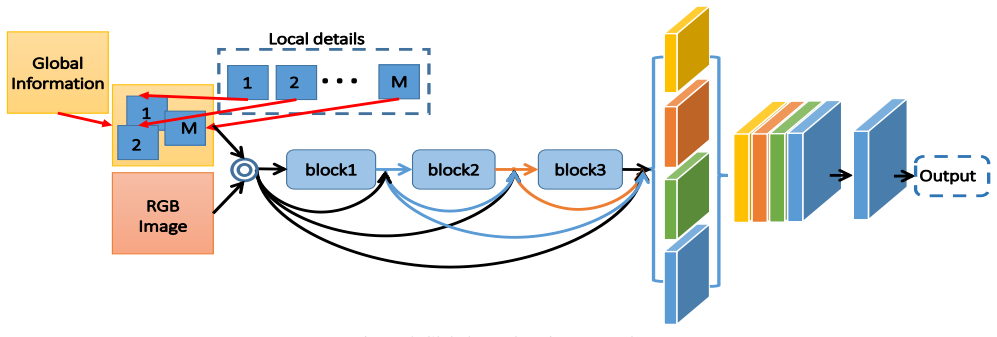
The load-bearing mechanism is coarse-to-fine refinement with uncertainty-driven attention. Attended Patch Sampling (APS) takes the coarse global saliency map from GSN, marks pixels whose predicted saliency falls between thresholds T1=50 and T2=200 as uncertain, and crops sub-images centered on those pixels; the Local Refinement Network then sees those patches at full local resolution, with the corresponding GSN map patch concatenated into its decoder as global guidance. A lightweight Global-Local Fusion Network, built from densely connected layers and dilated convolutions (which enlarge receptive field without down-sampling) and with only 11.9 kB of parameters, takes the fused GSN/LRN output together with the original high-resolution image and produces the final spatially consistent mask. This hierarchy is what lets the method keep global context at low resolution while spending computation only where boundaries and ambiguous regions need detail.
What would settle it
Retrain a strong baseline such as DGRL or DGF on the HRSOD training set (or on DUTS+HRSOD) using its own training protocol, then evaluate it on HRSOD-Test with the same metrics; if its Fβ approaches or exceeds 0.888, the paper's architectural claim is not the source of the large margin.
Extended reading notes
Core claim
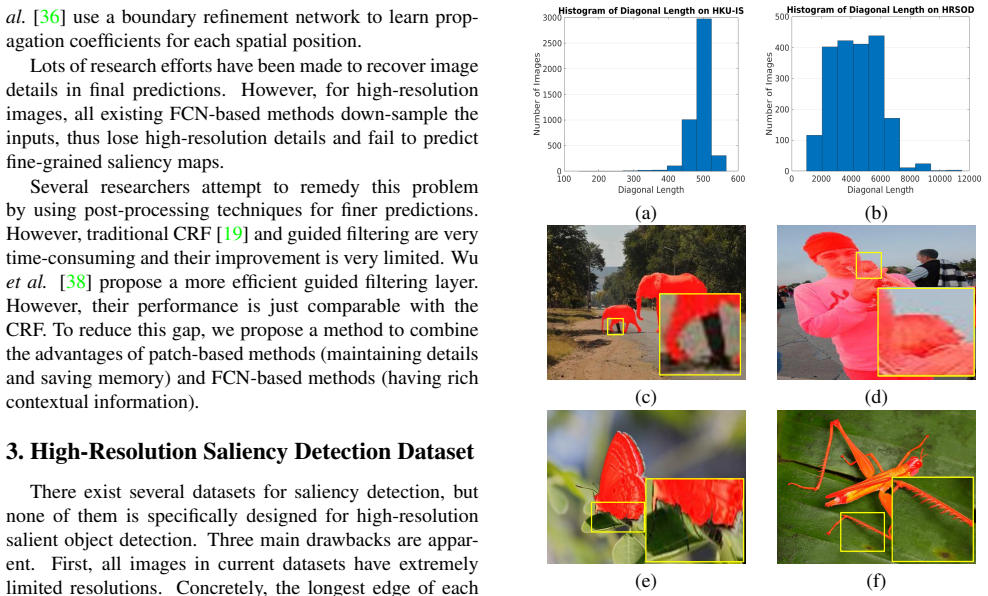
On its own terms, the paper claims two contributions. First, HRSOD is the first saliency detection dataset whose images have a shortest edge above 1200 pixels, with 1610 training and 400 test images and pixel-level annotations checked by multiple subjects, designed to expose boundary detail that low-resolution datasets lack. Second, the proposed GSN-LRN-GLFN framework combines a global semantic network that reads a 384×384 down-sampled image, a local refinement network that crops attended uncertain sub-regions at higher resolution, and a global-local fusion network that merges both into a spatially consistent prediction. The authors report Ours-DH reaching Fβ 0.888, S-measure 0.897, and MAE 0.030 on HRSOD-Test, against best prior values of 0.795, 0.853, and 0.053, and a similar lead on DAVIS-S, while remaining within a few points of the best methods on THUR, HKU-IS, and DUTS-Test.
Load-bearing premise
The load-bearing assumption is that the nine comparison methods, none of which was trained on high-resolution saliency data, are a fair baseline for a method that was; if that training-data gap were removed, the claimed large margin might shrink.
Editorial extensions
If this is right
- High-resolution saliency detection becomes tractable on a single 1080 Ti: GSN and LRN run at 384×384 and GLFN at 1024×1024, with reported 0.39 s per 1024×1024 image.
- Boundary accuracy improves substantially: BDE drops from 32.91 for the weakest baseline to 17.57 on HRSOD-Test, putting the method in range for downstream editing and compositing applications.
- The framework is backbone-agnostic; GSN and LRN can be swapped for any saliency model, so future improvements in low-resolution saliency should transfer directly to high-resolution settings.
- The HRSOD dataset gives the community a training and evaluation target where boundary detail and annotation quality, not just global overlap scores, are the differentiators.
Reading between the lines
- Because Ours-DH is trained on HRSOD while none of the nine baselines is, part of the large margin may come from seeing high-resolution training data; fine-tuning a baseline such as DGRL or DGF on HRSOD would tell how much remains architectural.
- APS is a general answer to the memory-versus-detail conflict: any dense prediction task with limited GPU memory could crop only the uncertain regions, guided by a cheap global pass, rather than processing the whole image at full resolution.
- If the margin persists under fair retraining, the practical implication is that saliency in consumer images can be computed at full resolution without heavy CRF post-processing, simplifying pipelines for background replacement and depth-of-field effects.
Signed reviews
Editorial analysis
A structured set of objections, weighed in public.
Referee Report
Summary. The paper tackles salient object detection in very high-resolution images, a regime where existing FCN-based methods downscale inputs and lose boundary details. The authors contribute a new dataset, HRSOD (1610 training and 400 test images, shortest edge over 1200 pixels, with careful pixel-level annotation), and propose a multi-branch framework: a Global Semantic Network (GSN) produces a coarse saliency map from a 384x384 downscaled image; an Attended Patch Sampling (APS) scheme selects patches around uncertain regions; a Local Refinement Network (LRN) refines those patches under semantic guidance from GSN; and a lightweight Global-Local Fusion Network (GLFN) fuses the coarse and refined predictions using the original high-resolution input. Experiments compare the method with nine prior saliency detectors on HRSOD-Test, a high-resolution subset of DAVIS (DAVIS-S), and three standard low-resolution benchmarks (DUTS-Test, HKU-IS, THUR), reporting F-beta, S-measure, MAE, and Boundary Displacement Error. Two versions are evaluated: Ours-D (trained on DUTS only) and Ours-DH (trained on DUTS + HRSOD). Ablation studies compare the full model against GSN alone, GSN+CRF, GSN+RPS+LRN, and GSN+APS+LRN+CRF.
Significance. If the results hold, the paper makes a timely contribution by defining a high-resolution saliency benchmark and showing that a modular global-local framework can be trained end-to-end on high-resolution images with modest GPU memory. The HRSOD dataset fills a real gap: existing benchmarks cap image sizes around 400-500 pixels, which is unrealistic for modern camera outputs. The APS uncertainty-guided patch sampling is a practical idea, and the ablations (APS vs RPS, GLFN vs CRF) give evidence that the specific design choices matter. The authors also report BDE on high-resolution data, which is more sensitive to boundary quality than standard metrics. The central accuracy claim, however, is weakened by an evaluation asymmetry: baselines are not trained on HRSOD and do not receive high-resolution test-time inputs, so the large margin on HRSOD-Test (F-beta 0.888 vs 0.795) is not cleanly attributable to the proposed architecture. The strengths of the paper are the dataset, the modular framework, and the generally careful ablation; the weakness is the comparison protocol for the headline claim.
major comments (3)
- The central claim of a "large margin" on high-resolution datasets is not fully disentangled from an evaluation asymmetry. Every baseline (RFCN, DHS, UCF, Amulet, NLDF, DSS, RAS, DGRL, DGF) is evaluated with its standard low-resolution pipeline and is not fine-tuned on HRSOD, while Ours-DH is trained on HRSOD training images. The Ours-D row (trained only on DUTS) mitigates part of this concern, but even Ours-D sees high-resolution pixels at train and test time, whereas no baseline is given a high-resolution pathway (either fine-tuning on HRSOD or a patch-based high-resolution inference mode). To support the claim that the margin comes from the GSN-LRN-GLFN design rather than merely from training data scale or input resolution, the authors should include at least one control: for example, fine-tune a strong baseline (e.g., DGRL or DGF) on the HRSOD training set, or apply a patch-based version of a baseline such that it also processes original high-resolution content, and compare on HRSOD-Test. If such a control is infeasible, the text should explicitly temper the "large margin" claim.
- [§5.2, Table 1] The paper reports a single run of each method and gives no error bars, confidence intervals, or significance tests. On HRSOD-Test the margins are large, but on low-resolution benchmarks several differences are small (e.g., HKU-IS F-beta 0.886 for Ours-DH vs 0.895 for DSS; DUTS-Test F-beta 0.791 vs 0.791 for DSS); without repeated runs or significance testing it is unclear whether these differences are meaningful. The authors should report variance over at least three training runs (or, if this is prohibitive, at least for the main model and the closest baseline) or use significance tests such as paired bootstrap over images.
- [§5.2] The claim that the comparison is "fair" in §5.2 is not substantiated for the high-resolution setting. The compared methods' official implementations or provided saliency maps are used with recommended settings, which means they are optimized for low-resolution benchmarks. This is fine for standard benchmarks, but on HRSOD-Test and DAVIS-S it conflates task adaptation with method quality. The paper should either provide adapted baselines or explicitly frame the comparison as "off-the-shelf methods vs. a method trained for high resolution," which is a weaker claim than the current wording.
minor comments (7)
- [§5.3.2, Table 3] The statement "our method is the fasted among all the compared methods" is inaccurate: in Table 3, DGF and UCF also run at 0.05 s at 384x384, and Ours* (0.39 s at 1024x1024) is slower than several 384x384 baselines. The time comparison mixes input sizes; it should be clearly stated that Ours* uses a different (higher) input resolution and the claim should be restricted accordingly.
- [§4.3] The hyper-parameters T1, T2, D, n, and r are said to be set by grid search with "results not sensitive to their specific choices," but no sensitivity analysis is shown (e.g., a plot of F-beta or MAE vs. each parameter). Adding this analysis, even in the supplementary material, would support the claim of robustness.
- [§4.4] The GLFN model size is reported as 11.9 kB, which is unusually small for a network with conv layers and dense connectivity; it should be clarified whether this is parameter storage after quantization, a compressed format, or a misprint, and how the size is computed.
- [Figures 7 and 8] The text in §5.2 says "Figure 8 shows a visual comparison of our method with respect to others," but the quantitative visual comparison appears to be Figure 7 (labeled "Visual comparison"); §5.3.1 uses Figure 8 for the CRF comparison. The figure numbering is inconsistent and should be fixed.
- [§5.1.3] The paper states "Source code will be released" but does not provide a public repository at the time of this review; given the paper's reliance on a new dataset and a multi-stage training protocol, making the code available is important for reproducibility and should be stated with an actual link.
- [§5.3.2] The BDE is evaluated only on HRSOD-Test and DAVIS-S, with the justification that other benchmarks have poor boundary annotations. This is reasonable, but the paper does not report whether BDE values are stable across thresholds or boundary extraction methods; a brief explanation of the boundary pixel extraction would help.
- [Abstract / §1] Minor language issue: "the above defect becomes more severe" and several other informal phrasings (e.g., "very high-resolution") could be tightened; also 'fasted' in §5.3.2 should be 'fastest'.
Circularity Check
No significant circularity: the proposed method is evaluated against external benchmarks and its components are ablated independently, so the central performance claim does not reduce to its inputs.
full rationale
The paper's central claims are empirical: it introduces a new high-resolution dataset (HRSOD) and a GSN-LRN-GLFN framework, then compares against published methods on HRSOD-Test, DAVIS-S, DUTS-Test, HKU-IS, and THUR. No fitted constant is renamed as a prediction; the architecture is trained with standard losses and the hyper-parameters (T1, T2, D, n, r) are chosen by grid search with reported insensitivity. The fact that Ours-DH is trained on HRSOD while prior baselines are not is a legitimate comparison-protocol concern, but it is a correctness/evaluation issue, not circularity: the method's outputs are not defined in terms of the test labels or the reported metrics. Self-citations in the related-work section (e.g., Amulet, DGRL, UCF) are prior art descriptions and are not load-bearing for the main derivation. The ablations compare GSN-only, GSN+CRF, GSN+RPS+LRN, GSN+APS+LRN, and the full model, showing incremental gains, which is an independent internal check rather than a circular reduction. The low-resolution benchmark results and DAVIS-S provide external support outside the introduced dataset. Therefore, no step in the claimed derivation chain reduces by construction to its own inputs.
Assumptions & free parameters
free parameters (5)
- T1 =
50
- T2 =
200
- D =
384
- n =
5
- r =
range [-D/6, D/6]
assumptions (3)
- domain assumption The saliency annotations in HRSOD are accurate and consistent at pixel level.
- domain assumption Down-sampling the full image to 384x384 preserves enough semantic information for global saliency reasoning.
- standard math The evaluation metrics (Fβ, S-measure, MAE, BDE) are standard and appropriate for the task.
Cite this review
Pith. "Pith review of Towards High-Resolution Salient Object Detection." pith.science (2026). https://pith.science/paper/FZJ24CB3
@misc{pith2026190807274,
  author       = {Pith},
  title        = {Pith review of: Towards High-Resolution Salient Object Detection},
  year         = {2026},
  howpublished = {\url{https://pith.science/paper/FZJ24CB3}},
  note         = {Machine review of arXiv:1908.07274}
}
abstract
Deep neural network based methods have made a significant breakthrough in salient object detection. However, they are typically limited to input images with low resolutions ($400\times400$ pixels or less). Little effort has been made to train deep neural networks to directly handle salient object detection in very high-resolution images. This paper pushes forward high-resolution saliency detection, and contributes a new dataset, named High-Resolution Salient Object Detection (HRSOD). To our best knowledge, HRSOD is the first high-resolution saliency detection dataset to date. As another contribution, we also propose a novel approach, which incorporates both global semantic information and local high-resolution details, to address this challenging task. More specifically, our approach consists of a Global Semantic Network (GSN), a Local Refinement Network (LRN) and a Global-Local Fusion Network (GLFN). GSN extracts the global semantic information based on down-sampled entire image. Guided by the results of GSN, LRN focuses on some local regions and progressively produces high-resolution predictions. GLFN is further proposed to enforce spatial consistency and boost performance. Experiments illustrate that our method outperforms existing state-of-the-art methods on high-resolution saliency datasets by a large margin, and achieves comparable or even better performance than them on widely-used saliency benchmarks. The HRSOD dataset is available at https://github.com/yi94code/HRSOD.
Figures


Figures from the paper (6 more)



Reference graph
Works this paper leans on
-
[1]
Frequency-tuned salient region detection
Ravi Achanta, Sheila Hemami, Francisco Estrada, and Sabine Susstrunk. Frequency-tuned salient region detection. In CVPR, pages 1597–1604, 2009. 6
work page 2009
-
[2]
Salient object detection: A benchmark
Ali Borji, Ming-Ming Cheng, Huaizu Jiang, and Jia Li. Salient object detection: A benchmark. IEEE TIP , 24(12):5706–5722, 2015. 2
work page 2015
-
[3]
Re- verse attention for salient object detection
Shuhan Chen, Xiuli Tan, Ben Wang, and Xuelong Hu. Re- verse attention for salient object detection. In ECCV, pages 234–250, 2018. 6, 7
work page 2018
-
[4]
Learn- ing active contour models for medical image segmentation
Xu Chen, Bryan M Williams, Srinivasa R Vallabhaneni, Gabriela Czanner, Rachel Williams, and Yalin Zheng. Learn- ing active contour models for medical image segmentation. In CVPR, pages 11632–11640, 2019. 2
work page 2019
-
[5]
Salientshape: Group saliency in image collections
Ming-Ming Cheng, Niloy J Mitra, Xiaolei Huang, and Shi- Min Hu. Salientshape: Group saliency in image collections. The Visual Computer, 30(4):443–453, 2014. 3, 6
work page 2014
-
[6]
Global contrast based salient region detection
Ming-Ming Cheng, Niloy J Mitra, Xiaolei Huang, Philip HS Torr, and Shi-Min Hu. Global contrast based salient region detection. IEEE TPAMI, 37(3):569–582, 2015. 2
work page 2015
-
[7]
Abhishek Das, Harsh Agrawal, Larry Zitnick, Devi Parikh, and Dhruv Batra. Human attention in visual question an- swering: Do humans and deep networks look at the same regions? CVIU, 163:90–100, 2017. 1
work page 2017
-
[8]
Salient objects in clut- ter: Bringing salient object detection to the foreground
Deng-Ping Fan, Ming-Ming Cheng, Jiang-Jiang Liu, Shang- Hua Gao, Qibin Hou, and Ali Borji. Salient objects in clut- ter: Bringing salient object detection to the foreground. In ECCV, pages 186–202, 2018. 1
work page 2018
Show all 53 references
-
[9]
Structure-measure: A New Way to Evaluate Fore- ground Maps
Deng-Ping Fan, Ming-Ming Cheng, Yun Liu, Tao Li, and Ali Borji. Structure-measure: A New Way to Evaluate Fore- ground Maps. In ICCV, pages 4548–4557, 2017. 6
2017
-
[10]
From captions to vi- sual concepts and back
Hao Fang, Saurabh Gupta, Forrest Iandola, Rupesh K Sri- vastava, Li Deng, Piotr Doll´ar, Jianfeng Gao, Xiaodong He, Margaret Mitchell, John C Platt, et al. From captions to vi- sual concepts and back. In CVPR, pages 1473–1482, 2015. 1
2015
-
[11]
Yet another survey on image segmentation: Re- gion and boundary information integration
Jordi Freixenet, Xavier Mu ˜noz, David Raba, Joan Mart´ı, and Xavier Cuf´ı. Yet another survey on image segmentation: Re- gion and boundary information integration. In ECCV, pages 408–422, 2002. 8
2002
-
[12]
Delving deep into rectifiers: Surpassing human-level perfor- mance on imagenet classification
Kaiming He, Xiangyu Zhang, Shaoqing Ren, and Jian Sun. Delving deep into rectifiers: Surpassing human-level perfor- mance on imagenet classification. In CVPR, pages 1026– 1034, 2015. 7
2015
-
[13]
Deep residual learning for image recognition
Kaiming He, Xiangyu Zhang, Shaoqing Ren, and Jian Sun. Deep residual learning for image recognition. In CVPR, pages 770–778, 2016. 1
2016
-
[14]
Deeply supervised salient ob- ject detection with short connections
Qibin Hou, Ming-Ming Cheng, Xiaowei Hu, Ali Borji, Zhuowen Tu, and Philip Torr. Deeply supervised salient ob- ject detection with short connections. In CVPR, pages 5300– 5309, 2017. 6, 7
2017
-
[15]
Densely connected convolutional net- works
Gao Huang, Zhuang Liu, Laurens Van Der Maaten, and Kil- ian Q Weinberger. Densely connected convolutional net- works. In CVPR, pages 4700–4708, 2017. 6
2017
-
[16]
A model of saliency-based visual attention for rapid scene analysis
Laurent Itti, Christof Koch, and Ernst Niebur. A model of saliency-based visual attention for rapid scene analysis. IEEE TPAMI, 20(11):1254–1259, 1998. 2
1998
-
[17]
Caffe: Convolutional architecture for fast feature embedding
Yangqing Jia, Evan Shelhamer, Jeff Donahue, Sergey Karayev, Jonathan Long, Ross Girshick, Sergio Guadarrama, and Trevor Darrell. Caffe: Convolutional architecture for fast feature embedding. In ACM Multimedia, pages 675–678,
-
[18]
Exploiting saliency for object segmentation from image level labels
Seong Joon Oh, Rodrigo Benenson, Anna Khoreva, Zeynep Akata, Mario Fritz, and Bernt Schiele. Exploiting saliency for object segmentation from image level labels. In CVPR, pages 4410–4419, 2017. 1
2017
-
[19]
Efficient inference in fully connected crfs with gaussian edge potentials
Philipp Kr ¨ahenb¨uhl and Vladlen Koltun. Efficient inference in fully connected crfs with gaussian edge potentials. In NIPS, pages 109–117, 2011. 2, 3, 7
2011
-
[20]
Saliency guided dictionary learning for weakly-supervised image parsing
Baisheng Lai and Xiaojin Gong. Saliency guided dictionary learning for weakly-supervised image parsing. In CVPR, pages 3630–3639, 2016. 1
2016
-
[21]
Visual saliency based on multi- scale deep features
Guanbin Li and Yizhou Yu. Visual saliency based on multi- scale deep features. In CVPR, pages 5455–5463, 2015. 2, 3, 6
2015
-
[22]
Saliency detection via dense and sparse reconstruction
Xiaohui Li, Huchuan Lu, Lihe Zhang, Xiang Ruan, and Ming-Hsuan Yang. Saliency detection via dense and sparse reconstruction. In ICCV, pages 2976–2983, 2013. 2
2013
-
[23]
Interactive local adjustment of tonal val- ues
Dani Lischinski, Zeev Farbman, Matt Uyttendaele, and Richard Szeliski. Interactive local adjustment of tonal val- ues. In ACM TOG, volume 25, pages 646–653, 2006. 2
2006
-
[24]
Dhsnet: Deep hierarchical saliency network for salient object detection
Nian Liu and Junwei Han. Dhsnet: Deep hierarchical saliency network for salient object detection. InCVPR, pages 678–686, 2016. 2, 6, 7
2016
-
[25]
Fully convolutional networks for semantic segmentation
Jonathan Long, Evan Shelhamer, and Trevor Darrell. Fully convolutional networks for semantic segmentation. In CVPR, pages 3431–3440, 2015. 4
2015
-
[26]
Non- local deep features for salient object detection
Zhiming Luo, Akshaya Kumar Mishra, Andrew Achkar, Justin A Eichel, Shaozi Li, and Pierre-Marc Jodoin. Non- local deep features for salient object detection. In CVPR, pages 6609–6617, 2017. 6, 7
2017
-
[27]
A benchmark dataset and evaluation methodology for video object segmentation
Federico Perazzi, Jordi Pont-Tuset, Brian McWilliams, Luc Van Gool, Markus Gross, and Alexander Sorkine-Hornung. A benchmark dataset and evaluation methodology for video object segmentation. In CVPR, pages 724–732, 2016. 6
2016
-
[28]
Grabcut: Interactive foreground extraction using iterated graph cuts
Carsten Rother, Vladimir Kolmogorov, and Andrew Blake. Grabcut: Interactive foreground extraction using iterated graph cuts. In ACM TOG, volume 23, pages 309–314, 2004. 2
2004
-
[29]
Automatic por- trait segmentation for image stylization
Xiaoyong Shen, Aaron Hertzmann, Jiaya Jia, Sylvain Paris, Brian Price, Eli Shechtman, and Ian Sachs. Automatic por- trait segmentation for image stylization. InComputer Graph- ics Forum, volume 35, pages 93–102, 2016. 2
2016
-
[30]
Very deep convo- lutional networks for large-scale image recognition
Karen Simonyan and Andrew Zisserman. Very deep convo- lutional networks for large-scale image recognition. ICLR,
-
[31]
Sky is not the limit: semantic-aware sky replacement
Yi-Hsuan Tsai, Xiaohui Shen, Zhe Lin, Kalyan Sunkavalli, and Ming-Hsuan Yang. Sky is not the limit: semantic-aware sky replacement. ACM TOG, 35(4):149–162, 2016. 2
2016
-
[32]
Deep networks for saliency detection via local estima- tion and global search
Lijun Wang, Huchuan Lu, Xiang Ruan, and Ming-Hsuan Yang. Deep networks for saliency detection via local estima- tion and global search. In CVPR, pages 3183–3192, 2015. 2
2015
-
[33]
Learning to de- tect salient objects with image-level supervision
Lijun Wang, Huchuan Lu, Yifan Wang, Mengyang Feng, Dong Wang, Baocai Yin, and Xiang Ruan. Learning to de- tect salient objects with image-level supervision. In CVPR, pages 136–145, 2017. 3, 6
2017
-
[34]
Saliency detection with recurrent fully con- volutional networks
Linzhao Wang, Lijun Wang, Huchuan Lu, Pingping Zhang, and Xiang Ruan. Saliency detection with recurrent fully con- volutional networks. In ECCV, pages 825–841, 2016. 6, 7
2016
-
[35]
Salience guided depth calibration for perceptually optimized compressive light field 3d display
Shizheng Wang, Wenjuan Liao, Phil Surman, Zhigang Tu, Yuanjin Zheng, and Junsong Yuan. Salience guided depth calibration for perceptually optimized compressive light field 3d display. In CVPR, pages 2031–2040, 2018. 1
2018
-
[36]
Detect globally, refine locally: A novel approach to saliency detection
Tiantian Wang, Lihe Zhang, Shuo Wang, Huchuan Lu, Gang Yang, Xiang Ruan, and Ali Borji. Detect globally, refine locally: A novel approach to saliency detection. In CVPR, pages 3127–3135, 2018. 3, 6, 7
2018
-
[37]
Geodesic saliency using background priors
Yichen Wei, Fang Wen, Wangjiang Zhu, and Jian Sun. Geodesic saliency using background priors. In ECCV, pages 29–42, 2012. 2
2012
-
[38]
Fast end-to-end trainable guided filter
Huikai Wu, Shuai Zheng, Junge Zhang, and Kaiqi Huang. Fast end-to-end trainable guided filter. In CVPR, pages 1838–1847, 2018. 3, 6, 7
2018
-
[39]
Auto- retoucher (art)-a framework for background replacement and image editing
Yunxuan Xiao, Yikai Li, Yuwei Wu, and Lizhen Zhu. Auto- retoucher (art)-a framework for background replacement and image editing. arXiv preprint arXiv:1901.03954, 2019. 2
1901 arXiv
-
[40]
Show, attend and tell: Neural image caption gen- eration with visual attention
Kelvin Xu, Jimmy Ba, Ryan Kiros, Kyunghyun Cho, Aaron Courville, Ruslan Salakhudinov, Rich Zemel, and Yoshua Bengio. Show, attend and tell: Neural image caption gen- eration with visual attention. In ICML, pages 2048–2057,
-
[41]
Hierarchical saliency detection
Qiong Yan, Li Xu, Jianping Shi, and Jiaya Jia. Hierarchical saliency detection. In CVPR, pages 1155–1162, 2013. 2
2013
-
[42]
Saliency detection via graph-based man- ifold ranking
Chuan Yang, Lihe Zhang, Huchuan Lu, Xiang Ruan, and Ming-Hsuan Yang. Saliency detection via graph-based man- ifold ranking. In CVPR, pages 3166–3173, 2013. 2
2013
-
[43]
Multi-scale context aggrega- tion by dilated convolutions
Fisher Yu and Vladlen Koltun. Multi-scale context aggrega- tion by dilated convolutions. ICLR, 2015. 4
2015
-
[44]
Saliency-guided unsupervised feature learning for scene classification
Fan Zhang, Bo Du, and Liangpei Zhang. Saliency-guided unsupervised feature learning for scene classification. IEEE TGRS, 53(4):2175–2184, 2015. 1
2015
-
[45]
A bi-directional message passing model for salient object de- tection
Lu Zhang, Ju Dai, Huchuan Lu, You He, and Gang Wang. A bi-directional message passing model for salient object de- tection. In CVPR, pages 1741–1750, 2018. 2
2018
-
[46]
Hyperfusion-net: Hyper-densely reflective feature fusion for salient object detection
Pingping Zhang, Wei Liu, Yinjie Lei, and Huchuan Lu. Hyperfusion-net: Hyper-densely reflective feature fusion for salient object detection. PR, 93:521–533, 2019. 1
2019
-
[47]
Salient object detection with lossless feature reflection and weighted structural loss
Pingping Zhang, Wei Liu, Huchuan Lu, and Chunhua Shen. Salient object detection with lossless feature reflection and weighted structural loss. IEEE TIP, 28(6):3048–3060, 2019. 1
2019
-
[48]
Non-rigid object tracking via deep multi-scale spatial- temporal discriminative saliency maps
Pingping Zhang, Dong Wang, Huchuan Lu, and Hongyu Wang. Non-rigid object tracking via deep multi-scale spatial- temporal discriminative saliency maps. arXiv:1802.07957,
-
[49]
Amulet: Aggregating multi-level convolu- tional features for salient object detection
Pingping Zhang, Dong Wang, Huchuan Lu, Hongyu Wang, and Xiang Ruan. Amulet: Aggregating multi-level convolu- tional features for salient object detection. In ICCV, pages 202–211, 2017. 1, 2, 6, 7
2017
-
[50]
Learning uncertain convolutional features for accurate saliency detection
Pingping Zhang, Dong Wang, Huchuan Lu, Hongyu Wang, and Baocai Yin. Learning uncertain convolutional features for accurate saliency detection. In ICCV, pages 212–221,
-
[51]
Agile amulet: Real-time salient ob- ject detection with contextual attention
Pingping Zhang, Luyao Wang, Dong Wang, Huchuan Lu, and Chunhua Shen. Agile amulet: Real-time salient ob- ject detection with contextual attention. arXiv:1802.06960,
-
[52]
Saliency detection by multi-context deep learning
Rui Zhao, Wanli Ouyang, Hongsheng Li, and Xiaogang Wang. Saliency detection by multi-context deep learning. In CVPR, pages 1265–1274, 2015. 2
2015
-
[53]
Unsupervised object class discovery via saliency-guided multiple class learning
Jun-Yan Zhu, Jiajun Wu, Yan Xu, Eric Chang, and Zhuowen Tu. Unsupervised object class discovery via saliency-guided multiple class learning. IEEE TPAMI, 37(4):862–875, 2015. 1
2015
Reviewed August 14, 2026 · model on record in the stance chip above.
Discussion (0). Continue with ORCID to comment.