REVIEW 4 major objections 5 minor 1 cited by
Reconstructing the redshift evolution of Type Ia supernovae absolute magnitude
T0 review · 4 major / 5 minor · reviewed 2026-08-16 · deepseek-v4-flash
Pith's one-line read This paper claims a flexible reconstruction of supernova brightness yields M = -19.456 ± 0.059, 3.2σ below the Cepheid value, with no redshift evolution.
desk verdict A worthwhile null-test idea, but an incorrect GP posterior covariance formula and a dimensionally off averaging formula invalidate the headline 3.2 sigma result as printed. read the letter →
The pith
A machine-rendered reading of the paper's core claim, the machinery that carries it, and where it could break.
The reading
What carries the argument
The carrying mechanism is the identity in Eq. (7) of the paper: $M = m - 5\log_{10}(D_M/D_H) - 5\log_{10}\big((1+z)c/[H(z)\cdot1\,\mathrm{Mpc}]\big) - 25$, which splits the supernova absolute magnitude into the observed apparent magnitude and two independently measurable combinations: the comoving angular-to-Hubble distance ratio from large-scale-structure clustering, and the Hubble rate from cosmic chronometers. Around that identity the paper builds a Gaussian-process regression with a squared-exponential kernel, using the two-parameter dark-energy parameterization known as CPL as the prior mean function. The kernel hyperparameters and the cosmological parameters of the prior mean are marginalised over by Monte Carlo sampling, so the reconstruction carries the full covariance between redshifts and yields both $M(z)$ and its derivative. This is what turns the background data into a null test of the standardizable-candle assumption.
What would settle it
A decisive check is to recompute the covariance-weighted average of $M(z)$ from the same supernova, large-scale-structure, and chronometer data using a zero-mean Gaussian process restricted to the well-sampled redshift interval (for example $0.01<z<1.5$): if that average lands within $1\sigma$ of $-19.243$ instead of $-19.456$, the $3.2\sigma$ offset is an artifact of the CPL prior; if it remains near $-19.456$, the offset is driven by the data.
Extended reading notes
Core claim
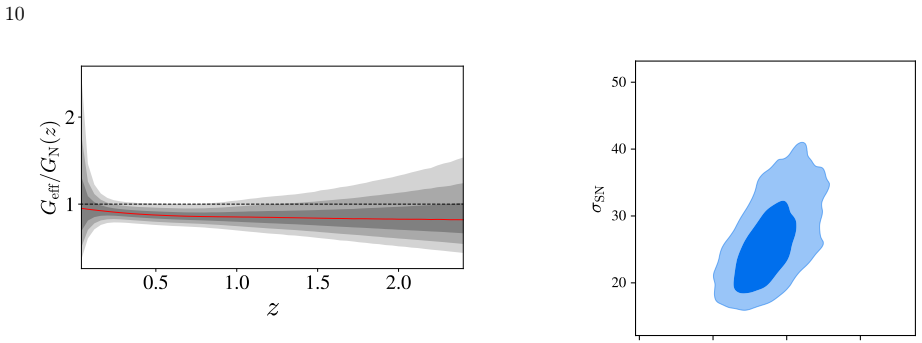
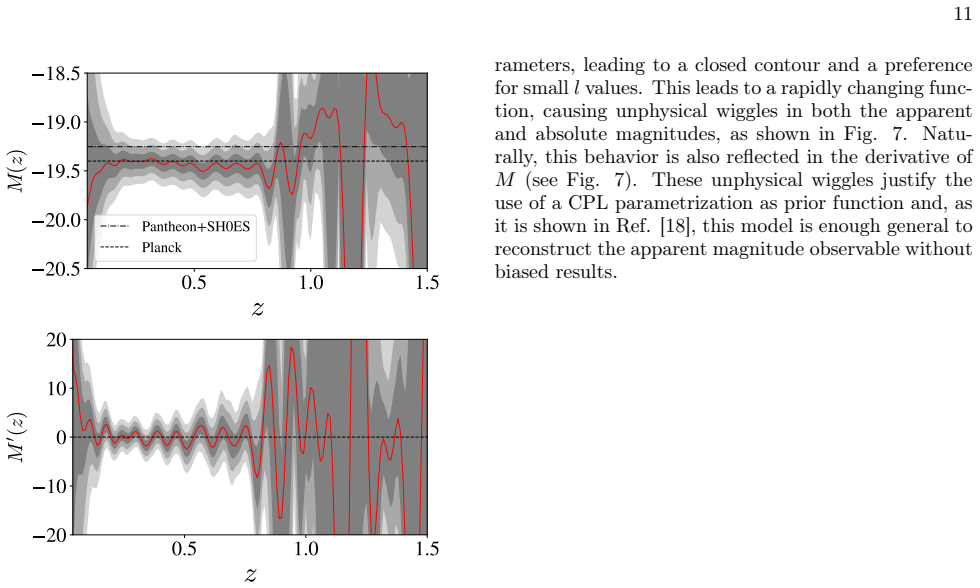
The paper's central quantitative result is the redshift-averaged absolute magnitude $M=-19.456\pm 0.059$, obtained by combining the reconstructed pieces through the identity $M = m - 5\log_{10}(D_M/D_H) - 5\log_{10}\big((1+z)c/[H(z)\,1\,\mathrm{Mpc}]\big) - 25$. The reconstructed $M(z)$ is flat across the probed range and $M'(z)$ is compatible with zero, so the authors condense the information into a single weighted average. That average sits $3.2\sigma$ below the Cepheid-calibrated local value $M=-19.243\pm 0.030$, and agrees with an early-universe-anchored estimate $M=-19.438\pm 0.007$ quoted in the paper. The authors interpret the offset as evidence against the combination of late-time $\Lambda$CDM with local Cepheid calibration, not against the constancy of $M$, and note that using the local value in the white-dwarf-limit relation for supernova brightness implies an effective gravitational constant $G_{\rm eff}/G_N$ about $3\sigma$ below unity between $z\approx0.4$ and $z\approx0.9$.
Load-bearing premise
The analysis rests on the assumption that the CPL prior mean, with all of its parameters marginalised over, is flexible enough not to bias the reconstructed $M(z)$; the paper justifies this by asserting that a zero-mean prior produces unphysical wiggles, but it never quantifies how much of the final $3.2\sigma$ offset is inherited from the prior shape.
Editorial extensions
If this is right
- Type Ia supernovae remain usable as standardizable candles across the probed redshift range, because the null hypothesis of a constant M is not rejected.
- The redshift-averaged value M = -19.456 ± 0.059 is about 3.2σ dimmer than the Cepheid-calibrated local value, so a distance ladder built on a flexible, data-driven M would shift the Hubble constant toward the lower, early-universe-like value.
- The derivative M′(z) being consistent with zero means the tension does not grow or fade smoothly with distance; it presents as a uniform normalization offset.
- Agreement with early-universe-anchored estimates suggests the tension is between local Cepheid calibration and the more flexible late-time data combination, not between supernovae and other probes.
- If the local value is used to translate the offset through the white-dwarf-limit relation, the effective gravitational constant deviates from Newton's constant by roughly 3σ in the interval 0.4 < z < 0.9, a signature the paper links to departures from general relativity in modified-gravity scenarios.
Reading between the lines
- The flatness of M(z) in the main result is asserted rather than proven to be prior-independent; the Appendix's zero-mean Gaussian process changes the reconstruction qualitatively, so a direct comparison of the redshift-averaged M under the two priors would isolate how much of the reported offset is carried by the CPL prior shape.
- A constant but dimmer M could equally be produced by a calibration zero-point error, grey dust, or host-galaxy effects; comparing M(z) reconstructed from two independent distance indicators would separate an astrophysical dimming from a cosmological or gravitational effect.
- Because the same pipeline yields an M that agrees with early-universe anchors, it could be repurposed as a parameter-free consistency test of the distance ladder: adding future high-redshift supernova samples would either confirm the 3.2σ offset or reveal that it was a small-sample artifact of the current calibration objects.
- If the G_eff/G_N deviation is interpreted physically, the testable extension is to correlate the amplitude of the z ≈ 0.4–0.9 dip with independent probes of the growth of structure, which would be affected by a time-varying gravitational constant in modified-gravity theories.
Signed reviews
Editorial analysis
A structured set of objections, weighed in public.
Referee Report
Summary. The paper proposes a model-independent reconstruction of the Type Ia supernova absolute magnitude M(z) by combining Gaussian Process regressions of three independent observables: Pantheon+SH0ES apparent magnitudes, BAO/void measurements of DM/DH, and cosmic-chronometer Hubble rates. Through Eq. (7), the authors reconstruct M(z), find it compatible with a constant, report a redshift-averaged value M = -19.456 ± 0.059, and claim a 3.2σ tension with the local SH0ES estimate M = -19.243 ± 0.030 while remaining consistent with early-universe estimates. They further interpret the offset in a modified-gravity framework as a possible time variation of the effective gravitational constant. The central quantitative claims rest on the GP posterior covariance, the weighted-average formula, and the choice of the CPL prior mean, all of which are examined in this report.
Significance. If the result held, the paper would offer a useful null test: it combines independent datasets to reconstruct M(z) without parameterizing M itself, and the agreement with early-universe absolute-magnitude estimates would sharpen the known late-time/early-universe tension. The authors are also transparent about marginalizing over hyperparameters and include a zero-mean prior comparison in Appendix A. These are genuine strengths. However, the printed GP posterior covariance and the weighted-average formulas are not the correct Bayesian expressions, so the reported uncertainties and the 3.2σ significance are not supported by the manuscript as written. In addition, the modified-gravity section repackages the same magnitude offset rather than providing an independent test of gravity. The idea is interesting and the data combination is original, but the quantitative conclusions require substantial revision.
major comments (4)
- [Sec. III B 2, Eq. (13)] Equation (13) is not the covariance of a Gaussian Process conditioned on noisy data. For a prior covariance K and data covariance C, the posterior covariance is K(z*,z*) - K(z*,z)[K(z,z)+C]^{-1}K(z,z*). The paper prints K(z*,z*)+K(z*,z)[K(z,z)-C]^{-1}K(z,z*), with a plus sign and (K-C)^{-1} in place of (K+C)^{-1}. The matrix K-C need not be positive semidefinite, so the resulting confidence bands, derivative uncertainties, and the covariance used in Eq. (18) are not a Bayesian posterior. Every error bar in Figs. 2, 3, and 5, as well as the quoted 0.059 mag uncertainty and the 3.2σ significance, derives from Eq. (13), so the central quantitative result is unsupported as written.
- [Sec. IV A, Eqs. (17) and (18)] The weighted-average formulas are statistically and dimensionally inconsistent. For correlated Gaussian measurements, the inverse-variance weighted average divides by the total weight W = 1^T C^{-1} 1 and has variance 1/W. As printed, Eqs. (17) and (18) divide by the square root of the total weight rather than the total weight itself, which changes both the central value and the uncertainty of the reported M = -19.456 ± 0.059. The authors should state the exact discrete formula used to produce this number and verify it against the continuous limit in Eq. (17).
- [Sec. IV C, Eq. (21)] The modified-gravity result is not an independent test. Equation (21) defines Geff/GN as a deterministic function of M(z)-M0, so the approximately 3σ deviation of Geff/GN from unity shown in Fig. 5 is algebraically identical to the 3.2σ offset already present between the reconstructed M(z) and the SH0ES value of M0. Interpreting this as evidence for departures from General Relativity requires the additional assumption that the entire magnitude offset is caused by a varying gravitational constant; the analysis does not compare modified-gravity predictions with the data or constrain any specific gravity theory. At most, Eq. (21) is a change of variables applied to the magnitude offset, not a separate test of gravity.
- [Sec. III B 1 and Appendix A] The robustness of the constant-M conclusion and the 3.2σ tension to the GP prior mean is not established. Appendix A shows that a zero prior mean produces a qualitatively different, 'unphysical' reconstruction, and the CPL prior is then justified by an appeal to its generality and by the presence of wiggles in the zero-mean case. This is an assertion rather than a demonstration; no prior-sensitivity analysis is provided, such as varying the CPL parameter priors, using other smooth mean functions, or cross-validating the GP. The reported error budget is therefore conditional on one specific prior choice whose claimed unbiasedness is not verified.
minor comments (5)
- [Sec. II, Eq. (4)] The cosmic distance duality relation is assumed, but the assumption is only cited; the abstract and conclusions should state explicitly that DL = (1+z)^2 DA is used as an assumption.
- [Sec. III A and Fig. 2] The notation for the apparent magnitude is inconsistent: the text uses m(z), while the top panel of Fig. 2 and the data description use mb(z); one symbol should be used throughout and defined.
- [Sec. IV B] The sentence 'which implies that our result is driven by data rather than priors' is not justified by the preceding discussion, since the CPL prior parameters are part of the likelihood and the SH0ES calibrators are included in the dataset.
- [Sec. IV A] The sentence 'We also show in Fig. 3 the result obtained.' is incomplete and should be removed or finished.
- [References] Reference [18] is missing its publication year, reading 'JCAP 02, 014' with no year; please provide the complete citation information.
Circularity Check
The modified-gravity '~3 sigma departure from GR' is a self-definitional re-labeling of the reconstructed M(z)-M0 offset; the main M(z) reconstruction itself is not circular.
-
self definitional
[Sec. IV C (Eqs. 20-21, Fig. 5)]
"Within this framework, the ratio Geff(z)/GN can be algebraically derived using Eq. (20), yielding Geff/GN = 10^{4/15 [M(z)-M0]}."
Equation (21) is obtained by algebraically rearranging Eq. (20), with M0 fixed to the SH0ES local value. Thus Geff/GN(z) is a deterministic one-to-one transform of the reconstructed M(z)-M0. The claimed ~3 sigma departure from GR is exactly the 3.2 sigma offset between the GP average and the SH0ES M0, re-expressed under the assumed Chandrasekhar-mass scaling; no independent gravitational observable enters. The 'implication for modified gravity' is therefore the input magnitude tension relabeled, not a test that could fail independently.
full rationale
The central M(z) reconstruction is not circular: it combines three independent observables (SN apparent magnitude, DM/DH from LSS, and H from cosmic chronometers) through Eq. (7), and the resulting redshift-averaged M is a data-driven product rather than a restatement of an input. The one clear circular step is in the modified-gravity section, where the paper defines Geff/GN via Eq. (20) as a logarithmic rescaling of M-M0 and then presents the resulting ~3 sigma deviation from unity as evidence about General Relativity; that 'tension' is identical to the magnitude offset already found, just plotted on a new vertical axis. The prior-mean sensitivity shown in Appendix A and the incorrect-looking GP covariance in Eq. (13) are statistical and robustness concerns, not circularity, so they are not counted in the score. Because one prominent claim reduces by construction while the primary reconstruction does not, the overall circularity score is moderate.
Assumptions & free parameters
free parameters (7)
- GP output-scale sigma_SN =
not quoted; see Fig. 1 (left)
- GP length-scale l_SN =
not quoted; see Fig. 1 (left)
- GP output-scale sigma_LSS =
not quoted; see Fig. 1 (middle)
- GP length-scale l_LSS =
not quoted; see Fig. 1 (middle)
- GP output-scale sigma_CC =
not quoted; see Fig. 1 (right)
- GP length-scale l_CC =
not quoted; see Fig. 1 (right)
- CPL prior parameters {Omega_m, H0, w0, wa} and M =
marginalised over; not quoted
assumptions (8)
- domain assumption Spatial flatness of the Universe
- domain assumption Cosmic distance duality relation D_L = (1+z)^2 D_A
- ad hoc to paper CPL model is general enough to serve as an unbiased GP prior mean
- domain assumption GP joint Gaussianity with squared exponential kernel
- domain assumption Cosmic chronometer approximation H(z) = -dz/dt / (1+z)
- domain assumption LSS fiducial cosmology dependence is negligible
- domain assumption SN Ia absolute magnitude response to Chandrasekhar mass and G, M-M0 = (15/4) log(G_eff/G_N)
- domain assumption Cepheid geometric distances in SH0ES are accurate and model-independent
Cite this review
Pith. "Pith review of Reconstructing the redshift evolution of Type Ia supernovae absolute magnitude." pith.science (2026). https://pith.science/paper/G23WLILB
@misc{pith2026250415127,
  author       = {Pith},
  title        = {Pith review of: Reconstructing the redshift evolution of Type Ia supernovae absolute magnitude},
  year         = {2026},
  howpublished = {\url{https://pith.science/paper/G23WLILB}},
  note         = {Machine review of arXiv:2504.15127}
}
abstract
This work investigates a potential time dependence of the absolute magnitude of Type Ia Supernovae (SN Ia). Employing the Gaussian Process approach, we obtain the SN Ia absolute magnitude and its derivative as a function of redshift. The data set considered in the analysis comprises measurements of apparent magnitude from SN Ia, Hubble rate from cosmic chronometers, and the ratio between angular and radial distances from Large-Scale Structure data (BAO and voids). Our findings reveal good compatibility between the reconstructed SN Ia absolute magnitudes and a constant value. However, the mean value obtained from the Gaussian Process reconstruction is $M=-19.456\pm 0.059$, which is $3.2\sigma$ apart from local measurements by Pantheon+SH0ES. This incompatibility may be directly associated to the $\Lambda$CDM model and local data, as it does not appear in either model-dependent or model-independent estimates of the absolute magnitude based on early universe data. Furthermore, we assess the implications of a variable $M$ within the context of modified gravity theories. Considering the local estimate of the absolute magnitude, we find $\sim3\sigma$ tension supporting departures from General Relativity in analyzing scenarios involving modified gravity theories with variations in Planck mass through Newton's constant.
Figures


Figures from the paper (3 more)

Forward citations
Cited by 1 Pith paper
-
Hubble tension: the shape wall
Late-time modifications to the expansion history can raise H0 by at most about 2% (conservative) to 3.7% (permissive) if the CMB acoustic scale is fixed.
Reference graph
Works this paper leans on
-
[1]
On the Gaussian Process mean function It is crucial to mention the ongoing debate in the literature concerning the appropriate application of the Gaussian Process method in assessing cosmologi- cal problems. A key point of the debate regards around the choice of the prior mean function. Given that the Gaussian Process methodology is independent of as- sum...
-
[2]
On the Gaussian Process parameter distribution estimation and reconstruction Based on the assumption that the data,y, and the function describing an observable,f, are components of the same multivariate Gaussian distribution (com- ponents of a GP), we can compute the function of the observable given the data using the conditional proba- bility. As stated ...
work page 2021
-
[3]
A. G. Riesset al. (Supernova Search Team), Astron. J. 116, 1009 (1998), arXiv:astro-ph/9805201
arXiv 1998
-
[4]
S. Perlmutter et al. (Supernova Cosmology Project), Astrophys. J.517, 565 (1999), arXiv:astro-ph/9812133
arXiv 1999
-
[5]
R. Durrer and R. Maartens, Gen. Rel. Grav.40, 301 (2008), arXiv:0711.0077 [astro-ph]
work page Pith review arXiv 2008
-
[6]
M. Betouleet al. (SDSS), Astron. Astrophys.568, A22 (2014), arXiv:1401.4064 [astro-ph.CO]
arXiv 2014
-
[7]
D. M. Scolnic et al. (Pan-STARRS1), Astrophys. J. 859, 101 (2018), arXiv:1710.00845 [astro-ph.CO]
arXiv 2018
- [8]
Show all 54 references
-
[9]
(Planck),Astron.Astrophys
N.Aghanim et al. (Planck),Astron.Astrophys. 641,A6 (2020), [Erratum: Astron.Astrophys. 652, C4 (2021)], arXiv:1807.06209 [astro-ph.CO]
2020 arXiv
-
[10]
(DES),Phys.Rev.D 105,023520 (2022), arXiv:2105.13549 [astro-ph.CO]
T.M.C.Abbott et al. (DES),Phys.Rev.D 105,023520 (2022), arXiv:2105.13549 [astro-ph.CO]
2022 arXiv
-
[11]
M. M. Ivanov, E. McDonough, J. C. Hill, M. Simonović, M. W. Toomey, S. Alexander, and M. Zaldarriaga, Phys. Rev. D 102, 103502 (2020), arXiv:2006.11235 [astro-ph.CO]
2020 arXiv
-
[12]
S. L. Shapiro, S. A. Teukolsky, B. Holes, W. Dwarfs, and N. Stars, Wiley, New York19832, 119 (1983)
1983
-
[13]
Guy et al
J. Guy et al. (SNLS), Astron. Astrophys. 466, 11 (2007), arXiv:astro-ph/0701828
2007 arXiv
-
[14]
W. D. Kenworthyet al., Astrophys. J.923, 265 (2021), arXiv:2104.07795 [astro-ph.CO]
2021 arXiv
-
[15]
Camarena and V
D. Camarena and V. Marra, Phys. Rev. Res.2, 013028 (2020), arXiv:1906.11814 [astro-ph.CO]
2020 arXiv
-
[16]
Camarena and V
D. Camarena and V. Marra, Mon. Not. Roy. Astron. Soc. 504, 5164 (2021), arXiv:2101.08641 [astro-ph.CO]
2021 arXiv
-
[17]
Kang, Y.-W
Y. Kang, Y.-W. Lee, Y.-L. Kim, C. Chung, and C. H. Ree, Astrophys. J. 889, 8 (2020), arXiv:1912.04903 [astro-ph.GA]
2020 arXiv
-
[18]
Y.-L. Kim, Y. Kang, and Y.-W. Lee, J. Korean Astron. Soc. 52, 181 (2019), arXiv:1908.10375 [astro-ph.CO]
2019 arXiv
-
[19]
Rigault et al
M. Rigault et al. , Astrophys. J. 802, 20 (2015), arXiv:1412.6501 [astro-ph.CO]
2015 arXiv
-
[20]
Hwang, B
S.-g. Hwang, B. L’Huillier, R. E. Keeley, M. J. Jee, and A. Shafieloo, JCAP 02, 014, arXiv:2206.15081 [astro- ph.CO]
-
[21]
Sapone, S
D. Sapone, S. Nesseris, and C. A. P. Bengaly, Phys. Dark Univ.32, 100814 (2021), arXiv:2006.05461 [astro- ph.CO]
2021 arXiv
-
[22]
Kumar, A
D. Kumar, A. Rana, D. Jain, S. Mahajan, A. Mukher- jee, and R. F. L. Holanda, JCAP 01 (01), 053, arXiv:2107.04784 [astro-ph.CO]
-
[23]
H. Koo, A. Shafieloo, R. E. Keeley, and B. L’Huillier, Astrophys. J. 899, 9 (2020), arXiv:2001.10887 [astro- ph.CO]. 12
2020 arXiv
-
[24]
von Marttens, V
R. von Marttens, V. Marra, L. Casarini, J. E. Gonza- lez, and J. Alcaniz, Phys. Rev. D99, 043521 (2019), arXiv:1812.02333 [astro-ph.CO]
2019 arXiv
-
[25]
Andrade, D
U. Andrade, D. Anbajagane, R. von Marttens, D. Huterer, and J. Alcaniz, JCAP 11, 014, arXiv:2107.07538 [astro-ph.CO]
-
[26]
Nesseriset al
S. Nesseriset al. (Euclid), Astron. Astrophys.660, A67 (2022), arXiv:2110.11421 [astro-ph.CO]
2022 arXiv
-
[27]
Scolnic et al
D. Scolnic et al. , Astrophys. J. 938, 113 (2022), arXiv:2112.03863 [astro-ph.CO]
2022 arXiv
-
[28]
Rubin, G
D. Rubin, G. Aldering, M. Betoule, A. Fruchter, X. Huang, A. G. Kim, C. Lidman, E. Linder, S. Perl- mutter, P.Ruiz-Lapuente,andN.Suzuki,arXive-prints , arXiv:2311.12098 (2023), arXiv:2311.12098 [astro- ph.CO]
2023 arXiv
-
[29]
T. M. C. Abbottet al. (Abbott, DES: T. M. C, DES), Astrophys. J. Lett.973, L14 (2024), arXiv:2401.02929 [astro-ph.CO]
2024 arXiv
-
[30]
R. S. Gonçalves, S. Landau, J. S. Alcaniz, and R. F. L. Holanda, JCAP 06, 036, arXiv:1907.02118 [astro-ph.CO]
1907 arXiv
-
[31]
R. F. L. Holanda, R. S. Gonçalves, and J. S. Alcaniz, JCAP 06, 022, arXiv:1201.2378 [astro-ph.CO]
-
[32]
Alam et al
S. Alam et al. (eBOSS), Phys. Rev. D 103, 083533 (2021), arXiv:2007.08991 [astro-ph.CO]
2021 arXiv
-
[33]
Woodfinden, W
A. Woodfinden, W. J. Percival, S. Nadathur, H. A. Winther, T. S. Fraser, E. Massara, E. Paillas, and S. Radinović, Mon. Not. Roy. Astron. Soc.523, 6360 (2023), arXiv:2303.06143 [astro-ph.CO]
2023 arXiv
-
[34]
A. G. Riesset al., Astrophys. J. Lett.934, L7 (2022), arXiv:2112.04510 [astro-ph.CO]
2022 arXiv
-
[35]
Carter, F
P. Carter, F. Beutler, W. J. Percival, J. DeRose, R. H. Wechsler, and C. Zhao, Mon. Not. Roy. Astron. Soc. 494, 2076 (2020), arXiv:1906.03035 [astro-ph.CO]
2020 arXiv
-
[36]
J. Pan, D. Huterer, F. Andrade-Oliveira, and C. Avestruz, JCAP06, 051, arXiv:2312.05177 [astro- ph.CO]
-
[37]
S.Sanz-Wuhl, H.Gil-Marín, A.J.Cuesta,andL.Verde, JCAP 05, 116, arXiv:2402.03427 [astro-ph.CO]
-
[38]
Moresco, L
M. Moresco, L. Pozzetti, A. Cimatti, R. Jimenez, C. Maraston, L. Verde, D. Thomas, A. Citro, R. Tojeiro, and D. Wilkinson, JCAP 05, 014, arXiv:1601.01701 [astro-ph.CO]
-
[39]
Chevallier and D
M. Chevallier and D. Polarski, Int. J. Mod. Phys. D10, 213 (2001), arXiv:gr-qc/0009008
2001 arXiv
-
[40]
E. V. Linder, Phys. Rev. Lett. 90, 091301 (2003), arXiv:astro-ph/0208512
2003 arXiv
- [41]
-
[42]
J. E. Gonzalez, J. S. Alcaniz, and J. C. Carvalho, JCAP 04, 016, arXiv:1602.01015 [astro-ph.CO]
-
[43]
von Marttens, J
R. von Marttens, J. E. Gonzalez, J. Alcaniz, V. Marra, and L. Casarini, Phys. Rev. D 104, 043515 (2021), arXiv:2011.10846 [astro-ph.CO]
2021 arXiv
-
[44]
Z. Li, J. E. Gonzalez, H. Yu, Z.-H. Zhu, and J. S. Alcaniz, Phys. Rev. D 93, 043014 (2016), arXiv:1504.03269 [astro-ph.CO]
2016 arXiv
-
[45]
C. A. P. Bengaly, J. E. Gonzalez, and J. S. Alcaniz, Eur.Phys.J.C 80,936(2020),arXiv:2007.13789[astro- ph.CO]
2020 arXiv
-
[46]
Z. Li, B. Zhang, and N. Liang, Mon. Not. Roy. Astron. Soc. 521, 4406 (2023), arXiv:2212.14291 [astro-ph.CO]
2023 arXiv
-
[47]
Wu, J.-Z
P.-J. Wu, J.-Z. Qi, and X. Zhang, Chin. Phys. C47, 055106 (2023), arXiv:2209.08502 [astro-ph.CO]
2023 arXiv
-
[48]
L. R. Colaço, M. Ferreira, R. F. L. Holanda, J. E. Gonzalez, and R. C. Nunes, JCAP 05, 098, arXiv:2310.18711 [astro-ph.CO]
-
[49]
J. F. Jesus, R. Valentim, A. A. Escobal, and S. H. Pereira, JCAP04, 053, arXiv:1909.00090 [astro- ph.CO]
1909 arXiv
-
[50]
J. E. Gonzalez, Phys. Rev. D 96, 123501 (2017), arXiv:1710.07656 [astro-ph.CO]
2017 arXiv
-
[51]
J. E. Gonzalez, M. Ferreira, L. R. Colaço, R. F. L. Holanda, and R. C. Nunes, Phys. Lett. B857, 138982 (2024), arXiv:2405.13665 [astro-ph.CO]
2024 arXiv
-
[52]
C. E. Rasmussen and C. K. I. Williams, Gaussian processes for machine learning. , Adaptive computation and machine learning (MIT Press, 2006) pp. I–XVIII, 1–248
2006
-
[53]
Camarena and V
D. Camarena and V. Marra, arXiv e-prints , arXiv:2307.02434 (2023), arXiv:2307.02434 [astro- ph.CO]
2023 arXiv
-
[54]
Gaztanaga, E
E. Gaztanaga, E. Garcia-Berro, J. Isern, E. Bravo, and I. Dominguez, Phys. Rev. D 65, 023506 (2002), arXiv:astro-ph/0109299
2002 arXiv
Reviewed August 16, 2026 · model on record in the stance chip above.
Discussion (0). Continue with ORCID to comment.