REVIEW 3 major objections 7 minor 11 references
Peering into the Anneal Process of a Quantum Annealer
T0 review · 3 major / 7 minor · reviewed 2026-08-14 · deepseek-v4-flash
Pith's one-line read Quench-slicing reveals when each qubit freezes in a quantum anneal.
desk verdict A genuinely new slicing technique for peeking inside a D-Wave anneal, but the freeze assumption is unvalidated and the GA-optimized instances may amplify exactly the artifact the method needs to rule out. read the letter →
The pith
A machine-rendered reading of the paper's core claim, the machinery that carries it, and where it could break.
The reading
What carries the argument
The mechanism is 'slicing': a custom anneal schedule that follows the normal curve to time t, then includes a near-vertical quench to the full anneal at t+1, freezing the state for readout. The hardware constraint that the anneal curve slope stay within 45 degrees means the jump is not perfectly vertical, so the paper defines the last slice as the full anneal and assumes the quench does not materially change the solution. A genetic algorithm is the supporting device: it searches over QUBOs, scoring each by the energy decrease and percentage of bit flips between a 1 microsecond slice and a full 1000 microsecond anneal, in order to produce instances where the slice-resolved evolution is pronounced enough to visualize.
What would settle it
Run the same optimized QUBO with a pause-and-hold schedule at each slice time instead of a quench, and compare the energy and Hamming trajectories; a systematic divergence would show that the quench itself alters the state being measured.
Extended reading notes
Core claim
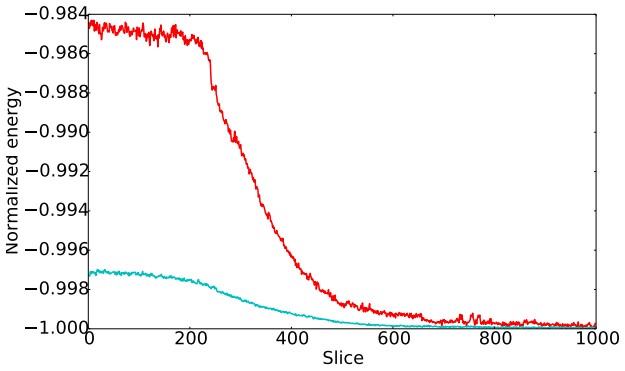
The central claim is that the anneal process of the D-Wave 2000Q can be meaningfully dissected. By following the standard anneal curve up to a slice time t and then jumping to anneal fraction 1 at t+1, the machine returns a solution that approximates the state at t; repeating this for many t yields a slice-resolved picture of energy and bit-string evolution. The paper reports that for a QUBO engineered to evolve strongly during annealing, the best energy stays nearly flat for the first quarter of the anneal, then drops steadily, and freezes near the anneal midpoint, with the Hamming distance between adjacent slices following the same trend. On the individual-qubit level, most qubits keep their initial measured value, while a minority flip at high rates and cluster together, consistent with chip leakage. These observations are offered as a first direct look at freeze-out dynamics in a commercial quantum annealer.
Load-bearing premise
The load-bearing premise is that the near-vertical quench from slice time t to full anneal at t+1 preserves the solution as it was at t, so the measured snapshot is not itself changed by the jump.
Editorial extensions
If this is right
- The anneal can be probed at arbitrary intermediate times, giving an empirical freeze-out time for every qubit rather than a single final readout.
- Energy trajectories show a plateau followed by a sharp decline and then stabilization, so slice-resolved measurements can indicate when additional anneal time stops improving solution quality.
- Hamming-distance curves between adjacent slices provide a second, independent signature of the same freeze-out point.
- Bit-flip maps of the chip support the picture of neighbor-to-neighbor leakage and could be used to study crosstalk in annealing hardware.
Reading between the lines
- One step beyond the paper: the per-qubit freeze-out map could be used as a calibration diagnostic, since qubits that flip at high rates in one QUBO should be tested against other instances before being attributed to the problem structure.
- The assumption that quenching is non-perturbative is testable in simulation: evolving the same Hamiltonian with and without the quench and comparing slice distributions would quantify how much the jump itself distorts the snapshot.
- For minor-embedded problems, applying slicing to chains rather than individual qubits could reveal when logical chains decohere, which is a natural extension of the method.
Signed reviews
Editorial analysis
A structured set of objections, weighed in public.
Referee Report
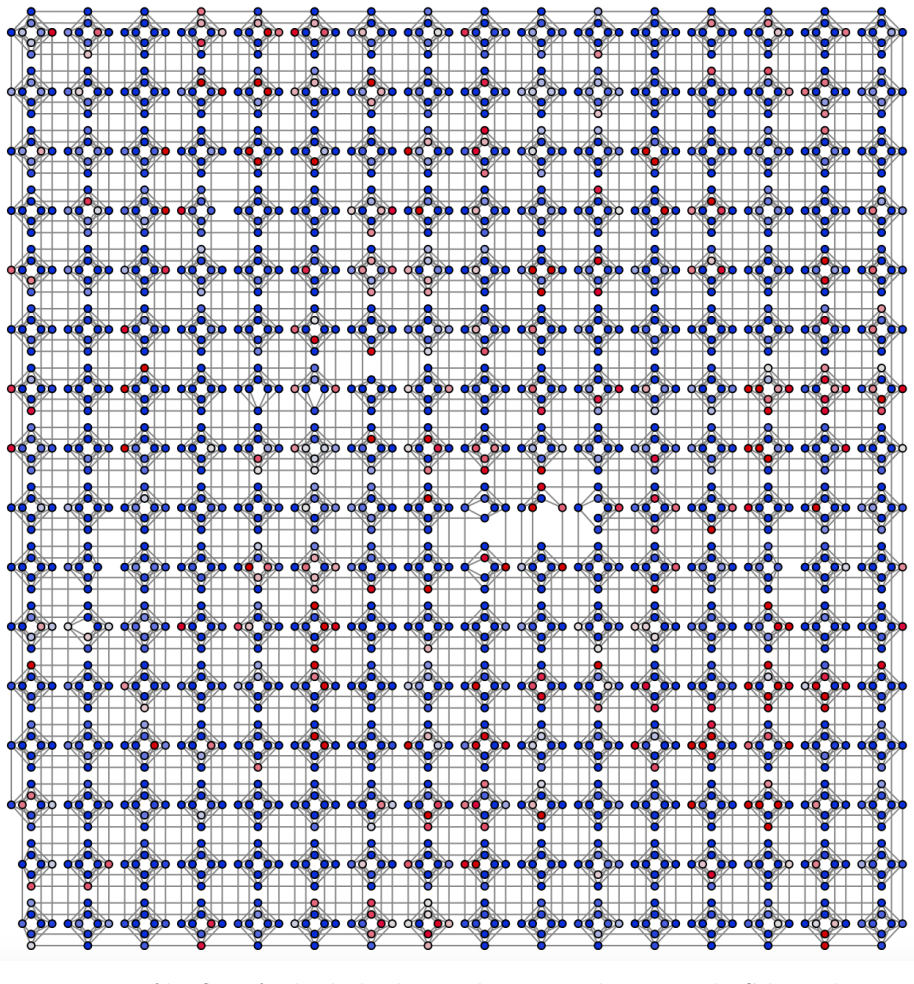
Summary. The paper introduces 'slicing', an experimental technique for probing the intermediate dynamics of a D-Wave 2000Q quantum annealer. Using the custom anneal-schedule feature, the authors follow the standard anneal curve up to a chosen time t and then quench the anneal fraction to 1 at time t+1, assuming that this fast ramp freezes the solution as it was at time t. Repeating this over many slice times produces an approximate per-slice distribution of solutions, from which the evolution of the minimum energy (Figure 5), the Hamming distance between adjacent slices (Figure 6), and per-qubit freeze-out points (Figure 7) are inferred. To make the dynamics visible, the authors use a genetic algorithm that selects QUBO instances whose 1-microsecond-versus-1000-microsecond energy difference and whose Hamming distance between the 1-microsecond slice and the full anneal are large, and they compare these optimized instances with random QUBOs (Figures 3-4). The main findings are that the optimized QUBO displays pronounced energy decrease and bit-flip activity during the first half of the anneal with a freeze-out at roughly slice 600 of 1000, that the energy and Hamming-distance freeze-out points roughly coincide, and that many qubits never flip while actively flipping qubits appear to cluster on the chimera graph.
Significance. If the central assumption holds, the slicing technique would be a genuinely new observational tool for commercial quantum annealers, enabling direct study of freeze-out, thermalization, and bit dynamics that are otherwise unobservable from final readouts. The paper is clearly written, the experimental protocol is described in enough detail to be reproduced, results (except Figure 4) carry error bars based on 10 runs of 1000 anneals, and the authors are appropriately modest, framing the work as a first attempt and explicitly flagging the expectation underlying the quench. The decisive weakness is that the validity of the quench assumption is not demonstrated anywhere in the manuscript, and the genetic-algorithm fitness function partially selects for quantities measured by the very technique whose validity is in question. These issues are fixable with additional experiments, but they are load-bearing for the paper's conclusions.
major comments (3)
- [Section 2.1] The paper's central methodological assumption, that quenching from the anneal fraction s(t) to s=1 at time t+1 preserves the solution state as of time t, is stated as an expectation rather than being validated. The text reads 'we expect this jump to not considerably change the solution, due in large part to the properties our genetic algorithm optimizes for', and while the authors say they investigated pause-based schedules with 'qualitatively similar' results, that comparison is not shown. During the 1-microsecond quench the Hamiltonian sweeps through intermediate values of the A(s)/B(s) ratio, and the state can evolve non-adiabatically, so bit flips and energy changes occurring during the ramp would be misattributed to the anneal itself. Since the energy trajectories of Section 3.3, the Hamming-distance trajectories of Section 3.4, and the per-qubit freeze-out points of Section 3.5 all inherit this assumption, the manuscript should provide a direct validation, for instance by comparing quench slices with pause-then-quench schedules at matched times or by demonstrating insensitivity of the measured slice distributions to the quench ramp rate.
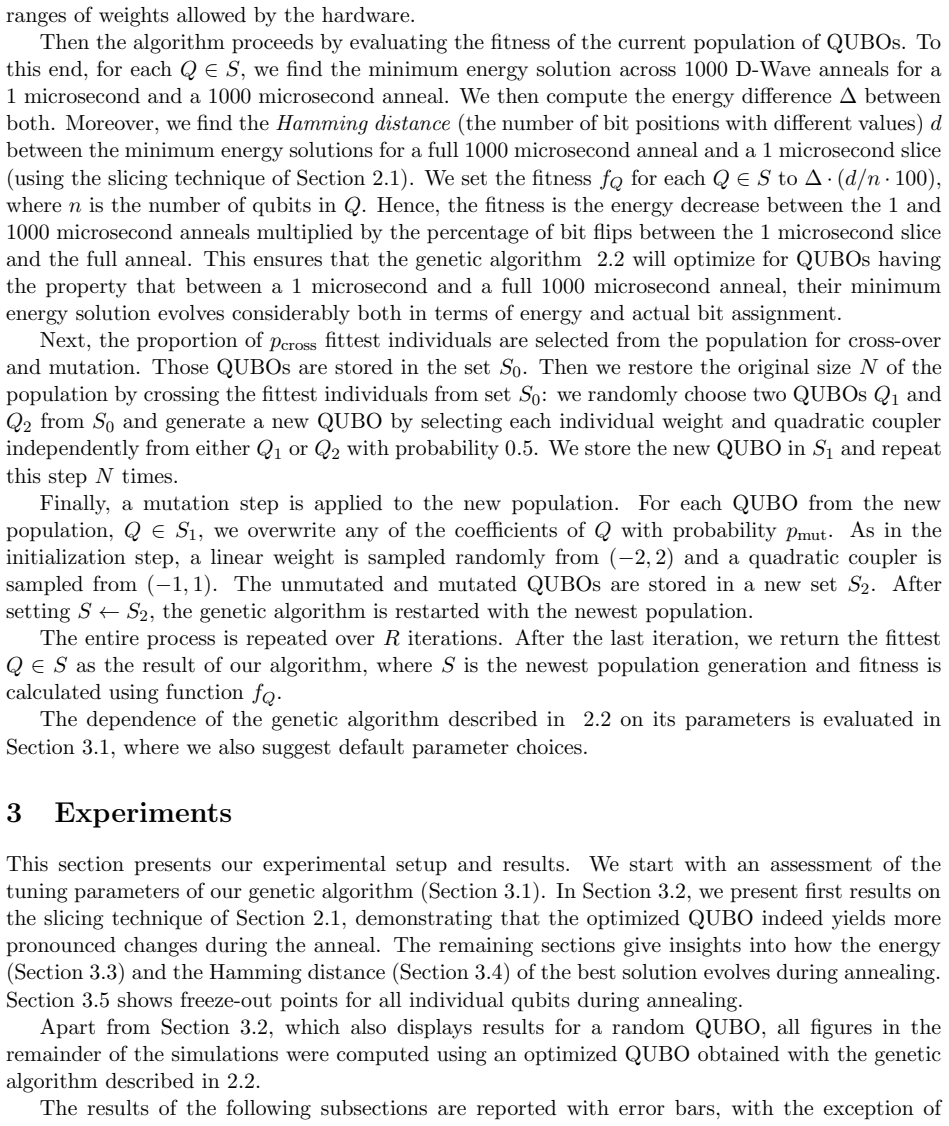
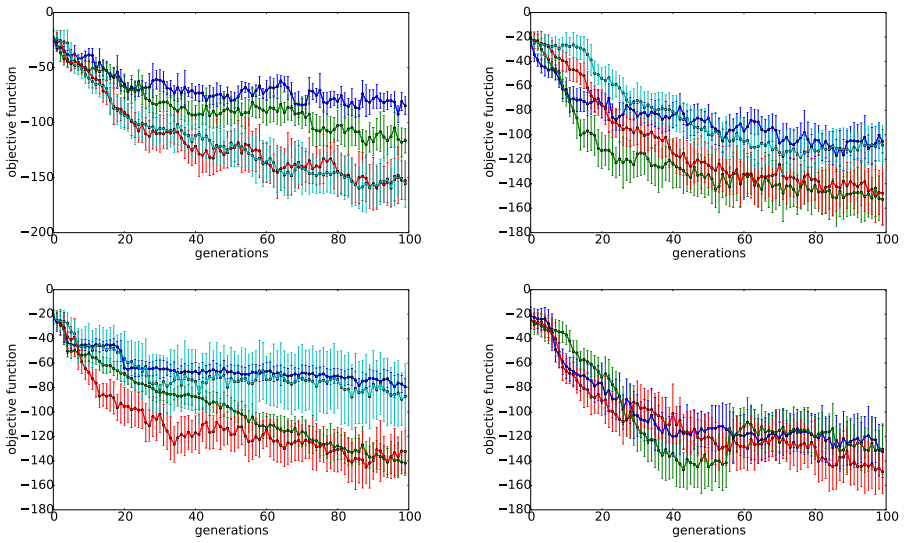
- [Section 2.2] The genetic-algorithm fitness function fQ = Δ·(d/n·100) includes the Hamming distance d between the 1-microsecond slice, measured through the slicing technique, and the full 1000-microsecond anneal. If the quench induces spurious bit flips, the GA will preferentially select QUBO instances in which those artifacts are largest, so the pronounced evolution in Figures 5-7 and the freeze-out points of Section 3.5 may partly reflect amplified quench artifacts rather than genuine anneal dynamics. The energy term Δ is independent of the slicing technique, but the Hamming term is not, so the concern is concrete. A test would be to recompute the fitness with d obtained from an independent probe (for example a pause-based schedule or reverse-annealing measurement) and to check whether the inferred freeze-out points and trajectories are stable; alternatively, the method could be validated on instances with a known intermediate classical state.
- [Figure 4] Figure 4, which is the central comparison between the random and the GA-optimized QUBO, is the only figure without error bars; the paper itself states that 'The results of the following subsections are reported with error bars, with the exception of Figure 4'. This figure supports two load-bearing claims: that the optimized QUBO shows a significantly larger energy decrease during the anneal and that both curves plateau around slice 600, which motivates the freeze-out definition in Section 3.2. Without error bars, or without the same 10 runs of 1000 anneals averaging used elsewhere, the separation between the curves and the flatness of the plateaus cannot be assessed, so the figure should be regenerated using the standard error-bar procedure.
minor comments (7)
- [Section 1] The phrase 'by inserting a pause is the anneal schedule' contains a typo and should read 'by inserting a pause in the anneal schedule'.
- [Section 2.1] The sentence 'This process, referred to as quenching, and is a standard feature provided by the D-Wave 2000Q' is ungrammatical; a main verb is missing.
- [Figure 2] The horizontal axis of Figure 2 is labeled 'anneal time [ms]', which is inconsistent with the text and experiments, which report times in microseconds.
- [Section 1, Eq. (1)] The Hamiltonian written in the introduction, H(s) = -A(s)/2 Σ ai σx_i + B(s)/2 (Σ σz_i + Σ aij σz_i σz_j), differs from the Hamiltonian in the QPU property box: the linear coefficients ai multiply the transverse-field term, and the longitudinal-field term omits the local fields hi. This is presumably a typographical error, but it should be corrected so the theory section is consistent with the QUBO definition and with the D-Wave Hamiltonian.
- [Section 2.1] The hardware constraint 'the maximal degree of the anneal curve to not exceed 45 degrees' is unclear; if this is a slope constraint on the anneal function, it deserves a brief clarification because it is the stated reason for jumping at t+1 rather than at t.
- [Section 3.5] The clustering observation is phrased as 'It also seems as if qubits with either low or high rates of bit flips somehow cluster together', and the leakage explanation is presented as known fact without a citation; the clustering could be quantified (for example with a spatial correlation statistic) or the wording softened.
- [Section 3.2] The freeze-out point is defined as 'roughly slice 600' by visual inspection of the curves; since the freeze-out point is one of the paper's main quantities, the definition could be made more precise, for example as the first slice after which the mean energy change stays below a threshold.
Circularity Check
No significant circularity: the slicing study is an experimental measurement with an explicit operational assumption, and the genetic algorithm is a disclosed instance-selection tool rather than a fitted prediction.
full rationale
The paper does not derive any predicted quantity from fitted parameters; it reports measurements from the D-Wave 2000Q using a custom anneal schedule. The slicing technique is an operational protocol, and the freeze-out point is defined as the observed plateau in energy or Hamming distance, not as the output of a fitted model. The genetic algorithm explicitly searches for QUBO instances with large energy decrease and bit flips; presenting those instances afterward is a disclosed selection effect, not a concealed prediction. The central assumption that the quench jump approximately preserves the intermediate solution is stated as an expectation in Section 2.1 and is a validity concern about the measurement, not a circular reduction of the paper's conclusions to its inputs. The self-citations in the paper support standard problem formulations and maximum-clique mappings, but they are not load-bearing for the slicing or freeze-out observations. Therefore no circularity is present.
Assumptions & free parameters
free parameters (4)
- GA population size N =
50
- GA crossover proportion p_cross =
0.25
- GA mutation rate p_mut =
0.01
- Freeze-out slice =
about 600
assumptions (4)
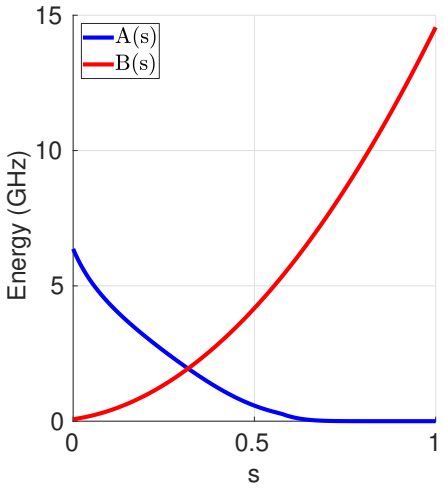
- domain assumption The D-Wave 2000Q is governed by the time-dependent Hamiltonian H(s) = -A(s)/2 * sum_i a_i sigma_x^i + B(s)/2 * (sum_i sigma_z^i + sum_{i<=j} a_ij sigma_z^i sigma_z^j), with A(s) and B(s) as in Figure 1.
- ad hoc to paper Quenching from an intermediate anneal fraction to s=1 at time t+1 preserves the solution state as of time t.
- domain assumption The minimum 1 percent energies over 1000 anneals is a stable statistic of solution quality.
- domain assumption Annealing schedules are limited to 50 points with a maximum slope of 45 degrees on D-Wave 2000Q.
Cite this review
Pith. "Pith review of Peering into the Anneal Process of a Quantum Annealer." pith.science (2026). https://pith.science/paper/G2I2WJEG
@misc{pith2026190802691,
  author       = {Pith},
  title        = {Pith review of: Peering into the Anneal Process of a Quantum Annealer},
  year         = {2026},
  howpublished = {\url{https://pith.science/paper/G2I2WJEG}},
  note         = {Machine review of arXiv:1908.02691}
}
read the original abstract
Commercial adiabatic quantum annealers have the potential to solve important NP-hard optimization problems efficiently. The newest generation of those machines additionally allows the user to customize the anneal schedule, that is, the schedule with which the anneal fraction is changed from the start to the end of the annealing. In this work we use the aforementioned feature of the D-Wave 2000Q to attempt to monitor how the anneal solution evolves during the anneal process. This process we call slicing: at each time slice during the anneal, we are able to obtain an approximate distribution of anneal solutions. We use our technique to obtain a variety of insights into the D-Wave 2000Q. For example, we observe when individual bits flip during the anneal process and when they stabilize, which allows us to determine the freeze-out point for each qubit individually. We highlight our results using both random QUBO (quadratic unconstrained binary optimization) instances and, for better visualization, instances which we specifically optimize (using our own genetic algorithm) to exhibit a pronounced evolution of its solution during the anneal.
Figures

Figures from the paper (5 more)


Reference graph
Works this paper leans on
-
[1]
Chapuis, G., Djidjev, H., Hahn, G., and Rizk, G. (2019). Finding Maximum Cliques on the D-Wave Quantum Annealer . Journal of Signal Processing Systems , 91(3-4):363--377
work page 2019
-
[2]
D-Wave Systems (2017). Quantum Computing for the Real World Today https://www.dwavesys.com/sites/default/files/D-Wave-Overview-Jan2017F3.pdf
work page 2017
-
[3]
D-Wave Systems (2019a). Technical Description of the D-Wave Quantum Processing Unit https://docs.dwavesys.com/docs/latest/_downloads/09-1109A-O_Technical_Description_of_DW_QPU.pdf
work page 2019
-
[4]
QPU Properties: D-Wave 2000Q System at LANL (DW\_2000Q\_LANL)
D-Wave Systems (2019b). QPU Properties: D-Wave 2000Q System at LANL (DW\_2000Q\_LANL)
work page 2019
-
[5]
E. D. Dahl, D-Wave Systems (2013). Programming with D-Wave : Map coloring problem
work page 2013
-
[6]
Lucas, A. (2014). Ising formulations of many NP problems. Front Phys , 2(5):1--27
work page 2014
-
[7]
Marshall, J., Venturelli, D., Hen, I., and Rieffel, E. G. (2019). Power of pausing: Advancing understanding of thermalization in experimental quantum annealers. Phys. Rev. Applied , 11:044083
work page 2019
-
[8]
Mitchell, M. (1996). An Introduction to Genetic Algorithms . MIT Press, Cambridge, MA, USA
work page 1996
Show all 11 references
-
[9]
Passarelli, G., Cataudella, V., and Lucignano, P. (2019). Improving quantum annealing of the ferromagnetic p -spin model through pausing. Phys. Rev. B , 100:024302
2019
-
[10]
Pelofske, E., Hahn, G., and Djidjev, H. (2019a). Solving large maximum clique problems on a quantum annealer. In Proceedings of the First International Workshop on Quantum Technology and Optimization Problems, QTOP , Munich, Germany, March 18, 2019 , pages 123--135
2019
-
[11]
Pelofske, E., Hahn, G., and Djidjev, H. (2019b). Solving large minimum vertex cover problems on a quantum annealer. In Proceedings of the 16th ACM International Conference on Computing Frontiers, CF 2019, Alghero, Italy, April 30 - May 2, 2019. , pages 76--84. ACM
2019
Reviewed August 14, 2026 · model on record in the stance chip above.
Discussion (0). Continue with ORCID to comment.