MEDAL: Manifold Embedding Distillation via Autoencoder Learning
Pith reviewed 2026-06-30 14:19 UTC · model grok-4.3
The pith
MEDAL distills any manifold embedding into a constrained autoencoder that matches the embedding at the bottleneck while reconstructing inputs, enabling held-out validation.
A machine-rendered reading of the paper's core claim, the machinery that carries it, and where it could break.
Core claim
By training a constrained autoencoder so that its bottleneck exactly reproduces any given teacher embedding while the decoder reconstructs the original inputs, MEDAL produces an explicit out-of-sample map, an approximate inverse map, and a pointwise reconstruction error that serves as a distortion measure, thereby converting static manifold embeddings into models that admit held-out validation, method comparison, and hyperparameter tuning.
What carries the argument
Constrained autoencoder whose bottleneck is forced to match the teacher embedding exactly while the decoder reconstructs the input.
If this is right
- New samples receive an explicit map into the embedding space.
- The decoder supplies an approximate inverse from embedding coordinates back to original features.
- Pointwise reconstruction error quantifies local distortion in the manifold space.
- Different dimension reduction methods can be compared quantitatively on held-out data.
- Hyperparameters of the original embedding can be tuned using validation metrics.
Where Pith is reading between the lines
- The reconstruction error could flag regions where the original embedding compresses biologically meaningful structure.
- Mapping new samples and inspecting their reconstruction errors might serve as a practical test for distribution shift relative to the training manifold.
- The same distillation step could be applied to other embedding algorithms to create a uniform validation layer across the field.
- One could check whether the distilled model preserves higher-order neighborhood statistics better than existing out-of-sample extensions.
Load-bearing premise
The autoencoder can be trained to reproduce the geometry and neighborhoods of an arbitrary teacher embedding without adding its own systematic distortions.
What would settle it
A held-out test set where the neighborhoods or distances in the MEDAL-mapped space differ substantially from those produced by applying the original embedding method directly to the same points.
Figures





read the original abstract
Low-dimensional embeddings are widely used as visual summaries of high-dimensional data and to enable downstream scientific discoveries. Yet, popular nonlinear dimension reduction methods, such as t-SNE and UMAP, are often selected based on visual appeal alone and without rigorous quantitative validation. A major reason is that manifold embeddings typically do not provide an out-of-sample map nor an inverse back to the original feature space; this makes held-out validation, the gold standard in supervised learning, all but impossible. To address these challenges, we develop a novel framework, MEDAL (Manifold Embedding Distillation via Autoencoder Learning), which distills a fitted manifold embedding into a reusable encoder--decoder model. MEDAL trains a constrained autoencoder whose bottleneck exactly matches any teacher embedding while the decoder reconstructs the original input; this yields an explicit map for new samples, an approximate inverse, and a pointwise reconstruction-based measure of distortion in the manifold space. This converts static manifold embeddings into models that can be evaluated on held-out data, enabling quantitative validation including comparing different dimension reduction methods as well as hyperparameter tuning. Across multiple benchmark and scientific case studies, we show that MEDAL enables held-out validation to determine optimal manifold embeddings and hyperparameters, reveals biologically coherent regions that are difficult to preserve in two dimensional embeddings, and detects distribution shift when new samples are mapped into a fixed reference manifold. MEDAL provides a general validation wrapper to any existing dimension reduction technique that will improve the rigor and reliability of dimension reduction in scientific workflows.
Editorial analysis
A structured set of objections, weighed in public.
Referee Report
Summary. The paper introduces MEDAL, a framework for distilling any pre-fitted nonlinear manifold embedding (e.g., t-SNE or UMAP) into a constrained autoencoder. The encoder is trained so its bottleneck layer exactly reproduces the teacher embedding coordinates on training points while the decoder reconstructs the original high-dimensional input; this supplies an explicit out-of-sample map, an approximate inverse, and a pointwise reconstruction error that serves as a distortion measure in the embedded space. The resulting model enables held-out quantitative validation, hyperparameter selection, and distribution-shift detection for dimension-reduction methods that otherwise lack these capabilities.
Significance. If the central construction holds, MEDAL would convert static, non-reusable embeddings into evaluable models, directly addressing the lack of rigorous validation that currently limits the scientific use of nonlinear dimension reduction. The approach is general (applicable to any teacher embedding) and supplies concrete tools—out-of-sample extension and a reconstruction-based fidelity metric—that are absent from standard t-SNE/UMAP pipelines. No machine-checked proofs or parameter-free derivations are claimed, but the empirical demonstration on benchmarks and biological case studies, if supported by appropriate controls, would constitute a practical advance.
major comments (2)
- [§3.2] §3.2 (composite loss): the coordinate-matching term ||f_θ(x) − teacher(x)||_2 does not constrain local geometry or neighborhood structure. Nothing prevents the joint optimizer from trading small increases in matching error for large reconstruction gains by introducing folds or warps invisible to the pointwise L2 term yet visible to downstream nearest-neighbor or distance-based validation; the manuscript must supply explicit evidence (e.g., k-NN preservation or trustworthiness scores on held-out data) that such distortion does not occur.
- [§5] §5 (held-out validation experiments): the reported improvements in hyperparameter selection and distribution-shift detection rely on the assumption that the bottleneck faithfully reproduces the teacher geometry on unseen points. Without an ablation that isolates the effect of the matching loss weight or compares against a pure reconstruction autoencoder, it is unclear whether the observed gains are attributable to faithful distillation or to the autoencoder’s own inductive bias.
minor comments (2)
- Notation for the teacher embedding and the encoder output should be unified across equations and text to avoid confusion between the static teacher map and the learned f_θ.
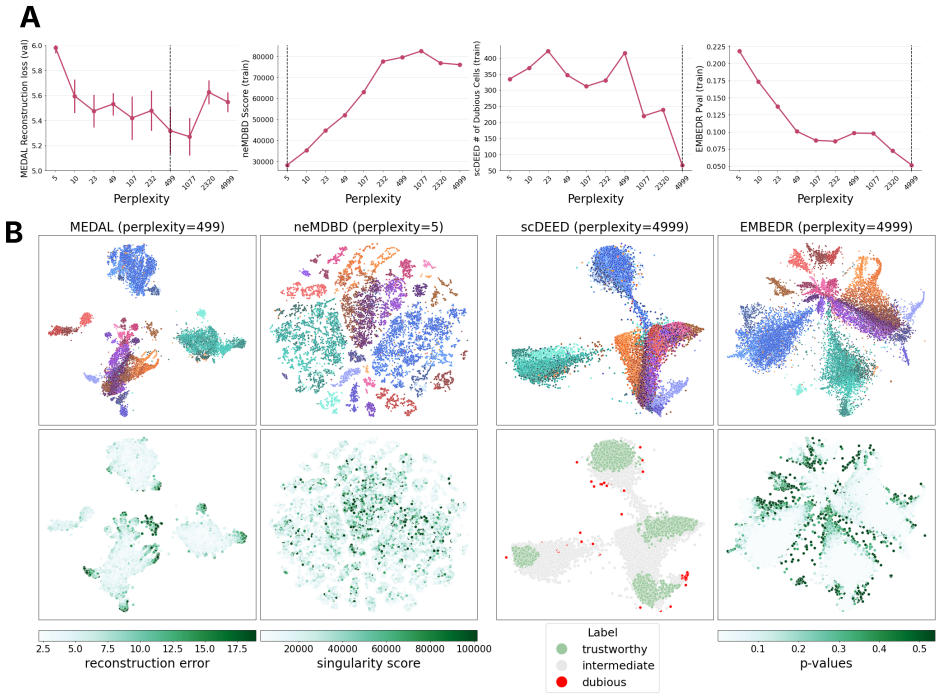
- Figure captions should explicitly state whether the displayed embeddings are the original teacher or the MEDAL-reconstructed versions, and whether any quantitative metric is computed on training or held-out points.
Simulated Author's Rebuttal
We thank the referee for the constructive feedback on empirical validation. We address each major comment below, agreeing where additional evidence is warranted and outlining the revisions we will make.
read point-by-point responses
-
Referee: [§3.2] §3.2 (composite loss): the coordinate-matching term ||f_θ(x) − teacher(x)||_2 does not constrain local geometry or neighborhood structure. Nothing prevents the joint optimizer from trading small increases in matching error for large reconstruction gains by introducing folds or warps invisible to the pointwise L2 term yet visible to downstream nearest-neighbor or distance-based validation; the manuscript must supply explicit evidence (e.g., k-NN preservation or trustworthiness scores on held-out data) that such distortion does not occur.
Authors: We agree that the pointwise L2 matching term alone does not explicitly regularize local geometry. While the training procedure is designed to reproduce the teacher coordinates exactly on the training points, we acknowledge that verification of neighborhood preservation on held-out data is required. In the revised manuscript we will add k-NN preservation and trustworthiness scores evaluated on held-out points, comparing the distilled MEDAL embeddings against the original teacher embeddings to provide the requested evidence that distortion does not occur. revision: yes
-
Referee: [§5] §5 (held-out validation experiments): the reported improvements in hyperparameter selection and distribution-shift detection rely on the assumption that the bottleneck faithfully reproduces the teacher geometry on unseen points. Without an ablation that isolates the effect of the matching loss weight or compares against a pure reconstruction autoencoder, it is unclear whether the observed gains are attributable to faithful distillation or to the autoencoder’s own inductive bias.
Authors: We agree that isolating the contribution of the matching loss is important for attributing the observed gains. The revised manuscript will include an ablation that varies the weight of the coordinate-matching term and directly compares the full MEDAL model against a pure reconstruction autoencoder (matching weight set to zero). These experiments will clarify whether the improvements stem from faithful distillation rather than the autoencoder architecture alone. revision: yes
Circularity Check
No circularity: derivation self-contained with independent losses and evaluation
full rationale
The paper defines MEDAL as training an autoencoder with a composite objective that includes both reconstruction of the input and matching to a pre-fitted teacher embedding; the held-out validation, distortion measure, and out-of-sample mapping are defined directly from the decoder and encoder outputs without reducing to the teacher coordinates by construction. No self-citation is load-bearing for the central claim, no fitted parameter is relabeled as a prediction, and no uniqueness theorem or ansatz is imported from prior author work. The method is a standard constrained autoencoder wrapper whose outputs are independently falsifiable on held-out data.
Axiom & Free-Parameter Ledger
axioms (1)
- domain assumption A standard autoencoder architecture can be trained so that its bottleneck layer exactly reproduces the coordinates of any given nonlinear manifold embedding.
Reference graph
Works this paper leans on
-
[1]
Allen, Luqin Gan, and Lili Zheng
Genevera I. Allen, Luqin Gan, and Lili Zheng. Interpretable machine learning for discovery: Statistical challenges and opportunities.Annual Review of Statistics and Its Application, 11 (Volume 11, 2024):97–121, 2024
2024
-
[2]
Bingxue An and Tiffany M. Tang. Consensus dimension reduction via multi-view learning,
- [3]
-
[4]
Hypernp: Interactive visual exploration of multidimensional projection hyperparameters, 2021
Gabriel Appleby, Mateus Espadoto, Rui Chen, Samuel Goree, Alexandru Telea, Erik W Anderson, and Remco Chang. Hypernp: Interactive visual exploration of multidimensional projection hyperparameters, 2021. URLhttps://arxiv.org/abs/2106.13777
-
[5]
Reidenbach, Adam Gayoso, and Nir Yosef
Tal Ashuach, Danny A. Reidenbach, Adam Gayoso, and Nir Yosef. Multivi: Deep generative model for the integration of multimodal data.Nature Methods, 20:1222–1231, 2023. doi: 10.1038/s41592-023-01909-9
-
[6]
Pierre Baldi and Kurt Hornik. Neural networks and principal component analysis: Learning from examples without local minima.Neural Networks, 2(1):53–58, 1989. ISSN 0893-6080. doi: https://doi.org/10.1016/0893-6080(89)90014-2. URLhttps://www.sciencedirect. com/science/article/pii/0893608089900142
-
[7]
Andrew R. Barron. Universal approximation bounds for superpositions of a sigmoidal func- tion.IEEE Trans. Inf. Theory, 39:930–945, 1993. URLhttps://api.semanticscholar. org/CorpusID:15383918
1993
-
[8]
Dimensionality reduction for visualizing single-cell data using umap.Nature Biotechnology, 37(1):38–44, 2019
Etienne Becht, Leland McInnes, John Healy, Charles-Antoine Dutertre, Immanuel W H Kwok, Lai Guan Ng, Florent Ginhoux, and Evan W Newell. Dimensionality reduction for visualizing single-cell data using umap.Nature Biotechnology, 37(1):38–44, 2019
2019
-
[9]
Laplacian eigenmaps for dimensionality reduction and data representation.Neural Computation, 15(6):1373–1396, 2003
Mikhail Belkin and Partha Niyogi. Laplacian eigenmaps for dimensionality reduction and data representation.Neural Computation, 15(6):1373–1396, 2003. doi: 10.1162/ 089976603321780317
2003
-
[10]
Out-of-sample extensions for lle, isomap, mds, eigenmaps, and spectral clustering.Advances in neural information processing systems, 16, 2003
Yoshua Bengio, Jean-fran¸ ccois Paiement, Pascal Vincent, Olivier Delalleau, Nicolas Roux, and Marie Ouimet. Out-of-sample extensions for lle, isomap, mds, eigenmaps, and spectral clustering.Advances in neural information processing systems, 16, 2003
2003
-
[11]
Yoshua Bengio, Aaron Courville, and Pascal Vincent. Representation learning: A review and new perspectives.IEEE Transactions on Pattern Analysis and Machine Intelligence, 35(8): 1798–1828, 2013. doi: 10.1109/TPAMI.2013.50
-
[12]
Vanderburg,˚Asa Segerstolpe, Meng Zhang, Inbal Avraham- Davidi, and Aviv Regev
Tommaso Biancalani, Gabriele Scalia, Lorenzo Buffoni, Rahul Avasthi, Ziqing Lu, Aviv Sanger, Nazli Tokcan, Charles R. Vanderburg,˚Asa Segerstolpe, Meng Zhang, Inbal Avraham- Davidi, and Aviv Regev. Deep learning and alignment of spatially resolved single-cell transcriptomes with tangram.Nature Methods, 18(11):1352–1362, 2021. doi: 10.1038/ s41592-021-01264-7
2021
-
[13]
Strategies for eels data analysis
Javier Blanco-Portals, Francesca Peir´ o, and S` onia Estrad´ e. Strategies for eels data analysis. introducing umap and hdbscan for dimensionality reduction and clustering.Microscopy and Microanalysis, 28(1):109–122, 2022. 26
2022
-
[14]
H. Bourlard and Y. Kamp. Auto-association by multilayer perceptrons and singular value decomposition.Biological Cybernetics, 59(4):291–294, 1988. doi: 10.1007/BF00332918. URL https://doi.org/10.1007/BF00332918
-
[15]
Stability and generalization.Journal of Machine Learning Research, 2:499–526, 2002
Olivier Bousquet and Andr´ e Elisseeff. Stability and generalization.Journal of Machine Learning Research, 2:499–526, 2002. doi: 10.1162/153244302760200704
-
[16]
Pierre Boyeau, Jeremy Hong, Adam Gayoso, Michelle Kim, Jos´ e L. McFaline-Figueroa, Michael I. Jordan, Elham Azizi, Can Ergen, and Nir Yosef. Deep generative model- ing of sample-level heterogeneity in single-cell genomics.Nature Methods, 2025. doi: 10.1038/s41592-025-02808-x
-
[17]
Friedman, Richard A
Leo Breiman, Jerome H. Friedman, Richard A. Olshen, and Charles J. Stone.Classification and Regression Trees. Wadsworth, Belmont, CA, 1984
1984
-
[18]
Automatic Selection of t-SNE Perplexity
Yanshuai Cao and Luyu Wang. Automatic selection of t-sne perplexity, 2017. URLhttps: //arxiv.org/abs/1708.03229
work page internal anchor Pith review Pith/arXiv arXiv 2017
-
[19]
Dylan Cashman, Mark Keller, Hyeon Jeon, Bum Chul Kwon, and Qianwen Wang. A critical analysis of the usage of dimensionality reduction in four domains.IEEE Transactions on Visualization and Computer Graphics, 31(10):9405–9423, October 2025. ISSN 2160-9306. doi: 10.1109/tvcg.2025.3567989. URLhttp://dx.doi.org/10.1109/TVCG.2025.3567989
-
[20]
Raymond B. Cattell. The scree test for the number of factors.Multivariate Behavioral Research, 1(2):245–276, 1966. doi: 10.1207/s15327906mbr0102 10
-
[21]
Andersen Chang, Tiffany M. Tang, Tarek M. Zikry, and Genevera I. Allen. Unsupervised machine learning for scientific discovery: Workflow and best practices, 2025. URLhttps: //arxiv.org/abs/2506.04553
-
[22]
Dataslingers/medal: v0.1.0, May 2026
Irene Chang, tzUNC, and Matthew Shen. Dataslingers/medal: v0.1.0, May 2026. URL https://doi.org/10.5281/zenodo.20347573
-
[23]
The specious art of single-cell genomics.PLOS Computational Biology, 19(8):1–20, 08 2023
Tara Chari and Lior Pachter. The specious art of single-cell genomics.PLOS Computational Biology, 19(8):1–20, 08 2023. doi: 10.1371/journal.pcbi.1011288. URLhttps://doi.org/ 10.1371/journal.pcbi.1011288
-
[24]
Neural population dynamics during reaching.Nature, 487(7405):51–56, 2012
Mark M Churchland, John P Cunningham, Matthew T Kaufman, Justin D Foster, Paul Nuyujukian, Stephen I Ryu, and Krishna V Shenoy. Neural population dynamics during reaching.Nature, 487(7405):51–56, 2012
2012
-
[25]
Haotian Cui, Chen Wang, Hassaan Maan, Kuan Pang, Feng Luo, and Bo Wang. scgpt: Toward building a foundation model for single-cell multi-omics using generative ai.Nature Methods, 21:1470–1480, 2024. doi: 10.1038/s41592-024-02201-0
-
[26]
Dimensionality reduction for large-scale neural record- ings.Nature neuroscience, 17(11):1500–1509, 2014
John P Cunningham and Byron M Yu. Dimensionality reduction for large-scale neural record- ings.Nature neuroscience, 17(11):1500–1509, 2014
2014
-
[27]
George V. Cybenko. Approximation by superpositions of a sigmoidal function.Mathematics of Control, Signals and Systems, 2:303–314, 1989. URLhttps://api.semanticscholar. org/CorpusID:3958369. 27
1989
-
[28]
Sloan, Derek Croote, Marco Mignardi, Sophia Chernikova, Pey- man Samghababi, Ye Zhang, Norma Neff, Mark Kowarsky, Christine Caneda, Gordon Li, Steven D
Spyros Darmanis, Steven A. Sloan, Derek Croote, Marco Mignardi, Sophia Chernikova, Pey- man Samghababi, Ye Zhang, Norma Neff, Mark Kowarsky, Christine Caneda, Gordon Li, Steven D. Chang, Ian David Connolly, Yingmei Li, Ben A. Barres, Melanie Hayden Gephart, and Stephen R. Quake. Single-cell rna-seq analysis of infiltrating neoplastic cells at the mi- grat...
2017
-
[29]
Lowell E. Davis. Histological and ultrastructural studies of the basal disk of hydra. iii. the gastrodermis and the mesoglea.Cell and Tissue Research, 162:107–118, 1975. doi: 10.1007/BF00223266
-
[30]
Hamprecht, Em˝ oke´Agnes Horv´ at, Dhruv Kohli, Smita Krishnaswamy, John A
Cyril de Bodt, Alex Diaz-Papkovich, Michael Bleher, Kerstin Bunte, Corinna Coupette, Se- bastian Damrich, Enrique Fita Sanmartin, Fred A. Hamprecht, Em˝ oke´Agnes Horv´ at, Dhruv Kohli, Smita Krishnaswamy, John A. Lee, Boudewijn P. F. Lelieveldt, Leland McInnes, Ian T. Nabney, Maximilian Noichl, Pavlin G. Poliˇ car, Bastian Rieck, Guy Wolf, Gal Mishne, an...
-
[31]
Kangning Dong and Shihua Zhang. Deciphering spatial domains from spatially resolved transcriptomics with an adaptive graph attention auto-encoder.Nature Communications, 13 (1):1739, 2022. doi: 10.1038/s41467-022-29439-6
-
[32]
Michael W. Dorrity, Lauren M. Saunders, Christine Queitsch, Stanley Fields, and Cole Trapnell. Dimensionality reduction by umap to visualize physical and genetic interac- tions.Nature Communications, 11(1):1537, 2020. doi: 10.1038/s41467-020-15351-4. URL https://doi.org/10.1038/s41467-020-15351-4
-
[33]
Duque, Sacha Morin, Guy Wolf, and Kevin Moon
Andres F. Duque, Sacha Morin, Guy Wolf, and Kevin Moon. Extendable and invertible mani- fold learning with geometry regularized autoencoders. In2020 IEEE International Conference on Big Data (Big Data), page 5027–5036. IEEE, December 2020. doi: 10.1109/bigdata50022. 2020.9378049. URLhttp://dx.doi.org/10.1109/BigData50022.2020.9378049
-
[34]
gene expression cancer RNA-Seq
Samuele Fiorini. gene expression cancer RNA-Seq. UCI Machine Learning Repository, 2016. DOI: https://doi.org/10.24432/C5R88H
-
[35]
A review of unsupervised learning in astronomy.Astronomy and Com- puting, 48:100851, 2024
Sotiria Fotopoulou. A review of unsupervised learning in astronomy.Astronomy and Com- puting, 48:100851, 2024
2024
-
[36]
Luqin Gan, Tarek M Zikry, and Genevera I Allen. Are machine learning interpretations reliable? a stability study on global interpretations.arXiv preprint arXiv:2505.15728, 2025
-
[37]
Nazor, Aaron Streets, and Nir Yosef
Adam Gayoso, Zo¨ e Steier, Romain Lopez, Jeffrey Regier, Kristopher L. Nazor, Aaron Streets, and Nir Yosef. Joint probabilistic modeling of single-cell multi-omic data with totalvi.Nature Methods, 18(3):272–282, 2021. doi: 10.1038/s41592-020-01050-x
-
[38]
Rufus Gikera, Elizaphan Maina, Shadrack Maina Mambo, and Jonathan Mwaura. K- hyperparameter tuning in high-dimensional genomics using joint optimization of deep differ- ential evolutionary algorithm and unsupervised transfer learning from intelligent genoumap embeddings.International Journal of Information Technology, 17(3):1679–1701, 2025
2025
-
[39]
Expressivity of deep neural networks,
Ingo G¨ uhring, Mones Raslan, and Gitta Kutyniok. Expressivity of deep neural networks,
- [40]
-
[41]
Laleh Haghverdi, Aaron T. L. Lun, Michael D. Morgan, and John C. Marioni. Batch effects in single-cell rna-sequencing data are corrected by matching mutual nearest neighbors.Nature Biotechnology, 36:421–427, 2018. doi: 10.1038/nbt.4091
-
[42]
Approximating Continuous Functions by ReLU Nets of Minimal Width
Boris Hanin and Mark Sellke. Approximating continuous functions by relu nets of minimal width, 2018. URLhttps://arxiv.org/abs/1710.11278
work page internal anchor Pith review Pith/arXiv arXiv 2018
-
[43]
Mauck III, Shiwei Zheng, Andrew Butler, Maddie J
Yuhan Hao, Stephanie Hao, Erica Andersen-Nissen, William M. Mauck III, Shiwei Zheng, Andrew Butler, Maddie J. Lee, Aaron J. Wilk, Charlotte Darby, Michael Zager, et al. In- tegrated analysis of multimodal single-cell data.Cell, 184(13):3573–3587.e29, 2021. doi: 10.1016/j.cell.2021.04.048
-
[44]
Interactive single-cell data analysis using cellar.Nature Communications, 13(1):1998, 2022
Euxhen Hasanaj, Jingtao Wang, Arjun Sarathi, Jun Ding, and Ziv Bar-Joseph. Interactive single-cell data analysis using cellar.Nature Communications, 13(1):1998, 2022
1998
-
[45]
Distilling the knowledge in a neural network,
Geoffrey Hinton, Oriol Vinyals, and Jeff Dean. Distilling the knowledge in a neural network,
-
[46]
URLhttps://arxiv.org/abs/1503.02531
work page internal anchor Pith review Pith/arXiv arXiv
-
[47]
Hinton and Richard S
Geoffrey E. Hinton and Richard S. Zemel. Autoencoders, minimum description length and helmholtz free energy. In Jack D. Cowan, Gerald Tesauro, and Joshua Alspector, editors, Advances in Neural Information Processing Systems 6, pages 3–10. Morgan Kaufmann, 1994
1994
-
[48]
Thomas W. Holstein. The hydra stem cell system – revisited.Cells & Development, 174: 203846, 2023. doi: 10.1016/j.cdev.2023.203846
-
[49]
Approximation capabilities of multilayer feedforward networks.Neural Net- works, 4(2):251–257, 1991
Kurt Hornik. Approximation capabilities of multilayer feedforward networks.Neural Net- works, 4(2):251–257, 1991
1991
-
[50]
Multilayer feedforward networks are universal approximators.Neural Networks, 2(5):359–366, 1989
Kurt Hornik, Maxwell Stinchcombe, and Halbert White. Multilayer feedforward networks are universal approximators.Neural Networks, 2(5):359–366, 1989
1989
-
[51]
Analysis of a complex of statistical variables into principal components
Harold Hotelling. Analysis of a complex of statistical variables into principal components. Journal of educational psychology, 24(6):417, 1933
1933
-
[52]
Haiyang Huang, Yingfan Wang, Cynthia Rudin, and Edward P. Browne. Towards a com- prehensive evaluation of dimension reduction methods for transcriptomic data visualiza- tion.Communications Biology, 5(1):719, 2022. doi: 10.1038/s42003-022-03628-x. URL https://doi.org/10.1038/s42003-022-03628-x
-
[53]
Stop misusing t-sne and umap for visual analytics, 2025
Hyeon Jeon, Jeongin Park, Sungbok Shin, and Jinwook Seo. Stop misusing t-sne and umap for visual analytics, 2025. URLhttps://arxiv.org/abs/2506.08725
-
[54]
Embedr: distinguishing signal from noise in single-cell omics data.Patterns, 3(3), 2022
Eric M Johnson, William Kath, and Madhav Mani. Embedr: distinguishing signal from noise in single-cell omics data.Patterns, 3(3), 2022
2022
-
[55]
Optimizing dimension- ality reduction in sdn: A metaheuristic approach of umap parameter tuning
Abderrahmane Jouilili, Hajar Hantouti, and Rajae E L Ouazzani. Optimizing dimension- ality reduction in sdn: A metaheuristic approach of umap parameter tuning. In2024 5th International Conference on Communications, Information, Electronic and Energy Systems (CIEES), pages 1–6, 2024. doi: 10.1109/CIEES62939.2024.10811181
-
[56]
Kang, Aparna Nathan, Kathryn Weinand, Fan Zhang, Nghia Millard, Laurie Rumker, D
Joyce B. Kang, Aparna Nathan, Kathryn Weinand, Fan Zhang, Nghia Millard, Laurie Rumker, D. Branch Moody, Ilya Korsunsky, and Soumya Raychaudhuri. Efficient and pre- cise single-cell reference atlas mapping with symphony.Nature Communications, 12(1):5890,
-
[57]
doi: 10.1038/s41467-021-25957-x. 29
-
[58]
Self-Normalizing Neural Networks
G¨ unter Klambauer, Thomas Unterthiner, Andreas Mayr, and Sepp Hochreiter. Self- normalizing neural networks, 2017. URLhttps://arxiv.org/abs/1706.02515
work page internal anchor Pith review Pith/arXiv arXiv 2017
-
[59]
Vitalii Kleshchevnikov, Artem Shmatko, Emma Dann, Alexander Aivazidis, Hamish W. King, Tong Li, Rasa Elmentaite, Artem Lomakin, Veronika Kedlian, Adam Gayoso, Mika Sarkin Jain, Jun Sung Park, Lauma Ramona, Elizabeth Tuck, Anna Arutyunyan, Roser Vento- Tormo, Moritz Gerstung, Louisa James, Oliver Stegle, and Omer Ali Bayraktar. Cell2location maps fine-grai...
-
[60]
doi: 10.1038/s41587-021-01139-4
-
[61]
The art of using t-sne for single-cell transcriptomics
Dmitry Kobak and Philipp Berens. The art of using t-sne for single-cell transcriptomics. Nature communications, 10(1):5416, 2019
2019
-
[62]
Linderman
Dmitry Kobak and George C. Linderman. Initialization is critical for preserving global data structure in both t-sne and umap.Nature Biotechnology, 39(2):156–157, 2021. doi: 10.1038/ s41587-020-00809-z
2021
-
[63]
Fast, sensitive and accurate integration of single-cell data with harmony.Nature Methods, 16(12):1289–1296,
Ilya Korsunsky, Nghia Millard, Jean Fan, Kamil Slowikowski, Fan Zhang, Kevin Wei, Yuriy Baglaenko, Michael Brenner, Po-Ru Loh, and Soumya Raychaudhuri. Fast, sensitive and accurate integration of single-cell data with harmony.Nature Methods, 16(12):1289–1296,
-
[64]
doi: 10.1038/s41592-019-0619-0
-
[65]
Yann LeCun, L´ eon Bottou, Yoshua Bengio, and Patrick Haffner. Gradient-based learning applied to document recognition.Proceedings of the IEEE, 86(11):2278–2324, 1998. doi: 10.1109/5.726791
-
[66]
John A. Lee and Michel Verleysen. Quality assessment of dimensionality reduction: Rank- based criteria.Neurocomputing, 72(7–9):1431–1443, 2009. doi: 10.1016/j.neucom.2008.12.017
-
[67]
Lin, Allan Pinkus, and Shimon Schocken
Moshe Leshno, Vladimir Ya. Lin, Allan Pinkus, and Shimon Schocken. Multilayer feedforward networks with a nonpolynomial activation function can approximate any function.Neural Networks, 6(6):861–867, 1993
1993
-
[68]
Yin-Ting Liao, Hengrui Luo, and Anna Ma. Efficient and robust bayesian selection of hyper- parameters in dimension reduction for visualization, 2023. URLhttps://arxiv.org/abs/ 2306.00357
-
[69]
Calibrating dimension reduction hyperparameters in the presence of noise.PLOS Computational Biology, 20(9):e1012427, September 2024
Justin Lin and Julia Fukuyama. Calibrating dimension reduction hyperparameters in the presence of noise.PLOS Computational Biology, 20(9):e1012427, September 2024. ISSN 1553-
2024
-
[70]
URLhttp://dx.doi.org/10.1371/journal
doi: 10.1371/journal.pcbi.1012427. URLhttp://dx.doi.org/10.1371/journal. pcbi.1012427
-
[71]
Zhexuan Liu, Rong Ma, and Yiqiao Zhong. Assessing and improving reliability of neighbor embedding methods: a map-continuity perspective, 2025. URLhttps://arxiv.org/abs/ 2410.16608
-
[72]
Romain Lopez, Jeffrey Regier, Michael B. Cole, Michael I. Jordan, and Nir Yosef. Deep generative modeling for single-cell transcriptomics.Nature Methods, 15(12):1053–1058, 2018. doi: 10.1038/s41592-018-0229-2
-
[73]
Mohammad Lotfollahi, F. Alexander Wolf, and Fabian J. Theis. scgen predicts single-cell perturbation responses.Nature Methods, 16:715–721, 2019. doi: 10.1038/s41592-019-0494-8. 30
-
[74]
Mohammad Lotfollahi, Mohsen Naghipourfar, Malte D. Luecken, Matin Khajavi, Maren B¨ uttner, Marco Wagenstetter, ˇZiga Avsec, Adam Gayoso, Nir Yosef, Marta Interlandi, Sergei Rybakov, Alexander V. Misharin, and Fabian J. Theis. Mapping single-cell data to reference atlases by transfer learning.Nature Biotechnology, 40(1):121–130, 2022. doi: 10.1038/s41587-...
-
[75]
Mohammad Lotfollahi, Anna Klimovskaia Susmelj, Carlo De Donno, Yuge Ji, Ignacio L. Ibarra, Sanjay R. Srivatsan, Mohsen Naghipourfar, Riza M. Daza, Beth Martin, F. Alexander Wolf, Nailya Yakubova, Jay Shendure Lee, Jos´ e L. McFaline-Figueroa, and Fabian J. Theis. Predicting cellular responses to complex perturbations in high-throughput screens.Molecular S...
-
[76]
The Expressive Power of Neural Networks: A View from the Width
Zhou Lu, Hongming Pu, Feicheng Wang, Zhiqiang Hu, and Liwei Wang. The expressive power of neural networks: A view from the width, 2017. URLhttps://arxiv.org/abs/ 1709.02540
work page internal anchor Pith review Pith/arXiv arXiv 2017
-
[77]
Manifold-learning- based feature extraction for classification of hyperspectral data: A review of advances in manifold learning.IEEE Signal Processing Magazine, 31(1):55–66, 2013
Dalton Lunga, Saurabh Prasad, Melba M Crawford, and Okan Ersoy. Manifold-learning- based feature extraction for classification of hyperspectral data: A review of advances in manifold learning.IEEE Signal Processing Magazine, 31(1):55–66, 2013
2013
-
[78]
Leland McInnes, John Healy, Nathaniel Saul, and Lukas Grossberger. Umap: Uniform man- ifold approximation and projection.Journal of Open Source Software, 3(29):861, 2018. doi: 10.21105/joss.00861. URLhttps://doi.org/10.21105/joss.00861
-
[79]
UMAP: Uniform Manifold Approximation and Projection for Dimension Reduction
Leland McInnes, John Healy, and James Melville. Umap: Uniform manifold approximation and projection for dimension reduction, 2020. URLhttps://arxiv.org/abs/1802.03426
work page internal anchor Pith review Pith/arXiv arXiv 2020
-
[80]
Marina Meil˘ a and Hanyu Zhang. Manifold learning: What, how, and why.Annual Review of Statistics and Its Application, 11:27–57, 2024. doi: 10.1146/annurev-statistics-112723-034552. URLhttps://arxiv.org/abs/2311.03757
discussion (0)
Sign in with ORCID, Apple, or X to comment. Anyone can read and Pith papers without signing in.