REVIEW 4 major objections 6 minor 65 references
A computational study of transient shear banding in soft jammed solids
T0 review · 4 major / 6 minor · reviewed 2026-08-14 · deepseek-v4-flash
Pith's one-line read The paper claims that stress overshoot and transient shear banding are robust features of yielding overdamped jammed solids, not artifacts of the simulation setup.
desk verdict A careful 3D simulation study that robustly shows transient banding across protocols, but the 'large enough samples' qualifier is never tested. read the letter →
The pith
A machine-rendered reading of the paper's core claim, the machinery that carries it, and where it could break.
The reading
What carries the argument
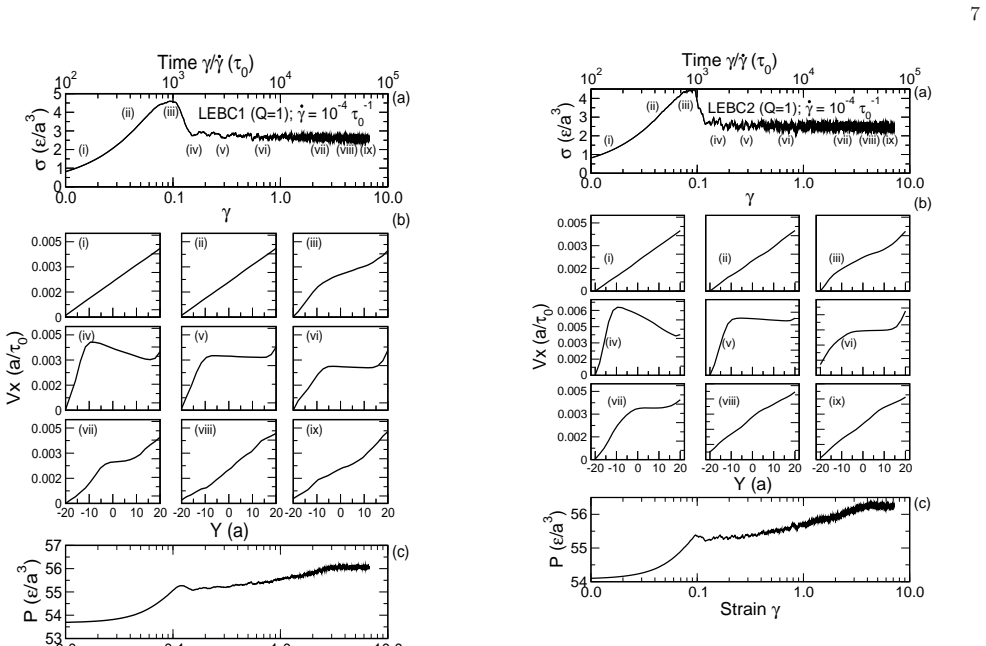
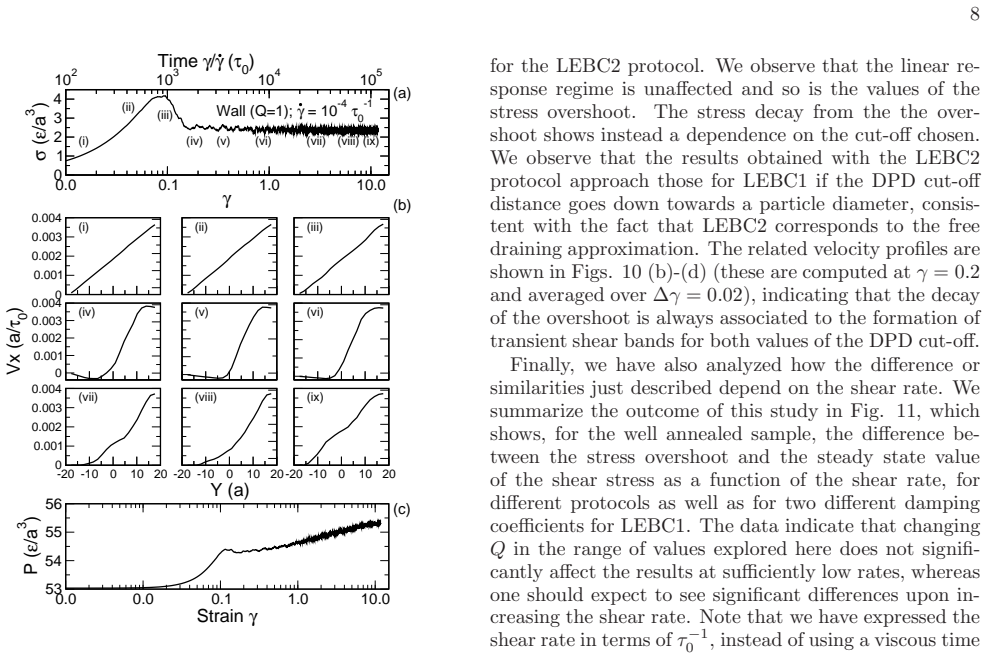
The central machinery is a set of 3D athermal simulations of about 97,556 polydisperse soft spheres interacting through a truncated and shifted Lennard-Jones potential at a volume fraction near 0.70. Shear is imposed either through Lees-Edwards periodic boundary conditions or by confining the sample between two frozen walls; dissipation is either pairwise through dissipative particle dynamics or particle-wise through a Stokes-like drag. The inertial quality factor $Q = \tau_{\text{damp}}/\tau_{\text{vib}}$, the ratio of the drag time to the vibrational time, quantifies how overdamped the dynamics are, and the paper uses $Q \approx 1$ as its overdamped working point, with additional tests spanning $Q = 0.5$ to $Q = 100$. The robustness argument rests on tracking velocity profiles across the shear-gradient direction in successive strain windows: homogeneous flow before the overshoot, a band with back-flow during the stress decay, and return to homogeneous flow in steady state.
What would settle it
Run the same well-annealed sample preparation and low-rate shear with the shear-gradient dimension doubled, tripled, or increased by an order of magnitude while keeping the thickness-to-particle-size ratio and shear rate fixed. If the overshoot magnitude shrinks, the transient band becomes wall-localized, or the banding disappears at larger system sizes, then the claim that banding is intrinsic would be falsified. A complementary check would be to simulate at $Q$ well below 1, such as $Q = 0.01$, to directly probe the overdamped limit rather than relying on $Q \approx 1$ as equivalent.
Extended reading notes
Core claim
The paper claims that in well-aged, deeply jammed polydisperse soft-sphere solids under start-up shear, the stress overshoot and the accompanying transient shear banding are intrinsic consequences of the material's yielding rather than numerical artifacts. It supports this by repeating the same deformation with two boundary-condition schemes (Lees-Edwards periodic and wall-confined) and with different dissipation implementations (pairwise dissipative-particle-dynamics drag, Stokes-like free-draining drag, and pairwise drag with a transverse contribution), and by varying the damping strength over two decades of an inertial quality factor. In every protocol at low shear rate, the load curve develops an overshoot, the velocity profile develops a banded region during the stress decay, and the band eventually disappears as flow becomes homogeneous. The abstract's stated caveat is that this robustness holds for large enough samples, and the phenomenon is controlled by sample age, since poorly annealed samples show no overshoot.
Load-bearing premise
The 'large enough samples' caveat is assumed rather than demonstrated: all reported simulations use a single system size of about 97,556 particles, so the robustness claim presumes that this size is already in the asymptotic regime.
Editorial extensions
If this is right
- Low-rate start-up shear of a well-aged jammed solid should generically show a stress overshoot followed by transient flow localization, regardless of whether deformation is imposed uniformly or through walls.
- The transient band's lifetime and the stress decay after the overshoot depend on the microscopic damping mechanism, so quantitative comparisons between simulations must account for how dissipation is implemented.
- Because the band disappears in steady state, observing localization only during start-up does not require a non-monotonic constitutive flow curve.
- Sample age is the controlling factor: fast-quenched samples lack the overshoot and therefore lack transient banding, so the aging state should be reported alongside rheological data.
- The positive first normal stress difference that grows while the bands develop indicates that dilation accompanies the inhomogeneous flow, coupling transient banding to volume-change tendencies.
Reading between the lines
- If the robustness claim holds, transient shear banding during start-up could serve as a non-invasive diagnostic of sample age in jammed soft solids: the presence and height of the overshoot read out how deeply annealed the glass is.
- The protocol dependence of the post-overshoot decay suggests that transient start-up rheology may encode information about the viscous dissipation mechanism itself, not just the yield stress, which is an implication the paper does not develop.
- A direct testable extension would be to compare the simulated velocity profiles with 3D particle-tracking rheology on dense emulsions or microgels at matched Weissenberg numbers, looking for the same back-flow signature during the overshoot decay.
- The reported variation with $Q$ hints that inertia softens the post-overshoot decay; at higher rates or lower damping one would expect the banding window to narrow, a prediction that could be probed by changing particle mass in simulations or solvent viscosity in experiments.
Signed reviews
Editorial analysis
A structured set of objections, weighed in public.
Referee Report
Summary. This manuscript reports three-dimensional molecular dynamics simulations of a polydisperse, athermal soft-sphere jammed solid (volume fraction about 0.70) sheared at finite rates, with the aim of identifying which features of the shear start-up transient are intrinsic to the material rather than numerical artifacts. The authors prepare samples with different cooling rates, characterize their linear viscoelastic and structural properties, and then compare three shearing protocols: Lees-Edwards boundary conditions with DPD-type pairwise drag, Lees-Edwards boundary conditions with a Stokes-like single-particle drag, and a wall-confined geometry. For a well-annealed sample at a low shear rate, all protocols show a stress overshoot, a transient flow instability that develops near yielding, a back-flow region in the velocity profile, and eventual recovery of homogeneous flow; these features are accompanied by a positive first normal stress difference and changes in the fraction of icosahedrally coordinated particles. The paper also varies the damping strength via an inertial quality factor Q, varies the DPD cutoff, and compares different sample ages. The central claim, stated in the abstract, is that the stress overshoot and transient shear banding are robust features for overdamped systems in large enough samples, independent of the specific drag and boundary conditions.
Significance. If the central claim holds, the paper makes a useful contribution to the debate on shear banding in soft jammed solids: it provides evidence that transient banding during yielding is not an artifact of a particular thermostat, drag model, or boundary condition, and it extends observations to three dimensions at finite shear rates. The systematic comparison of two drag implementations and wall versus Lees-Edwards boundary conditions is a genuine strength, as is the explicit study of sample age through different cooling protocols. The paper also offers falsifiable predictions, namely that the overshoot magnitude and the banding phenomenology should persist under changes of damping and boundary conditions at low rates. However, the evidence presented is largely qualitative and based on a single system size and, in the key figures, on a single initial configuration; the quantitative support for the 'large enough samples' and 'overdamped' qualifiers is not yet at the level claimed in the abstract.
major comments (4)
- [Section II; abstract]
- [Section IV; Figs. 6-8]
- [Section III; Section V]
- [Section V; Fig. 11]
minor comments (6)
- [Section VI; Fig. 12]
- [Fig. 5 caption]
- [Fig. 3 caption]
- [Throughout]
- [Section IV]
- [Section II]
Circularity Check
No significant circularity: the robustness claim rests on direct protocol comparisons; only minor self-citations appear in scope-setting assumptions (Q≈1 overdamped mapping) and auxiliary persistence discussion.
-
other
[Section III (Shearing protocols), Q≈1 overdamped mapping; supporting self-citation to [64] in Section VI.]
"It has been shown that for the athermal conditions considered here, and for similar type of interactions, Q ≈ 1 well approximates the overdamped regime [48, 61]. Hence here we focus on Q ≈ 1 and show also that the results we obtained do not vary significantly by decreasing Q or varying it around 1."
The circular ingredient is limited to the scope-setting label: the headline claim is restricted to 'overdamped systems,' and the Q=1 runs that carry that label are identified as overdamped via the authors' own arXiv preprint [61], not by a theorem proved here. If [61] were invalid, the Q=1 data would not directly establish the overdamped case. The reduction stops there, however: the paper itself varies Q from 0.5 to 100 and observes banding in every case, and [48] is an independent external citation for the same Q≈1 mapping. The companion-paper reference [64] for persistence of inhomogeneities is auxiliary and not needed for the transient banding observed here. This is a minor, non-forcing self-citation rather than a construction-level circularity.
full rationale
The central claim — that stress overshoot and transient shear banding are robust across drag mechanisms and boundary conditions — is a direct observation from new simulations, not a derivation from fitted parameters. The load curves and velocity profiles in Figs. 5–10 are raw simulation outputs compared across LEBC1, LEBC2, and WB protocols, and no parameter is fit and then renamed as a prediction. The only self-references are [61] for the Q≈1 overdamped mapping and [64] for an auxiliary persistence analysis; neither carries the argument, because [48] independently supports the Q≈1 mapping, the paper's own Q=0.5–100 sweep shows banding even away from Q=1, and [64] is only used to defer a companion-paper discussion. The 'large enough samples' qualifier is not tested by any finite-size study — all production runs use 97,556 particles in one box of side ~42a — but that is a missing-evidence and correctness gap, not a circular reduction of the kind defined here. Accordingly, the circularity score is low.
Assumptions & free parameters
assumptions (3)
- domain assumption Q≈1 well approximates the overdamped limit for athermal soft spheres.
- ad hoc to paper The single system size of 97,556 particles is in the 'large enough samples' regime.
- domain assumption The truncated-shifted Lennard-Jones (WCA-type) polydisperse sphere model at φ≈0.70 captures the physics of jammed soft solids.
Cite this review
Pith. "Pith review of A computational study of transient shear banding in soft jammed solids." pith.science (2026). https://pith.science/paper/G45YNUMZ
@misc{pith2026190803943,
  author       = {Pith},
  title        = {Pith review of: A computational study of transient shear banding in soft jammed solids},
  year         = {2026},
  howpublished = {\url{https://pith.science/paper/G45YNUMZ}},
  note         = {Machine review of arXiv:1908.03943}
}
read the original abstract
We have designed 3D numerical simulations of a soft spheres model, with size polidispersity and in athermal conditions, to study the transient shear banding that occurs during yielding of jammed soft solids. We analyze the effects of different types of drag coefficients used in the simulations and compare the results obtained using Lees-Edwards periodic boundary conditions with the case in which the same model solid is confined between two walls. The specific damping mechanism and the different boundary conditions indeed modify the load curves and the velocity profiles in the transient regime. Nevertheless, we find that the presence of a stress-overshoot and of a related transient banding phenomenon for large enough samples are a robust feature for overdamped systems, where their presence do not depend on the specific drag used and on the different boundary conditions.
Figures


Figures from the paper (8 more)





Reference graph
Works this paper leans on
-
[1]
J. Bibette, F. Leal-Calderon, V. Schmitt, and P. Poulin, Emulsion Science: Basic Principles. An Overview , Springer Tracts in Modern Physics (Springer Berlin Heidelberg, 2003)
work page 2003
-
[2]
Van Hecke, Journal of Physics: Condensed Matter 22, 033101 (2009)
M. Van Hecke, Journal of Physics: Condensed Matter 22, 033101 (2009)
work page 2009
-
[3]
D. Bonn, M. M. Denn, L. Berthier, T. Divoux, and S. Manneville, Rev. Mod. Phys. 89, 035005 (2017)
2017
- [4]
-
[5]
S. M. Fielding, Reports on Progress in Physics 77, 102601 (2014)
work page 2014
- [6]
-
[7]
G. P. Shrivastav, P. Chaudhuri, and J. Horbach, Journal of Rheology 60, 835 (2016)
2016
- [8]
Show all 65 references
-
[9]
Nicolas, K
A. Nicolas, K. Martens, L. Bocquet, and J.-L. Barrat, Soft Matter 10, 4648 (2014)
2014
-
[10]
Goyon, A
J. Goyon, A. Colin, G. Ovarlez, A. Ajdari, and L. Boc- quet, Nature 454, 84 (2008)
2008
-
[11]
Lema ˆ ıtre and C
A. Lema ˆ ıtre and C. Caroli, Physical Review Letters103, 065501 (2009)
2009
-
[12]
B. P. Tighe, E. Woldhuis, J. J. C. Remmers, W. van Saarloos, and M. van Hecke, Physical Review Letters 105, 088303 (2010)
2010
-
[13]
Martens, L
K. Martens, L. Bocquet, and J.-L. Barrat, Soft Matter 8, 4197 (2012)
2012
-
[14]
J. R. Seth, L. Mohan, C. Locatelli-Champagne, M. Cloitre, and R. T. Bonnecaze, Nature Mater. 10, 838 (2011)
2011
-
[15]
V. V. Vasisht, S. K. Dutta, E. Del Gado, and D. L. Blair, Physical review letters 120, 018001 (2018)
2018
-
[16]
Nicolas, E
A. Nicolas, E. E. Ferrero, K. Martens, and J.-L. Barrat, Reviews of Modern Physics 90, 045006 (2018)
2018
-
[17]
J. K. Dhont, Physical Review E 60, 4534 (1999)
1999
-
[18]
P. D. Olmsted, Rheologica Acta 47, 283 (2008)
2008
-
[19]
J. K. Dhont and W. J. Briels, Rheologica acta 47, 257 (2008)
2008
-
[20]
Lerouge and J.-F
S. Lerouge and J.-F. Berret, in Polymer Characterization (Springer, 2009) pp. 1–71
2009
-
[21]
B´ ecu, S
L. B´ ecu, S. Manneville, and A. Colin, Physical Review Letters 96, 138302 (2006)
2006
-
[22]
Fielding, M
S. Fielding, M. Cates, and P. Sollich, Soft Matter 5, 2378 (2009)
2009
-
[23]
Divoux, D
T. Divoux, D. Tamarii, C. Barentin, and S. Manneville, Physical Review Letters 104, 208301 (2010)
2010
-
[24]
Besseling, L
R. Besseling, L. Isa, P. Ballesta, G. Petekidis, M. E. Cates, and W. C. K. Poon, Physical Review Letters 105, 268301 (2010)
2010
-
[25]
Mansard, A
V. Mansard, A. Colin, P. Chauduri, and L. Bocquet, Soft Matter 7, 5524 (2011)
2011
-
[26]
Irani, P
E. Irani, P. Chaudhuri, and C. Heussinger, Physical Re- view Letters 112, 188303 (2014)
2014
-
[27]
Gross and F
M. Gross and F. Varnik, Soft matter 14, 4577 (2018)
2018
-
[28]
R. L. Moorcroft, M. E. Cates, and S. M. Fielding, Phys- ical Review Letters 106, 055502 (2011)
2011
-
[29]
J. M. Adams, S. M. Fielding, and P. D. Olmsted, Journal of Rheology 55, 1007 (2011)
2011
-
[30]
Wisitsorasak and P
A. Wisitsorasak and P. G. Wolynes, Proceedings of the National Academy of Sciences 114, 1287 (2017)
2017
-
[31]
Parisi, I
G. Parisi, I. Procaccia, C. Rainone, and M. Singh, Pro- ceedings of the National Academy of Sciences 114, 5577 (2017)
2017
-
[32]
Ozawa, L
M. Ozawa, L. Berthier, G. Biroli, A. Rosso, and G. Tar- jus, Proceedings of the National Academy of Sciences 115, 6656 (2018)
2018
-
[33]
Popovi´ c, T
M. Popovi´ c, T. W. de Geus, and M. Wyart, Physical Review E 98, 040901 (2018)
2018
-
[34]
Divoux, C
T. Divoux, C. Barentin, and S. Manneville, Soft Matter 7, 9335 (2011)
2011
-
[35]
J. D. Weeks, D. Chandler, and H. C. Andersen, The Journal of Chemical Physics 54, 5237 (1971)
1971
-
[36]
Varnik, L
F. Varnik, L. Bocquet, J.-L. Barrat, and L. Berthier, Physical Review Letters 90, 095702 (2003)
2003
-
[37]
P. J. Steinhardt, D. R. Nelson, and M. Ronchetti, Phys- ical Review B 28, 784 (1983)
1983
-
[38]
Sastry, P
S. Sastry, P. G. Debenedetti, and F. H. Stillinger, Natu re 393, 554 (1998)
1998
-
[39]
F. H. Stillinger, Science 267, 1935 (1995)
1995
-
[40]
Mosayebi, P
M. Mosayebi, P. Ilg, A. Widmer-Cooper, and E. Del Gado, Physical review letters 112, 105503 (2014)
2014
-
[41]
Ashwin, Y
S. Ashwin, Y. Brumer, D. R. Reichman, and S. Sastry, The Journal of Physical Chemistry B 108, 19703 (2004)
2004
-
[42]
R. G. Larson, The structure and rheology of complex flu- ids, Vol. 150 (Oxford university press New York, 1999)
1999
-
[43]
C. H. Rycroft, Chaos: An Interdisciplinary Journal of Nonlinear Science 19, 041111 (2009)
2009
-
[44]
P. J. Steinhardt, D. R. Nelson, and M. Ronchetti, Phys- ical Review Letters 47, 1297 (1981)
1981
-
[45]
Mosayebi, E
M. Mosayebi, E. Del Gado, P. Ilg, and H. C. ¨Ottinger, The Journal of Chemical Physics 137, 024504 (2012)
2012
-
[46]
C. P. Royall and S. R. Williams, Physics Reports 560, 1 (2015)
2015
-
[47]
Ronceray and P
P. Ronceray and P. Harrowell, Soft Matter 11, 3322 (2015)
2015
-
[48]
Nicolas, J.-L
A. Nicolas, J.-L. Barrat, and J. Rottler, Physical Revi ew Letters 116, 058303 (2016)
2016
-
[49]
N. Xu, C. S. O’Hern, and L. Kondic, Physical review letters 94, 016001 (2005)
2005
-
[50]
C. E. Maloney and M. O. Robbins, Journal of Physics: Condensed Matter 20, 244128 (2008)
2008
-
[51]
Puosi, J
F. Puosi, J. Olivier, and K. Martens, Soft Matter 11, 7639 (2015)
2015
-
[52]
Puosi, J
F. Puosi, J. Rottler, and J.-L. Barrat, Physical Review E 89, 042302 (2014)
2014
-
[53]
Baumgarten and B
K. Baumgarten and B. P. Tighe, Soft matter 13, 8368 (2017)
2017
-
[54]
Irani, P
E. Irani, P. Chaudhuri, and C. Heussinger, Physical Re- view Fluids 4, 074307 (2019)
2019
-
[55]
Ikeda, L
A. Ikeda, L. Berthier, and P. Sollich, Soft Matter 9, 7669 (2013)
2013
-
[56]
Colombo and E
J. Colombo and E. Del Gado, Journal of rheology 58, 1089 (2014)
2014
-
[57]
Hoh and R
N. Hoh and R. Zia, Journal of Fluid Mechanics 785, 189 (2015)
2015
-
[58]
Y. Su, J. W. Swan, and R. N. Zia, The Journal of chem- ical physics 146, 124903 (2017)
2017
-
[59]
Soddemann, B
T. Soddemann, B. D¨ unweg, and K. Kremer, Physical Review E 68, 046702 (2003). 12
2003
-
[60]
Frenkel and B
D. Frenkel and B. Smit, Understanding molecular simu- lation: from algorithms to applications , Vol. 1 (Elsevier, 2001)
2001
-
[61]
V. V. Vasisht, M. L. Goff, K. Martens, and J.-L. Barrat, arXiv preprint arXiv:1812.03948 (2018)
2018 arXiv
-
[62]
Plimpton, Journal of Computational Physics 117, 1 (1995)
S. Plimpton, Journal of Computational Physics 117, 1 (1995)
1995
-
[63]
R. L. Moorcroft and S. M. Fielding, Physical review let- ters 110, 086001 (2013)
2013
-
[64]
V. V. Vasisht, G. Roberts, and E. Del Gado, arXiv preprint arXiv:1709.08717 (2017)
2017 arXiv
-
[65]
K. M. Salerno, C. E. Maloney, and M. O. Robbins, Phys- ical Review Letters 109, 105703 (2012)
2012
Reviewed August 14, 2026 · model on record in the stance chip above.
Discussion (0). Continue with ORCID to comment.