REVIEW 4 major objections 7 minor 2 cited by
Quenching of Galaxies at Cosmic Noon: Understanding the Effect of Environment
T0 review · 4 major / 7 minor · reviewed 2026-08-12 · deepseek-v4-flash
Pith's one-line read This paper claims that massive galaxies at z≈3.1 stop forming stars in a uniformly short time, 300–500 Myr, and that this happens independently of their environment, pointing to internal processes such as AGN feedback rather than…
desk verdict A careful null result on environment and quenching at z~3.1, undermined by unpropagated Tq uncertainties and small-sample fragility. read the letter →
The pith
A machine-rendered reading of the paper's core claim, the machinery that carries it, and where it could break.
The reading
What carries the argument
The argument is carried by the quenching timescale $T_q = t_{\rm quench} - t_{\rm form}$, where $t_{\rm form}$ is the star-formation-weighted formation time and $t_{\rm quench}$ is the moment when $t\,{\rm SFR}(t)/M_{\rm formed}$ drops below 0.1, both extracted by fitting a double power-law star-formation history with the BAGPIPES SED-fitting code to 29-band photometry. This parameter does the work of linking photometry to mechanism, because the paper's simulations literature associates short timescales (≈0.1 Gyr) with stellar and AGN feedback and long timescales (≈1 Gyr) with merger-driven quenching. On the environment side, the machinery is a Voronoi Monte Carlo density map built independently from Lyman-$\alpha$ emitters and from photo-$z$-selected galaxies, with protocluster and filament catalogues taken from that LAE map, and Anderson–Darling tests used to compare quiescent and star-forming galaxy distributions.
What would settle it
Take spectra of the 24 MQGs to pin down redshifts and star-formation rates, then refit the star-formation histories with a non-parametric model: if the quenching timescales spread out or begin to correlate with local density, the uniformity claim collapses. A simpler check is to remove the four galaxies with unconstrained sSFR values (log sSFR ≈ −31 to −41) and see whether the environment correlations stay null; if those four are actually dusty star-forming galaxies, the sample may be too small to support the conclusion.
Extended reading notes
Core claim
The central claim is that at z≈3.1 massive quiescent galaxies are quenched rapidly and uniformly, and that this quenching is independent of environment. The 24 MQGs share a common star-formation history shape: an intense early starburst followed by a fast decline, with a median quenching timescale around 350 Myr and most galaxies in the 300–500 Myr range. Their quenched fraction is flat across local density, their neighbor counts match the general galaxy population, and their distances to protoclusters and filaments are statistically indistinguishable from those of massive star-forming galaxies. The paper concludes that environmental processes alone—mergers, interactions, ram-pressure stripping, strangulation—cannot account for quenching at this epoch, and that internal processes such as AGN feedback, stellar feedback, virial shock heating, or morphological quenching play the leading role.
Load-bearing premise
The load-bearing assumption is that the mathematical model used to fit the galaxies' light correctly measures when their star formation stopped, so the uniform 300–500 Myr quenching times are real; this is fragile because four of the 24 galaxies have essentially unconstrained star-formation rates in the fit.
Editorial extensions
If this is right
- If the claim holds, theoretical models of galaxy formation at z≈3 must make internal feedback—AGN, stellar, or virial shock heating—the primary quenching channel for massive galaxies, rather than relying on environmental processes.
- Surveys that search for high-redshift quiescent galaxies inside protoclusters will systematically miss most of the population, since the quiescent fraction is flat across density.
- Simulations now have a quantitative target: reproduce a quenching timescale of 300–500 Myr that is independent of environment at cosmic noon.
- The presence of quenched galaxies near gas-rich filaments, with no sign of rejuvenation, implies gas heating rather than gas exhaustion, and motivates searches for heated or ionized gas around these galaxies.
Reading between the lines
- Editorial inference: the tight clustering of $T_q$ could partly reflect the double power-law prior; a non-parametric star-formation history refit would reveal how much of the uniformity is imposed by the model.
- Editorial inference: the two density tracers used here may miss bound group-scale environments at z≈3, so group-scale halo mass could still influence quenching even though large-scale density does not.
- Editorial inference: if internal quenching dominates at z≈3.1, the same analysis at the other ODIN redshift slices (z≈2.4 and z≈4.5) should show the same environmental independence—a testable prediction of the paper's interpretation.
- Editorial inference: dropping the four MQGs with unconstrained sSFR values and repeating the correlation analysis would show whether the null environmental result survives on the securely quiescent subsample.
Signed reviews
Editorial analysis
A structured set of objections, weighed in public.
Referee Report
Summary. This paper identifies 24 massive quiescent galaxies (MQGs) at z ≈ 3.1 in the COSMOS field, using COSMOS2020 photometry and BAGPIPES SED fitting with a double power-law star-formation history. It constructs Voronoi-based density maps from two independent tracers (photo-z selected galaxies and ODIN Lyman-alpha emitters) and compares the MQGs' quenching timescales, quenched fractions, and distances to protoclusters and filaments with those of massive star-forming galaxies. The main claims are that quenching timescales are uniformly short (300–500 Myr for 19 of 24 objects) and independent of environment, implying that internal processes such as AGN feedback dominate over environmental quenching at this epoch.
Significance. If the result holds, the paper provides an observational constraint on quenching mechanisms at z ≈ 3.1, complementing simulation-based studies such as IllustrisTNG and Magneticum and extending the study of quiescent galaxies to the cosmic-noon epoch. The authors are careful in several respects: they check FIR/sub-mm non-detections, visually inspect SEDs, reject contaminants, use two independent density tracers, and run Monte Carlo simulations to assess the power of the Spearman correlation test. However, the central quantitative claim of uniformly short quenching timescales is presented without propagated uncertainties, and a few sample members appear not to satisfy the stated quiescence criterion, so the conclusion is not yet established at the level claimed.
major comments (4)
- [§3.1, Eq. (5), Fig. 3] The central claim that 19 of 24 MQGs have uniformly short quenching timescales (300–500 Myr) is presented without any uncertainty on Tq. Tq is a deterministic function of the BAGPIPES parameters, but the paper quotes only point estimates. Appendix C shows broad or asymmetric posteriors for α, β, and τ for several objects (e.g., IDs 310229, 341682, 779869, 962569), and Table A.1 lists four galaxies with log sSFR uncertainties of ±19 to ±33 dex. The authors should compute the full posterior distribution of Tq for each galaxy and report 68% credible intervals. If those intervals are wide or overlap the 0.9 Gyr outlier, the uniformity claim, and hence the argument for a common internal quenching mechanism, is not supported.
- [§2.5, Eq. (2), Table A.1] Three objects included in the MQG sample appear to violate the stated quiescence criterion (sSFR + σ_sSFR ≤ 0.2/t_age). For IDs 383298, 779869, and 961549, the quoted log sSFR + σ_sSFR values are approximately -9.90, -9.20, and -9.93, respectively, all above the -10.01 threshold. The authors should either correct the criterion, re-evaluate these objects, or explicitly justify their inclusion. The size and composition of the final sample is the basis for all subsequent environmental comparisons, so this inconsistency is load-bearing.
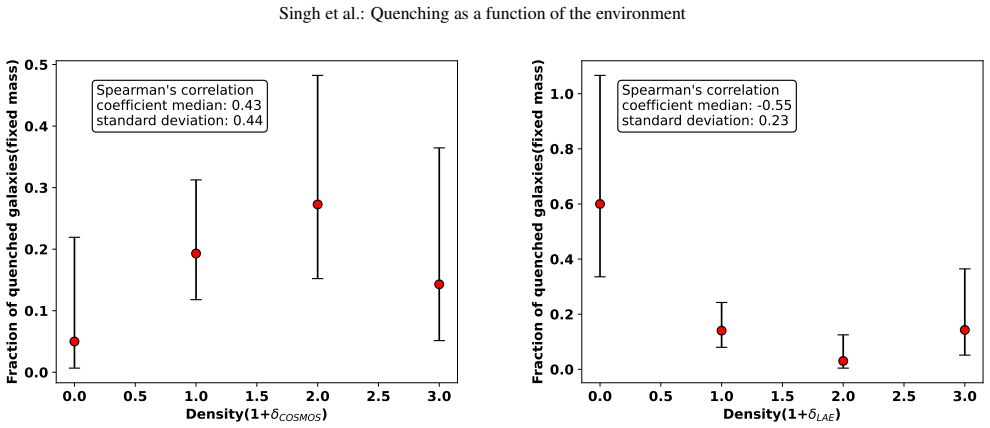
- [§3.3, Fig. 8, Appendix A] The conclusion of no density dependence in the quenched fraction is stronger than the statistics support. The bootstrap Spearman coefficient for the COSMOS2020 map is 0.55 ± 0.4, and the LAE map gives -0.55 ± 0.23, which is not obviously 'no correlation'. The Monte Carlo simulations in Appendix A show that a weakly correlated input with ~25 galaxies yields a median coefficient near 0.6, so the test has limited power to distinguish a weak correlation from no correlation. A quantitative upper limit (for example, a confidence interval on the Spearman coefficient or a model comparison) should be reported before concluding that the environment is irrelevant to the quenched fraction.
- [§3.2, Fig. 5] The Anderson-Darling test p-value of ~0.25 is used to conclude that MQGs and MSFGs have the same distribution with respect to protoclusters. With only 24 MQGs the test has limited power, and a non-significant p-value does not quantify the similarity of the two distributions. The authors should provide a power analysis or a confidence interval on the difference in median distance to protoclusters, parallel to the Monte Carlo exercise already performed for the Spearman test.
minor comments (7)
- [Abstract and §5] The Abstract states quenching timescales of ≤400 Myr while the Results and Conclusions state <500 Myr and Fig. 3 shows a median of ~350 Myr; the numbers should be made consistent.
- [§3.2 and §4] Section 3.2 says 6 of 24 MQGs (25%) are in protocluster candidates, while Section 4 says 20%; the correct fraction should be stated consistently.
- [§3.5] The text says 9 of 24 MQGs are within 5 cMpc of a filament but later refers to 25% of MQGs; 9/24 is 37.5%, so one of these statements is incorrect.
- [Fig. 3 caption] The caption references 'Equation 3.1' for the quenching timescale definition, but the definition appears as Eq. (5); the cross-reference should be corrected.
- [Eq. (2)] The expression '0.2yr/t_age' is garbled and the units are unclear; the threshold should be written with explicit units for t_age and the derivation of 10^-10.01 shown.
- [Table A.1] No quenching timescale or its uncertainty is listed; adding a Tq column with credible intervals would make Fig. 3 reproducible and is directly relevant to the paper's main claim.
- [§4] There is an unresolved citation '(Park et al. 2024; ?)' in the discussion of AGN outflows; the reference should be completed.
Circularity Check
No significant circularity: environmental density analysis is self-contained; Tq uniformity is a model-based posterior inference, and self-citations are non-load-bearing.
full rationale
The paper's central environmental comparison is not circular: the density field is constructed from LAEs (Ramakrishnan et al. 2023; Firestone et al. 2024) and from COSMOS2020 photo-z galaxies (Section 2), while MQGs are selected from COSMOS2020 photometry with BAGPIPES SED fits; no MQG property enters the density map construction, so the null correlations in Figures 6-8 are not forced by definition. The quenching timescale Tq is defined in Equation 5 as tquench - tform and is a derived parameter of the fitted double power-law SFH (Equation 1), not a parameter fitted to the environment; the model permits long Tq (one galaxy with about 0.9 Gyr), so the reported 300-500 Myr uniformity is a posterior inference, not a by-construction constant. The paper itself flags the model dependence in Section 3.1: 'The quenching timescale in our analysis is derived from SED fitting of photometric data using a double power-law star formation history model, which may introduce some uncertainty in its estimation.' This is a robustness limitation, as also shown by four MQGs in Table A.1 with essentially unconstrained sSFR (e.g., log sSFR = -41.3 +/- 19.4), meaning those individual Tq values are not securely pinned down; but unconstrained posteriors are a data-quality issue, not a circular reduction. Self-citations to Ramakrishnan et al. (2023) for the LAE map and protocluster detection thresholds and to Firestone et al. (2024) for LAE selection are data and method references from the same collaboration; they are externally testable (published map and validated contamination rate) and the conclusion does not hinge on those particular thresholds because the local-density correlations, neighbor counts, and filament-distance tests stand independently. No uniqueness theorem from the authors is imported, and no fitted parameter is renamed as a prediction. Hence no specific circular step can be exhibited; the score reflects only the minor, non-load-bearing self-citations.
Assumptions & free parameters
free parameters (6)
- Double-power-law falling slope alpha =
Per-galaxy fitted values (range 0.01-1000; see Table A.1 and corner plots)
- Double-power-law rising slope beta =
Per-galaxy fitted values (range 0.01-1000; see Table A.1 and corner plots)
- Turnover time tau =
Per-galaxy fitted values (range 0.1 Gyr to t_obs)
- Total stellar mass formed =
Per-galaxy fitted values (range log(M/Msun) ~ 1-13)
- Metallicity Z/Zsun =
Per-galaxy fitted values (range 0.2-2.5)
- Dust attenuation parameters (AV, delta, B) =
Per-galaxy fitted values: AV in 0-8 mag, delta in -0.3-0.3, B in 0-5
assumptions (6)
- domain assumption The double power-law SFH model accurately represents the star formation histories of high-redshift quenched galaxies.
- domain assumption LePhare photometric redshifts in COSMOS2020 are accurate enough for the z~3.1 selection.
- domain assumption Voronoi Monte Carlo density maps trace the true galaxy environment at z~3.1.
- domain assumption The SExtractor criteria adopted from Ramakrishnan et al. (2023) identify protoclusters with only 20% contamination.
- domain assumption The sSFR-based quiescence criterion (sSFR + sigma <= 0.2/t_age) separates quiescent from star-forming galaxies at z~3.1.
- domain assumption LAE-selected filaments are gas-rich reservoirs, and projected distances to them are a meaningful environmental probe.
Cite this review
Pith. "Pith review of Quenching of Galaxies at Cosmic Noon: Understanding the Effect of Environment." pith.science (2026). https://pith.science/paper/G4EQZR5W
@misc{pith2026241112722,
  author       = {Pith},
  title        = {Pith review of: Quenching of Galaxies at Cosmic Noon: Understanding the Effect of Environment},
  year         = {2026},
  howpublished = {\url{https://pith.science/paper/G4EQZR5W}},
  note         = {Machine review of arXiv:2411.12722}
}
abstract
The aim of this study is to identify quiescent galaxies in the 2-deg$^2$ COSMOS field at $z \sim 3.1$ and analyze their environment. Using data from the ODIN survey and COSMOS2020 catalog, we identify 24 massive quiescent galaxies (MQGs) with stellar masses $\geq 10^{10.6}$ and derive their star formation histories and quenching timescales using SED fitting with BAGPIPES. Voronoi-based density maps trace local and large-scale environments using Lyman-$\alpha$ Emitters and photometric galaxies. Results indicate uniformly short quenching timescales ($<$500 Myr) independent of environmental density, suggesting rapid internal mechanisms such as AGN feedback dominate over environmental factors. MQGs do not correlate with protoclusters or filaments, although some are near gas-rich filaments but show no rejuvenation. These findings suggest quenching at high redshift is driven primarily by internal processes rather than environmental interactions.
Figures


Figures from the paper (6 more)



Forward citations
Cited by 2 Pith papers
-
Ergodicity of FIRE: star formation variations within and between simulated galaxies
FIRE-2 galaxies show apparent ergodic convergence in star-forming-main-sequence deviations by the Thirumalai–Mountain metric, but block-scrambling reveals this is not true ergodicity.
-
Dust removal timescale in galaxies across cosmic time
The dust removal timescale in galaxies decreases from about 1.8 Gyr at z~0.05 to about 0.4 Gyr at z>3, indicating more efficient dust clearing in the early universe.
Reference graph
Works this paper leans on
-
[1]
2019, , 71, 114
Aihara, H., AlSayyad, Y., Ando, M., et al. 2019, , 71, 114
2019
-
[2]
1999, , 310, 540
Arnouts, S., Cristiani, S., Moscardini, L., et al. 1999, , 310, 540
1999
-
[3]
2016, Journal of Open Source Software, 1, 58
Barbary, K. 2016, Journal of Open Source Software, 1, 58
2016
-
[4]
& Arnouts , S
Bertin , E. & Arnouts , S. 1996, , 117, 393
1996
-
[5]
2022, Astronomy and Astrophysics Reviews, 30, 3
Boselli, A., Fossati, M., & Sun, M. 2022, Astronomy and Astrophysics Reviews, 30, 3
2022
-
[6]
& Gavazzi , G
Boselli , A. & Gavazzi , G. 2006, , 118, 517
2006
-
[7]
2012, , 427, 127
Bressan, A., Marigo, P., Girardi, L., et al. 2012, , 427, 127
2012
-
[8]
& Charlot, S
Bruzual, G. & Charlot, S. 2003, , 344, 1000
2003
Show all 107 references
-
[9]
2023, , 678, A15
Calvi, R., Castignani, G., & Dannerbauer, H. 2023, , 678, A15
2023
-
[10]
C., et al
Calzetti, D., Armus, L., Bohlin, R. C., et al. 2000, , 533, 682
2000
-
[11]
2023, , 520, 3974
Carnall, A., McLeod, D., McLure, R., et al. 2023, , 520, 3974
2023
-
[12]
C., McLure, R
Carnall, A. C., McLure, R. J., Dunlop, J. S., & Davé, R. 2018, , 480, 4379–4401
2018
-
[13]
Casey, C. M. 2016, , 824, 36
2016
-
[14]
& Klypin, A
Ceverino, D. & Klypin, A. 2009, , 695, 292
2009
-
[15]
& Charlot, S
Chevallard, J. & Charlot, S. 2016, , 462, 1415
2016
-
[16]
2013, , 779, 127
Chiang, Y.-K., Overzier, R., & Gebhardt, K. 2013, , 779, 127
2013
-
[17]
2014, , 562, A21
Cicone, C., Maiolino, R., Sturm, E., et al. 2014, , 562, A21
2014
-
[18]
2017, Frontiers in Astronomy and Space Sciences, 4, 10
Combes, F. 2017, Frontiers in Astronomy and Space Sciences, 4, 10
2017
-
[19]
Cowie, L. L. & Songaila, A. 1977, , 266, 501
1977
-
[20]
J., Springel, V., White, S
Croton, D. J., Springel, V., White, S. D., et al. 2006, , 365, 11
2006
-
[21]
2018, , 619, A49
Cucciati, O., Lemaux, B., Zamorani, G., et al. 2018, , 619, A49
2018
-
[22]
Dav \'e , R., Thompson, R., & Hopkins, P. F. 2016, , 462, 3265
2016
-
[23]
2012, , 420, 2221
DeBuhr, J., Quataert, E., & Ma, C.-P. 2012, , 420, 2221
2012
-
[24]
2023, arXiv e-prints, arXiv:2308.06317
D'Eugenio , F., Perez-Gonzalez , P., Maiolino , R., et al. 2023, arXiv e-prints, arXiv:2308.06317
2023 arXiv
-
[25]
1980, , 236, 351
Dressler , A. 1980, , 236, 351
1980
-
[26]
S., Bowler, R
Dunlop, J. S., Bowler, R. A., Franx, M., et al. 2023, A Decade of ESO Wide-field Imaging Surveys (surveys2023, 10
2023
-
[27]
2020, , 892, L2
D’Eugenio, C., Daddi, E., Gobat, R., et al. 2020, , 892, L2
2020
-
[28]
Fabian, A. C. 2012, , 50, 455
2012
-
[29]
2011, , 532, A95
Falc \'o n-Barroso, J., S \'a nchez-Bl \'a zquez, P., Vazdekis, A., et al. 2011, , 532, A95
2011
-
[30]
M., Gawiser, E., Ramakrishnan, V., et al
Firestone, N. M., Gawiser, E., Ramakrishnan, V., et al. 2024, , 974, 217
2024
-
[31]
2020, , 890, L1
Forrest, B., Annunziatella, M., Wilson, G., et al. 2020, , 890, L1
2020
-
[32]
C., Shah, E., et al
Forrest, B., Lemaux, B. C., Shah, E., et al. 2023, , 526, L56
2023
-
[33]
2007, , 671, 278
Gawiser, E., Francke, H., Lai, K., et al. 2007, , 671, 278
2007
-
[34]
1986, , 303, 336
Gehrels , N. 1986, , 303, 336
1986
-
[35]
2019, , 632, A80
Girelli , G., Bolzonella , M., & Cimatti , A. 2019, , 632, A80
2019
-
[36]
2022, Proceedings of the International Astronomical Union, 18, 3
Glazebrook, K., Nanayakkara, T., Marchesini, D., Kacprzak, G., & Jacobs, C. 2022, Proceedings of the International Astronomical Union, 18, 3
2022
-
[37]
2024, in Early Disk-Galaxy Formation from JWST to the Milky Way, ed
Glazebrook , K., Nanayakkara , T., Marchesini , D., Kacprzak , G., & Jacobs , C. 2024, in Early Disk-Galaxy Formation from JWST to the Milky Way, ed. F. Tabatabaei , B. Barbuy , & Y.-S. Ting , Vol. 377, 3--8
2024
-
[38]
2017, , 544, 71
Glazebrook, K., Schreiber, C., Labb \'e , I., et al. 2017, , 544, 71
2017
-
[39]
Gunn, J. E. & Gott III, J. R. 1972, , 176, 1
1972
-
[40]
A., Bonoli , S., Baugh , C
Gurung-L \'o pez , S., Orsi , \'A . A., Bonoli , S., Baugh , C. M., & Lacey , C. G. 2019, , 486, 1882
2019
-
[41]
A., Bonoli , S., et al
Gurung-L \'o pez , S., Orsi , \'A . A., Bonoli , S., et al. 2020, , 491, 3266
2020
-
[42]
I., Nelson, E
Hartley, A. I., Nelson, E. J., Suess, K. A., et al. 2023, , 522, 3138
2023
-
[43]
2017, , 472, 2468
Hirschmann, M., Charlot, S., Feltre, A., et al. 2017, , 472, 2468
2017
-
[44]
Hu, E. M. & McMahon, R. G. 1996, , 382, 231
1996
-
[45]
2020, , 491, 5524
Hung, D., Lemaux, B., Gal, R., et al. 2020, , 491, 5524
2020
-
[46]
2022, , 929, 53
Ito , K., Tanaka , M., Miyaji , T., et al. 2022, , 929, 53
2022
-
[47]
2023, , 945, L9
Ito, K., Tanaka, M., Valentino, F., et al. 2023, , 945, L9
2023
-
[48]
2023, , 945, L9
Ito , K., Tanaka , M., Valentino , F., et al. 2023, , 945, L9
2023
-
[49]
2018, , 864, 56
Jin, S., Daddi, E., Liu, D., et al. 2018, , 864, 56
2018
-
[50]
B., Magdis, G
Jin, S., Sillassen, N. B., Magdis, G. E., et al. 2024, , 683, L4
2024
-
[51]
Kalita , B. et al. 2021, ApJ, 917, L17
2021
-
[52]
C., Remus, R.-S., Seidel, B., et al
Kimmig, L. C., Remus, R.-S., Seidel, B., et al. 2025, , 979, 15
2025
-
[53]
S., Rhoads, J
Kova c , K., Somerville, R. S., Rhoads, J. E., Malhotra, S., & Wang, J. 2007, , 668, 15
2007
-
[54]
2022, , 935, 89
Kubo , M., Umehata , H., Matsuda , Y., et al. 2022, , 935, 89
2022
-
[55]
2024, , 534, 3974
Kurinchi-Vendhan, S., Farcy, M., Hirschmann, M., & Valentino, F. 2024, , 534, 3974
2024
-
[56]
Larson, R. B. 1990, , 102, 709
1990
-
[57]
2013, , 559, A14
Le F \`e vre, O., Cassata, P., Cucciati, O., et al. 2013, , 559, A14
2013
-
[58]
2024, , 962, 36
Lee , K.-S., Gawiser , E., Park , C., et al. 2024, , 962, 36
2024
-
[59]
C., Johnson, B
Leja, J., Carnall, A. C., Johnson, B. D., Conroy, C., & Speagle, J. S. 2019, , 876, 3
2019
-
[60]
2014, , 572, A41
Lemaux, B., Cucciati, O., Tasca, L., et al. 2014, , 572, A41
2014
-
[61]
C., Le F \`e vre, O., Cucciati, O., et al
Lemaux, B. C., Le F \`e vre, O., Cucciati, O., et al. 2018, , 615, A77
2018
-
[62]
2019, , 244, 40
Liu, D., Lang, P., Magnelli, B., et al. 2019, , 244, 40
2019
-
[63]
& Belli, S
Man, A. & Belli, S. 2018, Nature Astronomy, 2, 695
2018
-
[64]
M., et al
Mao, Z., Kodama, T., P \'e rez-Mart \' nez, J. M., et al. 2022, , 666, A141
2022
-
[65]
2017, , 835, 77
Marigo, P., Girardi, L., Bressan, A., et al. 2017, , 835, 77
2017
-
[66]
C., et al
Martizzi, D., Vogelsberger, M., Artale, M. C., et al. 2019, , 486, 3766
2019
-
[67]
2012, , 544, A156
McCracken, H., Milvang-Jensen, B., Dunlop, J., et al. 2012, , 544, A156
2012
-
[68]
2019, , 490, 3309
Merlin, E., Fortuni, F., Torelli, M., et al. 2019, , 490, 3309
2019
-
[69]
1996, , 379, 613
Moore, B., Katz, N., Lake, G., Dressler, A., & Oemler, A. 1996, , 379, 613
1996
-
[70]
2024, Scientific Reports, 14, 3724
Nanayakkara, T., Glazebrook, K., Jacobs, C., et al. 2024, Scientific Reports, 14, 3724
2024
-
[71]
2025, , 981, 78
Nanayakkara, T., Glazebrook, K., Schreiber, C., et al. 2025, , 981, 78
2025
-
[72]
2020, , 58, 617
Ouchi, M., Ono, Y., & Shibuya, T. 2020, , 58, 617
2020
-
[73]
2003, , 582, 60
Ouchi, M., Shimasaku, K., Furusawa, H., et al. 2003, , 582, 60
2003
-
[74]
Overzier, R. A. 2016, Astronomy and Astrophysics Reviews, 24, 14
2016
-
[75]
Pacifici, C., Oh, S., Oh, K., Lee, J., & Sukyoung, K. Y. 2016, , 824, 45
2016
-
[76]
& Hwang , H
Park , C. & Hwang , H. S. 2009, , 699, 1595
2009
-
[77]
2024, , 976, 72
Park, M., Belli, S., Conroy, C., et al. 2024, , 976, 72
2024
-
[78]
Peng, Y. et al. 2010, , 721, 193
2010
-
[79]
H., et al
Ramakrishnan, V., Moon, B., Im, S. H., et al. 2023, , 951, 119
2023
-
[80]
2019, , 490, 2139
Rodr \' guez Montero, F., Dav \'e , R., Wild, V., Angl \'e s-Alc \'a zar, D., & Narayanan, D. 2019, , 490, 2139
2019
-
[81]
& Narayanan, D
Salim, S. & Narayanan, D. 2020, , 58, 529
2020
-
[82]
2006, , 371, 703
Sanchez-Blazquez, P., Peletier, R., Jimenez-Vicente, J., et al. 2006, , 371, 703
2006
-
[83]
2019, , 489, 5202
Sawicki , M., Arnouts , S., Huang , J., et al. 2019, , 489, 5202
2019
-
[84]
2018, , 618, A85
Schreiber, C., Glazebrook, K., Nanayakkara, T., et al. 2018, , 618, A85
2018
-
[85]
2007, , 172, 1
Scoville, N., Aussel, H., Brusa, M., et al. 2007, , 172, 1
2007
-
[86]
A., Lemaux, B., Forrest, B., et al
Shah, E. A., Lemaux, B., Forrest, B., et al. 2024, , stae519
2024
-
[87]
2019, , 879, 9
Shi, K., Huang, Y., Lee, K.-S., et al. 2019, , 879, 9
2019
-
[88]
2020, , 899, 79
Shi, K., Toshikawa, J., Cai, Z., Lee, K.-S., & Fang, T. 2020, , 899, 79
2020
-
[89]
2017, : Letters, 468, L21
Shimakawa, R., Kodama, T., Hayashi, M., et al. 2017, : Letters, 468, L21
2017
-
[90]
2011, , 414, 350
Sousbie, T. 2011, , 414, 350
2011
-
[91]
R., Straatman, C
Spitler, L. R., Straatman, C. M., Labb \'e , I., et al. 2014, , 787, L36
2014
-
[92]
2016, , 591, A51
Steinhauser, D., Schindler, S., & Springel, V. 2016, , 591, A51
2016
-
[93]
M., Labb \'e , I., Spitler, L
Straatman, C. M., Labb \'e , I., Spitler, L. R., et al. 2014, , 783, L14
2014
-
[94]
Tacchella , S. et al. 2022, ApJ, 927, 170
2022
-
[95]
2024, , 970, 59
Tanaka, M., Onodera, M., Shimakawa, R., et al. 2024, , 970, 59
2024
-
[96]
2020, , 889, 93
Valentino, F., Tanaka, M., Davidzon, I., et al. 2020, , 889, 93
2020
-
[97]
Walters, D., Woo, J., & Ellison, S. L. 2022, , 511, 6126
2022
-
[98]
2023, , 677, A184
Weaver, J., Davidzon, I., Toft, S., et al. 2023, , 677, A184
2023
-
[99]
R., Kauffmann , O., Shuntov , M., et al
Weaver , J. R., Kauffmann , O., Shuntov , M., et al. 2021, in American Astronomical Society Meeting Abstracts, Vol. 53, American Astronomical Society Meeting Abstracts, 215.06
2021
-
[100]
R., Tinker, J
Wetzel, A. R., Tinker, J. L., Conroy, C., & Van Den Bosch, F. C. 2013, , 432, 336
2013
-
[101]
E., Kriek, M., van Dokkum, P
Whitaker, K. E., Kriek, M., van Dokkum, P. G., et al. 2012, , 745, 179
2012
-
[102]
2016, , 463, 832
Wild, V., Almaini, O., Dunlop, J., et al. 2016, , 463, 832
2016
-
[103]
J., Quadri , R
Williams , R. J., Quadri , R. F., Franx , M., van Dokkum , P., & Labb \'e , I. 2009, , 691, 1879
2009
-
[104]
J., Lagos, C
Wright, R. J., Lagos, C. d. P., Davies, L. J., et al. 2019, , 487, 3740
2019
-
[105]
2020, , 499, 768
Zinger, E., Pillepich, A., Nelson, D., et al. 2020, , 499, 768
2020
-
[106]
, " * write output.state after.block = add.period write newline
ENTRY address archiveprefix author booktitle chapter edition editor howpublished institution eprint journal key month note number organization pages publisher school series title type volume year label extra.label sort.label short.list INTEGERS output.state before.all mid.sent...
-
[107]
write newline
" write newline "" before.all 'output.state := FUNCTION n.dashify 't := "" t empty not t #1 #1 substring "-" = t #1 #2 substring "--" = not "--" * t #2 global.max substring 't := t #1 #1 substring "-" = "-" * t #2 global.max substring 't := while if t #1 #1 substring * t #2 gl...
Reviewed August 12, 2026 · model on record in the stance chip above.
Discussion (0). Continue with ORCID to comment.