REVIEW 2 major objections 5 minor 3 cited by
Neutrino magnetic moments: effective versus fundamental parameters
T0 review · 2 major / 5 minor · reviewed 2026-08-16 · deepseek-v4-flash
Pith's one-line read The effective neutrino magnetic moment is not a universal quantity; each experiment type probes a different combination of fundamental transition moments.
desk verdict Correct and useful clarification of experiment-dependent effective magnetic moments, with updated DMDD benchmarks; the translation procedure needs more documentation before the numbers can be fully trusted. read the letter →
The pith
A machine-rendered reading of the paper's core claim, the machinery that carries it, and where it could break.
The reading
What carries the argument
The central object is the pair consisting of the fundamental Majorana transition-magnetic-moment matrix $\lambda$ and the experiment-dependent effective moment $(\mu_\nu^{\mathrm{eff}})^2 = a_-^\dagger\lambda^\dagger\lambda a_- + a_+^\dagger\lambda\lambda^\dagger a_+$, with $a_\pm$ determined by the neutrino source. For solar neutrinos the incoherent mass-eigenstate average reduces this to $(\mu_{\mathrm{sol}})^2 = |\Lambda|^2 - \sum_j P^{3\nu}_{ej}|\Lambda_j|^2$, which drops the CP-violating phases. This separation lets the same fundamental parameters be evaluated under different beam compositions, which is what converts DMDD bounds into reactor and accelerator benchmarks.
What would settle it
Re-run the combined XENONnT, LZ, and PandaX-4T analysis with the full published likelihoods and systematic treatment; if the 90% C.L. limits on the individual $\Lambda_i$ shift by more than a few tens of percent, the translated reactor and accelerator benchmarks shift accordingly. An independent check is a reactor experiment reaching a limit below $1.0\times10^{-11}\,\mu_B$: if its effective moment cannot be reconciled with the DMDD-derived parameter space, the mapping or the DMDD fit is wrong.
Extended reading notes
Core claim
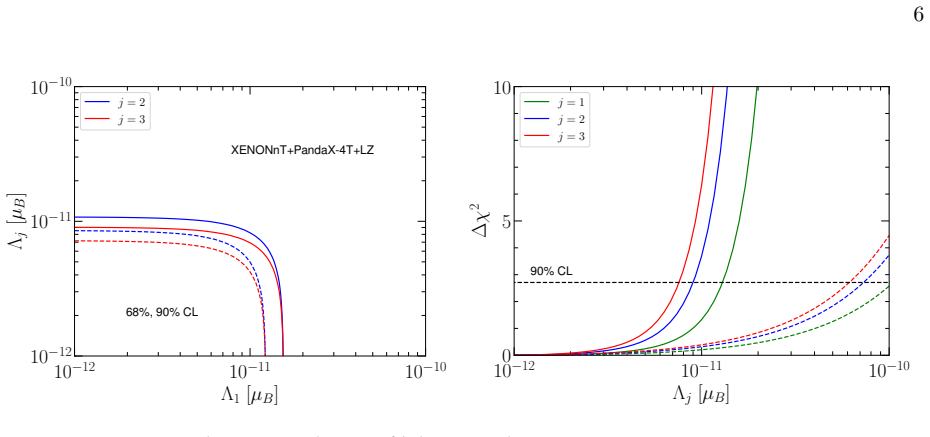
For Majorana neutrinos the magnetic interaction is governed by an antisymmetric transition-moment matrix $\lambda$ with entries $\Lambda_e,\Lambda_\mu,\Lambda_\tau$ in the flavor basis and $\Lambda_1,\Lambda_2,\Lambda_3$ in the mass basis. The effective moment for a particular experiment is $(\mu^F_\nu)^2 = a_-^\dagger \lambda^\dagger\lambda a_- + a_+^\dagger \lambda\lambda^\dagger a_+$, where $a_\pm$ encode the helicity amplitudes of the incoming neutrinos. Reactor antineutrinos probe $|\Lambda_\mu|^2+|\Lambda_\tau|^2$; the LSND beam probes a different combination with interference terms; solar neutrinos arrive as an incoherent mass-eigenstate mixture and probe yet another combination. The paper fits the fundamental $\Lambda_i$ directly to XENONnT, LZ, and PandaX-4T electronic-recoil data, obtains $\Lambda_i \lesssim 0.8\text{--}1.3\times10^{-11}\,\mu_B$ at 90% C.L., and maps these into the reactor and accelerator effective moments. The central conclusion is that the translated values, not the solar limit, should be used as benchmarks when comparing reactor and accelerator constraints.
Load-bearing premise
The translated bounds in Eqs. (20)-(21) inherit the DMDD direct fit described in Ref. [25]; the paper does not reproduce that fit's likelihood, binning, background model, or systematic uncertainties, so if that fit is incorrect the benchmark numbers change.
Editorial extensions
If this is right
- Limits from reactor and accelerator experiments should be gauged against the translated values $1.0\times10^{-11}\,\mu_B$ and $2.1\times10^{-11}\,\mu_B$, not against the solar limit $7.5\times10^{-12}\,\mu_B$.
- The cancellation conditions for GEMMA-like reactor data ($\phi_1\approx0$, $\phi_3\approx\pi$) and LSND-like muon-beam data ($\phi_1=\pi$, $\phi_3=0$) are mutually exclusive, so a combined fit cannot hide large transition moments in both experiments at once.
- Current reactor experiments are within about a factor of three of the translated benchmark, while accelerator experiments need roughly an order-of-magnitude improvement to compete.
- Dark-matter direct-detection experiments now constrain the fundamental $\Lambda_i$ more strongly than dedicated solar detectors such as Borexino.
- Even if new reactor or accelerator searches reach these sensitivities, combined global analyses remain necessary to lift the degeneracies among the $\Lambda_i$.
Reading between the lines
- The same non-universality should apply to Dirac neutrinos, where diagonal moments are allowed, so a Dirac-neutrino version of the DMDD translation would yield different benchmark numbers.
- A cleaner strategy for global analyses would be to write the likelihood directly in terms of the fundamental $\Lambda_i$ with experiment-specific mappings, which would remove the cross-experiment comparison problem at the source.
- The DMDD-derived parameter space makes reactor and accelerator channels discriminating: a claimed reactor signal above $1.0\times10^{-11}\,\mu_B$ would contradict the combined DMDD constraints unless the direct fit's systematics are underestimated or the transition-moment framework is incomplete.
- Because the solar-neutrino background is irreducible in DMDD detectors, the reach of this translation will be set by exposure and background systematics, making updated combined DMDD fits a direct path to sharper reactor and accelerator benchmarks.
Signed reviews
Editorial analysis
A structured set of objections, weighed in public.
Referee Report
Summary. This paper argues that the effective neutrino magnetic moment is not a universal, experiment-independent quantity, and that comparing limits on it across reactor, accelerator, and solar-neutrino experiments can be misleading. The authors present the general relation between the underlying Majorana transition magnetic moment matrix and the effective moments measured in different setups, review existing bounds from GEMMA, LSND, Borexino, and dark matter direct detection (DMDD) experiments, and use a direct fit to XENONnT, LZ, and PandaX-4T data to obtain updated constraints on the fundamental parameters Λ_i. They then translate these constraints into benchmark effective moments for reactor and accelerator experiments, obtaining µ_ν,reactor < 1.0×10^-11 µ_B and µ_ν,acceler < 2.1×10^-11 µ_B at 90% CL (Eqs. (20)-(21)), and argue that these translated values, rather than the solar limit, should be used when comparing reactor and accelerator sensitivities.
Significance. The conceptual message of the paper is important and well made: effective neutrino magnetic moments are experiment-dependent, as seen in Eqs. (4), (6), (11), (12), and (15), and a direct comparison of reactor, accelerator, and solar limits can be misleading. The paper also usefully updates the fundamental-parameter constraints using the latest DMDD data, and the idea of providing a benchmark for future reactor and accelerator searches is timely. The analytical derivations are standard and clearly presented. However, the central quantitative result, the translated benchmark in Eqs. (20)-(21), is not reproducible from the manuscript because the underlying DMDD fit is described only by reference to Ref. [25] and the statistical mapping from the fundamental-parameter constraints to the effective moments is not described in sufficient detail. The phase-dependent interference in Eq. (12) makes the validity of the translation sensitive to the statistical procedure. If the translation is performed correctly, the paper would make a solid contribution; with the current level of detail, the numerical benchmark should be treated as provisional.
major comments (2)
- [Section III.B] The DMDD fit that produces the fundamental-parameter bounds in Eqs. (17)-(19) is not reproducible from the manuscript. The text says only that the authors 'perform a direct fit to the fundamental parameters' following the approach in Ref. [25], but it does not provide the likelihood, binning, background model, treatment of systematic uncertainties, or the solar neutrino flux and oscillation parameter treatment. Since these bounds are the basis for the central benchmark in Eqs. (20)-(21), the authors should either include a self-contained description of the fit or provide a publicly available likelihood/code that allows the results to be reproduced.
- [Section IV, Eqs. (20)-(21)] The translation from the one-dimensional 90% CL limits on |Λ_1|, |Λ_2|, |Λ_3| in Eqs. (17)-(19) to the reactor and accelerator effective moments is not described. This matters because Eq. (12) for the accelerator effective moment contains the phase-dependent interference term -2|Λ_e||Λ_µ| cos(φ_e-φ_µ), and an upper limit on such a combination cannot be recovered reliably by substituting the individual margins into the mass-to-flavor rotation; the correct procedure requires profiling the joint DMDD likelihood over the phases φ_1, φ_3 and the oscillation parameters. The authors should state explicitly whether Eqs. (20)-(21) came from such a full joint profile or from a simpler substitution, and if the latter, the numerical benchmark should be recalculated.
minor comments (5)
- [Eq. (16)] The quantity P^{2ν}_{e1} is introduced as the effective two-neutrino oscillation probability for solar neutrinos, but no explicit expression or reference for this quantity is given. Please define it or provide a citation.
- [Fig. 1 caption] The caption states that the LSND region is represented for two different assumptions for the effective magnetic moment, but the red and blue lines in the right panel are not labeled in the figure text. Please add the correspondence between line style and the assumptions (pure ν_µ beam vs. realistic mixed beam) directly in the caption.
- [Table I] The note for the COHERENT row reads 'The real bound would be slightly stronger,' which is vague. Please state explicitly what quantity is actually bounded and why a recast for µ_ν,acceler is not possible.
- [Section III.A, footnote 2] The discussion of the LSND bound and the value µ_ν_µ < 6.8×10^-10 is placed in a footnote; given that it is central to explaining why the LSND effective moment should not be identified with a pure ν_µ moment, consider moving it into the main text.
- [General] Several equations use the symbol |Λ|^2 to denote the sum of the three squared matrix elements; this is defined in the text after Eq. (12), but it would be helpful to introduce this notation before first use to avoid confusion with the single parameter Λ_i.
Circularity Check
No significant circularity: the experiment-dependence claim follows from the framework algebra, and the numerical translation is anchored to external DMDD data.
full rationale
The paper's central claim is that the effective neutrino magnetic moment is not an experiment-independent quantity and that different experiments should be compared through the underlying fundamental parameters, not through the effective moments directly. This claim is supported by the algebraic relations in Eqs. (4), (6), (11), (12), (15), and (16), which follow from the definition of the effective moment in terms of the transition magnetic moment matrix and the neutrino state vectors. These relations are not fitted to data and do not presuppose the conclusion. The numerical results in Eqs. (17)-(21) are obtained from a direct fit to XENONnT, LZ, and PandaX-4T data, which are external experimental inputs, and the reactor and accelerator effective moments are then derived by mapping the fitted fundamental parameters through Eqs. (11)-(12). This is a translation, not a prediction fitted to the same data. Some self-citations appear, notably Ref. [25] for the DMDD fitting approach and Ref. [44] for oscillation parameters, but these are methodological or standard physics inputs and are not load-bearing for the conceptual point. The lack of a fully documented likelihood, binning, and background model for the DMDD fit is a reproducibility limitation rather than a circularity, because the claimed reduction would be absent even if those details were supplied. The paper is essentially self-contained against external benchmarks, with the core argument depending on definitions and data, not on the authors' prior conclusions.
Assumptions & free parameters
free parameters (3)
- Lambda_1, Lambda_2, Lambda_3 =
Lambda_1 < 1.3e-11, Lambda_2 < 0.9e-11, Lambda_3 < 0.8e-11 mu_B at 90% C.L.
- phi_1, phi_3
- Standard neutrino oscillation parameters
assumptions (4)
- domain assumption Majorana nature of neutrinos with antisymmetric TMM matrix, implying vanishing diagonal moments.
- domain assumption Standard Model cross sections for E nu ES and CE nu NS, plus the magnetic moment cross section Eq. (1) adding incoherently.
- domain assumption Solar neutrinos arrive at Earth as an incoherent mixture of mass eigenstates, leading to the absence of interference terms in Eq. (14).
- domain assumption Neutrino mixing parameters and their uncertainties as reported in Ref. [44] are correct and complete.
Cite this review
Pith. "Pith review of Neutrino magnetic moments: effective versus fundamental parameters." pith.science (2026). https://pith.science/paper/G4ZQNQGT
@misc{pith2026250502633,
  author       = {Pith},
  title        = {Pith review of: Neutrino magnetic moments: effective versus fundamental parameters},
  year         = {2026},
  howpublished = {\url{https://pith.science/paper/G4ZQNQGT}},
  note         = {Machine review of arXiv:2505.02633}
}
read the original abstract
The search for neutrino magnetic moments offers a valuable window into physics beyond the Standard Model. However, a common misconception arises in the interpretation of experimental results: the assumption that the so-called effective neutrino magnetic moment is a universal, experiment-independent quantity. In reality, this effective parameter depends on the specific characteristics of each experiment, including the neutrino source, flavor composition or energy spectrum. As a result, the effective magnetic moment derived from solar neutrino data differs fundamentally from that obtained in reactor or accelerator-based experiments. Treating these quantities as directly comparable can lead to misleading conclusions. In this work, we clarify the proper definition of the effective neutrino magnetic moment in various experimental contexts and discuss the implications of this misconception for global analyses and theoretical interpretations.
Figures


Forward citations
Cited by 3 Pith papers
-
Isochrone fitting of Galactic globular clusters - IX. Tip of the red-giant branch for 27 clusters and constraints on new particle physics
No anomalous energy loss is seen in the red-giant tips of 27 globular clusters, yielding g_ae < 3.8e-14 at 95% confidence, the strongest bound for axion-electron coupling below about 1 keV.
-
Prospect of the NUCLEUS Experiment at Chooz for Coherent Elastic Neutrino-Nucleus Scattering and New Physics Searches
Assuming the low-energy background can be eliminated, a 7-gram NUCLEUS detector at Chooz is projected to see coherent neutrino-nucleus scattering at 4.7σ in one year and to set competitive bounds on new neutrino interactions.
-
When backgrounds become signals: neutrino interactions in xenon-based dark matter detectors
Solar neutrino data from three xenon dark matter experiments provide updated standard-model tests and competitive limits on neutrino electromagnetic properties.
Reference graph
Works this paper leans on
-
[25]
Testing neutrino electromagnetic properties at current and future dark matter experiments,
C. Giunti and C. A. Ternes, “Testing neutrino electromagnetic properties at current and future dark matter experiments,” Phys. Rev. D 108 no. 9, (2023) 095044, arXiv:2309.17380 [hep-ph]
arXiv 2023
-
[1]
Majorana Neutrinos and Magnetic Fields,
J. Schechter and J. W. F. Valle, “Majorana Neutrinos and Magnetic Fields,” Phys. Rev. D 24 (1981) 1883–1889. [Erratum: Phys.Rev.D 25, 283 (1982)]
work page 1981
-
[2]
Electromagnetic Properties of Majorana Neutrinos,
J. F. Nieves, “Electromagnetic Properties of Majorana Neutrinos,” Phys. Rev. D 26 (1982) 3152
work page 1982
-
[3]
R. E. Shrock, “Electromagnetic properties and decays of Dirac and Majorana neutrinos in a general class of gauge theories,” Nucl. Phys. B206 (1982) 359
work page 1982
-
[4]
Majorana Neutrinos and their Electromagnetic Properties,
B. Kayser, “Majorana Neutrinos and their Electromagnetic Properties,” Phys. Rev. D 26 (1982) 1662
1982
-
[5]
L. A. Ahrens et al., “Determination of electroweak parameters from the elastic scattering of muon-neutrinos and anti-neutrinos on electrons,” Phys. Rev. D 41 (1990) 3297–3316
work page 1990
-
[6]
Study of electron-neutrino electron elastic scattering at LAMPF,
R. C. Allen et al., “Study of electron-neutrino electron elastic scattering at LAMPF,” Phys. Rev. D 47 (1993) 11–28
work page 1993
-
[7]
Measurement of electron - neutrino - electron elastic scattering,
LSND Collaboration, L. B. Auerbach et al., “Measurement of electron - neutrino - electron elastic scattering,” Phys. Rev. D 63 (2001) 112001, arXiv:hep-ex/0101039
arXiv 2001
Show all 52 references
-
[8]
A New upper limit for the tau - neutrino magnetic moment,
DONUT Collaboration, R. Schwienhorst et al., “A New upper limit for the tau - neutrino magnetic moment,” Phys. Lett. B 513 (2001) 23–29, arXiv:hep-ex/0102026
2001 arXiv
-
[9]
Final results on the neutrino magnetic moment from the MUNU experiment,
MUNU Collaboration, Z. Daraktchieva et al., “Final results on the neutrino magnetic moment from the MUNU experiment,” Phys. Lett. B 615 (2005) 153–159, arXiv:hep-ex/0502037
2005 arXiv
-
[10]
A Search of Neutrino Magnetic Moments with a High-Purity Germanium Detector at the Kuo-Sheng Nuclear Power Station,
TEXONO Collaboration, H. T. Wong et al., “A Search of Neutrino Magnetic Moments with a High-Purity Germanium Detector at the Kuo-Sheng Nuclear Power Station,” Phys. Rev. D 75 (2007) 012001, arXiv:hep-ex/0605006
2007 arXiv
-
[11]
The results of search for the neutrino magnetic moment in GEMMA experiment,
A. G. Beda, V. B. Brudanin, V. G. Egorov, D. V. Medvedev, V. S. Pogosov, M. V. Shirchenko, and A. S. Starostin, “The results of search for the neutrino magnetic moment in GEMMA experiment,” Adv. High Energy Phys. 2012 (2012) 350150
2012
-
[12]
Limiting neutrino magnetic moments with Borexino Phase-II solar neutrino data,
Borexino Collaboration, M. Agostini et al., “Limiting neutrino magnetic moments with Borexino Phase-II solar neutrino data,” Phys. Rev. D 96 no. 9, (2017) 091103, arXiv:1707.09355 [hep-ex]
2017 arXiv
-
[13]
A Search for Solar Axions and Anomalous Neutrino Magnetic Moment with the Complete PandaX-II Data,
PandaX-II Collaboration, X. Zhou et al., “A Search for Solar Axions and Anomalous Neutrino Magnetic Moment with the Complete PandaX-II Data,” Chin. Phys. Lett. 38 no. 1, (2021) 011301, arXiv:2008.06485 [hep-ex] . [Erratum: Chin.Phys.Lett. 38, 109902 (2021)]
2021 arXiv
-
[14]
Search for New Physics in Electronic Recoil Data from XENONnT,
XENON Collaboration, E. Aprile et al., “Search for New Physics in Electronic Recoil Data from XENONnT,” Phys. Rev. Lett. 129 no. 16, (2022) 161805, arXiv:2207.11330 [hep-ex]
2022 arXiv
-
[15]
New constraint on neutrino magnetic moment and neutrino millicharge from LUX-ZEPLIN dark matter search results,
M. Atzori Corona, W. M. Bonivento, M. Cadeddu, N. Cargioli, and F. Dordei, “New constraint on neutrino magnetic moment and neutrino millicharge from LUX-ZEPLIN dark matter search results,” Phys. Rev. D 107 no. 5, (2023) 053001, arXiv:2207.05036 [hep-ph]
2023 arXiv
-
[16]
Implications of first LZ and XENONnT results: A comparative study of neutrino properties and light mediators,
S. K. A., A. Majumdar, D. K. Papoulias, H. Prajapati, and R. Srivastava, “Implications of first LZ and XENONnT results: A comparative study of neutrino properties and light mediators,” Phys. Lett. B 839 (2023) 137742, arXiv:2208.06415 [hep-ph] . 10
2023 arXiv
-
[17]
Light new physics and neutrino electromagnetic interactions in XENONnT,
A. N. Khan, “Light new physics and neutrino electromagnetic interactions in XENONnT,” Phys. Lett. B 837 (2023) 137650, arXiv:2208.02144 [hep-ph]
2023 arXiv
-
[18]
Impact of the Dresden-II and COHERENT neutrino scattering data on neutrino electromagnetic properties and electroweak physics,
M. Atzori Corona, M. Cadeddu, N. Cargioli, F. Dordei, C. Giunti, Y. F. Li, C. A. Ternes, and Y. Y. Zhang, “Impact of the Dresden-II and COHERENT neutrino scattering data on neutrino electromagnetic properties and electroweak physics,” JHEP 09 (2022) 164, arXiv:2205.09484 [hep-ph]
2022 arXiv
-
[19]
Bounds on new physics with data of the Dresden-II reactor experiment and COHERENT,
P. Coloma, I. Esteban, M. C. Gonzalez-Garcia, L. Larizgoitia, F. Monrabal, and S. Palomares-Ruiz, “Bounds on new physics with data of the Dresden-II reactor experiment and COHERENT,” JHEP 05 (2022) 037, arXiv:2202.10829 [hep-ph]
2022 arXiv
-
[20]
Implications of the first evidence for coherent elastic scattering of reactor neutrinos,
J. Liao, H. Liu, and D. Marfatia, “Implications of the first evidence for coherent elastic scattering of reactor neutrinos,” Phys. Rev. D 106 no. 3, (2022) L031702, arXiv:2202.10622 [hep-ph]
2022 arXiv
-
[21]
Solarνe flux: revisiting bounds on neutrino magnetic moments and solar magnetic field,
E. Akhmedov and P. Mart´ ınez-Mirav´ e, “Solarνe flux: revisiting bounds on neutrino magnetic moments and solar magnetic field,” JHEP 10 (2022) 144, arXiv:2207.04516 [hep-ph]
2022 arXiv
-
[22]
Neutrino millicharge and other electromagnetic interactions with COHERENT-2021 data,
A. N. Khan, “Neutrino millicharge and other electromagnetic interactions with COHERENT-2021 data,” Nucl. Phys. B 986 (2023) 116064, arXiv:2201.10578 [hep-ph]
2023 arXiv
-
[23]
Physics implications of a combined analysis of COHERENT CsI and LAr data,
V. De Romeri, O. G. Miranda, D. K. Papoulias, G. Sanchez Garcia, M. T´ ortola, and J. W. F. Valle, “Physics implications of a combined analysis of COHERENT CsI and LAr data,” JHEP 04 (2023) 035, arXiv:2211.11905 [hep-ph]
2023 arXiv
-
[24]
Constraining new physics with Borexino Phase-II spectral data,
P. Coloma, M. C. Gonzalez-Garcia, M. Maltoni, J. a. P. Pinheiro, and S. Urrea, “Constraining new physics with Borexino Phase-II spectral data,” JHEP 07 (2022) 138, arXiv:2204.03011 [hep-ph] . [Erratum: JHEP 11, 138 (2022)]
2022 arXiv
-
[26]
Muon collider probes of Majorana neutrino dipole moments and masses,
M. Frigerio and N. Vignaroli, “Muon collider probes of Majorana neutrino dipole moments and masses,” JHEP 04 (2025) 008, arXiv:2409.02721 [hep-ph]
2025 arXiv
-
[27]
Neutrino electromagnetic properties and sterile dipole portal in light of the first solar CE νNS data,
V. De Romeri, D. K. Papoulias, G. Sanchez Garcia, C. A. Ternes, and M. T´ ortola, “Neutrino electromagnetic properties and sterile dipole portal in light of the first solar CE νNS data,” JCAP 05 (2025) 080, arXiv:2412.14991 [hep-ph]
2025 arXiv
-
[28]
Implications of the first CONUS+ measurement of coherent elastic neutrino-nucleus scattering,
V. De Romeri, D. K. Papoulias, and G. Sanchez Garcia, “Implications of the first CONUS+ measurement of coherent elastic neutrino-nucleus scattering,” Phys. Rev. D 111 no. 7, (2025) 075025, arXiv:2501.17843 [hep-ph]
2025 arXiv
-
[29]
Reactor antineutrinos CE νNS on germanium: CONUS+ and TEXONO as a new gateway to SM and BSM physics,
M. Atzori Corona, M. Cadeddu, N. Cargioli, F. Dordei, and C. Giunti, “Reactor antineutrinos CE νNS on germanium: CONUS+ and TEXONO as a new gateway to SM and BSM physics,” Phys. Rev. D 112 no. 1, (2025) 015007, arXiv:2501.18550 [hep-ph]
2025 arXiv
-
[30]
Neutrino electromagnetic interactions: a window to new physics,
C. Giunti and A. Studenikin, “Neutrino electromagnetic interactions: a window to new physics,” Rev. Mod. Phys. 87 (2015) 531, arXiv:1403.6344 [hep-ph]
2015 arXiv
-
[31]
The Magnetic Moment of a Massive Neutrino and Neutrino Spin Rotation,
K. Fujikawa and R. Shrock, “The Magnetic Moment of a Massive Neutrino and Neutrino Spin Rotation,” Phys. Rev. Lett. 45 (1980) 963
1980
-
[32]
Radiative Decays of Massive Neutrinos,
P. B. Pal and L. Wolfenstein, “Radiative Decays of Massive Neutrinos,” Phys. Rev. D25 (1982) 766
1982
-
[33]
Large Neutrino Magnetic Moments in the Light of Recent Experiments,
K. S. Babu, S. Jana, and M. Lindner, “Large Neutrino Magnetic Moments in the Light of Recent Experiments,” JHEP 10 (2020) 040, arXiv:2007.04291 [hep-ph]
2020 arXiv
-
[34]
Neutrino Electromagnetic Form-Factors,
P. Vogel and J. Engel, “Neutrino Electromagnetic Form-Factors,” Phys. Rev. D 39 (1989) 3378
1989
-
[35]
Constraining Majorana neutrino electromagnetic properties from the LMA-MSW solution of the solar neutrino problem,
W. Grimus, M. Maltoni, T. Schwetz, M. A. Tortola, and J. W. F. Valle, “Constraining Majorana neutrino electromagnetic properties from the LMA-MSW solution of the solar neutrino problem,” Nucl. Phys. B 648 (2003) 376–396, arXiv:hep-ph/0208132
2003 arXiv
-
[36]
Updating neutrino magnetic moment constraints,
B. C. Canas, O. G. Miranda, A. Parada, M. Tortola, and J. W. F. Valle, “Updating neutrino magnetic moment constraints,” Phys. Lett. B 753 (2016) 191–198, arXiv:1510.01684 [hep-ph] . [Addendum: Phys.Lett.B 757, 568–568 (2016)]
2016 arXiv
-
[37]
Neutrino magnetic and electric dipole moments: From measurements to parameter space,
D. Aristizabal Sierra, O. G. Miranda, D. K. Papoulias, and G. S. Garcia, “Neutrino magnetic and electric dipole moments: From measurements to parameter space,” Phys. Rev. D 105 no. 3, (2022) 035027, arXiv:2112.12817 [hep-ph]
2022 arXiv
-
[38]
Neutrino Decay and Spontaneous Violation of Lepton Number,
J. Schechter and J. W. F. Valle, “Neutrino Decay and Spontaneous Violation of Lepton Number,” Phys. Rev. D 25 (1982) 774
1982
-
[39]
Elastic neutrino electron scattering of solar neutrinos and potential effects of magnetic and electric dipole moments,
W. Grimus and T. Schwetz, “Elastic neutrino electron scattering of solar neutrinos and potential effects of magnetic and electric dipole moments,” Nucl. Phys. B 587 (2000) 45–66, 11 arXiv:hep-ph/0006028
2000 arXiv
-
[40]
Limits on neutrino electromagnetic properties: An update,
G. G. Raffelt, “Limits on neutrino electromagnetic properties: An update,” Phys. Rept. 320 (1999) 319–327
1999
-
[41]
Neutrino and axion bounds from the globular cluster M5 (NGC 5904),
N. Viaux, M. Catelan, P. B. Stetson, G. Raffelt, J. Redondo, A. A. R. Valcarce, and A. Weiss, “Neutrino and axion bounds from the globular cluster M5 (NGC 5904),” Phys. Rev. Lett. 111 (2013) 231301, arXiv:1311.1669 [astro-ph.SR]
2013 arXiv
-
[42]
Axion and neutrino bounds improved with new calibrations of the tip of the red-giant branch using geometric distance determinations,
F. Capozzi and G. Raffelt, “Axion and neutrino bounds improved with new calibrations of the tip of the red-giant branch using geometric distance determinations,” Phys. Rev. D 102 no. 8, (2020) 083007, arXiv:2007.03694 [astro-ph.SR]
2020 arXiv
-
[43]
Neutrino Electromagnetic Properties,
C. Giunti, K. Kouzakov, Y.-F. Li, and A. Studenikin, “Neutrino Electromagnetic Properties,” arXiv:2411.03122 [hep-ph]
-
[44]
2020 global reassessment of the neutrino oscillation picture,
P. F. de Salas, D. V. Forero, S. Gariazzo, P. Mart´ ınez-Mirav´ e, O. Mena, C. A. Ternes, M. T´ ortola, and J. W. F. Valle, “2020 global reassessment of the neutrino oscillation picture,” JHEP 02 (2021) 071, arXiv:2006.11237 [hep-ph]
2021 arXiv
-
[45]
Neutrino magnetic moments, flavor mixing, and the Super-Kamiokande solar data,
J. F. Beacom and P. Vogel, “Neutrino magnetic moments, flavor mixing, and the Super-Kamiokande solar data,” Phys. Rev. Lett. 83 (1999) 5222–5225, arXiv:hep-ph/9907383
1999 arXiv
-
[46]
sin2θW Estimate and Neutrino Electromagnetic Properties from Low-Energy Solar Data,
A. N. Khan, “ sin2θW Estimate and Neutrino Electromagnetic Properties from Low-Energy Solar Data,” J. Phys. G 46 no. 3, (2019) 035005, arXiv:1709.02930 [hep-ph]
2019 arXiv
-
[47]
First Dark Matter Search Results from the LUX-ZEPLIN (LZ) Experiment,
LZ Collaboration, J. Aalbers et al., “First Dark Matter Search Results from the LUX-ZEPLIN (LZ) Experiment,” Phys. Rev. Lett. 131 no. 4, (2023) 041002, arXiv:2207.03764 [hep-ex]
2023 arXiv
-
[48]
Search for Light Fermionic Dark Matter Absorption on Electrons in PandaX-4T,
PandaX Collaboration, D. Zhang et al., “Search for Light Fermionic Dark Matter Absorption on Electrons in PandaX-4T,” Phys. Rev. Lett. 129 no. 16, (2022) 161804, arXiv:2206.02339 [hep-ex]
2022 arXiv
-
[49]
Excess electronic recoil events in XENON1T,
XENON Collaboration, E. Aprile et al., “Excess electronic recoil events in XENON1T,” Phys. Rev. D 102 no. 7, (2020) 072004, arXiv:2006.09721 [hep-ex]
2020 arXiv
-
[50]
Limitations on the magnetic moment and charge radius of the electron-anti-neutrino,
G. S. Vidyakin, V. N. Vyrodov, I. I. Gurevich, Y. V. Kozlov, V. P. Martemyanov, S. V. Sukhotin, V. G. Tarasenkov, E. V. Turbin, and S. K. Khakhimov, “Limitations on the magnetic moment and charge radius of the electron-anti-neutrino,” JETP Lett. 55 (1992) 206–210
1992
-
[51]
Experiment on anti-neutrino scattering by electrons at a reactor of the Rovno nuclear power plant,
A. I. Derbin, A. V. Chernyi, L. A. Popeko, V. N. Muratova, G. A. Shishkina, and S. I. Bakhlanov, “Experiment on anti-neutrino scattering by electrons at a reactor of the Rovno nuclear power plant,” JETP Lett. 57 (1993) 768–772
1993
-
[52]
First upper limits on neutrino electromagnetic properties from the CONUS experiment,
CONUS Collaboration, H. Bonet et al., “First upper limits on neutrino electromagnetic properties from the CONUS experiment,” Eur. Phys. J. C 82 no. 9, (2022) 813, arXiv:2201.12257 [hep-ex]
2022 arXiv
Reviewed August 16, 2026 · model on record in the stance chip above.
Discussion (0). Continue with ORCID to comment.