REVIEW 2 major objections 4 minor 77 references
Bound states in the continuum of higher-order topological insulators
T0 review · 2 major / 4 minor · reviewed 2026-08-14 · deepseek-v4-flash
Pith's one-line read A two-dimensional higher-order topological lattice hosts four zero-energy corner-bound states inside its gapless bulk continuum, protected by the simultaneous presence of C4v and chiral symmetry.
desk verdict Loss-probe diagnostic is mathematically unsound, so the central BIC claim is not established; the symmetry idea is still worth exploring. read the letter →
The pith
A machine-rendered reading of the paper's core claim, the machinery that carries it, and where it could break.
The reading
What carries the argument
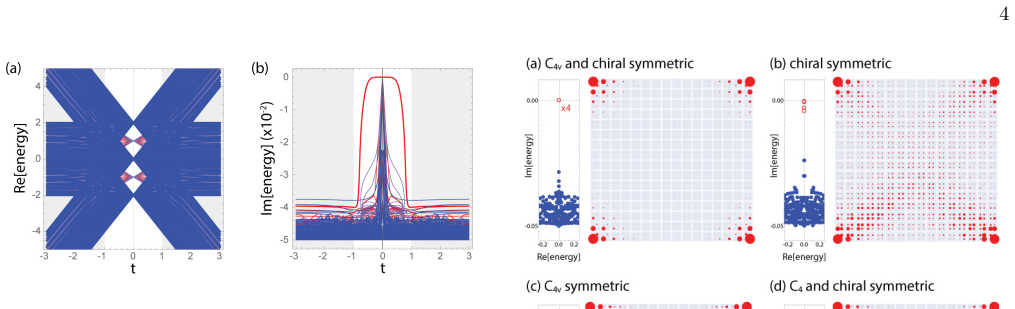
The central mechanism is the loss-probe diagnostic: the lattice is split into four corner 'system' regions $S$ and the rest as the 'environment' $R$, and a uniform on-site loss $-i\kappa$ is added to $R$ (Eq. 2). Bulk and edge states acquire negative imaginary energies of order $\kappa$, whereas BIC wave functions, being exponentially confined to $S$, have imaginary energies that vanish exponentially with system size. The supporting symmetry mechanism is the representation analysis of the corner states ($A_1\oplus B_2\oplus E$) against the bulk zero-energy states (pure $E$), combined with chiral symmetry, which forces any $E$-type hybridization to remain at zero energy and therefore cannot produce a physical avoided crossing that would destroy the BICs.
What would settle it
Diagonalize the original Hermitian lattice for increasing $n$ and isolate the zero-energy subspace: if the four corner-localized states have bulk weight that decays only algebraically, or if the loss-probe imaginary energies scale as $\kappa$ rather than exponentially with $n$, the BIC claim fails. A direct calculation that exhibits a basis of the degenerate zero-energy subspace in which the four corner states are not exact eigenstates would also falsify the paper's central assertion.
Extended reading notes
Core claim
For the Bloch Hamiltonian $h(k)$ in Eq. (1), the paper's central claim is that the topological phase with dimerized hopping $|t|<1$ hosts four degenerate zero-energy corner-localized bound states in the continuum, embedded in the zero-energy continuum of the central bulk band, while the trivial phase $|t|>1$ does not. The four corner states are exact eigenstates in the thermodynamic limit whose penetration into the bulk decays exponentially, and they are unaffected by the loss-probe's environmental loss because they have no support in the lossy region. The symmetry argument is that under $C_{4v}$ the four corner states form the representations $A_1\oplus B_2\oplus E$, while all degenerate bulk states at zero energy transform as the two-dimensional $E$ representation; chiral symmetry pins every $E$-type state to zero energy, so a corner-bulk hybrid cannot move off zero energy and split. Thus the simultaneous preservation of $C_{4v}$ and chiral symmetry protects an identifiable BIC subspace, and breaking either symmetry turns the corner states into higher-order topological resonances.
Load-bearing premise
The load-bearing premise is that adding a small uniform loss to the environment and declaring 'BIC' any eigenstate whose imaginary energy vanishes as the lattice grows is a complete and valid way to certify bound states in the continuum of the original lossless lattice.
Editorial extensions
If this is right
- Corner bound states can exist without a bulk gap, so higher-order topological boundary states are not contingent on spectral isolation.
- The BICs are protected by $C_{4v}$ and chiral symmetry together; preserving the symmetries that protect the topological phase but breaking either of these two converts them into higher-order topological resonances.
- The loss-probe method provides a direct numerical way to identify BICs in closed crystalline lattices, complementing open-system radiative definitions of BICs.
- BIC protection holds for nonseparable Hamiltonians, so the separability of $h(k_x,k_y)$ into $k_x$ and $k_y$ parts is not the origin of these BICs.
- The corner filling anomaly is a necessary onset condition but not sufficient: additional symmetries decide whether the corner states emerge as BICs or as resonances.
Reading between the lines
- Extending the symmetry logic, any chiral- and $C_n$-symmetric higher-order topological insulator whose corner states and bulk states carry incompatible irreps, or whose $E$-type partners are pinned to zero by chirality, should host corner BICs even with a gapless bulk; the paper does not test this general criterion.
- The same loss-probe protocol could be applied to hinge modes of three-dimensional HOTIs or to other boundary-localized states, as long as the lossless region fully contains the exponentially confined mode — a straightforward but untested extension.
- Because the loss probe maps onto gain-loss contrast, a photonic or acoustic metamaterial realization of this lattice should show four corner modes with near-zero linewidth while the surrounding bulk remains lossy; observing this would confirm the BIC character experimentally.
Signed reviews
Editorial analysis
A structured set of objections, weighed in public.
Referee Report
Summary. The paper claims that two-dimensional higher-order topological insulators can host corner-localized bound states in the continuum despite having gapless zero-energy bulk bands. To identify such states, the authors propose a non-Hermitian loss-probe method: a small lossless region S (four corner squares) is kept intact while a large environment R is given uniform local loss, and eigenstates of the resulting non-Hermitian Hamiltonian whose imaginary energies tend to zero as the system grows are declared to be BICs of the original Hermitian lattice. Applying this to a C4v- and chiral-symmetric lattice, they find four zero-energy corner states in the topological phase, argue that they are protected by the simultaneous presence of C4v and chiral symmetries, and show that breaking either symmetry transforms them into corner-localized resonances. The paper also argues that their BICs are not due to Hamiltonian separability and that the filling anomaly alone is insufficient for BIC protection.
Significance. If established, the result would be significant: it would extend the notion of higher-order topological corner states to systems without a bulk gap, broaden the design space for topological metamaterials, and offer a generic diagnostic for BICs in closed crystalline systems. The paper includes direct spatial-density evidence and a symmetry-based protection argument that goes beyond earlier separability-based BIC mechanisms. However, the central diagnostic is formally flawed, and the symmetry argument for two of the four claimed BICs is incomplete. The core claim is therefore not supported by the presented numerics, although the underlying idea may be salvageable with a different analysis.
major comments (2)
- [Bound states in the continuum; Eq. (2); Fig. 2(b); Supplemental Fig. S2] The loss-probe criterion is not a valid test for BICs of the original Hermitian Hamiltonian. For H = H0 - iκ P_R, any right eigenvector ψ satisfies Im E = -κ ||P_R ψ||^2 / ||ψ||^2. Thus a vanishing imaginary part requires the eigenstate to have exactly zero support in the lossy environment R. For a fixed lossless region S of size ns and an exponentially localized state with penetration length ξ, the integrated weight in R is dominated by the region just outside S and is independent of the total lattice size n once n exceeds ξ; it is of order e^{-2ns/ξ}, a nonzero constant. The imaginary part should therefore saturate at a nonzero value as n grows, not decay exponentially. The decay shown in Fig. 2(b) and the exactly zero values for fixed ns=4 in Fig. S2(a) imply that the selected states have no support in R, i.e., they are either exactly compact within S or some parameter such as ns or κ is being varied without being reported. This contradicts the paper's stated exponential penetration of the BICs into the bulk. The presented numerics therefore do not establish that the four corner states are eigenstates of the original Hermitian H0 embedded in the continuum.
- [Symmetry protection of the BICs] The protection argument for the two E-representation corner states is incomplete. The claim that the hybridized states |ψ1,2⟩ are merely arbitrary choices in the highly degenerate zero-energy subspace does not prove that the localized corner states are eigenstates. A Hermitian Hamiltonian diagonalizes within the degenerate subspace, and generically the true eigenstates are mixtures of corner and bulk components unless an additional symmetry or a vanishing coupling forces a localized eigenstate to exist. To establish that the E corner states are BICs, one must show that there is an eigenstate whose overlap with all bulk states is zero, for example by symmetry or by a direct inverse-participation-ratio calculation in the thermodynamic limit. The loss-probe was intended to supply this evidence, but as argued above it is invalid.
minor comments (4)
- [Eq. (2) and figure captions] The loss term is defined with 0<κ≪1 in Eq. (2), but the captions of Figs. 2, 3, and 4 state κ=-5×10^{-2}; a negative κ would produce gain rather than loss, so the sign convention is inconsistent and should be corrected.
- [Fig. 2(b)] The caption describes the horizontal axis as 'system size' without stating whether the varied parameter is the total lattice size n or the size ns of the lossless corner regions; this ambiguity is material to the claimed exponential decay and should be clarified.
- [BICs as a signature of the topological phase] The statement that indirect gap closings 'start to occur at t=0.5' appears to conflict with the earlier assertion that the topological transition is at |t|=1; please clarify which quantity is being described.
- [Supplemental Fig. S2] The insets in Fig. S2 lack labeled axes and scales, making it difficult to verify the claim that the BIC imaginary energies are exactly zero as a function of n; adding labels would improve the presentation.
Circularity Check
No significant circularity: the corner BIC demonstration rests on direct numerical diagnostics and a symmetry argument, with only a minor non-load-bearing self-citation.
full rationale
The central claim—that the two-dimensional HOTI lattice of Eq. (1) hosts zero-energy corner-localized bound states in the continuum—is supported by an explicit numerical probe and by a symmetry analysis, not by fitting a parameter to the claimed outcome. The non-Hermitian loss term in Eq. (2) is used as a diagnostic: eigenstates whose imaginary energies approach zero with system size are identified as BICs, and Fig. 2(c)-(d) independently shows the selected states are corner-localized and embedded in the zero-energy bulk continuum. No parameter is fitted to force the four near-real eigenvalues; they emerge from the spectrum of H0 - iκP_R. The symmetry-protection section additionally provides a non-numerical argument: under C4v and chiral symmetry, the corner-state E-representation partners |C+> and |C-> are pinned to zero energy, and any C4v-allowed hybridization with bulk E states remains in the zero-energy subspace rather than producing a physical resonance. This argument does not reduce to the paper's conclusion by construction. The only notable self-citation is Ref. [11], used for Wannier-center positions and filling-anomaly indices. That prior work is published, external to the present model's BIC diagnosis, and is explicitly described as only the 'onset' for the states; the paper's own diagnostic and symmetry argument carry the load. The loss-probe criterion could be questioned on physical grounds (e.g., whether fixed loss region R gives a true exponential-in-n decay), but that is a validation/correctness concern, not circularity. Overall, the derivation is self-contained and the central claim is not equivalent to its inputs.
Assumptions & free parameters
free parameters (3)
- t (hopping ratio) =
0.25 (Figs. 2, 4; 0.15 in Fig. 1)
- k (environment loss strength) =
0.05, though captions write k=-5e-2
- n_s (lossless corner region size) =
3 (Figs. 2-4) and 4 (Fig. S2)
assumptions (6)
- domain assumption The tight-binding Bloch Hamiltonian in Eq. (1) with four sites per unit cell is the physical model, and finite open-boundary lattices approximate the thermodynamic limit.
- ad hoc to paper The loss-probe criterion identifies BICs: eigenstates of the non-Hermitian Hamiltonian in Eq. (2) with imaginary parts tending to zero as system size grows correspond to BICs of the original Hermitian Hamiltonian.
- domain assumption All zero-energy bulk states transform as the E irreducible representation of C4v, and the four corner states transform as A1+B2+E.
- domain assumption The corner-induced filling anomaly and symmetry-indicator invariants from Ref. [11] apply to this lattice, so a fractional corner charge exists in the topological phase.
- standard math Chiral symmetry forces zero-energy states to come in chiral pairs or to be eigenstates of the chiral operator.
- domain assumption The random symmetry-preserving perturbations described in Supplement D are generic, so no accidental symmetry beyond those stated protects the BICs.
Cite this review
Pith. "Pith review of Bound states in the continuum of higher-order topological insulators." pith.science (2026). https://pith.science/paper/G5B6D4F6
@misc{pith2026190805687,
  author       = {Pith},
  title        = {Pith review of: Bound states in the continuum of higher-order topological insulators},
  year         = {2026},
  howpublished = {\url{https://pith.science/paper/G5B6D4F6}},
  note         = {Machine review of arXiv:1908.05687}
}
read the original abstract
We show that lattices with higher-order topology can support corner-localized bound states in the continuum (BICs). We propose a method for the direct identification of BICs in condensed matter settings and use it to demonstrate the existence of BICs in a concrete lattice model. Although the onset for these states is given by corner-induced filling anomalies in certain topological crystalline phases, additional symmetries are required to protect the BICs from hybridizing with their degenerate bulk states. We demonstrate the protection mechanism for BICs in this model and show how breaking this mechanism transforms the BICs into higher-order topological resonances. Our work shows that topological states arising from the bulk-boundary correspondence in topological phases are more robust than previously expected, expanding the search space for crystalline topological phases to include those with boundary-localized BICs or resonances.
Figures


Figures from the paper (1 more)

Reference graph
Works this paper leans on
-
[57]
Topological protection of bound states against the hybridization,
Bohm-Jung Yang, Mohammad Saeed Bahramy, and Naoto Nagaosa, “Topological protection of bound states against the hybridization,” Nature Communications 4, 1524 EP – (2013)
work page 2013
-
[1]
W. P. Su, J. R. Schrieffer, and A. J. Heeger, “Solitons in Polyacetylene,” Phys. Rev. Lett. 42, 1698–1701 (1979)
work page 1979
-
[2]
in the first and fourth bands of the lattice [11]. These quantized dipole moments are accompanied by two edge energy bands (i.e., bands with edge-localized states) spectrally isolated from the bulk energy bands [Fig. 1(c)]. In addition to the dipole moments, the topological phase has a corner-induced filling anomaly [11] [62] with secondary topological indi...
-
[3]
Guido van Miert, Carmine Ortix, and Cristiane Morais Smith, “Topological origin of edge states in two- dimensional inversion-symmetric insulators and semimet- als,” 2D Materials 4, 015023 (2016)
work page 2016
-
[4]
Bulk-boundary correspondence from the intercel- lular zak phase,
Jun-Won Rhim, Jan Behrends, and Jens H. Bardar- son, “Bulk-boundary correspondence from the intercel- lular zak phase,” Phys. Rev. B 95, 035421 (2017)
work page 2017
-
[5]
Excess charges as a probe of one-dimensional topological crystalline insu- lating phases,
Guido van Miert and Carmine Ortix, “Excess charges as a probe of one-dimensional topological crystalline insu- lating phases,” Phys. Rev. B 96, 235130 (2017)
work page 2017
-
[6]
Quantized electric multipole insulators,
Wladimir A. Benalcazar, B. Andrei Bernevig, and Tay- lor L. Hughes, “Quantized electric multipole insulators,” Science 357, 61–66 (2017)
work page 2017
-
[7]
Wladimir A. Benalcazar, B. Andrei Bernevig, and Tay- lor L. Hughes, “Electric multipole moments, topological multipole moment pumping, and chiral hinge states in crystalline insulators,” Phys. Rev. B 96, 245115 (2017)
work page 2017
Show all 77 references
-
[8]
( d− 2)- dimensional edge states of rotation symmetry protected topological states,
Zhida Song, Zhong Fang, and Chen Fang, “( d− 2)- dimensional edge states of rotation symmetry protected topological states,” Phys. Rev. Lett. 119, 246402 (2017)
2017
-
[9]
The axion insulator as a pump of fragile topology,
Benjamin J. Wieder and B. Andrei Bernevig, “The axion insulator as a pump of fragile topology,” arXiv:1810.02373 (2018)
2018 arXiv
-
[10]
Higher-order topo- logical insulators protected by inversion and rotoinver- sion symmetries,
Guido van Miert and Carmine Ortix, “Higher-order topo- logical insulators protected by inversion and rotoinver- sion symmetries,” Phys. Rev. B 98, 081110 (2018)
2018
-
[11]
Minimal models for wannier-type higher-order topological insulators and phosphorene,
Motohiko Ezawa, “Minimal models for wannier-type higher-order topological insulators and phosphorene,” Phys. Rev. B 98, 045125 (2018)
2018
-
[12]
Quantization of fractional corner charge in Cn-symmetric higher-order topological crystalline insu- lators,
Wladimir A. Benalcazar, Tianhe Li, and Taylor L. Hughes, “Quantization of fractional corner charge in Cn-symmetric higher-order topological crystalline insu- lators,” Phys. Rev. B 99, 245151 (2019)
2019
-
[13]
Higher-order band topology and cor- ner charges in monolayer graphdiyne,
Eunwoo Lee, Rokyeon Kim, Junyeong Ahn, and Bohm-Jung Yang, “Higher-order band topology and cor- ner charges in monolayer graphdiyne,” arXiv preprint arXiv:1904.11452 (2019)
2019 arXiv
-
[14]
Two-dimensional second-order topological insulator in graphdiyne,
Xian-Lei Sheng, Cong Chen, Huiying Liu, Ziyu Chen, Zhi-Ming Yu, Y. X. Zhao, and Shengyuan A. Yang, “Two-dimensional second-order topological insulator in graphdiyne,” Phys. Rev. Lett. 123, 256402 (2019)
2019
-
[15]
Fractional cor- ner charges in spin-orbit coupled crystals,
Frank Schindler, Marta Brzezi´ nska, Wladimir A. Benal- cazar, Mikel Iraola, Adrien Bouhon, Stepan S. Tsirkin, Maia G. Vergniory, and Titus Neupert, “Fractional cor- ner charges in spin-orbit coupled crystals,” Phys. Rev. Research 1, 033074 (2019)
2019
-
[16]
Classification of two-dimensional topo- logical crystalline superconductors and majorana bound states at disclinations,
Wladimir A. Benalcazar, Jeffrey C. Y. Teo, and Tay- lor L. Hughes, “Classification of two-dimensional topo- logical crystalline superconductors and majorana bound states at disclinations,” Phys. Rev. B 89, 224503 (2014)
2014
-
[17]
Topological protection of photonic mid-gap defect modes,
Jiho Noh, Wladimir A. Benalcazar, Sheng Huang, Matthew J. Collins, Kevin P. Chen, Taylor L. Hughes, and Mikael C. Rechtsman, “Topological protection of photonic mid-gap defect modes,” Nature Photonics (2018)
2018
-
[18]
A quantized mi- crowave quadrupole insulator with topologically pro- tected corner states,
Christopher W. Peterson, Wladimir A. Benalcazar, Tay- lor L. Hughes, and Gaurav Bahl, “A quantized mi- crowave quadrupole insulator with topologically pro- tected corner states,” Nature 555, 346 EP – (2018)
2018
-
[19]
Observation of higher-order topolog- ical acoustic states protected by generalized chiral sym- metry,
Xiang Ni, Matthew Weiner, Andrea Al` u, and Alexan- der B. Khanikaev, “Observation of higher-order topolog- ical acoustic states protected by generalized chiral sym- metry,” Nature Materials 18, 113–120 (2019)
2019
-
[20]
Braiding photonic topological zero modes,
Jiho Noh, Thomas Schuster, Thomas Iadecola, Sheng Huang, Mohan Wang, Kevin P. Chen, Claudio Cha- mon, and Mikael C. Rechtsman, “Braiding photonic topological zero modes,” (2019), arXiv:1907.03208 [physics.optics]
2019 arXiv
-
[21]
Braiding majorana corner modes in a two-layer second-order topological insulator,
Tudor E. Pahomi, Manfred Sigrist, and Alexey A. Soluyanov, “Braiding majorana corner modes in a two-layer second-order topological insulator,” (2019), arXiv:1904.07822 [cond-mat.mes-hall]
2019 arXiv
-
[22]
¨Uber merkw¨ urdige diskrete eigenwerte,
J. von Neumann and E. Wigner, “ ¨Uber merkw¨ urdige diskrete eigenwerte,” Phys. Z. 30, 465 (1929)
1929
-
[23]
Quan- tum bound states in a classically unbound system of crossed wires,
R. L. Schult, D. G. Ravenhall, and H. W. Wyld, “Quan- tum bound states in a classically unbound system of crossed wires,” Phys. Rev. B 39, 5476–5479 (1989)
1989
-
[24]
Suppression of feshbach resonance widths in two-dimensional waveguides and quantum dots: 6 A lower bound for the number of bound states in the con- tinuum,
Nimrod Moiseyev, “Suppression of feshbach resonance widths in two-dimensional waveguides and quantum dots: 6 A lower bound for the number of bound states in the con- tinuum,” Phys. Rev. Lett. 102, 167404 (2009)
2009
-
[25]
Conical intersections and bound molecular states embedded in the contin- uum,
Lorenz S. Cederbaum, Ronald S. Friedman, Victor M. Ryaboy, and Nimrod Moiseyev, “Conical intersections and bound molecular states embedded in the contin- uum,” Phys. Rev. Lett. 90, 013001 (2003)
2003
-
[26]
Trapping modes in the theory of surface waves,
F. Ursell, “Trapping modes in the theory of surface waves,” Math. Proc. Cambridge Philos. Soc. 47, 347–358 (1951)
1951
-
[27]
The eigenvalues of ∇2u +λu = 0 when the boundary conditions are given on semi-infinite domains,
D. S. Jones, “The eigenvalues of ∇2u +λu = 0 when the boundary conditions are given on semi-infinite domains,” Math. Proc. Cambridge Philos. Soc. 49, 668–684 (1953)
1953
-
[28]
Trapped modes in two-dimensional waveguides,
M. Callan, C. M. Linton, and D. V. Evans, “Trapped modes in two-dimensional waveguides,” J. Fluid Mech. 229, 51–64 (1991)
1991
-
[29]
Trapped modes: an experimental inves- tigation,
C. H. Retzler, “Trapped modes: an experimental inves- tigation,” Appl. Ocean Res. 4, 249–250 (2001)
2001
-
[30]
Experimental observation of trapped modes in a water wave channel,
P. J. Cobelli, V. Pagneux, A. Maurel, and P. Petitjeans, “Experimental observation of trapped modes in a water wave channel,” Euro. Phys. Lett. 88, 20006 (2009)
2009
-
[31]
Experimental study on water-wave trapped modes,
P. J. Cobelli, V. Pagneux, A. Maurel, and P. Petitjeans, “Experimental study on water-wave trapped modes,” J. Fluid Mech. 666, 445–476 (2011)
2011
-
[32]
Resonance effects in wake shedding from par- allel plates: some experimental observations
R. Parker, “Resonance effects in wake shedding from par- allel plates: some experimental observations.” J. Sound Vib. 4, 62 (1966)
1966
-
[33]
Resonance effects in wake shedding from parallel plates: calculation of resonant frequencies
R. Parker, “Resonance effects in wake shedding from parallel plates: calculation of resonant frequencies.” J. Sound Vib. 5, 330 (1967)
1967
-
[34]
The excitation of acoustic resonances by vortex shedding
N. A. Cumpsty and D. S. Whitehead, “The excitation of acoustic resonances by vortex shedding.” J. Sound Vib. 18, 353 (1971)
1971
-
[35]
Resonant acoustic frequencies of flat plate cascades
W. Koch, “Resonant acoustic frequencies of flat plate cascades.” J. Sound Vib. 88, 233 (1983)
1983
-
[36]
The Excitation and Consequences of Acoustic Resonances in Enclosed Fluid Flow Around Solid Bodies,
R. Parker and S. A. T. Stoneman, “The Excitation and Consequences of Acoustic Resonances in Enclosed Fluid Flow Around Solid Bodies,” Proc. Inst. Mech. Eng. C 203, 9–19 (1989)
1989
-
[37]
Existence theorems for trapped modes,
D. V. Evans, M. Levitin, and D. Vassiliev, “Existence theorems for trapped modes,” J. Fluid Mech 261, 21–31 (1994)
1994
-
[38]
Two-dimensional vector- coupled-mode theory for textured planar waveguides,
P. Paddon and Jeff F. Young, “Two-dimensional vector- coupled-mode theory for textured planar waveguides,” Phys. Rev. B 61, 2090–2101 (2000)
2000
-
[39]
Photonic band structure of dielectric membranes periodically textured in two dimensions,
V. Pacradouni, W. J. Mandeville, A. R. Cowan, P. Pad- don, Jeff F. Young, and S. R. Johnson, “Photonic band structure of dielectric membranes periodically textured in two dimensions,” Phys. Rev. B 62, 4204–4207 (2000)
2000
-
[40]
Dispersion relation and opti- cal transmittance of a hexagonal photonic crystal slab,
T. Ochiai and K. Sakoda, “Dispersion relation and opti- cal transmittance of a hexagonal photonic crystal slab,” Phys. Rev. B 63, 125107 (2001)
2001
-
[41]
Analysis of guided resonances in photonic crystal slabs,
Shanhui Fan and J. D. Joannopoulos, “Analysis of guided resonances in photonic crystal slabs,” Phys. Rev. B 65, 235112 (2002)
2002
-
[42]
Bloch surface eigenstates within the radiation contin- uum,
Chia Wei Hsu, Bo Zhen, Song-Liang Chua, Steven G. Johnson, John D. Joannopoulos, and Marin Soljaˇ ci´ c, “Bloch surface eigenstates within the radiation contin- uum,” Light Sci. Appl. 2, e84 (2013)
2013
-
[43]
Observation of trapped light within the radiation continuum,
Chia Wei Hsu, Bo Zhen, Jeongwon Lee, Song-Liang Chua, Steven G. Johnson, John D. Joannopoulos, and Marin Soljaˇ ci´ c, “Observation of trapped light within the radiation continuum,” Nature 499, 188–191 (2013)
2013
-
[44]
Analytical Perspective for Bound States in the Continuum in Photonic Crystal Slabs,
Yi Yang, Chao Peng, Yong Liang, Zhengbin Li, and Susumu Noda, “Analytical Perspective for Bound States in the Continuum in Photonic Crystal Slabs,” Phys. Rev. Lett. 113, 037401 (2014)
2014
-
[45]
Topological Nature of Optical Bound States in the Continuum,
Bo Zhen, Chia Wei Hsu, Ling Lu, A. Douglas Stone, and Marin Soljaˇ ci´ c, “Topological Nature of Optical Bound States in the Continuum,” Phys. Rev. Lett. 113, 257401 (2014)
2014
-
[46]
Perfect single-sided radiation and absorption without mirrors,
Hengyun Zhou, Bo Zhen, Chia Wei Hsu, Owen D. Miller, Steven G. Johnson, John D. Joannopoulos, and Marin Soljaˇ ci´ c, “Perfect single-sided radiation and absorption without mirrors,” Optica 3, 1079–1086 (2016)
2016
-
[47]
Formation mechanism of guided resonances and bound states in the continuum in photonic crystal slabs,
Xingwei Gao, Chia Wei Hsu, Bo Zhen, Xiao Lin, John D. Joannopoulos, Marin Soljaˇ ci´ c, and Hongsheng Chen, “Formation mechanism of guided resonances and bound states in the continuum in photonic crystal slabs,” Sci. Rep. 6, 31908 (2016)
2016
-
[48]
Lasing action from photonic bound states in continuum,
Ashok Kodigala, Thomas Lepetit, Qing Gu, Babak Ba- hari, Yeshaiahu Fainman, and Boubacar Kant´ e, “Lasing action from photonic bound states in continuum,” Nature 541, 196–199 (2017)
2017
-
[49]
Extraordinary optical reflection resonances and bound states in the continuum from a periodic array of thin metal plates,
Wei Zhang, Aaron Charous, Masaya Nagai, Daniel M. Mittleman, and Rajind Mendis, “Extraordinary optical reflection resonances and bound states in the continuum from a periodic array of thin metal plates,” Opt. Express 26, 13195–13204 (2018)
2018
-
[50]
Zero-Index Bound States in the Contin- uum,
Momchil Minkov, Ian A.D. Williamson, Meng Xiao, and Shanhui Fan, “Zero-Index Bound States in the Contin- uum,” Phys. Rev. Lett. 121, 263901 (2018)
2018
-
[51]
Bound States in the Continuum through Environ- mental Design,
Alexander Cerjan, Chia Wei Hsu, and Mikael C. Rechts- man, “Bound States in the Continuum through Environ- mental Design,” Phys. Rev. Lett. 123, 023902 (2019)
2019
-
[52]
Experimental Observation of Optical Bound States in the Continuum,
Yonatan Plotnik, Or Peleg, Felix Dreisow, Matthias Heinrich, Stefan Nolte, Alexander Szameit, and Mordechai Segev, “Experimental Observation of Optical Bound States in the Continuum,” Phys. Rev. Lett. 107, 183901 (2011)
2011
-
[53]
Compact Surface Fano States Embedded in the Continuum of Waveguide Arrays,
Steffen Weimann, Yi Xu, Robert Keil, Andrey E. Miroshnichenko, Andreas T¨ unnermann, Stefan Nolte, Andrey A. Sukhorukov, Alexander Szameit, and Yuri S. Kivshar, “Compact Surface Fano States Embedded in the Continuum of Waveguide Arrays,” Phys. Rev. Lett.111, 240403 (2013)
2013
-
[54]
Observation of Surface States with Algebraic Localization,
G. Corrielli, G. Della Valle, A. Crespi, R. Osellame, and S. Longhi, “Observation of Surface States with Algebraic Localization,” Phys. Rev. Lett. 111, 220403 (2013)
2013
-
[55]
Anisotropy-induced photonic bound states in the con- tinuum,
Jordi Gomis-Bresco, David Artigas, and Lluis Torner, “Anisotropy-induced photonic bound states in the con- tinuum,” Nat. Photon. 11, 232 (2017)
2017
-
[56]
Topological properties of bound states in the continuum in geome- tries with broken anisotropy symmetry,
Samyobrata Mukherjee, Jordi Gomis-Bresco, Pilar Pujol- Closa, David Artigas, and Lluis Torner, “Topological properties of bound states in the continuum in geome- tries with broken anisotropy symmetry,” Phys. Rev. A 98, 063826 (2018)
2018
-
[58]
Corner states in a second-order acoustic topological insulator as bound states in the con- tinuum,
Ze-Guo Chen, Changqing Xu, Rasha Al Jahdali, Jun Mei, and Ying Wu, “Corner states in a second-order acoustic topological insulator as bound states in the con- tinuum,” Phys. Rev. B 100, 075120 (2019)
2019
-
[59]
A simple separable hamiltonian having bound states in the continuum,
M Robnik, “A simple separable hamiltonian having bound states in the continuum,” Journal of Physics A: Mathematical and General 19, 3845–3848 (1986)
1986
-
[60]
Resonances in quantum-dot transport,
J. U. N¨ ockel, “Resonances in quantum-dot transport,” 7 Phys. Rev. B 46, 15348–15356 (1992)
1992
-
[61]
Novel topological phase with a zero berry curvature,
Feng Liu and Katsunori Wakabayashi, “Novel topological phase with a zero berry curvature,” Phys. Rev. Lett.118, 076803 (2017)
2017
-
[62]
4, and scaling argu- ments for the BICs
See Supplemental Material for a detailed description of the topological phases and invariants in this model, the implementation of the symmetry-breaking terms added to the pristine Hamiltonian for Fig. 4, and scaling argu- ments for the BICs. This material includes Refs. [65-67]
-
[63]
Although a proper definition of corner-induced filling anomaly requires the vanishing of polarization in insu- lators, here we do not enforce this requirement as we envision the topology per band instead of the topology below a given Fermi level
-
[64]
In contrast, if the BICs were the result of adding losses into the environment R, we would observe their modal profiles to have a relatively uniform distribution over the entire lossless regionsS
-
[65]
Although the plot shows that the edge states are spec- trally separated from the bulk bands only for a fraction of the topological phase, they persist up to the bulk tran- sition point|t| = 1
-
[66]
Dynamics of band electrons in electric and magnetic fields,
Gregory H. Wannier, “Dynamics of band electrons in electric and magnetic fields,” Rev. Mod. Phys. 34, 645– 655 (1962)
1962
-
[67]
Maximally local- ized generalized wannier functions for composite energy bands,
Nicola Marzari and David Vanderbilt, “Maximally local- ized generalized wannier functions for composite energy bands,” Phys. Rev. B 56, 12847 (1997)
1997
-
[68]
Topological quantum chemistry,
Barry Bradlyn, L. Elcoro, Jennifer Cano, M. G. Vergniory, Zhijun Wang, C. Felser, M. I. Aroyo, and B. Andrei Bernevig, “Topological quantum chemistry,” Nature 547, 298 EP – (2017). Supplementary Information: Bound states in the continuum of higher-order topological insulators ...
2017 arXiv
-
[69]
A case in point is the lattice in Fig
have a corner-induced filling anomaly. A case in point is the lattice in Fig. 2(e) in Ref. 4. The symmetry indicator invariants and their topolog- ical indices for polarization and corner filling anomalies for the bands in our model are shown in Table S4 and S5. C. Constraints o...
-
[70]
For chiral symmetry Under chiral symmetry, Πh(k)Π = −h(k), all T ma- trices must obey {T, Π} = 0. (S12)
-
[71]
To first satisfy C2 symmetry, ˆr2h(kx,ky)ˆr† 2 = h(−kx,−ky), we require [Tx1, ˆr2] = 0, {Tx2, ˆr2} = 0
For C4 symmetry Let us first focus on the nearest neighbor T ma- trices. To first satisfy C2 symmetry, ˆr2h(kx,ky)ˆr† 2 = h(−kx,−ky), we require [Tx1, ˆr2] = 0, {Tx2, ˆr2} = 0. (S13) Now, to satisfyC4 symmetry, ˆr4h(kx,ky)ˆr† 4 =h(ky,−kx), we additionally require Ty1 = ˆr4Tx1ˆr†...
-
[72]
Take first T1 to obey {T1, ˆr2} = 0, (S15) and then determine T2 via the constraint due to C4 sym- metry, T2 =−ˆr4T2ˆr†
(S14) The two next nearest neighborT matrices are odd under C2 symmetry. Take first T1 to obey {T1, ˆr2} = 0, (S15) and then determine T2 via the constraint due to C4 sym- metry, T2 =−ˆr4T2ˆr†
-
[73]
If more than one symmetry is to be preserved, the con- straints due to each of them have to be met simultane- ously
For reflection symmetry Under reflection symmetry along x, ˆMxh(kx,ky) ˆM † x = h(−kx,ky), four T matrices are even under Mx and two are odd, [Tx1, ˆMx] = 0 , [Ty1, ˆMx] = 0, [Ty2, ˆMx] = 0, [T1, ˆMx] = 0, (S17) {Tx2, ˆMx} = 0, {T2, ˆMx} = 0. If more than one symmetry is to be p...
-
[74]
G. H. Wannier, Rev. Mod. Phys. 34, 645 (1962)
1962
-
[75]
Marzari and D
N. Marzari and D. Vanderbilt, Phys. Rev. B 56, 12847 (1997)
1997
-
[76]
Bradlyn, L
B. Bradlyn, L. Elcoro, J. Cano, M. G. Vergniory, Z. Wang, C. Felser, M. I. Aroyo, and B. A. Bernevig, Nature 547, 298 EP (2017)
2017
-
[77]
W. A. Benalcazar, T. Li, and T. L. Hughes, Phys. Rev. B 99, 245151 (2019)
2019
Reviewed August 14, 2026 · model on record in the stance chip above.
Discussion (0). Continue with ORCID to comment.