Ludii and XCSP: Playing and Solving Logic Puzzles
Pith reviewed 2026-05-25 12:43 UTC · model grok-4.3
The pith
Logic puzzles from the Ludii system can be translated into XCSP instances and solved by any CSP solver.
A machine-rendered reading of the paper's core claim, the machinery that carries it, and where it could break.
Core claim
The central claim is that logic puzzles described in Ludii can be mapped to XCSP instances so that any CSP solver can be used to solve them, building on the observation that such puzzles are often NP-complete and that constraint programming is a natural fit for finding and checking their solutions.
What carries the argument
The mapping that turns a Ludii puzzle description into an equivalent XCSP instance while preserving the original rules and solution set.
If this is right
- Any existing CSP solver becomes applicable to the full range of Ludii logic puzzles without custom code for each puzzle.
- Verification of proposed solutions becomes straightforward once the instance is in XCSP form.
- The same translation opens a route to solving other NP-complete puzzles that can be expressed in Ludii.
- Puzzle designers gain access to off-the-shelf solvers for testing difficulty or uniqueness.
Where Pith is reading between the lines
- An automated translator from Ludii to XCSP could be added to the Ludii platform to give users built-in solving support.
- The approach might extend to generating new puzzles by searching the XCSP space for instances with desired properties.
- Similar translations could link Ludii to other constraint or SAT frameworks beyond XCSP.
Load-bearing premise
Every logic puzzle that can be written in Ludii has an exact counterpart in XCSP that adds no extra solutions and loses none of the original meaning.
What would settle it
Take any Ludii puzzle with a known solution set, translate it to XCSP, and check whether the solver returns exactly the same solutions with no invalids and no omissions.
Figures


read the original abstract
Many of the famous single-player games, commonly called puzzles, can be shown to be NP-Complete. Indeed, this class of complexity contains hundreds of puzzles, since people particularly appreciate completing an intractable puzzle, such as Sudoku, but also enjoy the ability to check their solution easily once it's done. For this reason, using constraint programming is naturally suited to solve them. In this paper, we focus on logic puzzles described in the Ludii general game system and we propose using the XCSP formalism in order to solve them with any CSP solver.
Editorial analysis
A structured set of objections, weighed in public.
Referee Report
Summary. The paper claims that many single-player logic puzzles are NP-complete and that constraint programming is well-suited to solve them; it focuses on puzzles described in the Ludii general game system and proposes translating them into the XCSP formalism so that any CSP solver can be used.
Significance. A verified, semantics-preserving translation from Ludii ludemes to XCSP would allow reuse of mature CSP solvers on the growing library of Ludii puzzles, potentially improving both automated puzzle solving and the interoperability of general game-description systems with constraint technology.
major comments (2)
- [Abstract] Abstract: the central claim that 'logic puzzles described in the Ludii general game system' can be solved via XCSP encodings is asserted without any translation rules, equivalence proof, or example mapping; the manuscript therefore provides no evidence that the mapping is semantics-preserving or free of spurious solutions.
- [Abstract] Abstract: no account is given of how Ludii's higher-order constructs (dynamic ludeme evaluation, player-specific filters, etc.) are encoded in XCSP's static constraint language, leaving the claim that the approach works for 'every' expressible puzzle unverified.
Simulated Author's Rebuttal
We thank the referee for the constructive comments. The concerns correctly identify that the current manuscript is a high-level proposal and does not yet contain the detailed translation machinery needed to substantiate the central claim. We will perform a major revision to address both points.
read point-by-point responses
-
Referee: [Abstract] Abstract: the central claim that 'logic puzzles described in the Ludii general game system' can be solved via XCSP encodings is asserted without any translation rules, equivalence proof, or example mapping; the manuscript therefore provides no evidence that the mapping is semantics-preserving or free of spurious solutions.
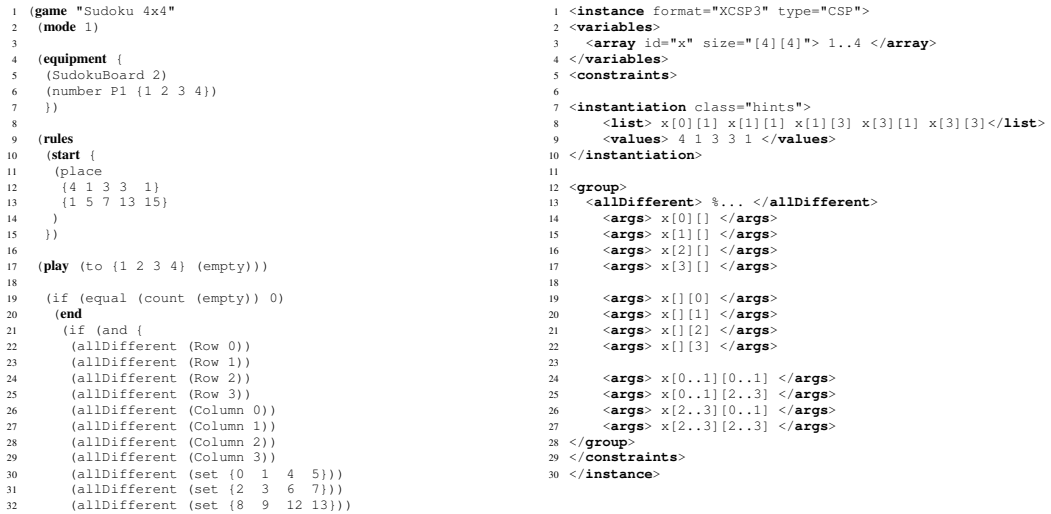
Authors: We agree that the abstract asserts the claim without supporting material. The present manuscript is a short position paper and contains neither explicit translation rules nor an equivalence argument. In the revised version we will add (i) a section defining the mapping from a core set of Ludii ludemes to XCSP variables and constraints, (ii) a worked example for at least one puzzle (e.g., Sudoku), and (iii) a brief argument that the encoding preserves solutions for the supported ludemes and introduces no spurious solutions. revision: yes
-
Referee: [Abstract] Abstract: no account is given of how Ludii's higher-order constructs (dynamic ludeme evaluation, player-specific filters, etc.) are encoded in XCSP's static constraint language, leaving the claim that the approach works for 'every' expressible puzzle unverified.
Authors: The manuscript does not address higher-order or dynamic constructs. We will revise the abstract and introduction to restrict the claim to the static, single-player logic puzzles for which a direct mapping is feasible. We will also add a short discussion of the limitations, noting that dynamic ludeme evaluation would require a preprocessing step to produce an equivalent static XCSP instance and that player-specific filters are outside the current scope. revision: yes
Circularity Check
No circularity; methodological proposal with no self-referential derivation
full rationale
The paper proposes encoding logic puzzles from the Ludii system into XCSP instances for solution by CSP solvers. No equations, fitted parameters, predictions, or first-principles derivations are present that could reduce to their own inputs by construction. No self-citation load-bearing steps, uniqueness theorems, or ansatzes are invoked. The central claim is a direct methodological suggestion whose validity rests on the (unproven here) mapping assumption, but this does not constitute circularity under the defined patterns. The derivation chain is self-contained and non-circular.
Axiom & Free-Parameter Ledger
axioms (1)
- domain assumption Logic puzzles expressible in Ludii can be faithfully represented as constraint satisfaction problems
Reference graph
Works this paper leans on
-
[1]
Collins, The Times Japanese Logic Puzzles: Hitori Hashi, Slitherlin k and Mosaic , London, 2006
H. Collins, The Times Japanese Logic Puzzles: Hitori Hashi, Slitherlin k and Mosaic , London, 2006
work page 2006
-
[2]
Realization of a general game-playing progr am
J. Pitrat, “Realization of a general game-playing progr am.” in IFIP Congress, 1968, pp. 1570–1574
work page 1968
-
[3]
A survey of Monte Carlo tree search methods,
C. Browne, E. Powley, D. Whitehouse, S. Lucas, P . I. Cowli ng, P . Rohlfshagen, S. Tavener, D. Perez, S. Samothrakis, and S. Colton, “A survey of Monte Carlo tree search methods,” IEEE Transactions on Computational Intelligence and AI in Games , vol. 4, no. 1, pp. 1–49, 2012
work page 2012
-
[4]
Learning simulation con trol in general game-playing agents,
H. Finnsson and Y . Bj¨ ornsson, “Learning simulation con trol in general game-playing agents,” in Proceedings of AAAI’10 , 2010, pp. 954–959
work page 2010
-
[5]
Single-player monte-carlo tree search fo r samegame,
M. P . D. Schadd, M. H. M. Winands, M. J. W. Tak, and J. W. H. M. Uiterwijk, “Single-player monte-carlo tree search fo r samegame,” Know.-Based Syst., vol. 34, pp. 3–11, Oct. 2012
work page 2012
-
[6]
Feature selection as a one-playe r game,
R. Gaudel and M. Sebag, “Feature selection as a one-playe r game,” in Proceedings of ICML’10 , 2010, pp. 359–366
work page 2010
-
[7]
C. B. Browne, “The nature of puzzles,” Game & Puzzle Design , vol. 1, no. 1, pp. 23–34, 2015
work page 2015
-
[8]
Computational complexity of games and puzz les,
D. M. Costa, “Computational complexity of games and puzz les,” CoRR,
-
[9]
Available: http://arxiv.org/abs/1807.0 4724
[Online]. Available: http://arxiv.org/abs/1807.0 4724
-
[10]
Generating and solving logi c puzzles through constraint satisfaction,
B. O’Sullivan and J. Horan, “Generating and solving logi c puzzles through constraint satisfaction,” in Proceedings of AAAI’07, Canada , 2007, pp. 1974–1975
work page 2007
-
[11]
Comparing ASP and CP on four grid puzzles,
M. C ¸ elik, H. Erdogan, F. Tahaoglu, T. Uras, and E. Erdem , “Comparing ASP and CP on four grid puzzles,” in Proceedings of the 16th Inter- national RCRA W orkshop: Experimental Evaluation of Algori thms for Solving Problems with Combinatorial Explosion , 2009
work page 2009
-
[12]
Constraint logic programmin g: A survey,
J. Jaffar and M. J. Maher, “Constraint logic programmin g: A survey,” J. Log. Program., vol. 19/20, pp. 503–581, 1994
work page 1994
-
[13]
Ludii - the ludemic general game sys tem,
´E. Piette, D. J. N. J. Soemers, M. Stephenson, C. F. Sironi, M. H. M. Winands, and C. Browne, “Ludii - the ludemic general game sys tem,” CoRR, vol. abs/1905.05013, 2019
-
[14]
XCSP3: an in tegrated format for benchmarking combinatorial constrained proble ms,
F. Boussemart, C. Lecoutre, and C. Piette, “XCSP3: an in tegrated format for benchmarking combinatorial constrained proble ms,” CoRR,
-
[15]
Available: http://arxiv.org/abs/1611.0 3398
[Online]. Available: http://arxiv.org/abs/1611.0 3398
-
[16]
Modern techniques for ancient games,
C. Browne, “Modern techniques for ancient games,” in IEEE Conference on CIG . IEEE, 2018, pp. 490–497
work page 2018
-
[17]
A class grammar for general games,
C. B. Browne, “A class grammar for general games,” in Advances in Computer Games , ser. LNCS, vol. 10068, 2016, pp. 167–182
work page 2016
-
[18]
General game playing: Game description language specifica tion,
N. Love, T. Hinrichs, D. Haley, E. Schkufza, and M. Genes ereth, “General game playing: Game description language specifica tion,” 2008
work page 2008
-
[19]
R. A. Hearn and E. D. Demaine, “Pspace-completeness of s liding-block puzzles and other problems through the nondeterministic co nstraint logic model of computation,” CoRR, 2002
work page 2002
-
[20]
Constr aint-based sym- metry detection in general game playing,
F. Koriche, S. Lagrue, E. Piette, and S. Tabary, “Constr aint-based sym- metry detection in general game playing,” in Proceedings of IJCAI’17 , 2017, pp. 280–287
work page 2017
-
[21]
Ludii and XCSP: Playing and Solving Logic Puzzles
C. Browne, “Deductive search for logic puzzles,” in IEEE Conference on CIG , 2013, pp. 359–366. This figure "CaptureSudoku.PNG" is available in "PNG" format from: http://arxiv.org/ps/1907.00245v1
work page internal anchor Pith review Pith/arXiv arXiv 2013
discussion (0)
Sign in with ORCID, Apple, or X to comment. Anyone can read and Pith papers without signing in.