Symmetry-adapted qubit encoding with complete active space and Bravyi--Kitaev mapping for quantum chemistry on a quantum computer
Pith reviewed 2026-06-28 01:11 UTC · model grok-4.3
The pith
Symmetry-adapted active-space encoding maps frozen orbitals to fewer qubits while matching standard CAS energies.
A machine-rendered reading of the paper's core claim, the machinery that carries it, and where it could break.
Core claim
SAE-CAS derives a mapping from the second-quantised Hamiltonian to active-space qubit Hamiltonians that is equivalent to the canonical CAS Hamiltonian with frozen-core and virtual-orbital projection, then combines it with point-group and spin-parity encodings through affine Clifford transformations to maximise qubit reduction while preserving the target symmetry sector, and extends the construction to the Bravyi-Kitaev mapping.
What carries the argument
Symmetry-adapted qubit encoding for complete active space (SAE-CAS) via affine Clifford transformations that incorporate approximate Z-symmetries of frozen and virtual orbitals.
If this is right
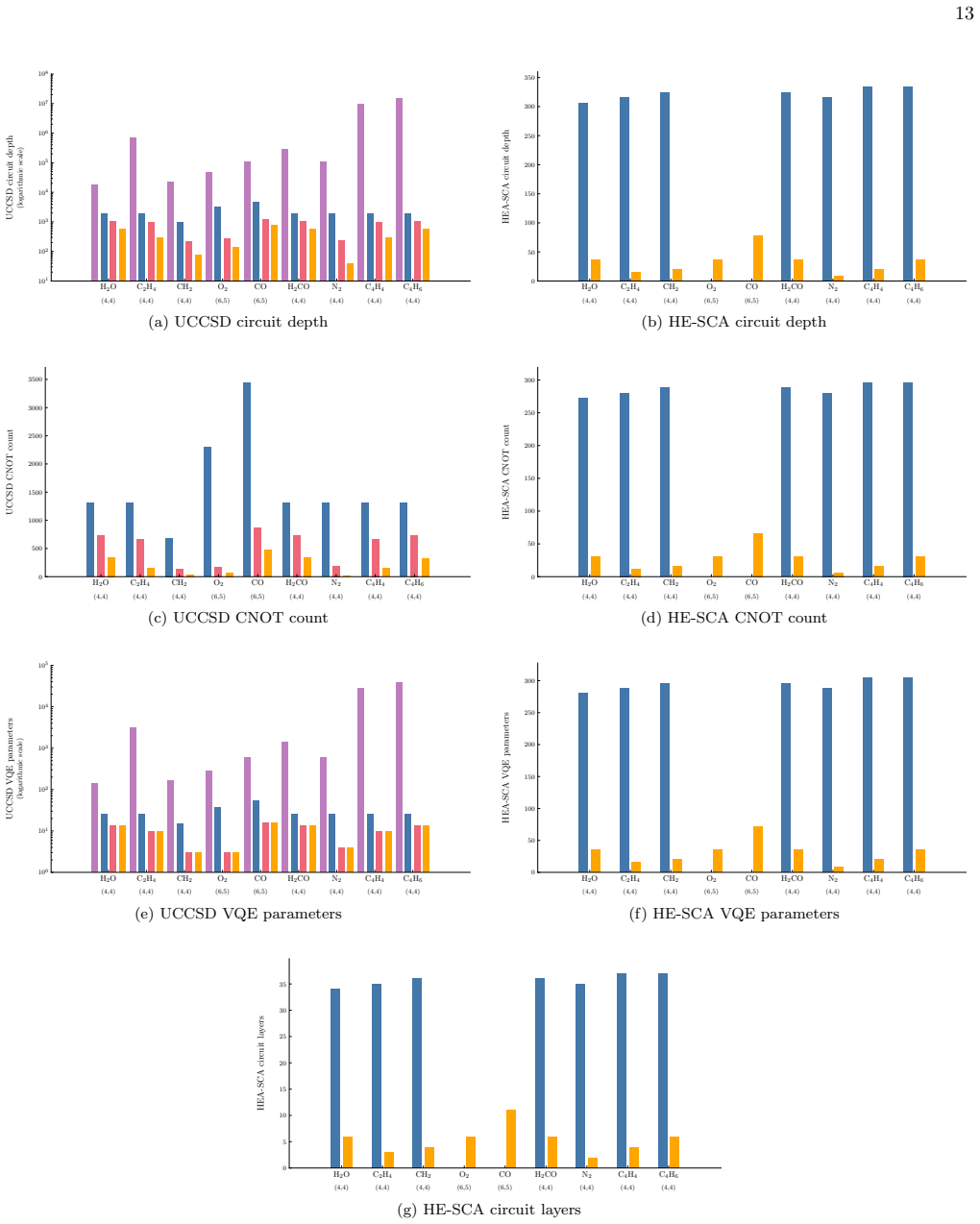
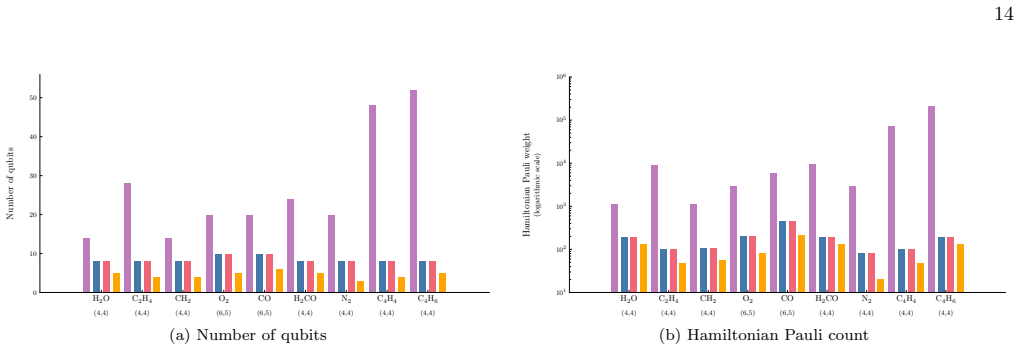
- SAE-CAS produces Hamiltonians with fewer qubits and lower Pauli-operator weight than Jordan-Wigner CAS encodings.
- The resulting circuits are shallower and contain fewer variational parameters.
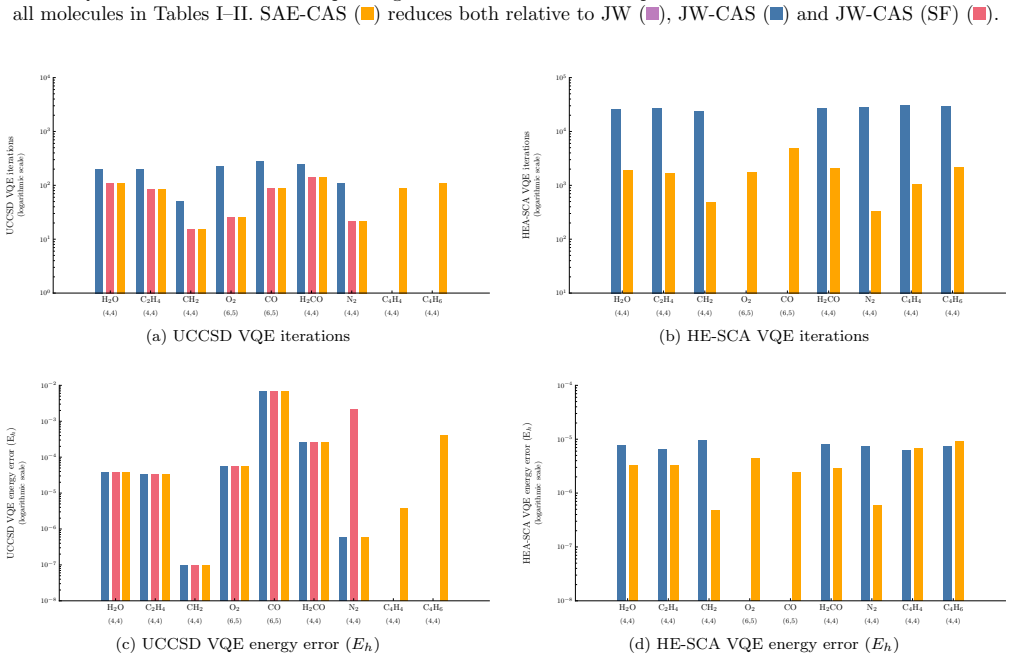
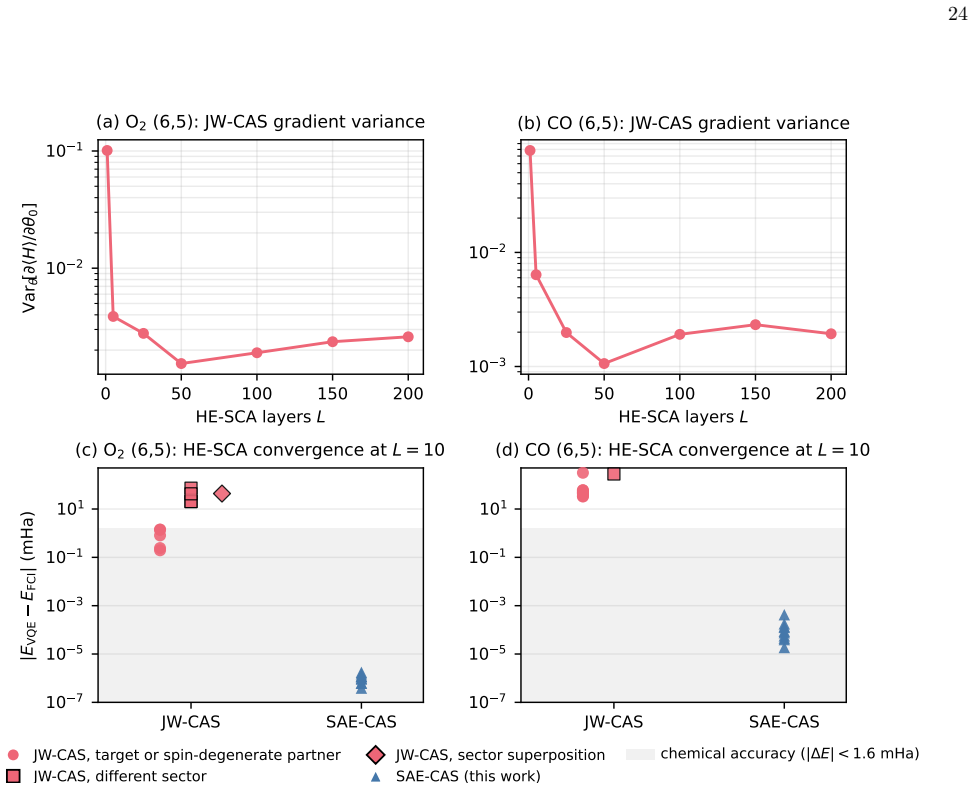
- With hardware-efficient shifted-circular-alternating ansatzes, SAE-CAS reaches CAS reference energies in cases where Jordan-Wigner CAS fails to converge within the same iteration budget.
- The construction remains unitarily equivalent when the Bravyi-Kitaev mapping is substituted for Jordan-Wigner.
Where Pith is reading between the lines
- The qubit savings could be traded for additional error-mitigation qubits on near-term devices.
- The same affine-transformation technique might be applied to other active-space approximations beyond CAS.
- The open-source implementation permits direct comparison on molecular systems larger than the nine tested.
Load-bearing premise
The derived mapping from the second-quantised Hamiltonian to active-space qubit Hamiltonians is exactly equivalent to the canonical CAS Hamiltonian after frozen-core and virtual-orbital projection.
What would settle it
A ground-state energy calculation on any of the nine benchmark molecules in which the SAE-CAS variational minimum differs from the standard CAS reference energy beyond numerical tolerance.
Figures
read the original abstract
We present a symmetry-adapted qubit encoding with complete active space (SAE-CAS) for quantum chemistry on fault-tolerant and near-term quantum processors. Building on exact-symmetry encodings, we extend symmetry-adapted mappings to approximate $Z$-symmetries corresponding to frozen-core and virtual orbitals, thereby reducing qubit requirements without significant loss of accuracy. We derive the mapping from the second-quantised Hamiltonian to active-space qubit Hamiltonians, prove its equivalence to the canonical CAS Hamiltonian with frozen-core and virtual-orbital projection, and integrate it with point-group and spin-parity symmetry encodings via affine Clifford transformations to maximise qubit reduction while preserving the target symmetry sector. The same framework also accommodates the Bravyi--Kitaev mapping, yielding an SAE-CAS-BK variant that is unitarily equivalent to SAE-CAS. Numerical benchmarking on nine small molecules using UCCSD and a hardware-efficient shifted-circular-alternating (HE-SCA) ansatz shows that SAE-CAS reduces qubit counts and Pauli-operator weight, yields shallower circuits with fewer parameters, and often accelerates VQE convergence; with HE-SCA it consistently reaches CAS reference energies in cases where JW-CAS does not converge within the tested budgets. We provide an open-source implementation in the Python package QuantumSymmetry. SAE-CAS offers a route to resource-efficient molecular simulations on fault-tolerant and near-term quantum processors.
Editorial analysis
A structured set of objections, weighed in public.
Referee Report
Summary. The manuscript introduces SAE-CAS, a symmetry-adapted qubit encoding for complete active space quantum chemistry simulations. It extends symmetry-adapted mappings to approximate Z-symmetries for frozen-core and virtual orbitals, derives the mapping from the second-quantized Hamiltonian to active-space qubit Hamiltonians, proves equivalence to the canonical CAS Hamiltonian after frozen-core and virtual-orbital projection, and integrates it with point-group and spin-parity symmetries via affine Clifford transformations. The framework also yields an SAE-CAS-BK variant that is unitarily equivalent. Numerical benchmarks on nine small molecules with UCCSD and HE-SCA ansatzes report reduced qubit counts, lower Pauli weights, shallower circuits, fewer parameters, and accelerated VQE convergence, with an open-source implementation in QuantumSymmetry.
Significance. If the equivalence holds, the method provides a systematic route to lower qubit requirements and circuit depths for molecular simulations on near-term and fault-tolerant hardware while preserving accuracy in the active space. The explicit derivation and proof, together with the open-source code, are strengths that support reproducibility and potential adoption.
major comments (1)
- [Derivation and equivalence proof section] Derivation and equivalence proof section: the claimed proof of equivalence to the canonical CAS Hamiltonian after frozen-core/virtual projection must explicitly demonstrate that the approximate Z-symmetries commute with the active-space projection operators and that the unitary equivalence for the BK variant preserves the exact spectrum in the target sector; without this, the reported VQE advantages (especially HE-SCA reaching reference energies where JW-CAS does not) could arise from an altered Hamiltonian rather than the encoding.
minor comments (2)
- [Abstract] Abstract: the long sentence describing the numerical results and ansatzes could be split for readability.
- [Numerical benchmarking section] Numerical benchmarking section: inclusion of a summary table listing qubit counts, Pauli weights, and circuit depths for SAE-CAS versus JW-CAS across all nine molecules would improve clarity and allow direct comparison.
Simulated Author's Rebuttal
We thank the referee for their careful reading and constructive feedback. We address the single major comment below.
read point-by-point responses
-
Referee: [Derivation and equivalence proof section] Derivation and equivalence proof section: the claimed proof of equivalence to the canonical CAS Hamiltonian after frozen-core/virtual projection must explicitly demonstrate that the approximate Z-symmetries commute with the active-space projection operators and that the unitary equivalence for the BK variant preserves the exact spectrum in the target sector; without this, the reported VQE advantages (especially HE-SCA reaching reference energies where JW-CAS does not) could arise from an altered Hamiltonian rather than the encoding.
Authors: We agree that the equivalence proof would benefit from greater explicitness on these points. In the revised manuscript we will augment the derivation section with a direct verification that the approximate Z-symmetries commute with the active-space projection operators, together with an explicit argument establishing that the unitary equivalence for the SAE-CAS-BK variant preserves the exact spectrum inside the target sector. These additions will make clear that the Hamiltonian in the active space remains unaltered and that the reported VQE improvements originate from the encoding. revision: yes
Circularity Check
No significant circularity; derivation chain is self-contained.
full rationale
The paper claims to derive the SAE-CAS mapping from the second-quantised Hamiltonian and prove its equivalence to the canonical CAS Hamiltonian after frozen-core and virtual-orbital projection, then combine with symmetry encodings via affine Clifford transformations. No quoted equations or steps in the abstract or description reduce any result to a fitted parameter, self-definition, or unverified self-citation chain. The central equivalence is presented as a derived proof rather than an ansatz or renaming. Self-citations, if present for 'exact-symmetry encodings,' are not shown to be load-bearing for the equivalence claim. The numerical benchmarks use standard VQE methods and reference energies, providing external falsifiability. This meets the criteria for a self-contained derivation.
Axiom & Free-Parameter Ledger
Reference graph
Works this paper leans on
-
[1]
Any two are independent; their fixed eigenvalues are determined by the chosenNandM S. b. Point-group symmetry.A molecule’s point group is the group of symmetry operations (rotations, reflections, inversion and improper rotations, together with the identity) that leave its geometry unchanged about a fixed point. Its irreducible representations govern symme...
-
[2]
andD 2h (isomorphic toZ 3 2). In practice, in quantum chemistry we descend to the largest Boolean subgroup of the full point group to make the irreducible representations one-dimensional and real: in this case each symmetry-adapted orbital is either symmetric (the symmetry acts on the orbital as multiplication by +1) or antisymmetric (−1) under each symme...
-
[3]
JW: the standard Jordan–Wigner mapping without any symmetry-based qubit removal
-
[4]
JW-CAS: the Jordan–Wigner mapping of the complete active-space orbitals only, with excitations restricted to the chosen active orbitals but not exploiting any point-group symmetries
-
[5]
JW-CAS (SF): the same active-space encoding as JW-CAS with manual screening of excitations to enforce point-group symmetry by including only operators in the totally symmetric representation; this matches the number of variational parameters of SAE-CAS and reduces circuit complexity
-
[6]
SAE-CAS: the symmetry-adapted qubit encoding with complete active space mapping which incorporates both point-group and spin-parity symmetries to remove redundant qubits. For the HE-SCA ansatz we compare Jordan–Wigner mapping of the complete active-space orbitals only (JW-CAS) and our proposal, SAE-CAS. Tables I and II report, for each encoding, (a) numbe...
-
[7]
the linear mapT∈ {0,1} n×n is obtained from the identityI n by replacing its firstkrows withS
-
[8]
the shiftb∈ {0,1} n isb= c 0 . Proof.Since eachg i acts diagonally in the JW computational basis and its action commutes with a reordering of the spin-orbitals, its JW image is aZ–string: ΦJW(gi) =Z(z i), z i ∈F n 2 .(D2) By (i).By Proposition 4, ifCpermutes computational-basis states without phases it is an affine Clifford: C|a⟩=|T a⊕b⟩, T∈GL(n,2), b∈F n...
-
[9]
Ifp∈Vorq∈V, the term vanishes by (G5)
-
[10]
Similarly, ifp∈Aandq∈F,P a † paiP=a † p(P ai)P= 0, using (G6) and (G4)
Ifp∈Fandq∈A, thenP a † i apP= (a † i P)a pP= 0. Similarly, ifp∈Aandq∈F,P a † paiP=a † p(P ai)P= 0, using (G6) and (G4)
-
[11]
Ifp=q=i∈F, thenP a † i aiP=P n iP=P
-
[12]
Therefore the projected one-electron operator equals P X pq hpq a† paq P= X p,q∈A hpq a† paq P+ X i∈F hii P.(G7) Two-electron part.ConsiderP 1 2 P pqrs gpqrs a† pa† qasar P
Ifp, q∈A, the term is unchanged because active operators commute withP. Therefore the projected one-electron operator equals P X pq hpq a† paq P= X p,q∈A hpq a† paq P+ X i∈F hii P.(G7) Two-electron part.ConsiderP 1 2 P pqrs gpqrs a† pa† qasar P. Any term that contains a virtual index vanishes by (G5). Terms with exactly one or three frozen indices also va...
-
[13]
Proof.Conjugation and associativity give Q′H ′ qQ′ = (C1QC †
Then Q′ H ′ q Q′ =C 1 Q Hq Q C † 1 =C 1 ΦJW(P HP)C † 1.(I1) After fixing theZeigenvalues onF∪Vand removing those qubits, the two active-space Hamiltonians—obtained by applyingC 1 before the CAS projection or after it—are related by an affine Clifford on the active qubits and are therefore isospectral. Proof.Conjugation and associativity give Q′H ′ qQ′ = (C1QC †
-
[14]
By Proposition 13,QH qQ= Φ JW(P HP), proving (I1)
=C 1 QHqQ C† 1. By Proposition 13,QH qQ= Φ JW(P HP), proving (I1). Because the symmetry qubits correspond to active spin-orbitals,T 1 andb 1 have the form: T1 = I0 0 TAF TAA TAV 0 0I , b 1 = 0 bA 0 (I2) SoC 1 acts as the identity on the space of frozen-core and virtual qubits. Moreover the values of the frozen-core qubits are fixed to only...
-
[15]
B. O. Roos, P. R. Taylor, and P. E. M. Siegbahn, Chemical Physics48, 157 (1980)
1980
-
[16]
Helgaker, P
T. Helgaker, P. Jørgensen, and J. Olsen,Molecular Electronic-Structure Theory(John Wiley & Sons, Chichester, 2000)
2000
-
[17]
R. P. Feynman, International Journal of Theoretical Physics21, 467 (1982)
1982
-
[18]
Y. Cao, J. Romero, J. P. Olson, M. Degroote, P. D. Johnson, M. Kieferov´ a, I. D. Kivlichan, T. Menke, B. Peropadre, N. P. D. Sawaya, S. Sim, L. Veis, and A. Aspuru-Guzik, Chemical Reviews119, 10856 (2019)
2019
-
[19]
McArdle, S
S. McArdle, S. Endo, A. Aspuru-Guzik, S. C. Benjamin, and X. Yuan, Reviews of Modern Physics92, 015003 (2020)
2020
-
[20]
Preskill, Quantum2, 79 (2018)
J. Preskill, Quantum2, 79 (2018)
2018
-
[21]
J. R. McClean, J. Romero, R. Babbush, and A. Aspuru-Guzik, New Journal of Physics18, 023023 (2016)
2016
-
[22]
Arute, K
F. Arute, K. Arya, R. Babbush, and et al., Nature574, 505 (2019)
2019
-
[23]
McArdle, T
S. McArdle, T. Jones, S. Endo, Y. Li, S. C. Benjamin, and X. Yuan, npj Quantum Information5, 75 (2019)
2019
-
[24]
S. Endo, J. Sun, Y. Li, S. C. Benjamin, and X. Yuan, Physical Review Letters125, 010501 (2020)
2020
-
[25]
Benedetti, M
M. Benedetti, M. Fiorentini, and M. Lubasch, Physical Review Research3, 033083 (2021)
2021
- [26]
-
[27]
Adaptive Variational Quantum Imaginary Time Evolution Approach for Ground State Preparation,
N. Gomes, A. Mukherjee, F. Zhang, T. Iadecola, C.-Z. Wang, K.-M. Ho, P. P. Orth, and Y.-X. Yao, arXiv preprint arXiv:2102.01544 (2021)
-
[28]
Stokes, J
J. Stokes, J. Izaac, N. Killoran, and G. Carleo, Quantum4, 269 (2020)
2020
-
[29]
H. R. Grimsley, S. E. Economou, E. Barnes, and N. J. Mayhall, Nature Communications10, 3007 (2019). 24 0 50 100 150 200 HE-SCA layers L 10 2 10 1 Var [ H / 0] (a) O2 (6,5): JW-CAS gradient variance 0 50 100 150 200 HE-SCA layers L 10 3 10 2 (b) CO (6,5): JW-CAS gradient variance JW-CAS SAE-CAS 10 7 10 5 10 3 10 1 101 |EVQE EFCI| (mHa) (c) O2 (6,5): HE-SCA...
2019
- [30]
-
[31]
Verteletskyi, T
V. Verteletskyi, T. Yen, and A. F. Izmaylov, The Journal of Chemical Physics152, 124114 (2020)
2020
-
[32]
H. L. Tang, V. O. Shkolnikov, G. S. Barron, H. R. Grimsley, N. J. Mayhall, E. Barnes, and S. E. Economou, PRX Quantum 2, 020310 (2021)
2021
-
[33]
Setia, R
K. Setia, R. Chen, J. E. Rice, A. Mezzacapo, M. Pistoia, and J. D. Whitfield, Journal of Chemical Theory and Computation 16, 6091 (2020)
2020
-
[34]
Picozzi and J
D. Picozzi and J. Tennyson, Quantum Science and Technology8, 035026 (2023)
2023
-
[35]
Tapering off qubits to simulate fermionic Hamiltonians
S. Bravyi, J. M. Gambetta, A. Mezzacapo, and K. Temme, arXiv preprint arXiv:1701.08213 (2017)
work page internal anchor Pith review Pith/arXiv arXiv 2017
-
[36]
van Leeuwen, New Journal of Physics26, 103023 (2024)
R. van Leeuwen, New Journal of Physics26, 103023 (2024)
2024
-
[37]
Steudtner and S
M. Steudtner and S. Wehner, New Journal of Physics20, 063010 (2018)
2018
-
[38]
S. B. Bravyi and A. Y. Kitaev, Annals of Physics298, 210 (2002)
2002
-
[39]
J. T. Seeley, M. J. Richard, and P. J. Love, The Journal of Chemical Physics137, 224109 (2012). 25
2012
-
[40]
Tranter, P
A. Tranter, P. J. Love, F. Mintert, and P. V. Coveney, Journal of Chemical Theory and Computation14, 5617 (2018)
2018
-
[41]
Romero, R
J. Romero, R. Babbush, J. R. McClean, and et al., Quantum Science and Technology4, 014008 (2018)
2018
-
[42]
Bonet-Monroig, R
X. Bonet-Monroig, R. Sagastizabal, M. Singh, and T. E. O’Brien, Physical Review A98, 062339 (2018)
2018
-
[43]
McArdle, X
S. McArdle, X. Yuan, and S. Benjamin, Physical Review Letters122, 180501 (2019)
2019
-
[44]
R. J. Bartlett and M. Musia l, Reviews of Modern Physics79, 291 (2007)
2007
-
[45]
Peruzzo, J
A. Peruzzo, J. McClean, P. Shadbolt, M.-H. Yung, X.-Q. Zhou, P. J. Love, A. Aspuru-Guzik, and J. L. O’Brien, Nature Communications5, 4213 (2014)
2014
-
[46]
Kandala, A
A. Kandala, A. Mezzacapo, K. Temme, M. Takita, M. Brink, J. M. Chow, and J. M. Gambetta, Nature549, 242 (2017)
2017
- [47]
-
[48]
Kraft,A Software Package for Sequential Quadratic Programming, Tech
D. Kraft,A Software Package for Sequential Quadratic Programming, Tech. Rep. FB 88-28 (Deutsche Forschungs- und Versuchsanstalt f¨ ur Luft- und Raumfahrt (DFVLR), K¨ oln, Germany, 1988)
1988
-
[49]
B. T. Gard, L. Zhu, G. S. Barron, N. J. Mayhall, S. E. Economou, and E. Barnes, npj Quantum Information6, 10 (2020)
2020
-
[50]
Picozzi, QuantumSymmetry: Quantum computing research package,https://github.com/dariopicozzi/ quantumsymmetry(2023), concept DOI, all versions; source on GitHub
D. Picozzi, QuantumSymmetry: Quantum computing research package,https://github.com/dariopicozzi/ quantumsymmetry(2023), concept DOI, all versions; source on GitHub
2023
-
[51]
J. R. McClean, S. Boixo, V. N. Smelyanskiy, R. Babbush, and H. Neven, Nature Communications9, 4812 (2018)
2018
discussion (0)
Sign in with ORCID, Apple, or X to comment. Anyone can read and Pith papers without signing in.