REVIEW 3 major objections 6 minor 69 references
Tokenizing Loops of Antibodies
T0 review · 3 major / 6 minor · reviewed 2026-08-04 · deepseek-v4-flash
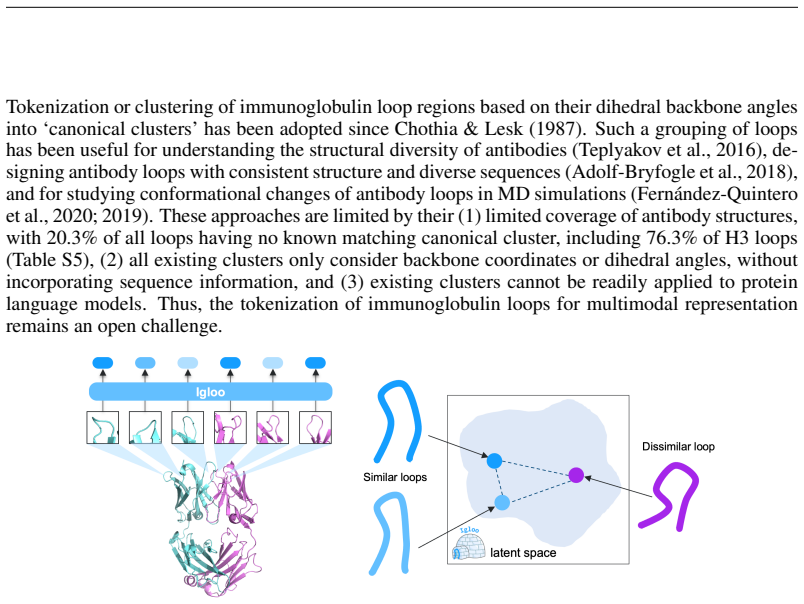
Pith's one-line read Igloo, a multimodal antibody-loop tokenizer that encodes sequence and backbone dihedral angles, claims to retrieve structurally similar H3 loops from a structural antibody database, beating the previous best structure tokenizer by 5.9%.
desk verdict Genuinely new loop-level antibody tokenizer, but the 5.9% H3 headline is metric-bound and doesn't hold up on RMSD; worth reviewing, not worth accepting the SOTA claim yet. read the letter →
The pith
A machine-rendered reading of the paper's core claim, the machinery that carries it, and where it could break.
The reading
What carries the argument
The load-bearing mechanism is the dihedral-angle distance D (Eq. 1), the mean over phi/psi/omega of $2(1 - \cos(\text{difference}))$, with a dynamic-time-warping alignment when loop lengths differ. D is used twice: it defines positive and negative pairs for the contrastive loss (positive if same length and $D<0.1$, negative if $D>0.47$ or different length), and it is the criterion for a retrieval to count as correct in evaluation. Around that distance, the model is a compact transformer whose input is the sum of dihedral-circle embeddings and amino acid embeddings; its classification token t serves as the continuous loop token, and a learned codebook maps t to a discrete token $\hat{t}$.
What would settle it
Test Igloo's H3 retrieval with a correctness criterion independent of $D$ — for example, full-atom RMSD after global superposition of the flanking stem residues, or binding to a panel of antigens as a functional readout — and check whether its precision at rank 20 still beats Amino Aseed and the best sequence language model. A sharper version would hold out a set of H3 loops whose D-based labels disagree with the independent measure and show that Igloo's rankings track the independent measure; if they only track $D$, the tokenizer is encoding the training metric rather than the structure it is cla
Extended reading notes
Core claim
The central discovery is that representing an antibody loop as one token formed from both sequence and backbone dihedral angles, rather than from amino acid-level structure tokens, organizes the latent space by loop geometry in a way that makes structural similarity directly readable. The token is computed by wrapping phi/psi/omega angles onto the unit circle, projecting them, summing with per-residue amino acid embeddings, and passing the mixture through a small transformer; the classification token is trained with a contrastive loss on dihedral-distance pairs plus masked reconstruction of angles and sequence and a codebook loss. In retrieval from SAbDab using precision at rank 20 with the
Load-bearing premise
The load-bearing premise is that the dihedral-angle distance D, with dynamic time warping for unequal loop lengths, is a faithful measure of how similar two antibody loops are in structure, and that the boundaries $D<0.1$ for 'similar' and $D>0.47$ for 'different' separate the two correctly. If $D$ is not a good measure for the most diverse H3 loops, the same flawed metric both trains Igloo and awards it the reported 5.9% improvement.
Editorial extensions
If this is right
- Igloo gives antibody language models a compact loop-level structural token, so a 420M-parameter model can beat a 3B-parameter sequence model on H3 loop retrieval while also outperforming prior structure tokenizers.
- Every loop receives a token, including the H3 loops that canonical clusters do not cover, and the learned codebook still reproduces the known canonical cluster boundaries at high purity.
- Inserting Igloo loop tokens into an antibody language model (IglooLM) improves binding-affinity prediction over the base model on 8 of 10 antibody-antigen targets from the evaluated benchmark, with average performance comparable to models more than 7 times larger.
- IglooALM samples loop sequences that are diverse in sequence (average sequence identity 0.27 in the SARS-CoV-2 H3 example) but consistent in structure (less than 1 Å RMSD to the original loop), which is the pattern needed for controllable antibody CDR design.
- The full training, evaluation, and inference code is released, so the tokenizer can be retrained on additional antibody/TCR datasets or directly applied to new structures.
Reading between the lines
- If the loop-token representation is as general as it appears, the same contrastive scheme could be applied to any repetitive structural element in proteins — TCR CDRs, nanobody scaffolds, or binding loops of other immune receptors — where canonical classifications are incomplete.
- Because Igloo is trained and evaluated with the same D metric, the reported 5.9% gain is partly a measure of how well the model fits that specific geometric similarity; an independent test, such as full-atom RMSD after global superposition or functional binding data, would reveal whether the latent space captures the structural variation that matters for biology.
- The gap between the positive threshold (D<0.1) and negative threshold (D>0.47) creates a neutral zone that the contrastive loss ignores; Igloo may therefore be less sensitive to moderate but functionally relevant conformational changes, exactly the regime where affinity maturation operates.
- The quantized codebook behaves like a learned, fully covering version of canonical clusters, which suggests a fast indexing scheme: a large antibody structure library can be pre-indexed by discrete loop tokens, and retrieval or annotation of new loops becomes a lookup rather than pairwise distance computation.
Editorial analysis
A structured set of objections, weighed in public.
Referee Report
Summary. The paper introduces Igloo, a multimodal tokenizer for antibody CDR loops that encodes backbone dihedral angles and amino-acid sequence. Igloo is trained with a contrastive objective based on the dihedral-angle distance D of North et al. (2011), together with masked reconstruction and codebook learning. The authors report three applications: retrieval of similar loop structures from SAbDab (with a claimed 5.9% improvement over prior methods on H3 loops), recovery of known canonical clusters, integration into protein language models (IglooLM and IglooALM) for affinity prediction and controllable loop sampling. The manuscript includes substantial implementation detail, ablations, and a public code repository.
Significance. If the central claims hold, Igloo is a useful and timely contribution: it provides a loop-level structural tokenizer for antibodies, addresses the limited coverage of canonical cluster assignments, and demonstrates a practical path for injecting structural information into antibody language models. The paper is generally well executed: the training setup is described in detail, ablations are provided, and the code is promised to be public. The main value is not a single state-of-the-art number but the demonstration that a compact, contrastively trained loop tokenizer can capture antibody backbone geometry and be plugged into downstream models. However, the headline retrieval claim is currently weaker than stated, because the reported gain is concentrated on a metric that is aligned with the training objective and disappears under an independent RMSD criterion.
major comments (3)
- [§4.1, Table 1, Eq. (2)] The headline 5.9% H3 retrieval improvement is metric-specific and partly circular. The contrastive loss in Eq. (2) is trained with positive pairs D<0.1 and negative pairs D>0.47, and retrieval success is defined in §4.1 as D<0.47. On the independent RMSD<1 Å criterion in Table 1, Igloo's H3 precision@20 is 0.278, below Amino Aseed (0.292) and ProteinMPNN (0.286). Thus the claim 'outperforming existing methods on identifying similar H3 loops' is supported only for a dihedral-distance criterion aligned with the training objective, not for a conventional structural-similarity measure. Table 1 also reports no confidence intervals, error bars, or query counts, so the 5.9% relative gap may be within noise. Please qualify the abstract and main text to 'D<0.47 dihedral-distance retrieval' and report uncertainty or an independent structural metric for the H3 claim.
- [§4.4, Fig. 5, Appendix A.1] The IglooALM self-consistency evaluation may be biased by shared use of Ibex. Igloo is trained on 699,648 Ibex-predicted OAS loops (Appendix A.1), and IglooALM tokenizes structures derived from Ibex predictions; in §4.4 the sampled sequences are folded with Ibex and compared to the original loops. Baseline inverse-folding models such as AbMPNN and AntiFold were not trained on Ibex predictions. A model that has internalized Ibex's structural biases is likely to obtain lower scRMSD when the same predictor is used for evaluation. Please add evaluation with an independent structure-prediction method or native crystal structures, or show that the relative ranking survives under a different predictor.
- [§4.2, Table 2, Table S5] The canonical-cluster recovery experiment is evaluated only on loops that can be assigned to a reference cluster. For H3, 76.3% of SAbDab loops have no known canonical cluster (Table S5), so the reported H3 purity of 0.754 in Table 2 applies to the 23.7% assigned subset. This does not invalidate the claim that Igloo assigns a token to every loop, but it limits the strength of the statement that Igloo 'retains the ability to recover canonical loop conformations' across the diverse H3 landscape. Please state this restriction explicitly and, if possible, report how the unassigned loops are distributed over Igloo codebooks.
minor comments (6)
- [Abstract] The phrase 'outperforming the existing methods on identifying similar H3 loops by 5.9%' should specify that this gain is for the D<0.47 dihedral-distance criterion, not for RMSD-based structural similarity.
- [Table 1] Table 1 reports precision at rank 20 without confidence intervals or query counts. Given the small relative differences, error bars or a paired bootstrap would substantially strengthen the comparison.
- [§4.3, Table 3] IglooLM outperforms IgBert on 8/10 targets, but on many targets the differences are within the reported standard errors. A paired significance test or a confidence interval on the average improvement would make the claim more robust.
- [Fig. S1 caption] Typo: 'IGLOOlatet space' should be 'IGLOO latent space'.
- [§4.2, Figure 4] The observation that the most frequent H3 codebook entry appears 387 times and corresponds to identical Fv16 sequences suggests possible redundancy in SAbDab. Please state whether the retrieval and clustering evaluations are robust to redundancy filtering at, e.g., 80% sequence identity.
- [§5, Conclusion] The manuscript appropriately notes that wet-lab validation is needed for the design claims. This limitation should also be reflected in the abstract's phrase 'more consistent in structure' by clarifying that consistency is measured in silico via re-folding.
Circularity Check
H3 retrieval gain is on the same dihedral-distance metric used to define contrastive training labels; canonical-cluster recovery uses the same D=0.47 cutoff that defines training negatives.
-
fitted input called prediction
[Section 3.2 (Eqs. 1–2) and Section 4.1]
"A pair of loops u, v is a positive pair (Y_uv = 1) if the loops are of the same length and D < 0.1. A pair of loops is a negative pair (Y_uv = 0) if they are of different lengths or D > 0.47 for loops of the same length, where D = 0.47 corresponds to an average difference in dihedral angles of 40°, which is the threshold used in the clustering by Kelow et al. (2022). ... Retrieved CDRs are deemed correct if D < 0.47 (Eq. 1) or RMSD < 1 Å to the query CDR loop."
The contrastive loss in Eq. 2 is trained with binary labels derived directly from the North dihedral distance D: positive pairs are defined by D<0.1 and negative pairs by D>0.47. The headline retrieval result is then evaluated by counting a hit as correct when D<0.47 to the query, i.e. using the same distance function and a threshold that is the complement of the training negative boundary. The model is therefore optimizing a representation to separate D>0.47 pairs from D<0.1 pairs, and the D<0.47 retrieval metric is aligned with that training signal. The 5.9% H3 improvement over Amino Aseed is metric-specific and does not carry over to the independent RMSD<1Å criterion, where Igloo (0.278) trails Amino Aseed (0.292) and ProteinMPNN (0.286).
-
self definitional
[Section 3.2 and Section 4.2]
"where D = 0.47 corresponds to an average difference in dihedral angles of 40°, which is the threshold used in the clustering by Kelow et al. (2022). ... We evaluate on all loops in SAbDab that can be assigned to a reference cluster with a cutoff of D = 0.47 to the centroid."
The canonical clusters used as ground truth in Section 4.2 are the Kelow et al. clusters, which are defined by assigning loops to a centroid when D<0.47. But D>0.47 is exactly the negative-pair boundary used to construct the contrastive training labels in Section 3.2, and D<0.1 is the positive-pair boundary. Thus the model's latent space is trained to place loops on the same side of D=0.47 as the reference clusters. The reported cluster purity is therefore partly a check that the trained representation respects the same dihedral-distance threshold that generated the training labels, rather than an independent discovery of canonical conformations.
full rationale
The paper is not globally circular: IglooLM affinity prediction on AbBiBench and IglooALM loop generation are evaluated against external benchmarks and independent RMSD/self-consistency criteria, and the code is released. However, the paper's strongest quantitative claim—the 5.9% H3 retrieval improvement—is made on a metric (D<0.47) that is the same dihedral-distance measure and threshold family used to define the contrastive training positives/negatives. The abstract states this as 'identifying similar H3 loops' without qualifying that the gain appears only under D and disappears under RMSD<1Å. The canonical-cluster recovery result is also entangled with the training objective because the reference clusters are defined by the same D=0.47 cutoff used as the training negative boundary. The use of Ibex for both generating the training loop structures and folding sampled sequences for scRMSD is a same-tool evaluation concern, but it is not a derivation-level circularity and does not by itself force the reported numbers. Overall, the central retrieval/clustering claims partially reduce to the training definition of structural similarity, warranting a score of 6 rather than a higher score, because the affinity and generation results retain independent content.
Assumptions & free parameters
free parameters (6)
- positive dihedral-distance threshold (D<0.1) =
0.1
- negative dihedral-distance threshold (D>0.47) =
0.47
- contrastive temperature tau =
not reported
- codebook size =
8192
- embedding dimension =
128
- loss weights (alpha, lambda) =
alpha=0.5, lambda=0.01
assumptions (6)
- domain assumption The dihedral-distance D (North et al., 2011) with DTW alignment is a faithful similarity measure for antibody loop structures.
- ad hoc to paper Loops with D<0.1 are structurally similar and loops with D>0.47 are structurally dissimilar.
- domain assumption Ibex-predicted structures are accurate enough to serve as ground truth for training and evaluation of the downstream models.
- ad hoc to paper Self-consistency RMSD after folding with Ibex is a meaningful metric for structural consistency of designed loops.
- domain assumption AbBiBench binding affinity measurements are reliable labels for the affinity prediction experiments.
- standard math The standard transformer and contrastive learning machinery are correctly implemented.
Cite this review
Pith. "Pith review of Tokenizing Loops of Antibodies." pith.science (2026). https://pith.science/paper/G6PKSVHI
@misc{pith2026250908707,
  author       = {Pith},
  title        = {Pith review of: Tokenizing Loops of Antibodies},
  year         = {2026},
  howpublished = {\url{https://pith.science/paper/G6PKSVHI}},
  note         = {Machine review of arXiv:2509.08707}
}
abstract
The complementarity-determining regions of antibodies are loop structures that are key to their interactions with antigens, and of high importance to the design of novel biologics. Since the 1980s, categorizing the diversity of CDR structures into canonical clusters has enabled the identification of key structural motifs of antibodies. However, existing approaches have limited coverage and cannot be readily incorporated into protein foundation models. Here we introduce ImmunoGlobulin LOOp Tokenizer, Igloo, a multimodal antibody loop tokenizer that encodes backbone dihedral angles and sequence. Igloo is trained using a contrastive learning objective to map loops with similar backbone dihedral angles closer together in latent space. Igloo can efficiently retrieve the closest matching loop structures from a structural antibody database, outperforming existing methods on identifying similar H3 loops by 5.9\%. Igloo assigns tokens to all loops, addressing the limited coverage issue of canonical clusters, while retaining the ability to recover canonical loop conformations. To demonstrate the versatility of Igloo tokens, we show that they can be incorporated into protein language models with IglooLM and IglooALM. On predicting binding affinity of heavy chain variants, IglooLM outperforms the base protein language model on 8 out of 10 antibody-antigen targets. Additionally, it is on par with existing state-of-the-art sequence-based and multimodal protein language models, performing comparably to models with $7\times$ more parameters. IglooALM samples antibody loops which are diverse in sequence and more consistent in structure than state-of-the-art antibody inverse folding models. Igloo demonstrates the benefit of introducing multimodal tokens for antibody loops for encoding the diverse landscape of antibody loops, improving protein foundation models, and for antibody CDR design.
Figures


Figures from the paper (2 more)


Reference graph
Works this paper leans on
-
[1]
write newline
" write newline "" before.all 'output.state := FUNCTION n.dashify 't := "" t empty not t #1 #1 substring "-" = t #1 #2 substring "--" = not "--" * t #2 global.max substring 't := t #1 #1 substring "-" = "-" * t #2 global.max substring 't := while if t #1 #1 substring * t #2 global.max substring 't := if while FUNCTION format.date year duplicate empty "emp...
-
[2]
@esa (Ref
\@ifxundefined[1] #1\@undefined \@firstoftwo \@secondoftwo \@ifnum[1] #1 \@firstoftwo \@secondoftwo \@ifx[1] #1 \@firstoftwo \@secondoftwo [2] @ #1 \@temptokena #2 #1 @ \@temptokena \@ifclassloaded agu2001 natbib The agu2001 class already includes natbib coding, so you should not add it explicitly Type <Return> for now, but then later remove the command n...
-
[3]
\@lbibitem[] @bibitem@first@sw\@secondoftwo \@lbibitem[#1]#2 \@extra@b@citeb \@ifundefined br@#2\@extra@b@citeb \@namedef br@#2 \@nameuse br@#2\@extra@b@citeb \@ifundefined b@#2\@extra@b@citeb @num @parse #2 @tmp #1 NAT@b@open@#2 NAT@b@shut@#2 \@ifnum @merge>\@ne @bibitem@first@sw \@firstoftwo \@ifundefined NAT@b*@#2 \@firstoftwo @num @NAT@ctr \@secondoft...
-
[4]
@open @close @open @close and [1] URL: #1 \@ifundefined chapter * \@mkboth \@ifxundefined @sectionbib * \@mkboth * \@mkboth\@gobbletwo \@ifclassloaded amsart * \@ifclassloaded amsbook * \@ifxundefined @heading @heading NAT@ctr thebibliography [1] @ \@biblabel @NAT@ctr \@bibsetup #1 @NAT@ctr @ @openbib .11em \@plus.33em \@minus.07em 4000 4000 `\.\@m @bibit...
-
[5]
Pyigclassify: a database of antibody cdr structural classifications
Jared Adolf-Bryfogle, Qifang Xu, Benjamin North, Andreas Lehmann, and Roland L Dunbrack Jr. Pyigclassify: a database of antibody cdr structural classifications. Nucleic acids research, 43 0 (D1): 0 D432--D438, 2015
2015
-
[6]
Rosettaantibodydesign (rabd): A general framework for computational antibody design
Jared Adolf-Bryfogle, Oleks Kalyuzhniy, Michael Kubitz, Brian D Weitzner, Xiaozhen Hu, Yumiko Adachi, William R Schief, and Roland L Dunbrack Jr. Rosettaantibodydesign (rabd): A general framework for computational antibody design. PLoS computational biology, 14 0 (4): 0 e1006112, 2018
2018
-
[7]
Can alphafold2 predict the impact of missense mutations on structure? Nature structural & molecular biology, 29 0 (1): 0 1--2, 2022
Gwen R Buel and Kylie J Walters. Can alphafold2 predict the impact of missense mutations on structure? Nature structural & molecular biology, 29 0 (1): 0 1--2, 2022
2022
-
[8]
Canonical structures for the hypervariable regions of immunoglobulins
Cyrus Chothia and Arthur M Lesk. Canonical structures for the hypervariable regions of immunoglobulins. Journal of molecular biology, 196 0 (4): 0 901--917, 1987
1987
Show all 69 references
-
[9]
Antibodies to watch in 2025
Silvia Crescioli, H \'e l \`e ne Kaplon, Lin Wang, Jyothsna Visweswaraiah, Vaishali Kapoor, and Janice M Reichert. Antibodies to watch in 2025. In MAbs, volume 17, pp.\ 2443538. Taylor & Francis, 2025
2025
-
[10]
scgpt: toward building a foundation model for single-cell multi-omics using generative ai
Haotian Cui, Chloe Wang, Hassaan Maan, Kuan Pang, Fengning Luo, Nan Duan, and Bo Wang. scgpt: toward building a foundation model for single-cell multi-omics using generative ai. Nature methods, 21 0 (8): 0 1470--1480, 2024
2024
-
[11]
Robust deep learning--based protein sequence design using proteinmpnn
Justas Dauparas, Ivan Anishchenko, Nathaniel Bennett, Hua Bai, Robert J Ragotte, Lukas F Milles, Basile IM Wicky, Alexis Courbet, Rob J de Haas, Neville Bethel, et al. Robust deep learning--based protein sequence design using proteinmpnn. Science, 378 0 (6615): 0 49--56, 2022
2022
-
[12]
Bert: Pre-training of deep bidirectional transformers for language understanding
Jacob Devlin, Ming-Wei Chang, Kenton Lee, and Kristina Toutanova. Bert: Pre-training of deep bidirectional transformers for language understanding. In Proceedings of the 2019 conference of the North American chapter of the association for computational linguistics: human langu...
2019
-
[13]
An image is worth 16x16 words: Transformers for image recognition at scale
Alexey Dosovitskiy, Lucas Beyer, Alexander Kolesnikov, Dirk Weissenborn, Xiaohua Zhai, Thomas Unterthiner, Mostafa Dehghani, Matthias Minderer, Georg Heigold, Sylvain Gelly, et al. An image is worth 16x16 words: Transformers for image recognition at scale. arXiv preprint arXiv...
2010 arXiv
-
[14]
Inverse folding for antibody sequence design using deep learning
Fr \'e d \'e ric A Dreyer, Daniel Cutting, Constantin Schneider, Henry Kenlay, and Charlotte M Deane. Inverse folding for antibody sequence design using deep learning. arXiv preprint arXiv:2310.19513, 2023
2023 arXiv
-
[15]
Conformation-aware structure prediction of antigen-recognizing immune proteins
Fr \'e d \'e ric A Dreyer, Jan Ludwiczak, Karolis Martinkus, Brennan Abanades, Robert G Alberstein, Pan Kessel, Pranav Rao, Jae Hyeon Lee, Richard Bonneau, Andrew M Watkins, et al. Conformation-aware structure prediction of antigen-recognizing immune proteins. arXiv preprint a...
2025 arXiv
-
[16]
Computational design of therapeutic antibodies with improved developability: efficient traversal of binder landscapes and rescue of escape mutations
Fr \'e d \'e ric A Dreyer, Constantin Schneider, Aleksandr Kovaltsuk, Daniel Cutting, Matthew J Byrne, Daniel A Nissley, Henry Kenlay, Claire Marks, David Errington, Richard J Gildea, et al. Computational design of therapeutic antibodies with improved developability: efficient...
2025
-
[17]
Anarci: antigen receptor numbering and receptor classification
James Dunbar and Charlotte M Deane. Anarci: antigen receptor numbering and receptor classification. Bioinformatics, 32 0 (2): 0 298--300, 2016
2016
-
[18]
Sabdab: the structural antibody database
James Dunbar, Konrad Krawczyk, Jinwoo Leem, Terry Baker, Angelika Fuchs, Guy Georges, Jiye Shi, and Charlotte M Deane. Sabdab: the structural antibody database. Nucleic acids research, 42 0 (D1): 0 D1140--D1146, 2014
2014
-
[19]
Esm cambrian: Revealing the mysteries of proteins with unsupervised learning, December 2024
ESM Team . Esm cambrian: Revealing the mysteries of proteins with unsupervised learning, December 2024. URL https://evolutionaryscale.ai/blog/esm-cambrian
2024
-
[20]
Learning universal representations of intermolecular interactions with atomica
Ada Fang, Michael Desgagné, Zaixi Zhang, Andrew Zhou, Joseph Loscalzo, Bradley L Pentelute, and Marinka Zitnik. Learning universal representations of intermolecular interactions with atomica. In Review, 2025. URL https://www.biorxiv.org/content/10.1101/2025.04.02.646906
2025 doi
-
[21]
Transitions of cdr-l3 loop canonical cluster conformations on the micro-to-millisecond timescale
Monica L Fern \'a ndez-Quintero, Barbara A Math, Johannes R Loeffler, and Klaus R Liedl. Transitions of cdr-l3 loop canonical cluster conformations on the micro-to-millisecond timescale. Frontiers in immunology, 10: 0 2652, 2019
2019
-
[22]
Antibody cdr loops as ensembles in solution vs
Monica L Fern \'a ndez-Quintero, Martin C Heiss, Nancy D Pomarici, Barbara A Math, and Klaus R Liedl. Antibody cdr loops as ensembles in solution vs. canonical clusters from x-ray structures. In MAbs, volume 12, pp.\ 1744328. Taylor & Francis, 2020
2020
-
[23]
Lab-in-the-loop therapeutic antibody design with deep learning
Nathan C Frey, Isidro H \"o tzel, Samuel D Stanton, Ryan Kelly, Robert G Alberstein, Emily Makowski, Karolis Martinkus, Daniel Berenberg, Jack Bevers III, Tyler Bryson, et al. Lab-in-the-loop therapeutic antibody design with deep learning. bioRxiv, pp.\ 2025--02, 2025
2025
-
[24]
Computing and visualizing dynamic time warping alignments in r: the dtw package
Toni Giorgino. Computing and visualizing dynamic time warping alignments in r: the dtw package. Journal of statistical Software, 31: 0 1--24, 2009
2009
-
[25]
Simulating 500 million years of evolution with a language model
Thomas Hayes, Roshan Rao, Halil Akin, Nicholas J Sofroniew, Deniz Oktay, Zeming Lin, Robert Verkuil, Vincent Q Tran, Jonathan Deaton, Marius Wiggert, et al. Simulating 500 million years of evolution with a language model. Science, pp.\ eads0018, 2025
2025
-
[26]
Bilingual language model for protein sequence and structure
Michael Heinzinger, Konstantin Weissenow, Joaquin Gomez Sanchez, Adrian Henkel, Milot Mirdita, Martin Steinegger, and Burkhard Rost. Bilingual language model for protein sequence and structure. NAR Genomics and Bioinformatics, 6 0 (4): 0 lqae150, 2024
2024
-
[27]
Efficient evolution of human antibodies from general protein language models
Brian L Hie, Varun R Shanker, Duo Xu, Theodora UJ Bruun, Payton A Weidenbacher, Shaogeng Tang, Wesley Wu, John E Pak, and Peter S Kim. Efficient evolution of human antibodies from general protein language models. Nature biotechnology, 42 0 (2): 0 275--283, 2024
2024
-
[28]
Antifold: Improved antibody structure-based design using inverse folding
Magnus Haraldson H ie, Alissa Hummer, Tobias H Olsen, Broncio Aguilar-Sanjuan, Morten Nielsen, and Charlotte M Deane. Antifold: Improved antibody structure-based design using inverse folding. arXiv preprint arXiv:2405.03370, 2024
2024 arXiv
-
[29]
Yet another numbering scheme for immunoglobulin variable domains: an automatic modeling and analysis tool
Annemarie Honegger and Andreas Plu \`e ckthun. Yet another numbering scheme for immunoglobulin variable domains: an automatic modeling and analysis tool. Journal of molecular biology, 309 0 (3): 0 657--670, 2001
2001
-
[30]
Learning inverse folding from millions of predicted structures
Chloe Hsu, Robert Verkuil, Jason Liu, Zeming Lin, Brian Hie, Tom Sercu, Adam Lerer, and Alexander Rives. Learning inverse folding from millions of predicted structures. In International conference on machine learning, pp.\ 8946--8970. PMLR, 2022
2022
-
[31]
Learning from protein structure with geometric vector perceptrons
Bowen Jing, Stephan Eismann, Patricia Suriana, Raphael JL Townshend, and Ron Dror. Learning from protein structure with geometric vector perceptrons. arXiv preprint arXiv:2009.01411, 2020
2009 arXiv
-
[32]
A penultimate classification of canonical antibody cdr conformations
Simon Kelow, Bulat Faezov, Qifang Xu, Mitchell Parker, Jared Adolf-Bryfogle, and Roland L Dunbrack Jr. A penultimate classification of canonical antibody cdr conformations. bioRxiv, pp.\ 2022--10, 2022
2022
-
[33]
Hiding in plain sight: structure and sequence analysis reveals the importance of the antibody de loop for antibody-antigen binding
Simon P Kelow, Jared Adolf-Bryfogle, and Roland L Dunbrack. Hiding in plain sight: structure and sequence analysis reveals the importance of the antibody de loop for antibody-antigen binding. In MAbs, volume 12, pp.\ 1840005. Taylor & Francis, 2020
2020
-
[34]
Large scale paired antibody language models
Henry Kenlay, Fr \'e d \'e ric A Dreyer, Aleksandr Kovaltsuk, Dom Miketa, Douglas Pires, and Charlotte M Deane. Large scale paired antibody language models. PLOS Computational Biology, 20 0 (12): 0 e1012646, 2024
2024
-
[35]
Protein function prediction as approximate semantic entailment
Maxat Kulmanov, Francisco J Guzm \'a n-Vega, Paula Duek Roggli, Lydie Lane, Stefan T Arold, and Robert Hoehndorf. Protein function prediction as approximate semantic entailment. Nature Machine Intelligence, 6 0 (2): 0 220--228, 2024
2024
-
[36]
Stcrdab: the structural t-cell receptor database
Jinwoo Leem, Saulo H P de Oliveira, Konrad Krawczyk, and Charlotte M Deane. Stcrdab: the structural t-cell receptor database. Nucleic acids research, 46 0 (D1): 0 D406--D412, 2018
2018
-
[37]
Prosst: Protein language modeling with quantized structure and disentangled attention
Mingchen Li, Yang Tan, Xinzhu Ma, Bozitao Zhong, Huiqun Yu, Ziyi Zhou, Wanli Ouyang, Bingxin Zhou, Pan Tan, and Liang Hong. Prosst: Protein language modeling with quantized structure and disentangled attention. Advances in Neural Information Processing Systems, 37: 0 35700--35...
2024
-
[38]
Evolutionary-scale prediction of atomic-level protein structure with a language model
Zeming Lin, Halil Akin, Roshan Rao, Brian Hie, Zhongkai Zhu, Wenting Lu, Nikita Smetanin, Robert Verkuil, Ori Kabeli, Yaniv Shmueli, et al. Evolutionary-scale prediction of atomic-level protein structure with a language model. Science, 379 0 (6637): 0 1123--1130, 2023
2023
-
[39]
Do antibody cdr loops change conformation upon binding? In MAbs, volume 16, pp.\ 2322533
Chu’nan Liu, Lilian M Denzler, Oliver EC Hood, and Andrew CR Martin. Do antibody cdr loops change conformation upon binding? In MAbs, volume 16, pp.\ 2322533. Taylor & Francis, 2024
2024
-
[40]
Scop: a structural classification of proteins database
Loredana Lo Conte, Bart Ailey, Tim JP Hubbard, Steven E Brenner, Alexey G Murzin, and Cyrus Chothia. Scop: a structural classification of proteins database. Nucleic acids research, 28 0 (1): 0 257--259, 2000
2000
-
[41]
Co-optimization of therapeutic antibody affinity and specificity using machine learning models that generalize to novel mutational space
Emily K Makowski, Patrick C Kinnunen, Jie Huang, Lina Wu, Matthew D Smith, Tiexin Wang, Alec A Desai, Craig N Streu, Yulei Zhang, Jennifer M Zupancic, et al. Co-optimization of therapeutic antibody affinity and specificity using machine learning models that generalize to novel...
2022
-
[42]
Umap: Uniform manifold approximation and projection for dimension reduction
Leland McInnes, John Healy, and James Melville. Umap: Uniform manifold approximation and projection for dimension reduction. arXiv preprint arXiv:1802.03426, 2018
2018 arXiv
-
[43]
Pfam: The protein families database in 2021
Jaina Mistry, Sara Chuguransky, Lowri Williams, Matloob Qureshi, Gustavo A Salazar, Erik LL Sonnhammer, Silvio CE Tosatto, Lisanna Paladin, Shriya Raj, Lorna J Richardson, et al. Pfam: The protein families database in 2021. Nucleic acids research, 49 0 (D1): 0 D412--D419, 2021
2021
-
[44]
A new clustering of antibody cdr loop conformations
Benjamin North, Andreas Lehmann, and Roland L Dunbrack Jr. A new clustering of antibody cdr loop conformations. Journal of molecular biology, 406 0 (2): 0 228--256, 2011
2011
-
[45]
Proteingym: Large-scale benchmarks for protein fitness prediction and design
Pascal Notin, Aaron Kollasch, Daniel Ritter, Lood Van Niekerk, Steffanie Paul, Han Spinner, Nathan Rollins, Ada Shaw, Rose Orenbuch, Ruben Weitzman, et al. Proteingym: Large-scale benchmarks for protein fitness prediction and design. Advances in Neural Information Processing S...
2023
-
[46]
Length-independent structural similarities enrich the antibody cdr canonical class model
Jaroslaw Nowak, Terry Baker, Guy Georges, Sebastian Kelm, Stefan Klostermann, Jiye Shi, Sudharsan Sridharan, and Charlotte M Deane. Length-independent structural similarities enrich the antibody cdr canonical class model. In MAbs, volume 8, pp.\ 751--760. Taylor & Francis, 2016
2016
-
[47]
Observed antibody space: A diverse database of cleaned, annotated, and translated unpaired and paired antibody sequences
Tobias H Olsen, Fergus Boyles, and Charlotte M Deane. Observed antibody space: A diverse database of cleaned, annotated, and translated unpaired and paired antibody sequences. Protein Science, 31 0 (1): 0 141--146, 2022
2022
-
[48]
Addressing the antibody germline bias and its effect on language models for improved antibody design
Tobias H Olsen, Iain H Moal, and Charlotte M Deane. Addressing the antibody germline bias and its effect on language models for improved antibody design. Bioinformatics, 40 0 (11): 0 btae618, 2024
2024
-
[49]
Classification schemes for protein structure and function
Christos A Ouzounis, Richard MR Coulson, Anton J Enright, Victor Kunin, and Jos \'e B Pereira-Leal. Classification schemes for protein structure and function. Nature Reviews Genetics, 4 0 (7): 0 508--519, 2003
2003
-
[50]
Using alphafold to predict the impact of single mutations on protein stability and function
Marina A Pak, Karina A Markhieva, Mariia S Novikova, Dmitry S Petrov, Ilya S Vorobyev, Ekaterina S Maksimova, Fyodor A Kondrashov, and Dmitry N Ivankov. Using alphafold to predict the impact of single mutations on protein stability and function. Plos one, 18 0 (3): 0 e0282689, 2023
2023
-
[51]
Quaternet: A quaternion-based recurrent model for human motion
Dario Pavllo, David Grangier, and Michael Auli. Quaternet: A quaternion-based recurrent model for human motion. arXiv preprint arXiv:1805.06485, 2018
2018 arXiv
-
[52]
Structural classification of cdr-h3 in antibodies
Hiroki Shirai, Akinori Kidera, and Haruki Nakamura. Structural classification of cdr-h3 in antibodies. FEBS letters, 399 0 (1-2): 0 1--8, 1996
1996
-
[53]
Prosite, a protein domain database for functional characterization and annotation
Christian JA Sigrist, Lorenzo Cerutti, Edouard De Castro, Petra S Langendijk-Genevaux, Virginie Bulliard, Amos Bairoch, and Nicolas Hulo. Prosite, a protein domain database for functional characterization and annotation. Nucleic acids research, 38 0 (suppl\_1): 0 D161--D166, 2010
2010
-
[54]
Mmseqs2 enables sensitive protein sequence searching for the analysis of massive data sets
Martin Steinegger and Johannes S \"o ding. Mmseqs2 enables sensitive protein sequence searching for the analysis of massive data sets. Nature biotechnology, 35 0 (11): 0 1026--1028, 2017
2017
-
[55]
Saprot: Protein language modeling with structure-aware vocabulary
Jin Su, Chenchen Han, Yuyang Zhou, Junjie Shan, Xibin Zhou, and Fajie Yuan. Saprot: Protein language modeling with structure-aware vocabulary. bioRxiv, pp.\ 2023--10, 2023
2023
-
[56]
Semantical and geometrical protein encoding toward enhanced bioactivity and thermostability
Yang Tan, Bingxin Zhou, Lirong Zheng, Guisheng Fan, and Liang Hong. Semantical and geometrical protein encoding toward enhanced bioactivity and thermostability. Elife, 13: 0 RP98033, 2025
2025
-
[57]
Structural diversity in a human antibody germline library
Alexey Teplyakov, Galina Obmolova, Thomas J Malia, Jinquan Luo, Salman Muzammil, Raymond Sweet, Juan Carlos Almagro, and Gary L Gilliland. Structural diversity in a human antibody germline library. In MAbs, volume 8, pp.\ 1045--1063. Taylor & Francis, 2016
2016
-
[58]
Somatic generation of antibody diversity
Susumu Tonegawa. Somatic generation of antibody diversity. Nature, 302 0 (5909): 0 575--581, 1983
1983
-
[59]
Neural discrete representation learning
Aaron Van Den Oord, Oriol Vinyals, et al. Neural discrete representation learning. Advances in neural information processing systems, 30, 2017
2017
-
[60]
Fast and accurate protein structure search with foldseek
Michel Van Kempen, Stephanie S Kim, Charlotte Tumescheit, Milot Mirdita, Jeongjae Lee, Cameron LM Gilchrist, Johannes S \"o ding, and Martin Steinegger. Fast and accurate protein structure search with foldseek. Nature biotechnology, 42 0 (2): 0 243--246, 2024
2024
-
[61]
Learning hierarchical protein representations via complete 3d graph networks
Limei Wang, Haoran Liu, Yi Liu, Jerry Kurtin, and Shuiwang Ji. Learning hierarchical protein representations via complete 3d graph networks. arXiv preprint arXiv:2207.12600, 2022
2022 arXiv
-
[62]
Scalop: sequence-based antibody canonical loop structure annotation
Wing Ki Wong, Guy Georges, Francesca Ros, Sebastian Kelm, Alan P Lewis, Bruck Taddese, Jinwoo Leem, and Charlotte M Deane. Scalop: sequence-based antibody canonical loop structure annotation. Bioinformatics, 35 0 (10): 0 1774--1776, 2019 a
2019
-
[63]
Comparative analysis of the cdr loops of antigen receptors
Wing Ki Wong, Jinwoo Leem, and Charlotte M Deane. Comparative analysis of the cdr loops of antigen receptors. Frontiers in immunology, 10: 0 2454, 2019 b
2019
-
[64]
Diversity in the cdr3 region of vh is sufficient for most antibody specificities
John L Xu and Mark M Davis. Diversity in the cdr3 region of vh is sufficient for most antibody specificities. Immunity, 13 0 (1): 0 37--45, 2000
2000
-
[65]
Masked inverse folding with sequence transfer for protein representation learning
Kevin K Yang, Niccol \`o Zanichelli, and Hugh Yeh. Masked inverse folding with sequence transfer for protein representation learning. Protein Engineering, Design and Selection, 36: 0 gzad015, 2023
2023
-
[66]
Protein structure tokenization: Benchmarking and new recipe
Xinyu Yuan, Zichen Wang, Marcus Collins, and Huzefa Rangwala. Protein structure tokenization: Benchmarking and new recipe. arXiv preprint arXiv:2503.00089, 2025
2025 arXiv
-
[67]
Fast and accurate antibody sequence design via structure retrieval
Xingyi Zhang, Kun Xie, Ningqiao Huang, Wei Liu, Peilin Zhao, Sibo Wang, Kangfei Zhao, and Biaobin Jiang. Fast and accurate antibody sequence design via structure retrieval. arXiv preprint arXiv:2502.19395, 2025
2025 arXiv
-
[68]
Protein representation learning by geometric structure pretraining
Zuobai Zhang, Minghao Xu, Arian Jamasb, Vijil Chenthamarakshan, Aurelie Lozano, Payel Das, and Jian Tang. Protein representation learning by geometric structure pretraining. arXiv preprint arXiv:2203.06125, 2022
2022 arXiv
-
[70]
Benchmark for antibody binding affinity maturation and design
Xinyan Zhao, Yi-Ching Tang, Akshita Singh, Victor J Cantu, KwanHo An, Junseok Lee, Adam E Stogsdill, Ashwin Kumar Ramesh, Zhiqiang An, Xiaoqian Jiang, et al. Benchmark for antibody binding affinity maturation and design. arXiv preprint arXiv:2506.04235, 2025 b
2025
Reviewed August 4, 2026 · model on record in the stance chip above.
Discussion (0). Sign in to comment.