REVIEW 3 major objections 5 minor 250 references
Enhancing Blockchain Cross Chain Interoperability: A Comprehensive Survey
T0 review · 3 major / 5 minor · reviewed 2026-08-15 · deepseek-v4-flash
Pith's one-line read This survey claims that blockchain interoperability is best understood through a three-way split—native, local, and external verification—and that this split supports the most extensive classification of cross-chain technologies, industry…
desk verdict Useful survey with an unverifiable comprehensiveness claim and a flawed formal definition; correctable but needs revision. read the letter →
The pith
A machine-rendered reading of the paper's core claim, the machinery that carries it, and where it could break.
The reading
What carries the argument
The load-bearing machinery is a verification trichotomy drawn as a triangle: native verification, where the source or target chain's own consensus checks the cross-chain state; external verification, where a third-party validator, notary, or committee vouches for it; and local verification, where the transacting parties check each other directly. The paper adds a generic interoperability paradigm—setup, commit on the source, verify, commit on the target or abort—and a security definition in terms of weak and strong atomicity. The taxonomy assigns every surveyed technology to a point or combination in this triangle, which is what carries the 'most comprehensive classification' claim.
What would settle it
Reproduce the stated keyword search over the 2016–2024 window, apply the stated 'highly cited' filter, and audit whether every selected source maps into one of the survey's ten technology categories; if a substantial cluster (for example, oracle-based or intent-based cross-chain systems) falls outside the native/local/external verification trichotomy, the 'most comprehensive classification to date' claim is unsupported.
Extended reading notes
Core claim
The paper's systematization, offered as a survey rather than a new protocol, is that blockchain interoperability is not an unstructured grab bag of bridges. It proposes a generic paradigm in which a cross-chain transaction commits on the source chain, is verified, then commits on the target chain or aborts, and it defines security through weak atomicity (the target-side effect appears only if the source-side effect is already stable) and strong atomicity (both sides appear together or not at all). Against this framework it lays a verification-based taxonomy: native verification (e.g., light clients and sharding), external verification (e.g., notaries and validator networks), and local verification (e.g., state-channel-style direct-party checks), with chain relays, rollups, and sidechains combining modes. It then claims that this taxonomy, applied to over 150 sources, yields the most comprehensive classification to date, including at least ten technology types, and that treating interoperability as computational offloading helps balance the blockchain trilemma.
Load-bearing premise
The survey's claim to be the most comprehensive classification depends on the unstated assumption that a keyword search of academic and grey literature from 2016 to 2024, prioritizing highly cited works, produced a representative corpus of over 150 studies; the paper provides no reproducible inclusion criteria or full source list and concedes potential publication bias and the risk of omitting significant studies.
Editorial extensions
If this is right
- Researchers gain a standard way to place a cross-chain protocol: ask where verification happens, then read off the trust assumption and the dominant cost.
- Security comparisons become formulaic: external verification is only as strong as its weakest link, while native verification inherits the stronger of the two chains.
- The weak and strong atomicity definitions give protocol designers a precise target: a bridge is secure when it satisfies strong atomicity, and only weakly safe when target-side effects can lag behind source-side effects.
- The survey's comparison of permissionless and permissioned industry platforms gives practitioners a menu for choosing between asset swap, asset migration, and data-transfer modes.
- Interoperability is repositioned as a scalability tool: routing work across chains relaxes the blockchain trilemma instead of merely adding bridging features.
Reading between the lines
- Beyond the paper, if the trichotomy is adopted by the field, newer 'chain abstraction' and intent-based cross-chain systems would likely fall under external verification, which would expose their trust assumptions rather than presenting them as a brand-new category.
- The paper's open challenge of cross-chain redaction suggests a natural next frontier: rewriting a transaction on one chain should cascade to dependent transactions on other chains while preserving atomicity, a problem the survey only sketches.
- A testable extension would be to run the same verification-based taxonomy on protocols published after this survey's 2024 cutoff and check whether any genuinely new family appears or whether the existing ten categories absorb them.
- Because the survey's 'most comprehensive' claim rests on a corpus selected without a published inclusion list, a useful follow-up is to release the full annotated source list and criteria, turning the classification into an auditable dataset.
Signed reviews
Editorial analysis
A structured set of objections, weighed in public.
Referee Report
Summary. This survey aims to systematize blockchain cross-chain interoperability (CCI). It proposes a three-way classification of verification modes (native, local, external), defines a formal interoperability paradigm and security properties, reviews ten or more technology categories (HTLC, adaptor signatures, notaries, light clients, sidechains, chain relays, rollups, burn-and-mint, hierarchical chains, sharding), analyzes representative industry platforms (Interledger, Cosmos, Polkadot, HyperService, LayerZero, RSK, and several permissioned frameworks), and discusses interdisciplinary avenues such as redactable blockchains, asynchronous consensus, and the metaverse. The paper claims to be 'the most comprehensive overview to date' and 'the most extensive classification to date' based on a Google Scholar search yielding 'over 150 pertinent studies' from 2016 to 2024.
Significance. If the descriptive synthesis is taken as the main contribution, the survey is genuinely useful: it assembles a broad set of mechanisms, compares them across trust models and verification modes, and connects academic protocols with industrial practice. The comparison tables (e.g., Tables V, VII, VIII, IX, XI), the historical timeline in Fig. 6, and the explicit treatment of open challenges are likely to help newcomers and interdisciplinary readers. However, the paper's analytic apparatus is not yet reliable enough to carry the load placed on it: the formal atomicity definition is internally inconsistent, the security-metric formulas in Section IV are asserted without derivation or citation, and the corpus underlying the 'most comprehensive' claim is not auditable. These issues affect the credibility of the paper's central claims and require substantive revision.
major comments (3)
- [Section III.D, Definition 6] The weak-atomicity formula is internally inconsistent with the surrounding prose. The text defines Tx_CC.In as the input affecting the source ledger and Tx_CC.Out as the output affecting the target ledger, and the failure cases in Fig. 9 place Tx_CC.In on Chain #1 and Tx_CC.Out on Chain #2. Yet Definition 6 states 'Tx_CC.In∈L_T ⇒ Tx_CC.Out∈L_S', and the strong-atomicity formula uses the same reversed mapping. As written, the formulae assert that the input transaction appears on the target ledger and the output on the source ledger, contradicting the preceding description. Please correct the formal statements, and the accompanying explanation, so that Tx_CC.In is associated with L_S and Tx_CC.Out with L_T, or explicitly redefine the notation if the labels were intended to be different.
- [Section IV, paragraph following Fig. 11] The security metric M = Min(M1, M2, M3) for external verification, M = M1⊕M2 for local verification, and M = Max(M1, M2) for native verification is asserted without derivation or citation, and the operator ⊕ is never defined. These formulas are used to position technologies in Fig. 11 and to support the claim that the external verifier is the weakest link; without a stated adversary model or composition semantics, the formulas are not supported by the survey's own security definitions (Defs. 4 and 6). Please either derive them from the cited formal framework, replace them with qualitative statements that are referenced, or cite the source that establishes them.
- [Section I.B and Section I.C, Table II] The headline claim of being the most comprehensive overview and classification to date rests on a literature corpus that is not auditable. The method section reports only a Google Scholar keyword search ('Blockchain&(Interoperability|Cross-Chain)', 2016-2024) with 'over 150 pertinent studies' selected after 'initial screening and quality assessment', but it gives no inclusion/exclusion criteria, no citation threshold, no screening protocol, and no list of the selected sources. The paper itself concedes 'potential publication bias and the risk of omitting significant studies.' In addition, Table II rates the 'Our Survey' row as fully covered on every criterion using only the authors' self-assessment. Please make the corpus reproducible (for example, by adding an appendix with the full source list and selection criteria), and temper or precisely qualify the comprehensiveness claim if the corpus cannot be fully enumerated.
minor comments (5)
- [Abstract and Section I.B] The corpus is described as 'over 150 high-impact sources' in the abstract and 'over 150 pertinent studies' in Section I.B; an exact count, or at least a consistent figure, would improve precision.
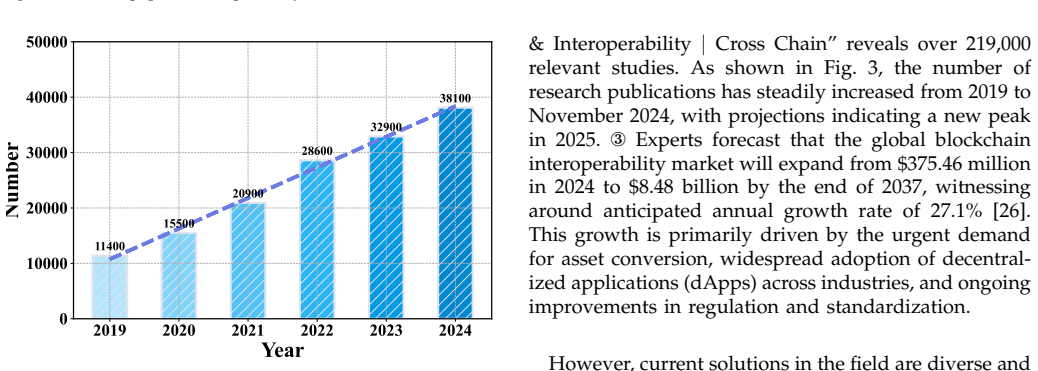
- [Fig. 3] The y-axis label appears garbled as '/glyph1197umber' and should read 'Number'.
- [Section IV.A.2] In the bullet list comparing adaptor signatures with HTLC, 'Mulit-path' should be 'Multi-path'.
- [Table VII] The entries for 'SSPV' under 'Backward Compatibility' and 'No Trusted Setup' read 'Constant', which is not a meaningful rating for those criteria; please re-check the intended symbols or notations.
- [Section VI.B, Fig. 26] The proposed asynchronous-consensus interoperability framework is presented only as a sketch without a security or feasibility analysis; either expand it with such a discussion or label it explicitly as a research agenda.
Circularity Check
No circular derivation; the survey synthesizes prior work, though the 'most comprehensive' claim is self-assessed and several citations are self-citations.
full rationale
This is a literature survey rather than a derivation, so there is no fitted parameter or equation whose output is recycled as input. The classification into native/local/external verification (Section IV, Fig. 11), the interoperability modes (Section II.E), and the security definitions (Section II.D) are built from external prior work and presented as organization, not as predictions. The five self-citations ([6], [135], [174], [178], [205]) appear as background pointers, example schemes in comparison tables (e.g., Tab. IX), or supporting references for sidechain/hierarchical/adaptor-signature discussions; none of them is load-bearing for the central taxonomy, and removing them would not change any classification. The headline claim of being 'the most comprehensive overview to date' (Abstract, Section I.C) is supported only by the authors' own Table II, where the 'Our Survey' row is filled entirely with ●, and by a non-reproducible Google Scholar corpus ('over 150 pertinent studies', Section I.B) with no stated inclusion/exclusion criteria; the paper itself concedes 'potential publication bias and the risk of omitting significant studies'. That is an evidentiary weakness, not a circular reduction: the claim is asserted rather than derived, and no step reduces by construction to its own inputs. A separate correctness issue, outside circularity, is Definition 6, whose weak-atomicity formula (Tx_CC.In∈L_T ⇒ Tx_CC.Out∈L_S) appears to swap the source/target chain labels relative to the surrounding text; this does not affect the circularity verdict.
Assumptions & free parameters
assumptions (4)
- domain assumption Source and target chains satisfy robust distributed ledger properties (persistence and liveness) as defined in Definition 4.
- domain assumption In an asynchronous setting, cross-chain interoperability is fundamentally impossible without a trusted third party (TTP).
- ad hoc to paper Interoperability is an essential prerequisite for enabling service scalability.
- ad hoc to paper Security of CCI is approximated by M = Min(M1, M2, M3) under external verification, M = M1⊕M2 under local verification, and M = Max(M1, M2) under native verification.
Cite this review
Pith. "Pith review of Enhancing Blockchain Cross Chain Interoperability: A Comprehensive Survey." pith.science (2026). https://pith.science/paper/G6V2O6GG
@misc{pith2026250504934,
  author       = {Pith},
  title        = {Pith review of: Enhancing Blockchain Cross Chain Interoperability: A Comprehensive Survey},
  year         = {2026},
  howpublished = {\url{https://pith.science/paper/G6V2O6GG}},
  note         = {Machine review of arXiv:2505.04934}
}
read the original abstract
Blockchain technology, introduced in 2008, has revolutionized data storage and transfer across sectors such as finance, healthcare, intelligent transportation, and the metaverse. However, the proliferation of blockchain systems has led to discrepancies in architectures, consensus mechanisms, and data standards, creating data and value silos that hinder the development of an integrated multi chain ecosystem. Blockchain interoperability (a.k.a cross chain interoperability) has thus emerged as a solution to enable seamless data and asset exchange across disparate blockchains. In this survey, we systematically analyze over 150 high impact sources from academic journals, digital libraries, and grey literature to provide an in depth examination of blockchain interoperability. By exploring the existing methods, technologies, and architectures, we offer a classification of interoperability approaches including Atomic Swaps, Sidechains, Light Clients, and so on, which represent the most comprehensive overview to date. Furthermore, we investigate the convergence of academic research with industry practices, underscoring the importance of collaborative efforts in advancing blockchain innovation. Finally, we identify key strategic insights, challenges, and future research trajectories in this field. Our findings aim to support researchers, policymakers, and industry leaders in understanding and harnessing the transformative potential of blockchain interoperability to address current challenges and drive forward a cohesive multi-chain ecosystem.
Figures


Figures from the paper (22 more)




Reference graph
Works this paper leans on
-
[1]
A peer-to-peer electronic cash system,
S. Nakamoto and A. Bitcoin, “A peer-to-peer electronic cash system,” Bitcoin.–URL: https://bitcoin. org/bitcoin. pdf, vol. 4, no. 2, p. 15, 2008
2008
-
[2]
Blockchain for finance: A survey,
H. Wu, Q. Yao, Z. Liu, B. Huang, Y. Zhuang, H. Tang, and E. Liu, “Blockchain for finance: A survey,” IET Blockchain, 2024. 31
2024
-
[3]
Blockchain intelligence for internet of vehicles: Challenges and solutions,
X. Wang, H. Zhu, Z. Ning, L. Guo, and Y. Zhang, “Blockchain intelligence for internet of vehicles: Challenges and solutions,” IEEE Communications Surveys & Tutorials , 2023
2023
-
[4]
A survey on blockchain for healthcare: Challenges, benefits, and future directions,
M. S. Arbabi, C. Lal, N. R. Veeraragavan, D. Marijan, J. F. Nyg˚ard, and R. Vitenberg, “A survey on blockchain for healthcare: Challenges, benefits, and future directions,” IEEE communications surveys & tutorials , vol. 25, no. 1, pp. 386–424, 2022
2022
-
[5]
A survey of blockchain and artificial intelligence for 6g wireless communica- tions,
Y. Zuo, J. Guo, N. Gao, Y. Zhu, S. Jin, and X. Li, “A survey of blockchain and artificial intelligence for 6g wireless communica- tions,” IEEE Communications Surveys & Tutorials , 2023
2023
-
[6]
Metaopera: A cross-metaverse interoperability protocol,
T. Li, C. Yang, Q. Yang, S. Lan, S. Zhou, X. Luo, H. Huang, and Z. Zheng, “Metaopera: A cross-metaverse interoperability protocol,” IEEE Wireless Communications , vol. 30, no. 5, pp. 136– 143, 2023
2023
-
[8]
Hyperledger fabric: a distributed operating system for permissioned blockchains,
E. Androulaki, A. Barger, V . Bortnikov, C. Cachin, K. Christidis, A. De Caro, D. Enyeart, C. Ferris, G. Laventman, Y. Manevich et al. , “Hyperledger fabric: a distributed operating system for permissioned blockchains,” in Proceedings of the thirteenth EuroSys conference, 2018, pp. 1–15
2018
-
[9]
Tendermint: Consensus without mining,
J. Kwon, “Tendermint: Consensus without mining,” Draft v. 0.6, fall, vol. 1, no. 11, pp. 1–11, 2014
2014
Show all 250 references
-
[10]
Monoxide: Scale out blockchains with asynchronous consensus zones,
J. Wang and H. Wang, “Monoxide: Scale out blockchains with asynchronous consensus zones,” in 16th USENIX symposium on networked systems design and implementation (NSDI 19) , 2019, pp. 95–112
2019
-
[11]
Hybrid consensus: Efficient consensus in the permissionless model,
R. Pass and E. Shi, “Hybrid consensus: Efficient consensus in the permissionless model,” Cryptology ePrint Archive , 2016
2016
-
[12]
Sok: Security and privacy of blockchain interoperability [extended version],
A. Augusto, R. Belchior, M. Correia, A. Vasconcelos, L. Zhang, and T. Hardjono, “Sok: Security and privacy of blockchain interoperability [extended version],” Authorea Preprints, 2024
2024
-
[13]
The bitcoin lightning network: Scalable off-chain instant payments,
J. Poon and T. Dryja, “The bitcoin lightning network: Scalable off-chain instant payments,” 2016
2016
-
[14]
Post-quantum two-party adaptor signature based on coding theory,
J. B. Klamti and M. A. Hasan, “Post-quantum two-party adaptor signature based on coding theory,” Cryptography, vol. 6, no. 1, p. 6, 2022
2022
-
[15]
zkbridge: Trustless cross-chain bridges made practical,
T. Xie, J. Zhang, Z. Cheng, F. Zhang, Y. Zhang, Y. Jia, D. Boneh, and D. Song, “zkbridge: Trustless cross-chain bridges made practical,” in Proceedings of the 2022 ACM SIGSAC Conference on Computer and Communications Security , 2022, pp. 3003–3017
2022
-
[17]
A scalable multi-layer pbft consensus for blockchain,
W. Li, C. Feng, L. Zhang, H. Xu, B. Cao, and M. A. Imran, “A scalable multi-layer pbft consensus for blockchain,” IEEE Transactions on Parallel and Distributed Systems , vol. 32, no. 5, pp. 1146–1160, 2020
2020
-
[18]
A secure sharding protocol for open blockchains,
L. Luu, V . Narayanan, C. Zheng, K. Baweja, S. Gilbert, and P . Saxena, “A secure sharding protocol for open blockchains,” in Proceedings of the 2016 ACM SIGSAC conference on computer and communications security , 2016, pp. 17–30
2016
-
[19]
Layer 2 be or layer not 2 be: Scaling on uniswap v3,
A. Adams, “Layer 2 be or layer not 2 be: Scaling on uniswap v3,” arXiv preprint arXiv:2403.09494 , 2024
2024 arXiv
-
[20]
Concentration of defi’s liquidity: Evidence from decentralised exchanges (dexs) and automated market makers (amms),
I. K. Nassr, E. Kostika, and A. Melachrinos, “Concentration of defi’s liquidity: Evidence from decentralised exchanges (dexs) and automated market makers (amms),” 2024
2024
-
[21]
An empirical study of market inefficiencies in uniswap and sushiswap,
J. A. Berg, R. Fritsch, L. Heimbach, and R. Wattenhofer, “An empirical study of market inefficiencies in uniswap and sushiswap,” in International Conference on Financial Cryptography and Data Security . Springer, 2022, pp. 238–249
2022
-
[22]
Grant proposal: An ethereum light client on axelar,
S. Agrawal, D. Zindros, D. Karakostas, and A. Tzinas, “Grant proposal: An ethereum light client on axelar,” 2023
2023
-
[23]
Cosmos whitepaper,
J. Kwon and E. Buchman, “Cosmos whitepaper,” A Netw. Distrib. Ledgers, vol. 27, pp. 1–32, 2019
2019
-
[24]
Formal analysis of ibc protocol,
Q. Wei, X. Zhao, X.-Y. Zhu, and W. Zhang, “Formal analysis of ibc protocol,” in 2023 IEEE 31st International Conference on Network Protocols (ICNP) . IEEE, 2023, pp. 1–11
2023
-
[25]
Coinmarketcap
“Coinmarketcap.” [Online]. Available: https://coinmarketcap. com/
-
[26]
Research nester for blockchain interoperability market
“Research nester for blockchain interoperability market.” [Online]. Available: https://www.researchnester.com/reports/ blockchain-interoperability-market/5868
-
[27]
A survey on blockchain interoperability: Past, present, and future trends,
R. Belchior, A. Vasconcelos, S. Guerreiro, and M. Correia, “A survey on blockchain interoperability: Past, present, and future trends,” Acm Computing Surveys (CSUR) , vol. 54, no. 8, pp. 1–41, 2021
2021
-
[28]
Exploring blockchains interop- erability: A systematic survey,
G. Wang, Q. Wang, and S. Chen, “Exploring blockchains interop- erability: A systematic survey,” ACM Computing Surveys, vol. 55, no. 13s, pp. 1–38, 2023
2023
-
[29]
Interoperability in blockchain: A survey,
K. Ren, N.-M. Ho, D. Loghin, T.-T. Nguyen, B. C. Ooi, Q.-T. Ta, and F. Zhu, “Interoperability in blockchain: A survey,” IEEE Transactions on Knowledge and Data Engineering , vol. 35, no. 12, pp. 12 750–12 769, 2023
2023
-
[30]
Sok: Communication across distributed ledgers,
A. Zamyatin, M. Al-Bassam, D. Zindros, E. Kokoris-Kogias, P . Moreno-Sanchez, A. Kiayias, and W. J. Knottenbelt, “Sok: Communication across distributed ledgers,” in Financial Cryp- tography and Data Security: 25th International Conference, FC 2021, Virtual Event, March 1–5, 20...
2021
-
[31]
Assessing interoperability solutions for distributed ledgers,
T. Koens and E. Poll, “Assessing interoperability solutions for distributed ledgers,” Pervasive and Mobile Computing , vol. 59, p. 101079, 2019
2019
-
[32]
Interoperability solutions for blockchain,
R. Bhatia et al. , “Interoperability solutions for blockchain,” in 2020 international conference on smart technologies in computing, electrical and electronics (ICSTCEE) . IEEE, 2020, pp. 381–385
2020
-
[33]
An overview on cross-chain: Mechanism, platforms, challenges and advances,
W. Ou, S. Huang, J. Zheng, Q. Zhang, G. Zeng, and W. Han, “An overview on cross-chain: Mechanism, platforms, challenges and advances,” Computer Networks, vol. 218, p. 109378, 2022
2022
-
[34]
Blockchain interoperability: the state of heterogenous blockchain-to-blockchain communication,
S. D. Kotey, E. T. Tchao, A.-R. Ahmed, A. S. Agbe- menu, H. Nunoo-Mensah, A. Sikora, D. Welte, and E. Keel- son, “Blockchain interoperability: the state of heterogenous blockchain-to-blockchain communication,” IET Communications , vol. 17, no. 8, pp. 891–914, 2023
2023
-
[35]
Ex- ploring cross-chain mechanisms and projects in blockchain: A comprehensive summary,
Y. Zhou, Y. Bai, Z. Liu, H. Gao, C. Liu, and H. Lei, “Ex- ploring cross-chain mechanisms and projects in blockchain: A comprehensive summary,” inInternational Conference on Computer Engineering and Networks . Springer, 2023, pp. 421–431
2023
-
[36]
Blockchain cross-chain bridge security: Challenges, solutions, and future outlook,
N. Li, M. Qi, Z. Xu, X. Zhu, W. Zhou, S. Wen, and Y. Xiang, “Blockchain cross-chain bridge security: Challenges, solutions, and future outlook,” Distributed Ledger Technologies: Research and Practice, 2024
2024
-
[37]
Interoperability in defense communications,
G. LaVean, “Interoperability in defense communications,” IEEE transactions on communications, vol. 28, no. 9, pp. 1445–1455, 1980
1980
-
[38]
Interoperability,
P . Wegner, “Interoperability,” ACM Computing Surveys (CSUR) , vol. 28, no. 1, pp. 285–287, 1996
1996
-
[39]
Rfc0793: Transmission control protocol,
J. Postel, “Rfc0793: Transmission control protocol,” 1981
1981
-
[40]
Osi reference model-the iso model of archi- tecture for open systems interconnection,
H. Zimmermann, “Osi reference model-the iso model of archi- tecture for open systems interconnection,” IEEE Transactions on communications, vol. 28, no. 4, pp. 425–432, 1980
1980
-
[41]
F. P . Coyle, XML, Web services, and the data revolution . Addison- Wesley Professional, 2002
2002
-
[42]
The character- istics of cloud computing,
C. Gong, J. Liu, Q. Zhang, H. Chen, and Z. Gong, “The character- istics of cloud computing,” in 2010 39th International Conference on Parallel Processing Workshops . IEEE, 2010, pp. 275–279
2010
-
[43]
O’reilly, What is web 2.0
T. O’reilly, What is web 2.0 . ” O’Reilly Media, Inc.”, 2009
2009
-
[44]
Interoperability: Our exciting and terrifying web3 future,
A. Park, M. Wilson, K. Robson, D. Demetis, and J. Kietzmann, “Interoperability: Our exciting and terrifying web3 future,” Busi- ness Horizons, vol. 66, no. 4, pp. 529–541, 2023
2023
-
[45]
A survey of blockchain, artificial intelligence, and edge computing for web 3.0,
J. Zhu, F. Li, and J. Chen, “A survey of blockchain, artificial intelligence, and edge computing for web 3.0,” Computer Science Review, vol. 54, p. 100667, 2024
2024
-
[46]
A survey on standards for interoperability and security in the internet of things,
E. Lee, Y.-D. Seo, S.-R. Oh, and Y.-G. Kim, “A survey on standards for interoperability and security in the internet of things,” IEEE Communications Surveys & Tutorials , vol. 23, no. 2, pp. 1020–1047, 2021
2021
-
[47]
A multiple blockchains architecture on inter-blockchain communication,
L. Kan, Y. Wei, A. H. Muhammad, W. Siyuan, L. C. Gao, and H. Kai, “A multiple blockchains architecture on inter-blockchain communication,” in 2018 IEEE international conference on software quality, reliability and security companion (QRS-C) . IEEE, 2018, pp. 139–145
2018
-
[48]
Distributed and parallel blockchain: Towards a multi-chain system with enhanced secu- rity,
W. Liu, B. Cao, M. Peng, and B. Li, “Distributed and parallel blockchain: Towards a multi-chain system with enhanced secu- rity,” IEEE Transactions on Dependable and Secure Computing, 2024
2024
-
[49]
Interledger protocol
“Interledger protocol.” [Online]. Available: https://interledger. org/developers/
-
[50]
Interledger: Creating a standard for payments,
A. Hope-Bailie and S. Thomas, “Interledger: Creating a standard for payments,” in Proceedings of the 25th international conference companion on world wide web , 2016, pp. 281–282. 32
2016
-
[51]
Ripple: Overview and outlook,
F. Armknecht, G. O. Karame, A. Mandal, F. Youssef, and E. Zen- ner, “Ripple: Overview and outlook,” in Trust and Trustworthy Computing: 8th International Conference, TRUST 2015, Heraklion, Greece, August 24-26, 2015, Proceedings 8 . Springer, 2015, pp. 163–180
2015
-
[52]
Alt chains and atomic transfers,
T. Nolan, “Alt chains and atomic transfers,” in Bitcoin Forum , 2013
2013
-
[53]
En- abling blockchain innovations with pegged sidechains,
A. Back, M. Corallo, L. Dashjr, M. Friedenbach, G. Maxwell, A. Miller, A. Poelstra, J. Tim ´on, and P . Wuille, “En- abling blockchain innovations with pegged sidechains,” URL: http://www. opensciencereview. com/papers/123/enablingblockchain- innovations-with-pegged-sidechains...
2014
-
[54]
A fast and scalable payment net- work with bitcoin duplex micropayment channels,
C. Decker and R. Wattenhofer, “A fast and scalable payment net- work with bitcoin duplex micropayment channels,” in Stabiliza- tion, Safety, and Security of Distributed Systems: 17th International Symposium, SSS 2015, Edmonton, AB, Canada, August 18-21, 2015, Proceedings 17. S...
2015
-
[55]
Btcrelay reference implementation,
“Btcrelay reference implementation,” 2017. [Online]. Available: https://www.github.com/ethereum/btcrelay
2017
-
[56]
Chain interoperability,
V . Buterin, “Chain interoperability,” R3 research paper, vol. 9, pp. 1–25, 2016
2016
-
[57]
Polkadot: Vision for a heterogeneous multi-chain framework,
G. Wood, “Polkadot: Vision for a heterogeneous multi-chain framework,” White paper, vol. 21, no. 2327, p. 4662, 2016
2016
-
[58]
Inter blockchain communication: A survey,
I. A. Qasse, M. Abu Talib, and Q. Nasir, “Inter blockchain communication: A survey,” in Proceedings of the ArabWIC 6th Annual International Conference Research Track , 2019, pp. 1–6
2019
-
[59]
Atomic cross-chain swaps,
M. Herlihy, “Atomic cross-chain swaps,” in Proceedings of the 2018 ACM symposium on principles of distributed computing , 2018, pp. 245–254
2018
-
[60]
Bringing bitcoin to defi: A complete beginners deep dive into renvm,
M. Burgess, “Bringing bitcoin to defi: A complete beginners deep dive into renvm,” 2020
2020
-
[61]
Erc-20: Fungible tokens,
D. P . Bauer, “Erc-20: Fungible tokens,” in Getting Started with Ethereum: A Step-by-Step Guide to Becoming a Blockchain Developer . Springer, 2022, pp. 17–48
2022
-
[62]
Inter-blockchain communication message relay time measurement and analysis in cosmos,
J. Kim, M. Essaid, and H. Ju, “Inter-blockchain communication message relay time measurement and analysis in cosmos,” in 2022 23rd Asia-Pacific Network Operations and Management Sympo- sium (APNOMS). IEEE, 2022, pp. 1–6
2022
-
[63]
Layerzero: Trustless omnichain interoperability protocol,
R. Zarick, B. Pellegrino, and C. Banister, “Layerzero: Trustless omnichain interoperability protocol,” arXiv preprint arXiv:2110.13871, 2021
2021 arXiv
-
[64]
Multichain: Cross-chain router protocol
“Multichain: Cross-chain router protocol.” [Online]. Available: https://multichain.xyz/
-
[65]
Enabling blockchain services for ioe with zk-rollups,
T. Lavaur, J. Lacan, and C. P . Chanel, “Enabling blockchain services for ioe with zk-rollups,” Sensors, vol. 22, no. 17, p. 6493, 2022
2022
-
[66]
Why sharding is great: demystifying the technical properties (2021),
V . Buterin, “Why sharding is great: demystifying the technical properties (2021),” URL https://vitalik. ca/general/2021/04/07/sharding. html, 2021
2021
-
[67]
Scaling blockchains: A comprehensive survey,
A. Hafid, A. S. Hafid, and M. Samih, “Scaling blockchains: A comprehensive survey,” IEEE access, vol. 8, pp. 125 244–125 262, 2020
2020
-
[68]
A survey on blockchain scalability: From hardware to layer-two protocols,
G. A. F. Rebello, G. F. Camilo, L. A. C. de Souza, M. Potop- Butucaru, M. D. de Amorim, M. E. M. Campista, and L. H. M. Costa, “A survey on blockchain scalability: From hardware to layer-two protocols,” IEEE Communications Surveys & Tutorials , 2024
2024
-
[69]
Towards robust distributed systems,
E. A. Brewer, “Towards robust distributed systems,” in PODC, vol. 7, no. 10.1145. Portland, OR, 2000, pp. 343–477
2000
-
[70]
Permissioned blockchain frameworks in the industry: A comparison,
J. Polge, J. Robert, and Y. Le Traon, “Permissioned blockchain frameworks in the industry: A comparison,” Ict Express, vol. 7, no. 2, pp. 229–233, 2021
2021
-
[71]
Layer 2 blockchain scaling: A survey,
C. Sguanci, R. Spatafora, and A. M. Vergani, “Layer 2 blockchain scaling: A survey,” arXiv preprint arXiv:2107.10881 , 2021
2021 arXiv
-
[72]
A survey of blockchain consensus protocols,
J. Xu, C. Wang, and X. Jia, “A survey of blockchain consensus protocols,” ACM Computing Surveys , vol. 55, no. 13s, pp. 1–35, 2023
2023
-
[73]
Multav: A multi-chain token backed voting framework for decentralized blockchain gover- nance,
X. Fan, Q. Chai, and Z. Zhong, “Multav: A multi-chain token backed voting framework for decentralized blockchain gover- nance,” in International Conference on Blockchain . Springer, 2020, pp. 33–47
2020
-
[74]
Sidechain technologies in blockchain networks: An examination and state-of-the-art review,
A. Singh, K. Click, R. M. Parizi, Q. Zhang, A. Dehghantanha, and K.-K. R. Choo, “Sidechain technologies in blockchain networks: An examination and state-of-the-art review,” Journal of Network and Computer Applications , vol. 149, p. 102471, 2020
2020
-
[75]
Interchain timestamping for mesh security,
E. N. Tas, R. Han, D. Tse, and M. Yu, “Interchain timestamping for mesh security,” in Proceedings of the 2023 ACM SIGSAC Conference on Computer and Communications Security , 2023, pp. 1585–1599
2023
-
[76]
Connext
“Connext.” [Online]. Available: https://connextscan.io/
-
[77]
Coindesk
“Coindesk.” [Online]. Available: https://www.coindesk.com/ tag/cross-chain/
-
[78]
A brief history of blockchain interoperability,
R. Belchior, J. S ¨ußenguth, Q. Feng, T. Hardjono, A. Vasconcelos, and M. Correia, “A brief history of blockchain interoperability,” Communications of the ACM , 2023
2023
-
[79]
Raval, Decentralized applications: harnessing Bitcoin’s blockchain technology
S. Raval, Decentralized applications: harnessing Bitcoin’s blockchain technology. ” O’Reilly Media, Inc.”, 2016
2016
-
[80]
On identity, transaction, and smart contract privacy on permissioned and permissionless blockchain: A comprehensive survey,
W. Liang, Y. Liu, C. Yang, S. Xie, K. Li, and W. Susilo, “On identity, transaction, and smart contract privacy on permissioned and permissionless blockchain: A comprehensive survey,” ACM Computing Surveys, vol. 56, no. 12, pp. 1–35, 2024
2024
-
[81]
Time, clocks, and the ordering of events in a distributed system,
L. Lamport, “Time, clocks, and the ordering of events in a distributed system,” in Concurrency: the Works of Leslie Lamport , 2019, pp. 179–196
2019
-
[82]
The bitcoin backbone protocol: Analysis and applications,
J. Garay, A. Kiayias, and N. Leonardos, “The bitcoin backbone protocol: Analysis and applications,” in Advances in Cryptology- EUROCRYPT 2015: 34th Annual International Conference on the Theory and Applications of Cryptographic Techniques, Sofia, Bulgaria, April 26-30, 2015, P...
2015
-
[83]
A secure decentralised generalised transaction ledger,
G. Wood, “A secure decentralised generalised transaction ledger,” Ethereum project yellow paper , vol. 151, pp. 1–32, 2014
2014
-
[84]
Interoperable enterprise systems: architectures and methods,
F. Vernadat, “Interoperable enterprise systems: architectures and methods,” IFAC Proceedings Volumes , vol. 39, no. 3, pp. 13–20, 2006
2006
-
[85]
Tendermint: Byzantine fault tolerance in the age of blockchains,
E. Buchman, “Tendermint: Byzantine fault tolerance in the age of blockchains,” Ph.D. dissertation, University of Guelph, 2016
2016
-
[86]
Blockchain interoperable digital objects,
B. Pillai, K. Biswas, and V . Muthukkumarasamy, “Blockchain interoperable digital objects,” in Blockchain–ICBC 2019: Second International Conference, Held as Part of the Services Conference Federation, SCF 2019, San Diego, CA, USA, June 25–30, 2019, Proceedings 2. Springer, 20...
2019
-
[87]
Blockchain technol- ogy overview,
D. Yaga, P . Mell, N. Roby, and K. Scarfone, “Blockchain technol- ogy overview,” arXiv preprint arXiv:1906.11078 , 2019
1906 arXiv
-
[88]
Geraci, IEEE standard computer dictionary: Compilation of IEEE standard computer glossaries
A. Geraci, IEEE standard computer dictionary: Compilation of IEEE standard computer glossaries . IEEE Press, 1991
1991
-
[89]
Tokenhook: Secure erc-20 smart contract,
R. Rahimian and J. Clark, “Tokenhook: Secure erc-20 smart contract,” arXiv preprint arXiv:2107.02997 , 2021
2021 arXiv
-
[90]
Improving the token erc-721 implemen- tation for selective receipt: rejectable nfts,
M. `A. Cabot-Nadal, M. M. Payeras-Capell `a, M. Mut-Puigserver, and A. Soto-Fern´andez, “Improving the token erc-721 implemen- tation for selective receipt: rejectable nfts,” in 2022 6th Interna- tional conference on system reliability and safety (ICSRS) . IEEE, 2022, pp. 243–250
2022
-
[91]
Glimpse:{On-Demand}{PoW} light client with {Constant- Size} storage for{DeFi},
G. Scaffino, L. Aumayr, Z. Avarikioti, and M. Maffei, “Glimpse:{On-Demand}{PoW} light client with {Constant- Size} storage for{DeFi},” in 32nd USENIX Security Symposium (USENIX Security 23) , 2023, pp. 733–750
2023
-
[92]
Do you need a distributed ledger technology interoperability solution?
R. Belchior, L. Riley, T. Hardjono, A. Vasconcelos, and M. Correia, “Do you need a distributed ledger technology interoperability solution?” Distributed Ledger Technologies: Research and Practice , vol. 2, no. 1, pp. 1–37, 2023
2023
-
[93]
Universal atomic swaps: Secure exchange of coins across all blockchains,
S. A. Thyagarajan, G. Malavolta, and P . Moreno-Sanchez, “Universal atomic swaps: Secure exchange of coins across all blockchains,” in 2022 IEEE symposium on security and privacy (SP). IEEE, 2022, pp. 1299–1316
2022
-
[94]
Eth relay: A cost-efficient relay for ethereum-based blockchains,
P . Frauenthaler, M. Sigwart, C. Spanring, M. Sober, and S. Schulte, “Eth relay: A cost-efficient relay for ethereum-based blockchains,” in 2020 IEEE International Conference on Blockchain (Blockchain). IEEE, 2020, pp. 204–213
2020
-
[95]
Account- able light client systems for pos blockchains,
O. Ciobotaru, F. Shirazi, A. Stewart, and S. Vasilyev, “Account- able light client systems for pos blockchains,” Cryptology ePrint Archive, 2022
2022
-
[96]
zkrelay: Facilitating sidechains using zksnark-based chain-relays,
M. Westerkamp and J. Eberhardt, “zkrelay: Facilitating sidechains using zksnark-based chain-relays,” in 2020 IEEE European Symposium on Security and Privacy Workshops (EuroS&PW). IEEE, 2020, pp. 378–386
2020
-
[97]
Zendoo: A zk- snark verifiable cross-chain transfer protocol enabling decoupled and decentralized sidechains,
A. Garoffolo, D. Kaidalov, and R. Oliynykov, “Zendoo: A zk- snark verifiable cross-chain transfer protocol enabling decoupled and decentralized sidechains,” in 2020 IEEE 40th International Conference on Distributed Computing Systems (ICDCS). IEEE, 2020, pp. 1257–1262. 33
2020
-
[98]
Can we share the same perspective? blockchain interoperability with views,
R. Belchior, L. Torres, J. Pfannschmid, A. Vasconcelos, and M. Correia, “Can we share the same perspective? blockchain interoperability with views,” 2022
2022
-
[99]
Trustable blockchain interoperability: Securing asset transfers on permissioned blockchains,
C. Pedreira, R. Belchior, M. Matos, and A. Vasconcelos, “Trustable blockchain interoperability: Securing asset transfers on permissioned blockchains,” Authorea Preprints, 2023
2023
-
[100]
Bft consensus algorithms,
X. Zhang, W. Zhong, C. Yang, L. Chen, J. Liao, and N. Xiong, “Bft consensus algorithms,” in 2023 IEEE 10th International Conference on Cyber Security and Cloud Computing (CSCloud)/2023 IEEE 9th International Conference on Edge Computing and Scalable Cloud (EdgeCom). IEEE, 2023...
2023
-
[101]
Fruitchains: A fair blockchain,
R. Pass and E. Shi, “Fruitchains: A fair blockchain,” in Proceedings of the ACM symposium on principles of distributed computing , 2017, pp. 315–324
2017
-
[102]
Time-lock puz- zles from lattices,
S. Agrawalr, G. Malavolta, and T. Zhang, “Time-lock puz- zles from lattices,” in Annual International Cryptology Conference . Springer, 2024, pp. 425–456
2024
-
[103]
Verifiable delay functions,
D. Boneh, J. Bonneau, B. B ¨unz, and B. Fisch, “Verifiable delay functions,” in Annual international cryptology conference. Springer, 2018, pp. 757–788
2018
-
[104]
Cer- berus channels: Incentivizing watchtowers for bitcoin,
Z. Avarikioti, O. S. Thyfronitis Litos, and R. Wattenhofer, “Cer- berus channels: Incentivizing watchtowers for bitcoin,” in Finan- cial Cryptography and Data Security: 24th International Conference, FC 2020, Kota Kinabalu, Malaysia, February 10–14, 2020 Revised Selected Paper...
2020
-
[105]
Sok: Off the chain transactions
L. Gudgeon, P . Moreno-Sanchez, S. Roos, P . McCorry, and A. Ger- vais, “Sok: Off the chain transactions.” IACR Cryptol. ePrint Arch., vol. 2019, p. 360, 2019
2019
-
[106]
Crosschain risk framework
“Crosschain risk framework.” [Online]. Available: https:// crosschainriskframework.github.io/
-
[107]
Overview of blockchain oracle research,
G. Caldarelli, “Overview of blockchain oracle research,” Future Internet, vol. 14, no. 6, p. 175, 2022
2022
-
[108]
Atomic swap 2013,
“Atomic swap 2013,” 2013. [Online]. Available: https://iq.wiki/ wiki/atomic-swap/
2013
-
[109]
Bitcoin gold, litecoin silver: An introduction to cryptocurrency valuation and trading strategy,
H. Yu, Y. Sun, Y. Liu, and L. Zhang, “Bitcoin gold, litecoin silver: An introduction to cryptocurrency valuation and trading strategy,” in Future of Information and Communication Conference . Springer, 2024, pp. 573–586
2024
-
[110]
Atomic swap 2020,
“Atomic swap 2020,” 2020. [Online]. Available: https: //corporatefinanceinstitute.com/resources/cryptocurrency/ atomic-swaps/
2020
-
[111]
Cryptocurrency wallet: A review,
S. Suratkar, M. Shirole, and S. Bhirud, “Cryptocurrency wallet: A review,” in 2020 4th international conference on computer, com- munication and signal processing (ICCCSP) . IEEE, 2020, pp. 1–7
2020
-
[112]
Sas: Succinct atomic swap,
“Sas: Succinct atomic swap,” 2020. [On- line]. Available: https://gist.github.com/RubenSomsen/ 8853a66a64825716f51b409be528355f
2020
-
[113]
Generalized bitcoin- compatible channels,
L. Aumayr, O. Ersoy, A. Erwig, S. Faust, K. Hostakova, M. Maf- fei, P . Moreno-Sanchez, and S. Riahi, “Generalized bitcoin- compatible channels,” 2020
2020
-
[114]
Tesseract: Real-time cryptocurrency exchange using trusted hardware,
I. Bentov, Y. Ji, F. Zhang, L. Breidenbach, P . Daian, and A. Juels, “Tesseract: Real-time cryptocurrency exchange using trusted hardware,” in Proceedings of the 2019 ACM SIGSAC Conference on Computer and Communications Security , 2019, pp. 1521–1538
2019
-
[115]
Teechan: Payment channels using trusted execution environments,
J. Lind, I. Eyal, P . Pietzuch, and E. G. Sirer, “Teechan: Payment channels using trusted execution environments,” arXiv preprint arXiv:1612.07766, 2016
2016 arXiv
-
[116]
Mecury: Prac- tical cross-chain exchange via trusted hardware,
X. Wen, Q. Feng, J. Niu, Y. Zhang, and C. Feng, “Mecury: Prac- tical cross-chain exchange via trusted hardware,” arXiv preprint arXiv:2409.14640, 2024
2024 arXiv
-
[117]
Trusted execution environment: What it is, and what it is not,
M. Sabt, M. Achemlal, and A. Bouabdallah, “Trusted execution environment: What it is, and what it is not,” in 2015 IEEE Trustcom/BigDataSE/Ispa, vol. 1. IEEE, 2015, pp. 57–64
2015
-
[118]
Sgx- pectre: Stealing intel secrets from sgx enclaves via speculative execution,
G. Chen, S. Chen, Y. Xiao, Y. Zhang, Z. Lin, and T. H. Lai, “Sgx- pectre: Stealing intel secrets from sgx enclaves via speculative execution,” in 2019 IEEE European Symposium on Security and Privacy (EuroS&P). IEEE, 2019, pp. 142–157
2019
-
[119]
A tale of two worlds: Assessing the vulnerability of enclave shielding runtimes,
J. Van Bulck, D. Oswald, E. Marin, A. Aldoseri, F. D. Garcia, and F. Piessens, “A tale of two worlds: Assessing the vulnerability of enclave shielding runtimes,” in Proceedings of the 2019 ACM SIGSAC Conference on Computer and Communications Security , 2019, pp. 1741–1758
2019
-
[120]
Cheapay: An optimal algorithm for fee minimization in blockchain-based payment channel net- works,
Y. Zhang, D. Yang, and G. Xue, “Cheapay: An optimal algorithm for fee minimization in blockchain-based payment channel net- works,” in ICC 2019-2019 ieee international conference on commu- nications (icc). IEEE, 2019, pp. 1–6
2019
-
[121]
Anonymous multi-hop locks for blockchain scalability and interoperability,
G. Malavolta, P . Moreno-Sanchez, C. Schneidewind, A. Kate, and M. Maffei, “Anonymous multi-hop locks for blockchain scalability and interoperability,” Cryptology ePrint Archive , 2018
2018
-
[122]
Privacy-preserving cross-chain atomic swaps,
A. Deshpande and M. Herlihy, “Privacy-preserving cross-chain atomic swaps,” in International conference on financial cryptography and data security . Springer, 2020, pp. 540–549
2020
-
[123]
Mad-htlc: because htlc is crazy-cheap to attack,
I. Tsabary, M. Yechieli, A. Manuskin, and I. Eyal, “Mad-htlc: because htlc is crazy-cheap to attack,” in 2021 IEEE symposium on security and privacy (SP) . IEEE, 2021, pp. 1230–1248
2021
-
[124]
Cross- channel: Scalable off-chain channels supporting fair and atomic cross-chain operations,
Y. Guo, M. Xu, D. Yu, Y. Yu, R. Ranjan, and X. Cheng, “Cross- channel: Scalable off-chain channels supporting fair and atomic cross-chain operations,” IEEE Transactions on Computers , vol. 72, no. 11, pp. 3231–3244, 2023
2023
-
[125]
zkcross: A novel architecture for cross-chain privacy- preserving auditing,
Y. Guo, M. Xu, X. Cheng, D. Yu, W. Qiu, G. Qu, W. Wang, and M. Song, “zkcross: A novel architecture for cross-chain privacy- preserving auditing,” Cryptology ePrint Archive , 2024
2024
-
[126]
Blockchain-based payment channel networks: Challenges and recent advances,
N. Papadis and L. Tassiulas, “Blockchain-based payment channel networks: Challenges and recent advances,” IEEE Access, vol. 8, pp. 227 596–227 609, 2020
2020
-
[127]
Sequential games and optimal strate- gies,
M. Escard ´o and P . Oliva, “Sequential games and optimal strate- gies,” Proceedings of the Royal Society A: Mathematical, Physical and Engineering Sciences, vol. 467, no. 2130, pp. 1519–1545, 2011
2011
-
[128]
Omniring: Scaling private payments without trusted setup,
R. W. Lai, V . Ronge, T. Ruffing, D. Schr¨oder, S. A. K. Thyagarajan, and J. Wang, “Omniring: Scaling private payments without trusted setup,” in Proceedings of the 2019 ACM SIGSAC Conference on Computer and Communications Security , 2019, pp. 31–48
2019
-
[129]
The ripple protocol consensus algorithm,
D. Schwartz, N. Youngs, A. Britto et al. , “The ripple protocol consensus algorithm,” Ripple Labs Inc White Paper , vol. 5, no. 8, p. 151, 2014
2014
-
[130]
Zerocash: Decentralized anonymous payments from bitcoin,
E. B. Sasson, A. Chiesa, C. Garman, M. Green, I. Miers, E. Tromer, and M. Virza, “Zerocash: Decentralized anonymous payments from bitcoin,” in 2014 IEEE symposium on security and privacy . IEEE, 2014, pp. 459–474
2014
-
[131]
Monero timelock woes
“Monero timelock woes.” [Online]. Available: https: //thecharlatan.ch/Monero-Unlock-Time-Privacy/
-
[132]
Time locked transaction outputs
“Time locked transaction outputs.” [Online]. Available: https: //github.com/mimblewimble/grin/issues/25
-
[133]
Implement confidentially timelocked funds
“Implement confidentially timelocked funds.” [Online]. Available: https://github.com/zcash/zcash/issues/344
-
[134]
Flash boys 2.0: Frontrunning in de- centralized exchanges, miner extractable value, and consensus instability,
P . Daian, S. Goldfeder, T. Kell, Y. Li, X. Zhao, I. Bentov, L. Brei- denbach, and A. Juels, “Flash boys 2.0: Frontrunning in de- centralized exchanges, miner extractable value, and consensus instability,” in 2020 IEEE symposium on security and privacy (SP) . IEEE, 2020, pp. 910–927
2020
-
[135]
Lightpay: A lightweight and secure off-chain multi-path payment scheme based on adapter signatures,
Y. Liu, W. Liang, K. Xie, S. Xie, K. Li, and W. Meng, “Lightpay: A lightweight and secure off-chain multi-path payment scheme based on adapter signatures,” IEEE Transactions on Services Com- puting, 2023
2023
-
[136]
A multi-party, multi-blockchain atomic swap protocol with universal adaptor secret,
S. You, A. Joshi, A. Kuehlkamp, and J. Nabrzyski, “A multi-party, multi-blockchain atomic swap protocol with universal adaptor secret,” arXiv preprint arXiv:2406.16822 , 2024
2024 arXiv
-
[137]
pipeswap: Forcing the early release of a secret for atomic swaps across all blockchains,
P . Ni, A. Tian, and J. Xu, “pipeswap: Forcing the early release of a secret for atomic swaps across all blockchains,” Cryptology ePrint Archive, 2024
2024
-
[138]
Generalized adaptor signa- ture scheme: From two-party to n-party settings
K. Kajita, G. Ohtake, and T. Takagi, “Generalized adaptor signa- ture scheme: From two-party to n-party settings.” IACR Cryptol. ePrint Arch., vol. 2024, p. 241, 2024
2024
-
[139]
Privacy- preserving multi-party cross-chain transaction protocols,
C. Chen, G. Yang, Z. Li, F. Xiao, Q. Chen, and J. Li, “Privacy- preserving multi-party cross-chain transaction protocols,” Cryp- tography, vol. 8, no. 1, p. 6, 2024
2024
-
[140]
Threshold/multi adap- tor signature and their applications in blockchains,
Y. Ji, Y. Xiao, B. Gao, and R. Zhang, “Threshold/multi adap- tor signature and their applications in blockchains,” Electronics, vol. 13, no. 1, p. 76, 2023
2023
-
[141]
Bool network: An open, distributed, secure cross-chain notary platform,
Z. Yin, B. Zhang, J. Xu, K. Lu, and K. Ren, “Bool network: An open, distributed, secure cross-chain notary platform,” IEEE Transactions on Information Forensics and Security , vol. 17, pp. 3465–3478, 2022
2022
-
[142]
Cross-chain supervision mechanism of distributed notaries for consortium blockchain,
J. Wang, Y. Wan, Y. Hu, Y. Yuan, and K. Fan, “Cross-chain supervision mechanism of distributed notaries for consortium blockchain,” in 2023 6th International Conference on Artificial In- telligence and Big Data (ICAIBD) . IEEE, 2023, pp. 579–584
2023
-
[143]
Enabling cross-chain transactions: A decentralized cryp- tocurrency exchange protocol,
H. Tian, K. Xue, X. Luo, S. Li, J. Xu, J. Liu, J. Zhao, and D. S. Wei, “Enabling cross-chain transactions: A decentralized cryp- tocurrency exchange protocol,” IEEE Transactions on Information Forensics and Security , vol. 16, pp. 3928–3941, 2021. 34
2021
-
[144]
A notary group-based cross-chain mechanism,
A. Xiong, G. Liu, Q. Zhu, A. Jing, and S. W. Loke, “A notary group-based cross-chain mechanism,” Digital Communications and Networks, vol. 8, no. 6, pp. 1059–1067, 2022
2022
-
[145]
Nft cross- chain transfer method under the notary group scheme,
X. Niu, L. Kong, F. Jin, X. Song, X. Min, and Q. Li, “Nft cross- chain transfer method under the notary group scheme,” in 2023 26th International Conference on Computer Supported Cooperative Work in Design (CSCWD) . IEEE, 2023, pp. 996–1001
2023
-
[146]
Dynamic notary group election algorithm based on reputation value,
S. Zhao and L. Cao, “Dynamic notary group election algorithm based on reputation value,” in 2022 International Conference on Bigdata Blockchain and Economy Management (ICBBEM 2022) . At- lantis Press, 2022, pp. 903–915
2022
-
[147]
A decentralized cross- chain service protocol based on notary schemes and hash- locking,
Y. Sun, L. Yi, L. Duan, and W. Wang, “A decentralized cross- chain service protocol based on notary schemes and hash- locking,” in 2022 IEEE International Conference on Services Com- puting (SCC). IEEE, 2022, pp. 152–157
2022
-
[148]
A blockchain cross-chain transaction method based on decentralized dynamic reputation value assessment,
X. Hu, Y. Ling, J. Hua, Z. Dong, Y. Sun, and J. Qi, “A blockchain cross-chain transaction method based on decentralized dynamic reputation value assessment,” IEEE Transactions on Network and Service Management, 2024
2024
-
[149]
Sok: Blockchain light clients,
P . Chatzigiannis, F. Baldimtsi, and K. Chalkias, “Sok: Blockchain light clients,” in International Conference on Financial Cryptography and Data Security . Springer, 2022, pp. 615–641
2022
-
[150]
Proofs of proofs of work with sublinear complexity,
A. Kiayias, N. Lamprou, and A.-P . Stouka, “Proofs of proofs of work with sublinear complexity,” in Financial Cryptography and Data Security: FC 2016 International Workshops, BITCOIN, VOTING, and WAHC, Christ Church, Barbados, February 26, 2016, Revised Selected Papers 20 . Sp...
2016
-
[151]
Non-interactive proofs of proof-of-work,
A. Kiayias, A. Miller, and D. Zindros, “Non-interactive proofs of proof-of-work,” in Financial Cryptography and Data Security: 24th International Conference, FC 2020, Kota Kinabalu, Malaysia, February 10–14, 2020 Revised Selected Papers 24 . Springer, 2020, pp. 505– 522
2020
-
[152]
Flyclient: Super-light clients for cryptocurrencies,
B. B ¨unz, L. Kiffer, L. Luu, and M. Zamani, “Flyclient: Super-light clients for cryptocurrencies,” in 2020 IEEE Symposium on Security and Privacy (SP) . IEEE, 2020, pp. 928–946
2020
-
[153]
Coda: Decentral- ized cryptocurrency at scale,
J. Bonneau, I. Meckler, V . Rao, and E. Shapiro, “Coda: Decentral- ized cryptocurrency at scale,” Cryptology ePrint Archive , 2020
2020
-
[154]
Harmonia: Securing cross-chain applica- tions using zero-knowledge proofs,
R. Belchior, D. Dimov, Z. Karadjov, J. Pfannschmidt, A. Vascon- celos, and M. Correia, “Harmonia: Securing cross-chain applica- tions using zero-knowledge proofs,” Authorea Preprints, 2024
2024
-
[155]
Bitml: a calculus for bitcoin smart contracts,
M. Bartoletti and R. Zunino, “Bitml: a calculus for bitcoin smart contracts,” in Proceedings of the 2018 ACM SIGSAC Conference on Computer and Communications Security , 2018, pp. 83–100
2018
-
[156]
Stateless spv proofs and economic se- curity
“Stateless spv proofs and economic se- curity.” [Online]. Available: https://ethresear.ch/t/ stateless-spv-proofs-and-economic-security/5451
-
[157]
Blink: An optimal proof of proof-of-work,
L. Aumayr, Z. Avarikioti, M. Maffei, G. Scaffino, and D. Zindros, “Blink: An optimal proof of proof-of-work,” Cryptology ePrint Archive, 2024
2024
-
[158]
Compact storage of superblocks for nipopow applications,
K. Karantias, A. Kiayias, and D. Zindros, “Compact storage of superblocks for nipopow applications,” in Mathematical Research for Blockchain Economy: 1st International Conference MARBLE 2019, Santorini, Greece. Springer, 2020, pp. 77–91
2019
-
[159]
A gas- efficient superlight bitcoin client in solidity,
S. Daveas, K. Karantias, A. Kiayias, and D. Zindros, “A gas- efficient superlight bitcoin client in solidity,” in Proceedings of the 2nd ACM Conference on Advances in Financial Technologies , 2020, pp. 132–144
2020
-
[160]
The velvet path to superlight blockchain clients,
A. Kiayias, A. Polydouri, and D. Zindros, “The velvet path to superlight blockchain clients,” in Proceedings of the 3rd ACM Conference on Advances in Financial Technologies , 2021, pp. 205– 218
2021
-
[161]
Mining in logarith- mic space,
A. Kiayias, N. Leonardos, and D. Zindros, “Mining in logarith- mic space,” in Proceedings of the 2021 ACM SIGSAC Conference on Computer and Communications Security , 2021, pp. 3487–3501
2021
-
[162]
How to validate bitcoin payments in ethereum (for only 700k gas!)
“How to validate bitcoin payments in ethereum (for only 700k gas!).” [Online]. Available: https://medium.com/ summa-technology/cross-chain-auction-technical-f16710bfe69f
-
[163]
Available: https://github.com/summa-tx/ bitcoin-spv
“Summa.” [Online]. Available: https://github.com/summa-tx/ bitcoin-spv
-
[164]
Bxtb: cross-chain exchanges of bitcoins for all bitcoin wrapped tokens,
F. Barb `ara and C. Schifanella, “Bxtb: cross-chain exchanges of bitcoins for all bitcoin wrapped tokens,” in 2022 Fourth Interna- tional Conference on Blockchain Computing and Applications (BCCA). IEEE, 2022, pp. 143–150
2022
-
[165]
Proof-of-stake sidechains,
P . Ga ˇzi, A. Kiayias, and D. Zindros, “Proof-of-stake sidechains,” in 2019 IEEE Symposium on Security and Privacy (SP). IEEE, 2019, pp. 139–156
2019
-
[166]
Strong federations: An interoperable blockchain solution to centralized third-party risks,
J. Dilley, A. Poelstra, J. Wilkins, M. Piekarska, B. Gorlick, and M. Friedenbach, “Strong federations: An interoperable blockchain solution to centralized third-party risks,” arXiv preprint arXiv:1612.05491, 2016
2016 arXiv
-
[167]
Ethereum white paper,
V . Buterin et al. , “Ethereum white paper,” GitHub repository , vol. 1, pp. 22–23, 2013
2013
-
[168]
Liquid: A bit- coin sidechain,
J. Nick, A. Poelstra, and G. Sanders, “Liquid: A bit- coin sidechain,” Liquid white paper. URL https://blockstream. com/assets/downloads/pdf/liquid-whitepaper. pdf, 2020
2020
-
[169]
Cumulus: a secure bft-based sidechain for off-chain scaling,
F. Gai, J. Niu, S. A. Tabatabaee, C. Feng, and M. Jalalzai, “Cumulus: a secure bft-based sidechain for off-chain scaling,” in 2021 IEEE/ACM 29th International Symposium on Quality of Service (IWQOS). IEEE, 2021, pp. 1–6
2021
-
[170]
Drivechain,
P . Sztorc, “Drivechain,” 2015
2015
-
[171]
A theoretical model for fork analysis in the bitcoin network,
Y. Shahsavari, K. Zhang, and C. Talhi, “A theoretical model for fork analysis in the bitcoin network,” in 2019 IEEE international conference on Blockchain (Blockchain) . IEEE, 2019, pp. 237–244
2019
-
[172]
Decentralized lightweight detection of eclipse attacks on bit- coin clients,
B. Alangot, D. Reijsbergen, S. Venugopalan, and P . Szalachowski, “Decentralized lightweight detection of eclipse attacks on bit- coin clients,” in 2020 IEEE international conference on Blockchain (Blockchain). IEEE, 2020, pp. 337–342
2020
-
[173]
Drivechain-the simple two way peg,
“Drivechain-the simple two way peg,” 2017. [Online]. Available: https://www.truthcoin.info/blog/drivechain/
2017
-
[174]
Sepow: Secure and efficient proof of work sidechains,
T. Li, M. Wang, Z. Deng, and D. Liu, “Sepow: Secure and efficient proof of work sidechains,” in Algorithms and Architectures for Parallel Processing: 21st International Conference, ICA3PP 2021, Virtual Event, December 3–5, 2021, Proceedings, Part III . Springer, 2022, pp. 376–396
2021
-
[175]
Txchain: Efficient cryptocurrency light clients via contingent transaction aggregation,
A. Zamyatin, Z. Avarikioti, D. Perez, and W. J. Knottenbelt, “Txchain: Efficient cryptocurrency light clients via contingent transaction aggregation,” in Data Privacy Management, Cryp- tocurrencies and Blockchain Technology: ESORICS 2020 International Workshops, DPM 2020 and C...
2020
-
[176]
Proof-of-work sidechains,
A. Kiayias and D. Zindros, “Proof-of-work sidechains,” in Fi- nancial Cryptography and Data Security: FC 2019 International Workshops, VOTING and WTSC, St. Kitts, St. Kitts and Nevis, February 18–22, 2019, Revised Selected Papers 23 . Springer, 2020, pp. 21–34
2019
-
[177]
Sidechains with fast cross-chain transfers,
L. Yin, J. Xu, and Q. Tang, “Sidechains with fast cross-chain transfers,” IEEE Transactions on Dependable and Secure Computing , vol. 19, no. 6, pp. 3925–3940, 2021
2021
-
[178]
Pssc: Practical and secure sidechains construction for heterogeneous blockchains orienting iot,
Z. Deng, T. Li, C. Tang, D. He, and Z. Zheng, “Pssc: Practical and secure sidechains construction for heterogeneous blockchains orienting iot,” IEEE Internet of Things Journal , 2023
2023
-
[179]
Ussc: Universal and storage-efficient sidechains,
T. Li, H. Huang, L. Yin, S. Yao, and Z. Zheng, “Ussc: Universal and storage-efficient sidechains,” in 2024 IEEE 44th International Conference on Distributed Computing Systems (ICDCS). IEEE, 2024, pp. 379–390
2024
-
[180]
Sidechains with opti- mally succinct proof,
L. Yin, J. Xu, K. Liang, and Z. Zhang, “Sidechains with opti- mally succinct proof,” IEEE Transactions on Dependable and Secure Computing, 2023
2023
-
[181]
A review of zk- snarks,
T. Chen, H. Lu, T. Kunpittaya, and A. Luo, “A review of zk- snarks,” arXiv preprint arXiv:2202.06877 , 2022
2022 arXiv
-
[182]
Retrofitting a two-way peg between blockchains,
J. Teutsch, M. Straka, and D. Boneh, “Retrofitting a two-way peg between blockchains,” arXiv preprint arXiv:1908.03999 , 2019
1908 arXiv
-
[183]
Cross- blockchain technology: integration framework and security as- sumptions,
B. Pillai, K. Biswas, Z. H ´ou, and V . Muthukkumarasamy, “Cross- blockchain technology: integration framework and security as- sumptions,” IEEE access, vol. 10, pp. 41 239–41 259, 2022
2022
-
[184]
Wrapping trust for interoperability: A preliminary study of wrapped tokens,
G. Caldarelli, “Wrapping trust for interoperability: A preliminary study of wrapped tokens,” Information, vol. 13, no. 1, p. 6, 2021
2021
-
[185]
Asyncsc: An asynchronous sidechain for multi- domain data exchange in internet of things,
L. Yang, X. Dong, Z. Wan, S. Gao, W. Tong, D. Lu, Y. Shen, and X. Du, “Asyncsc: An asynchronous sidechain for multi- domain data exchange in internet of things,” arXiv preprint arXiv:2412.12723, 2024
2024 arXiv
-
[186]
Xclaim: Trustless, interoperable, cryptocurrency-backed assets,
A. Zamyatin, D. Harz, J. Lind, P . Panayiotou, A. Ger- vais, and W. Knottenbelt, “Xclaim: Trustless, interoperable, cryptocurrency-backed assets,” in 2019 IEEE symposium on se- curity and privacy (SP) . IEEE, 2019, pp. 193–210
2019
-
[187]
Verilay: A verifiable proof of stake chain relay,
M. Westerkamp and M. Diez, “Verilay: A verifiable proof of stake chain relay,” in 2022 IEEE International Conference on Blockchain and Cryptocurrency (ICBC) . IEEE, 2022, pp. 1–9
2022
-
[188]
A rollup comparison framework,
J. Gorzny and M. Derka, “A rollup comparison framework,” arXiv preprint arXiv:2404.16150 , 2024
2024 arXiv
-
[189]
Arbitrum: Scalable, private smart contracts,
H. Kalodner, S. Goldfeder, X. Chen, S. M. Weinberg, and E. W. Felten, “Arbitrum: Scalable, private smart contracts,” in 27th 35 USENIX Security Symposium (USENIX Security 18) , 2018, pp. 1353–1370
2018
-
[190]
Welcome to the optimism collective
“Welcome to the optimism collective.” [Online]. Available: https://community.optimism.io/
-
[191]
Exploring the efficacy of rollups’a comparative study of optimistic and zk-rollups and their popular implementations
A. Jain, Y. Punjabi, and R. Mathur, “Exploring the efficacy of rollups’a comparative study of optimistic and zk-rollups and their popular implementations.”
-
[192]
Loopring: A decentralized token exchange protocol,
D. Wang, J. Zhou, A. Wang, and M. Finestone, “Loopring: A decentralized token exchange protocol,” URL https://github. com/Loopring/whitepaper/blob/master/en whitepaper. pdf, 2018
2018
-
[193]
Parole: Profitable arbitrage in optimistic rollup with erc-721 token transactions,
A. A. Khalil and M. A. Rahman, “Parole: Profitable arbitrage in optimistic rollup with erc-721 token transactions,” in 2024 54th Annual IEEE/IFIP International Conference on Dependable Systems and Networks (DSN) . IEEE, 2024, pp. 129–141
2024
-
[194]
Examination on interoperabil- ity of blockchains by using zk-rollups,
A. Yamamoto and S. Yamashita, “Examination on interoperabil- ity of blockchains by using zk-rollups,” in Proceedings of the 2023 5th Blockchain and Internet of Things Conference , 2023, pp. 41–49
2023
-
[195]
Analyzing the role of bridges in cross-chain mev extraction,
D. Ilisei, “Analyzing the role of bridges in cross-chain mev extraction,” Ph.D. dissertation, Master’s thesis, TU M ¨unchen, 2024
2024
-
[196]
Starkware docs
“Starkware docs.” [Online]. Available: https://docs.starkware. co/starkex/
-
[197]
Burn- to-claim: An asset transfer protocol for blockchain interoperabil- ity,
B. Pillai, K. Biswas, Z. H ´ou, and V . Muthukkumarasamy, “Burn- to-claim: An asset transfer protocol for blockchain interoperabil- ity,” Computer Networks, vol. 200, p. 108495, 2021
2021
-
[198]
The burn-to-claim cross-blockchain asset transfer pro- tocol,
——, “The burn-to-claim cross-blockchain asset transfer pro- tocol,” in 2020 25th International Conference on Engineering of Complex Computer Systems (ICECCS) . IEEE, 2020, pp. 119–124
2020
-
[199]
Formal verification of the burn-to-claim blockchain interoperable proto- col,
B. Pillai, Z. H ´ou, K. Biswas, and V . Muthukkumarasamy, “Formal verification of the burn-to-claim blockchain interoperable proto- col,” in International Conference on Formal Engineering Methods . Springer, 2023, pp. 249–254
2023
-
[200]
Enhancing bitcoin security and performance with strong consistency via collective signing,
E. K. Kogias, P . Jovanovic, N. Gailly, I. Khoffi, L. Gasser, and B. Ford, “Enhancing bitcoin security and performance with strong consistency via collective signing,” in 25th usenix security symposium (usenix security 16) , 2016, pp. 279–296
2016
-
[201]
Solida: A blockchain protocol based on reconfigurable byzan- tine consensus,
I. Abraham, D. Malkhi, K. Nayak, L. Ren, and A. Spiegelman, “Solida: A blockchain protocol based on reconfigurable byzan- tine consensus,” arXiv preprint arXiv:1612.02916 , 2016
2016 arXiv
-
[202]
Algorand: Scaling byzantine agreements for cryptocurrencies,
Y. Gilad, R. Hemo, S. Micali, G. Vlachos, and N. Zeldovich, “Algorand: Scaling byzantine agreements for cryptocurrencies,” in Proceedings of the 26th symposium on operating systems principles, 2017, pp. 51–68
2017
-
[203]
Dbpbft: A hierarchical pbft consensus algorithm with dual blockchain for iot,
X. Wu, Z. Wang, X. Li, and L. Chen, “Dbpbft: A hierarchical pbft consensus algorithm with dual blockchain for iot,” Future Generation Computer Systems , vol. 162, p. 107429, 2025
2025
-
[204]
A hierarchical byzantine fault tolerance consensus protocol for the internet of things,
R. Guo, Z. Guo, Z. Lin, and W. Jiang, “A hierarchical byzantine fault tolerance consensus protocol for the internet of things,” High-Confidence Computing, vol. 4, no. 3, p. 100196, 2024
2024
-
[205]
A distributed ledger-a ssisted robust and trusted service protocol for vanets,
Z. Deng, C. Tang, T. Li, and D. He, “A distributed ledger-a ssisted robust and trusted service protocol for vanets,” IEEE Internet of Things Journal, 2024
2024
-
[206]
Par- allel byzantine consensus based on hierarchical architecture and trusted hardware,
X. Chen, T. Ma, B. Er-Rahmadi, J. Hillston, and G. Yuan, “Par- allel byzantine consensus based on hierarchical architecture and trusted hardware,” IEEE Transactions on Dependable and Secure Computing, 2024
2024
-
[207]
Omniledger: A secure, scale-out, decentralized ledger via sharding,
E. Kokoris-Kogias, P . Jovanovic, L. Gasser, N. Gailly, E. Syta, and B. Ford, “Omniledger: A secure, scale-out, decentralized ledger via sharding,” in 2018 IEEE symposium on security and privacy (SP). IEEE, 2018, pp. 583–598
2018
-
[208]
Brokerchain: A cross-shard blockchain protocol for account/balance-based state sharding,
H. Huang, X. Peng, J. Zhan, S. Zhang, Y. Lin, Z. Zheng, and S. Guo, “Brokerchain: A cross-shard blockchain protocol for account/balance-based state sharding,” in IEEE INFOCOM 2022- IEEE Conference on Computer Communications . IEEE, 2022, pp. 1968–1977
2022
-
[209]
Prophet: Conflict-free sharding blockchain via byzantine-tolerant deterministic ordering,
Z. Hong, S. Guo, E. Zhou, J. Zhang, W. Chen, J. Liang, J. Zhang, and A. Zomaya, “Prophet: Conflict-free sharding blockchain via byzantine-tolerant deterministic ordering,” in IEEE INFOCOM 2023-IEEE Conference on Computer Communications . IEEE, 2023, pp. 1–10
2023
-
[210]
Replay attacks and defenses against cross-shard consensus in sharded distributed ledgers,
A. Sonnino, S. Bano, M. Al-Bassam, and G. Danezis, “Replay attacks and defenses against cross-shard consensus in sharded distributed ledgers,” in 2020 IEEE European Symposium on Secu- rity and Privacy (EuroS&P) . IEEE, 2020, pp. 294–308
2020
-
[211]
Rapidchain: Scal- ing blockchain via full sharding,
M. Zamani, M. Movahedi, and M. Raykova, “Rapidchain: Scal- ing blockchain via full sharding,” in Proceedings of the 2018 ACM SIGSAC conference on computer and communications security , 2018, pp. 931–948
2018
-
[212]
Chainspace: A sharded smart contracts platform,
M. Al-Bassam, A. Sonnino, S. Bano, D. Hrycyszyn, and G. Danezis, “Chainspace: A sharded smart contracts platform,” arXiv preprint arXiv:1708.03778 , 2017
2017 arXiv
-
[213]
Account migration across blockchain shards using fine-tuned lock mechanism,
H. Huang, Y. Lin, and Z. Zheng, “Account migration across blockchain shards using fine-tuned lock mechanism,” in IEEE INFOCOM 2024-IEEE Conference on Computer Communications . IEEE, 2024, pp. 271–280
2024
-
[214]
Spiralshard: Highly concurrent and secure blockchain sharding via linked cross-shard endorsement,
Y. Lin, M. Li, and J. Zhang, “Spiralshard: Highly concurrent and secure blockchain sharding via linked cross-shard endorsement,” arXiv preprint arXiv:2407.08651 , 2024
2024
-
[215]
Global networks of money and information at the crossroads: Correspondent banking and swift,
G. Robinson, S. D ¨orry, and B. Derudder, “Global networks of money and information at the crossroads: Correspondent banking and swift,” Global Networks, vol. 23, no. 2, pp. 478–493, 2023
2023
-
[216]
Using opc and hl7 standards to incorporate an industrial big data historian in a health it environment,
M. F. Cruz, C. A. M. T. Cavalcante, and S. T. S ´a Barretto, “Using opc and hl7 standards to incorporate an industrial big data historian in a health it environment,” Journal of Medical Systems , vol. 42, pp. 1–11, 2018
2018
-
[217]
The entire process of an atomic transaction via ilp
“The entire process of an atomic transaction via ilp.” [Online]. Available: https://interledger.org/developers/rfcs/ hashed-timelock-agreements/
-
[218]
A network of distributed ledgers,
J. Kwon and E. Buchman, “A network of distributed ledgers,” Cosmos, dated, pp. 1–41, 2018
2018
-
[219]
The gasper protocol: a proof of stake era for ethereum,
G. Pititto, “The gasper protocol: a proof of stake era for ethereum,” Ph.D. dissertation, Politecnico di Torino, 2022
2022
-
[220]
Overview of polkadot and its design considerations,
J. Burdges, A. Cevallos, P . Czaban, R. Habermeier, S. Hosseini, F. Lama, H. K. Alper, X. Luo, F. Shirazi, A. Stewart et al. , “Overview of polkadot and its design considerations,” arXiv preprint arXiv:2005.13456, 2020
2005 arXiv
-
[221]
Hyperservice: Interoperability and programmability across heterogeneous blockchains,
Z. Liu, Y. Xiang, J. Shi, P . Gao, H. Wang, X. Xiao, B. Wen, and Y.-C. Hu, “Hyperservice: Interoperability and programmability across heterogeneous blockchains,” in Proceedings of the 2019 ACM SIGSAC conference on computer and communications security , 2019, pp. 549–566
2019
-
[222]
Layerzero network
“Layerzero network.” [Online]. Available: https://layerzero. network/
-
[223]
Rsk: A bitcoin sidechain with stateful smart- contracts,
S. D. Lerner, J. ´A. Cid-Fuentes, J. Len, R. Fern `andez-Val`encia, P . Gallardo, N. Vescovo, R. Laprida, S. Mishra, F. Jinich, and D. Masini, “Rsk: A bitcoin sidechain with stateful smart- contracts,” Cryptology ePrint Archive , 2022
2022
-
[224]
Hyperledger cactus whitepaper
“Hyperledger cactus whitepaper.” [Online]. Available: https://github.com/opentaps/cactus/blob/main/whitepaper/ whitepaper.md
-
[225]
Wecross whitepaper
“Wecross whitepaper.” [Online]. Available: https://wecross. readthedocs.io/zh-cn/latest/
-
[226]
Fisco-bcos: An enterprise-grade permissioned blockchain system with high-performance,
H. Li, Y. Chen, X. Shi, X. Bai, N. Mo, W. Li, R. Guo, Z. Wang, and Y. Sun, “Fisco-bcos: An enterprise-grade permissioned blockchain system with high-performance,” in Proceedings of the International Conference for High Performance Computing, Network- ing, Storage and Analysis ...
2023
-
[227]
Hyperledger firefly
“Hyperledger firefly.” [Online]. Available: https://www. lfdecentralizedtrust.org/projects/firefly
-
[228]
Weaver: Interoperability across dlt networks
“Weaver: Interoperability across dlt networks.” [Online]. Available: https://github.com/hyperledger-labs/ weaver-dlt-interoperability/blob/main/OVERVIEW.md
-
[229]
Introducing hyperledger cacti, a multi-faceted pluggable interoperability framework
“Introducing hyperledger cacti, a multi-faceted pluggable interoperability framework.” [Online]. Available: https: //hyperledger-cacti.github.io/cacti/vision/
-
[230]
Redactable blockchain–or–rewriting history in bitcoin and friends,
G. Ateniese, B. Magri, D. Venturi, and E. Andrade, “Redactable blockchain–or–rewriting history in bitcoin and friends,” in 2017 IEEE European symposium on security and privacy (EuroS&P) . IEEE, 2017, pp. 111–126
2017
-
[231]
A survey on redactable blockchain: challenges and opportunities,
T. Ye, M. Luo, Y. Yang, K.-K. R. Choo, and D. He, “A survey on redactable blockchain: challenges and opportunities,” IEEE Transactions on Network Science and Engineering , vol. 10, no. 3, pp. 1669–1683, 2023
2023
-
[232]
Redactable blockchain in the permissionless setting,
D. Deuber, B. Magri, and S. A. K. Thyagarajan, “Redactable blockchain in the permissionless setting,” in 2019 IEEE Sympo- sium on Security and Privacy (SP) . IEEE, 2019, pp. 124–138
2019
-
[233]
Accountable fine-grained blockchain rewriting in the permissionless setting,
Y. Tian, B. Liu, Y. Li, P . Szalachowski, and J. Zhou, “Accountable fine-grained blockchain rewriting in the permissionless setting,” IEEE Transactions on Information Forensics and Security , 2023
2023
-
[234]
Redacting transactions from execute-order-validate blockchains,
Y. Manevich, A. Barger, and G. Assa, “Redacting transactions from execute-order-validate blockchains,” in 2021 IEEE Interna- 36 tional Conference on Blockchain and Cryptocurrency (ICBC) . IEEE, 2021, pp. 1–9
2021
-
[235]
Ivyredaction: Enabling atomic, consistent and accountable cross-chain rewrit- ing,
S. Hu, M. Li, J. Weng, J.-N. Liu, J. Weng, and Z. Li, “Ivyredaction: Enabling atomic, consistent and accountable cross-chain rewrit- ing,” IEEE Transactions on Dependable and Secure Computing, 2023
2023
-
[236]
Starcross: Redactable blockchain-based secure and lightweight data sharing frame- work for satellite-based iot,
R. Du, T. Chen, J. Tian, and T. Shang, “Starcross: Redactable blockchain-based secure and lightweight data sharing frame- work for satellite-based iot,” Computer Networks , vol. 253, p. 110718, 2024
2024
-
[237]
Arc: an asynchronous consensus and relay chain-based cross-chain solution to con- sortium blockchain,
S. Zhang, T. Xie, K. Gai, and L. Xu, “Arc: an asynchronous consensus and relay chain-based cross-chain solution to con- sortium blockchain,” in 2022 IEEE 9th International Conference on Cyber Security and Cloud Computing (CSCloud)/2022 IEEE 8th International Conference on Edge...
2022
-
[238]
Rac-chain: An asynchronous consensus-based cross-chain approach to scalable blockchain for metaverse,
T. Xie, K. Gai, L. Zhu, S. Wang, and Z. Zhang, “Rac-chain: An asynchronous consensus-based cross-chain approach to scalable blockchain for metaverse,” ACM Transactions on Multimedia Com- puting, Communications and Applications , vol. 20, no. 7, pp. 1–24, 2024
2024
-
[239]
Secure and efficient asynchronous broadcast protocols,
C. Cachin, K. Kursawe, F. Petzold, and V . Shoup, “Secure and efficient asynchronous broadcast protocols,” in Annual Interna- tional Cryptology Conference . Springer, 2001, pp. 524–541
2001
-
[240]
The honey badger of bft protocols,
A. Miller, Y. Xia, K. Croman, E. Shi, and D. Song, “The honey badger of bft protocols,” in Proceedings of the 2016 ACM SIGSAC conference on computer and communications security , 2016, pp. 31– 42
2016
-
[241]
Beat: Asynchronous bft made practical,
S. Duan, M. K. Reiter, and H. Zhang, “Beat: Asynchronous bft made practical,” in Proceedings of the 2018 ACM SIGSAC Conference on Computer and Communications Security , 2018, pp. 2028–2041
2018
-
[242]
Dumbo: Faster asynchronous bft protocols,
B. Guo, Z. Lu, Q. Tang, J. Xu, and Z. Zhang, “Dumbo: Faster asynchronous bft protocols,” in Proceedings of the 2020 ACM SIGSAC Conference on Computer and Communications Security , 2020, pp. 803–818
2020
-
[243]
In- teroperability of the metaverse: A digital ecosystem perspective review,
L. Yang, S.-T. Ni, Y. Wang, A. Yu, J.-A. Lee, and P . Hui, “In- teroperability of the metaverse: A digital ecosystem perspective review,” arXiv preprint arXiv:2403.05205 , 2024
2024 arXiv
-
[244]
Exploring interoperability of distributed ledger and decentralized technology adoption in virtual enterprises,
A. J. Bokolo, “Exploring interoperability of distributed ledger and decentralized technology adoption in virtual enterprises,” Information Systems and e-Business Management , vol. 20, no. 4, pp. 685–718, 2022
2022
-
[245]
Non-fungible tokens (nfts): tokens of digital assets on the blockchain,
J. Yang, Y. Li, Y. Lai, and M. Liu, “Non-fungible tokens (nfts): tokens of digital assets on the blockchain,” in Proceedings of the 2023 International Conference on Electronics, Computers and Communication Technology, 2023, pp. 175–182
2023
-
[246]
Blockchain state channels: A state of the art,
L. D. Negka and G. P . Spathoulas, “Blockchain state channels: A state of the art,” IEEE Access, vol. 9, pp. 160 277–160 298, 2021
2021
-
[247]
Blockchain gateways, bridges and delegated hash- locks,
T. Hardjono, “Blockchain gateways, bridges and delegated hash- locks,” arXiv preprint arXiv:2102.03933 , 2021
2021 arXiv
-
[248]
The eu general data protec- tion regulation (gdpr),
P . Voigt and A. Von dem Bussche, “The eu general data protec- tion regulation (gdpr),” A Practical Guide, 1st Ed., Cham: Springer International Publishing, vol. 10, no. 3152676, pp. 10–5555, 2017
2017
-
[249]
An introduction to the california consumer privacy act (ccpa),
E. Goldman, “An introduction to the california consumer privacy act (ccpa),” Santa Clara Univ. Legal Studies Research Paper , 2020
2020
-
[250]
Guide to the systems engineering body of knowledge (sebok)
“Guide to the systems engineering body of knowledge (sebok).” [Online]. Available: https://sebokwiki.org/wiki/Guide to the Systems Engineering Body of Knowledge (SEBoK)
-
[251]
Deep neural network- based secure healthcare framework,
A. Aldaej, T. A. Ahanger, and I. Ullah, “Deep neural network- based secure healthcare framework,” Neural Computing and Ap- plications, pp. 1–16, 2024
2024
-
[252]
Dohler, D
M. Dohler, D. R. Lopez, and C. Wang, Blockchains in 6G: A Standardized Approach to Permissioned Distributed Ledgers . CRC Press, 2024. AUTHOR BIOGRAPHIES Zhihong Deng received the M.S. degree in the School of Math- ematics and Computational Science, Hunan University of Science...
2024
Reviewed August 15, 2026 · model on record in the stance chip above.
Discussion (0). Continue with ORCID to comment.