REVIEW 3 major objections 4 minor 32 references
Med-Art: Diffusion Transformer for 2D Medical Text-to-Image Generation
T0 review · 3 major / 4 minor · reviewed 2026-08-06 · deepseek-v4-flash
Pith's one-line read This paper claims that auto-written VLM captions plus LoRA on PixArt-α and a pixel-level color loss let small medical datasets produce state-of-the-art text-to-image generation.
desk verdict Solid fine-tuning recipe undercut by an evaluation that measures memorization rather than text-to-image generalization. read the letter →
The pith
A machine-rendered reading of the paper's core claim, the machinery that carries it, and where it could break.
The reading
What carries the argument
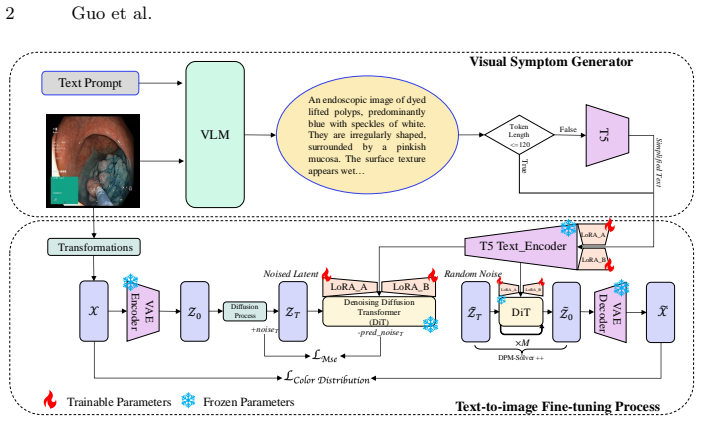
Three components carry the argument. The Visual Symptom Generator (VSG) uses a vision-language model (LLaVA-Next) with a structured prompt to produce natural-language descriptions of each medical image, then T5 simplifies captions longer than the 120-token limit. LoRA is applied to both the DiT denoising network and the T5 text encoder, so medical semantics enters through updated text embeddings as well as cross-attention. HLDF (Hybrid-Level Diffusion Fine-tuning) generates images during training using classifier-free guidance and DPM-Solver++ (about 20 steps) and adds a color loss comparing per-channel means and standard deviations of generated and real pixels; gradient checkpointing and an every-N-steps schedule keep the added cost to roughly 6-9% training time.
What would settle it
Replace the VSG captions with clinician-written captions for the same images and retrain under identical settings; if FID, KID, and downstream ViT classification improve or stay equal, the VLM captions are not the limiting factor, whereas if they change substantially, the caption generator is the active ingredient. Alternatively, have expert gastroenterologists and dermatologists label the VSG captions as correct, partially correct, or hallucinated, and check whether the model's per-class generation quality tracks caption correctness.
Extended reading notes
Core claim
Med-Art's central discovery is that the language gap, not just the image gap, is what prevents pretrained text-to-image models from generating medical images. By prompting LLaVA-Next to describe the visual symptoms of each image in natural language, the authors obtain image-conditioned captions that match the kind of text the base model saw during pretraining, turning a class-label-only setup into a true text-to-image setup. They then LoRA-fine-tune PixArt-α, including its T5 text encoder, and add Hybrid-Level Diffusion Fine-tuning, which runs DPM-Solver++ during training to synthesize images and penalizes per-channel mean and standard deviation differences between generated and real images. The result is state-of-the-art FID, KFD, and KID on Kvasir and best overall FID/KID on skin lesions, with generated images that train a ViT classifier to higher performance than images from any compared baseline.
Load-bearing premise
The whole pipeline assumes that LLaVA-Next, a general vision-language model that was not trained on endoscopy or dermoscopy, produces clinically accurate descriptions of the lesions rather than plausible but wrong ones; if the captions misdescribe what is in the image, the model learns the wrong image-text associations and the reported gains would not transfer to real clinical use.
Editorial extensions
If this is right
- If the claims hold, medical text-to-image generation no longer requires curated radiology reports or expert annotations: auto-generated visual symptom captions suffice to fine-tune a strong pretrained model.
- The HLDF color loss removes the oversaturated-color artifact that plagues latent diffusion fine-tuned on small medical sets, without adding sampling-time cost.
- LoRA on the text encoder is a measurable part of the gain: ablations show that removing it raises FID from 51.99 to 63.10 on Kvasir, and even without it Med-Art beats Hunyuan-DiT.
- Generated images from Med-Art train a ViT to a higher F1, balanced accuracy, and AUC on Kvasir than any baseline's synthetic images, and remain the best overall on skin lesions when all three metrics are considered.
- The method carries over to a different caption generator (Ovis) with similar results, so it is not tied to one specific VLM.
Reading between the lines
- Because the caption generator is the only source of medical knowledge in the pipeline, the ceiling on clinical usefulness is set by LLaVA-Next's accuracy; a clinician-audited caption set or a medical-tuned VLM should push FID and downstream classification further, and this can be tested directly.
- The same recipe likely transfers to other low-text medical modalities, such as histopathology, retinal fundus photography, or ultrasound, where class labels exist but free-text reports are scarce; a quick probe would fine-tune Med-Art on one such dataset and check KID plus a downstream classifier.
- Training classifiers on these synthetic images could serve as a privacy-preserving data-sharing strategy, since synthetic images avoid direct patient-identifiable content, though whether that holds is a separate clinical and legal question.
- The interval-based HLDF schedule (every 500 or 1500 steps) suggests the color loss mainly corrects a persistent bias rather than tracking every detail, so more frequent or adaptive scheduling may not improve results and could be wasteful.
Signed reviews
Editorial analysis
A structured set of objections, weighed in public.
Referee Report
Summary. The paper proposes Med-Art, a framework for medical text-to-image generation on small datasets. It uses LLaVA-Next as a Visual Symptom Generator to produce detailed captions from images, applies LoRA fine-tuning to both the PixArt-alpha Diffusion Transformer and the T5 text encoder, and introduces Hybrid-Level Diffusion Fine-tuning (HLDF) with a pixel-space color loss computed on images sampled during training. Experiments on the Kvasir endoscopy dataset and a skin lesion dataset report improved FID, KFD, and KID over several text-to-image baselines, as well as improved downstream classification performance when a ViT is trained on the generated images. The paper includes ablations showing the contribution of each module and presents qualitative comparisons.
Significance. The paper addresses two practical bottlenecks in medical text-to-image generation: the scarcity of paired medical text and the color oversaturation that arises when fine-tuning natural-image models. The proposed pipeline is technically coherent, and the ablations in Table 3 support the individual role of the VLM captions, LoRA on T5, and HLDF. If the generalization concern is resolved, the approach would be a practical recipe for adapting large text-to-image models to small medical datasets. The public project page, the release of code, and the inclusion of domain-specific FID variants (KFD, HFD) are strengths. The main weakness is that the evaluation protocol does not yet establish generalization to unseen prompts.
major comments (3)
- [§3 Experimental Setup] The evaluation protocol described in Section 3 states that 'A random subset of training images, matching the test set size (1600 for Kvasir and 1665 for skin lesions), is used to generate text prompts for test image synthesis.' Because these prompts are derived from the same training images on which Med-Art is fine-tuned, the FID/KFD/KID results in Table 2 and the downstream classification results in Table 4 can be explained by the model reproducing training image-caption pairs rather than by genuine text-to-image generalization. The row for Ovis in Table 3 does not remedy this, since Ovis captions are also generated from training images. The authors should add an evaluation with prompts generated from held-out images, or with class-level prompts not paired with any training image during fine-tuning, and report those metrics.
- [§2.2 Eq. (4)] The color loss in Eq. (4) penalizes the difference in per-channel mean and standard deviation between the generated image and the specific original training image x, while the prompt for that generated image is derived from the same x via the Visual Symptom Generator. On small training sets (about 8k and 6.7k images), this per-sample consistency loss is likely to reinforce memorization of individual training images. The authors should either add an experiment that isolates the effect of HLDF on held-out prompts, or discuss why this loss does not encourage trivial copying rather than learning a conditional distribution.
- [Tables 2–3] All quantitative results are reported without error bars or multiple seeds. Differences such as the KFD of 1.21 versus 1.26 and the KID of 0.012 versus 0.018 between Med-Art and the variant without LoRA on T5 are small enough to fall within typical run-to-run variability for these metrics, especially without a fixed seed. Reporting mean and standard deviation over at least three seeds for the main comparisons would strengthen the claims in Table 3, including the comparison with DoRA.
minor comments (4)
- [Table 2 and Table 4] The claim that Med-Art achieves the best overall classification performance is too strong, since Table 4 shows SD1.4 has the highest BACC and SD1.5 has the highest AUC on the skin lesion dataset; the text should be softened to 'best on most metrics' or supported by a multi-metric aggregation.
- [§3 Experimental Setup] The word 'datastet' in the experimental setup paragraph is a typographical error and should be corrected to 'dataset'.
- [§2.1 Visual Symptom Generator] The paper does not assess the clinical accuracy or diversity of the VSG captions; a small human evaluation or an automated caption-image alignment check would make the assumption about LLaVA-Next's medical proficiency explicit and would strengthen the credibility of the generated descriptions.
- [Figure 2] The generated images are shown at a size that makes it hard to evaluate texture and color differences; including zoomed crops or a quantitative color-statistics comparison would help the reader judge the qualitative improvement.
Circularity Check
No significant circularity: Med-Art's claims are empirical benchmark results against external baselines, not derived predictions that reduce to their inputs.
full rationale
The paper makes empirical performance claims (FID/KFD/KID and downstream ViT classification) relative to external baselines, and it does not claim a parameter-free first-principles derivation. The VSG captions are generated by LLaVA-Next from training images, and the HLDF color loss (Eq. 4) is a training-time regularizer that matches channel mean and standard deviation to the input image; neither of these defines the reported metrics, so no reported quantity reduces by construction to a fitted input or to the training objective. The KFD/HFD metrics use public ViT feature extractors pretrained on the same datasets as metric backbones; this is a metric design choice applied equally to all methods, not a circular derivation. The only self-citation with author overlap, reference [9], is an incidental dataset source and is not load-bearing. The experimental setup statement that 'A random subset of training images, matching the test set size (1600 for Kvasir and 1665 for skin lesions), is used to generate text prompts for test image synthesis' raises a legitimate generalization and memorization concern for correctness, but it is not circularity under the stated standards: the generated images are still new outputs evaluated against real test images, and the baseline comparison remains meaningful as a relative benchmark. No uniqueness theorem, ansatz, or known result is smuggled in by self-citation, and no prediction is manufactured from its own input. The central claim is fully grounded in external comparison, so the appropriate circularity score is 0.
Assumptions & free parameters
free parameters (8)
- LoRA rank r =
8
- Learning rate =
1e-4
- Color-loss interval N =
500 (Kvasir), 1500 (skin lesions)
- Color-loss weight 1/M =
1/20
- Classifier-free guidance weight =
4.5
- Training epochs =
15 (Kvasir), 10 (skin lesions)
- Batch size =
1
- Prompt selection subset size =
1600 (Kvasir), 1665 (skin lesions)
assumptions (5)
- domain assumption PixArt-alpha pretrained on natural images transfers to medical images after LoRA fine-tuning.
- domain assumption LLaVA-Next captions are accurate enough to serve as ground-truth text for training.
- domain assumption FID/KID with Inception or dataset-specific ViT features reflect clinically useful image quality.
- domain assumption DPM-Solver++ in 15-20 steps with guidance 4.5 yields images whose pixel statistics are close enough to real data for the color loss to be meaningful.
- domain assumption The dataset labels and train/test splits are trustworthy.
Cite this review
Pith. "Pith review of Med-Art: Diffusion Transformer for 2D Medical Text-to-Image Generation." pith.science (2026). https://pith.science/paper/G7JACM3P
@misc{pith2026250620449,
  author       = {Pith},
  title        = {Pith review of: Med-Art: Diffusion Transformer for 2D Medical Text-to-Image Generation},
  year         = {2026},
  howpublished = {\url{https://pith.science/paper/G7JACM3P}},
  note         = {Machine review of arXiv:2506.20449}
}
abstract
Text-to-image generative models have achieved remarkable breakthroughs in recent years. However, their application in medical image generation still faces significant challenges, including small dataset sizes, and scarcity of medical textual data. To address these challenges, we propose Med-Art, a framework specifically designed for medical image generation with limited data. Med-Art leverages vision-language models to generate visual descriptions of medical images which overcomes the scarcity of applicable medical textual data. Med-Art adapts a large-scale pre-trained text-to-image model, PixArt-$\alpha$, based on the Diffusion Transformer (DiT), achieving high performance under limited data. Furthermore, we propose an innovative Hybrid-Level Diffusion Fine-tuning (HLDF) method, which enables pixel-level losses, effectively addressing issues such as overly saturated colors. We achieve state-of-the-art performance on two medical image datasets, measured by FID, KID, and downstream classification performance.
Figures

Reference graph
Works this paper leans on
-
[1]
In: International Conference on Medical Image Computing and Computer- Assisted Intervention
Akrout, M., Gyepesi, B., Holló, P., Poór, A., Kincső, B., Solis, S., Cirone, K., Kawahara, J., Slade, D., Abid, L., et al.: Diffusion-based data augmentation for skin disease classification: Impact across original medical datasets to fully synthetic images. In: International Conference on Medical Image Computing and Computer- Assisted Intervention. pp. 99...
work page 2023
-
[2]
arXiv preprint arXiv: 2010.11929 (2020)
Alexey, D.: An image is worth 16x16 words: Transformers for image recognition at scale. arXiv preprint arXiv: 2010.11929 (2020)
arXiv 2020
-
[3]
arXiv preprint arXiv:2408.07009 (2024)
Baldridge, J., Bauer, J., Bhutani, M., Brichtova, N., Bunner, A., Chan, K., Chen, Y., Dieleman, S., Du, Y., Eaton-Rosen, Z., et al.: Imagen 3. arXiv preprint arXiv:2408.07009 (2024)
arXiv 2024
-
[4]
arXiv preprint arXiv:1801.01401 (2018)
Bińkowski, M., Sutherland, D.J., Arbel, M., Gretton, A.: Demystifying mmd gans. arXiv preprint arXiv:1801.01401 (2018)
arXiv 2018
-
[5]
Nature Biomedical Engineering pp
Bluethgen, C., Chambon, P., Delbrouck, J.B., van der Sluijs, R., Połacin, M., Zambrano Chaves, J.M., Abraham, T.M., Purohit, S., Langlotz, C.P., Chaudhari, A.S.: A vision–language foundation model for the generation of realistic chest x-ray images. Nature Biomedical Engineering pp. 1–13 (2024)
2024
-
[6]
In: International Conference on Learning Representations (ICLR) (2024)
Chen, J., Yu, J., Ge, C., Yao, L., Xie, E., Wu, Y., Wang, Z., Kwok, J., Luo, P., Lu, H., et al.: Pixart-α: Fast training of diffusion transformer for photorealistic text-to-image synthesis. In: International Conference on Learning Representations (ICLR) (2024)
work page 2024
-
[7]
arXiv preprint arXiv:1604.06174 (2016)
Chen, T., Xu, B., Zhang, C., Guestrin, C.: Training deep nets with sublinear mem- ory cost. arXiv preprint arXiv:1604.06174 (2016)
arXiv 2016
-
[8]
In: Proceedings of the IEEE/CVF conference on computer vision and pattern recognition
Esser, P., Rombach, R., Ommer, B.: Taming transformers for high-resolution image synthesis. In: Proceedings of the IEEE/CVF conference on computer vision and pattern recognition. pp. 12873–12883 (2021)
2021
Show all 32 references
-
[9]
In: International Workshop on Applications of Medical AI
Hannemose, M.R., Sundgaard, J.V., Ternov, N.K., Paulsen, R.R., Christensen, A.N.: Was that so hard? estimating human classification difficulty. In: International Workshop on Applications of Medical AI. pp. 88–97. Springer (2022)
2022
-
[10]
Advances in neural information processing systems30(2017)
Heusel,M.,Ramsauer,H.,Unterthiner,T.,Nessler,B.,Hochreiter,S.:Ganstrained by a two time-scale update rule converge to a local nash equilibrium. Advances in neural information processing systems30(2017)
2017
-
[11]
Advances in neural information processing systems33, 6840–6851 (2020) 10 Guo et al
Ho, J., Jain, A., Abbeel, P.: Denoising diffusion probabilistic models. Advances in neural information processing systems33, 6840–6851 (2020) 10 Guo et al
2020
-
[12]
arXiv preprint arXiv:2207.12598 (2022)
Ho, J., Salimans, T.: Classifier-free diffusion guidance. arXiv preprint arXiv:2207.12598 (2022)
2022 arXiv
-
[13]
arXiv preprint arXiv:2106.09685 (2021)
Hu, E.J., Shen, Y., Wallis, P., Allen-Zhu, Z., Li, Y., Wang, S., Wang, L., Chen, W.: Lora: Low-rank adaptation of large language models. arXiv preprint arXiv:2106.09685 (2021)
2021 arXiv
-
[14]
com/chuanyangjin/fast-DiT(2024)
Jin,C.,Xie,S.:Fast-dit:Fastdiffusionmodelswithtransformers.https://github. com/chuanyangjin/fast-DiT(2024)
2024
-
[15]
In: International Conference on Medical Image Computing and Computer-Assisted Intervention
Konz, N., Chen, Y., Dong, H., Mazurowski, M.A.: Anatomically-controllable med- ical image generation with segmentation-guided diffusion models. In: International Conference on Medical Image Computing and Computer-Assisted Intervention. pp. 88–98. Springer (2024)
2024
-
[16]
URL https://llava-vl
Li, B., Zhang, K., Zhang, H., Guo, D., Zhang, R., Li, F., Zhang, Y., Liu, Z., Li, C.: Llava-next: Stronger llms supercharge multimodal capabilities in the wild. URL https://llava-vl. github. io/blog/2024-05-10-llava-next-stronger-llms (2024)
2024
-
[17]
In: International Conference on Medical Image Computing and Computer-Assisted Intervention
Li, S., Lin, Y., Chen, H., Cheng, K.T.: Iterative online image synthesis via diffusion model for imbalanced classification. In: International Conference on Medical Image Computing and Computer-Assisted Intervention. pp. 371–381. Springer (2024)
2024
-
[18]
arXiv preprint arXiv:2405.08748 (2024)
Li, Z., Zhang, J., Lin, Q., Xiong, J., Long, Y., Deng, X., Zhang, Y., Liu, X., Huang, M., Xiao, Z., et al.: Hunyuan-dit: A powerful multi-resolution diffusion transformer with fine-grained chinese understanding. arXiv preprint arXiv:2405.08748 (2024)
2024 arXiv
-
[19]
arXiv preprint arXiv:2402.09353 (2024)
Liu, S.Y., Wang, C.Y., Yin, H., Molchanov, P., Wang, Y.C.F., Cheng, K.T., Chen, M.H.: Dora: Weight-decomposed low-rank adaptation. arXiv preprint arXiv:2402.09353 (2024)
2024 arXiv
-
[20]
arXiv preprint arXiv:1711.05101 (2017)
Loshchilov, I.: Decoupled weight decay regularization. arXiv preprint arXiv:1711.05101 (2017)
2017 arXiv
-
[21]
arXiv preprint arXiv:2211.01095 (2022)
Lu, C., Zhou, Y., Bao, F., Chen, J., Li, C., Zhu, J.: Dpm-solver++: Fast solver for guided sampling of diffusion probabilistic models. arXiv preprint arXiv:2211.01095 (2022)
2022 arXiv
-
[22]
arXiv preprint arXiv:2405.20797 (2024)
Lu, S., Li, Y., Chen, Q.G., Xu, Z., Luo, W., Zhang, K., Ye, H.J.: Ovis: Struc- tural embedding alignment for multimodal large language model. arXiv preprint arXiv:2405.20797 (2024)
2024 arXiv
-
[23]
arXiv preprint arXiv:1710.03740 (2017)
Micikevicius, P., Narang, S., Alben, J., Diamos, G., Elsen, E., Garcia, D., Ginsburg, B., Houston, M., Kuchaiev, O., Venkatesh, G., et al.: Mixed precision training. arXiv preprint arXiv:1710.03740 (2017)
2017 arXiv
-
[24]
arXiv preprint arXiv:2307.01952 (2023)
Podell, D., English, Z., Lacey, K., Blattmann, A., Dockhorn, T., Müller, J., Penna, J., Rombach, R.: Sdxl: Improving latent diffusion models for high-resolution image synthesis. arXiv preprint arXiv:2307.01952 (2023)
2023 arXiv
-
[25]
In: Proceedings of the 8th ACM on Multimedia Systems Conference
Pogorelov, K., Randel, K.R., Griwodz, C., Eskeland, S.L., de Lange, T., Johansen, D., Spampinato, C., Dang-Nguyen, D.T., Lux, M., Schmidt, P.T., et al.: Kvasir: A multi-class image dataset for computer aided gastrointestinal disease detection. In: Proceedings of the 8th ACM on...
2017
-
[26]
In: Interna- tional Conference on Medical Image Computing and Computer-Assisted Interven- tion
Prabhakar, C., Shit, S., Musio, F., Yang, K., Amiranashvili, T., Paetzold, J.C., Li, H.B., Menze, B.: 3d vessel graph generation using denoising diffusion. In: Interna- tional Conference on Medical Image Computing and Computer-Assisted Interven- tion. pp. 3–13. Springer (2024)
2024
-
[27]
Journal of machine learning research21(140), 1–67 (2020) Med-Art: Diffusion Transformer for 2D Medical Text-to-Image Generation 11
Raffel, C., Shazeer, N., Roberts, A., Lee, K., Narang, S., Matena, M., Zhou, Y., Li, W., Liu, P.J.: Exploring the limits of transfer learning with a unified text-to-text transformer. Journal of machine learning research21(140), 1–67 (2020) Med-Art: Diffusion Transformer for 2D...
2020
-
[28]
In: Proceedings of the IEEE/CVF conference on computer vision and pattern recognition
Rombach, R., Blattmann, A., Lorenz, D., Esser, P., Ommer, B.: High-resolution image synthesis with latent diffusion models. In: Proceedings of the IEEE/CVF conference on computer vision and pattern recognition. pp. 10684–10695 (2022)
2022
-
[29]
In: Medical image computing and computer-assisted intervention–MICCAI 2015: 18th international conference, Munich, Germany, Oc- tober 5-9, 2015, proceedings, part III 18
Ronneberger, O., Fischer, P., Brox, T.: U-net: Convolutional networks for biomed- ical image segmentation. In: Medical image computing and computer-assisted intervention–MICCAI 2015: 18th international conference, Munich, Germany, Oc- tober 5-9, 2015, proceedings, part III 18....
2015
-
[30]
Advances in neural information pro- cessing systems30(2017)
Vaswani,A.,Shazeer,N.,Parmar,N.,Uszkoreit,J.,Jones,L.,Gomez,A.N.,Kaiser, Ł., Polosukhin, I.: Attention is all you need. Advances in neural information pro- cessing systems30(2017)
2017
-
[31]
In: International Con- ference on Medical Image Computing and Computer-Assisted Intervention
Yuan, Z., Fang, Z., Huang, Z., Wu, F., Yao, Y.F., Li, Y.: Adapting pre-trained generative model to medical image for data augmentation. In: International Con- ference on Medical Image Computing and Computer-Assisted Intervention. pp. 79–89. Springer (2024)
2024
-
[32]
IEEE Transactions on Pattern Analysis and Machine Intelligence (2024)
Zhang, J., Huang, J., Jin, S., Lu, S.: Vision-language models for vision tasks: A survey. IEEE Transactions on Pattern Analysis and Machine Intelligence (2024)
2024
Reviewed August 6, 2026 · model on record in the stance chip above.
Discussion (0). Continue with ORCID to comment.