REVIEW 3 major objections 4 minor 1 cited by
Multi-Distribution Robust Conformal Prediction
T0 review · 3 major / 4 minor · reviewed 2026-08-03 · deepseek-v4-flash
Pith's one-line read One prediction set can be valid for every source distribution at once, and max-p aggregation reaches oracle-optimal size in the limit.
desk verdict The max-p aggregation and LP-duality characterization are clean, but Theorem 3's proof has a real gap: the uniqueness of the α-quantile is asserted without justification, so the asymptotic optimality claim likely needs extra assumptions. read the letter →
The pith
A machine-rendered reading of the paper's core claim, the machinery that carries it, and where it could break.
The reading
What carries the argument
The max-p aggregation rule p(y) = max_k p^{(k)}(y), inverted to C(x) = {y : p(y) ≥ α}, equals the union of the per-source conformal sets. The theoretical driver is the shared score h_λ(x,y) = Σ_k λ_k(x) f_k(y|x), with the dual multipliers λ* from a size-minimization program. It encodes which sources constrain the set locally, and its superlevel set {h* ≥ 1} is the oracle-optimal uniformly valid set.
What would settle it
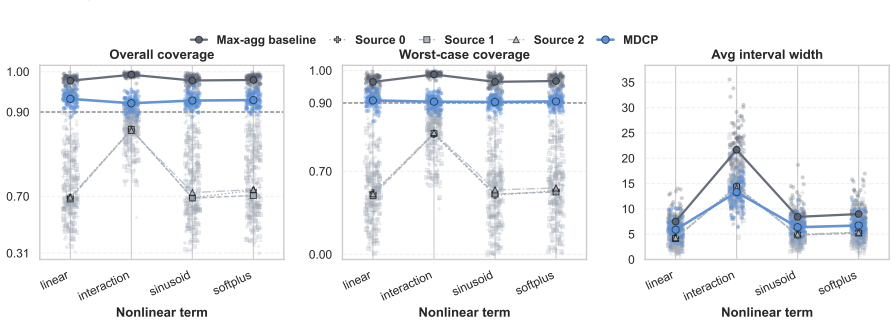
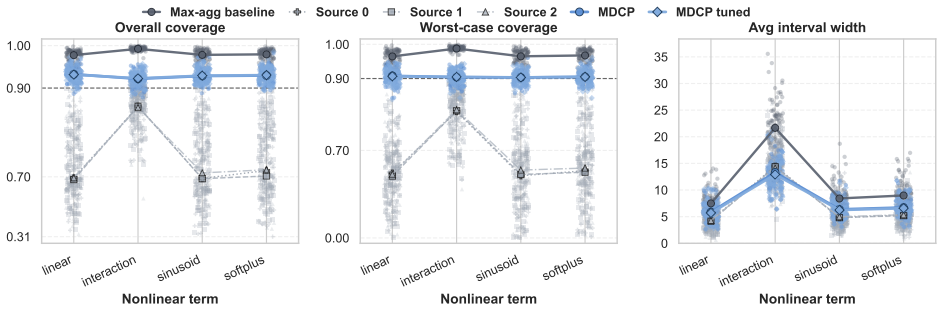
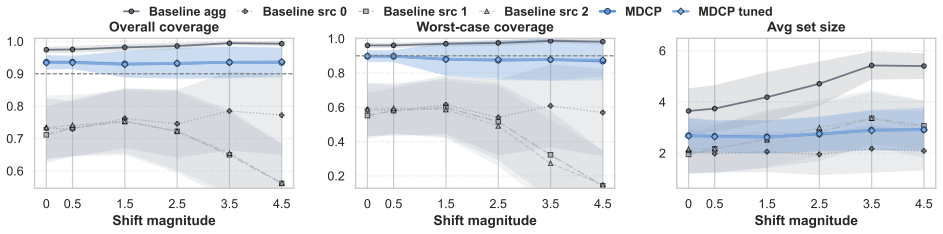
Take K=2 sources with known overlapping densities and compute the exact dual weights. If, with n growing, the size of the max-p aggregated set does not converge to the size of {y: h*(x,y) ≥ 1} up to the boundary, the asymptotic optimality claim fails; equally, if the worst-case source coverage stays strictly above 1−α with no downward trend as n grows, the tightness claim fails.
Extended reading notes
Core claim
Fix a covariate x. The oracle-optimal set under uniform coverage has the form {y: Σ_k λ_k*(x) f_k(y|x) > 1} up to boundary randomization, where the multipliers λ_k*(x) mark which sources are hardest to cover at x (a positive multiplier means that source's coverage constraint is active). The paper proves that max-p aggregation built from consistent estimates of these densities and multipliers converges to this oracle set, and that the final set achieves exact 1−α coverage for at least one source. The finite-sample validity of the union is distribution-free and does not depend on how the per-source scores were trained.
Load-bearing premise
The coverage guarantee itself only needs split conformal calibration, but the efficiency and tightness claims require that each source's conditional label density and the optimal weights are estimated consistently — if those estimates are poor, the set remains valid but can be larger than necessary.
Editorial extensions
If this is right
- A practitioner can return a single prediction set with guaranteed coverage for every source or any mixture of sources, without observing the source label at test time.
- Efficiency can match single-source conformal sets: with learned scores, the union shrinks toward the oracle set rather than inflating.
- Worst-case coverage is tight: at least one source is covered at exactly 1−α asymptotically, so the method is not needlessly conservative.
- The framework covers subpopulation shift and fairness without protected group labels, since any mixture of sources inherits the guarantee.
- In regression, the MDCP set is a union of at most K intervals, giving an efficient grid-search implementation.
Reading between the lines
- The dual weights λ_k(x) are an interpretable by-product: they identify, at each x, which source is hardest to cover; one could use them as a diagnostic for where a source is under-served by the model.
- A natural extension is to replace the density-based score with quantile or interval-preserving scores so the final set in regression is always an interval; the paper's own discussion suggests this as an open question.
- Because finite-sample validity is score-agnostic but efficiency depends on density estimation, a testable practical prediction is that MDCP's size advantage over naive union grows as the per-source density estimates improve (more data per source).
- The framework assumes the test point comes from one of the known sources or their mixture; applying it to a genuinely new environment is outside the guarantee and would require additional handling of novel groups.
Editorial analysis
A structured set of objections, weighed in public.
Referee Report
Summary. The paper proposes Multi-Distribution Conformal Prediction (MDCP): combine per-source conformal p-values by taking their maximum, and invert the max-p p-value to obtain a prediction set. Theorem 1 shows this aggregation is the union of single-source conformal sets and provides finite-sample uniform coverage for any conformity scores. For efficiency, the paper studies population-level size-minimization programs under uniform coverage (Theorems 2 and 10), characterizes the oracle-optimal set as a superlevel set of a shared score h*(x,y)=Σ_k λ_k*(x) f_k(y|x), and claims in Theorem 3 that max-p aggregation with consistent estimates of this score is asymptotically optimal and tight up to the boundary {h*=1}. The practical algorithm learns λ(·) by empirical dual objective (Theorem 9), with instantiations for classification and regression, supported by simulations and three real-data applications.
Significance. The finite-sample uniform-coverage result (Theorem 1) is clean, useful, and score-agnostic, and the LP-duality characterization of an oracle-optimal set is a valuable conceptual contribution. If the asymptotic optimality claim is made rigorous, the paper gives a principled way to design shared conformity scores for multi-distribution conformal prediction without group labels, with substantial potential application to fairness and subpopulation shift. The experiments are extensive and the code is available. However, the proof of the central asymptotic-optimality theorem has a gap, and the score-learning theorem rests on an undefined and potentially circular assumption; these issues currently prevent the theoretical contribution from being fully accepted as written.
major comments (3)
- [Appendix B.4, proof of Theorem 3] The proof asserts, for an active source k, that α∈[F_k(1−),F_k(1)] implies 'the generalized α-quantile is unique and equals 1.' This implication is false: if F_k is flat at level α on an interval [a,1) (e.g., h* takes the value a on a set of P_k-probability α and takes no values in (a,1)), then every q∈[a,1] is a generalized α-quantile, and 1 is not unique. Consequently, the conclusion q̂_{min,α}→1 and the bound ρ(Ĉ^{(n)} △ {h*≥1}) ≤ ρ(T) are not established by the given argument. A correct proof must either add an explicit no-flat-region/uniqueness assumption or show that any limit point of the randomized inf-quantile above 1 corresponds to a ρ-null region {1<h*<q}. The concrete counterexample circulated with the paper is not itself convincing as a feasibility counterexample as written—the second source has zero coverage in the proposed oracle set—but the proof gap is real and load-bear
- [Section 4.1, Assumptions 7–8 and proof of Theorem 9] Assumption 7 references λ̄*(x), but this object is never defined in the main text or in the proof of Theorem 9. If λ̄* is the population minimizer with the true p_pool, the assumption is close to vacuous; if it is a different quantity, the triangle inequality '∥λ̂−λ*∥ ≤ ∥λ̂−λ̄*∥ + ∥λ̄*−λ*∥' is not justified, and the assumed rate in Assumption 7 appears to contain the very convergence the theorem is meant to deliver. Moreover, Assumption 8 is asserted without verification for the sieve examples. As written, Theorem 9 does not provide a self-contained derivation of consistency of λ̂ to the dual solution. Please define λ̄*, state precisely which convergence is being assumed, and either verify or substantially weaken Assumptions 7–8.
- [Sections 4.3 and 6.3 (regression implementation)] Theorem 3 requires sup-consistent estimation of each true conditional density f_k(y|x). The regression algorithm instead uses a heteroskedastic Gaussian working model f̂_k(y|x)=N(y; μ̂_k(x), σ̂_k^2(x)). On the MEPS data the authors themselves apply a log transform because the raw label density is visibly skewed, showing that the working density is misspecified. Under misspecification ĥ does not converge to h*, so the claimed asymptotic efficiency optimality is not in force for these real-data comparisons (the finite-sample coverage guarantee from Theorem 1 is unaffected). The paper should either provide a misspecification analysis, prove optimality within the Gaussian working model, or explicitly label the real-data efficiency claims as heuristic.
minor comments (4)
- [Theorem 3 statement] The statement uses a deterministic-looking limsup of ρ(Ĉ^{(n)} △ {h*≥1}) after the proof has only established convergence in probability of the relevant quantities. The mode of convergence (in probability, almost sure, or along subsequences) should be made explicit and the proof adjusted accordingly.
- [Section 4.1, Assumption 8] The notation for function classes is inconsistent: Assumption 8 refers to θ*∈(Λ_c^p)^K, while the preceding text defines Λ_{c,+}^p and Θ=(Λ_{c,+}^p)^K. Please clarify whether nonnegativity is enforced in the Hölder class or handled separately.
- [Appendix B.4, Definition 13] The randomized empirical quantile uses a '+1' in the tie term, which differs from the more common convention. The effect of this choice on the limit of the quantile in the presence of atoms should be stated explicitly, since it is relevant to the proof of Theorem 3.
- [Section 6.1 / references] The MEPS19 and MEPS20 references appear to point to the same data-file URL; please check that both panels are cited with their correct identifiers.
Circularity Check
No significant circularity; central validity and optimality derivations are self-contained, with only a minor self-citation for sieve convergence rates.
-
other
[Section 4.1 (Theorem 9) and Appendix B.6]
"Similar to Jin et al. [2022, Theorem 1], we can show that the solution (10) is close to λ* once p̂pool is accurate."
The bridge from the fitted score to asymptotic optimality requires convergence λ̂→λ*. The paper's proof of this rate is explicitly delegated to a theorem of a prior preprint co-authored by the present second author — 'Similar to Jin et al. [2022, Theorem 1]' — rather than re-derived from the current assumptions. This is a self-citation chain in a supporting role: if the cited theorem were set aside, Theorem 9 would have no independent derivation in this manuscript. It is not a full circularity because the finite-sample coverage guarantee (Theorem 1) is calibration-based and does not rely on λ̂, and the oracle-optimal form is derived from the LP dual rather than from the fitted model.
full rationale
The central finite-sample uniform coverage (Theorem 1) is a direct split-conformal argument (union of per-source sets), holding for arbitrary scores and any mixture of sources; it is not an input being rediscovered. The optimality result (Theorem 2) is a standalone LP/dual derivation with explicit KKT complementary slackness; Theorem 3 is a conditional statement: if density estimators and dual-weight estimators are consistent, the max-p set converges to the oracle set. The learned λ̂ enters only through an ERM/dual objective whose convergence (Theorem 9) is stated under explicit assumptions (Assumptions 7 and 8). The residual self-citation is to the authors' own prior sieve-rate theorem in the proof of Theorem 9; it is supporting, not load-bearing for validity, and is not a prediction that reduces to a fitted constant. The skeptically flagged issue in Appendix B.4 (uniqueness of the α-quantile on flat regions) is a mathematical correctness/tightness concern, not circularity; it does not raise the circularity score.
Assumptions & free parameters
free parameters (3)
- Dual multiplier functions λ_k(x) =
ERM fit: cubic B-spline degree 3, 5 knots (simulations) or 2-layer NN width 4 (FMoW/PovertyMap/MEPS)
- Per-source conditional density models f̂_k(y|x) and p̂_pool =
Gradient-boosting classifiers (classification); gradient-boosting μ_k(x), σ_k(x) under a Gaussian working model (regress
- Misc hyperparameters: knots (5), NN width (4), PCA dim (16), grid M, penalty γ =
5; 4; 16; M≈100; γ ∈ {0,0.001,...,1000} chosen via mimic split
assumptions (6)
- standard math Strong LP duality (Slater's condition) for the coverage LPs in Theorems 2 and 10 (C(x)=Y is strictly feasible).
- standard math Standard empirical-process/concentration tools: DKW inequality, Lévy-distance continuity of quantiles (Appendix B.4).
- domain assumption Test distribution is one of the K sources or a fixed mixture of them (eq. 1); per-source data are i.i.d.
- domain assumption Each source has covariate density r_k w.r.t. ν and conditional density f_k(y|x) w.r.t. a common reference μ; ν(X), μ(Y) finite (§3.1).
- domain assumption Regression working model Y = μ_k(x) + σ_k(x)ε with ε ~ N(0,1) per source; sup|f̂_k−f_k| → 0 and sup‖λ̂−λ*‖ → 0 (Theorem 3).
- ad hoc to paper Assumption 7: ∥λ*−λ̄*∥ = O_P(∥p̂_pool−p_pool∥), and Assumption 8: η-strong convexity of the ERM loss at λ̄*(x).
invented entities (1)
-
Dual multiplier functions λ_k(x) (softplus parameterization)
independent evidence
Cite this review
Pith. "Pith review of Multi-Distribution Robust Conformal Prediction." pith.science (2026). https://pith.science/paper/G7JMC3BO
@misc{pith2026260102998,
  author       = {Pith},
  title        = {Pith review of: Multi-Distribution Robust Conformal Prediction},
  year         = {2026},
  howpublished = {\url{https://pith.science/paper/G7JMC3BO}},
  note         = {Machine review of arXiv:2601.02998}
}
read the original abstract
In many fairness and distribution robustness problems, one has access to labeled data from multiple source distributions yet the test data may come from an arbitrary member or a mixture of them. We study the problem of constructing a conformal prediction set that is uniformly valid across multiple, heterogeneous distributions, in the sense that no matter which distribution the test point is from, the coverage of the prediction set is guaranteed to exceed a pre-specified level. We first propose a max-p aggregation scheme that delivers finite-sample, multi-distribution coverage given any conformity scores associated with each distribution. Upon studying several efficiency optimization programs subject to uniform coverage, we prove the optimality and tightness of our aggregation scheme, and propose a general algorithm to learn conformity scores that lead to efficient prediction sets after the aggregation under standard conditions. We discuss how our framework relates to group-wise distributionally robust optimization, sub-population shift, fairness, and multi-source learning. In synthetic and real-data experiments, our method delivers valid worst-case coverage across multiple distributions while greatly reducing the set size compared with naively applying max-p aggregation to single-source conformity scores, and can be comparable in size to single-source prediction sets with popular, standard conformity scores.
Figures


Figures from the paper (20 more)








Forward citations
Cited by 1 Pith paper
-
Conformalized Large Language Models under Configuration Shift
Configuration shift (prompt, temperature, quantization) moves nonconformity score distributions and drives conformal coverage below target; bounds, diagnostics, and mitigations are provided.
Reference graph
Works this paper leans on
-
[1938]
Kaiming He, Xiangyu Zhang, Shaoqing Ren, and Jian Sun
PMLR, 2018. Kaiming He, Xiangyu Zhang, Shaoqing Ren, and Jian Sun. Deep residual learning for image recognition,
2018
-
[2009]
Rina Foygel Barber, Emmanuel J Candes, Aaditya Ramdas, and Ryan J Tibshirani
doi: 10.1109/CVPR.2009.5206848. Rina Foygel Barber, Emmanuel J Candes, Aaditya Ramdas, and Ryan J Tibshirani. The limits of distribution-free conditional predictive inference.Information and Inference: A Journal of the IMA, 10(2):455–482, 2021. Yarin Gal et al. Uncertainty in deep learning. 2016. Stuart Geman and Chii-Ruey Hwang. Nonparametric maximum lik...
arXiv 2009
-
[2015]
Gao Huang, Zhuang Liu, Laurens van der Maaten, and Kilian Q
URLhttps://arxiv.org/abs/1512.03385. Gao Huang, Zhuang Liu, Laurens van der Maaten, and Kilian Q. Weinberger. Densely connected convolu- tional networks, 2018. URLhttps://arxiv.org/abs/1608.06993. Kexin Huang, Ying Jin, Emmanuel Candes, and Jure Leskovec. Uncertainty quantification over graph with conformalized graph neural networks.Advances in Neural Inf...
arXiv 2018
-
[7501]
PMLR, 2021. 22 MEPS19. Medical expenditure panel survey, panel 19.https://meps.ahrq.gov/mepsweb/data_stats/ download_data_files_detail.jsp?cboPufNumber=HC-181. Accessed: Oct, 2025. MEPS20. Medical expenditure panel survey, panel 20.https://meps.ahrq.gov/mepsweb/data_stats/ download_data_files_detail.jsp?cboPufNumber=HC-181. Accessed: Oct, 2025. MEPS21. Me...
arXiv 2021
Reviewed August 3, 2026 · model on record in the stance chip above.
Discussion (0). Continue with ORCID to comment.