REVIEW 3 major objections 3 minor 72 references
Harnessing Text-to-Image Diffusion Models for Point Cloud Self-Supervised Learning
T0 review · 3 major / 3 minor · reviewed 2026-08-06 · deepseek-v4-flash
Pith's one-line read PointSD claims that a frozen Stable Diffusion model can teach 3D point cloud backbones useful semantics, replacing text conditioning with point-cloud tokens and aligning 3D features to SD's image features.
desk verdict PointSD is a solid empirical paper on using frozen Stable Diffusion as a teacher for 3D point cloud SSL; the layer-ablation table contradicts its own text, and the conditioning mechanism is under-evidenced, but the core result survives. read the letter →
The pith
A machine-rendered reading of the paper's core claim, the machinery that carries it, and where it could break.
The reading
What carries the argument
Two mechanisms carry the argument. The first is the cross-attention substitution: point-cloud tokens $H = g(P)$ replace text features as the keys and values in Stable Diffusion's cross-attention layers, so the UNet's denoising is conditioned on 3D content rather than language. Cross-attention is the mechanism by which the image generator's intermediate features attend to conditioning tokens, and in this design those tokens come from a 3D encoder instead of a text encoder. The second is the alignment objective $L_{\text{alignment}} = \lVert s(R_P) - R_X \rVert_2^2$, which forces the 3D backbone's projected representation to match SD's down-sampling-layer features extracted from a noise-free rendered image conditioned on the same point cloud. The paper also couples these with a patch-mixing point-cloud augmentation and a stitched-image counterpart so the aligned pairs are harder and more diverse.
What would settle it
Take the same point cloud at the same viewpoint and generate two images from it using different random seeds; do the same for two different point clouds at the same viewpoint. If the point-cloud conditioning is load-bearing, the images from different objects should differ more than the two images of the same object. This distance comparison would settle whether the Stable Diffusion features used for alignment actually encode 3D shape, and the paper only provides qualitative examples of the generated images.
Extended reading notes
Core claim
PointSD's central claim is that a frozen Stable Diffusion model, trained on web-scale text-image pairs, can serve as a teacher for 3D self-supervised learning. The method first converts the text-to-image generator into a point-to-image generator: a 3D encoder outputs tokens that are fed through Stable Diffusion's cross-attention layers as the condition, and only the 3D encoder and the key/value projection matrices are trained while the rest of the UNet stays frozen. In the second stage, a noise-free rendered image of the same object is passed through the same conditioned UNet, and the 3D backbone is trained so that its projected features match the SD features taken from the down-sampling layers, using an L2 alignment loss. The paper reports that this recipe pushes ScanObjectNN accuracy to 95.18% on OBJ-BG, 93.63% on OBJ-ONLY, and 90.08% on PB-T50-RS, and that it beats the prior diffusion-based point-cloud pre-training method in all three settings while matching a label-supervised cross-modal method with roughly half the parameters.
Load-bearing premise
The load-bearing premise is that letting Stable Diffusion's image generator look at point-cloud tokens through its attention mechanism actually produces image features that reflect 3D shape, even though Stable Diffusion was trained on text-conditioned natural images; if that conditioning is noisy or weak, the alignment targets in the second stage carry little useful 3D information.
Editorial extensions
If this is right
- A 3D backbone pre-trained this way outperforms single-modal generative pre-training methods, including masked autoencoders and 3D diffusion denoising, across all three ScanObjectNN settings.
- The alignment transfer is not limited to classification: the pre-trained backbone improves few-shot accuracy on ModelNet40, part segmentation, and lifts a 3D detection backbone on an indoor-scene benchmark from 37.9 to 42.4 AP50.
- The point-cloud condition is what makes the features useful: ablations show 90.08% with point-cloud conditioning versus 89.42% with class-text conditioning and 89.31% with no conditioning.
- SD's down-sampling layers carry the most semantic signal for 3D learning; using them as alignment targets gives 90.08% versus 87.12% for middle-layer and 86.78% for up-sampling-layer features.
- The second-stage alignment is needed on top of denoising: high-time-step denoising alone reaches 88.45%, and adding feature alignment raises accuracy to 90.08%.
- Editorial inference: because PointSD only relies on cross-attention conditioning, the same two-stage recipe could plausibly work with any large frozen conditional image generator, not just Stable Diffusion; the paper's pre-trained-model ablation compares image encoders rather than other diffusion backbones, so this remains untested.
- Editorial inference: the method's dependence on rendered views means its success may partly reflect a fixed rendering style; a direct test is to render the same 3D objects with varied lighting, camera height, or background and measure whether downstream accuracy degrades as the rendering distribution changes.
- Editorial inference: the authors attribute their weaker part-segmentation results to object-level alignment and show in the supplementary that adding a masked-point reconstruction loss improves classification; an untested follow-up is whether that same mix also closes the part-segmentation gap.
Editorial analysis
A structured set of objections, weighed in public.
Referee Report
Summary. PointSD proposes a two-stage self-supervised pretraining method for point clouds that leverages a frozen Stable Diffusion v1.5 model. In Stage I, a 3D encoder replaces the text encoder, and its output tokens condition the SD UNet through cross-attention layers while only the K/V projection matrices are trained, yielding a point-to-image diffusion model. In Stage II, noise-free rendered images are passed through SD with point-cloud tokens as the condition, and a 3D backbone plus projector is trained to align backbone features with the resulting SD features via an L2 loss. The paper also introduces a mixing augmentation for point clouds and stitched images. Experiments cover ScanObjectNN classification, ModelNet40 classification and few-shot learning, ShapeNetPart part segmentation, ScanNetV2 detection, SemanticKITTI segmentation in the supplementary, and several ablations over conditions, augmentation, SD layers, pre-trained models, and training stages.
Significance. If the claims hold, the paper provides a useful demonstration that a large frozen text-to-image diffusion model can transfer semantic knowledge to 3D point cloud representations through a trainable conditioning adapter in a label-free manner. The scope of evaluation is broad, the code is publicly released, and the method improves consistently over a Transformer baseline and over PointDif in the reported tables. The central mechanism, however, rests on the assumption that point-cloud tokens actively steer the Stable Diffusion features that serve as alignment targets, and this assumption is not directly measured; in addition, the paper contains a direct contradiction about which SD layer produces the best features. These issues must be addressed before the contribution can be considered established.
major comments (3)
- [Sec. 4.3 / Table 7] Table 7 reports 'up' as the best SD layer (90.08) and 'down' as the worst (86.78), while the text in Sec. 4.3 states that the best performance is achieved by the down-sampling layers and the worst by the up-sampling layers; the same down-sampling claim appears in Sec. 3.2, where Eq. (5) defines R_X as coming from the 'last down-sampling layer'. Because the headline PB-T50-RS result is 90.08, the value in the 'up' row, the reader cannot tell which configuration actually produced the main results. This contradiction must be resolved, and the main experiments must be clearly attributed to the correct layer or re-run accordingly.
- [Sec. 3.2, Stage II; Table 5] The central claim that point-cloud tokens H actively control the SD features used for alignment is not directly verified. Stage II extracts R_X from a noise-free rendered image with H as the condition, but the only quantitative evidence that H matters is the 0.77-point gap between 'pc' and 'zero' in Table 5, supported only by qualitative generations in Fig. 4. Since the same rendered image is used in both cases, R_X could be dominated by image content, which would make the Stage I point-to-image construction superfluous. Please add a direct fidelity test, such as measuring the feature-level distance between R_X extracted with H versus a zero or random condition, or showing that cross-attention maps localize the point-cloud structure; without such evidence the proposed mechanism is not established.
- [Sec. 4.2 / Table 1] The comparison in Table 1 mixes different fine-tuning protocols. The text states that recent works use rotation augmentation and 2048 points and that the authors follow this protocol, whereas older rows such as PointDif, Point-BERT, and Point-MAE are cited with their published numbers, which were obtained with different settings (typically 1024 points and no rotation). The claimed consistent improvement over PointDif is therefore not established under an identical protocol. Please re-run the baselines under the same fine-tuning settings as Ours, or clearly mark the protocol change and report its effect on accuracy.
minor comments (3)
- [Fig. 1] The caption and the surrounding discussion of low versus high time steps could be clearer about which end of the time-step range corresponds to higher noise; the current wording is easy to misread.
- [Table 7] The row labels 'down', 'mid', and 'up' should be defined in the caption with the exact layer indices used for feature extraction, so that the reported choice is reproducible.
- [Fig. 3 / Fig. 5] The t-SNE visualizations are qualitative; please either specify the subset of ShapeNet categories used in Fig. 3 or report a quantitative cluster-quality metric in addition to the plots.
Circularity Check
No significant circularity: PointSD is an empirically evaluated two-stage teacher-student framework whose results are measured against external benchmarks.
full rationale
The paper makes no first-principles derivation; its central claim is an empirical claim about a pre-training recipe. Stage I trains a 3D encoder g and cross-attention projections so point-cloud tokens H condition a frozen SD UNet via cross-attention (Eqs. 3-4 and 8). Stage II freezes g and the SD model and aligns a separate 3D backbone f to SD features R_X extracted from noise-free rendered images conditioned on H (Eqs. 5 and 9). The alignment target is produced by a frozen teacher, not by the student backbone itself, so this is a standard teacher-student/self-distillation loop rather than a circular reduction. Downstream numbers on ScanObjectNN, ModelNet40, ShapeNetPart, ScanNetV2, and SemanticKITTI are external benchmarks; no benchmark number is fitted or constructed from the method's own equations, and the reported gains are measured rather than derived. Citations to PointDif and VPD are external works and do not overlap with the present authorship, so no self-citation chain is load-bearing. One reporting inconsistency, which is a correctness/mechanism concern rather than a circularity issue: Section 3.2 and Section 4.3 state that down-sampling SD layers give the best features, while Table 7 reports 'up'=90.08 versus 'down'=86.78, so the reader cannot tell which layer configuration produced the headline results. Likewise, the conditioning fidelity of the point-cloud tokens is only supported qualitatively (Fig. 4) and by the modest 'pc' versus 'zero' ablation gap in Table 5; this is weak mechanistic evidence but not a circular reduction. No step in the paper reduces a claimed result to its own inputs by construction.
Assumptions & free parameters
free parameters (4)
- Stage I diffusion timestep range =
[500, 1000]
- Projector block count =
3
- Augmentation probability =
0.5
- SD feature extraction layer =
last down-sampling layer
assumptions (4)
- standard math The LDM denoising objective (Eq. 1) and the cross-attention update rule (Eq. 4) are valid as formulated.
- domain assumption Rendered images from ULIP faithfully represent the 3D object's shape and semantics.
- domain assumption Frozen SD can be successfully re-purposed to point-cloud conditioning by training only W_k, W_v and the 3D encoder.
- domain assumption Noise-free images passed through SD yield semantically meaningful features.
Cite this review
Pith. "Pith review of Harnessing Text-to-Image Diffusion Models for Point Cloud Self-Supervised Learning." pith.science (2026). https://pith.science/paper/G7KNTRYS
@misc{pith2026250709102,
  author       = {Pith},
  title        = {Pith review of: Harnessing Text-to-Image Diffusion Models for Point Cloud Self-Supervised Learning},
  year         = {2026},
  howpublished = {\url{https://pith.science/paper/G7KNTRYS}},
  note         = {Machine review of arXiv:2507.09102}
}
read the original abstract
Diffusion-based models, widely used in text-to-image generation, have proven effective in 2D representation learning. Recently, this framework has been extended to 3D self-supervised learning by constructing a conditional point generator for enhancing 3D representations. However, its performance remains constrained by the 3D diffusion model, which is trained on the available 3D datasets with limited size. We hypothesize that the robust capabilities of text-to-image diffusion models, particularly Stable Diffusion (SD), which is trained on large-scale datasets, can help overcome these limitations. To investigate this hypothesis, we propose PointSD, a framework that leverages the SD model for 3D self-supervised learning. By replacing the SD model's text encoder with a 3D encoder, we train a point-to-image diffusion model that allows point clouds to guide the denoising of rendered noisy images. With the trained point-to-image diffusion model, we use noise-free images as the input and point clouds as the condition to extract SD features. Next, we train a 3D backbone by aligning its features with these SD features, thereby facilitating direct semantic learning. Comprehensive experiments on downstream point cloud tasks and ablation studies demonstrate that the SD model can enhance point cloud self-supervised learning. Code is publicly available at https://github.com/wdttt/PointSD.
Figures


Figures from the paper (3 more)

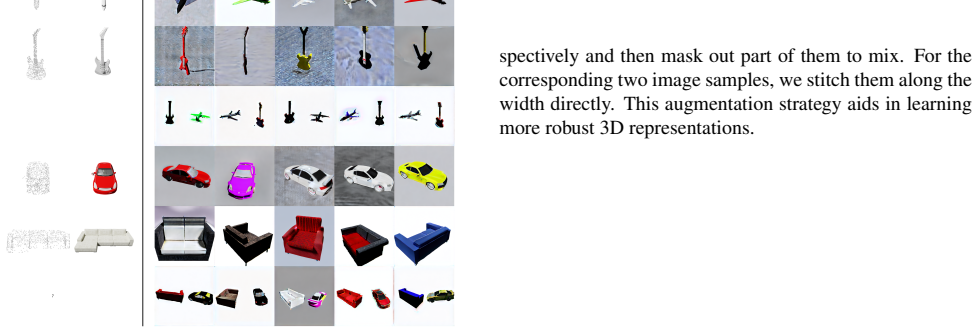

Reference graph
Works this paper leans on
-
[1]
Crosspoint: Self-supervised cross-modal contrastive learning for 3d point cloud understanding
Mohamed Afham, Isuru Dissanayake, Dinithi Dissanayake, Amaya Dharmasiri, Kanchana Thilakarathna, and Ranga Ro- drigo. Crosspoint: Self-supervised cross-modal contrastive learning for 3d point cloud understanding. InProceedings of the IEEE/CVF Conference on Computer Vision and Pattern Recognition, pages 9902–9912, 2022. 1, 2, 3
work page 2022
-
[2]
Se- mantickitti: A dataset for semantic scene understanding of lidar sequences
Jens Behley, Martin Garbade, Andres Milioto, Jan Quen- zel, Sven Behnke, Cyrill Stachniss, and Jurgen Gall. Se- mantickitti: A dataset for semantic scene understanding of lidar sequences. InProceedings of the IEEE/CVF inter- national conference on computer vision, pages 9297–9307,
-
[3]
Andreas Blattmann, Tim Dockhorn, Sumith Kulal, Daniel Mendelevitch, Maciej Kilian, Dominik Lorenz, Yam Levi, Zion English, Vikram V oleti, Adam Letts, et al. Stable video diffusion: Scaling latent video diffusion models to large datasets.arXiv preprint arXiv:2311.15127, 2023. 3
arXiv 2023
-
[4]
Lan- guage models are few-shot learners.Advances in neural in- formation processing systems, 33:1877–1901, 2020
Tom Brown, Benjamin Mann, Nick Ryder, Melanie Sub- biah, Jared D Kaplan, Prafulla Dhariwal, Arvind Neelakan- tan, Pranav Shyam, Girish Sastry, Amanda Askell, et al. Lan- guage models are few-shot learners.Advances in neural in- formation processing systems, 33:1877–1901, 2020. 1
1901
-
[5]
Emerg- ing properties in self-supervised vision transformers
Mathilde Caron, Hugo Touvron, Ishan Misra, Herv ´e J´egou, Julien Mairal, Piotr Bojanowski, and Armand Joulin. Emerg- ing properties in self-supervised vision transformers. InPro- ceedings of the IEEE/CVF international conference on com- puter vision, pages 9650–9660, 2021. 1, 7
work page 2021
-
[6]
Shapenet: An information-rich 3d model repository.arXiv preprint arXiv:1512.03012, 2015
Angel X Chang, Thomas Funkhouser, Leonidas Guibas, Pat Hanrahan, Qixing Huang, Zimo Li, Silvio Savarese, Manolis Savva, Shuran Song, Hao Su, et al. Shapenet: An information-rich 3d model repository.arXiv preprint arXiv:1512.03012, 2015. 5, 8
arXiv 2015
-
[7]
Pimae: Point cloud and image interactive masked autoencoders for 3d object detection
Anthony Chen, Kevin Zhang, Renrui Zhang, Zihan Wang, Yuheng Lu, Yandong Guo, and Shanghang Zhang. Pimae: Point cloud and image interactive masked autoencoders for 3d object detection. InProceedings of the IEEE/CVF Con- ference on Computer Vision and Pattern Recognition, pages 5291–5301, 2023. 2
work page 2023
-
[8]
Videocrafter1: Open diffusion models for high-quality video generation, 2023
Haoxin Chen, Menghan Xia, Yingqing He, Yong Zhang, Xiaodong Cun, Shaoshu Yang, Jinbo Xing, Yaofang Liu, Qifeng Chen, Xintao Wang, Chao Weng, and Ying Shan. Videocrafter1: Open diffusion models for high-quality video generation, 2023. 3
2023
Show all 72 references
-
[9]
A simple framework for contrastive learning of visual representations
Ting Chen, Simon Kornblith, Mohammad Norouzi, and Ge- offrey Hinton. A simple framework for contrastive learning of visual representations. InInternational conference on ma- chine learning, pages 1597–1607. PMLR, 2020. 1
2020
-
[10]
Pointmixup: Augmentation for point clouds
Yunlu Chen, Vincent Tao Hu, Efstratios Gavves, Thomas Mensink, Pascal Mettes, Pengwan Yang, and Cees GM Snoek. Pointmixup: Augmentation for point clouds. In Computer Vision–ECCV 2020: 16th European Conference, Glasgow, UK, August 23–28, 2020, Proceedings, Part III 16, pages 33...
2020
-
[11]
Text-to-image diffusion mod- els are zero shot classifiers.Advances in Neural Information Processing Systems, 36, 2024
Kevin Clark and Priyank Jaini. Text-to-image diffusion mod- els are zero shot classifiers.Advances in Neural Information Processing Systems, 36, 2024. 2, 3
2024
-
[12]
Scannet: Richly-annotated 3d reconstructions of indoor scenes
Angela Dai, Angel X Chang, Manolis Savva, Maciej Hal- ber, Thomas Funkhouser, and Matthias Nießner. Scannet: Richly-annotated 3d reconstructions of indoor scenes. In Proceedings of the IEEE conference on computer vision and pattern recognition, pages 5828–5839, 2017. 7
2017
-
[13]
Bert: Pre-training of deep bidirectional transformers for language understanding.arXiv preprint arXiv:1810.04805, 2018
Jacob Devlin, Ming-Wei Chang, Kenton Lee, and Kristina Toutanova. Bert: Pre-training of deep bidirectional transformers for language understanding.arXiv preprint arXiv:1810.04805, 2018. 1, 2
2018 arXiv
-
[14]
Runpei Dong, Zekun Qi, Linfeng Zhang, Junbo Zhang, Jian- jian Sun, Zheng Ge, Li Yi, and Kaisheng Ma. Autoencoders as cross-modal teachers: Can pretrained 2d image transform- ers help 3d representation learning? InThe Eleventh Inter- national Conference on Learning Representati...
-
[15]
Revisiting point cloud shape classification with a simple and effective baseline
Ankit Goyal, Hei Law, Bowei Liu, Alejandro Newell, and Jia Deng. Revisiting point cloud shape classification with a simple and effective baseline. InProceedings of the 38th In- ternational Conference on Machine Learning, pages 3809–
-
[16]
3d semantic segmentation with submani- fold sparse convolutional networks
Benjamin Graham, Martin Engelcke, and Laurens Van Der Maaten. 3d semantic segmentation with submani- fold sparse convolutional networks. InProceedings of the IEEE conference on computer vision and pattern recogni- tion, pages 9224–9232, 2018. 12
2018
-
[17]
Bootstrap your own latent-a new approach to self-supervised learning.Advances in neural information processing systems, 33:21271–21284, 2020
Jean-Bastien Grill, Florian Strub, Florent Altch ´e, Corentin Tallec, Pierre Richemond, Elena Buchatskaya, Carl Doersch, Bernardo Avila Pires, Zhaohan Guo, Mohammad Ghesh- laghi Azar, et al. Bootstrap your own latent-a new approach to self-supervised learning.Advances in neura...
2020
-
[18]
Animatediff: Animate your personalized text-to-image diffusion models without specific tuning.arXiv preprint arXiv:2307.04725, 2023
Yuwei Guo, Ceyuan Yang, Anyi Rao, Yaohui Wang, Yu Qiao, Dahua Lin, and Bo Dai. Animatediff: Animate your personalized text-to-image diffusion models without specific tuning.arXiv preprint arXiv:2307.04725, 2023. 3
2023 arXiv
-
[19]
Joint-mae: 2d-3d joint masked au- toencoders for 3d point cloud pre-training.arXiv preprint arXiv:2302.14007, 2023
Ziyu Guo, Renrui Zhang, Longtian Qiu, Xianzhi Li, and Pheng-Ann Heng. Joint-mae: 2d-3d joint masked au- toencoders for 3d point cloud pre-training.arXiv preprint arXiv:2302.14007, 2023. 2, 5, 6
2023 arXiv
-
[20]
Mvtn: Multi-view transformation network for 3d shape recognition
Abdullah Hamdi, Silvio Giancola, and Bernard Ghanem. Mvtn: Multi-view transformation network for 3d shape recognition. InProceedings of the IEEE/CVF International Conference on Computer Vision (ICCV), pages 1–11, 2021. 5
2021
-
[21]
Masked autoencoders are scalable vision learners
Kaiming He, Xinlei Chen, Saining Xie, Yanghao Li, Piotr Doll´ar, and Ross Girshick. Masked autoencoders are scalable vision learners. InProceedings of the IEEE/CVF conference on computer vision and pattern recognition, pages 16000– 16009, 2022. 1, 2, 7
2022
-
[22]
Denoising dif- fusion probabilistic models.Advances in neural information processing systems, 33:6840–6851, 2020
Jonathan Ho, Ajay Jain, and Pieter Abbeel. Denoising dif- fusion probabilistic models.Advances in neural information processing systems, 33:6840–6851, 2020. 2, 3
2020
-
[23]
Regu- larization strategy for point cloud via rigidly mixed sample
Dogyoon Lee, Jaeha Lee, Junhyeop Lee, Hyeongmin Lee, Minhyeok Lee, Sungmin Woo, and Sangyoun Lee. Regu- larization strategy for point cloud via rigidly mixed sample. InProceedings of the IEEE/CVF Conference on Computer Vision and Pattern Recognition, pages 15900–15909, 2021. 4
2021
-
[24]
Your diffusion model is secretly a zero-shot classifier
Alexander C Li, Mihir Prabhudesai, Shivam Duggal, Ellis Brown, and Deepak Pathak. Your diffusion model is secretly a zero-shot classifier. InProceedings of the IEEE/CVF Inter- national Conference on Computer Vision, pages 2206–2217,
-
[25]
Pointcnn: Convolution on x-transformed points
Yangyan Li, Rui Bu, Mingchao Sun, Wei Wu, Xinhan Di, and Baoquan Chen. Pointcnn: Convolution on x-transformed points. InAdvances in Neural Information Processing Sys- tems. Curran Associates, Inc., 2018. 5
2018
-
[26]
Masked discrim- ination for self-supervised learning on point clouds.Pro- ceedings of the European Conference on Computer Vision (ECCV), 2022
Haotian Liu, Mu Cai, and Yong Jae Lee. Masked discrim- ination for self-supervised learning on point clouds.Pro- ceedings of the European Conference on Computer Vision (ECCV), 2022. 5, 6, 7
2022
-
[27]
Zero-1-to-3: Zero-shot one image to 3d object
Ruoshi Liu, Rundi Wu, Basile Van Hoorick, Pavel Tok- makov, Sergey Zakharov, and Carl V ondrick. Zero-1-to-3: Zero-shot one image to 3d object. InProceedings of the IEEE/CVF International Conference on Computer Vision, pages 9298–9309, 2023. 3
2023
-
[28]
Wonder3d: Sin- gle image to 3d using cross-domain diffusion.arXiv preprint arXiv:2310.15008, 2023
Xiaoxiao Long, Yuan-Chen Guo, Cheng Lin, Yuan Liu, Zhiyang Dou, Lingjie Liu, Yuexin Ma, Song-Hai Zhang, Marc Habermann, Christian Theobalt, et al. Wonder3d: Sin- gle image to 3d using cross-domain diffusion.arXiv preprint arXiv:2310.15008, 2023. 3
-
[29]
Sgdr: Stochas- tic gradient descent with warm restarts.arXiv preprint arXiv:1608.03983, 2016
Ilya Loshchilov and Frank Hutter. Sgdr: Stochas- tic gradient descent with warm restarts.arXiv preprint arXiv:1608.03983, 2016. 5
2016 arXiv
-
[30]
Decoupled weight decay regularization.arXiv preprint arXiv:1711.05101, 2017
Ilya Loshchilov and Frank Hutter. Decoupled weight decay regularization.arXiv preprint arXiv:1711.05101, 2017. 5
2017 arXiv
-
[31]
Rethinking network design and local geometry in point cloud: A simple residual mlp framework.arXiv preprint arXiv:2202.07123, 2022
Xu Ma, Can Qin, Haoxuan You, Haoxi Ran, and Yun Fu. Rethinking network design and local geometry in point cloud: A simple residual mlp framework.arXiv preprint arXiv:2202.07123, 2022. 1, 5, 6
2022 arXiv
-
[32]
An end-to- end transformer model for 3d object detection
Ishan Misra, Rohit Girdhar, and Armand Joulin. An end-to- end transformer model for 3d object detection. InProceed- ings of the IEEE/CVF international conference on computer vision, pages 2906–2917, 2021. 6, 7
2021
-
[33]
Masked autoencoders for point cloud self-supervised learning
Yatian Pang, Wenxiao Wang, Francis EH Tay, Wei Liu, Yonghong Tian, and Li Yuan. Masked autoencoders for point cloud self-supervised learning. InEuropean conference on computer vision, pages 604–621. Springer, 2022. 1, 2, 3, 5, 6
2022
-
[34]
Diffusion autoen- coders: Toward a meaningful and decodable representation
Konpat Preechakul, Nattanat Chatthee, Suttisak Wizad- wongsa, and Supasorn Suwajanakorn. Diffusion autoen- coders: Toward a meaningful and decodable representation. InProceedings of the IEEE/CVF Conference on Computer Vision and Pattern Recognition, pages 10619–10629, 2022. 2
2022
-
[35]
Pointnet: Deep learning on point sets for 3d classification and segmentation
Charles R Qi, Hao Su, Kaichun Mo, and Leonidas J Guibas. Pointnet: Deep learning on point sets for 3d classification and segmentation. InProceedings of the IEEE conference on computer vision and pattern recognition, pages 652–660,
-
[36]
Pointnet++: Deep hierarchical feature learning on point sets in a metric space.Advances in neural information processing systems, 30, 2017
Charles Ruizhongtai Qi, Li Yi, Hao Su, and Leonidas J Guibas. Pointnet++: Deep hierarchical feature learning on point sets in a metric space.Advances in neural information processing systems, 30, 2017. 1, 5
2017
-
[37]
Contrast with reconstruct: Contrastive 3d representation learning guided by generative pretraining
Zekun Qi, Runpei Dong, Guofan Fan, Zheng Ge, Xiangyu Zhang, Kaisheng Ma, and Li Yi. Contrast with reconstruct: Contrastive 3d representation learning guided by generative pretraining. InInternational Conference on Machine Learn- ing (ICML), 2023. 2, 5, 6, 12, 13
2023
-
[38]
Pointnext: Revisiting pointnet++ with improved training and scaling strategies
Guocheng Qian, Yuchen Li, Houwen Peng, Jinjie Mai, Hasan Hammoud, Mohamed Elhoseiny, and Bernard Ghanem. Pointnext: Revisiting pointnet++ with improved training and scaling strategies. InAdvances in Neural In- formation Processing Systems, pages 23192–23204. Curran Associates,...
2022
-
[39]
Learning transferable visual models from natural language supervi- sion
Alec Radford, Jong Wook Kim, Chris Hallacy, Aditya Ramesh, Gabriel Goh, Sandhini Agarwal, Girish Sastry, Amanda Askell, Pamela Mishkin, Jack Clark, et al. Learning transferable visual models from natural language supervi- sion. InInternational conference on machine learning, p...
2021
-
[40]
Exploring the limits of transfer learning with a unified text-to-text transformer.Journal of machine learning research, 21(140):1–67, 2020
Colin Raffel, Noam Shazeer, Adam Roberts, Katherine Lee, Sharan Narang, Michael Matena, Yanqi Zhou, Wei Li, and Peter J Liu. Exploring the limits of transfer learning with a unified text-to-text transformer.Journal of machine learning research, 21(140):1–67, 2020. 1
2020
-
[41]
High-resolution image synthesis with latent diffusion models
Robin Rombach, Andreas Blattmann, Dominik Lorenz, Patrick Esser, and Bj ¨orn Ommer. High-resolution image synthesis with latent diffusion models. InProceedings of the IEEE/CVF conference on computer vision and pattern recognition, pages 10684–10695, 2022. 2, 3, 7
2022
-
[42]
Self-supervised few-shot learning on point clouds.Advances in Neural Information Processing Systems, 33:7212–7221, 2020
Charu Sharma and Manohar Kaul. Self-supervised few-shot learning on point clouds.Advances in Neural Information Processing Systems, 33:7212–7221, 2020. 6
2020
-
[43]
Mvdream: Multi-view diffusion for 3d gen- eration.arXiv preprint arXiv:2308.16512, 2023
Yichun Shi, Peng Wang, Jianglong Ye, Mai Long, Kejie Li, and Xiao Yang. Mvdream: Multi-view diffusion for 3d gen- eration.arXiv preprint arXiv:2308.16512, 2023. 3
2023 arXiv
-
[44]
Deep unsupervised learning using nonequilibrium thermodynamics
Jascha Sohl-Dickstein, Eric Weiss, Niru Maheswaranathan, and Surya Ganguli. Deep unsupervised learning using nonequilibrium thermodynamics. InInternational confer- ence on machine learning, pages 2256–2265. PMLR, 2015. 2, 3
2015
-
[45]
Epmf: Efficient perception-aware multi-sensor fusion for 3d semantic seg- mentation.IEEE Transactions on Pattern Analysis and Ma- chine Intelligence, 46(12):8258–8273, 2024
Mingkui Tan, Zhuangwei Zhuang, Sitao Chen, Rong Li, Kui Jia, Qicheng Wang, and Yuanqing Li. Epmf: Efficient perception-aware multi-sensor fusion for 3d semantic seg- mentation.IEEE Transactions on Pattern Analysis and Ma- chine Intelligence, 46(12):8258–8273, 2024. 1
2024
-
[46]
Diffuse, attend, and segment: Unsupervised zero-shot segmentation using stable diffusion
Junjiao Tian, Lavisha Aggarwal, Andrea Colaco, Zsolt Kira, and Mar Gonzalez-Franco. Diffuse, attend, and segment: Unsupervised zero-shot segmentation using stable diffusion. arXiv preprint arXiv:2308.12469, 2023. 2, 3
2023 arXiv
-
[47]
Revisiting point cloud classification: A new benchmark dataset and classification model on real-world data
Mikaela Angelina Uy, Quang-Hieu Pham, Binh-Son Hua, Thanh Nguyen, and Sai-Kit Yeung. Revisiting point cloud classification: A new benchmark dataset and classification model on real-world data. InProceedings of the IEEE/CVF international conference on computer vision, pages 158...
2019
-
[48]
Visualizing data using t-sne.Journal of machine learning research, 9 (11), 2008
Laurens Van der Maaten and Geoffrey Hinton. Visualizing data using t-sne.Journal of machine learning research, 9 (11), 2008. 8, 12
2008
-
[49]
Dynamic graph cnn for learning on point clouds.ACM Transactions on Graphics (tog), 38(5):1–12, 2019
Yue Wang, Yongbin Sun, Ziwei Liu, Sanjay E Sarma, Michael M Bronstein, and Justin M Solomon. Dynamic graph cnn for learning on point clouds.ACM Transactions on Graphics (tog), 38(5):1–12, 2019. 1, 5, 6
2019
-
[50]
Pointpatchmix: Point cloud mixing with patch scoring
Yi Wang, Jiaze Wang, Jinpeng Li, Zixu Zhao, Guangyong Chen, Anfeng Liu, and Pheng Ann Heng. Pointpatchmix: Point cloud mixing with patch scoring. InProceedings of the AAAI Conference on Artificial Intelligence, pages 5686– 5694, 2024. 4
2024
-
[51]
P2p: Tuning pre-trained image models for point cloud analysis with point-to-pixel prompting
Ziyi Wang, Xumin Yu, Yongming Rao, Jie Zhou, and Ji- wen Lu. P2p: Tuning pre-trained image models for point cloud analysis with point-to-pixel prompting. InAdvances in Neural Information Processing Systems, pages 14388– 14402. Curran Associates, Inc., 2022. 5
2022
-
[52]
Take-a-photo: 3d-to-2d generative pre-training of point cloud models
Ziyi Wang, Xumin Yu, Yongming Rao, Jie Zhou, and Ji- wen Lu. Take-a-photo: 3d-to-2d generative pre-training of point cloud models. InProceedings of the IEEE/CVF Inter- national Conference on Computer Vision, pages 5640–5650,
-
[53]
3d shapenets: A deep representation for volumetric shapes
Zhirong Wu, Shuran Song, Aditya Khosla, Fisher Yu, Lin- guang Zhang, Xiaoou Tang, and Jianxiong Xiao. 3d shapenets: A deep representation for volumetric shapes. In Proceedings of the IEEE conference on computer vision and pattern recognition, pages 1912–1920, 2015. 6, 12
1912
-
[54]
Pointcontrast: Unsupervised pre- training for 3d point cloud understanding
Saining Xie, Jiatao Gu, Demi Guo, Charles R Qi, Leonidas Guibas, and Or Litany. Pointcontrast: Unsupervised pre- training for 3d point cloud understanding. InComputer Vision–ECCV 2020: 16th European Conference, Glasgow, UK, August 23–28, 2020, Proceedings, Part III 16, pages 5...
2020
-
[55]
Ulip: Learning a unified representation of language, images, and point clouds for 3d understanding
Le Xue, Mingfei Gao, Chen Xing, Roberto Mart ´ın-Mart´ın, Jiajun Wu, Caiming Xiong, Ran Xu, Juan Carlos Niebles, and Silvio Savarese. Ulip: Learning a unified representation of language, images, and point clouds for 3d understanding. InProceedings of the IEEE/CVF Conference on...
2023
-
[56]
Ulip-2: Towards scalable multimodal pre-training for 3d understanding
Le Xue, Ning Yu, Shu Zhang, Artemis Panagopoulou, Jun- nan Li, Roberto Mart´ın-Mart´ın, Jiajun Wu, Caiming Xiong, Ran Xu, Juan Carlos Niebles, et al. Ulip-2: Towards scalable multimodal pre-training for 3d understanding. InProceed- ings of the IEEE/CVF Conference on Computer V...
2024
-
[57]
Gd-mae: gen- erative decoder for mae pre-training on lidar point clouds
Honghui Yang, Tong He, Jiaheng Liu, Hua Chen, Boxi Wu, Binbin Lin, Xiaofei He, and Wanli Ouyang. Gd-mae: gen- erative decoder for mae pre-training on lidar point clouds. InProceedings of the IEEE/CVF Conference on Computer Vision and Pattern Recognition, pages 9403–9414, 2023. 2
2023
-
[58]
Dis- diff: Unsupervised disentanglement of diffusion probabilis- tic models.arXiv preprint arXiv:2301.13721, 2023
Tao Yang, Yuwang Wang, Yan Lv, and Nanning Zheng. Dis- diff: Unsupervised disentanglement of diffusion probabilis- tic models.arXiv preprint arXiv:2301.13721, 2023. 2
2023 arXiv
-
[59]
Diffusion model with cross attention as an inductive bias for disentanglement
Tao Yang, Cuiling Lan, Yan Lu, et al. Diffusion model with cross attention as an inductive bias for disentanglement. arXiv preprint arXiv:2402.09712, 2024. 2
2024 arXiv
-
[60]
A scalable active framework for region annotation in 3d shape collections.ACM Transactions on Graphics (ToG), 35(6):1–12, 2016
Li Yi, Vladimir G Kim, Duygu Ceylan, I-Chao Shen, Mengyan Yan, Hao Su, Cewu Lu, Qixing Huang, Alla Shef- fer, and Leonidas Guibas. A scalable active framework for region annotation in 3d shape collections.ACM Transactions on Graphics (ToG), 35(6):1–12, 2016. 7
2016
-
[61]
Point-bert: Pre-training 3d point cloud transformers with masked point modeling
Xumin Yu, Lulu Tang, Yongming Rao, Tiejun Huang, Jie Zhou, and Jiwen Lu. Point-bert: Pre-training 3d point cloud transformers with masked point modeling. InProceedings of the IEEE/CVF conference on computer vision and pattern recognition, pages 19313–19322, 2022. 1, 2, 5, 6, 7, 12, 13
2022
-
[62]
Exploring diffusion time- steps for unsupervised representation learning.arXiv preprint arXiv:2401.11430, 2024
Zhongqi Yue, Jiankun Wang, Qianru Sun, Lei Ji, Eric I Chang, Hanwang Zhang, et al. Exploring diffusion time- steps for unsupervised representation learning.arXiv preprint arXiv:2401.11430, 2024. 2
2024 arXiv
-
[63]
Towards compact 3d representations via point feature enhancement masked au- toencoders.arXiv preprint arXiv:2312.10726, 2023
Yaohua Zha, Huizhen Ji, Jinmin Li, Rongsheng Li, Tao Dai, Bin Chen, Zhi Wang, and Shu-Tao Xia. Towards compact 3d representations via point feature enhancement masked au- toencoders.arXiv preprint arXiv:2312.10726, 2023. 2, 5, 6, 13
2023 arXiv
-
[64]
Point-m2ae: multi-scale masked autoencoders for hierarchical point cloud pre-training.Advances in neural information processing sys- tems, 35:27061–27074, 2022
Renrui Zhang, Ziyu Guo, Peng Gao, Rongyao Fang, Bin Zhao, Dong Wang, Yu Qiao, and Hongsheng Li. Point-m2ae: multi-scale masked autoencoders for hierarchical point cloud pre-training.Advances in neural information processing sys- tems, 35:27061–27074, 2022. 3, 5, 6
2022
-
[65]
Learning 3d representations from 2d pre-trained models via image-to-point masked autoencoders
Renrui Zhang, Liuhui Wang, Yu Qiao, Peng Gao, and Hong- sheng Li. Learning 3d representations from 2d pre-trained models via image-to-point masked autoencoders. InPro- ceedings of the IEEE/CVF Conference on Computer Vision and Pattern Recognition, pages 21769–21780, 2023. 2, 5, 6, 12
2023
-
[66]
Self-supervised pretraining of 3d features on any point-cloud
Zaiwei Zhang, Rohit Girdhar, Armand Joulin, and Ishan Misra. Self-supervised pretraining of 3d features on any point-cloud. InProceedings of the IEEE/CVF International Conference on Computer Vision, pages 10252–10263, 2021. 1, 2, 3
2021
-
[67]
Unsupervised rep- resentation learning from pre-trained diffusion probabilistic models.Advances in Neural Information Processing Sys- tems, 35:22117–22130, 2022
Zijian Zhang, Zhou Zhao, and Zhijie Lin. Unsupervised rep- resentation learning from pre-trained diffusion probabilistic models.Advances in Neural Information Processing Sys- tems, 35:22117–22130, 2022. 2
2022
-
[68]
Unleashing text-to-image diffu- sion models for visual perception
Wenliang Zhao, Yongming Rao, Zuyan Liu, Benlin Liu, Jie Zhou, and Jiwen Lu. Unleashing text-to-image diffu- sion models for visual perception. InProceedings of the IEEE/CVF International Conference on Computer Vision, pages 5729–5739, 2023. 2, 3, 4
2023
-
[69]
Point cloud pre-training with diffusion models
Xiao Zheng, Xiaoshui Huang, Guofeng Mei, Yuenan Hou, Zhaoyang Lyu, Bo Dai, Wanli Ouyang, and Yongshun Gong. Point cloud pre-training with diffusion models. InProceed- ings of the IEEE/CVF Conference on Computer Vision and Pattern Recognition (CVPR), pages 22935–22945, 2024. 1,...
2024
-
[70]
As shown in Tab
Additional Experiments Projector for Feature Alignment.We conduct experi- ments to investigate how the number of transformer blocks in the projector affects performance. As shown in Tab. 10, when the number of blocks is set to 3, our method achieves the best performance, sugge...
-
[71]
Visualization and Illustration Visualization of Point-to-image Generation.As shown in Fig. 4, we visualize the point cloud and the corresponding rendered image in the left two columns, respectively, and the results generated with different seeds are shown in the five right col...
-
[72]
Illustration of the Augmentation Strategy.We show our augmentation strategy in Fig
ScanObjectNN PB-T50-RS is a real-world dataset con- taining background noise, while our model is pre-trained on synthetic data, making it harder for the model to sep- arate different classes of samples in feature space without fine-tuning. Illustration of the Augmentation Stra...
Reviewed August 6, 2026 · model on record in the stance chip above.
Discussion (0). Sign in to comment.