REVIEW 4 major objections 4 minor 76 references
Squeezing-Fueled Quantum Otto Engine via Measurement-Induced Cooling: The Two-Qubit Quantum Rabi Model
T0 review · 4 major / 4 minor · reviewed 2026-08-04 · deepseek-v4-flash
Pith's one-line read This paper claims that a two-qubit quantum Otto engine, run on a single hot bath with measurement-induced cooling and cavity squeezing as fuel, operates above the standard quantum Otto efficiency bound while delivering more power.
desk verdict The paper's own analytic formulas imply Otto efficiency exactly; the above-Otto claim rests on excluding resource costs the paper later admits, so the abstract overstates the result. read the letter →
The pith
A machine-rendered reading of the paper's core claim, the machinery that carries it, and where it could break.
The reading
What carries the argument
The carrying machinery is the two-qubit quantum Rabi Hamiltonian in sector A plus the single-mode squeezing perturbation V = (μω/2)(e^{iφ}a^2 + e^{-iφ}(a†)^2). The principal analytic object is the squeezing-renormalised relaxation kernel Γ_eff = Γ_0(1 + 4rα²cosφ), where r is the squeezing parameter, α = g/ω the displacement amplitude, and φ the squeezing phase; it makes the heat absorbed during the hot isochore phase-dependent, so the squeezing phase acts as a thermal valve. The cold stroke is implemented by projective measurements Π_n(α) = D(α)|n><n|D†(α) on the cavity, with the engine post-selecting the outcome n* that minimises the qubit energy, in place of a cold thermal reservoir.
What would settle it
Evaluate the paper's own formulas: substituting W1 from Eq. (9), W2 from Eq. (30), and Q_H from Eq. (21) into η = -W/Q_H yields η = 1 - B_L/B_H exactly, so a numerical scan that instead multiplies the reported power by the post-selection probability p_{n*} and adds W_sq = ω sinh²r plus W_meas to the denominator would settle whether any efficiency above the Otto bound actually survives.
Extended reading notes
Core claim
On its own terms, the paper's discovery is that a multi-resource architecture—two qubits coupled to a squeezed cavity, thermalised by a single non-Markovian hot bath, and cooled by projecting the cavity onto displaced Fock states—can outperform a conventional two-bath Otto engine. The two-qubit Rabi Hamiltonian splits by parity into an active sector A and an inert sector B; starting in sector A keeps the cycle analytically tractable. Weak squeezing turns the conditional cavity states into displaced-squeezed states, generates qubit coherence through a squeezing source term, and renormalises the population relaxation kernel to Γ_eff = Γ_0(1+4rα²cosφ). The paper claims this makes hot-bath heat
Load-bearing premise
The engine is assumed to run on the post-selected measurement branch that maximizes cooling, and the costs of preparing the squeezed cavity and of performing the measurement are excluded from the efficiency denominator.
Editorial extensions
If this is right
- If correct, the same cavity-QED setup can serve as a quantum heat engine powered by a squeezed vacuum, with the squeezing phase as a controllable knob for heat flow and for trading power against efficiency.
- The measurement stroke would let a single hot bath do the job of two baths, provided the post-selected outcome n* occurs with high probability; the engine's viability hinges on that branch being typical rather than rare.
- In the limit-cycle regime, the cumulative efficiency would approach the Otto bound 1 - B_L/B_H from above rather than violate it, meaning the benefit is a finite-time enhancement paid for by non-thermal resources.
- Reversing the cycle with a suitable field-ratio and measurement-protocol change would yield a measurement-assisted quantum refrigerator whose coefficient of performance is tuned by the squeezing phase.
Reading between the lines
- Combining the paper's analytic expressions—W1 from Eq. (9), W2 from Eq. (30), and Q_H from Eq. (21)—gives η = -W/Q_H = 1 - B_L/B_H identically, independent of r, φ, τ_h, and bath parameters; if that is right, the above-Otto efficiency shown in the numerics is an artifact of the post-selected definition rather than a consequence of the derivation.
- The reported power P = -W/(2τ+τ_h) omits the probability p_{n*} of actually obtaining the cooling outcome; the cycle-averaged power would be p_{n*} times the reported value, and if p_{n*} is not near unity the engine is not deterministic.
- The paper's own Appendix D shows that including the squeezing-preparation cost W_sq = ω sinh²r and measurement cost W_meas bounds the resource-inclusive efficiency by a generalized Carnot-type bound, so the headline gain is best read as a paid-for conversion of non-passive free energy and information.
- A natural testable extension is to measure the hot-stroke heat Q_H as a function of φ for fixed r: the predicted linear-in-r correction δQ_H ∝ -r cos φ gives a direct experimental signature of the claimed thermal-valve effect, distinct from any post-selection accounting.
Editorial analysis
A structured set of objections, weighed in public.
Referee Report
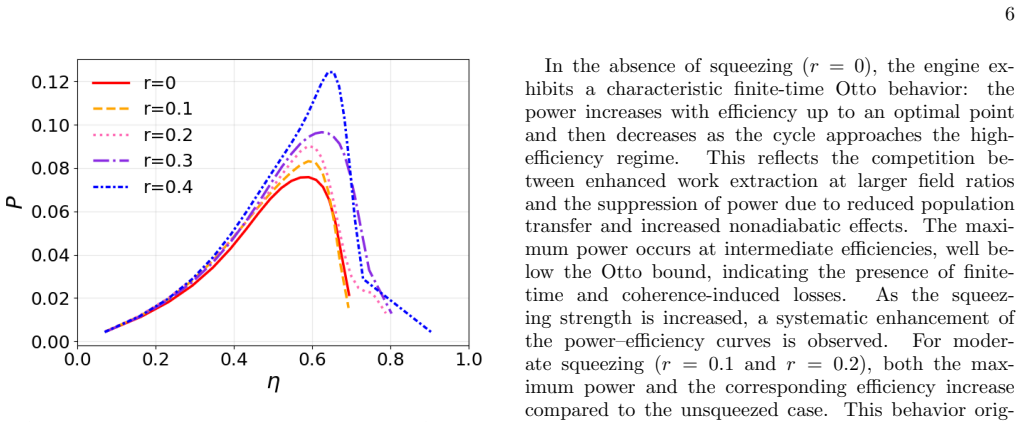
Summary. The paper proposes a four-stroke quantum Otto engine built from two qubits in a cavity (the two-qubit quantum Rabi model), with a single non-Markovian hot bath treated via HEOM, a projective measurement on the cavity replacing the cold bath, and a squeezing drive as a purported fuel. It derives perturbative expressions for stroke work and hot heat, and reports numerical HEOM simulations showing power–efficiency curves, phase–squeezing contour maps, and multi-cycle convergence. The headline claim is that cavity squeezing raises both power and efficiency, driving the efficiency above the standard Otto limit and asymptotically converging to it from above in the limit-cycle regime.
Significance. Some ingredients are genuinely valuable: a symmetry-reduced two-qubit Rabi model with solvable structure, an explicit attempt to quantify the squeezing and measurement costs in Appendix D, and a HEOM-based numerical treatment of non-Markovian effects. However, the central claim fails: the analytic work and heat formulas imply the standard Otto efficiency exactly, independent of squeezing; the numerical 'super-Otto' results rely on an efficiency definition that omits exactly the resource costs the paper itself identifies, and on post-selecting a single measurement outcome without branch averaging. The resource-inclusive efficiency defined in Eq. (D7) does not beat the generalized bound, as the authors concede. Thus the manuscript as submitted does not establish the advertised result. The main value is a structured framework and an honest resource-cost appendix, not the claimed demonstration.
major comments (4)
- [§II (Eqs. (9), (21), (30))] Combining W1 = −(B_H−B_L), Q_H = B_H(1−e^{−Φ})(1−tanh β_H B_H), and W2 = (B_H−B_L)[tanh β_H B_H + e^{−Φ}(1−tanh β_H B_H)] gives W = W1+W2 = −(B_H−B_L)(1−tanh β_H B_H)(1−e^{−Φ}), so η = −W/Q_H = 1−B_L/B_H identically. All dependence on r, φ, τ_h, and bath parameters cancels. This directly contradicts the abstract's central claim that squeezing drives the efficiency above the standard Otto limit. The numerical curves in Figs. 2–4 that show η above this value must be using a different work/heat definition or different initial conditions than Eqs. (9), (21), and (30); the manuscript does not reconcile the analytic and numerical results.
- [§II.A, Eq. (7) and Eq. (20); §III.B] The analytic calculation assumes the expansion starts from the pure state |Ψ⟩=|−−⟩⊗|ξ_{−−}^{(n)}⟩, so P(0)=−1. In the multi-cycle limit-cycle analysis of §III.B, the initial state at vertex A is the post-measurement state from the previous cycle. Unless the cold stroke always projects onto a branch that exactly reproduces a pure |−−⟩ state with unit probability, the analytic formulas for Q_H and W do not describe the limit-cycle engine, and the claimed saturation to η_Otto in Fig. 5 cannot be inferred from them. A limit-cycle calculation must use the actual fixed point of the map, not a single-cycle pure-state ansatz.
- [§II.A.4 (Eqs. (31)–(32)) and §III] The cold stroke post-selects the outcome n* that minimizes qubit energy and reports Q_C, W, and P without multiplying by the outcome probability p_{n*}. Work and power are not linear in the post-selection survival probability; if p_{n*} is not close to unity, the true cycle-averaged power is substantially lower and the engine is not deterministic. The manuscript does not report p_{n*} or provide a properly averaged treatment of all measurement branches. This is load-bearing for the numerical power–efficiency claims.
- [§III.A, Appendix D, Conclusion] The efficiency η=−W/Q_H used in Figs. 2–4 excludes the squeezing preparation cost W_sq=ω sinh²r and the measurement cost W_meas (Eqs. (D3), (D6)). Appendix D defines η_tot = −W/(Q_H+W_sq+W_meas) and states it does not exceed the generalized bound; the Conclusion explicitly says the operational gain is 'supplied and paid for' by squeezing and measurement resources. As written, the headline above-Otto result is an artifact of the resource-excluded efficiency definition. The paper should either report η_tot as the main efficiency or clearly frame the result as an operational gain with externally paid resources; it cannot claim 'above the standard quantum Otto limit' while omitting those costs.
minor comments (4)
- [§II.A, after Eq. (7)] The text says 'Note that ⟨E_q^A⟩=B_L' but Eq. (7) gives ⟨E_q^A⟩=−B_L for the state |−−⟩. Please correct this typo.
- [Appendix C, Eqs. (C21), (C37)] The transient correction δΓ^(2)(t)=−κ_0 μ²ω²e^{−Γ_eff t} with κ_0≈α²+1/2, and the squeezing overlap correction R_sq(τ)≈1+r f(ω,φ,τ), involve coefficients that are not derived from a complete calculation. As written, the claim of fully analytic expressions is overstated; a derivation or a clearly stated numerical extraction procedure is needed.
- [§III.B and Abstract] The abstract says the efficiency remains above the Otto bound throughout and asymptotically converges to it from above, while §III.B states the cumulative efficiency 'saturates to the Otto bound'. Please clarify whether the cumulative efficiency and the single-cycle efficiency plotted in Figs. 2–4 are different quantities and how the two statements are consistent.
- [Appendix D.2] The phrase 'ideal projective measurements is unbounded upwards' is unclear and likely means 'the resource cost of ideal projective measurements can diverge'. Please rephrase.
Circularity Check
The claimed above-Otto efficiency is built into the resource-excluded definition of η and is absent from the paper's own analytic equations, which give exactly η = 1 − B_L/B_H.
-
self definitional
[Section III.A (definition of η and P); Appendix D (η_tot, Eq. D7)]
"The output power is defined as P = −W/(2τ + τ_h), where W = W1 + W2 is the total work per cycle and 2τ + τ_h is the full cycle duration, while the efficiency is given by η = −W/QH, with QH denoting the heat absorbed from the hot bath. ... ηtot = −W/(QH + Wsq + Wmeas)."
The 'above Otto' result is produced by choosing η = −W/QH, so that the squeezing-preparation work Wsq and the measurement cost Wmeas are excluded from the denominator. Appendix D shows that when these costs are included, ηtot does not exceed the generalized bound. The claimed enhancement is therefore an artifact of the efficiency definition, not a consequence of the model dynamics.
-
other
[Section II.A, Eqs. (9), (21), (30)]
"W1 = −(BH − BL). (9) ... QH = BH (1 − e^{−Φ(th)})(1 − tanh(βH BH)). (21) ... W2 = (BH − BL)[tanh(βH BH) + e^{−Φ(th)}(1 − tanh(βH BH))]. (30)"
Substituting (9), (21), and (30) gives W = W1 + W2 = −(BH − BL)(1 − tanh βH BH)(1 − e^{−Φ}), and therefore η = −W/QH = (BH − BL)/BH = 1 − BL/BH identically. The squeezing strength r, phase φ, stroke time τ_h, and bath parameters all cancel. The analytic model thus predicts the standard Otto efficiency, not the claimed above-Otto enhancement; any super-Otto value in the numerics must come from a different definition of work or heat, so the headline prediction is an external input rather than a derived result.
1 more flagged steps
-
self definitional
[Section II.A.4, Eqs. (31)–(32); Section III.A power definition]
"The maximum cooling is achieved for n = n∗, for which the E(q)n becomes minimum. The energy extracted from the qubit subsystem, therefore, is QC = E(q)n∗ − ⟨EqD⟩. (32) ... The probability of each outcome is pn = Tr(Π̂n ρ̂globalD)."
The engine output is computed only for the post-selected branch n∗; the outcome probability p_{n∗} and all discarded branches are omitted from W and P. Hence P = −W/(2τ+τ_h) is a conditional, post-selected quantity, not the cycle-averaged engine output. If p_{n∗} is not unity, the true mean power is p_{n∗} times the reported value. This selection is an input assumption that creates the apparent gain rather than a consequence of the thermodynamic model.
full rationale
The central claim—that cavity squeezing drives the Otto efficiency above the standard quantum Otto limit—is not supported by the paper's own analytic derivation. Combining Eqs. (9), (21), and (30) gives exactly η = 1 − B_L/B_H, independent of r, φ, τ_h, and the bath parameters; the above-Otto effect appears only in the numerical discussion and in the resource-excluded definition of η. The paper itself concedes in Appendix D that the resource-inclusive efficiency η_tot = −W/(Q_H + W_sq + W_meas) obeys the generalized bound, and the Conclusion states that the enhancement is 'supplied and paid for' by squeezing and measurement resources. Additionally, the cold stroke is post-selected on the outcome n∗ that minimizes the qubit energy, with no averaging over p_{n∗} in the reported work or power. Together these choices make the claimed super-Otto behavior a definitional artifact: the figure of merit is constructed to omit the fuel and measurement costs, and the analytic equations—where the costs are consistently excluded—yield no enhancement at all. No load-bearing self-citation chain was identified; the problem is not citation-based but definitional and internal inconsistency.
Assumptions & free parameters
free parameters (10)
- bath reorganization energies λ_c, λ_q =
0.1, 0.1
- Drude cutoff frequencies γ_c, γ_q =
0.1, 0.1
- HEOM truncation (max depth, N_k) =
4, 4
- cavity-qubit displacement α =
0.5
- cavity frequency ω =
5
- stroke durations τ, τ_h =
1, 1
- hot bath temperature T =
1 (and 0.5, 2 in Fig. 3)
- field ratio B_H/B_L scan =
B_L=0.5, B_H up to 10 B_L
- coefficient κ_0 in δΓ^(2)(t) =
α² + 1/2 (≈0.75)
- function f(ω,φ,τ) in R_sq(τ) =
unspecified (computed numerically)
assumptions (6)
- domain assumption Two-qubit QRM Hamiltonian with symmetric constraints (J_x=J_y=J/2, J_z=0, g_1=g_2=g/2, B_1=B_2=B/2) and initial condition in sector A fully describes the engine.
- domain assumption HEOM with Drude-Lorentz baths, hierarchy depth 4 and N_k=4, is numerically exact for the parameters used.
- domain assumption The hot bath couples to the qubits only through σ_x^A and to the cavity through (a+a†), so population dynamics decouple from coherences and obey a rate equation (C5-C8).
- ad hoc to paper The cold stroke is an ideal projective measurement Π_n(α) = D(α)|n⟩⟨n|D†(α)⊗I with post-selection on the outcome n* that minimizes qubit energy.
- ad hoc to paper The work in the unitary strokes is computed from the qubit-only Hamiltonian B(t)σ_z^A (Eqs. 6 and 29), excluding the cavity energy change due to squeezing and measurement.
- ad hoc to paper The transient relaxation correction requires a coefficient κ_0 ≈ α²+1/2 (Eq. C21) and a squeezing overlap correction R_sq(τ) ≈ 1 + r f(ω,φ,τ) (Eq. C37), which are not derived from a complete calculation.
Cite this review
Pith. "Pith review of Squeezing-Fueled Quantum Otto Engine via Measurement-Induced Cooling: The Two-Qubit Quantum Rabi Model." pith.science (2026). https://pith.science/paper/G7LRVSBC
@misc{pith2026260802521,
  author       = {Pith},
  title        = {Pith review of: Squeezing-Fueled Quantum Otto Engine via Measurement-Induced Cooling: The Two-Qubit Quantum Rabi Model},
  year         = {2026},
  howpublished = {\url{https://pith.science/paper/G7LRVSBC}},
  note         = {Machine review of arXiv:2608.02521}
}
read the original abstract
We investigate a quantum Otto engine (QOE) constructed from the two-qubit quantum Rabi model, operating within a cavity quantum electrodynamics (QED) architecture. The engine operates with two qubits as the working substance and a single non-Markovian hot thermal bath, modeled via the hierarchical equations of motion (HEOM) formalism. In place of a conventional cold thermal reservoir, the cooling stroke is realized through a projective measurement protocol on the cavity mode, which acts as an ancillary subsystem and effectively mimics a cold bath for the qubit working medium via measurement back-action. A squeezing drive applied to the cavity mode serves as a quantum fuel. We demonstrate that cavity squeezing systematically enhances both the power output and operational efficiency of the engine - the work extracted per unit of heat drawn from the hot bath-driving it above the standard quantum Otto limit. In the limit-cycle regime, the efficiency, while remaining above the Otto bound throughout, asymptotically converges to it from above. This identifies squeezing as a controllable quantum resource for thermodynamic optimization. Our results reveal that the interplay between qubit-cavity coupling, measurement-induced cooling, and non-equilibrium squeezing gives rise to a multi-resource thermodynamic architecture with performance characteristics inaccessible to conventional two-bath quantum Otto engines, thereby providing a concrete route toward experimentally realizable quantum heat engines in cavity QED platforms.
Figures


Figures from the paper (2 more)


Reference graph
Works this paper leans on
-
[1]
The modulation follows a linear schedule:B(t) =B L + (BH −B L)t/τ
Expansion StrokeA→B In the first stage, the qubit frequency is non- adiabatically ramped from a lower valueB L to a higher valueB H over a finite time durationτ. The modulation follows a linear schedule:B(t) =B L + (BH −B L)t/τ. After this transformation, the evolved state of the sys- tem is given by ˆρ global B = ˆUexp(τ)ˆρglobal A ˆU † exp(τ), where ˆUe...
-
[2]
The resulting effective dynamics enables analytical treatment via Braak’s solu- tion to the asymmetric QRM [12, 55]. Upon imposing the symmetric constraints,J x =J y = J/2, Jz = 0,g 1 =g 2 =g/2, andB 1(t) =B 2(t) =B(t)/2, this configuration allows the system to be described in terms of symmetric and antisymmetric spin subspaces. Defining ⃗S=⃗ σ(1) +⃗ σ(2)...
-
[3]
To capture the non-perturbative system–bath correlations beyond the Born–Markov approximation, we employ the hierarchical equations of motion (HEOM) formalism [56]
Hot Isochoric StrokeB→C During the hot isochoric stroke, the qubit frequency is held fixed atB H while the system interacts with a thermal reservoir at temperatureTfor a finite timet h, partially thermalising the joint qubit–cavity state. To capture the non-perturbative system–bath correlations beyond the Born–Markov approximation, we employ the hierarchi...
-
[4]
Compression StrokeC→D The global state atCis given by Eq. (11). The unitary dynamics during this compression stroke are given by: ˆUcom(τ) = ˆUexp(t−τ).(23) As in the case of expansion stage, since [H eff ,ˆσA z ] = 0 holds also during the compression stroke, the unitary ˆUcom(τ) maps each qubit sector to itself: ˆUcom(τ) |m⟩⟨m′| ⊗Ωcav m,m′ ˆU † com(τ) = ...
-
[5]
We cool the qubits via a measurement-based stroke that projects the cavity mode onto displaced Fock states
Cold Stroke via Projective MeasurementD→A ′ After the unitary return stroke C→D, the system re- sides in a global state ˆρglobal D . We cool the qubits via a measurement-based stroke that projects the cavity mode onto displaced Fock states. We define the necessary pro- jector as Π n(α) =D(α)|n⟩⟨n|D †(α)⊗I q1q2 . For eachn, the cavity is projected, and the...
-
[6]
The relevant Hamil- tonian ˆHA can be diagonalized with Glauber’s displace- ment operator ˆD(α) = exp(αa † −α ∗a)
Exact diagonalization when r = 0 Block A: This subspace consists of states with total spinS= 1, and the coupling to the qubits modifies the cavity mode through displacement. The relevant Hamil- tonian ˆHA can be diagonalized with Glauber’s displace- ment operator ˆD(α) = exp(αa † −α ∗a). The eigenstates and corresponding energies are: |ψ±± n ⟩(0) =|±±⟩⊗ ˆ...
-
[7]
Perturbative approach forr̸= 0 a. Perturbative Energy Corrections in Block A To understand the influence of squeezing on the eigenenergies of the system, we consider the effective Hamiltonian ˆHeff = ˆHA + ˆV ,(A3) whereH A denotes the unperturbed Hamiltonian of the two-qubit Rabi model andVis the squeezing term treated as a perturbation, as given in Eq. ...
-
[8]
Derivation of the relaxation kernelΦ(t)and the effective rateΓ eff During the hot isochoric stroke, the populations of the two relevant qubit sectors evolve under bath-induced transitions. Since the population dynamics decouples from coherences in this subspace, it can be written in rate-equation form: ˙p++(t) =−Γ ↓(t)p ++(t) + Γ↑(t)p −−(t),(C5) 12 withp ...
Show all 76 references
-
[9]
Compression stroke: density matrix at D Since [ ˆHeff (t),ˆσA z ] = 0 throughout the compression, the unitary admits the block-diagonal decomposition ˆUcom(τ) = X m∈{++,−−} |m⟩⟨m| ⊗ˆUm(τ),(C25) 13 where ˆUm(τ) is the effective cavity unitary generated byH (m) eff (t) in sector...
-
[10]
W ork cost of the squeezing operation The squeezed vacuum|sq⟩ ≡ ˆS(r, ϕ)|0⟩is prepared by the operator of Eq. (5). The associated Bogoliubov trans- formation reads ˆS†ˆaˆS= ˆacoshr−e −iϕ ˆa† sinhr,(h.c. for ˆa †),(D1) whence the mean photon number as follows is phase- independ...
-
[11]
For the cold- stroke measurement{ ˆΠn(α)}[Eq
Information cost of the measurement cold stroke The cost of the measurement stroke is fixed by a ther- modynamicbound, since the projective measurement low- ers the entropy of the working substance. For the cold- stroke measurement{ ˆΠn(α)}[Eq. (31)], with conditional qubit st...
-
[12]
Quantum thermody- namics,
S. Vinjanampathy and J. Anders, “Quantum thermody- namics,”Contemporary Physics, vol. 57, no. 4, pp. 545– 579, 2016
2016
-
[13]
Deffner and S
S. Deffner and S. Campbell,Quantum Thermodynamics: An introduction to the thermodynamics of quantum in- formation. Morgan & Claypool Publishers, 2019
2019
-
[14]
Extracting work from a single heat bath via vanishing quantum coherence,
M. O. Scully, “Extracting work from a single heat bath via vanishing quantum coherence,”Science, vol. 299, pp. 862–864, 2003
2003
-
[15]
Superradiant quan- tum heat engine,
A. Hardal and O. M¨ ustecaplioglu, “Superradiant quan- tum heat engine,”Sci. Rep., vol. 5, p. 12953, 2015
2015
-
[16]
Nanoscale heat engine beyond the carnot limit,
J. Roßnagel, O. Abah, F. Schmidt-Kaler, K. Singer, and E. Lutz, “Nanoscale heat engine beyond the carnot limit,”Phys. Rev. Lett., vol. 112, p. 030602, Jan 2014
2014
-
[17]
The quantum open system as a model of the heat engine,
R. Alicki, “The quantum open system as a model of the heat engine,”Journal of Physics A, vol. 12, no. 5, pp. L103–L107, 1979
1979
-
[18]
Quantum heat engines and refrigerators: Continuous devices,
R. Kosloff and A. Levy, “Quantum heat engines and refrigerators: Continuous devices,”Annual Review of Physical Chemistry, vol. 65, no. 1, pp. 365–393, 2014
2014
-
[19]
Quantum thermodynamic cycles and quantum heat engines,
H. T. Quan, Y.-x. Liu, C. P. Sun, and F. Nori, “Quantum thermodynamic cycles and quantum heat engines,”Phys. Rev. E, vol. 76, p. 031105, Sep 2007
2007
-
[20]
Single-ion heat engine at maximum power,
O. Abah, J. Roßnagel, G. Jacob, S. Deffner, F. Schmidt- Kaler, K. Singer, and E. Lutz, “Single-ion heat engine at maximum power,”Phys. Rev. Lett., vol. 109, p. 203006, Nov 2012
2012
-
[21]
Haroche and J.-M
S. Haroche and J.-M. Raimond,Exploring the quantum: atoms, cavities, and photons. Oxford University Press, 2006
2006
-
[22]
Role of quan- tum correlations in light-matter quantum heat engines,
G. A. Barrios, F. Albarr´ an-Arriagada, F. A. C´ ardenas- L´ opez, G. Romero, and J. C. Retamal, “Role of quan- tum correlations in light-matter quantum heat engines,” Phys. Rev. A, vol. 96, p. 052119, Nov 2017
2017
-
[23]
Quantum phase transitions for an in- tegrable quantum rabi-like model with two interacting qubits,
R. Grimaudo, A. S. M. de Castro, A. Messina, E. Solano, and D. Valenti, “Quantum phase transitions for an in- tegrable quantum rabi-like model with two interacting qubits,”Phys. Rev. Lett., vol. 130, p. 043602, Jan 2023
2023
-
[24]
Ultrastrong coupling regimes of light-matter interaction,
P. Forn-D ´ ıaz, L. Lamata, E. Rico, J. Kono, and E. Solano, “Ultrastrong coupling regimes of light-matter interaction,”Rev. Mod. Phys., vol. 91, p. 025005, Jun 2019
2019
-
[25]
Ultrastrong coupling between light and matter,
A. Frisk Kockum, A. Miranowicz, S. De Liberato, S. Savasta, and F. Nori, “Ultrastrong coupling between light and matter,”Nature Reviews Physics, vol. 1, no. 1, pp. 19–40, 2019
2019
-
[26]
Quantum sensing close to a dissipative phase transition: Symmetry break- ing and criticality as metrological resources,
S. Fern´ andez-Lorenzo and D. Porras, “Quantum sensing close to a dissipative phase transition: Symmetry break- ing and criticality as metrological resources,”Phys. Rev. A, vol. 96, p. 013817, Jul 2017
2017
-
[27]
Critical behavior of the quantum stirling heat engine,
Y.-S. Wang, M.-H. Yung, D. Xu, M. Liu, and X. Chen, “Critical behavior of the quantum stirling heat engine,” Phys. Rev. A, vol. 109, p. 022208, Feb 2024
2024
-
[28]
Quantum stirling heat engine based on two-qubit quantum rabi model with spin-spin coupling,
L. Xu, C. Wu, and C. Ren, “Quantum stirling heat engine based on two-qubit quantum rabi model with spin-spin coupling,”Phys. Rev. A, vol. 112, p. 032226, Sep 2025. 15
2025
-
[29]
Entropy production and thermodynamic power of the squeezed thermal reservoir,
G. Manzano, F. Galve, R. Zambrini, and J. M. R. Par- rondo, “Entropy production and thermodynamic power of the squeezed thermal reservoir,”Phys. Rev. E, vol. 93, p. 052120, May 2016
2016
-
[30]
Performance bounds of nonadiabatic quantum harmonic otto engine and refrigerator under a squeezed thermal reservoir,
V. Singh and O. E. M¨ ustecaplıo˘ glu, “Performance bounds of nonadiabatic quantum harmonic otto engine and refrigerator under a squeezed thermal reservoir,” Phys. Rev. E, vol. 102, p. 062123, Dec 2020
2020
-
[31]
Power fluctuations in a finite- time quantum carnot engine,
T. Denzler and E. Lutz, “Power fluctuations in a finite- time quantum carnot engine,”Phys. Rev. Res., vol. 3, p. L032041, Aug 2021
2021
-
[32]
Effects of reservoir squeezing on quantum systems and work extraction,
X. L. Huang, T. Wang, and X. X. Yi, “Effects of reservoir squeezing on quantum systems and work extraction,” Phys. Rev. E, vol. 86, p. 051105, Nov 2012
2012
-
[33]
On the operation of machines pow- ered by quantum non-thermal baths,
W. Niedenzu, D. Gelbwaser-Klimovsky, A. G. Kofman, and G. Kurizki, “On the operation of machines pow- ered by quantum non-thermal baths,”New Journal of Physics, vol. 18, no. 8, p. 083012, 2016
2016
-
[34]
Single-temperature quantum engine without feedback control,
J. Yi, P. Talkner, and Y. W. Kim, “Single-temperature quantum engine without feedback control,”Phys. Rev. E, vol. 96, p. 022108, Aug 2017
2017
-
[35]
Measurement-driven single temperature engine,
X. Ding, J. Yi, Y. W. Kim, and P. Talkner, “Measurement-driven single temperature engine,”Phys. Rev. E, vol. 98, p. 042122, Oct 2018
2018
-
[36]
Time evolution of a quantum system in contact with a nearly gaussian-markoffian noise bath,
Y. Tanimura and R. Kubo, “Time evolution of a quantum system in contact with a nearly gaussian-markoffian noise bath,”Journal of the Physical Society of Japan, vol. 58, no. 1, pp. 101–114, 1989
1989
-
[37]
Quantum dynamics of sys- tem strongly coupled to low-temperature colored noise bath: Reduced hierarchy equations approach,
A. Ishizaki and Y. Tanimura, “Quantum dynamics of sys- tem strongly coupled to low-temperature colored noise bath: Reduced hierarchy equations approach,”Journal of the Physical Society of Japan, vol. 74, no. 12, pp. 3131– 3134, 2005
2005
-
[38]
Colloquium: Non-markovian dynamics in open quan- tum systems,
H.-P. Breuer, E.-M. Laine, J. Piilo, and B. Vacchini, “Colloquium: Non-markovian dynamics in open quan- tum systems,”Rev. Mod. Phys., vol. 88, p. 021002, Apr 2016
2016
-
[39]
Thermodynamic utility of non-markovianity from the perspective of resource interconversion,
S. Bhattacharya, B. Bhattacharya, and A. Majum- dar, “Thermodynamic utility of non-markovianity from the perspective of resource interconversion,”Journal of Physics A, vol. 53, no. 33, p. 335301, 2020
2020
-
[40]
Non-markovian thermal operations boosting the performance of quantum heat engines,
K. Ptaszy´ nski, “Non-markovian thermal operations boosting the performance of quantum heat engines,” Phys. Rev. E, vol. 106, p. 014114, Jul 2022
2022
-
[41]
Quantum processes as ther- modynamic resources: The role of non-markovianity,
G. Zambon and G. Adesso, “Quantum processes as ther- modynamic resources: The role of non-markovianity,” Phys. Rev. Lett., vol. 134, p. 200401, May 2025
2025
-
[42]
An out- of-equilibrium non-markovian quantum heat engine,
M. Pezzutto, M. Paternostro, and Y. Omar, “An out- of-equilibrium non-markovian quantum heat engine,” Quantum Science and Technology, vol. 4, no. 2, p. 025002, 2019
2019
-
[43]
Non-markovian effects on charging and self-discharging process of quantum batteries,
F. Kamin, F. T. Tabesh, S. Salimi, F. Kheirandish, and A. C. Santos, “Non-markovian effects on charging and self-discharging process of quantum batteries,”New Journal of Physics, vol. 22, no. 8, p. 083007, 2020
2020
-
[44]
Extracting work from a single thermal bath via quantum negentropy,
M. O. Scully, “Extracting work from a single thermal bath via quantum negentropy,”Phys. Rev. Lett., vol. 87, p. 220601, Nov 2001
2001
-
[45]
Sup- pressing coherence effects in quantum-measurement- based engines,
Z. Lin, S. Su, J. Chen, J. Chen, and J. F. G. Santos, “Sup- pressing coherence effects in quantum-measurement- based engines,”Phys. Rev. A, vol. 104, p. 062210, Dec 2021
2021
-
[46]
Non- ideal measurement heat engines,
A. Panda, F. C. Binder, and S. Vinjanampathy, “Non- ideal measurement heat engines,”Phys. Rev. A, vol. 108, p. 062214, Dec 2023
2023
-
[47]
Quantum measurement cooling,
L. Buffoni, A. Solfanelli, P. Verrucchi, A. Cuccoli, and M. Campisi, “Quantum measurement cooling,”Phys. Rev. Lett., vol. 122, p. 070603, Feb 2019
2019
-
[48]
Measurement-induced opera- tion of two-ion quantum heat machines,
S. Chand and A. Biswas, “Measurement-induced opera- tion of two-ion quantum heat machines,”Phys. Rev. E, vol. 95, p. 032111, Mar 2017
2017
-
[49]
The role of quantum measurement in stochastic thermodynamics,
C. Elouard, D. A. Herrera-Mart ´ ı, M. Clusel, and A. Auff` eves, “The role of quantum measurement in stochastic thermodynamics,”npj Quantum Information, vol. 3, no. 1, p. 9, 2017
2017
-
[50]
Quantum non- markovianity, quantum coherence and extractable work in a general quantum process,
A. Mohammadi and A. Shafiee, “Quantum non- markovianity, quantum coherence and extractable work in a general quantum process,”Physical Chemistry Chemical Physics, vol. 26, no. 5, pp. 3990–3999, 2024
2024
-
[51]
Ancilla measurement-based quantum otto engine using double- pair spin architecture,
S. R. Rathnakaran and A. Biswas, “Ancilla measurement-based quantum otto engine using double- pair spin architecture,”Phys. Rev. E, vol. 111, p. 064116, Jun 2025
2025
-
[52]
Two-qubit engine fueled by entanglement and local measurements,
L. Bresque, P. A. Camati, S. Rogers, K. Murch, A. N. Jordan, and A. Auff` eves, “Two-qubit engine fueled by entanglement and local measurements,”Phys. Rev. Lett., vol. 126, p. 120605, Mar 2021
2021
-
[53]
Efficiently fueling a quantum engine with incompatible measurements,
S. K. Manikandan, C. Elouard, K. W. Murch, A. Auff` eves, and A. N. Jordan, “Efficiently fueling a quantum engine with incompatible measurements,” Phys. Rev. E, vol. 105, p. 044137, Apr 2022
2022
-
[54]
Experimental investigation of a quantum heat engine powered by generalized measure- ments,
V. F. Lisboa, P. R. Dieguez, J. R. Guimar˜ aes, J. F. G. Santos, and R. M. Serra, “Experimental investigation of a quantum heat engine powered by generalized measure- ments,”Phys. Rev. A, vol. 106, p. 022436, Aug 2022
2022
-
[55]
Limits on quantum measure- ment engines,
G. Perna and E. Calzetta, “Limits on quantum measure- ment engines,”Phys. Rev. E, vol. 109, p. 044102, Apr 2024
2024
-
[56]
Revealing the fuel of a quantum continuous measurement-based refrigerator,
C. Elouard, S. K. Manikandan, A. N. Jordan, and G. Haack, “Revealing the fuel of a quantum continuous measurement-based refrigerator,”Phys. Rev. E, vol. 113, p. 014134, Jan 2026
2026
-
[57]
Quantum work and the thermodynamic cost of quantum measurements,
S. Deffner, J. P. Paz, and W. H. Zurek, “Quantum work and the thermodynamic cost of quantum measurements,” Phys. Rev. E, vol. 94, p. 010103(R), Jul 2016
2016
-
[58]
A thermodynamically consistent approach to the energy costs of quantum mea- surements,
C. L. Latune and C. Elouard, “A thermodynamically consistent approach to the energy costs of quantum mea- surements,”Quantum, vol. 9, p. 1614, 2025
2025
-
[59]
Energetic cost of mea- surements using quantum, coherent, and thermal light,
X. Linpeng, L. Bresque, M. Maffei, A. N. Jordan, A. Auff` eves, and K. W. Murch, “Energetic cost of mea- surements using quantum, coherent, and thermal light,” Phys. Rev. Lett., vol. 128, p. 220506, Jun 2022
2022
-
[60]
Quantum energetics of a noncommuting measurement,
X. Linpeng, N. Piccione, M. Maffei, L. Bresque, S. P. Prasad, A. N. Jordan, A. Auff` eves, and K. W. Murch, “Quantum energetics of a noncommuting measurement,” Phys. Rev. Res., vol. 6, p. 033045, Jul 2024
2024
-
[61]
Ideal projec- tive measurements have infinite resource costs,
Y. Guryanova, N. Friis, and M. Huber, “Ideal projec- tive measurements have infinite resource costs,”Quan- tum, vol. 4, p. 222, 2020
2020
-
[62]
Squeezed thermal reservoirs as a resource for a nanome- chanical engine beyond the carnot limit,
J. Klaers, S. Faelt, A. Imamoglu, and E. Togan, “Squeezed thermal reservoirs as a resource for a nanome- chanical engine beyond the carnot limit,”Phys. Rev. X, vol. 7, p. 031044, Sep 2017
2017
-
[63]
Asymmet- ric quantum harmonic otto engine under hot squeezed thermal reservoir,
Monika, K. Kaur, V. Singh, and S. Rebari, “Asymmet- ric quantum harmonic otto engine under hot squeezed thermal reservoir,”Journal of Non-Equilibrium Thermo- dynamics, vol. 50, no. 3, pp. 435–445, 2025
2025
-
[64]
Finite-time per- 16 formance of a single-ion quantum otto engine,
S. Chand, S. Dasgupta, and A. Biswas, “Finite-time per- 16 formance of a single-ion quantum otto engine,”Phys. Rev. E, vol. 103, p. 032144, Mar 2021
2021
-
[65]
Measurement-based quan- tum otto engine with a two-spin system coupled by anisotropic interaction: Enhanced efficiency at finite times,
C. Purkait and A. Biswas, “Measurement-based quan- tum otto engine with a two-spin system coupled by anisotropic interaction: Enhanced efficiency at finite times,”Phys. Rev. E, vol. 107, p. 054110, May 2023
2023
-
[66]
Integrability of the rabi model,
D. Braak, “Integrability of the rabi model,”Phys. Rev. Lett., vol. 107, p. 100401, Aug 2011
2011
-
[67]
Limitations of strong coupling in non-markovian quan- tum thermometry,
Q.-S. Tan, Y. Liu, X. Liu, H. Chen, X. Xiao, and W. Wu, “Limitations of strong coupling in non-markovian quan- tum thermometry,”Phys. Rev. A, vol. 112, p. 042612, Oct 2025
2025
-
[68]
M. O. Scully and M. S. Zubairy,Quantum Optics. Cam- bridge University Press, 1997
1997
-
[69]
Qutip-bofin: A bosonic and fermionic numerical hierarchical-equations- of-motion library with applications in light-harvesting, quantum control, and single-molecule electronics,
N. Lambert, T. Raheja, S. Cross, P. Menczel, S. Ahmed, A. Pitchford, D. Burgarth, and F. Nori, “Qutip-bofin: A bosonic and fermionic numerical hierarchical-equations- of-motion library with applications in light-harvesting, quantum control, and single-molecule electronics,”Phy...
2023
-
[70]
Phase-tunable thermal logic: Computation with heat,
F. Paolucci, G. Marchegiani, E. Strambini, and F. Gia- zotto, “Phase-tunable thermal logic: Computation with heat,”Phys. Rev. Appl., vol. 10, p. 024003, Aug 2018
2018
-
[71]
Tunable photonic heat transport in a quantum heat valve,
A. Ronzani, B. Karimi, J. Senior, Y.-C. Chang, J. T. Peltonen, C. Chen, and J. P. Pekola, “Tunable photonic heat transport in a quantum heat valve,”Nature Physics, vol. 14, no. 10, pp. 991–995, 2018
2018
-
[72]
Quanti- fying coherence,
T. Baumgratz, M. Cramer, and M. B. Plenio, “Quanti- fying coherence,”Phys. Rev. Lett., vol. 113, p. 140401, Sep 2014
2014
-
[73]
Continuous vari- able quantum information: Gaussian states and beyond,
G. Adesso, S. Ragy, and A. R. Lee, “Continuous vari- able quantum information: Gaussian states and beyond,” Open Syst. Inf. Dyn., vol. 21, no. 01n02, p. 1440001, 2014
2014
-
[74]
Numerically “exact
Y. Tanimura, “Numerically “exact” approach to open quantum dynamics: The hierarchical equations of motion (heom),”J. Chem. Phys., vol. 153, no. 2, p. 020901, 2020
2020
-
[75]
A problem of information gain by quantal measurements,
H. J. Groenewold, “A problem of information gain by quantal measurements,”International Journal of Theo- retical Physics, vol. 4, no. 5, pp. 327–338, 1971
1971
-
[76]
Second law of thermodynam- ics with discrete quantum feedback control,
T. Sagawa and M. Ueda, “Second law of thermodynam- ics with discrete quantum feedback control,”Phys. Rev. Lett., vol. 100, p. 080403, Feb 2008
2008
Reviewed August 4, 2026 · model on record in the stance chip above.
Discussion (0). Continue with ORCID to comment.