REVIEW 3 major objections 5 minor 19 references
TUNA-Net: Task-oriented UNsupervised Adversarial Network for Disease Recognition in Cross-Domain Chest X-rays
T0 review · 3 major / 5 minor · reviewed 2026-08-14 · deepseek-v4-flash
Pith's one-line read A pneumonia classifier trained on labeled adult chest X-rays can be adapted to unlabeled pediatric X-rays, reaching 96.3% AUC, close to the 98.1% supervised upper bound.
desk verdict Solid task-driven UDA paper with near-supervised results, but the pseudo-label consistency term deserves more scrutiny before the headline AUC is taken at face value. read the letter →
The pith
A machine-rendered reading of the paper's core claim, the machinery that carries it, and where it could break.
The reading
What carries the argument
The central object is TUNA-Net, a cycle-consistent adversarial translation network with two generators and two discriminators that maps adult X-rays to pediatric-like X-rays and back. The load-bearing addition is the class-aware semantic consistency constraint: a labeled source classifier $F_A$ must classify reconstructed adult images correctly, a target classifier $F_P$ (fine-tuned from $F_A$) is trained on synthetic pediatric images with adult labels, and $F_A$ is trained on synthetic adult images labeled by the target classifier's pseudo-labels $\arg\max(F_P(X_P))$. A feature reconstruction loss aligns $F_P$'s mid-layer activations for real and synthetic pediatric images, and the final objective sums adversarial losses, cycle-consistency loss, classification losses, and the feature loss; at test time $F_P$ predicts on real pediatric X-rays.
What would settle it
Run TUNA-Net with the target classifier's guesses replaced by random labels for the first ten training epochs; if the final AUC stays near 96.3%, the guess loop is not load-bearing, and if it falls toward 89.3%, the guess loop is the mechanism. Another check: during training, measure how often the source and target classifiers agree on pediatric images; sustained disagreement would contradict the claim that semantic consistency is achieved.
Extended reading notes
Core claim
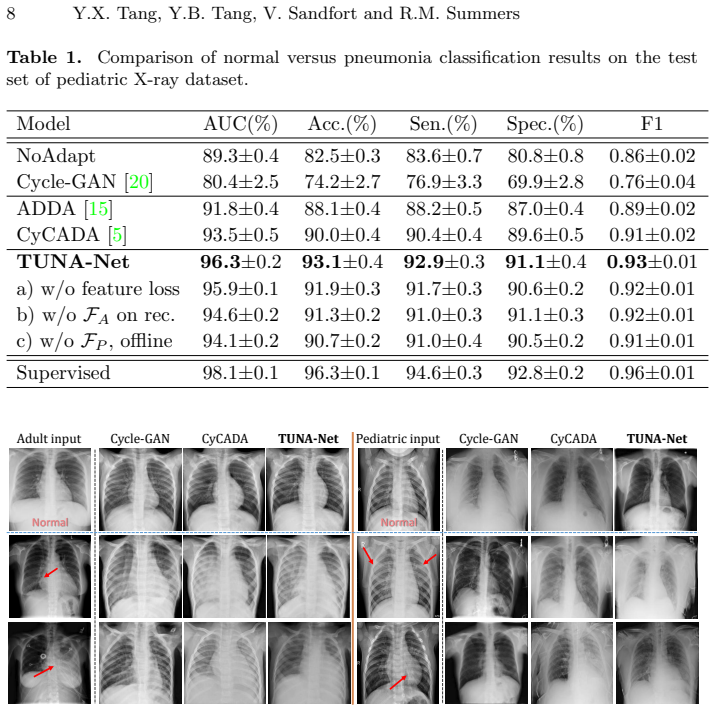
On the paper's own terms, the discovery is that class-specific disease semantics survive unpaired image-to-image translation when the translator is constrained at three levels: low-level anatomy via cycle consistency, high-level disease class via two coupled classifiers, and mid-level representation via a feature reconstruction loss. The source classifier trained on adult labels is reapplied to reconstructed adult images, and a target classifier fine-tuned from it is trained on synthetic pediatric images carrying adult labels; in the reverse cycle the source classifier is trained on synthetic adult images labeled by the target classifier's predictions on real pediatric images. With these constraints, TUNA-Net reports 96.3% AUC for pediatric pneumonia classification, outperforming two adversarial adaptation baselines (91.8% and 93.5% AUC) and approaching the 98.1% supervised upper bound. Ablations show each constraint contributes and that end-to-end online training of the target classifier is the largest contributor.
Load-bearing premise
The training loop treats the target classifier's own guesses about pediatric images as correct labels for the source classifier; if those guesses are wrong early, the loop can reinforce errors, and the 96.3% AUC depends on the guesses converging to the truth.
Editorial extensions
If this is right
- On the pediatric pneumonia test set, TUNA-Net reaches 96.3% AUC, beating the best compared adaptation baseline (93.5%) and the no-adaptation lower bound (89.3%) while using no target labels.
- Plain pixel-level cycle-consistent translation without class constraints can hurt the task, dropping AUC to 80.4% below even the no-adaptation baseline, so semantic preservation is what makes translation useful for disease recognition.
- Ablations show that removing the feature reconstruction loss, removing the source classifier on reconstructed images, or training the target classifier offline each lowers AUC, establishing that the three constraints are jointly load-bearing.
- Because the objective is task-oriented rather than tied to pneumonia specifically, the same framework can be carried to other disease classes, image modalities, and clinical tasks by swapping the classifier.
Reading between the lines
- A direct test of the pseudo-label mechanism would replace hard $\arg\max$ labels with soft or confidence-thresholded labels; stable AUC under that change would show the self-training loop is robust, while a drop would pinpoint early error reinforcement.
- The same three-level constraint is a plausible recipe for other label-scarce medical translation settings (CT to MRI, cross-institution radiographs) where the clinical goal is to preserve lesions during style transfer.
- If synthetic pediatric images generated by TUNA-Net are semantically faithful, they could be used to augment a small labeled pediatric set; this is an untested extension that would measure whether the translated images carry usable disease signal beyond the classifier.
Signed reviews
Editorial analysis
A structured set of objections, weighed in public.
Referee Report
Summary. The paper proposes TUNA-Net, an unsupervised domain adaptation method for pneumonia classification that transfers a classifier from labeled adult chest X-rays to unlabeled pediatric chest X-rays. The method builds on CycleGAN and adds three constraints: a cycle-consistency loss, a semantic classification loss that includes a pseudo-label consistency term using a target classifier FP, and a mid-level feature reconstruction loss. Experiments on two public chest X-ray datasets report an AUC of 96.3% for pediatric pneumonia classification, close to the supervised upper bound of 98.1%, and the paper includes an ablation study showing that each component contributes to the final performance. The manuscript is clearly written and the empirical evaluation is substantial, but I have concerns about the fairness of the baseline comparison and about the validation of the pseudo-label self-training loop that is central to the method.
Significance. If the reported results are robust, the method is potentially valuable for medical imaging applications where labeled target-domain data are expensive or difficult to obtain. The paper addresses a practical problem, uses publicly available datasets, and reports multiple evaluation metrics with standard deviations. The ablation study is a strength because it gives evidence that the proposed components matter. However, the central performance claim depends on two load-bearing points that are not fully established: the baseline comparison is not architecture-controlled, and the pseudo-label consistency term in Eq. (4) has not been isolated or validated for stability. These issues do not make the result circular, because the final AUC is evaluated on a held-out test set, but they do affect whether the reported 96.3% AUC can be attributed specifically to the proposed adaptation mechanism. With additional experiments, the claim would be much stronger.
major comments (3)
- [Section 3, Table 1 and Section 2.5] The comparison is not architecture-controlled. NoAdapt uses a ResNet-50, while the proposed TUNA-Net uses ResNet-18 as described in Section 2.5, and the backbones used for ADDA and CyCADA are not stated. Since network capacity can materially affect AUC, the reported improvement from NoAdapt (89.3%) to TUNA-Net (96.3%) may partly reflect the architecture difference rather than the adaptation mechanism. Please report a NoAdapt baseline with the same ResNet-18 backbone and specify the backbones used for all baselines, or otherwise use the same backbone throughout the comparison.
- [Equation (4) and Table 1, ablation rows (a)-(c)] The pseudo-label consistency term Lcls(FA,{GP->A(XP), argmax(FP(XP))}) is a hard self-training signal whose accuracy is never measured. At initialization FP is only fine-tuned from FA, and the no-adaptation baseline attains only 89.3% AUC on the target domain, so early pseudo-labels can be systematically wrong. Because argmax is non-differentiable, errors in FP are not corrected by gradients from this term, yet the term still trains FA, which in turn supervises the translation model that trains FP. The ablations remove the entire FP module (row c) or other losses (rows a and b), but never isolate this specific consistency term, so the 2.2-point gap between row c and the full model conflates pseudo-label consistency with other benefits of online FP training. Please provide an analysis of pseudo-label accuracy over training, a comparison with soft labels or confidence thresholding, and an ablation that removes only this consistency term.
- [Section 3, Materials and settings] The relationship between the 5-fold cross-validation and the hold-out test set of 624 pediatric X-rays is unclear. The text states that 5232 pediatric X-rays are used for training and validation, but it does not specify whether the 624 test images are disjoint from these 5232, how the five folds are used relative to the translation and classifier training, or how the threshold is selected per fold. Please clarify the exact data split and confirm that no test image is used for model selection or threshold optimization.
minor comments (5)
- [Section 3] There is a typo in "hold-out test test of 624 pediatric X-rays"; the word "test" is repeated.
- [References] References [2] and [7] appear to be identical; please correct the duplicate reference and verify all citation numbering.
- [Equation (5)] The feature reconstruction loss would benefit from an explicit statement defining fi and f_hat_i as the feature maps extracted from real target images XP and synthetic target images GA->P(XA) at the same convolutional block i.
- [Section 2.5] The sentence "All other networks are trained from scratch" is ambiguous; please specify which networks are trained from scratch (generators, discriminators, or both) and which are initialized from ImageNet.
- [Section 3, Reference methods] For reproducibility, please state the hyperparameters and training details used for the ADDA and CyCADA baselines, including whether they use the same backbone and image size as TUNA-Net.
Circularity Check
No significant circularity: the 96.3% AUC is evaluated on a held-out pediatric test set with withheld labels, and the self-training term in Eq. 4 is a training bootstrap rather than a construction of the measured result.
full rationale
TUNA-Net is an empirical domain-adaptation method, not a derivation whose conclusion is equivalent to its premises. The central claim, 96.3% AUC for pediatric pneumonia recognition without target labels, is obtained by applying the trained target classifier FP to a hold-out test set of 624 pediatric X-rays with labels withheld during training; this is an external evaluation, not a fitted value or a renamed training loss. The pseudo-label consistency term in Eq. 4, Lcls(FA,{GP→A(XP), argmax(FP(XP))}), uses the target classifier's own hard predictions as supervisory signal for the source classifier on reconstructed target images. This is a standard self-training/consistency mechanism. Although it creates a feedback loop that could reinforce early errors, it does not make the reported test-set AUC circular: the final performance is measured against ground-truth labels that are never used in this loop, and the paper's ablations (rows a, b, c) show the contribution of the components is empirically incremental. The paper cites several prior works by the same authors (e.g., abnormal chest X-ray identification, lesion detection, lung segmentation), but these citations support general methodology and prior architecture choices; none is invoked as a uniqueness theorem or as the sole justification for the main claim. The comparison against NoAdapt, Cycle-GAN, ADDA, CyCADA, and Supervised on an externally labeled test set provides independent validation. Any concern about pseudo-label accuracy is a correctness or robustness risk, not a circularity of the kind defined by the analysis protocol.
Assumptions & free parameters
free parameters (3)
- lambda (cycle consistency weight) =
10
- feature layers for L_feat =
conv3 and conv4 of ResNet-18
- Initial learning rate =
0.0002
assumptions (4)
- domain assumption Adult and pediatric chest X-rays share the same pneumonia disease semantics, so labels are transferable across domains.
- domain assumption CycleGAN can learn invertible mappings that preserve low-level content via cycle consistency.
- domain assumption ImageNet-pretrained ResNet features are useful for chest X-ray classification.
- domain assumption The target domain contains an unknown but existing labeling function that can be approximated by training on translated source images.
Cite this review
Pith. "Pith review of TUNA-Net: Task-oriented UNsupervised Adversarial Network for Disease Recognition in Cross-Domain Chest X-rays." pith.science (2026). https://pith.science/paper/G7SXC6XK
@misc{pith2026190807926,
  author       = {Pith},
  title        = {Pith review of: TUNA-Net: Task-oriented UNsupervised Adversarial Network for Disease Recognition in Cross-Domain Chest X-rays},
  year         = {2026},
  howpublished = {\url{https://pith.science/paper/G7SXC6XK}},
  note         = {Machine review of arXiv:1908.07926}
}
read the original abstract
In this work, we exploit the unsupervised domain adaptation problem for radiology image interpretation across domains. Specifically, we study how to adapt the disease recognition model from a labeled source domain to an unlabeled target domain, so as to reduce the effort of labeling each new dataset. To address the shortcoming of cross-domain, unpaired image-to-image translation methods which typically ignore class-specific semantics, we propose a task-driven, discriminatively trained, cycle-consistent generative adversarial network, termed TUNA-Net. It is able to preserve 1) low-level details, 2) high-level semantic information and 3) mid-level feature representation during the image-to-image translation process, to favor the target disease recognition task. The TUNA-Net framework is general and can be readily adapted to other learning tasks. We evaluate the proposed framework on two public chest X-ray datasets for pneumonia recognition. The TUNA-Net model can adapt labeled adult chest X-rays in the source domain such that they appear as if they were drawn from pediatric X-rays in the unlabeled target domain, while preserving the disease semantics. Extensive experiments show the superiority of the proposed method as compared to state-of-the-art unsupervised domain adaptation approaches. Notably, TUNA-Net achieves an AUC of 96.3% for pediatric pneumonia classification, which is very close to that of the supervised approach (98.1%), but without the need for labels on the target domain.
Figures

Reference graph
Works this paper leans on
-
[2]
In: International Conference on Medical Image Computing and Computer- Assisted Intervention
Ghafoorian, M., Mehrtash, A., Kapur, T., Karssemeijer, N., Marchiori, E., Pesteie, M., Guttmann, C.R., de Leeuw, F.E., Tempany, C.M., van Ginneken, B., et al.: Transfer learning for domain adaptation in mri: Application in brain lesion segmen- tation. In: International Conference on Medical Image Computing and Computer- Assisted Intervention. pp. 516–524....
work page 2017
-
[3]
In: Advances in neural information processing systems, pp
Goodfellow, I., Pouget-Abadie, J., Mirza, M., Xu, B., Warde-Farley, D., Ozair, S., Courville, A., Bengio, Y.: Generative adversarial nets. In: Advances in neural information processing systems, pp. 2672–2680 (2014)
work page 2014
-
[4]
In: Proceedings of the IEEE conference on computer vision and pattern recognition
He, K., Zhang, X., Ren, S., Sun, J.: Deep residual learning for image recognition. In: Proceedings of the IEEE conference on computer vision and pattern recognition. pp. 770–778 (2016)
2016
-
[5]
In: Proceedings of the 35th International Conference on Machine Learning
Hoffman, J., Tzeng, E., Park, T., Zhu, J.Y., Isola, P., Saenko, K., Efros, A., Darrell, T.: CyCADA: Cycle-consistent adversarial domain adaptation. In: Proceedings of the 35th International Conference on Machine Learning. pp. 1989–1998 (2018)
work page 2018
-
[6]
In: European conference on computer vision
Johnson, J., Alahi, A., Fei-Fei, L.: Perceptual losses for real-time style transfer and super-resolution. In: European conference on computer vision. pp. 694–711. Springer (2016)
2016
-
[7]
In: International conference on information processing in medical imaging
Kamnitsas, K., Baumgartner, C., Ledig, C., Newcombe, V., Simpson, J., Kane, A., Menon, D., Nori, A., Criminisi, A., Rueckert, D., et al.: Unsupervised domain adap- tation in brain lesion segmentation with adversarial networks. In: International conference on information processing in medical imaging. pp. 597–609. Springer (2017) 10 Y.X. Tang, Y.B. Tang, V...
work page 2017
-
[8]
In: IEEE 16th Inter- national Symposium on Biomedical Imaging
Tang, Y., Tang, Y., Han, M., Xiao, J., Summers, R.M.: Abnormal chest x-ray identification with generative adversarial one-class classifier. In: IEEE 16th Inter- national Symposium on Biomedical Imaging. pp. 1358–1361 (2019)
work page 2019
-
[9]
In: IEEE 16th International Symposium on Biomedical Imaging
Tang, Y., Yan, K., Tang, Y., Liu, J., Xiao, J., Summers, R.M.: Uldor: A universal lesion detector for ct scans with pseudo masks and hard negative example min- ing. In: IEEE 16th International Symposium on Biomedical Imaging. pp. 833–836 (2019)
work page 2019
Show all 19 references
-
[10]
arXiv preprint arXiv:1904.09229 (2019)
Tang, Y., Tang, Y., Xiao, J., Summers, R.M.: Xlsor: A robust and accurate lung segmentor on chest x-rays using criss-cross attention and customized radiorealistic abnormalities generation. arXiv preprint arXiv:1904.09229 (2019)
2019 arXiv
-
[11]
In: Medical Imaging 2019: Computer-Aided Diagnosis
Tang, Y.X., Tang, Y.B., Han, M., Xiao, J., Summers, R.M.: Deep adversarial one- class learning for normal and abnormal chest radiograph classification. In: Medical Imaging 2019: Computer-Aided Diagnosis. vol. 10950, p. 1095018. International Society for Optics and Photonics (2019)
2019
-
[12]
In: Proceedings of the IEEE Conference on Computer Vision and Pattern Recognition
Tang, Y., Wang, J., Gao, B., Dellandr´ ea, E., Gaizauskas, R., Chen, L.: Large scale semi-supervised object detection using visual and semantic knowledge transfer. In: Proceedings of the IEEE Conference on Computer Vision and Pattern Recognition. pp. 2119–2128 (2016)
2016
-
[13]
IEEE transactions on pattern analysis and machine intelligence 40(12), 3045–3058 (2017)
Tang, Y., Wang, J., Wang, X., Gao, B., Dellandr´ ea, E., Gaizauskas, R., Chen, L.: Visual and semantic knowledge transfer for large scale semi-supervised object detection. IEEE transactions on pattern analysis and machine intelligence 40(12), 3045–3058 (2017)
2017
-
[14]
In: International Workshop on Machine Learning in Medical Imaging
Tang, Y., Wang, X., Harrison, A.P., Lu, L., Xiao, J., Summers, R.M.: Attention- guided curriculum learning for weakly supervised classification and localization of thoracic diseases on chest radiographs. In: International Workshop on Machine Learning in Medical Imaging. pp. 249...
2018
-
[15]
In: Proceedings of the IEEE Conference on Computer Vision and Pat- tern Recognition
Tzeng, E., Hoffman, J., Saenko, K., Darrell, T.: Adversarial discriminative domain adaptation. In: Proceedings of the IEEE Conference on Computer Vision and Pat- tern Recognition. pp. 7167–7176 (2017)
2017
-
[16]
In: Proceedings of the IEEE conference on computer vision and pattern recognition
Wang, X., Peng, Y., Lu, L., Lu, Z., Bagheri, M., Summers, R.M.: Chestx-ray8: Hospital-scale chest x-ray database and benchmarks on weakly-supervised classi- fication and localization of common thorax diseases. In: Proceedings of the IEEE conference on computer vision and patter...
2017
-
[17]
arXiv preprint arXiv:1908.04373 (2019)
Yan, K., Tang, Y., Peng, Y., Sandfort, V., Bagheri, M., Lu, Z., Summers, R.M.: Mulan: Multitask universal lesion analysis network for joint lesion detection, tag- ging, and segmentation. arXiv preprint arXiv:1908.04373 (2019)
2019 arXiv
-
[18]
In: International Conference on Medical Image Computing and Computer-Assisted Intervention
Zhang, Y., Miao, S., Mansi, T., Liao, R.: Task driven generative modeling for unsupervised domain adaptation: Application to x-ray image segmentation. In: International Conference on Medical Image Computing and Computer-Assisted Intervention. pp. 599–607. Springer (2018)
2018
-
[19]
In: Pro- ceedings of the IEEE Conference on Computer Vision and Pattern Recognition
Zhang, Z., Yang, L., Zheng, Y.: Translating and segmenting multimodal medical volumes with cycle-and shape-consistency generative adversarial network. In: Pro- ceedings of the IEEE Conference on Computer Vision and Pattern Recognition. pp. 9242–9251 (2018)
2018
-
[20]
In: Proceedings of the IEEE interna- tional conference on computer vision
Zhu, J.Y., Park, T., Isola, P., Efros, A.A.: Unpaired image-to-image translation using cycle-consistent adversarial networks. In: Proceedings of the IEEE interna- tional conference on computer vision. pp. 2223–2232 (2017)
2017
Reviewed August 14, 2026 · model on record in the stance chip above.
Discussion (0). Continue with ORCID to comment.