Beyond the Thin-Layer Limit: Differentiable Volumetric Training for Visible-Range Diffractive Neural Networks
Pith reviewed 2026-06-27 20:38 UTC · model grok-4.3
The pith
Modeling each diffractive layer as a finite-thickness volume during training lets visible-range optical networks match their simulated performance after fabrication.
A machine-rendered reading of the paper's core claim, the machinery that carries it, and where it could break.
Core claim
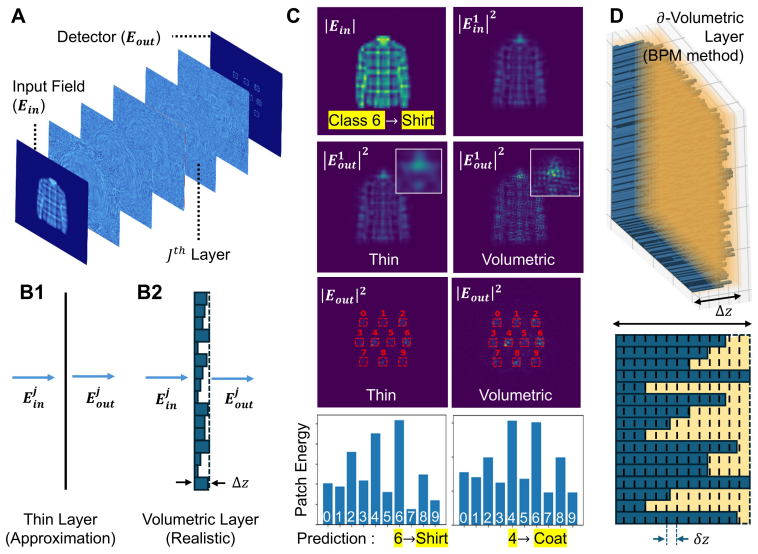
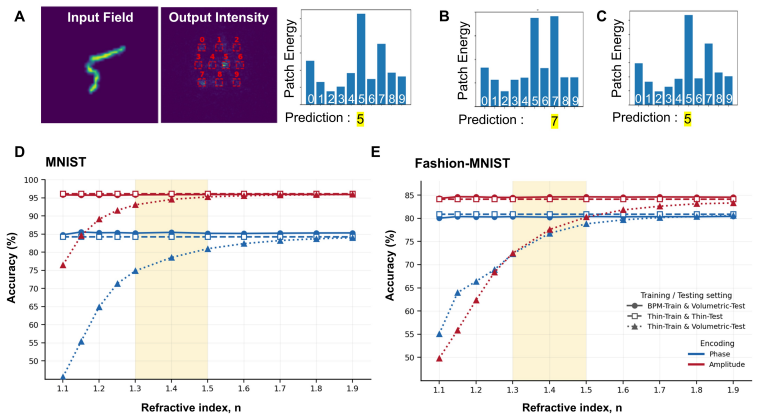
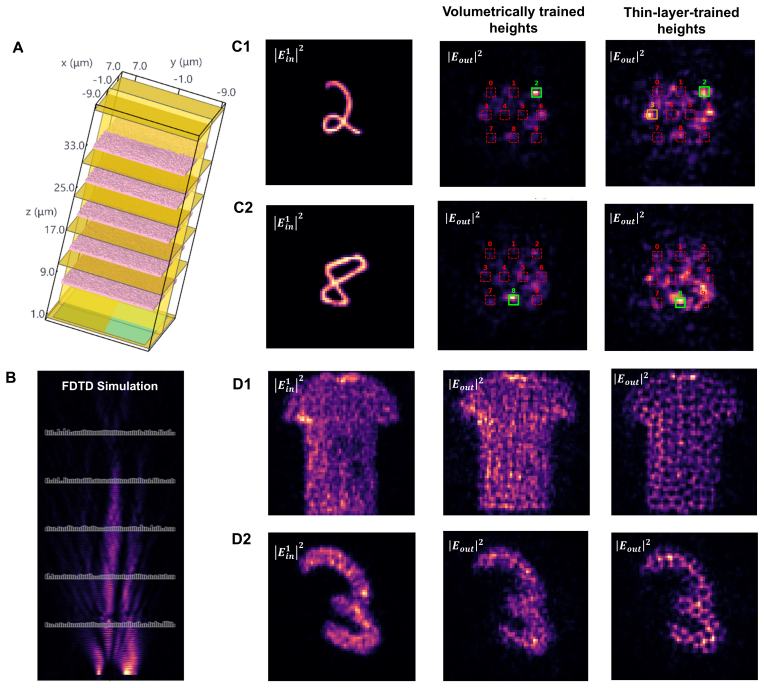
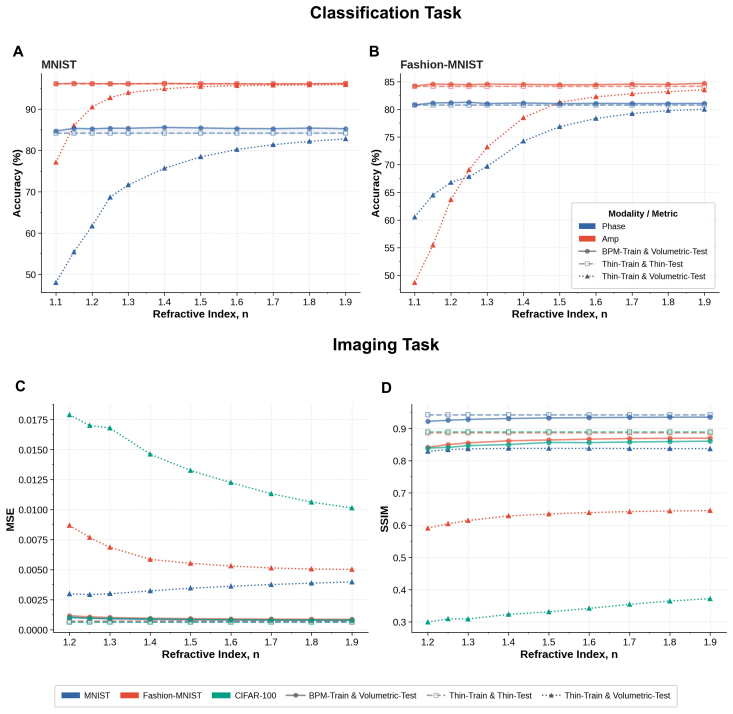
Replacing the thin-layer mask model with a differentiable beam-propagation layer that treats each neuron as a finite-thickness volume and propagates light through it during optimization produces fabrication-consistent visible-range diffractive networks whose full-wave FDTD performance reaches 90 percent accuracy on standard benchmarks.
What carries the argument
The differentiable beam-propagation (∂BPM) layer, which models each diffractive element as a finite-thickness volume and computes light propagation through it at training time.
If this is right
- Design-to-device mismatch drops substantially across MNIST, Fashion-MNIST, and CIFAR-100 tasks.
- Full-wave validation accuracy rises from 50 percent to 90 percent without re-optimization.
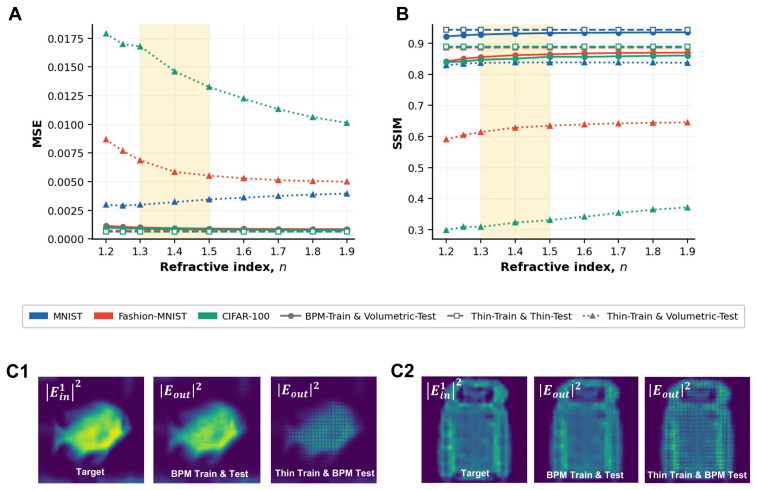
- The same volumetric training applies to both classification and imaging objectives.
- Height maps remain fabrication-compatible and end-to-end trainable without inserting full-wave solvers in the loop.
Where Pith is reading between the lines
- The approach could be combined with actual nano-fabrication runs to test whether the simulated 90 percent accuracy survives real material and etch variations.
- Similar volumetric modeling might be needed for other low-index platforms such as visible metasurfaces or integrated photonic circuits.
- If the method generalizes, it would allow direct transfer of digitally optimized diffractive front-ends into compact visible cameras without digital post-processing.
Load-bearing premise
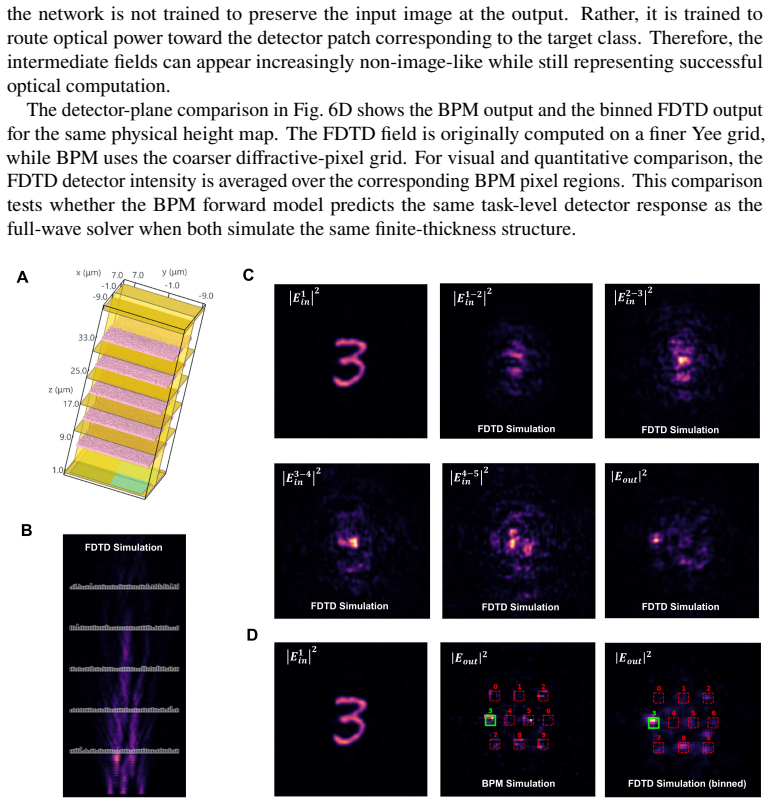
The beam-propagation method inside the differentiable layer accurately captures intra-layer diffraction and phase accumulation for the low-refractive-index relief structures used at visible wavelengths, without needing full-wave simulation during training.
What would settle it
A full-wave FDTD simulation or fabricated measurement of a ∂BPM-trained height map that still shows classification accuracy near 50 percent instead of 90 percent.
Figures
read the original abstract
Diffractive deep neural networks (D2NNs) promise miniaturized, power-efficient, light-speed optical front-ends for machine vision, yet the most mature demonstrations remain in the terahertz regime, built from readily fabricated millimeter-scale neurons. Translating D2NNs to the visible range, where nearly all vision pipelines operate, was long blamed on the difficulty of fabricating nanoscale neurons; but even after recent advances removed that barrier, visible-range D2NNs matching their terahertz counterparts remain out of reach. We identify the true obstacle as the thin-layer approximation underlying nearly all D2NN training, which treats each diffractive layer as an infinitely thin mask. It fails not because of the short wavelength, as is commonly assumed, but because the low-refractive-index materials (n approximately 1.3-1.5) used at visible wavelengths require relief structures thick enough that intra-layer diffraction and phase accumulation become significant. To overcome this, we introduce a differentiable beam-propagation ($\partial$BPM) layer that models each element as a finite-thickness volume and propagates light through it during training, keeping the fabrication-compatible height map end-to-end trainable without full-wave simulation in the loop. Across MNIST, Fashion-MNIST, and CIFAR-100 classification and imaging, $\partial$BPM training substantially reduces the design-to-device mismatch, and full-wave FDTD validation raises classification accuracy from 50% to 90% without re-optimization. The $\partial$BPM layer thus offers a scalable, physics-aware bridge between efficient optical neural-network optimization and fabrication-consistent diffractive design.
Editorial analysis
A structured set of objections, weighed in public.
Referee Report
Summary. The paper claims that the thin-layer approximation fails for visible-range diffractive neural networks because low-index (n≈1.3-1.5) relief structures require thicknesses where intra-layer diffraction matters; it introduces a differentiable beam-propagation (∂BPM) layer that treats each diffractive element as a finite-thickness volume, enabling end-to-end training of fabrication-compatible height maps. Across MNIST, Fashion-MNIST and CIFAR-100 classification/imaging tasks, ∂BPM training reduces design-to-device mismatch, and post-training full-wave FDTD validation raises accuracy from ~50% to 90% without re-optimization.
Significance. If the central result holds, the work supplies a practical, scalable bridge between efficient gradient-based optimization of D2NNs and fabrication-consistent designs at visible wavelengths, where full-wave simulation in the training loop remains prohibitive. The explicit separation of the differentiable propagation operator from the FDTD validation step, together with the retention of a height-map parameterization, is a concrete strength that could be adopted by other groups working on volumetric diffractive optics.
major comments (2)
- [Abstract / Results] Abstract and Results (performance claims): the reported FDTD-validated accuracy increase from 50% to 90% is presented without dataset splits, error bars, number of independent runs, or exclusion criteria; because this number is the primary quantitative support for the claim that ∂BPM reduces design-to-device mismatch, the absence of these controls is load-bearing for the central empirical result.
- [Methods] Methods / ∂BPM layer definition: no quantitative BPM-versus-FDTD field-error metric (e.g., L2 field difference or phase RMSE) is supplied for the final trained structures; without this datum it remains possible that the optimizer exploits BPM-specific artifacts (paraxial or scalar approximations) rather than converging to a physically accurate solution, undermining the interpretation that the accuracy gain arises from correct intra-layer modeling.
minor comments (2)
- [Methods] Notation: the symbol ∂BPM is introduced without an explicit statement of whether the split-step or angular-spectrum implementation is used and how polarization is (or is not) handled.
- [Figures] Figure captions: several performance plots lack axis labels for the thin-layer baseline, making direct visual comparison with the ∂BPM curves difficult.
Simulated Author's Rebuttal
We thank the referee for the constructive comments, which help strengthen the empirical foundation of the work. We address each major point below and will revise the manuscript to incorporate the requested details.
read point-by-point responses
-
Referee: [Abstract / Results] Abstract and Results (performance claims): the reported FDTD-validated accuracy increase from 50% to 90% is presented without dataset splits, error bars, number of independent runs, or exclusion criteria; because this number is the primary quantitative support for the claim that ∂BPM reduces design-to-device mismatch, the absence of these controls is load-bearing for the central empirical result.
Authors: We agree that the central performance claim requires more rigorous statistical reporting. In the revised manuscript we will explicitly state the dataset splits (standard 60 000/10 000 train/test for MNIST and Fashion-MNIST; 50 000/10 000/10 000 for CIFAR-100), report all accuracies as mean ± standard deviation over five independent training runs with distinct random seeds, and confirm that no data were excluded beyond the conventional splits. These details will appear in the Results section and, space permitting, the Abstract. revision: yes
-
Referee: [Methods] Methods / ∂BPM layer definition: no quantitative BPM-versus-FDTD field-error metric (e.g., L2 field difference or phase RMSE) is supplied for the final trained structures; without this datum it remains possible that the optimizer exploits BPM-specific artifacts (paraxial or scalar approximations) rather than converging to a physically accurate solution, undermining the interpretation that the accuracy gain arises from correct intra-layer modeling.
Authors: We acknowledge that a direct field-error metric would further rule out exploitation of BPM approximations. While the large FDTD-validated accuracy gain already indicates that the learned height maps are physically functional, we will add quantitative BPM-versus-FDTD comparisons (L2 field difference and phase RMSE) evaluated on the final trained structures in the revised Methods section. These metrics will be computed by propagating identical test fields through both the trained ∂BPM model and a full-wave FDTD solver. revision: yes
Circularity Check
No significant circularity; independent differentiable operator with external validation
full rationale
The paper defines a new differentiable beam-propagation (∂BPM) layer that models finite-thickness volumes, uses it for end-to-end training of height maps, and reports performance via external full-wave FDTD validation on standard datasets (MNIST, Fashion-MNIST, CIFAR-100). The accuracy gains (50% to 90%) are measured on held-out classification/imaging tasks and FDTD, not by construction from fitted parameters inside the same loop. No self-citation chains, self-definitional equations, fitted-input-as-prediction, or ansatz smuggling appear in the abstract or described chain; the method is self-contained against external benchmarks.
Axiom & Free-Parameter Ledger
axioms (1)
- domain assumption Beam propagation method sufficiently approximates intra-layer diffraction and phase accumulation for low-index relief structures at visible wavelengths
invented entities (1)
-
∂BPM layer
no independent evidence
Reference graph
Works this paper leans on
-
[1]
All-optical machine learning using diffractive deep neural networks,
X. Lin, Y. Rivenson, N. T. Yardimci,et al., “All-optical machine learning using diffractive deep neural networks,” Science361, 1004–1008 (2018)
2018
-
[2]
Optical neural networks: progress and challenges,
T. Fu, J. Zhang, R. Sunet al., “Optical neural networks: progress and challenges,” Light. Sci. & Appl.13, 263 (2024)
2024
-
[3]
Diffractive deep neural networks: Theories, optimization, and applications,
H. Chen, S. Lou, Q. Wanget al., “Diffractive deep neural networks: Theories, optimization, and applications,” Appl. Phys. Rev.11, 021316 (2024)
2024
-
[4]
Diffractive optical computing in free space,
J. Hu, D. Mengu, D. C. Tzarouchis,et al., “Diffractive optical computing in free space,” Nat. Commun.15, 1525 (2024)
2024
-
[5]
Design of task-specific optical systems using broadband diffractive neural networks,
Y. Luo, D. Mengu, N. T. Yardimci,et al., “Design of task-specific optical systems using broadband diffractive neural networks,” Light. Sci. & Appl.8, 112 (2019)
2019
-
[6]
Terahertz pulse shaping using diffractive surfaces,
M. Veli, D. Mengu, N. T. Yardimci,et al., “Terahertz pulse shaping using diffractive surfaces,” Nat. Commun.12, 37 (2021)
2021
-
[7]
Learning diffractive optical communication around arbitrary opaque occlusions,
M. S. S. Rahman, T. Gan, E. A. Deger,et al., “Learning diffractive optical communication around arbitrary opaque occlusions,” Nat. Commun.14, 6830 (2023)
2023
-
[8]
Snapshot multispectral imaging using a diffractive optical network,
D. Mengu, A. Tabassum, M. Jarrahi, and A. Ozcan, “Snapshot multispectral imaging using a diffractive optical network,” Light. Sci. & Appl.12, 86 (2023)
2023
-
[9]
All-optical image denoising and feature enhancement using a diffractive visual processor,
c. Işı l, T. Gan, F. O. Ardicet al., “All-optical image denoising and feature enhancement using a diffractive visual processor,” Light. Sci. & Appl.13, 43 (2024)
2024
-
[10]
All-optical complex field imaging using diffractive processors,
J. Li, Y. Li, T. Gan,et al., “All-optical complex field imaging using diffractive processors,” Light. Sci. & Appl.13, 120 (2024)
2024
-
[11]
Pre-sensor computing with compact multilayer optical neural networks,
Z. Huanget al., “Pre-sensor computing with compact multilayer optical neural networks,” Sci. Adv.10, eado8516 (2024)
2024
-
[12]
Spectrally encoded single-pixel machine vision using diffractive networks,
J. Li, D. Mengu, N. T. Yardimci,et al., “Spectrally encoded single-pixel machine vision using diffractive networks,” Sci. Adv.7, eabd7690 (2021)
2021
-
[13]
All-optical phase conjugation using diffractive wavefront processing,
C.-Y. Shen, J. Liet al., “All-optical phase conjugation using diffractive wavefront processing,” Nat. Commun.15, 5406 (2024)
2024
-
[14]
Diffractive deep neural networks at visible wavelengths,
H. Chen, J. Feng, M. Jiang,et al., “Diffractive deep neural networks at visible wavelengths,” Engineering7, 1483–1491 (2021)
2021
-
[15]
Isotropic shrinkage of patterned vacancies enables three-dimensional nanoprecise metastructures for visible light applications,
Q. Yang, G. Yang, T. Nambara,et al., “Isotropic shrinkage of patterned vacancies enables three-dimensional nanoprecise metastructures for visible light applications,” Nat. Photonics pp. 1–11 (2026)
2026
-
[16]
Analysis of diffractive optical neural networks and their integration with electronic neural networks,
D. Mengu, Y. Luo, Y. Rivenson, and A. Ozcan, “Analysis of diffractive optical neural networks and their integration with electronic neural networks,” IEEE J. Sel. Top. Quantum Electron.26, 1–14 (2019)
2019
-
[17]
Tidy3d: Fastfdtdelectromagneticsolver,
FlexcomputeInc.,“Tidy3d: Fastfdtdelectromagneticsolver,”https://www.flexcompute.com/tidy3d/(2024).Accessed: 2026-03-20. Beyond the Thin-Layer Limit: Differentiable Volumetric Training for Visible-Range Diffractive Neural Networks - Supplementary Material
2024
-
[18]
Toverifythattheobservedthin-to-volumetricmismatchisnotspecifictothisabsolutewavelength, werepeatthesameBPMexperimentsunderawavelength-scaledTHzconfiguration
Validation at THz Wavelengths The main experiments in this work are reported at the visible wavelength of𝜆=532 nm , where low- and moderate-index transparent materials make finite-thickness effects especially relevant. Toverifythattheobservedthin-to-volumetricmismatchisnotspecifictothisabsolutewavelength, werepeatthesameBPMexperimentsunderawavelength-scal...
-
[19]
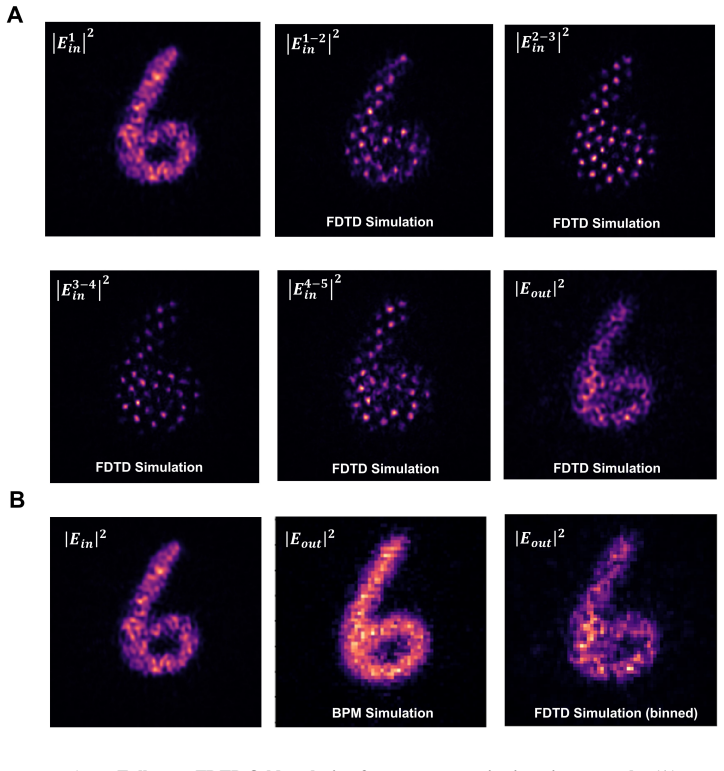
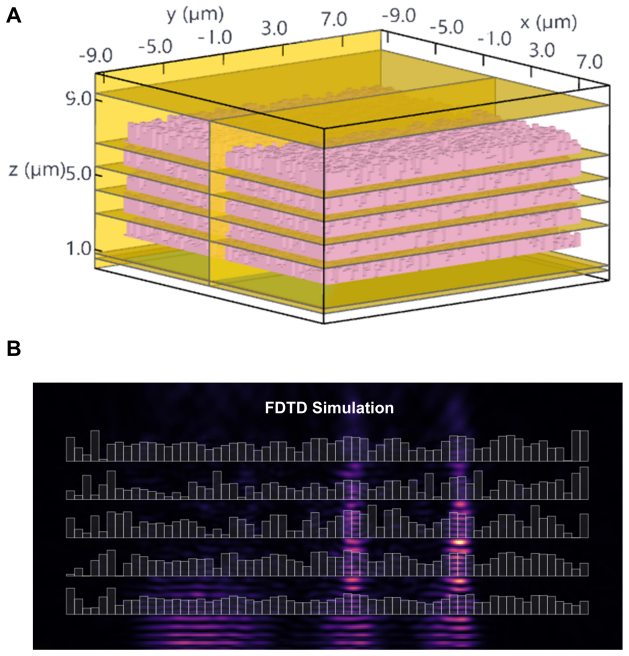
FDTD Simulation Details 2.1. FDTD source construction and numerical discretization For the BPM–FDTD validation experiments, the learned diffractive layers are exported as physical height maps and reconstructed as finite-thickness dielectric structures in the FDTD solver. The validation uses a matched64×64 diffractive-layer grid to keep the full-wave simul...
-
[20]
Consider an optical field𝑈(𝑥, 𝑦,0) at the input plane
Connection Between ASM Propagation, Evanescent Components, and the Neuron-Size Limit The angular spectrum method (ASM) provides a direct way to understand why the conventional diffraction-angle formula is no longer physically meaningful when the neuron size becomes smaller than𝜆/2. Consider an optical field𝑈(𝑥, 𝑦,0) at the input plane. In ASM, this field ...
-
[21]
We now connect this propagation limit to the geometric connectivity condition used for visible-wavelength𝐷2NN design
Derivation of the Inter-Layer Connectivity Condition The above neuron-size argument explains when a spatial-frequency component can propagate in free space. We now connect this propagation limit to the geometric connectivity condition used for visible-wavelength𝐷2NN design. In a free-space 𝐷2NN, the field diffracted by each neuron should spread sufficient...
discussion (0)
Sign in with ORCID, Apple, or X to comment. Anyone can read and Pith papers without signing in.