REVIEW 3 major objections 7 minor 91 references
Shaping Magnetic Order by Local Frustration for Itinerant Fermions on a Graph
T0 review · 3 major / 7 minor · reviewed 2026-08-06 · deepseek-v4-flash
Pith's one-line read Local frustration centers bind singlets while sharing a delocalized hole, so embedding diagonals lowers the ground-state spin by about one per bond.
desk verdict A credible, reproducible numerical study of kinetic magnetism on frustrated graphs; the headline 'general principle' is extrapolated beyond the finite-size evidence, but the core observations are solid and deserve referee time. read the letter →
The pith
A machine-rendered reading of the paper's core claim, the machinery that carries it, and where it could break.
The reading
What carries the argument
The central object is the one-hole, $U\to\infty$ Hubbard model on a graph, whose low-energy physics is governed entirely by the hole's hopping while double occupancy is forbidden. The load-bearing mechanism is the frustration center, meaning a diagonal bond or odd loop that spoils the constructive interference behind the ferromagnetic ground state, binding exactly one singlet while the same hole is shared across the graph. The paper analyzes this with exact diagonalization of the combined hole-and-magnon Hilbert space, builds variational cross-dimer states for collective plaquettes, and defines frustration measures such as the number of odd loops, the frustration index, and the minimum loop size to organize the random-graph results.
What would settle it
Compute the ground-state total spin of a much larger frustrated graph, such as a grid with dozens of random diagonal bonds or random graphs with hundreds of sites, by a scalable numerical method: if the average spin reduction per diagonal stops being roughly one, or if the hole's density localizes on the frustration centers, the general principle fails. A cold-atom experiment with two or three engineered diagonal bonds could also falsify it by measuring the total spin or spin correlations and finding a reduction different from one per bond.
Extended reading notes
Core claim
In the infinite-$U$ Hubbard model with a single hole, the paper claims that the ground state on a frustrated graph is organized by the rule that frustration centers bind singlets while sharing a delocalized hole. The hole's kinetic interference, which normally favors a fully aligned ferromagnet on bipartite lattices, is locally spoiled by an odd loop or a diagonal bond; that spoiled region traps a down spin into a singlet, while the hole keeps moving and the rest of the lattice stays spin-polarized. Consequently the ground-state total spin $S_{\rm total}$ drops by approximately one per added diagonal on a rectangular grid, and two nearby frustrated plaquettes can share the hole and bind distorted singlets collectively. On random graphs the same principle shows up statistically: $S_{\rm total}$ is anticorrelated with the frustration index and with odd-loop counts, positively correlated with even-loop counts, and its distribution swings as the minimum loop size is increased. The authors present this as a collective effect that exchange magnetism does not possess.
Load-bearing premise
The small-system numerical results, covering graphs with 20 sites, a 4-by-5 grid, and ladders up to 32 sites, are assumed to keep holding on arbitrarily large graphs, with every frustration center still binding exactly one singlet and the hole staying delocalized; the paper gives no proof or thermodynamic-limit scaling for that step.
Editorial extensions
If this is right
- On a rectangular grid with one hole, adding a diagonal bond to a plaquette reduces the ground-state total spin by approximately one, so the net magnetization can be tuned in unit steps by embedding frustration centers.
- On random graphs, ground-state total spin is strongly anticorrelated with the frustration index and with the number of odd loops, and positively correlated with even loops; restricting the minimum loop size swings the magnetization distribution between nearly ferromagnetic and nearly singlet.
- Two frustrated plaquettes placed close together share the hole and bind distorted singlets collectively, producing regions where the spin reduction exceeds what independent plaquettes would give.
- A focused-laser protocol can create effective diagonal hops in selected plaquettes of a cold-atom optical lattice, making the key predictions testable in existing experiments.
- Exchange magnetism at half filling shows no such sensitivity to diagonal bonds or loop structure, so this effect is diagnostic of kinetic magnetism.
Reading between the lines
- Beyond the paper, the additivity of the spin reduction suggests that any set of well-separated frustration centers on a large graph should give a predictable saturation value of $S_{\rm total}$, turning the rule into a design recipe for synthetic quantum magnets.
- Beyond the paper, if the principle survives the thermodynamic limit, standard network diagnostics such as odd-loop density, girth, and frustration index become direct predictors of a quantum ground-state property, connecting network science to strongly correlated electron physics.
- Beyond the paper, one could test the hole-sharing claim directly by measuring the hole's inverse participation ratio on a large frustrated lattice: the principle predicts the hole remains delocalized even when all magnons are pinned to frustration centers.
- Beyond the paper, multi-hole versions may inherit the same mechanism and produce interactions between singlet centers, since the shared hole mediates the collective binding seen in the two-plaquette calculation.
Editorial analysis
A structured set of objections, weighed in public.
Referee Report
Summary. This paper studies how local kinetic frustration shapes magnetic order in the infinite-U Hubbard model with a single hole on a graph. The authors solve a single square with diagonal hopping exactly, identifying three regions: a Nagaoka ferromagnet, a vertical-singlet state, and a cross-dimer singlet, with an exact energy expression in the intermediate region. They then embed one or two frustrated plaquettes in ladders, using exact diagonalization and DMRG up to length 32, and show that the frustrated plaquette binds magnons with perturbatively controlled weights (P_out = 1/5 for the ladder, 1/9 for the grid). The central claim is a general principle: local frustration centers bind singlets while sharing a delocalized hole, so each added diagonal bond on a 4x5 grid reduces the ground-state total spin by roughly 1, and the total spin on 20-site random graphs is anticorrelated with loop counts and the frustration index. A half-filled Heisenberg comparison shows none of this sensitivity. An appendix outlines an optical-lattice scheme for realizing tunable diagonal hops.
Significance. Strengths: the single-square solution is exact and its three phases are characterized analytically with parity assignments; the perturbation-theory prediction for the magnon occupation outside the frustrated plaquette (P_out = 1/5) is verified against ED across the whole cross-dimer region; the ladder phase diagrams are stable to length 32 in DMRG; the Heisenberg contrast cleanly isolates the kinetic mechanism; and the data and source codes are archived on Zenodo (refs. 80-81). The most valuable outcome, if confirmed at larger size, is a falsifiable design rule: placing a diagonal bond in an otherwise bipartite ferromagnetic background locally binds a singlet and lowers S_total by one, enabling spatially resolved control of magnetization that exchange magnetism cannot provide. The variational ansatz for the two-plaquette collective state is presented with overlap data rather than as a derivation, and the fitted parameter alpha is not used as an input to the additivity claim, so no circularity is apparent.
major comments (3)
- [Grid with diagonal bonds (Fig. 4a)] The central additivity claim is not what Fig. 4(a) shows over its full range. For the 4x5 grid with 19 fermions, S_max = 9.5 and the hard lower bound is S = 1/2, so at most 9 of the 12 possible diagonals can reduce S by a full unit. The average total spin plotted in Fig. 4(a) falls from about 9.5 at N_diag = 0 to about 1.5 at N_diag = 12, i.e., an average reduction of roughly 8 units over 12 diagonals, or about 2/3 per diagonal, not 1. The paper does not state this saturation bound, does not identify the crossover where the slope-1 rule must fail, and does not report how the distribution over the 1000 graphs interacts with the S = 1/2 floor. In addition, the text claims that the Shastry-Sutherland-constrained placement reduces S by 1 per diagonal, but Fig. 4(a) shows the unconstrained case; the two should be shown separately, since the unconstrained data as plotted are consistent with a much weaker average slope near the upper end of N_diag. Because the headline general principle is exactly the additive slope-1 behavior, a quantitative regime statement, including the dependence on the diagonal-to-side hopping ratio (held fixed at t' = t in the grid data), is required.
- [Random graphs (Fig. 5; SM Fig. S5)] The extension to random graphs rests on exact diagonalization of 20-site graphs, with SM Fig. S5 extending the loop-count correlations down to 10 sites. This is encouraging but is not a scaling analysis: no statement is made about whether the about -0.5 correlation with the frustration index or the loop-count correlations converge with N, and the mechanism advanced for grids (each frustration center binds one singlet while the hole stays delocalized) is not directly testable on random graphs because, as the authors note, these do not have well-defined frustration centers. The abstract's claim that the principle extends to random graphs therefore currently bridges from a local mechanism to aggregate loop statistics by analogy. Either add a finite-size study showing a trend (e.g., correlation strength and S-distribution moments for N = 22-28 in fixed S_z sectors), or explicitly delimit the random-graph claim to what is computed.
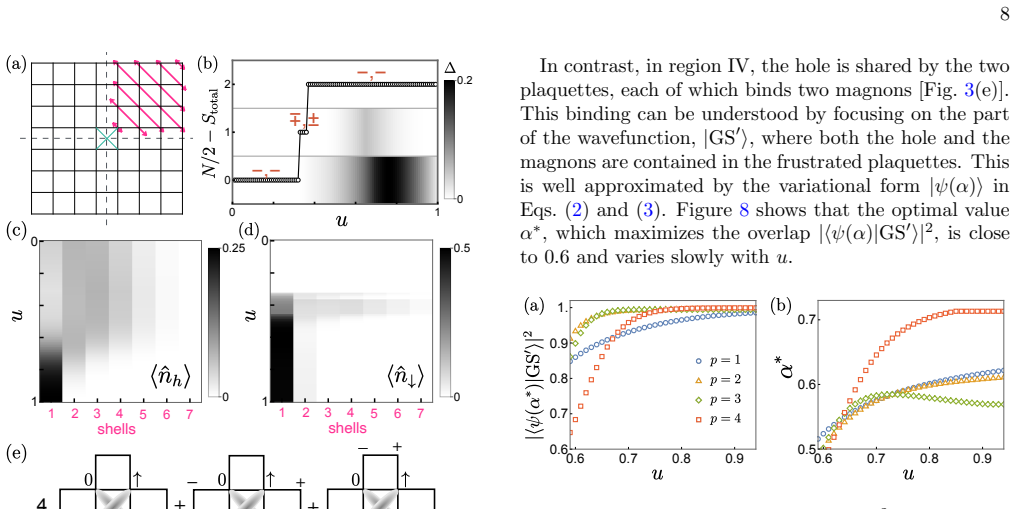
- [Abstract and Figs. 3-4] The stated general principle, that local frustration centers bind singlets while sharing a delocalized hole, is not the operative mechanism in all regimes presented in the paper. In region V of Fig. 3 the hole is localized in one plaquette while the other stays polarized (S is still reduced by 2), and in region III the hole is confined between the plaquettes with two domain walls; a shared, delocalized hole occurs only in regions II and IV. Furthermore, all grid data in Fig. 4 are taken at one parameter point, equal hopping on all bonds, which for a single square sits exactly at the II-III degeneracy in Fig. 1(b); for a weaker diagonal (u < 1/5 in Fig. 1) a single square remains a fully polarized Nagaoka ferromagnet and the reduction per diagonal is zero, so the additivity rule must depend on the frustration strength and not just on the number of centers. The general principle should be reformulated with its regime of validity (hopping ratio, distance between centers, and proximity to saturation), or the claims should be explicitly presented as regime-specific.
minor comments (7)
- [Fig. 4 caption] Please clarify how the N_diag axis is sampled: are the plotted points independent random graphs with exactly N_diag diagonals, or averages over growth trajectories in which bonds are added one at a time? The two procedures give different distributions, and the caption's 'up to 1000 graphs' does not resolve this.
- [Appendix B / Fig. 8] The maximum variational overlap in region IV, |<psi(alpha*)|GS'>|^2 ~ 0.6-0.8, is moderate; the main text should state that the two-plaquette collective wavefunction is an illustration and that the primary evidence for region IV is the ED/DMRG reduction of S by 4.
- [Random graphs section] A Pearson correlation of about -0.5 is moderate, not 'strong' as stated in the text; please report the correlation type, the scatter, and confidence intervals (the SM already gives 95% intervals for Fig. S5), and soften the wording accordingly.
- [Fig. 3b] Please specify how the five regions of the two-plaquette phase diagram are delimited (e.g., level crossings between symmetry sectors) and whether the transitions are first-order; the figure currently shows no gap or transition data for this case.
- [Setup] The parenthetical comment '(For t_i,j < 0, ferromagnetism is not frustrated [36-38])' is too compressed; one sentence explaining the role of the hopping sign relative to the loop orientation would help readers who are not specialists in kinetic frustration.
- [SM Fig. S4] For the Heisenberg random-graph comparison, please report the fraction of nonseparable graphs in the ensembles that are non-bipartite and check the claim of 'negligible spread' of S around zero for r_min = 3, since an antiferromagnet on a graph containing an isolated odd cycle generically has a nonzero ground-state spin.
- [Appendix D] Please state the role of the central mediator site in the U to infinity limit: whether it is empty in the initial state, whether its on-site interaction enters the virtual tunneling, and what condition keeps it from being occupied; as written, the second-order process is described only through the band-structure plots in Fig. 10.
Circularity Check
No significant circularity: the central singlet-binding principle is an independently computed result, not an input refit or a self-citation chain.
full rationale
The paper's central claim—that local frustration centers bind singlets while sharing a delocalized hole—is supported by several independent strands, none of which reduces to its own inputs. The single-square and single-plaquette results are exact or controlled: the ground-state sectors are obtained by direct diagonalization of the few-site Hubbard Hamiltonian, the large-u cross-dimer states are explicit wavefunctions with stated energies, and the leakage probabilities P_out = 1/5 (ladder) and 1/9 (grid) follow from an explicit third-order perturbation expansion in t/t'. These are parameter-free calculations, not fits. The grid and random-graph claims are numerical observations against exact diagonalization and DMRG benchmarks; the only fitted quantity, the variational deformation parameter alpha* in Appendix B, is chosen a posteriori to maximize overlap with the already-computed exact ground state and is not used to generate the S_total-reduction prediction. The frustration measures used for random graphs (odd/even loop counts, frustration index, bond-local loop counts) are independent graph-theoretic properties computed from the connectivity, while S_total and bond correlations are separately computed from the Hubbard Hamiltonian; the reported anticorrelations are empirical correlations, not definitional identities. The only self-reference is Ref. [33] (Preethi and Dutta), used for the exchange-magnetism comparison, but this is not load-bearing: the same comparison is independently reproduced in the Supplemental Material with HPhi exact diagonalization, and the kinetic-magnetism claims do not depend on that reference. The extrapolation from 20-site and 4x5 systems to arbitrarily large graphs is an untested finite-size assumption, which is a robustness and scaling concern rather than a circular reduction; within the sizes actually computed, the derivation is self-contained.
Assumptions & free parameters
free parameters (1)
- deformation parameter alpha =
approx 0.6
assumptions (5)
- domain assumption U=infinity Hubbard model with exactly one hole
- domain assumption Positive hopping amplitudes t>0 on all bonds
- standard math Ground-state total spin is well defined on nonseparable graphs
- domain assumption Heisenberg comparison at half filling uses J approx 4t^2/U
- ad hoc to paper Variational product form for the two-plaquette collective state
Cite this review
Pith. "Pith review of Shaping Magnetic Order by Local Frustration for Itinerant Fermions on a Graph." pith.science (2026). https://pith.science/paper/GAEOSPDI
@misc{pith2026250707886,
  author       = {Pith},
  title        = {Pith review of: Shaping Magnetic Order by Local Frustration for Itinerant Fermions on a Graph},
  year         = {2026},
  howpublished = {\url{https://pith.science/paper/GAEOSPDI}},
  note         = {Machine review of arXiv:2507.07886}
}
read the original abstract
Kinetic magnetism is an iconic and rare example of collective quantum order that emerges from the interference of paths taken by a hole in a sea of strongly interacting fermions. Here the lattice topology plays a fundamental role, with odd loops frustrating ferromagnetism, as seen in recent experiments. However, the resulting magnetic order on a general graph has remained elusive. Here we systematically establish a general principle: that local frustration centers bind singlets while sharing a delocalized hole. This collective effect -- absent in exchange magnetism -- extends from rectangular grids to random graphs, producing sharp and predictable variation with tunable frustration measures. Our findings demonstrate that one can shape the spin order and tune the net magnetization by embedding kinetic frustration, opening ways of spatially resolved quantum control of many-body systems. We outline a protocol to realize some of the key findings in existing cold-atom setups.
Figures


Figures from the paper (5 more)




Reference graph
Works this paper leans on
-
[1]
Lacroix, P
C. Lacroix, P. Mendels, and F. Mila, eds.,Introduction to Frustrated Magnetism: Materials, Experiments, Theory, Vol. 164 (Springer, New York, 2011)
2011
-
[2]
H. T. Diep, ed.,Frustrated Spin Systems(World Scien- tific, Singapore, 2013)
2013
-
[3]
Balents, Spin liquids in frustrated magnets, Nature 464, 199 (2010)
L. Balents, Spin liquids in frustrated magnets, Nature 464, 199 (2010)
2010
-
[4]
Moessner and A
R. Moessner and A. P. Ramirez, Geometrical frustration, Phys. Today59, 24 (2006)
2006
-
[5]
J. O. Haerter and B. S. Shastry, Kinetic antiferromag- netism in the triangular lattice, Phys. Rev. Lett.95, 087202 (2005)
2005
-
[6]
D. C. Mattis,The Theory of Magnetism I: Statics and Dynamics(Springer, Berlin, 1981) p. 258
1981
-
[7]
Keeling, Quantum Magnetism
J. Keeling, Quantum Magnetism
-
[8]
Tasaki,Physics and Mathematics of Quantum Many- Body Systems(Springer, Cham, 2020)
H. Tasaki,Physics and Mathematics of Quantum Many- Body Systems(Springer, Cham, 2020)
2020
Show all 91 references
-
[9]
D. P. Arovas, E. Berg, S. A. Kivelson, and S. Raghu, The Hubbard model, Annu. Rev. Condens. Matter Phys.13, 239 (2022)
2022
-
[10]
Nagaoka, Ferromagnetism in a narrow, almost half- filledsband, Phys
Y. Nagaoka, Ferromagnetism in a narrow, almost half- filledsband, Phys. Rev.147, 392 (1966)
1966
-
[11]
Kim, Exact hole-induced resonating-valence-bond ground state in certainU=∞Hubbard models, Phys
K.-S. Kim, Exact hole-induced resonating-valence-bond ground state in certainU=∞Hubbard models, Phys. Rev. B107, L140401 (2023)
2023
-
[12]
C. N. Sposetti, B. Bravo, A. E. Trumper, C. J. Gazza, and L. O. Manuel, Classical antiferromagnetism in kinet- ically frustrated electronic models, Phys. Rev. Lett.112, 187204 (2014)
2014
-
[13]
Glittum, A
C. Glittum, A. ˇStrkalj, D. Prabhakaran, P. A. Goddard, C. D. Batista, and C. Castelnovo, A resonant valence bond spin liquid in the dilute limit of doped frustrated Mott insulators, Nat. Phys.21, 1211 (2025)
2025
-
[14]
Poilblanc, Enhanced pairing in doped quantum mag- nets with frustrated hole motion, Phys
D. Poilblanc, Enhanced pairing in doped quantum mag- nets with frustrated hole motion, Phys. Rev. Lett.93, 197204 (2004)
2004
-
[15]
J. P. Dehollain, U. Mukhopadhyay, V. P. Michal, Y. Wang, B. Wunsch, C. Reichl, W. Wegscheider, M. S. Rudner, E. Demler, and L. M. K. Vandersypen, Nagaoka ferromagnetism observed in a quantum dot plaquette, Nature579, 528 (2020)
2020
-
[16]
Lebrat, M
M. Lebrat, M. Xu, L. H. Kendrick, A. Kale, Y. Gang, P. Seetharaman, I. Morera, E. Khatami, E. Demler, and M. Greiner, Observation of Nagaoka polarons in a Fermi– Hubbard quantum simulator, Nature629, 317 (2024)
2024
-
[17]
M. L. Prichard, B. M. Spar, I. Morera, E. Demler, Z. Z. Yan, and W. S. Bakr, Directly imaging spin polarons in a kinetically frustrated Hubbard system, Nature629, 323 (2024)
2024
-
[18]
Hanisch, B
T. Hanisch, B. Kleine, A. Ritzl, and E. M¨ uller- Hartmann, Ferromagnetism in the Hubbard model: in- stability of the Nagaoka state on the triangular, honey- comb and kagome lattices, Ann. Phys.507, 303 (1995)
1995
-
[19]
F. T. Lisandrini, B. Bravo, A. E. Trumper, L. O. Manuel, and C. J. Gazza, Evolution of Nagaoka phase with kinetic energy frustrating hopping, Phys. Rev. B95, 195103 (2017)
2017
-
[20]
Gross and W
C. Gross and W. S. Bakr, Quantum gas microscopy for single atom and spin detection, Nat. Phys.17, 1316 (2021)
2021
-
[21]
G. M. Nixon, F. N. ¨Unal, and U. Schneider, Individually 6 tunable tunnelling coefficients in optical lattices using local periodic driving, Quantum Sci. Technol.9, 045030 (2024)
2024
-
[22]
and superconducting qubits [55, 56]. Our findings motivate further studies of kinetic mag- netism on graphs that can explore (i) deeper connec- tions to polaron physics [39, 57] and effective spin models [5, 12], (ii) the physics of multiple holes, which is even richer and sen...
2024
-
[23]
Gonz´ alez-Cuadra, D
D. Gonz´ alez-Cuadra, D. Bluvstein, M. Kalinowski, R. Kaubruegger, N. Maskara, P. Naldesi, T. V. Zache, A. M. Kaufman, M. D. Lukin, H. Pichler, B. Vermersch, J. Ye, and P. Zoller, Fermionic quantum processing with programmable neutral atom arrays, Proc. Natl. Acad. Sci.120, e2...
2023
-
[24]
S. B. Bravyi and A. Y. Kitaev, Fermionic quantum com- putation, Ann. Phys.298, 210 (2002)
2002
-
[25]
Verstraete and J
F. Verstraete and J. I. Cirac, Mapping local Hamiltonians of fermions to local Hamiltonians of spins, J. Stat. Mech. 2005, P09012 (2005)
2005
-
[26]
Steudtner and S
M. Steudtner and S. Wehner, Quantum codes for quan- tum simulation of fermions on a square lattice of qubits, Phys. Rev. A99, 022308 (2019)
2019
-
[27]
S. H. Strogatz, Exploring complex networks, Nature410, 268 (2001)
2001
-
[28]
M. E. J. Newman,Networks: An Introduction(Oxford University Press, Oxford, UK, 2018)
2018
-
[29]
Barrat, M
A. Barrat, M. Barthelemy, and A. Vespignani,Dynamical Processes on Complex Networks(Cambridge University Press, Cambridge, UK, 2008)
2008
-
[30]
S. N. Dorogovtsev, A. V. Goltsev, and J. F. F. Mendes, Critical phenomena in complex networks, Rev. Mod. Phys.80, 1275 (2008)
2008
-
[31]
R. M. D’Souza, J. G´ omez-Garde˜ nes, J. Nagler, and A. Arenas, Explosive phenomena in complex networks, Adv. Phys.68, 123 (2019)
2019
-
[32]
Nokkala, J
J. Nokkala, J. Piilo, and G. Bianconi, Complex quantum networks: a topical review, J. Phys. A57, 233001 (2024)
2024
-
[33]
Zheng, D
X. Zheng, D. Zeng, and F.-Y. Wang, Social balance in signed networks, Inf. Syst. Front.17, 1077 (2014)
2014
-
[34]
Preethi and S
G. Preethi and S. Dutta, Frustrated quantum mag- netism on complex networks: What sets the total spin, arXiv:2403.09116
-
[35]
[82, 83]
See Supplemental Material for comparisons with Heisen- berg antiferromagnetism and data for random graphs of varying system size, which includes Refs. [82, 83]
-
[36]
F. H. Essler, H. Frahm, F. G¨ ohmann, A. Kl¨ umper, and V. E. Korepin,The One-Dimensional Hubbard Model (Cambridge University Press, Cambridge, UK, 2005)
2005
-
[37]
Tasaki, Extension of Nagaoka’s theorem on the large- UHubbard model, Phys
H. Tasaki, Extension of Nagaoka’s theorem on the large- UHubbard model, Phys. Rev. B40, 9192 (1989)
1989
-
[38]
Bobrow, K
E. Bobrow, K. Stubis, and Y. Li, Exact results on itin- erant ferromagnetism and the 15-puzzle problem, Phys. Rev. B98, 180101 (2018)
2018
-
[39]
B. J. Powell, Balance and frustration in strongly cor- related itinerant electron systems: An extension of Na- gaoka’s theorem, Phys. Rev. B96, 174435 (2017)
2017
-
[40]
Morera, A
I. Morera, A. Bohrdt, W. W. Ho, and E. Demler, At- traction from kinetic frustration in ladder systems, Phys. Rev. Res.6, 023196 (2024)
2024
-
[41]
H. Zhai, H. R. Larsson, S. Lee, Z.-H. Cui, T. Zhu, C. Sun, L. Peng, R. Peng, K. Liao, J. T¨ olle, J. Yang, S. Li, and G. K.-L. Chan,Block2: A comprehensive open source framework to develop and apply state-of-the-art DMRG algorithms in electronic structure and beyond, J. Chem. ...
2023
-
[42]
Sriram Shastry and B
B. Sriram Shastry and B. Sutherland, Exact ground state of a quantum mechanical antiferromagnet, Physica B+C 108, 1069 (1981)
1981
-
[43]
P. W. Leung and Y. F. Cheng, Absence of hole pairing in a simplet-Jmodel on the Shastry-Sutherland lattice, Phys. Rev. B69, 180403 (2004)
2004
-
[44]
Holme, F
P. Holme, F. Liljeros, C. R. Edling, and B. J. Kim, Net- work bipartivity, Phys. Rev. E68, 056107 (2003)
2003
-
[45]
Aref and M
S. Aref and M. C. Wilson, Measuring partial balance in signed networks, J. Complex Netw.6, 566 (2018)
2018
-
[46]
Aref and M
S. Aref and M. C. Wilson, Balance and frustration in signed networks, J. Complex Netw.7, 163 (2019)
2019
-
[47]
Bayati, A
M. Bayati, A. Montanari, and A. Saberi, Generating ran- dom networks without short cycles, Oper. Res.66, 1227 (2018)
2018
-
[48]
Verstra¨ ete, Extremal problems for cycles in graphs, in Recent Trends in Combinatorics(Springer International Publishing, 2016) p
J. Verstra¨ ete, Extremal problems for cycles in graphs, in Recent Trends in Combinatorics(Springer International Publishing, 2016) p. 83
2016
-
[49]
Esslinger, Fermi-Hubbard physics with atoms in an optical lattice, Annu
T. Esslinger, Fermi-Hubbard physics with atoms in an optical lattice, Annu. Rev. Condens. Matter Phys.1, 129 (2010)
2010
-
[50]
Gross and I
C. Gross and I. Bloch, Quantum simulations with ultra- cold atoms in optical lattices, Science357, 995 (2017)
2017
-
[51]
Tarruell and L
L. Tarruell and L. Sanchez-Palencia, Quantum simula- tion of the Hubbard model with ultracold fermions in optical lattices, C. R. Phys.19, 365 (2018)
2018
-
[52]
G. Ji, M. Xu, L. H. Kendrick, C. S. Chiu, J. C. Br¨ uggenj¨ urgen, D. Greif, A. Bohrdt, F. Grusdt, E. Dem- ler, M. Lebrat, and M. Greiner, Coupling a mobile hole to an antiferromagnetic spin background: Transient dy- namics of a magnetic polaron, Phys. Rev. X11, 021022 (2021)
2021
-
[53]
Chalopin, P
T. Chalopin, P. Bojovi´ c, D. Bourgund, S. Wang, T. Franz, I. Bloch, and T. Hilker, Optical superlattice for engineering Hubbard couplings in quantum simula- tion, Phys. Rev. Lett.134, 053402 (2025)
2025
-
[54]
Lloyd, Universal quantum simulators, Science273, 1073 (1996)
S. Lloyd, Universal quantum simulators, Science273, 1073 (1996)
1996
-
[55]
Bassman Oftelie, M
L. Bassman Oftelie, M. Urbanek, M. Metcalf, J. Carter, A. F. Kemper, and W. A. de Jong, Simulating quantum materials with digital quantum computers, Quantum Sci. Technol.6, 043002 (2021)
2021
-
[56]
Barends, L
R. Barends, L. Lamata, J. Kelly, L. Garc ´ ıa- ´Alvarez, A. G. Fowler, A. Megrant, E. Jeffrey, T. C. White, D. Sank, J. Y. Mutus, B. Campbell, Y. Chen, Z. Chen, B. Chiaro, A. Dunsworth, I.-C. Hoi, C. Neill, P. J. J. O’Malley, C. Quintana, P. Roushan, A. Vainsencher, J. Wenner,...
2015
-
[57]
Lamata, A
L. Lamata, A. Parra-Rodriguez, M. Sanz, and E. Solano, Digital-analog quantum simulations with superconduct- ing circuits, Adv. Phys. X3, 1457981 (2018)
2018
-
[58]
Samajdar and R
R. Samajdar and R. N. Bhatt, Polaronic mechanism of Nagaoka ferromagnetism in Hubbard models, Phys. Rev. B109, 235128 (2024)
2024
-
[59]
Doucot and X
B. Doucot and X. G. Wen, Instability of the Nagaoka state with more than one hole, Phys. Rev. B40, 2719 (1989)
1989
-
[60]
B. S. Shastry, H. R. Krishnamurthy, and P. W. Anderson, Instability of the Nagaoka ferromagnetic state of theU= ∞Hubbard model, Phys. Rev. B41, 2375 (1990)
1990
-
[61]
J. A. Riera and A. P. Young, Ferromagnetism in the one- band Hubbard model, Phys. Rev. B40, 5285 (1989)
1989
-
[62]
Ivantsov, A
I. Ivantsov, A. Ferraz, and E. Kochetov, Breakdown of the Nagaoka phase at finite doping, Phys. Rev. B95, 155115 (2017). 7
2017
-
[63]
H. B. Xavier, E. Kochetov, and A. Ferraz, Onset of ferromagnetism for strongly correlated electrons in one- dimensional chains, Phys. Rev. B101, 045112 (2020)
2020
-
[64]
Zhang, W
S.-S. Zhang, W. Zhu, and C. D. Batista, Pairing from strong repulsion in triangular lattice Hubbard model, Phys. Rev. B97, 140507 (2018)
2018
-
[65]
S. Yun, W. Dobrautz, H. Luo, V. Katukuri, N. Lieber- mann, and A. Alavi, Ferromagnetic domains in the large- UHubbard model with a few holes: A full configuration interaction quantum Monte Carlo study, Phys. Rev. B 107, 064405 (2023)
2023
-
[66]
L. Liu, H. Yao, E. Berg, S. R. White, and S. A. Kivel- son, Phases of the infiniteUHubbard model on square lattices, Phys. Rev. Lett.108, 126406 (2012)
2012
-
[67]
Z. Zhu, D. N. Sheng, and A. Vishwanath, Doped Mott insulators in the triangular-lattice Hubbard model, Phys. Rev. B105, 205110 (2022)
2022
-
[68]
Sharma, Y
P. Sharma, Y. Peng, D. N. Sheng, H. J. Changlani, and Y. Wang, Instability of Nagaoka state and quan- tum phase transition via kinetic frustration control, arXiv:2508.08410
-
[69]
B´ eran, D
P. B´ eran, D. Poilblanc, and R. Laughlin, Evidence for composite nature of quasiparticles in the 2Dt-Jmodel, Nucl. Phys. B473, 707 (1996)
1996
-
[70]
C. S. Chiu, G. Ji, A. Bohrdt, M. Xu, M. Knap, E. Dem- ler, F. Grusdt, M. Greiner, and D. Greif, String patterns in the doped Hubbard model, Science365, 251 (2019)
2019
-
[71]
Grusdt, A
F. Grusdt, A. Bohrdt, and E. Demler, Microscopic spinon-chargon theory of magnetic polarons in thet-J model, Phys. Rev. B99, 224422 (2019)
2019
-
[72]
Schl¨ omer, U
H. Schl¨ omer, U. Schollw¨ ock, A. Bohrdt, and F. Grusdt, Kinetic-to-magnetic frustration crossover and linear con- finement in the doped triangulart-Jmodel, Phys. Rev. B110, L041117 (2024)
2024
-
[73]
Watanabe and S
Y. Watanabe and S. Miyashita, Existence of saturated ferromagnetic and spiral states in 1D Lieb-Ferrimagnetic models away from half-filling, J. Phys. Soc. Jpn.68, 3086 (1999)
1999
-
[74]
Y. Li, K. Liu, and G. W. Bryant, Nagaoka ferromag- netism in 3×3 arrays and beyond, Phys. Rev. B110, 245141 (2024)
2024
-
[75]
Mielke, Ferromagnetism in the Hubbard model on line graphs and further considerations, J
A. Mielke, Ferromagnetism in the Hubbard model on line graphs and further considerations, J. Phys. A24, 3311 (1991)
1991
-
[76]
Horiike and Y
Y. Horiike and Y. Kawaguchi, A comprehensive ex- ploration of interaction networks reveals a connec- tion between entanglement and network structure, arXiv:2505.11466
-
[77]
Morera, M
I. Morera, M. Kan´ asz-Nagy, T. Smolenski, L. Ciorciaro, A. Imamo˘ glu, and E. Demler, High-temperature kinetic magnetism in triangular lattices, Phys. Rev. Res.5, L022048 (2023)
2023
-
[78]
R. C. Newby and E. Khatami, Finite-temperature kinetic ferromagnetism in the square-lattice Hubbard model, Phys. Rev. B111, 245120 (2025)
2025
-
[79]
Pereira and E
D. Pereira and E. J. Mueller, Kinetic magnetism in the crossover between the square and triangular lat- tice Fermi-Hubbard models, Phys. Rev. B112, 245120 (2025)
2025
-
[80]
P. A. Lee, N. Nagaosa, and X.-G. Wen, Doping a Mott insulator: Physics of high-temperature superconductiv- ity, Rev. Mod. Phys.78, 17 (2006)
2006
-
[81]
Shaping magnetic order by local frustration for itinerant fermions on a graph
R. B. S and S. Dutta, Dataset for “Shaping magnetic order by local frustration for itinerant fermions on a graph”, Zenodo, 10.5281/zenodo.19019802 (2026)
2026 doi
-
[82]
Shaping mag- netic order by local frustration for itinerant fermions on a graph
R. B. S and S. Dutta, Source codes for “Shaping mag- netic order by local frustration for itinerant fermions on a graph”, Zenodo, 10.5281/zenodo.19028546 (2026)
2026 doi
-
[83]
Kawamura, K
M. Kawamura, K. Yoshimi, T. Misawa, Y. Yamaji, S. Todo, and N. Kawashima, Quantum lattice model solverHΦ, Comput. Phys. Commun.217, 180 (2017)
2017
-
[84]
K. Ido, M. Kawamura, Y. Motoyama, K. Yoshimi, Y. Ya- maji, S. Todo, N. Kawashima, and T. Misawa, Update ofHΦ: Newly added functions and methods in versions 2 and 3, Comput. Phys. Commun.298, 109093 (2024)
2024
-
[85]
Grimm, M
R. Grimm, M. Weidem¨ uller, and Y. B. Ovchinnikov, Op- tical dipole traps for neutral atoms, Adv. At. Mol. Opt. Phys.42, 95 (2000)
2000
-
[86]
Bloch and M
I. Bloch and M. Greiner, Exploring quantum matter with ultracold atoms in optical lattices, Adv. At. Mol. Opt. Phys.52, 1 (2005)
2005
-
[87]
Bloch, J
I. Bloch, J. Dalibard, and W. Zwerger, Many-body physics with ultracold gases, Rev. Mod. Phys.80, 885 (2008)
2008
-
[88]
C. Chin, R. Grimm, P. Julienne, and E. Tiesinga, Fesh- bach resonances in ultracold gases, Rev. Mod. Phys.82, 1225 (2010)
2010
-
[89]
Weitenberg, M
C. Weitenberg, M. Endres, J. F. Sherson, M. Cheneau, P. Schauß, T. Fukuhara, I. Bloch, and S. Kuhr, Single- spin addressing in an atomic Mott insulator, Nature471, 319 (2011)
2011
-
[90]
Zupancic, P
P. Zupancic, P. M. Preiss, R. Ma, A. Lukin, M. Eric Tai, M. Rispoli, R. Islam, and M. Greiner, Ultra-precise holo- graphic beam shaping for microscopic quantum control, Opt. Express24, 13881 (2016)
2016
-
[91]
Shaping Magnetic Order by Local Frustration for Itinerant Fermions on a Graph
M. Lebrat, A. Kale, L. H. Kendrick, M. Xu, Y. Gang, A. Nikolaenko, P. M. Bonetti, S. Sachdev, and M. Greiner, Ferrimagnetism of ultracold fermions in a multi-band Hubbard system, arXiv:2404.17555 End Matter Appendix A: Square grid with a frustrated plaque- tte—The ordering of ...
2017 arXiv
Reviewed August 6, 2026 · model on record in the stance chip above.
Discussion (0). Continue with ORCID to comment.