REVIEW 4 major objections 6 minor 20 references
Nonlinear Stability and Dynamics of Supersonic Compressible Flows
T0 review · 4 major / 6 minor · reviewed 2026-08-07 · deepseek-v4-flash
Pith's one-line read A weakly nonlinear expansion of the compressible Euler equations yields a Landau-Stuart amplitude equation whose Mach-dependent coefficients switch between saturating and destabilizing regimes for shear-layer instability.
desk verdict The linearized equations drop the shear term that defines Kelvin-Helmholtz instability, so the paper's central results are about acoustic waves in uniform flow, not shear layers. read the letter →
The pith
A machine-rendered reading of the paper's core claim, the machinery that carries it, and where it could break.
The reading
What carries the argument
The central object is the Landau-Stuart equation $dA/dT = \mu A - \zeta |A|^2 A$ for the complex amplitude $A$ on the slow time scale $T = \varepsilon^2 t$. The coefficient $\mu$ is the linear growth rate and $\zeta$ is the complex Landau coefficient; the real part of $\zeta$ decides whether nonlinearity saturates the disturbance (supercritical case) or amplifies it (subcritical case), while the imaginary part controls phase rotation. The equation is obtained from a multiple-scales expansion of the compressible Euler equations: first-order normal modes modulate in amplitude, quadratic self-interaction generates second harmonics and mean-flow corrections, and a solvability condition at third order projects the resonant nonlinear terms onto the adjoint eigenfunction. The Mach number enters through every coefficient, which is what lets the paper read off bifurcation type as a function of $M$.
What would settle it
Solve the linearized compressible Euler equations retaining the $v_1\,d\bar{u}/dy$ term for a hyperbolic-tangent profile $\bar{u}(y)=\tanh(y)$ and check the imaginary part of $\omega$; if no wavenumber $k$ gives $\Im(\omega)\neq 0$, the growth-rate maps in the paper are not Kelvin-Helmholtz growth rates. A complementary check is a direct numerical simulation of a compressible mixing layer at $M=1.1$ versus $M=1.3$: the first should saturate to a finite-amplitude limit cycle, while the second should show runaway amplitude growth.
Extended reading notes
Core claim
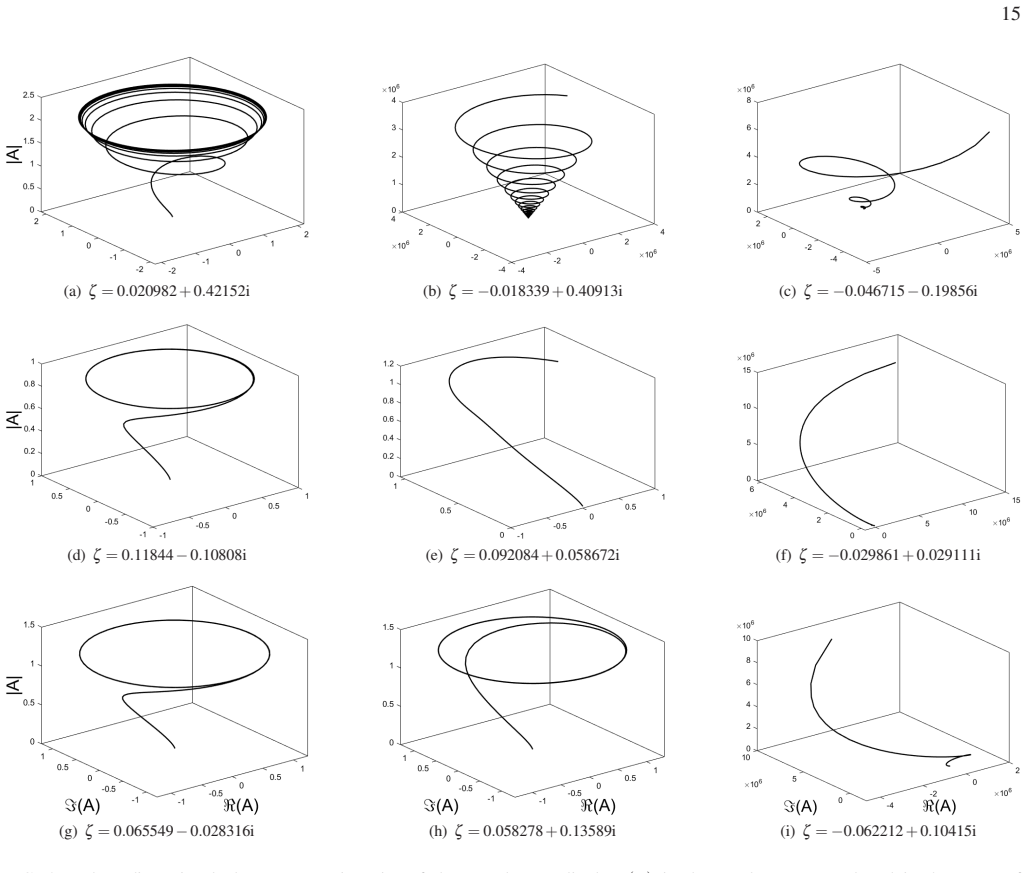
The paper claims that a weakly nonlinear multiple-scales expansion of the two-dimensional compressible Euler equations, with a slow-time amplitude modulation, yields the Landau-Stuart equation $dA/dT = \mu A - \zeta |A|^2 A$ for the complex perturbation amplitude $A$. The linear growth rate $\mu$ and the complex Landau coefficient $\zeta$ inherit their dependence on Mach number from the first- and second-order perturbation equations. The substance of the claim is that $\Re(\zeta)$ changes sign repeatedly as $M$ increases: negative values give subcritical Hopf bifurcations where finite-amplitude disturbances explode, while positive values give supercritical Hopf bifurcations where disturbances saturate into limit cycles. The paper reports five critical Mach numbers $M_c = 0.2564, 1.0283, 1.2755, 1.3313, 1.5484$ at which the nonlinear stability character switches, and it interprets phase portraits and trajectories as evidence of saturation, spiral decay, and blow-up in the complex amplitude plane. It further claims that the bounded-domain boundary conditions used here lower perturbation amplitudes and confine pressure fluctuations to the shear-layer center, altering the Mach-number dependence relative to the classical unbounded analysis.
Load-bearing premise
The first-order perturbation equations drop the term $v_1\,d\bar{u}/dy$ from the momentum balance, so the background velocity is effectively treated as uniform; without that term, the equations cannot represent the velocity-gradient mechanism that drives Kelvin-Helmholtz instability.
Editorial extensions
If this is right
- At Mach numbers where $\Re(\zeta)>0$, linearly unstable disturbances saturate into finite-amplitude periodic states (supercritical Hopf bifurcation), so the long-time state is a stable vortex street rather than unbounded growth.
- At Mach numbers where $\Re(\zeta)<0$, the same disturbances blow up without saturation (subcritical Hopf bifurcation), meaning finite-amplitude perturbations can destabilize a linearly stable flow and generate hysteresis.
- Five critical Mach numbers, 0.2564, 1.0283, 1.2755, 1.3313, and 1.5484, mark alternating stable and unstable nonlinear regimes in the compressible shear layer.
- The finite-domain boundary conditions reduce perturbation amplitudes and localize pressure fluctuations near the layer center, so confinement acts as a stabilizing mechanism.
- Linear stability analysis alone is insufficient: the sign of the real part of the Landau coefficient, not just the linear growth rate, determines whether the flow transitions smoothly or abruptly.
Reading between the lines
- Restoring the omitted $v_1\,d\bar{u}/dy$ term in the first-order equations and recomputing the Landau coefficient would be the most direct test of whether the five critical Mach numbers survive; the alternating bifurcation pattern may change substantially.
- Because the coefficient $\zeta$ is computed at a single wavenumber, a natural extension is to allow spatial modulation of $A$, yielding a complex Ginzburg-Landau equation that would connect the present amplitude dynamics to the streamwise growth of mixing layers.
- The same multiple-scales machinery should transfer to stratified or magnetized shear layers, where the control parameter would be a Richardson or Alfvén Mach number instead of $M$, giving cheap predictions for astrophysical jet stability and filament formation.
Editorial analysis
A structured set of objections, weighed in public.
Referee Report
Summary. The paper claims to extend Blumen's linear stability theory of inviscid compressible shear layers to the weakly nonlinear regime. Using a multiple-scales expansion of the compressible Euler equations, the authors derive a Landau-Stuart equation for the disturbance amplitude, compute Mach-number-dependent Landau and linear growth coefficients, and present phase portraits, bifurcation diagrams, and amplitude evolutions that indicate alternating supercritical and subcritical Hopf bifurcations of the Kelvin-Helmholtz instability. The analysis incorporates finite-boundary conditions and is framed as a generalizable framework for nonlinear dynamics of compressible shear flows.
Significance. If the derivation were correct, the paper would offer a valuable systematic weakly nonlinear framework for compressible shear-layer instability, extending a classical linear result and providing concrete predictions about long-time state selection. The paper includes a physically motivated problem setup and a broad set of figures illustrating dynamical regimes. However, the central derivation is flawed: the first-order linearized equations omit the shear term that defines the Kelvin-Helmholtz mechanism, and the Landau coefficients are not derived from the model. As a result, the claimed bifurcation structure and dynamics are not established for compressible shear layers, and the significance is not realized in the present form.
major comments (4)
- [Sec. III.A, Eqs. (11)-(13) and (21)] The first-order x-momentum equation (11) omits the term v1 d\bar{u}/dy that is present in the full x-momentum equation (5). With this term absent, the linearized problem reduces to a constant-coefficient algebraic system, and the dispersion relation (21), ω = kx\bar{u} ± sqrt(kx²+ky²)/M, is purely real. Hence Im(ω) = σ = 0 identically, which contradicts Figure 2, where positive and negative growth rates are plotted. Since the velocity gradient is the physical source of Kelvin-Helmholtz instability, the subsequent nonlinear analysis is not a study of shear-layer instability.
- [Sec. III.B and Table I] The coefficients μ and ζ in Eq. (26) are stated to be 'obtained from linear stability analysis' and 'estimated values,' but no derivation is shown. The solvability condition (25) is never evaluated, and the values in Table I cannot be obtained from the dispersion relation (21), which has no imaginary part. The phase portraits and bifurcation diagrams in Figs. 5-9 are therefore consequences of the input coefficients, not of the compressible Euler equations. This is a circular argument.
- [Appendix A, Eqs. (A1)-(A9)] The second-order problem is internally inconsistent. The normal mode assumption (A4) treats the second-order amplitudes as constants, yet Eqs. (A6)-(A7) and the resulting ODE (A9) contain y-derivatives such as \hat{p}'_2 and \hat{v}'_2. Additionally, the term v1 d\bar{u}/dy appears at O(ε²) in (A1), whereas expansion of Eq. (5) shows that it belongs at O(ε). These inconsistencies invalidate any Landau coefficient derived from this system.
- [Sec. II, base flow specification] The base flow is specified only at the boundaries, U(±h)=±1, with no profile between, and Sec. III.A states that u0=\bar{u} represents a steady, uniform base flow. If \bar{u} is uniform, there is no shear and no Kelvin-Helmholtz mechanism; if it is y-dependent, the linearized problem must be solved as an eigenvalue problem in y, not as the algebraic system (15)-(17). The paper does not resolve this ambiguity, which undermines the connection to Blumen's shear-layer analysis.
minor comments (6)
- [Throughout] The term 'Mach number' is repeatedly misspelled as 'Mech number' (e.g., Fig. 3 caption, Sec. IV).
- [Sec. II] The 'Neumann condition' is misspelled as 'Newmann condition'.
- [Eq. (27)] The interpolation formula for the critical Mach number has unbalanced parentheses and is difficult to parse.
- [Fig. 2] The caption describes a red dashed curve of maximum growth rate, but with Im(ω)=0 from Eq. (21) there is no growth rate to maximize.
- [References] Reference 4 contains a typographical error: 'N. . Chaturvedi' has an extra period.
- [Sec. I] The introduction states that the Landau coefficient is 'computed explicitly as a function of compressibility,' but no explicit expression or derivation is provided anywhere in the manuscript.
Circularity Check
The bifurcation predictions are read off from estimated Landau coefficients, and the linear model drops the shear term that defines KHI, so the central claim reduces to its inputs.
-
fitted input called prediction
[Section III.B, Eq. (26); Section IV, Table I]
"Further discussion of our results is based on the estimated values of ζ and µ from Eq. (26), presented in Table I. ... The sign of ζ determines whether the instability saturates to a steady state (supercritical bifurcation) or grows exponentially (subcritical bifurcation)."
The amplitude equation (26) is presented as the output of a weakly nonlinear multiple-scales derivation, but the coefficients ζ and µ that control all subsequent dynamics are 'estimated values' in Table I, not computed from the solvability condition (25) or from the Euler equations. Every bifurcation diagram, phase portrait, and saturation/blow-up classification in Section IV is generated by Eq. (26) using these table entries. Since the paper itself says the supercritical/subcritical designation is determined by the sign of Re(ζ), the predicted alternating bifurcation structure is simply the sign pattern of the input coefficients read back from the table. The central claim therefore does not follow from the compressible Euler equations; it is a restatement of fitted inputs.
-
other
[Section III.A, Eqs. (5), (11)-(13), (21); Fig. 2]
"∂u/∂t + ¯u ∂u/∂x + v ∂¯u/∂y = −∂p/∂x (5) ... ∂u1/∂t + ¯u ∂u1/∂x = −∂p1/∂x (11) ... ω = kx ¯u ± √(k2x + k2y)/M (21) ... Fig. 2(a) illustrates the isoline of the growth rate σ in the M, k plane."
The full x-momentum equation (5) contains the shear term v ∂¯u/∂y, but the linearized first-order equations (11)-(13) omit it, effectively setting ∂¯u/∂y = 0. With a uniform base flow, the dispersion relation (21) gives ω real for all real wavenumbers, so σ = Im(ω) ≡ 0 and there is no Kelvin-Helmholtz mechanism in the linear problem. Nevertheless Fig. 2 and the accompanying text plot nonzero growth rates and neutral curves, and the first-order acoustic eigenfunctions are used in Appendix A to construct the nonlinear terms and the Landau coefficient.
full rationale
The paper's central claim—a Mach-dependent Landau-Stuart equation with alternating supercritical and subcritical Hopf bifurcations for compressible Kelvin-Helmholtz instability—is not supported by an independent derivation. The coefficients ζ and µ are explicitly labeled 'estimated values' in Table I, and all phase portraits, bifurcation diagrams, and amplitude-evolution curves are produced by the generic Landau equation (26) using those table entries; the bifurcation type is determined solely by the sign of the input Re(ζ). In addition, the linearized first-order equations drop the v ∂¯u/∂y shear term present in Eq. (5), so the dispersion relation (21) is purely real and the linear problem contains no shear-layer growth; the plotted nonzero σ values are inconsistent with the stated linear model. The paper does not rely on self-citations in a load-bearing way, and the comparisons with Blumen are external, but the central predictive content reduces to fitted inputs and to a reduced acoustic model rather than to a first-principles shear-layer calculation. The appropriate circularity score is therefore high, though not maximal, because some algebraic structure (the formal multiple-scales framework and the second-order equations in Appendix A) is present even though it is never connected to the reported Landau coefficients.
Assumptions & free parameters
free parameters (18)
- zeta at M=0.2 =
0.020982+0.42152i
- mu at M=0.2 =
-0.1068
- zeta at M=0.3 =
-0.018339+0.40913i
- mu at M=0.3 =
0.0932
- zeta at M=1.0 =
-0.046715-0.19856i
- mu at M=1.0 =
-0.0566
- zeta at M=1.1 =
0.11844-0.10808i
- mu at M=1.1 =
0.1434
- zeta at M=1.2 =
0.092084+0.058672i
- mu at M=1.2 =
-0.1510
- zeta at M=1.3 =
-0.029861+0.029111i
- mu at M=1.3 =
0.0490
- zeta at M=1.4 =
0.065549-0.028316i
- mu at M=1.4 =
0.1374
- zeta at M=1.5 =
0.058278+0.13589i
- mu at M=1.5 =
-0.0968
- zeta at M=1.6 =
-0.062212+0.10415i
- mu at M=1.6 =
0.1032
assumptions (5)
- domain assumption The flow is inviscid, homogeneous, isentropic, and governed by the compressible Euler equations with a constant-speed-of-sound relation.
- domain assumption The multiple-scales ansatz with slow time T = epsilon^2 t and a slowly varying amplitude A(T) is valid.
- domain assumption The boundary conditions are v = 0 at y = +/- h and a streamwise Neumann condition on pressure at x = 0, L.
- ad hoc to paper The shear term v1 d\bar{u}/dy is negligible or absent in the first-order linearized equations.
- standard math Fredholm's alternative with an adjoint eigenfunction yields the solvability condition Eq. (25).
Cite this review
Pith. "Pith review of Nonlinear Stability and Dynamics of Supersonic Compressible Flows." pith.science (2026). https://pith.science/paper/GAZJAOPQ
@misc{pith2026250521650,
  author       = {Pith},
  title        = {Pith review of: Nonlinear Stability and Dynamics of Supersonic Compressible Flows},
  year         = {2026},
  howpublished = {\url{https://pith.science/paper/GAZJAOPQ}},
  note         = {Machine review of arXiv:2505.21650}
}
read the original abstract
The study of shear layer instability in compressible flows is key to understanding phenomena from aerodynamics to astrophysical jets. Blumen's seminal paper [``Shear layer instability of an inviscid compressible fluid," J. Fluid Mech. {\bf 40}, 769--781 (1970)] established a linear stability framework for inviscid compressible shear flows, emphasizing velocity gradients and compressibility effects. However, the nonlinear regime remains insufficiently explored. This research extends Blumen's framework by conducting a weakly nonlinear stability analysis using the method of multiple scales to derive amplitude equations, such as the Landau-Stuart and complex Landau equations. Perturbation variables are expanded in a power series to capture amplitude evolution beyond linear theory. Finite boundary conditions are incorporated to enhance physical applicability. The study analyzes how compressibility and Mach number influence nonlinear saturation, revealing Mach-dependent bifurcations in Kelvin-Helmholtz instability (KHI) with alternating stable and unstable regimes. Phase portraits and trajectories illustrate transitions, saturation, and spiral decay, which are relevant to astrophysical shear flows. Bifurcation analysis reveals both supercritical and subcritical Hopf behavior in compressible shear flows, underscoring the importance of nonlinear effects in the onset and evolution of flow instabilities. Qualitative and quantitative results of instability evolution have been shown from nonlinear stability analysis. This work bridges the critical gap between linear and fully nonlinear stability analyses by offering a systematic weakly nonlinear framework and the nonlinear dynamics for compressible shear layers. It generalizes the earlier linear results and provides new predictions about bifurcation behavior and long-time state selection in compressible flows.
Figures


Figures from the paper (6 more)



Reference graph
Works this paper leans on
-
[1]
merlin.mbs aapmrev4-1.bst 2010-07-25 4.21a (PWD, AO, DPC) hacked
FUNCTION id.bst "merlin.mbs aapmrev4-1.bst 2010-07-25 4.21a (PWD, AO, DPC) hacked" ENTRY address archive archivePrefix author bookaddress booktitle chapter collaboration doi edition editor eid eprint howpublished institution isbn issn journal key language month note number organization pages primaryClass publisher school SLACcitation series title translat...
2010
-
[2]
merlin.mbs aipauth4-1.bst 2010-07-25 4.21a (PWD, AO, DPC) hacked
FUNCTION id.bst "merlin.mbs aipauth4-1.bst 2010-07-25 4.21a (PWD, AO, DPC) hacked" ENTRY address archive archivePrefix author bookaddress booktitle chapter collaboration doi edition editor eid eprint howpublished institution isbn issn journal key language month note number organization pages primaryClass publisher school SLACcitation series title translat...
2010
-
[3]
merlin.mbs aipnum4-1.bst 2010-07-25 4.21a (PWD, AO, DPC) hacked
FUNCTION id.bst "merlin.mbs aipnum4-1.bst 2010-07-25 4.21a (PWD, AO, DPC) hacked" ENTRY address archive archivePrefix author bookaddress booktitle chapter collaboration doi edition editor eid eprint howpublished institution isbn issn journal key language month note number organization pages primaryClass publisher school SLACcitation series title translati...
2010
-
[4]
merlin.mbs apsrev4-1.bst 2010-07-25 4.21a (PWD, AO, DPC) hacked
FUNCTION id.bst "merlin.mbs apsrev4-1.bst 2010-07-25 4.21a (PWD, AO, DPC) hacked" ENTRY address archive archivePrefix author bookaddress booktitle chapter collaboration doi edition editor eid eprint howpublished institution isbn issn journal key language month note number organization pages primaryClass publisher school SLACcitation series title translati...
2010
-
[5]
merlin.mbs apsrmp4-1.bst 2010-07-25 4.21a (PWD, AO, DPC) hacked
FUNCTION id.bst "merlin.mbs apsrmp4-1.bst 2010-07-25 4.21a (PWD, AO, DPC) hacked" ENTRY address archive archivePrefix author bookaddress booktitle chapter collaboration doi edition editor eid eprint howpublished institution isbn issn journal key language month note number organization pages primaryClass publisher school SLACcitation series title translati...
2010
-
[6]
author author L. Lees \ and\ author C. C. \ Lin ,\ https://ntrs.nasa.gov/citations/19930081816 title Investigation of the stability of the laminar boundary layer , \ type NACA TN \ number 1115 \ ( year 1946 ) NoStop
arXiv 1946
-
[7]
author author S. Chandrasekhar ,\ https://cmc.marmot.org/Record/.b27674666 title Hydrodynamic and Hydromagnetic Stability \ ( publisher Oxford University Press ,\ year 1961 ) NoStop
work page 1961
-
[8]
author author C. Eckart ,\ title title Extension of howard's circle theorem to adiabatic jets , \ https://doi.org/10.1063/1.1706860 journal journal Phys. Fluids \ volume 6 ,\ pages 1042--7 ( year 1963 ) NoStop
Show all 20 references
-
[9]
\ Chaturvedi , author S
author author N. . \ Chaturvedi , author S. Bhaumik , \ and\ author R. Somcanshi ,\ title title Linear stability analysis of compressible boundary layer over an insulated wall using compound matrix method: Existence of multiple unstable modes for mach number beyond 3 , \ https...
-
[10]
author author L. M. \ Mack ,\ title title Linear stability theory and the problem of supersonic boundary-layer transition , \ https://doi.org/10.2514/3.49693 journal journal AIAA Journal \ volume 13 ,\ pages 278--289 ( year 1975 ) NoStop
-
[11]
author author P. G. \ Drazin \ and\ author W. H. \ Reid ,\ https://doi.org/10.1017/CBO9780511616938 title Hydrodynamic Stability \ ( publisher Cambridge University Press ,\ year 2004 ) NoStop
2004 doi
-
[12]
author author N. M. \ El-Hady ,\ https://ntrs.nasa.gov/citations/19890018607 title Spatial three-dimensional secondary instability of compressible boundary-layer flows , \ type Tech. Rep. \ number 4251 \ ( year 1989 ) NoStop
1989
-
[13]
author author M. E. \ Goldstein \ and\ author P. Ricco ,\ title title Non-localized boundary layer instabilities resulting from leading edge receptivity at moderate supersonic mach numbers , \ https://doi.org/10.1017/jfm.2017.889 journal journal J. Fluid Mech. \ volume 838 ,\ ...
-
[14]
author author L. M. \ Faria , author A. R. \ Kasimov , \ and\ author R. R. \ Rosales ,\ title title Theory of weakly nonlinear self-sustained detonations , \ https://doi.org/10.1017/jfm.2015.577 journal journal J. Fluid Mech. \ volume 784 ,\ pages 163--198 ( year 2015 ) NoStop
2015 doi
-
[15]
Ladeinde \ and\ author J
author author F. Ladeinde \ and\ author J. Wu ,\ title title Second order nonlinear spatial stability analysis of compressible mixing layers , \ https://doi.org/10.1063/1.1492284 journal journal Phys. Fluids \ volume 14 ,\ pages 2968--2986 ( year 2002 ) NoStop
-
[16]
Hildebrand , author A
author author N. Hildebrand , author A. Dwivedi , author J. W. \ Nichols , author M. R. \ Jovanovi\' c , \ and\ author G. V. \ Candler ,\ title title Simulation and stability analysis of oblique shock-wave/boundary-layer interactions at mach 5.92 , \ https://doi.org/10.1103/Ph...
- [17]
-
[18]
Blumen ,\ title title Shear layer instability of an inviscid compressible fluid , \ https://doi.org/10.1017/S0022112070000435 journal journal J
author author W. Blumen ,\ title title Shear layer instability of an inviscid compressible fluid , \ https://doi.org/10.1017/S0022112070000435 journal journal J. Fluid Mech. \ volume 40 ,\ pages 769--781 ( year 1970 ) NoStop
1970 doi
-
[19]
Blumen , author P
author author W. Blumen , author P. G. \ Drazin , \ and\ author D. F. \ Billings ,\ title title Shear layer instability of an inviscid compressible fluid. part 2 , \ https://doi.org/10.1017/S0022112075002595 journal journal J. Fluid Mech. \ volume 71 ,\ pages 305--316 ( year 1...
-
[20]
author author P. G. \ Drazin \ and\ author A. Davey ,\ title title Shear layer instability of an inviscid compressible fluid. part 3 , \ https://doi.org/10.1017/S0022112077000640 journal journal J. Fluid Mech. \ volume 82 ,\ pages 255--260 ( year 1977 ) NoStop
Reviewed August 7, 2026 · model on record in the stance chip above.
Discussion (0). Sign in to comment.