REVIEW 2 major objections 4 minor 67 references
Off forward non-SCHC contributions to exclusive vector quarkonium production from the "spin dependent BFKL Pomeron"
T0 review · 2 major / 4 minor · reviewed 2026-08-07 · deepseek-v4-flash
Pith's one-line read A proton-helicity-flip spin-dependent BFKL Pomeron contributes to exclusive vector quarkonium production at order $\Delta_\perp^2$, with eikonal amplitudes for all helicity channels and a route to the gluon GPD $E_g$ through double-spin…
desk verdict A genuinely useful set of helicity-flip amplitudes for exclusive quarkonium, with a numerical extraction bug in Sec. V that should be fixed before the estimates are trusted. read the letter →
The pith
A machine-rendered reading of the paper's core claim, the machinery that carries it, and where it could break.
The reading
What carries the argument
The load-bearing object is the helicity-resolved eikonal dipole-proton amplitude $P_{\Lambda\Lambda'}(r_\perp,\Delta_\perp)$, written as the C-even part of a Wilson-line dipole expectation value in the proton state. The paper decomposes this amplitude into a spin-independent Pomeron $P$ and two spin-dependent Pomerons $P_S$ and $P_S^\perp$ whose angular structure encodes the proton helicity flip, and it computes the photon--vector-meson overlaps for transverse and longitudinal photons. For the numerical estimate, the proton is modeled by a light-front constituent quark wave function with three quarks and parameters tuned to electromagnetic form factors, with quark transverse momenta converted to light-front helicities by a spin rotation; the eikonal two-gluon exchange is evaluated from the correlator of two color-charge operators. The key mechanism is that this spin rotation depends on the quarks' transverse momenta, so a momentum transfer can flip the proton helicity through quark orbital angular momentum even when the individual quarks do not flip their helicities.
What would settle it
Measure the double-spin asymmetry $\Delta\sigma(\lambda_e=+1,S_\perp)-\Delta\sigma(\lambda_e=-1,S_\perp)$ for exclusive $J/\psi$ electroproduction as a function of $\Delta_\perp$. The model predicts a proton-helicity-flip contribution to the cross section of order $\langle r_\perp^2\rangle_V\,\Delta_\perp^2$, with the spin-flip-to-non-flip ratio reaching roughly 15 percent at $\Delta_\perp\approx1\text{--}2$ GeV; a measurement consistent with zero across that range, at comparable kinematics and with the recoil electron detected, would contradict the estimate. A lattice calculation of the helicity-flip two-gluon correlator $G_{2,\Lambda\Lambda'}(q_{1\perp},q_{2\perp})$ at moderate $x$ would also settle the model dependence independently of any collider measurement.
Extended reading notes
Core claim
The paper's central claim is that the eikonal BFKL dipole amplitude for $\gamma^{(*)}+p\to V+p$ contains a proton-helicity-flip component at non-zero momentum transfer, described by two scalar spin-dependent Pomeron functions $P_S(r_\perp,\Delta_\perp)$ and $P_S^\perp(r_\perp,\Delta_\perp)$. These functions enter the dipole-proton amplitude with specified angular phases, and the paper derives the resulting amplitudes for every photon, vector-meson, and proton helicity configuration (Eqs. (16)--(20)). At leading twist, the combination $P_S+2P_S^\perp$ corresponds to the gluon generalized parton distribution $E_g(x,t)$ at vanishing skewness, so the eikonal amplitudes constitute a dipole-formalism expression of $E_g$ that is not expanded in powers of $r_\perp\Delta_\perp$. In the photoproduction limit the proton-helicity-flip contributions to the cross section begin at order $\Delta_\perp^2$, and unlike the photon-helicity-flip non-SCHC amplitudes they are not suppressed by powers of the light-cone momentum imbalance $z-\bar z$. A two-gluon exchange calculation in a light-front constituent quark model gives negative spin-dependent Pomeron functions of a few percent of the isotropic Pomeron, with the combination that enters the helicity-flip amplitudes growing to roughly 15 percent at $\Delta_\perp$ between 1 and 2 GeV.
Load-bearing premise
The predicted size of the effect rests on the assumption that a simple three-quark model of the proton, with parameters tuned to its electromagnetic form factors, and a basic two-gluon exchange at $\alpha_s=0.35$, correctly describes the proton's non-perturbative helicity-flip coupling at moderate $x$; if that spin-flip coupling is wrong, the predicted magnitude of the double-spin asymmetry changes.
Editorial extensions
If this is right
- Proton-helicity-flip terms enter the exclusive quarkonium cross section at order $\Delta_\perp^2$ in photoproduction, and the same order for nonzero photon virtuality, so they are formally the first non-SCHC corrections once momentum transfer is turned on.
- The helicity-flip cross section is suppressed relative to the non-flip one by $\langle r_\perp^2\rangle_V\,\Delta_\perp^2$ times the ratio of spin-flip to non-flip Pomeron functions, with no $(z-\bar z)^4$ suppression, so the effect should be larger for $J/\psi$ and $\psi(2S)$ than naive photon-side SCHC violations.
- At leading twist the exchange is the gluon GPD $E_g(x,t)$ at zero skewness, so exclusive quarkonium data at moderate momentum transfer can be used to extract $E_g$ in a kinematic region where it is essentially unmeasured.
- Single target spin asymmetries vanish in the eikonal limit because the amplitudes are real; a double spin asymmetry with a longitudinally polarized electron and transversely polarized proton accesses the real part of the interference between longitudinal and transverse photon amplitudes and is the proposed observable.
- The computed two-gluon amplitudes provide initial conditions that can be evolved to small $x$ with the known small-$x$ evolution of $E_g$, connecting valence-like moderate-$x$ model input to the high-energy regime.
Reading between the lines
- If the model estimate is indicative, the proton-helicity-flip contribution may need to be included as a background in other exclusive spin observables, such as polarization or azimuthal asymmetries in ultraperipheral collisions, even though those measurements are not designed to isolate it.
- Comparing $J/\psi$, $\psi(2S)$, and $\Upsilon$ could disentangle the spin-dependent Pomeron from other non-SCHC mechanisms, since the proton-flip term scales with the meson's mean transverse size squared while competing terms carry different $z-\bar z$ suppressions.
- An alternative test of the same physics would be a lattice QCD computation of the helicity-flip two-gluon color-charge correlator at moderate $x$; agreement or disagreement with the quark-model values would settle whether the proposed double-spin asymmetry has the estimated size.
- The same helicity-resolved dipole amplitudes could be adapted to other exclusive final states, such as light vector mesons or deeply virtual Compton scattering, where $E_g$ enters with different power counting and might provide independent extraction channels.
Editorial analysis
A structured set of objections, weighed in public.
Referee Report
Summary. The paper derives eikonal amplitudes for exclusive vector quarkonium production, gamma(*) + p -> V + p, including a t-channel exchange that flips the proton helicity, termed the 'spin-dependent BFKL Pomeron'. The amplitudes are organized by powers of the transverse momentum transfer Delta_perp, and the leading-twist, small-Delta_perp limit is connected to the gluon GPD E_g(x,t). Explicit expressions are given for all helicity configurations of the photon, vector meson, and proton, and a light-front quark model is used to estimate the size of the spin-dependent exchange relative to the standard spin-independent Pomeron. The central phenomenological claim is that the proton-helicity-flip contribution can reach the ~10-15% level at Delta_perp ~ 1-2 GeV, potentially observable through double spin asymmetries at the EIC.
Significance. If the derivation is correct, the paper provides a valuable extension of the dipole formalism to proton-helicity-flip exchanges in exclusive vector meson production, with explicit amplitudes that go beyond the usual SCHC approximation and a concrete proposal for accessing the gluon GPD E_g at small x. The analytic framework is systematic and builds on earlier independent work on GTMD parametrizations and spin-dependent Pomerons; the amplitudes in Eqs. (16)-(20) are given to all orders in dipole size times momentum transfer, and the power counting is clearly explained. The numerical Section V is the weakest part of the manuscript and, as detailed below, contains an error in the extraction of the spin-dependent scalar function P_perp_S0 that undermines the quoted numerical estimates. Subject to that correction, the paper would be a useful contribution to the phenomenology of exclusive processes at the EIC.
major comments (2)
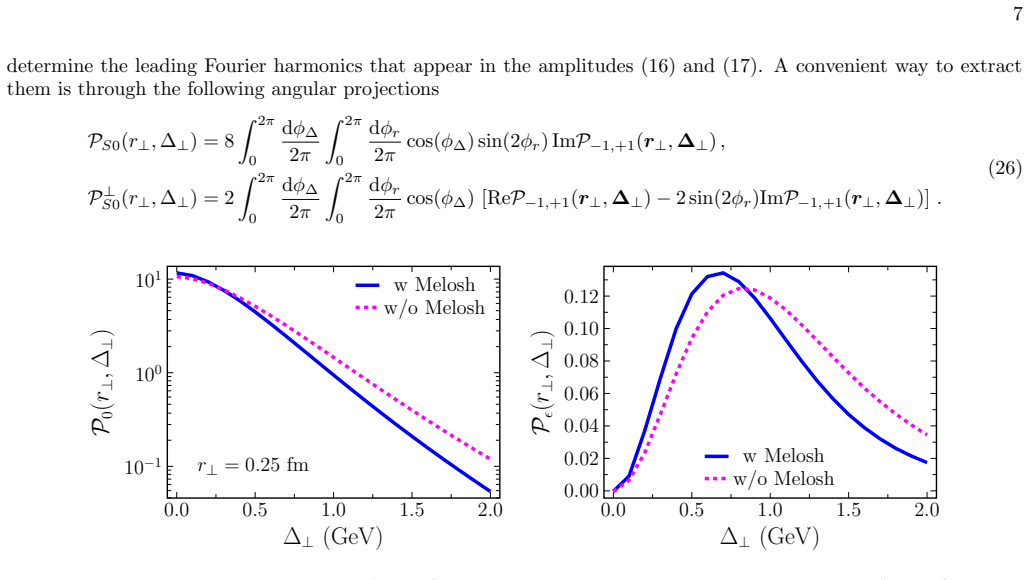
- [Sec. V, Eq. (26)] The angular projection for P_perp_S0 does not isolate the function P_perp_S defined in Eq. (4). For the helicity combination used in Eq. (26), namely P_{-1,+1}, Eq. (4) gives, at leading Fourier order, P_{-1,+1} = -e^{-i phi_Delta} (PS0/2 + P_perp_S0) - (PS0/2) e^{-i(2 phi_r - phi_Delta)}. Substituting this into the second line of Eq. (26) yields P_perp_S0^{(extracted)} = -(PS0 + P_perp_S0), not P_perp_S0. The first line of Eq. (26) does correctly return PS0. The failure is visible in simple limits: if PS0 = 0, the second projection gives -P_perp_S0, and if P_perp_S0 = 0, it gives -PS0. Consequently, the quantity labeled P_perp_S0 in Fig. 2 is a combination of both spin-dependent functions, and the plotted ratios v_perp_S and vS + 2 v_perp_S do not correspond to the functions appearing in the amplitudes (17). If the authors intended to use the opposite helicity amplitude P_{+1,-1}, the same projection (26) is correct; as written, the extraction is wrong.
- [Sec. V, Fig. 2 and Sec. VI] Because the numerical estimate of the proton-helicity-flip contribution relies on the misidentified P_perp_S0, the claim that vS + 2 v_perp_S can reach approximately 15% at Delta_perp ~ 1-2 GeV is not supported by the paper as written. This number is the only quantitative support for the abstract's statement that the spin-dependent Pomeron could be discovered via double spin asymmetries. The corrected extraction should be implemented, the figures recomputed, and the corresponding statements in Secs. V and VI and the abstract updated. The analytic amplitudes in Eqs. (16)-(20) are not affected by this numerical error, but the numerical conclusions are.
minor comments (4)
- [Sec. V, Eq. (23)] The value alpha_s = 0.35 is chosen with no explicit scale or uncertainty estimate; a brief comment on the scale choice and its sensitivity would help the reader assess the robustness of the numerical results.
- [Fig. 1 and Fig. 2] The axis labels 'w Melosh' and 'w/o Melosh' are informal; spell out 'with/without Melosh rotation' in the legends, and define all plotted quantities in the caption, especially after the corrected extraction is implemented.
- [Sec. VI] The paper states that numerical estimates for EIC kinematics are deferred to future work, but the abstract claims the effect could be discovered via double spin asymmetries; a rough rate or asymmetry estimate for EIC kinematics would make the discovery claim more concrete.
- [Secs. III-IV] The notation PS and P_perp_S is sometimes used interchangeably with their leading Fourier components PS0 and P_perp_S0; a short table defining the scalar functions and the Fourier truncation would remove ambiguity.
Circularity Check
No significant circularity: the analytic derivation is self-contained and the numerical estimate is fitted to external electromagnetic observables, not to the predicted asymmetry.
full rationale
The claimed derivation chain is not circular in the sense of this review. The eikonal amplitudes (16)-(20) follow from the BFKL formula (1), the general helicity-flip parametrization (4) taken from independent references [8,9,27], and the photon-vector-meson overlaps of App. A; the Δ⊥ power counting is an algebraic consequence of Bessel-function expansions, not of a fitted parameter. The numerical model in Sec. V computes G2,ΛΛ' via Eqs. (23)-(25) with the Schlumpf wave function whose parameters m_q=0.26 GeV and β=0.55 GeV were tuned to electromagnetic radii and anomalous magnetic moments, i.e. to external static properties, not to the exclusive J/ψ cross section or to PS/P⊥S; thus the quoted vS and vS+2v⊥S ratios are not fitted inputs renamed as predictions. The self-citations (e.g. refs. [25,47,49,51,65]) supply the color-charge correlator framework and earlier quark-model technology, but the proton-helicity-flip overlap and the SDP amplitudes are newly computed here and are not imported as a black-box uniqueness result. No load-bearing step reduces an output to an input by construction. A separate technical caveat flagged in the review is that the second projection in Eq. (26) does not appear to isolate P⊥S as labeled: substituting Eq. (4) for P_{-1,+1} gives, for the leading harmonics, extracted P⊥S0 = -(PS+P⊥S) rather than P⊥S (the first projection does return PS). This is an internal self-consistency/correctness issue in Sec. V that undermines the numerical ratios as stated, but it is not an input-output circularity, so per the hard rules it does not increase the circularity score.
Assumptions & free parameters
free parameters (3)
- alpha_s =
0.35
- quark mass m_q =
0.26 GeV
- wavefunction parameter beta =
0.55 GeV
assumptions (6)
- domain assumption Eikonal factorization of the exclusive amplitude into a Wilson-line dipole amplitude P_{ΛΛ'} and a photon-vector meson overlap A_{λ̄λ} (Eqs. (1)-(3)).
- domain assumption The general parametrization of P_{ΛΛ'} in Eq. (4) with three real scalar functions P, P_S, P^⊥_S, from ref. [8].
- domain assumption Leading-twist collinear identification E_g ∼ P_S0 + 2P^⊥_S0 (Sec. IV, App. C), from refs. [9,10,27].
- domain assumption Higher Fourier harmonics of the Pomeron beyond P_0, P_ϵ, P_S0, P^⊥_S0 are power suppressed and neglected (Sec. II).
- domain assumption Two-gluon exchange approximation for the numerical Pomeron amplitude, Eq. (23), with fixed alpha_s, rather than a full BFKL resummed amplitude.
- domain assumption Schlumpf light-front constituent quark model with Melosh-transformed helicity wave functions (App. B, Eq. (B3)).
Cite this review
Pith. "Pith review of Off forward non-SCHC contributions to exclusive vector quarkonium production from the "spin dependent BFKL Pomeron"." pith.science (2026). https://pith.science/paper/GB5HOMIE
@misc{pith2026250602184,
  author       = {Pith},
  title        = {Pith review of: Off forward non-SCHC contributions to exclusive vector quarkonium production from the "spin dependent BFKL Pomeron"},
  year         = {2026},
  howpublished = {\url{https://pith.science/paper/GB5HOMIE}},
  note         = {Machine review of arXiv:2506.02184}
}
abstract
A novel contribution to off-forward, exclusive vector quarkonium production, $\gamma^{(*)}+p \to V+p$, at high energy is derived which corresponds to a $t$-channel exchange of a BFKL hard Pomeron, with a helicity flip of the proton. This ``spin-dependent BFKL Pomeron" is required in a consistent expansion in powers of the momentum transfer $ t \approx -\Delta_\perp^2$ beyond first order. The spin-dependent Pomeron violates $s$-channel helicity conservation (SCHC) at ${\cal O}(\Delta_\perp^2)$, and beyond. Expanding to leading twist only, it corresponds to GPD $E_g(x,t)$ for vanishing skewness. We derive explicit expressions for the eikonal BFKL amplitudes, to all orders in dipole size times momentum transfer, for all helicity configurations of the particles in the initial and final states. We also provide numerical estimates of the helicity flip two gluon exchange amplitude at moderate $x$ from a light-cone quark model of the proton. The spin dependent BFKL Pomeron could, in principle, be discovered via double spin asymmetries in $e+p \to e+p+J/\psi$ with transversely polarized proton and longitudinally polarized electron in the initial state.
Figures

Reference graph
Works this paper leans on
-
[1]
L. N. Lipatov, Reggeization of the Vector Meson and the Vacuum Singularity in Nonabelian Gauge Theories, Sov. J. Nucl. Phys. 23, 338 (1976)
work page 1976
-
[2]
E. A. Kuraev, L. N. Lipatov, and V. S. Fadin, The Pomeranchuk Singularity in Nonabelian Gauge Theories, Sov. Phys. JETP 45, 199 (1977)
work page 1977
-
[3]
I. I. Balitsky and L. N. Lipatov, The Pomeranchuk Singularity in Quantum Chromodynamics, Sov. J. Nucl. Phys. 28, 822 (1978)
work page 1978
-
[4]
A. H. Mueller, Soft gluons in the infinite momentum wave function and the BFKL pomeron, Nucl. Phys. B 415, 373 (1994)
work page 1994
-
[5]
I. P. Ivanov, N. N. Nikolaev, and A. A. Savin, Diffractive vector meson production at HERA: From soft to hard QCD, Phys. Part. Nucl. 37, 1 (2006), arXiv:hep-ph/0501034
arXiv 2006
-
[6]
J. Nemchik, N. N. Nikolaev, and B. G. Zakharov, Scanning the BFKL pomeron in elastic production of vector mesons at HERA, Phys. Lett. B 341, 228 (1994), arXiv:hep-ph/9405355
arXiv 1994
-
[7]
E. V. Kuraev, N. N. Nikolaev, and B. G. Zakharov, Diffractive vector mesons beyond the s channel helicity conservation, JETP Lett. 68, 696 (1998), arXiv:hep-ph/9809539
work page Pith review arXiv 1998
-
[8]
Probing the Sivers function with an unpolarized target: GTMD distributions and the Odderons
R. Boussarie, Y. Hatta, L. Szymanowski, and S. Wallon, Probing the Gluon Sivers Function with an Unpolarized Target: GTMD Distributions and the Odderons, Phys. Rev. Lett. 124, 172501 (2020), arXiv:1912.08182 [hep-ph]
work page Pith review arXiv 2020
Show all 67 references
-
[9]
Hagiwara, Y
Y. Hagiwara, Y. Hatta, R. Pasechnik, and J. Zhou, Spin-dependent Pomeron and Odderon in elastic proton-proton scat- tering, Eur. Phys. J. C 80, 427 (2020), arXiv:2003.03680 [hep-ph]
2020 arXiv
-
[10]
Hatta and J
Y. Hatta and J. Zhou, Small- x evolution of the gluon GPD Eg, Phys. Rev. Lett. 129, 252002 (2022), arXiv:2207.03378 [hep-ph]. 9
2022 arXiv
-
[11]
Agrawal, N
S. Agrawal, N. Vasim, and R. Abir, Spin-flip gluon generalized transverse-momentum-dependent parton distribution F1,2 at small x, Phys. Rev. D 109, 074039 (2024), arXiv:2312.04132 [hep-ph]
2024 arXiv
-
[12]
Chekanov et al
S. Chekanov et al. (ZEUS), Exclusive photoproduction of J / psi mesons at HERA, Eur. Phys. J. C 24, 345 (2002), arXiv:hep-ex/0201043
2002 arXiv
-
[13]
Aktas et al
A. Aktas et al. (H1), Elastic J/psi production at HERA, Eur. Phys. J. C 46, 585 (2006), arXiv:hep-ex/0510016
2006 arXiv
-
[14]
Acharya et al
S. Acharya et al. (ALICE), First polarisation measurement of coherently photoproduced J/ ψ in ultra-peripheral Pb −Pb collisions at √sNN = 5.02 TeV (2023), arXiv:2304.10928 [nucl-ex]
2023 arXiv
-
[15]
L. Massacrier (ALICE), Coherent J/ ψ photoproduction and polarization in peripheral Pb-Pb collisions with ALICE, in 58th Rencontres de Moriond on QCD and High Energy Interactions (2024) arXiv:2407.09707 [nucl-ex]
2024 arXiv
-
[16]
J. D. Brandenburg, H. Duan, Z. Tu, R. Venugopalan, and Z. Xu, Entanglement enabled intensity interferometry in ultrarelativistic ultraperipheral nuclear collisions, Phys. Rev. Res. 7, 013131 (2025), arXiv:2407.15945 [hep-ph]
2025 arXiv
-
[17]
Adamczyk et al
L. Adamczyk et al. (STAR), Single Spin Asymmetry AN in Polarized Proton-Proton Elastic Scattering at √s = 200 GeV, Phys. Lett. B 719, 62 (2013), arXiv:1206.1928 [nucl-ex]
2013 arXiv
-
[18]
M¨ antysaari, K
H. M¨ antysaari, K. Roy, F. Salazar, and B. Schenke, Gluon imaging using azimuthal correlations in diffractive scattering at the Electron-Ion Collider, Phys. Rev. D 103, 094026 (2021), arXiv:2011.02464 [hep-ph]
2021 arXiv
-
[19]
Kowalski, L
H. Kowalski, L. Motyka, and G. Watt, Exclusive diffractive processes at HERA within the dipole picture, Phys. Rev. D 74, 074016 (2006), arXiv:hep-ph/0606272
2006 arXiv
-
[20]
Armesto and A
N. Armesto and A. H. Rezaeian, Exclusive vector meson production at high energies and gluon saturation, Phys. Rev. D 90, 054003 (2014), arXiv:1402.4831 [hep-ph]
2014 arXiv
-
[21]
M¨ antysaari, F
H. M¨ antysaari, F. Salazar, and B. Schenke, Energy dependent nuclear suppression from gluon saturation in exclusive vector meson production, Phys. Rev. D 109, L071504 (2024), arXiv:2312.04194 [hep-ph]
2024 arXiv
-
[22]
Boer and C
D. Boer and C. Setyadi, Probing gluon GTMDs through exclusive coherent diffractive processes, Eur. Phys. J. C 83, 890 (2023), arXiv:2301.07980 [hep-ph]
2023 arXiv
-
[23]
Penttala and C
J. Penttala and C. Royon, Gluon saturation effects in exclusive heavy vector meson photoproduction, Phys. Lett. B 864, 139394 (2025), arXiv:2411.14815 [hep-ph]
2025 arXiv
-
[24]
Hatta, B.-W
Y. Hatta, B.-W. Xiao, and F. Yuan, Gluon Tomography from Deeply Virtual Compton Scattering at Small-x, Phys. Rev. D 95, 114026 (2017), arXiv:1703.02085 [hep-ph]
2017 arXiv
-
[25]
Dumitru, H
A. Dumitru, H. M¨ antysaari, and R. Paatelainen, Color charge correlations in the proton at NLO: Beyond geometry based intuition, Phys. Lett. B 820, 136560 (2021), arXiv:2103.11682 [hep-ph]
2021 arXiv
-
[26]
Hwang, Study of quark distribution amplitudes of 1S and 2S heavy quarkonium states, Eur
C.-W. Hwang, Study of quark distribution amplitudes of 1S and 2S heavy quarkonium states, Eur. Phys. J. C 62, 499 (2009), arXiv:0811.0648 [hep-ph]
2009 arXiv
-
[27]
Koempel, P
J. Koempel, P. Kroll, A. Metz, and J. Zhou, Exclusive production of quarkonia as a probe of the GPD E for gluons, Phys. Rev. D 85, 051502 (2012), arXiv:1112.1334 [hep-ph]
2012 arXiv
-
[28]
Bessidskaia Bylund, M
O. Bessidskaia Bylund, M. Defurne, and P. A. M. Guichon, Recoil proton polarization: A new discriminative observable for deeply virtual Compton scattering, Phys. Rev. D 107, 014020 (2023), arXiv:2209.04313 [hep-ph]
2023 arXiv
-
[29]
A. E. Dorokhov, N. I. Kochelev, and Y. A. Zubov, Proton spin within nonperturbative QCD, Int. J. Mod. Phys. A 8, 603 (1993)
1993
-
[30]
N. I. Kochelev, The Pauli form-factor of the quark induced by instantons, Phys. Lett. B 565, 131 (2003), arXiv:hep- ph/0304171
2003
-
[31]
Kochelev, H.-J
N. Kochelev, H.-J. Lee, B. Zhang, and P. Zhang, Gluonic Structure of the Constituent Quark, Phys. Lett. B 757, 420 (2016), arXiv:1512.03863 [hep-ph]
2016 arXiv
-
[32]
Zhang, A
B. Zhang, A. Radzhabov, N. Kochelev, and P. Zhang, Pauli form factor of quark and nontrivial topological structure of the QCD, Phys. Rev. D 96, 054030 (2017), arXiv:1703.04333 [hep-ph]
2017 arXiv
-
[33]
Shuryak and I
E. Shuryak and I. Zahed, Hadronic structure on the light front. I. Instanton effects and quark-antiquark effective potentials, Phys. Rev. D 107, 034023 (2023), arXiv:2110.15927 [hep-ph]
2023 arXiv
-
[34]
Shuryak and I
E. Shuryak and I. Zahed, Hadronic structure on the light front. IV. Heavy and light baryons, Phys. Rev. D 107, 034026 (2023), arXiv:2202.00167 [hep-ph]
2023 arXiv
-
[35]
Miesch, E
N. Miesch, E. Shuryak, and I. Zahed, Baryons and tetraquarks using instanton-induced interactions, Phys. Rev. D 109, 014022 (2024), arXiv:2308.05638 [hep-ph]
2024 arXiv
-
[36]
Tarasov and R
A. Tarasov and R. Venugopalan, Role of the chiral anomaly in polarized deeply inelastic scattering. II. Topological screening and transitions from emergent axionlike dynamics, Phys. Rev. D 105, 014020 (2022), arXiv:2109.10370 [hep-ph]
2022 arXiv
-
[37]
Tarasov and R
A. Tarasov and R. Venugopalan, Role of the chiral anomaly in polarized deeply inelastic scattering. III. Wess-Zumino- Witten contributions and chiral Ward identities for finite quark mass, Phys. Rev. D 111, 074027 (2025), arXiv:2501.10519 [hep-ph]
2025 arXiv
-
[38]
Schlumpf, Relativistic constituent quark model of electroweak properties of baryons, Phys
F. Schlumpf, Relativistic constituent quark model of electroweak properties of baryons, Phys. Rev. D 47, 4114 (1993), [Erratum: Phys.Rev.D 49, 6246 (1994)], arXiv:hep-ph/9212250
1993 arXiv
-
[39]
S. J. Brodsky and F. Schlumpf, Wave function independent relations between the nucleon axial coupling g(A) and the nucleon magnetic moments, Phys. Lett. B 329, 111 (1994), arXiv:hep-ph/9402214
1994 arXiv
-
[40]
G. A. Miller, Charge Density of the Neutron, Phys. Rev. Lett. 99, 112001 (2007), arXiv:0705.2409 [nucl-th]
2007 arXiv
-
[41]
Ji, J.-P
X.-d. Ji, J.-P. Ma, and F. Yuan, Three quark light cone amplitudes of the proton and quark orbital motion dependent observables, Nucl. Phys. B 652, 383 (2003), arXiv:hep-ph/0210430
2003 arXiv
-
[42]
Pasquini, S
B. Pasquini, S. Cazzaniga, and S. Boffi, Transverse momentum dependent parton distributions in a light-cone quark model, Phys. Rev. D 78, 034025 (2008), arXiv:0806.2298 [hep-ph]
2008 arXiv
-
[43]
Pasquini and F
B. Pasquini and F. Yuan, Sivers and Boer-Mulders functions in Light-Cone Quark Models, Phys. Rev. D81, 114013 (2010), 10 arXiv:1001.5398 [hep-ph]
2010 arXiv
-
[44]
Chakrabarti, C
D. Chakrabarti, C. Mondal, A. Mukherjee, S. Nair, and X. Zhao, Gravitational form factors and mechanical properties of proton in a light-front quark-diquark model, Phys. Rev. D 102, 113011 (2020), arXiv:2010.04215 [hep-ph]
2020 arXiv
-
[45]
Choudhary, B
P. Choudhary, B. Gurjar, D. Chakrabarti, and A. Mukherjee, Gravitational form factors and mechanical properties of the proton: Connections between distributions in 2D and 3D, Phys. Rev. D 106, 076004 (2022), arXiv:2206.12206 [hep-ph]
2022 arXiv
-
[46]
S. Nair, C. Mondal, S. Xu, X. Zhao, A. Mukherjee, and J. P. Vary (BLFQ), Gravitational form factors and mechanical prop- erties of quarks in protons: A basis light-front quantization approach, Phys. Rev. D 110, 056027 (2024), arXiv:2403.11702 [hep-ph]
2024 arXiv
-
[47]
Dumitru, G
A. Dumitru, G. A. Miller, and R. Venugopalan, Extracting many-body color charge correlators in the proton from exclusive DIS at large Bjorken x, Phys. Rev. D 98, 094004 (2018), arXiv:1808.02501 [hep-ph]
2018 arXiv
-
[48]
Dumitru and T
A. Dumitru and T. Stebel, Multiquark matrix elements in the proton and three gluon exchange for exclusive ηc production in photon-proton diffractive scattering, Phys. Rev. D 99, 094038 (2019), arXiv:1903.07660 [hep-ph]
2019 arXiv
-
[49]
Dumitru, V
A. Dumitru, V. Skokov, and T. Stebel, Subfemtometer scale color charge correlations in the proton, Phys. Rev. D 101, 054004 (2020), arXiv:2001.04516 [hep-ph]
2020 arXiv
-
[50]
Y. Yang, T. Liu, and B.-Q. Ma, Six-dimensional light-front Wigner distributions of the proton, Eur. Phys. J. C 85, 504 (2025), arXiv:2505.06615 [hep-ph]
2025 arXiv
-
[51]
Dumitru, H
A. Dumitru, H. M¨ antysaari, and Y. Tawabutr, Polarized dipole scattering amplitudes meet the valence quark model, Phys. Rev. D 110, 054030 (2024), arXiv:2407.08893 [hep-ph]
2024 arXiv
-
[52]
S. J. Brodsky and G. R. Farrar, Scaling Laws for Large Momentum Transfer Processes, Phys. Rev. D 11, 1309 (1975)
1975
-
[53]
A. V. Belitsky, X.-d. Ji, and F. Yuan, A Perturbative QCD analysis of the nucleon’s Pauli form-factor F(2)(Q**2), Phys. Rev. Lett. 91, 092003 (2003), arXiv:hep-ph/0212351
2003 arXiv
-
[54]
B. G. Zakharov, Quark - Diquark Model of Nucleon and Properties of Pomeron and Odderon N NScattering Amplitudes in QCD Born Approximation. (In Russian), Sov. J. Nucl. Phys. 49, 860 (1989)
1989
-
[55]
B. Z. Kopeliovich and B. G. Zakharov, Spin - Flip Component of the Pomeron, Phys. Lett. B 226, 156 (1989)
1989
-
[56]
Ma and I
B.-Q. Ma and I. Schmidt, The Quark orbital angular momentum in a light cone representation, Phys. Rev. D 58, 096008 (1998), arXiv:hep-ph/9808202
1998 arXiv
-
[57]
Frankfurt, W
L. Frankfurt, W. Koepf, and M. Strikman, Diffractive heavy quarkonium photoproduction and electroproduction in QCD, Phys. Rev. D 57, 512 (1998), arXiv:hep-ph/9702216
1998 arXiv
-
[58]
D. Y. Ivanov, A. Schafer, L. Szymanowski, and G. Krasnikov, Exclusive photoproduction of a heavy vector meson in QCD, Eur. Phys. J. C 34, 297 (2004), [Erratum: Eur.Phys.J.C 75, 75 (2015)], arXiv:hep-ph/0401131
2004 arXiv
-
[59]
J. P. Lansberg, L. Massacrier, L. Szymanowski, and J. Wagner, Single-Transverse-Spin Asymmetries in Exclusive Photo- production of J/ψ in Ultra-Peripheral Collisions in the Fixed-Target Mode at the LHC and in the Collider Mode at RHIC, Phys. Lett. B 793, 33 (2019), arXiv:1812....
2019 arXiv
-
[60]
However, as we have pointed out, single target spin asymmetries vanish in the eikonal limit, i.e
and/or the LHC [61, 62]. However, as we have pointed out, single target spin asymmetries vanish in the eikonal limit, i.e. they are suppressed by powers of energy and may be difficult to access experimentally in high-energy collider experiments. Our proposal is to consider dou...
2024
-
[61]
Aschenauer et al
E.-C. Aschenauer et al. (RHIC SPIN), The RHIC Cold QCD Program (2023), arXiv:2302.00605 [nucl-ex]
2023 arXiv
-
[62]
Hadjidakis et al., A fixed-target programme at the LHC: Physics case and projected performances for heavy-ion, hadron, spin and astroparticle studies, Phys
C. Hadjidakis et al., A fixed-target programme at the LHC: Physics case and projected performances for heavy-ion, hadron, spin and astroparticle studies, Phys. Rept. 911, 1 (2021), arXiv:1807.00603 [hep-ex]
2021 arXiv
-
[63]
Accardi et al
A. Accardi et al. (LHCspin), LHCspin: a Polarized Gas Target for LHC (2025), arXiv:2504.16034 [hep-ex]
2025 arXiv
-
[64]
Zhou, Transverse single spin asymmetries at small x and the anomalous magnetic moment, Phys
J. Zhou, Transverse single spin asymmetries at small x and the anomalous magnetic moment, Phys. Rev. D 89, 074050 (2014), arXiv:1308.5912 [hep-ph]
2014 arXiv
-
[65]
Y. V. Kovchegov and M. G. Santiago, Quark sivers function at small x: spin-dependent odderon and the sub-eikonal evolution, JHEP 11, 200, [Erratum: JHEP 09, 186 (2022)], arXiv:2108.03667 [hep-ph]
2022 arXiv
-
[66]
Benic, A
S. Benic, A. Dumitru, L. Motyka, and T. Stebel, Gluon Sivers function from forward exclusive χc1 photoproduction on unpolarized protons, Phys. Rev. D 111, 054008 (2025), arXiv:2407.04968 [hep-ph]. Appendix A: Photon-vector meson overlaps The light-cone wave function γ − V over...
2025 arXiv
-
[67]
l and l′ represent on-shell momenta with l− = l′− = zq −
The VM polarization is Eµ(¯λ = 0, ∆) = 1 MV ∆µ − MV ∆− nµ , E µ(¯λ = ±1, ∆) = ϵ¯λ ⊥ · ∆⊥ ∆− , 0, ϵ ¯λ ⊥ ! , (A3) 11 where MV is the VM mass. l and l′ represent on-shell momenta with l− = l′− = zq −. The traces Aλ¯λ(l⊥, l1⊥, z) evaluate to Aλ=±1,¯λ=0(l⊥, l1⊥, z) = −4MV z ¯z(z −...
Reviewed August 7, 2026 · model on record in the stance chip above.
Discussion (0). Sign in to comment.