Reconfigurable Strain Gradient Polarity in Crystalline Oxide Nanomembranes for Controlled Bending of Functional Materials
Pith reviewed 2026-06-27 12:14 UTC · model grok-4.3
The pith
A switchable bistable nanodrum in oxide nanomembranes provides reconfigurable strain gradient polarities.
A machine-rendered reading of the paper's core claim, the machinery that carries it, and where it could break.
Core claim
The central claim is that a fabricated switchable bistable nanodrum in crystalline oxide nanomembranes allows access to local strain gradients with opposite polarities, supporting strain variations from 0.01% to 1% by using epitaxial strain and boundary condition control.
What carries the argument
The switchable bistable nanodrum in the bubble geometry, which sustains and switches the polarity of strain gradients.
If this is right
- The device supports strain gradients with strain variation ranging from 0.01% to 1%.
- Switching energetics can be designed to configure the bubble morphology.
- The platform provides a mechanical framework for sustained strain gradients.
- This supports scalable oxide membrane applications such as the mechanical manipulation of magnetism coupled to local probes.
Where Pith is reading between the lines
- If the polarity switching works reliably, it could enable dynamic tuning of material properties in response to strain.
- The method may be extended to other crystalline oxides for similar strain engineering.
- This could facilitate integration with local probe techniques for studying strain effects in real time.
Load-bearing premise
Epitaxial strain can be leveraged as a reliable source of pre-strain and that geometrical and mechanical boundary conditions can be controlled sufficiently to produce a stable, switchable bistable nanodrum with opposite strain gradient polarities.
What would settle it
Experimental observation that the nanodrum does not switch between states with opposite strain gradient polarities or does not achieve strain variations in the 0.01% to 1% range would falsify the central claim.
Figures
read the original abstract
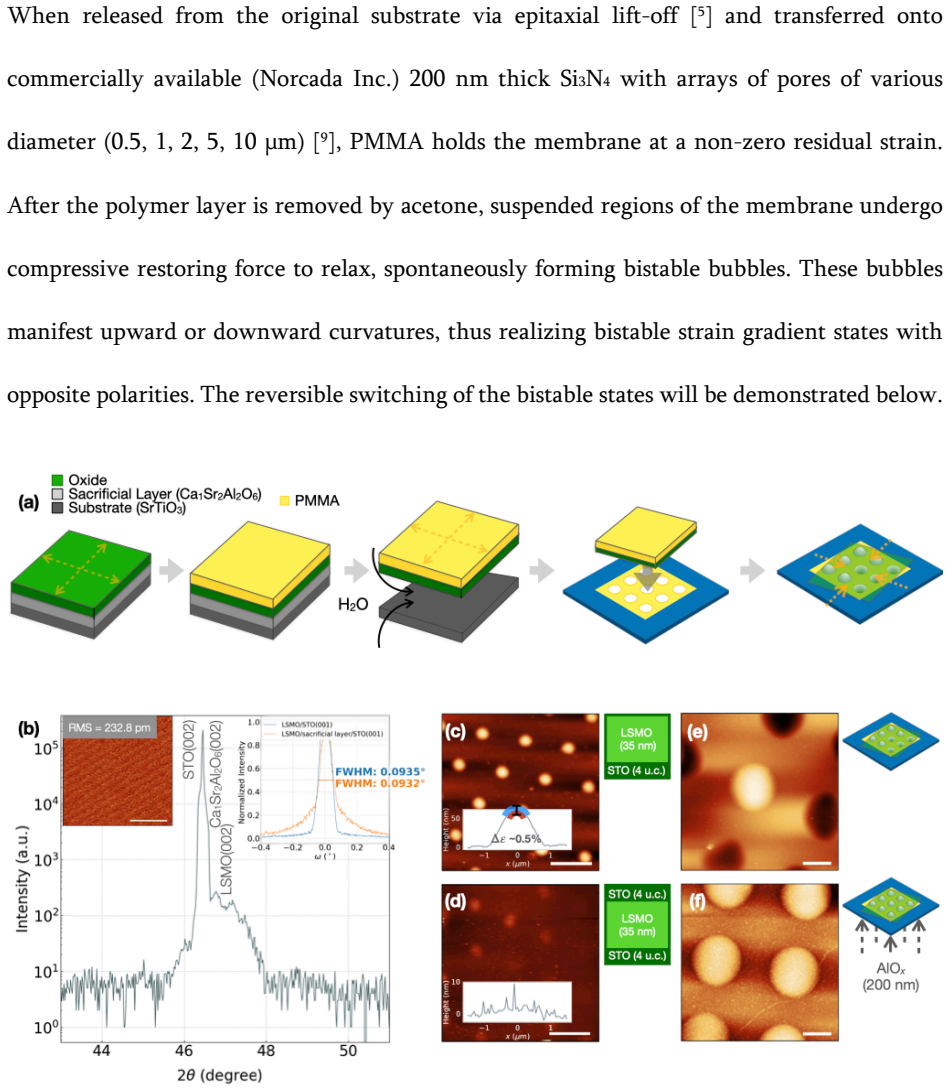
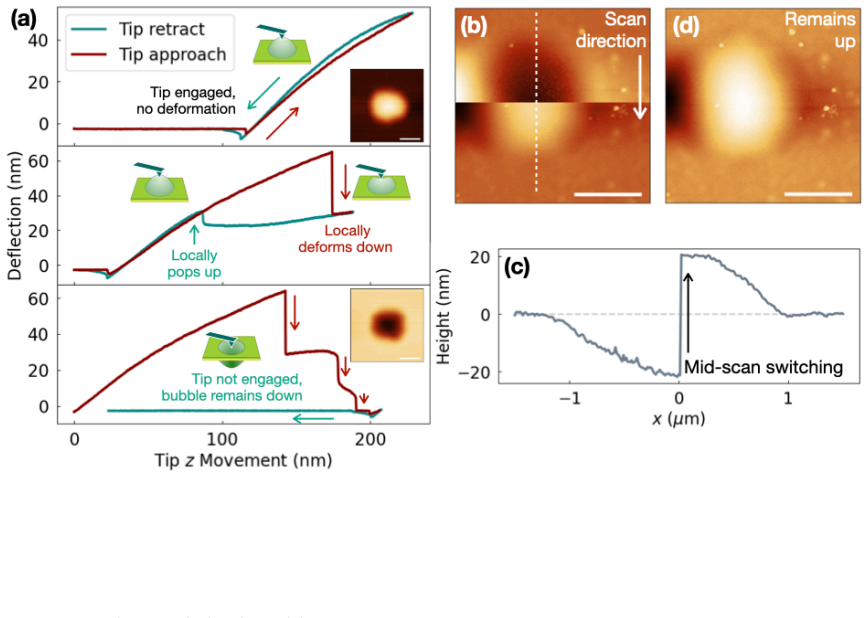
We report the fabrication and mechanical characterization of a "bubble" geometry for accessing local strain gradients using freestanding, single-crystalline manganite nanomembranes: a switchable bistable nanodrum, with opposite strain gradient polarities. By leveraging epitaxial strain as a source of pre-strain and with control of geometrical and mechanical boundary conditions, the fabricated device can support strain gradients with strain variation ranging from 0.01% to 1%. Switching energetics can be designed to configure the bubble morphology. By providing a mechanical framework for sustained strain gradients, this platform supports scalable oxide membrane applications such as the mechanical manipulation of magnetism, coupled to local probes.
Editorial analysis
A structured set of objections, weighed in public.
Referee Report
Summary. The manuscript reports the fabrication and mechanical characterization of a switchable bistable nanodrum geometry in freestanding single-crystalline manganite nanomembranes. By leveraging epitaxial strain as pre-strain and controlling geometrical and mechanical boundary conditions, the device is claimed to sustain strain gradients with variations ranging from 0.01% to 1%, with switchable opposite polarities. Switching energetics can be designed to configure bubble morphology, providing a platform for applications such as mechanical manipulation of magnetism in scalable oxide membrane devices.
Significance. If the experimental results hold with supporting data, this work establishes a mechanical framework for sustained and reconfigurable strain gradients in crystalline oxide nanomembranes. It enables controlled access to local strain states that could couple to functional properties like magnetism, offering a scalable approach beyond traditional epitaxial methods. The demonstration of bistable switching via boundary condition design is a potentially enabling advance for strain-based device concepts.
major comments (2)
- [Abstract and Results] The abstract states fabrication and mechanical characterization results but supplies no data, error bars, methods details, or verification steps. The central claim that the device supports strain gradients with 0.01–1% variation cannot be evaluated for support from the provided text; the results section must include explicit strain maps, measurement protocols, and stability data to substantiate the range and bistability.
- [Fabrication and Mechanical Characterization] The weakest assumption—that epitaxial strain serves as a reliable pre-strain source and that geometrical/mechanical boundary conditions can be controlled sufficiently for a stable, switchable bistable nanodrum—is load-bearing for the polarity-switching claim. The manuscript should provide direct evidence (e.g., time-dependent strain measurements or boundary condition characterization) to rule out relaxation or instability.
Simulated Author's Rebuttal
We thank the referee for their constructive comments. We address each major comment below and indicate where revisions have been made to the manuscript.
read point-by-point responses
-
Referee: [Abstract and Results] The abstract states fabrication and mechanical characterization results but supplies no data, error bars, methods details, or verification steps. The central claim that the device supports strain gradients with 0.01–1% variation cannot be evaluated for support from the provided text; the results section must include explicit strain maps, measurement protocols, and stability data to substantiate the range and bistability.
Authors: We agree that the abstract is a high-level summary and does not contain detailed data or methods. The full results section of the manuscript already presents explicit strain maps, measurement protocols, and stability data that support the 0.01–1% strain variation and bistability. To improve accessibility, we have added a brief reference in the abstract to the relevant figures and methods where these supporting data are shown. revision: yes
-
Referee: [Fabrication and Mechanical Characterization] The weakest assumption—that epitaxial strain serves as a reliable pre-strain source and that geometrical/mechanical boundary conditions can be controlled sufficiently for a stable, switchable bistable nanodrum—is load-bearing for the polarity-switching claim. The manuscript should provide direct evidence (e.g., time-dependent strain measurements or boundary condition characterization) to rule out relaxation or instability.
Authors: The manuscript already includes direct evidence addressing this point. Time-dependent strain measurements and boundary condition characterizations are reported in the results section and supplementary information, confirming the stability of the epitaxial pre-strain and the absence of significant relaxation over the relevant timescales. These data support the switchable bistability under the designed geometrical and mechanical boundary conditions. revision: no
Circularity Check
No significant circularity; experimental fabrication report
full rationale
The manuscript is an experimental fabrication and mechanical characterization study of a switchable bistable nanodrum in freestanding manganite nanomembranes. It reports achieved strain gradients (0.01–1 %) via epitaxial pre-strain and boundary-condition design, with no equations, derivations, fitted parameters presented as predictions, or load-bearing theoretical steps. No self-citations, ansatzes, or uniqueness theorems are invoked in the provided abstract or described claims. The central results rest on direct fabrication outcomes and measurements rather than any reduction to inputs by construction.
Axiom & Free-Parameter Ledger
Reference graph
Works this paper leans on
-
[1]
J., Wang, B., Ziegler, J
Conley, H. J., Wang, B., Ziegler, J. I., Haglund, R. F., Pantelides, S. T. & Bolotin, K. I., Bandgap Engineering of Strained Monolayer and Bilayer MoS2. Nano Lett. 13, 3626–3630 (2013). 2. Hong, S. S., Gu, M., Verma, M., Harbola, V ., Wang, B. Y ., Lu, D., Vailionis, A., Hikita, Y ., Pentcheva, R., Rondinelli, J. M. & Hwang, H. Y ., Extreme tensile strain...
2013
-
[2]
A., Watanabe, K., Taniguchi, T., Ertekin, E., Huang, P
Han, E., Yu, J., Annevelink, E., Son, J., Kang, D. A., Watanabe, K., Taniguchi, T., Ertekin, E., Huang, P. Y . & Van Der Zande, A. M., Ultrasoft slip-mediated bending in few-layer graphene. Nat. Mater. 19, 305–309 (2020). 9. Harbola, V ., Crossley, S., Hong, S. S., Lu, D., Birkhölzer, Y . A., Hikita, Y . & Hwang, H. Y ., Strain Gradient Elasticity in SrTi...
2020
-
[3]
J., Tchernyshyov, O., Hicks, C
Ikhlas, M., Dasgupta, S., Theuss, F., Higo, T., Kittaka, S., Ramshaw, B. J., Tchernyshyov, O., Hicks, C. W. & Nakatsuji, S., Piezomagnetic switching of the anomalous Hall effect in an antiferromagnet at room temperature. Nat. Phys. 18, 1086–1093 (2022). 16. Du, D., Manzo, S., Zhang, C., Saraswat, V ., Genser, K. T., Rabe, K. M., V oyles, P. M., Arnold, M....
2022
-
[4]
Guo, D., Guo, P., Ren, L., Yao, Y ., Wang, W., Jia, M., Wang, Y ., Wang, L., Wang, Z. L. & Zhai, J., Silicon flexoelectronic transistors. Sci. Adv. 9, eadd3310 (2023). 24. Wang, L., Liu, S., Feng, X., Zhang, C., Zhu, L., Zhai, J., Qin, Y . & Wang, Z. L., Flexoelectronics of centrosymmetric semiconductors. Nat. Nanotechnol. 15, 661–667 (2020). 25. Sun, H.,...
2023
discussion (0)
Sign in with ORCID, Apple, or X to comment. Anyone can read and Pith papers without signing in.