REVIEW 3 major objections 4 minor 5 references
Skewness-Robust Causal Discovery in Location-Scale Noise Models
T0 review · 3 major / 4 minor · reviewed 2026-08-03 · deepseek-v4-flash
Pith's one-line read The paper claims that explicitly modeling skew-normal noise in location-scale noise models removes the failure mode of Gaussian LSNM estimators under skewed noise, and introduces SKEWD to do it.
desk verdict Useful, credible extension of LSNM causal discovery to skewed noise, but the headline claim is only fully supported by the independence-test variant; the likelihood scorer leans on a normal-marginal assumption that breaks on real benchmarks. read the letter →
The pith
A machine-rendered reading of the paper's core claim, the machinery that carries it, and where it could break.
The reading
What carries the argument
The key object is the skew-normal location-scale noise model, Y=f(X)+g(X)N with N~SN(0,1,λ), which makes the conditional Y|X=x skew-normal with location f(x), scale g(x), and shape λ. Because the skew-normal reduces to the normal when λ=0, this is a strict generalization of the Gaussian LSNM used by prior estimators, and identifiability follows from the known LSNM identifiability result except for a pathological differential-equation case. The estimation machinery is a penalized log-likelihood with B-spline bases for f and log g, optimized by Bayesian-tuned CMA-ES and refined by an ECM algorithm that treats the skew-normal as a normal with a latent variable; direction is decided by HSIC inde
What would settle it
Construct LSNM pairs with truly skew-normal noise and causes drawn from a clearly non-normal distribution, such as exponential or bimodal. If SKEWD-LL's direction accuracy collapses while SKEWD-IT stays high, the marginal-normality assumption is implicated; if both collapse, the skew-normal conditional fit is the problem. A direct check is whether replacing the assumed standard-normal marginal with a kernel density estimate restores accuracy on the Tübingen pairs.
Extended reading notes
Core claim
The central claim is that in the model Y=f(X)+g(X)N with independent noise N, replacing the usual normal assumption N~N(0,1) with skew-normal N~SN(0,1,λ) makes cause-effect inference reliable when the noise is asymmetric. SKEWD estimates f and g with penalized B-spline regressions and estimates λ jointly, using a CMA-ES heuristic refined by an ECM algorithm. Inference is then either HSIC-based independence testing on residual-cause pairs or joint likelihood scoring. The paper's key evidence is that SKEWD-LL reaches 100% accuracy on all six synthetic ANs/LSs datasets at skewness -0.455, 0.985, and 1.750, while LOCI-LL drops to 83%, 66%, and other lower values, and ROCHE degrades to 81% on the
Load-bearing premise
For the likelihood-scoring version, the assumption that standardized marginals of cause and effect are approximately standard normal is load-bearing; Proposition 1 proves this only when the true marginal is exactly normal, and the Tübingen accuracy of 45.97% for SKEWD-LL indicates real marginals can violate it.
Editorial extensions
If this is right
- If the central claim is right, Gaussian LSNM estimators such as LOCI should not be trusted on data with skewed noise; their residual-independence tests are systematically misspecified.
- Skewed noise in LSNMs is not a barrier to identifiability; explicitly modeling the skewness restores the asymmetry that makes the causal direction recoverable.
- The likelihood-scoring variant of SKEWD is, on synthetic skewed data, the strongest single configuration, while the independence-test variant is the safer choice on varied real-world benchmarks.
- The paper's new synthetic skewed-noise datasets provide a controlled benchmark on which future LSNM methods can be compared at specific skewness levels.
Reading between the lines
- Editorial inference: because the skew-normal distribution has a maximum skewness of about 0.995, SKEWD cannot exactly match the GNO(1.750) noise used in the highest-skewness datasets; its perfect accuracy there suggests the method exploits the asymmetric conditional shape rather than needing the exact noise family.
- Editorial inference: the stark gap between SKEWD-LL's 45.97% accuracy on the Tübingen benchmark and its perfect synthetic results points to the marginal-normality assumption as the load-bearing part; replacing the assumed standard-normal marginal with a nonparametric density estimate is a direct, testable extension.
- Editorial inference: the same penalized-B-spline-plus-ECM architecture could be extended to skew-t noise to cover heavy tails and skewness simultaneously, a direction the authors name as future work but do not pursue.
Editorial analysis
A structured set of objections, weighed in public.
Referee Report
Summary. The paper proposes SKEWD, a bivariate causal discovery method for location-scale noise models (LSNMs) with skew-normal noise. It models the location and scale functions via penalized B-splines, estimates parameters by a CMA-ES heuristic refined with an ECM algorithm, and performs cause-effect inference either by HSIC-based independence testing (SKEWD-IT) or by likelihood scoring that standardizes variables and neglects marginal log-likelihoods under a normality assumption (SKEWD-LL). The authors introduce synthetic ANs/LSs datasets with skew-normal and generalized-normal noise at skewness levels -0.455, 0.985, and 1.750, and evaluate on 13 established benchmarks. SKEWD-LL achieves 100% accuracy on all six synthetic settings; SKEWD-IT is competitive on benchmarks; SKEWD-LL is much weaker on the real-world Tübingen benchmark (45.97%). The paper concludes that SKEWD is the most reliable LSNM approach under high skewness and on par with state of the art elsewhere.
Significance. The paper addresses a real failure mode: skewed noise degrades Gaussian LSNM estimators, and the proposed skew-normal extension is natural. The empirical evidence on synthetic GNO noise, which is outside the skew-normal family, supports the claim of robustness at high skewness. The ECM ablation (Table 2) demonstrates that the refinement step is necessary, and the authors provide code for reproducibility. However, the headline claim is split: the likelihood variant's marginal-normality assumption is violated on real benchmarks, and the identifiability of the skew-normal LSNM is asserted rather than proven. If these gaps are fixed or the claims are appropriately qualified, the contribution would be a useful step for skew-robust causal discovery.
major comments (3)
- [Sec. 4 'Likelihood Scoring'; Appendix A 'Neglection of Marginal Log-Likelihoods'] The likelihood scoring variant assumes that after standardization the marginals are standard normal, so log p(x) and log p(y) cancel. Appendix A's Proposition 1 only establishes this convergence for samples drawn from a normal distribution. On the Tübingen benchmark, where marginals are non-normal, SKEWD-LL achieves 45.97% accuracy (Table 6), the lowest among LSNM baselines (ROCHE 77.27%, GRCI 81.59%). This contradicts the conclusion that SKEWD 'performs on par with SOTA' on established benchmarks for the likelihood variant. The authors list 'lifting the Gaussianity assumption of the marginals' as a limitation, but the conclusion still presents SKEWD as a single reliable method. Please either qualify the on-par claim to SKEWD-IT, or modify likelihood scoring to estimate marginal densities without the normality assumption.
- [Sec. 4 'Notes on Identifiability'; Theorem 1 in Appendix A] The paper states that general LSNM identifiability (Strobl and Lasko 2023; Immer et al. 2023) 'includes the skew-normal LSNM, so that identifiability should hold apart from pathological cases.' However, the cited theorem only gives a PDE condition; the authors do not verify that no skew-normal conditional densities solve this PDE. Since both likelihood scoring and independence testing require identifiability, this is a load-bearing assumption. Please provide a proof, or at least a systematic numerical verification over the skew-normal parameter range, that the non-identifiable ODE/PDE is not satisfied by the skew-normal LSNM.
- [Sec. 6 'Results for Established Benchmarks'; Table 6] The mean accuracy in Table 1 (77.43% for SKEWD-LL) is driven by high synthetic benchmarks; on the real-world Tübingen subset SKEWD-LL is at chance. Reporting a single mean across 13 benchmarks hides this failure mode. The paper's claim that SKEWD is 'performing on par with SOTA in other settings' (Sec. 1 and Sec. 7) is therefore not supported for SKEWD-LL. We recommend reporting per-benchmark comparisons with the likelihood and independence variants separated.
minor comments (4)
- [Appendix B, 'Ablation of the ECM Algorithm'] The text says 'We denote the corresponding cause-effect methods as CMA-ES-LL and CMA-ES-LL'; the second should be CMA-ES-IT.
- [Abstract and Fig. 2 caption] The method is inconsistently capitalized as 'SkewD' in the abstract and Fig. 2 caption, while the rest of the paper uses 'SKEWD'.
- [Sec. 2, Eq. (3)] The text says 'natural cubic B-splines' but the penalty matrices are based on second-order differences of B-spline coefficients (P-splines). Please clarify the spline basis and penalty relationship.
- [Appendix A, 'Generalized Normal'] The skewness formula for the GNO distribution uses both k and κ notation; please unify and ensure parentheses are correct in the displayed equation.
Circularity Check
No significant circularity: SkewD's procedures are evaluated rather than derived from their assumptions; in-family synthetic benchmarks and the normal-marginal assumption are scope caveats, not circular reductions.
full rationale
SkewD's derivation chain is self-contained. The paper proposes a skew-normal LSNM (Sec. 2, Eq. 3), estimates it by penalized ML with CMA-ES+ECM (Sec. 3), and makes causal decisions either by HSIC on residuals or by comparing joint likelihoods (Sec. 4). No step fits a parameter to the benchmark answer and then reports it as a prediction; the direction is chosen from the fitted models. The synthetic evaluation includes ε∼SN(0,1,λ), λ∈{-2,20} (Sec. 6), i.e., two of the six noise settings are inside SkewD's model class, so perfect accuracy there is partly an in-family check; the GNO settings with γ1≈1.75 (Sec. 6) are outside the skew-normal family, so the robustness claim is not logically forced by the model definition. The likelihood scorer's neglect of marginal log-likelihoods is an explicit assumption ('It further assumes that the marginal distributions of X and Y are normal distributions'), and the paper itself lists 'lifting the Gaussianity assumption of the marginals for the likelihood-based approach' as a limitation (Sec. 7); the weak Tübingen result (45.97%, Table 6) is evidence of that scope limitation, not of a circular reduction. Identifiability is cited to Strobl and Lasko (2023) and Immer et al. (2023); although the latter shares a coauthor (Marx), the theorem is a published external result and also independently stated by Strobl and Lasko, and SkewD's empirical claims do not reduce to it. Appendix A's Proposition 1 is a stated asymptotic approximation, and the marginal-neglect algebra uses the standardization identity ∑x_i²=n−1; even if Proposition 1 or the normal-marginal assumption is wrong, that is a correctness risk, not circularity. No equation in the paper is identical by construction to an input.
Assumptions & free parameters
free parameters (6)
- Noise shape parameter lambda =
Estimated by MLE/ECM; not reported per dataset
- Mean-function B-spline coefficients psi (q=14) =
Estimated by penalized MLE
- Scale-function B-spline coefficients rho (p=7) =
Estimated by penalized MLE
- Penalty strengths alpha, kappa =
Selected by Bayesian optimization on log-scale [-4,4]^2 with 8-fold CV
- B-spline dimensions q=14, p=7 =
q=14, p=7
- Stability bounds: rho in [-10,5]^p, lambda in [-25,25] =
rho bound [-10,5], lambda bound [-25,25]
assumptions (7)
- domain assumption Data arise from an LSNM: Y = f(X) + g(X)N with N independent of X and g > 0
- domain assumption The noise N follows a skew-normal distribution SN(0,1,lambda)
- domain assumption Identifiability theorem for general LSNMs applies to skew-normal LSNMs
- domain assumption After standardization, marginal distributions of X and Y are approximately N(0,1)
- domain assumption B-spline basis with second-order difference penalties is sufficiently flexible for f and g
- standard math HSIC independence test has power to detect residual dependence in the tested sample sizes
- domain assumption The CMA-ES + ECM optimization finds adequate global optima of the non-convex penalized likelihood
Cite this review
Pith. "Pith review of Skewness-Robust Causal Discovery in Location-Scale Noise Models." pith.science (2026). https://pith.science/paper/GBOELWT4
@misc{pith2026251114441,
  author       = {Pith},
  title        = {Pith review of: Skewness-Robust Causal Discovery in Location-Scale Noise Models},
  year         = {2026},
  howpublished = {\url{https://pith.science/paper/GBOELWT4}},
  note         = {Machine review of arXiv:2511.14441}
}
abstract
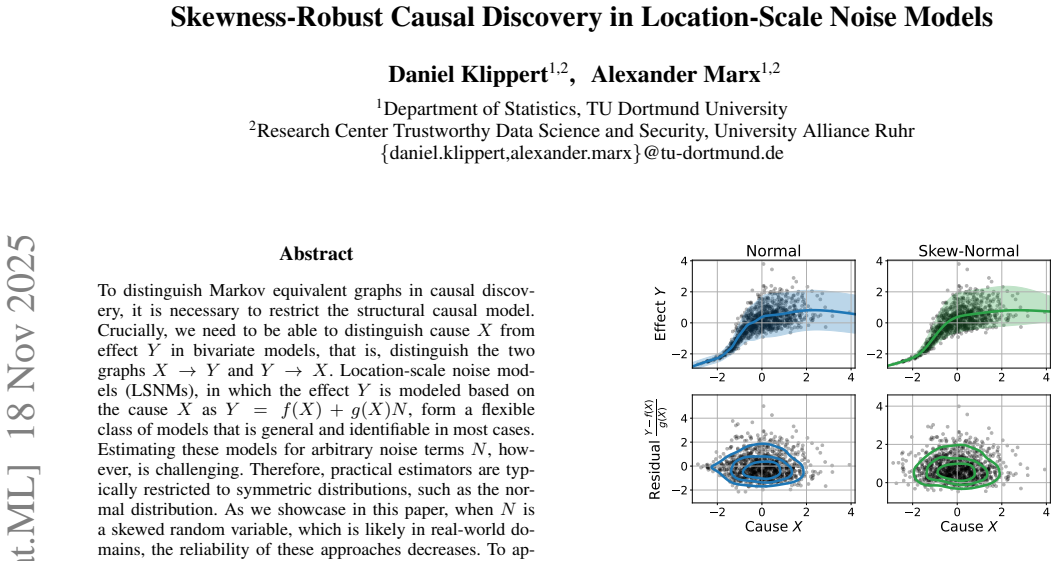
To distinguish Markov equivalent graphs in causal discovery, it is necessary to restrict the structural causal model. Crucially, we need to be able to distinguish cause $X$ from effect $Y$ in bivariate models, that is, distinguish the two graphs $X \to Y$ and $Y \to X$. Location-scale noise models (LSNMs), in which the effect $Y$ is modeled based on the cause $X$ as $Y = f(X) + g(X)N$, form a flexible class of models that is general and identifiable in most cases. Estimating these models for arbitrary noise terms $N$, however, is challenging. Therefore, practical estimators are typically restricted to symmetric distributions, such as the normal distribution. As we showcase in this paper, when $N$ is a skewed random variable, which is likely in real-world domains, the reliability of these approaches decreases. To approach this limitation, we propose SkewD, a likelihood-based algorithm for bivariate causal discovery under LSNMs with skewed noise distributions. SkewD extends the usual normal-distribution framework to the skew-normal setting, enabling reliable inference under symmetric and skewed noise. For parameter estimation, we employ a combination of a heuristic search and an expectation conditional maximization algorithm. We evaluate SkewD on novel synthetically generated datasets with skewed noise as well as established benchmark datasets. Throughout our experiments, SkewD exhibits a strong performance and, in comparison to prior work, remains robust under high skewness.
Figures


Figures from the paper (6 more)


Reference graph
Works this paper leans on
-
[100]
We also specified bounds for certain parameters for stability:ρ∈[−10,5] p andλ∈[−25,25]
The optimizer was set to terminate after a maximum of 5000 iterations or when the parameters barely changed within 25 iterations, specifically if||θ (k) −θ (k−25)||2 <10 −6. We also specified bounds for certain parameters for stability:ρ∈[−10,5] p andλ∈[−25,25]. The restriction onλhas a negligible effect on the skewness range, as the maximum absolute skew...
-
[2005]
InInternational Conference on Algorith- mic Learning Theory, 63–77
Measuring Statistical Dependence with Hilbert- Schmidt Norms. InInternational Conference on Algorith- mic Learning Theory, 63–77. Springer. Guyon, I.; Statnikov, A.; and Batu, B. B. 2019.Cause effect pairs in machine learning. Springer. Hansen, N. 2023. The CMA Evolution Strategy: A Tutorial. arXiv:1604.00772. Hansen, N.; and Ostermeier, A. 2001. Complete...
arXiv 2019
-
[2015]
InProceedings of the 18th Interna- tional Conference on Artificial Intelligence and Statistics, volume 38 ofJMLR Workshop and Conference Proceedings, 847–855
Inference of Cause and Effect with Unsupervised Inverse Regression. InProceedings of the 18th Interna- tional Conference on Artificial Intelligence and Statistics, volume 38 ofJMLR Workshop and Conference Proceedings, 847–855. Shimizu, S.; Hoyer, P. O.; Hyv¨arinen, A.; Kerminen, A.; and Jordan, M. 2006. A Linear Non-Gaussian Acyclic Model for Causal Disco...
2006
-
[2021]
InInternational Con- ference on Artificial Intelligence and Statistics, 3520–3528
Causal Autoregressive Flows. InInternational Con- ference on Artificial Intelligence and Statistics, 3520–3528. PMLR. Kozlov, V .; and Maysuradze, A. 2019. Parameter Estima- tion in a Three-Parameter Lognormal Distribution.Compu- tational Mathematics and Modeling, 30(3): 302–310. Kozubowski, T.; and Podgorski, K. 2000. A Multivariate and Asymmetric Genera...
arXiv 2019
-
[2024]
Order-Based Structure Learning with Normalizing Flows. arXiv:2308.07480. Karlis, D.; and Xekalaki, E. 2003. Choosing Initial Values for the EM Algorithm for Finite Mixtures.Computational Statistics & Data Analysis, 41(3-4): 577–590. Khemakhem, I.; Monti, R.; Leech, R.; and Hyvarinen, A
arXiv 2003
Reviewed August 3, 2026 · model on record in the stance chip above.
Discussion (0). Continue with ORCID to comment.