REVIEW 3 major objections 3 minor 42 references
Out-of-Distribution Detection in Molecular Complexes via Diffusion Models for Irregular Graphs
T0 review · 3 major / 3 minor · reviewed 2026-08-03 · deepseek-v4-flash
Pith's one-line read The paper claims that PF-ODE log-likelihoods and trajectory features from a single unsupervised diffusion model can identify held-out protein families as out-of-distribution and forecast the errors of an independent binding-affinity predict
desk verdict Useful diffusion-based OOD tool for 3D graphs, but the 'label-free' headline relies on a transductive setup that uses target-family OOD labels; fix the framing and the comparison. read the letter →
The pith
A machine-rendered reading of the paper's core claim, the machinery that carries it, and where it could break.
The reading
What carries the argument
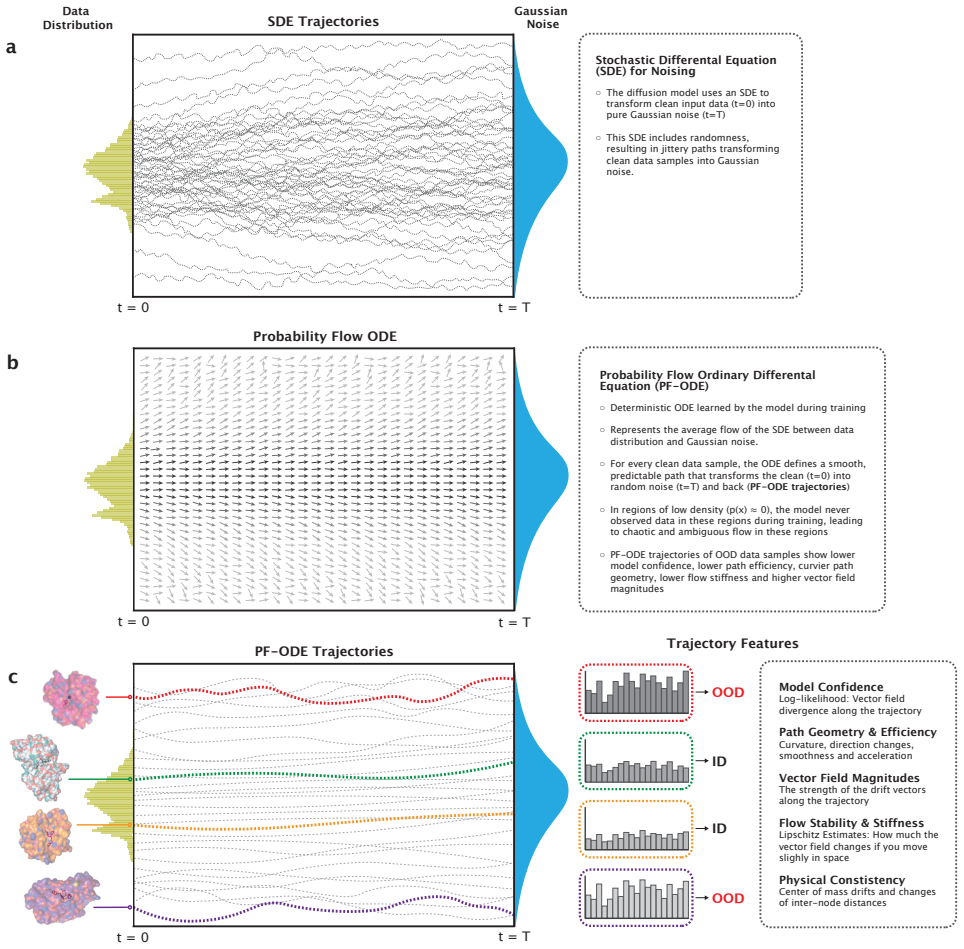
The key machinery is a unified continuous diffusion over the joint state of 3D coordinates and L2-normalized embeddings of discrete atom/residue types, with categorical denoising done by posterior-mean interpolation from softmax logits. This yields a single self-consistent probability-flow ODE (a deterministic ordinary differential equation whose marginals match the diffusion's noisy distributions at every time), and integrating the divergence of its drift along the trajectory gives an exact per-complex log-likelihood via the change-of-variables formula. The same integration supplies eighteen trajectory statistics—path tortuosity, vector-field magnitude and spikiness, Lipschitz stiffness, fl
What would settle it
Train the trajectory-aware LDR detector using OOD calibration complexes from one held-out protein family and test it on a second, structurally distinct held-out family without any re-calibration; if AUROC drops to chance, the method depends on family-specific calibration rather than a general OOD signature.
Extended reading notes
Core claim
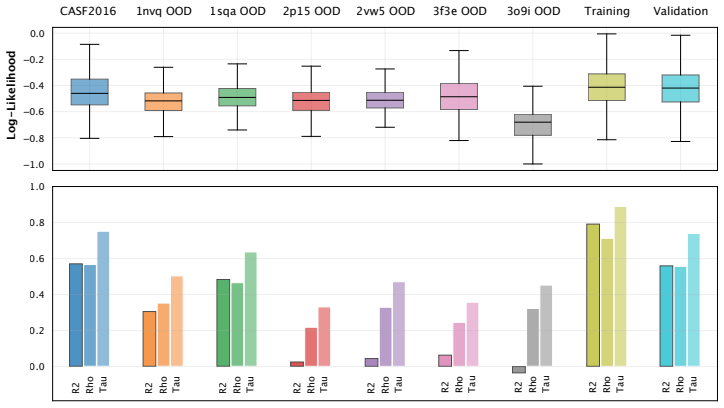
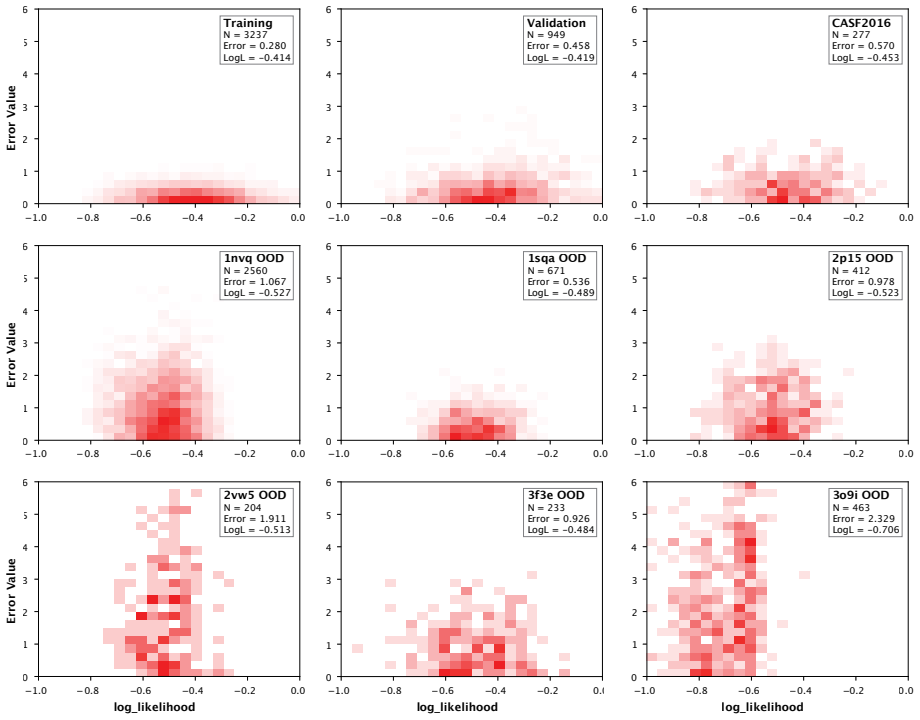
The central discovery: a diffusion model's probability-flow ODE behaves differently for in-distribution and out-of-distribution molecular complexes. OOD inputs traverse longer, more tortuous, less stable paths through low-density regions of the learned flow. Integrating the ODE's divergence yields an exact log-likelihood that aligns with bioinformatic similarity and with errors of an independent affinity predictor across eight of nine test sets. Scalar likelihoods fail on one low-complexity family, but eighteen additional trajectory statistics, modeled jointly via a density ratio, fix that failure and reach AUROC above 0.9 on the strongest shifts. A formal bound ties likelihood to predictor
Load-bearing premise
The label-free detection claim presumes that representative out-of-distribution complexes from the target shift are available to fit the OOD density model, and the error-control guarantee presumes a monotone calibration curve fitted to the very scatter it is meant to bound; either assumption failing would undercut the paper's central claims.
Editorial extensions
If this is right
- Deployed geometric models can be paired with one unsupervised diffusion model to flag inputs whose predictions are likely to be unreliable, without needing task-specific labels.
- Benchmark performance claims can be audited: a shallow increase in error as inputs become more OOD indicates true generalization, while a steep increase points to memorization of training motifs.
- The trajectory-feature detector corrects the complexity-bias failure of likelihood-only methods, as demonstrated on the low-complexity carbonic anhydrase family.
- Because the framework only requires a diffusion or flow-matching model of the in-distribution, it transfers to any data modality with continuous diffusion dynamics.
Reading between the lines
- The paper's label-free OOD claim presupposes access to representative OOD samples from the target shift: the trajectory-aware KDE in Section 4.5 is fit on OOD complexes from the same held-out family being tested. Applying the detector to a genuinely unseen family with no such calibration sample would be a stronger test than the paper runs.
- The formal error-control theorem relies on a monotone calibration curve fitted to the same (log-likelihood, error) scatter used to demonstrate the correlation, so its a priori guarantee is weaker than the statement suggests; the guarantee would be more convincing if the curve were fixed once on a separate calibration set and then locked.
- A testable extension is whether the trajectory-feature detector can be trained once on a diverse pool of OOD families and then generalize to unencountered families; the paper's per-family KDE calibration may be transferable if the features capture a universal dynamic signature.
Editorial analysis
A structured set of objections, weighed in public.
Referee Report
Summary. The paper proposes a diffusion-based OOD detection framework for 3D irregular molecular graphs, specifically protein–ligand complexes. It introduces a unified continuous diffusion over coordinates and categorical embeddings, uses the PF-ODE to compute per-complex log-likelihoods, and augments them with 18 trajectory statistics. A trajectory-aware log-density-ratio (LDR) classifier is then evaluated on held-out protein-family OOD datasets and compared with post-hoc baselines built on the GEMS binding-affinity encoder. The paper also claims that PF-ODE likelihoods correlate with GEMS prediction errors and that a formal theorem guarantees error control with high probability. The likelihood-only analysis is unsupervised; the trajectory-aware LDR detector, however, fits its OOD density on labeled examples from the same target family used for testing, which undermines the paper's central 'label-free' claim.
Significance. If the central claim were sound, this would be a valuable contribution: a single unsupervised generative model acting as a reliability certificate for geometric deep learning predictors would have broad applicability in drug discovery and structural bioinformatics. The paper contains several genuine strengths: the bioinformatic construction of OOD splits by withholding entire protein families, the careful demonstration that likelihood-only scores align with structural similarity measures, the explicit correlation of likelihoods with an independent model's errors, and a detailed trajectory-feature analysis. The likelihood-only portions of Sections 2.2–2.4 are unsupervised and empirically informative. However, the headline trajectory-aware detector is not label-free, and the formal error-control result is conditional on an assumption that is fitted to the same data it is claimed to explain. Because these issues affect the paper's central advertised contribution, the significance of the results as presented is substantially lower than claimed.
major comments (3)
- [§4.5, Eq. (4.16)–(4.17), Tables 1 and S3] The trajectory-aware LDR detector is not label-free, contrary to the abstract and Section 3. In §4.5, the OOD density is fit to X_OOD = {φ(x_j)}_{j∈O}, where O is defined as 'OOD calibration samples for a given shift condition.' In the experiments these are complexes from the same held-out protein family that is later used as the test set; the decision threshold τ is also chosen on a labeled calibration set of ID and OOD examples. The reported AUROC and accuracy in Table 1 and Table S3 therefore measure transductive performance under access to representative OOD samples from the target shift. This invalidates the claim that the framework 'requires no labels' and undermines the head-to-head comparison with the GEMS embedding-space and Rate-In baselines, which are trained on ID data only and never see target-family OOD examples. The likelihood-only analysis in Sections 2.3–2.4 remains unsu
- [§2.4, Prop. 2.1; §S1.6.3, Assumption S1.8, Theorem S1.9] The formal error-control theorem is a Chebyshev rearrangement of Assumption S1.8, not a demonstration that diffusion log-likelihoods control GEMS errors. Assumption S1.8 postulates the existence of a non-decreasing envelope φ such that e_θ(x) ≤ φ(L(x)) for almost all x. The proof of Prop. 2.1 and Theorem S1.9 simply combines this assumption with Chebyshev concentration of L(x). The monotonicity of the error–likelihood relationship is assumed, not established. Moreover, the paper states that φ is obtained by fitting a monotone upper envelope to the empirical (L(x), e_θ(x)) scatter in Figure S1, and the reported coverage (75.8%) appears to be computed on the same scatter. This does not support the 'a priori reliability estimate' claim; it is a post-hoc calibration, and no out-of-sample validation of the fitted envelope is provided. The theorem is valid as a conditional statement, but it ca
- [§2.5–§2.6, Tables 1 and 2] The comparison with baselines is structurally unfair for the reported headline numbers. The trajectory-aware LDR classifier is trained with OOD examples from the target family, while the GEMS embedding-space baseline and Rate-In are trained only on ID data and never observe target-family OOD examples. Table 2 thus compares a transductive method with unsupervised baselines. The fact that Traj-LDR outperforms these baselines on most datasets does not establish the paper's claimed unsupervised advantage. A valid comparison for the label-free claim would require fitting the OOD density on ID data only, or on a disjoint set of held-out families, and then testing on an unseen family; this is not what is done in §4.5 and Tables 1/S3.
minor comments (3)
- [Various] Typos and minor presentation issues: 'withing' (Section 2.1), 'out baselines' (Section 2.6), 'reduced trough' (Section 4.1), 'T rajectory statistics' (Section 2.5), 'T able 1' (Table caption). The caption of Figure 3 says 'N=10,510 similarity scores' for all boxplots, but dataset sizes differ; this should be clarified. Figure S1 caption says '100 randomly sampled complexes from each datasets' — should be 'dataset.' The text in Section S1.5 reports different sampling-quality numbers (84% unfragmented, JSD 0.010/0.009) than Section 4.2.4 (72% unfragmented, JSD 0.0017/0.004); the discrepancy should be reconciled.
- [§2.5, Figure 7] The 'Importance Score' in Figure 7 is described as a composite of separation strength and stability under resampling, but the exact formula is not given. Since this figure is used to support the claim that trajectory features contribute beyond log-likelihood, the definition should be provided.
- [§4.5] The statement 'We first learn a preprocessing map T = Π_m ∘ Z ∘ Q' is clear, but the choice m=15 for PCA is introduced without justification. Since the ablation of m is not reported, the sensitivity of the LDR results to this free parameter is unknown.
Circularity Check
The advertised label-free trajectory detector is calibrated on OOD labels from the target family, and the error-control theorem assumes the monotone envelope it claims to establish.
-
self definitional
[Section 4.5, 'Class-conditional density model' and 'Bootstrap evaluation under class imbalance' (Eqs. 4.16-4.17)]
"Let I index ID training samples and O index OOD calibration samples for a given shift condition, with corresponding PF-ODE features XID ={phi(x_i)}_{i in I}, X_OOD ={phi(x_j)}_{j in O}. ... For each OOD split we partition ID and OOD complexes into training, validation, and test subsets. The two KDEs and the preprocessing map T are fit on their respective training data, and the decision threshold tau is fixed once by maximizing the F1-score for the OOD class on the validation set."
The detector's OOD density p_hat_OOD is fit to OOD calibration complexes from the same shift condition being tested, and the decision threshold is tuned on labeled ID/OOD validation data from that split. The score S(x)=-log p_ID(z)+log p_OOD(z) therefore has OOD labels built into its construction. AUROC on held-out complexes from the same family is transductive, not unsupervised detection of an unseen family. The abstract's 'label-free OOD quantification workflow' and the Discussion's 'completely unsupervised setting' are contradicted by the method. Since this component carries the high-sensitivity results (3dd0; Table 1), the central headline claim rests on supervised OOD calibration.
-
self definitional
[Section 2.4, Proposition 2.1; Section S1.6.3, Assumption S1.8 and Theorem S1.9]
"Assumption S1.8 (Monotone NLL-error envelope). There exists a non-decreasing function phi:R->[0,infty) such that, for p0-almost every complex x, e_theta(x) <= phi(L(x)). ... Theorem S1.9 ... P_x~p0( e_theta(x) <= phi(L_typ+alpha) ) >= 1 - sigma^2/alpha^2."
Theorem S1.9 / Prop 2.1 is a Chebyshev/set-inclusion rearrangement of Assumption S1.8: the substantive claim that NLL controls GEMS error is exactly the assumed monotone envelope. The theorem adds only concentration of L under p0; it does not derive error control from the diffusion model. The paper also says phi is obtained by fitting a monotone upper envelope to the empirical (L(x),e_theta(x)) scatter, so the 'guarantee' restates the fit. The formal result therefore cannot serve as independent evidence for the error-likelihood link it is used to legitimize.
1 more flagged steps
-
fitted input called prediction
[Section S1.2, Figure S1 caption]
"Exponential curves are fit to a maximum of 500 randomly sampled points from each non-training distribution. ... Across all non-training complexes (N= 6223), 75.8% had predicted errors that fell within the bounds of the fitted exponential curves."
The calibration envelope (scaled and shifted exponentials) is fitted on the same non-training datasets on which the 75.8% coverage is reported. The 'predicted errors' are in-sample values of curves fitted to those distributions, not a priori forecasts for new complexes. This contradicts the main-text description of a held-out calibration set and weakens the claim that PF-ODE likelihoods enable a priori reliability estimates: the coverage statistic describes the fit, not an out-of-sample prediction.
full rationale
The diffusion-model likelihoods themselves (Sections 2.2-2.4) are computed unsupervised and are not circular; the paper honestly shows they are insufficient for 3dd0 and have overlapping ID/OOD distributions. The advertised high-sensitivity detector, however, is the trajectory-aware LDR of Section 4.5, whose OOD KDE is fit to OOD calibration samples from the target family and whose threshold is chosen on labeled validation data from the same split. That makes the central 'label-free OOD quantification' claim transductive by construction. The error-control proposition is also a Chebyshev restatement of the assumed monotone NLL-error envelope, and the envelope is fitted on the very non-training scatter used to report coverage. I do not count the citations to [23] (published Nature Machine Intelligence work) as circular: they are external, peer-reviewed support. Because the likelihood-only parts retain independent unsupervised content, the overall circularity is partial rather than total, giving a score of 6.
Assumptions & free parameters
free parameters (5)
- KDE bandwidths h_ID, h_OOD =
selected by cross-validation
- PCA dimension m =
15
- Monotone error envelope phi =
scaled and shifted exponential fit to (NLL, GEMS error) scatter
- Diffusion hyperparameters =
e.g., 6 layers, hidden 256, learning rate 1e-4, 400 sampling steps
- Hutchinson probe count m =
not stated
assumptions (7)
- standard math VE diffusion PF-ODE likelihood formula (Eq. 4.3) and score-via-posterior-mean relation (Eq. 4.7-4.9)
- domain assumption Assumption S1.1: smooth positive densities with sufficient decay and no boundary terms
- domain assumption Assumption S1.4: bounded integrated relative Fisher information
- domain assumption Assumption S1.6: finite NLL variance under the ID distribution
- ad hoc to paper Assumption S1.8: monotone NLL-error envelope exists and is fitted
- domain assumption The learned softmax posterior over categorical prototypes equals the true denoising posterior at every noise level
- domain assumption PLINDER pocket-level family clusters define semantically meaningful OOD splits
Cite this review
Pith. "Pith review of Out-of-Distribution Detection in Molecular Complexes via Diffusion Models for Irregular Graphs." pith.science (2026). https://pith.science/paper/GBS5UOOB
@misc{pith2026251218454,
  author       = {Pith},
  title        = {Pith review of: Out-of-Distribution Detection in Molecular Complexes via Diffusion Models for Irregular Graphs},
  year         = {2026},
  howpublished = {\url{https://pith.science/paper/GBS5UOOB}},
  note         = {Machine review of arXiv:2512.18454}
}
read the original abstract
Predictive machine learning models generally excel on in-distribution data, but their performance degrades on out-of-distribution (OOD) inputs. Reliable deployment therefore requires robust OOD detection, yet this is particularly challenging for irregular 3D graphs that combine continuous geometry with categorical identities and are unordered by construction. Here, we present a probabilistic OOD detection framework for complex 3D graph data built on a diffusion model that learns a density of the training distribution in a fully unsupervised manner. A key ingredient we introduce is a unified continuous diffusion over both 3D coordinates and discrete features: categorical identities are embedded in a continuous space and trained with cross-entropy, while the corresponding diffusion score is obtained analytically via posterior-mean interpolation from predicted class probabilities. This yields a single self-consistent probability-flow ODE (PF-ODE) that produces per-sample log-likelihoods, providing a principled typicality score for distribution shift. We validate the approach on protein-ligand complexes and construct strict OOD datasets by withholding entire protein families from training. PF-ODE likelihoods identify held-out families as OOD and correlate strongly with prediction errors of an independent binding-affinity model (GEMS), enabling a priori reliability estimates on new complexes. Beyond scalar likelihoods, we show that multi-scale PF-ODE trajectory statistics - including path tortuosity, flow stiffness, and vector-field instability - provide complementary OOD information. Modeling the joint distribution of these trajectory features yields a practical, high-sensitivity detector that improves separation over likelihood-only baselines, offering a label-free OOD quantification workflow for geometric deep learning.
Figures


Figures from the paper (4 more)


Reference graph
Works this paper leans on
-
[1]
A BASELINE FOR DETECTING MISCLASSIFIED AND OUT- OF-DISTRIBUTION EXAMPLES IN NEURAL NETWORKS,
Hendrycks and K. Gimpel, “A BASELINE FOR DETECTING MISCLASSIFIED AND OUT- OF-DISTRIBUTION EXAMPLES IN NEURAL NETWORKS,” inICLR 2017, 2017
2017
-
[2]
Enhancing the reliability of out-of-distribution image detection in neural networks,
S. Liang, Y. Li, and R. Srikant, “Enhancing the reliability of out-of-distribution image detection in neural networks,”arXiv, 2017
2017
-
[3]
Energy-based out-of-distribution detection,
W. Liu, X. Wang, J. D. Owens, and Y. Li, “Energy-based out-of-distribution detection,”arXiv, 2020
2020
-
[4]
ReAct: Out-of-distribution detection with rectified activations,
Y. Sun, C. Guo, and Y. Li, “ReAct: Out-of-distribution detection with rectified activations,” arXiv, 2021
2021
-
[5]
Variational autoencoder based anomaly detection using reconstruction prob- ability,
J. An and S. Cho, “Variational autoencoder based anomaly detection using reconstruction prob- ability,” 2015
2015
-
[6]
Generalized out-of-distribution detection: A survey,
J. Yang, K. Zhou, Y. Li, and Z. Liu, “Generalized out-of-distribution detection: A survey,”arXiv, 2021
2021
-
[7]
Out-of-distribution de- tection with memory-augmented variational autoencoder,
F. Ataeiasad, D. Elizondo, S. C. Ram ´ ırez, S. Greenfield, and L. Deka, “Out-of-distribution de- tection with memory-augmented variational autoencoder,”Mathematics, vol. 12, no. 19, p. 3153, 2024
2024
-
[8]
Improving re- construction autoencoder out-of-distribution detection with mahalanobis distance,
T. Denouden, R. Salay, K. Czarnecki, V. Abdelzad, B. Phan, and S. Vernekar, “Improving re- construction autoencoder out-of-distribution detection with mahalanobis distance,”arXiv, 2018
2018
Show all 42 references
-
[9]
Deep autoencoding gaussian mixture model for unsupervised anomaly detection,
B. Zong, Q. Song, M. R. Min, W. Cheng, C. Lumezanu, D. Cho, and H. Chen, “Deep autoencoding gaussian mixture model for unsupervised anomaly detection,” inInternational Conference on Learning Representations, 2018
2018
-
[10]
Score-based generative modeling through stochastic differential equations,
Y. Song, J. Sohl-Dickstein, D. P. Kingma, A. Kumar, S. Ermon, and B. Poole, “Score-based generative modeling through stochastic differential equations,”arXiv, 2020. Probability Flow ODE canonical reference
2020
-
[11]
Likelihood-based out-of-distribution detection with denoising diffusion probabilistic models,
J. Goodier and N. D. F. Campbell, “Likelihood-based out-of-distribution detection with denoising diffusion probabilistic models,”arXiv, 2023
2023
-
[12]
Do deep genera- tive models know what they don’t know?,
E. Nalisnick, A. Matsukawa, Y. W. Teh, D. Gorur, and B. Lakshminarayanan, “Do deep genera- tive models know what they don’t know?,”arXiv, 2018
2018
-
[13]
Input complexity and out-of-distribution detection with likelihood-based generative models,
J. Serr` a, D. ´Alvarez, V. G´ omez, O. Slizovskaia, J. F. N´ u˜ nez, and J. Luque, “Input complexity and out-of-distribution detection with likelihood-based generative models,”arXiv, 2019
2019
-
[14]
Why normalizing flows fail to detect out-of- distribution data,
P. Kirichenko, P. Izmailov, and A. G. Wilson, “Why normalizing flows fail to detect out-of- distribution data,”arXiv, 2020
2020
-
[15]
Out-of-distribution detection with a single unconditional dif- fusion model,
A. Heng, H. Soh, and A. Thiery, “Out-of-distribution detection with a single unconditional dif- fusion model,”Advances in Neural Information Processing Systems 37, pp. 43952–43974, 2024
2024
-
[16]
Energy-based out-of-distribution detection for graph neural networks,
Q. Wu, Y. Chen, C. Yang, and J. Yan, “Energy-based out-of-distribution detection for graph neural networks,”arXiv, 2023. Graphs
2023
-
[17]
Deep graph-level anomaly detection by glocal knowledge distillation,
R. Ma, G. Pang, L. Chen, and A. v. d. Hengel, “Deep graph-level anomaly detection by glocal knowledge distillation,”arXiv, 2021. Graphs
2021
-
[18]
GraphDE: A generative framework for debiased learning and out-of-distribution detection on graphs,
Z. Li, Q. Wu, F. Nie, and J. Yan, “GraphDE: A generative framework for debiased learning and out-of-distribution detection on graphs,” inAdvances in Neural Information Processing Systems, pp. 30277—30290, 2022. Graphs. 33
2022
-
[19]
Optimizing OOD detection in molecular graphs: A novel approach with diffusion models,
X. Shen, Y. Wang, K. Zhou, S. Pan, and X. Wang, “Optimizing OOD detection in molecular graphs: A novel approach with diffusion models,”arXiv, 2024. Graphs
2024
-
[20]
The PDBbind database: Collection of binding affinities for protein-ligand complexes with known three-dimensional structures,
R. Wang, X. Fang, Y. Lu, and S. Wang, “The PDBbind database: Collection of binding affinities for protein-ligand complexes with known three-dimensional structures,”Journal of Medicinal Chemistry, vol. 47, no. 12, pp. 2977–2980, 2004. PDBbind Database
2004
-
[21]
PDB-wide collection of binding data: current status of the PDBbind database,
Z. Liu, Y. Li, L. Han, J. Li, J. Liu, Z. Zhao, W. Nie, Y. Liu, and R. Wang, “PDB-wide collection of binding data: current status of the PDBbind database,”Bioinformatics, vol. 31, no. 3, pp. 405– 412, 2015. PDBbind Database
2015
-
[22]
Gen- eralization beyond benchmarks: Evaluating learnable protein-ligand scoring functions on unseen targets,
J. Kopko, D. Graber, S. M. Eyrilmez, S. Mazurenko, D. Bednar, J. Sedlar, and J. Sivic, “Gen- eralization beyond benchmarks: Evaluating learnable protein-ligand scoring functions on unseen targets,”arXiv preprint arXiv:2512.05386, 2025
2025
-
[23]
Resolving data bias improves generalization in binding affinity prediction,
D. Graber, P. Stockinger, F. Meyer, S. Mishra, C. Horn, and R. Buller, “Resolving data bias improves generalization in binding affinity prediction,”Nature Machine Intelligence, vol. 7, no. 10, pp. 1713–1725, 2025
2025
-
[24]
TM-align: a protein structure alignment algorithm based on the TM-score,
Y. Zhang and J. Skolnick, “TM-align: a protein structure alignment algorithm based on the TM-score,”Nucleic Acids Research, vol. 33, no. 7, pp. 2302–2309, 2005. TM-align
2005
-
[25]
Why is tanimoto index an appropriate choice for fingerprint-based similarity calculations?,
D. Bajusz, A. R´ acz, and K. H´ eberger, “Why is tanimoto index an appropriate choice for fingerprint-based similarity calculations?,”Journal of Cheminformatics, vol. 7, no. 1, p. 20, 2015. Tanimoto
2015
-
[26]
Rate-in: Information-driven adaptive dropout rates for improved inference-time uncertainty estimation,
T. Zeevi, R. Shwartz-Ziv, Y. LeCun, L. H. Staib, and J. A. Onofrey, “Rate-in: Information-driven adaptive dropout rates for improved inference-time uncertainty estimation,” inProceedings of the Computer Vision and Pattern Recognition Conference, pp. 20757–20766, 2025
2025
-
[27]
Structure-based drug design with equivariant diffusion models,
A. Schneuing, C. Harris, Y. Du, K. Didi, A. Jamasb, I. Igashov, W. Du, C. Gomes, T. L. Blundell, P. Lio, M. Welling, M. Bronstein, and B. Correia, “Structure-based drug design with equivariant diffusion models,”Nature Computational Science, pp. 1–11, 2024. DiffSBDD
2024
-
[28]
3d equivariant diffusion for target- aware molecule generation and affinity prediction,
J. Guan, W. W. Qian, X. Peng, Y. Su, J. Peng, and J. Ma, “3d equivariant diffusion for target- aware molecule generation and affinity prediction,”arXiv, 2023. TargetDiff
2023
-
[29]
Three- dimensional convolutional neural networks and a cross-docked data set for structure-based drug design,
P. G. Francoeur, T. Masuda, J. Sunseri, A. Jia, R. B. Iovanisci, I. Snyder, and D. R. Koes, “Three- dimensional convolutional neural networks and a cross-docked data set for structure-based drug design,”Journal of Chemical Information and Modeling, vol. 60, no. 9, pp. 4200–421...
2020
-
[30]
PLINDER: The protein-ligand interactions dataset and evaluation resource,
J. Durairaj, Y. Adeshina, Z. Cao, X. Zhang, V. Oleinikovas, T. Duignan, Z. McClure, X. Robin, G. Studer, D. Kovtun, E. Rossi, G. Zhou, S. Veccham, C. Isert, Y. Peng, P. Sundareson, M. Akdel, G. Corso, H. St¨ ark, G. Tauriello, Z. Carpenter, M. Bronstein, E. Kucukbenli, T. Schw...
2024
-
[31]
Comparative assessment of scoring functions: The CASF-2016 update,
M. Su, Q. Yang, Y. Du, G. Feng, Z. Liu, Y. Li, and R. Wang, “Comparative assessment of scoring functions: The CASF-2016 update,”Journal of Chemical Information and Modeling, vol. 59, no. 2, pp. 895–913, 2019. CASF2016
2016
-
[32]
Elucidating the design space of diffusion-based generative models,
T. Karras, M. Aittala, T. Aila, and S. Laine, “Elucidating the design space of diffusion-based generative models,”arXiv, 2022. EDM
2022
-
[33]
Con- tinuous diffusion for categorical data,
S. Dieleman, L. Sartran, A. Roshannai, N. Savinov, Y. Ganin, P. H. Richemond, A. Doucet, R. Strudel, C. Dyer, C. Durkan, C. Hawthorne, R. Leblond, W. Grathwohl, and J. Adler, “Con- tinuous diffusion for categorical data,”arXiv, 2022. CDCD Loss. 34
2022
-
[34]
Evolutionary-scale pre- diction of atomic level protein structure with a language model,
Z. Lin, H. Akin, R. Rao, B. Hie, Z. Zhu, W. Lu, N. Smetanin, R. Verkuil, O. Kabeli, Y. Shmueli, A. D. S. Costa, M. Fazel-Zarandi, T. Sercu, S. Candido, and A. Rives, “Evolutionary-scale pre- diction of atomic level protein structure with a language model,” 2022
2022
-
[35]
Ankh: Optimized protein language model unlocks general-purpose modelling,
A. Elnaggar, H. Essam, W. Salah-Eldin, W. Moustafa, M. Elkerdawy, C. Rochereau, and B. Rost, “Ankh: Optimized protein language model unlocks general-purpose modelling,”arXiv, 2023
2023
-
[36]
ChemBERTa-2: Towards chemical foundation models,
W. Ahmad, E. Simon, S. Chithrananda, G. Grand, and B. Ramsundar, “ChemBERTa-2: Towards chemical foundation models,”arXiv, 2022
2022
-
[37]
Dropout as a bayesian approximation: Representing model uncer- tainty in deep learning,
Y. Gal and Z. Ghahramani, “Dropout as a bayesian approximation: Representing model uncer- tainty in deep learning,” ininternational conference on machine learning, pp. 1050–1059, PMLR, 2016
2016
-
[38]
Likelihood ratios for out-of-distribution detection,
J. Ren, P. J. Liu, E. Fertig, J. Snoek, R. Poplin, M. A. DePristo, J. V. Dillon, and B. Lakshmi- narayanan, “Likelihood ratios for out-of-distribution detection,”arXiv, 2019
2019
-
[39]
Revisiting likelihood-based out-of-distribution detection by modeling representations,
Y. Ding, A. Aleksandrauskas, A. Ahmadian, J. Unger, F. Lindsten, and G. Eilertsen, “Revisiting likelihood-based out-of-distribution detection by modeling representations,”arXiv, 2025
2025
-
[40]
Enhanced graph autoencoder for graph anomaly detection using subgraph information,
C. Zhang and J.-W. Jung, “Enhanced graph autoencoder for graph anomaly detection using subgraph information,”Applied Sciences, vol. 15, no. 15, p. 8691, 2025. Anomalies WITHIN graphs
2025
-
[41]
Equivariant diffusion for molecule generation in 3d,
E. Hoogeboom, V. G. Satorras, C. Vignac, and M. Welling, “Equivariant diffusion for molecule generation in 3d,”arXiv, 2022. 35 S1 Supplementary Information S1.1 Related Work The problem of detecting out-of-distribution (OOD) samples has been extensively studied in computer vis...
2022
-
[42]
typicality
of a diffusion model for OOD detection in 3D molecular complexes remains unexplored. Our work bridges this gap by adapting the equivariant diffusion backbone from DiffSBDD [27] for precise OOD detection, thereby providing a much-needed OOD detection capability to the growing f...
Reviewed August 3, 2026 · model on record in the stance chip above.
Discussion (0). Continue with ORCID to comment.