Reinforcement Learning-Based Traffic Signal Control for IoT-Enabled Intersections
Pith reviewed 2026-06-26 11:40 UTC · model grok-4.3
The pith
A PPO reinforcement learning controller for traffic signals reduces average vehicle delay by 46% versus fixed-time control in a Kuwait intersection simulation.
A machine-rendered reading of the paper's core claim, the machinery that carries it, and where it could break.
Core claim
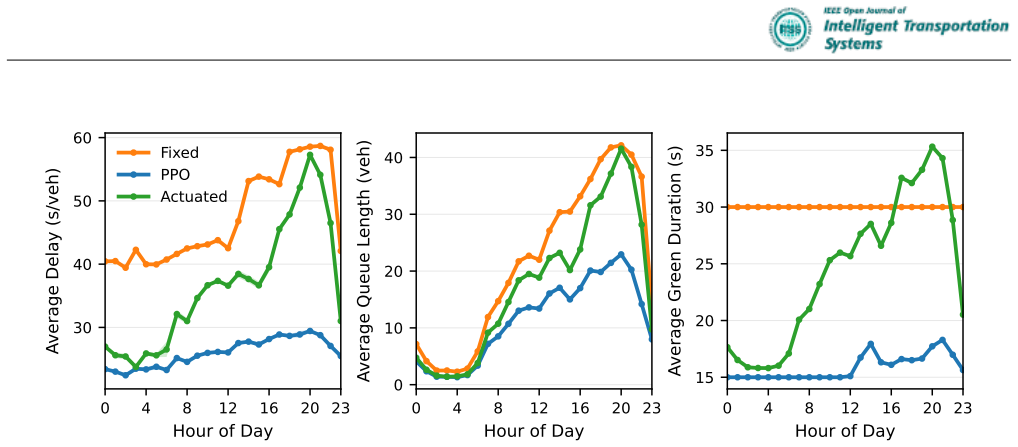
The paper presents a PPO-based controller that dynamically allocates green-phase durations from locally observed traffic states at a signalized intersection. Evaluated in a simulation environment using real-world hourly traffic volumes from Kuwait, the controller reduces average vehicle delay by 46% relative to fixed-time control and 34% relative to actuated control, while lowering per-vehicle CO2 emissions by about 23%. These gains hold under demand perturbations of plus or minus 15%, generalize from weekday to weekend patterns, and show low variance across five random seeds.
What carries the argument
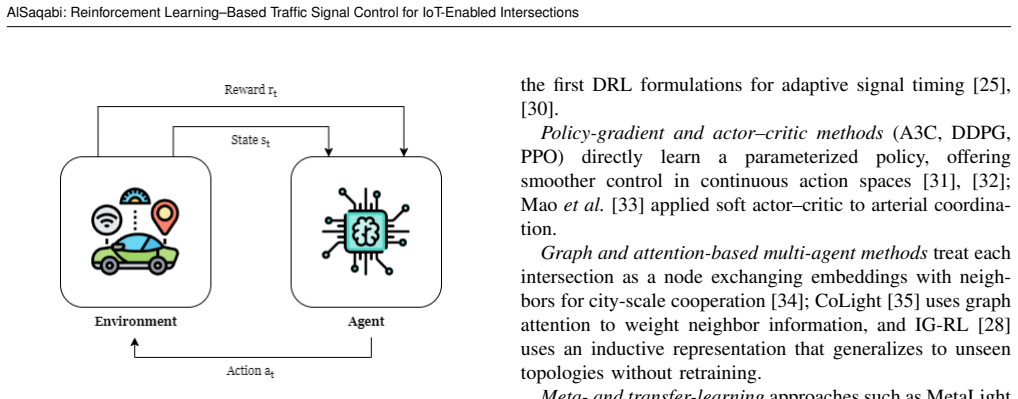
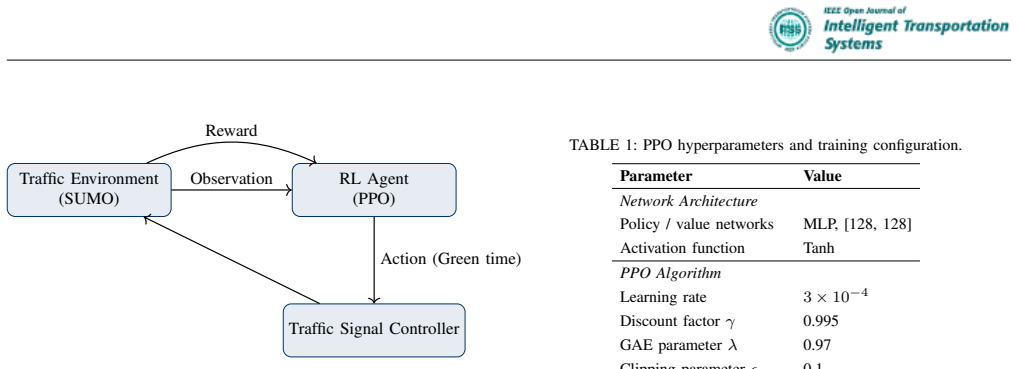
The Proximal Policy Optimization (PPO) controller that maps locally observed traffic states to green-phase durations without future demand data or centralized coordination.
If this is right
- The reported gains persist under plus or minus 15% demand perturbations.
- Performance generalizes from weekday to weekend traffic patterns.
- Low variance across five random seeds supports statistical reliability.
- The controller can serve as a deployable precursor toward IoV-based urban mobility systems.
Where Pith is reading between the lines
- Similar local-observation RL controllers could be tested at intersections with different geometry or vehicle mixes.
- The approach might lower the need for city-wide centralized traffic computers if scaled.
- Real sensor data streams could replace the simulation inputs to check whether the reported percentages survive field conditions.
Load-bearing premise
The simulation environment built from real hourly traffic volume data accurately represents the dynamics and variability of actual traffic at the intersection.
What would settle it
Deployment at the same Kuwait intersection that produces average delay reductions below 30% compared with the actuated baseline would falsify the performance claim.
Figures

read the original abstract
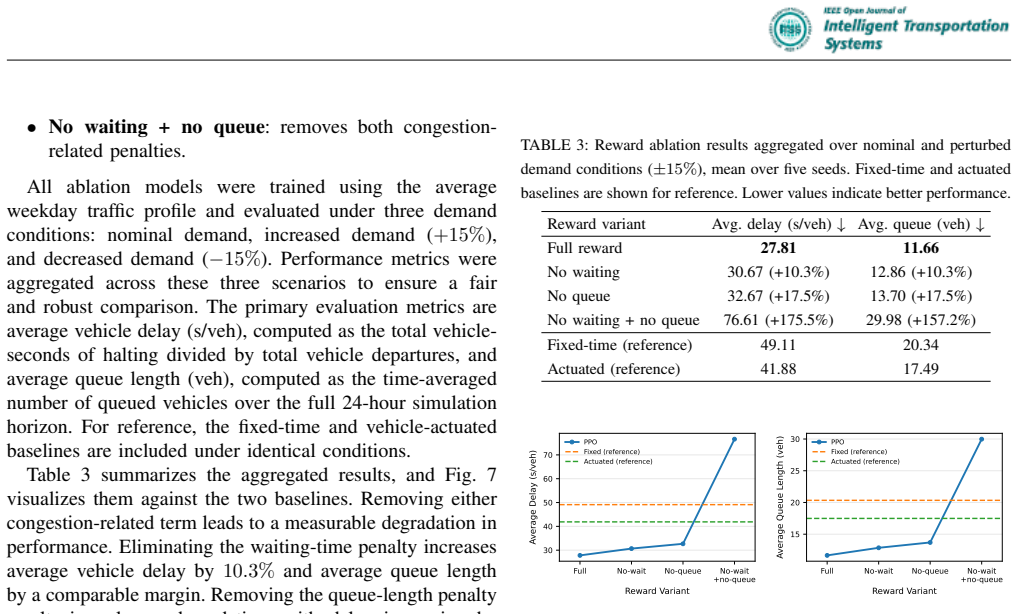
Urban traffic congestion remains a persistent challenge in car-dependent cities, imposing significant economic and societal costs. Traffic signal systems are increasingly deployed as networked cyber-physical components within smart-city infrastructures, where distributed sensing and edge intelligence enable adaptive traffic management. This paper investigates reinforcement learning (RL) as an edge-intelligent approach for adaptive traffic signal operation at a signalized urban intersection in Kuwait. A Proximal Policy Optimization (PPO)-based controller is developed to dynamically allocate green-phase durations using locally observed traffic states, without relying on future demand information or centralized coordination. The controller is evaluated in a realistic simulation environment informed by real-world hourly traffic volume data from Kuwait, and is compared against both conventional fixed-time control and a vehicle-actuated controller representing the current state of practice, using average vehicle delay, queue length, and emissions as performance metrics. Under nominal conditions, the proposed controller reduces average vehicle delay by 46% relative to fixed-time control and 34% relative to actuated control, while also lowering per-vehicle CO2 emissions by approximately 23%. These performance gains persist under demand perturbations of +/-15%, generalize from weekday to weekend traffic patterns, and are corroborated by a reward function ablation; low variance across five random seeds confirms their statistical reliability. These findings demonstrate the practicality of learning-based edge traffic signal control as a building block for IoT-enabled smart-city transportation systems, and as a deployable precursor toward fully connected, Internet of Vehicles (IoV)-based urban mobility.
Editorial analysis
A structured set of objections, weighed in public.
Referee Report
Summary. The paper proposes a PPO-based reinforcement learning controller for adaptive traffic signal timing at an IoT-enabled urban intersection in Kuwait. The controller uses local traffic observations to set green-phase durations without future demand forecasts or central coordination. Evaluated in a simulator informed by real hourly traffic volumes, it reports 46% lower average vehicle delay than fixed-time control, 34% lower than actuated control, and ~23% lower per-vehicle CO2 emissions; gains hold under ±15% demand perturbations, generalize to weekend patterns, and are supported by reward ablation and five-seed variance analysis.
Significance. If the simulation environment accurately reproduces real intersection dynamics, the work would provide concrete evidence that edge-deployable RL controllers can deliver substantial, robust improvements in delay and emissions over standard practice, supporting their role as building blocks for smart-city IoT systems. The use of real hourly volume data, explicit ablation, and multi-seed statistics are positive elements that increase the credibility of the quantitative claims.
major comments (2)
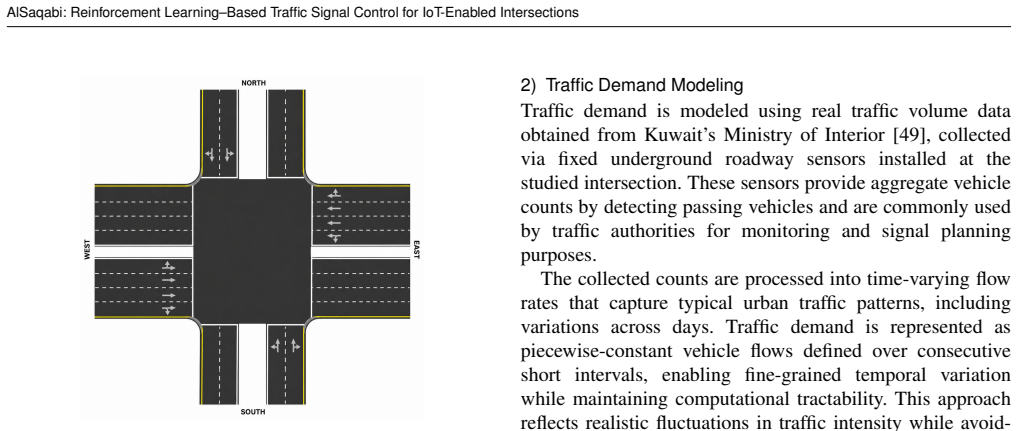
- [§4] §4 (Simulation Environment): The environment is described only as 'informed by real-world hourly traffic volume data from Kuwait.' No calibration against observed headway distributions, saturation flows, turning ratios, or field measurements is reported. Because every performance metric (delay, queue length, emissions) is generated inside this simulator, the lack of fidelity validation directly scales the headline claims of 46% and 34% delay reduction.
- [§5.3] §5.3 (Demand Perturbations): Robustness is tested solely via ±15% mean demand shifts. No sensitivity analysis to arrival-process variance, driver reaction times, or other higher-moment parameters is provided, even though these factors dominate real-world delay variability and are not captured by mean-volume perturbations alone.
minor comments (2)
- [§3] The state representation and action space definitions in §3 would benefit from an explicit diagram or table listing all observed variables and their discretization.
- Figure captions for the reward-ablation and seed-variance plots should include the exact numerical values of the reported improvements rather than relying solely on visual comparison.
Simulated Author's Rebuttal
We thank the referee for the constructive review and positive assessment of the work's significance. We address the two major comments below, proposing targeted revisions where appropriate while defending the relative performance claims that form the core contribution.
read point-by-point responses
-
Referee: [§4] §4 (Simulation Environment): The environment is described only as 'informed by real-world hourly traffic volume data from Kuwait.' No calibration against observed headway distributions, saturation flows, turning ratios, or field measurements is reported. Because every performance metric (delay, queue length, emissions) is generated inside this simulator, the lack of fidelity validation directly scales the headline claims of 46% and 34% delay reduction.
Authors: We agree that the absence of explicit microscopic calibration limits the strength of absolute performance claims. The simulator is driven by real hourly volume counts from Kuwait to set time-dependent arrival rates at the intersection; all other parameters (saturation flows, turning ratios, vehicle lengths) follow the default urban settings of the underlying SUMO environment, which are standard for studies lacking richer field data. Because the identical simulator instance is used for the RL, fixed-time, and actuated controllers, the reported relative reductions (46 % and 34 %) remain internally consistent and are further supported by the multi-seed statistics and demand-perturbation results. In revision we will expand §4 to list every simulator parameter with its source, add an explicit limitations paragraph on the lack of headway or saturation-flow calibration, and qualify the headline numbers accordingly. We do not claim the simulator reproduces every real-world microscopic statistic, only that it provides a controlled, data-informed testbed for comparing control policies. revision: partial
-
Referee: [§5.3] §5.3 (Demand Perturbations): Robustness is tested solely via ±15% mean demand shifts. No sensitivity analysis to arrival-process variance, driver reaction times, or other higher-moment parameters is provided, even though these factors dominate real-world delay variability and are not captured by mean-volume perturbations alone.
Authors: The ±15 % mean-volume tests were chosen because they directly reflect the range observed in the Kuwait hourly data set. We acknowledge that arrival-process variance and driver-behavior parameters can affect delay variability beyond mean shifts. The current implementation inherits the simulator’s default Poisson arrivals and Krauss car-following model. In the revised manuscript we will add a supplementary sensitivity study that (i) replaces Poisson arrivals with higher-variance headway distributions and (ii) perturbs driver reaction-time parameters within the ranges supported by the simulator. These additional runs will be reported alongside the existing mean-shift results, thereby addressing the referee’s concern about higher-moment robustness while remaining computationally feasible. revision: yes
Circularity Check
No circularity; empirical simulation results are independent of inputs
full rationale
The paper trains a PPO controller on traffic states observed in simulation and reports performance metrics (delay, queue, CO2) from direct comparisons against fixed-time and actuated baselines inside the same simulator. No equations derive predictions from fitted parameters, no self-citations bear the central claim, and no ansatz or uniqueness theorem is invoked. The evaluation chain is self-contained against the simulator outputs and does not reduce to its own inputs by construction.
Axiom & Free-Parameter Ledger
free parameters (1)
- PPO reward function weights
axioms (1)
- domain assumption The simulation model faithfully represents real traffic dynamics
Reference graph
Works this paper leans on
-
[1]
2001 annual urban mobility report,
D. Schrank and T. Lomax, “2001 annual urban mobility report,” Texas Transportation Institute, Texas A&M University, Tech. Rep.,
2001
-
[2]
Available: https://rosap.ntl.bts.gov/view/dot/49633
[Online]. Available: https://rosap.ntl.bts.gov/view/dot/49633
-
[3]
2019 urban mobility report,
D. Schrank, T. Lomax, and B. Eisele, “2019 urban mobility report,” Texas Transportation Institute, Texas A&M University, Tech. Rep.,
2019
-
[4]
Available: https://mobility.tamu.edu/umr/
[Online]. Available: https://mobility.tamu.edu/umr/
-
[5]
2018 global traffic scorecard,
I. Research, “2018 global traffic scorecard,” INRIX, Inc., Tech. Rep., 2019. [Online]. Available: https://inrix.com/press-releases/ scorecard-2018-us/
2018
-
[6]
Number of registered vehicles in use in kuwait — 2023,
CEIC Data, “Number of registered vehicles in use in kuwait — 2023,” 2025. [Online]. Available: https://www.ceicdata.com/en/kuwait/ number-of-registered-vehicles/no-of-registered-vehicles-in-use
2023
-
[7]
Passenger cars per 1,000 persons in kuwait — 2019,
Central Statistical Bureau, State of Kuwait, “Passenger cars per 1,000 persons in kuwait — 2019,” 2023. [Online]. Available: https://www.csb.gov.kw/Pages/Statistics en?ID=41&ParentCatID=70
2019
-
[8]
Passenger cars per 1,000 people in kuwait — 2019,
Helgi Library, “Passenger cars per 1,000 people in kuwait — 2019,” 2020. [Online]. Available: https://www.helgilibrary.com/charts/ passenger-cars-per-1000-people-rose-0473-to-445-vehicles-in-kuwait-in-2019/
2019
-
[9]
Waiting for the bus: Commuting patterns in kuwait,
N. M. Ghadanfar, “Waiting for the bus: Commuting patterns in kuwait,”Massachusetts Institute of Technology (MIT) Architecture Studies, 2019. [Online]. Available: https://dspace.mit.edu/handle/1721. 1/123955
2019
-
[10]
Kuwait vision 2035,
Government of Kuwait, “Kuwait vision 2035,” 2017. [Online]. Available: https://www.newkuwait.gov.kw/
2035
-
[11]
Combining traffic assignment models and intersection delay functions in kuwait city’s road network,
W. Al Haidar and A. Al Hakim, “Combining traffic assignment models and intersection delay functions in kuwait city’s road network,” Journal of Advanced Engineering Studies (JAES), vol. 11, no. 39, pp. 591–600, 2016
2016
-
[12]
The im- pact of congestion charging technique on traffic flow and atmospheric pollution in kuwait city,
F. Alrukaibi, D. Alrukaibi, A. AlBurait, and A. Al-Mutairi, “The im- pact of congestion charging technique on traffic flow and atmospheric pollution in kuwait city,”Journal of Engineering Research, vol. 9, 02 2021
2021
-
[13]
Reinforcement learning in urban network traffic signal control: A systematic literature review,
M. Noaeen, A. Naik, L. Goodman, J. Crebo, T. Abrar, Z. S. H. Abad, A. L. C. Bazzan, and B. Far, “Reinforcement learning in urban network traffic signal control: A systematic literature review,”Expert Systems with Applications, vol. 199, p. 116830, 2022
2022
-
[14]
R. S. Sutton and A. G. Barto,Reinforcement Learning: An Introduc- tion, 2nd ed. MIT Press, 2018
2018
-
[15]
Incentivizing private data sharing in vehicular networks: A game-theoretic approach,
Y . AlSaqabi and B. Krishnamachari, “Incentivizing private data sharing in vehicular networks: A game-theoretic approach,” in2023 IEEE 98th Vehicular Technology Conference (VTC2023-Fall), 2023, pp. 1–8
2023
-
[16]
Traffic control systems handbook,
R. L. Gordon, R. A. Reiss, H. Haenel, E. Case, R. L. French, A. Mohaddes, R. Wolcottet al., “Traffic control systems handbook,” United States. Federal Highway Administration. Office of Technology Applications, Tech. Rep., 1996
1996
-
[17]
A survey on traffic signal control methods,
L. Li, Y . Lv, and F.-Y . Wang, “A survey on traffic signal control methods,”IEEE Transactions on Intelligent Transportation Systems, vol. 15, no. 3, pp. 1091–1103, 2014
2014
-
[18]
Review of road traffic control strategies,
M. Papageorgiou, C. Diakaki, V . Dinopoulou, A. Kotsialos, and Y . Wang, “Review of road traffic control strategies,”Proceedings of the IEEE, vol. 91, no. 12, pp. 2043–2067, 2003
2043
-
[19]
Intelligent transportation systems using roadside infrastructure: A literature survey,
C. Creß, Z. Bing, and A. C. Knoll, “Intelligent transportation systems using roadside infrastructure: A literature survey,”IEEE Transactions on Intelligent Transportation Systems, vol. 25, no. 7, pp. 6309–6327, 2024
2024
-
[20]
Stochastic optimization of traffic control and transit priority settings in vissim,
A. Stevanovic, J. Stevanovic, K. Zhang, and S. Batterman, “Stochastic optimization of traffic control and transit priority settings in vissim,” inTransportation Research Board 89th Annual Meeting, 2010, pp. 10–2561
2010
-
[21]
Cooperative multi-agent system for coordinated traffic signal control,
D. Srinivasan and M. C. Choy, “Cooperative multi-agent system for coordinated traffic signal control,”IEE Proceedings—Intelligent Transportation Systems, vol. 153, no. 1, pp. 41–50, 2006
2006
-
[22]
Fuzzy logic systems for transportation engineering: The state of the art,
D. Teodorovi ´c, “Fuzzy logic systems for transportation engineering: The state of the art,”Transportation Research Part A: Policy and Practice, vol. 33, no. 5, pp. 337–364, 2000
2000
-
[23]
Smart infrastructure: An emerging frontier for multidisciplinary research,
R. I. Ogie, P. Perez, and V . Dignum, “Smart infrastructure: An emerging frontier for multidisciplinary research,”Proceedings of the ICE—Smart Infrastructure and Construction, vol. 170, no. 1, pp. 8–16, 2017
2017
-
[24]
A survey of intelligence methods in urban traffic signal control,
Z. Liu, “A survey of intelligence methods in urban traffic signal control,”IJCSNS International Journal of Computer Science and Network Security, vol. 7, no. 7, pp. 105–112, 2007
2007
-
[25]
Data-aware path planning for autonomous vehicles using reinforcement learning,
Y . AlSaqabi and B. Krishnamachari, “Data-aware path planning for autonomous vehicles using reinforcement learning,”Applied Sciences, vol. 15, no. 11, 2025. 14 VOLUME ,
2025
-
[26]
Multi-robot path planning method using reinforcement learning,
H. Bae, G. D. Kim, J. Kim, D. Qian, and S.-G. Lee, “Multi-robot path planning method using reinforcement learning,”Applied Sciences, vol. 9, no. 15, p. 3057, 2019
2019
-
[27]
Recent advances in rein- forcement learning for traffic signal control: A survey of models and evaluation,
H. Wei, G. Zheng, V . Gayah, and Z. Li, “Recent advances in rein- forcement learning for traffic signal control: A survey of models and evaluation,”SIGKDD Explor. Newsl., vol. 22, no. 2, pp. 12–18, 2021
2021
-
[28]
A survey of reinforcement and deep reinforcement learning for coordination in intelligent traffic light control,
A. Saadi, N. Abghour, Z. Chiba, K. Moussaid, and S. Ali, “A survey of reinforcement and deep reinforcement learning for coordination in intelligent traffic light control,”J. Big Data, vol. 12, p. 84, 2025
2025
-
[29]
Multi-agent deep reinforce- ment learning for large-scale traffic signal control,
T. Chu, J. Wang, L. Codec `a, and Z. Li, “Multi-agent deep reinforce- ment learning for large-scale traffic signal control,”IEEE Transactions on Intelligent Transportation Systems, vol. 21, no. 3, pp. 1086–1095, 2020
2020
-
[30]
Ig-rl: Inductive graph reinforcement learning for massive-scale traffic signal control,
F.-X. Devailly, D. Larocque, and L. Charlin, “Ig-rl: Inductive graph reinforcement learning for massive-scale traffic signal control,”IEEE Transactions on Intelligent Transportation Systems, vol. 23, no. 7, pp. 7496–7507, 2021
2021
-
[31]
Traffic signal timing via deep rein- forcement learning,
L. Li, Y . Lv, and F.-Y . Wang, “Traffic signal timing via deep rein- forcement learning,”IEEE/CAA Journal of Automatica Sinica, vol. 3, no. 3, pp. 247–254, 2016
2016
-
[32]
Q-learning,
C. J. C. H. Watkins and P. Dayan, “Q-learning,”Machine Learning, vol. 8, pp. 279–292, 1992
1992
-
[33]
Natural actor-critic,
J. Peters and S. Schaal, “Natural actor-critic,”Neurocomputing, vol. 71, no. 7, pp. 1180–1190, 2008
2008
-
[34]
A novel actor–critic–identifier architecture for approximate optimal control of uncertain nonlinear systems,
S. Bhasin, R. Kamalapurkar, M. Johnson, K. G. Vamvoudakis, F. L. Lewis, and W. E. Dixon, “A novel actor–critic–identifier architecture for approximate optimal control of uncertain nonlinear systems,” Automatica, vol. 49, no. 1, pp. 82–92, 2013
2013
-
[35]
Mastering arterial traffic signal control with multi-agent attention-based soft actor-critic model,
F. Mao, Z. Li, Y . Lin, and L. Li, “Mastering arterial traffic signal control with multi-agent attention-based soft actor-critic model,”IEEE Transactions on Intelligent Transportation Systems, vol. 24, no. 3, pp. 3129–3144, 2022
2022
-
[36]
Cooperative traffic signal control using a distributed agent-based deep reinforce- ment learning with incentive communication,
B. Zhou, Q. Zhou, S. Hu, D. Ma, S. Jin, and D.-H. Lee, “Cooperative traffic signal control using a distributed agent-based deep reinforce- ment learning with incentive communication,”IEEE Transactions on Intelligent Transportation Systems, vol. 25, no. 8, pp. 10 147–10 160, 2024
2024
-
[37]
Colight: Learning network-level coop- eration for traffic signal control,
H. Wei, N. Xu, H. Zhang, G. Zheng, X. Zang, C. Chen, W. Zhang, Y . Zhu, K. Xu, and Z. Li, “Colight: Learning network-level coop- eration for traffic signal control,” inProceedings of the 28th ACM international conference on information and knowledge management, 2019, pp. 1913–1922
2019
-
[38]
Integrating multimodality and partial observability solutions into decentralized multiagent reinforcement learning adaptive traffic signal control,
K. Othman, X. Wang, A. Shalaby, and B. Abdulhai, “Integrating multimodality and partial observability solutions into decentralized multiagent reinforcement learning adaptive traffic signal control,” IEEE Open Journal of Intelligent Transportation Systems, vol. 6, pp. 322–334, 2025
2025
-
[39]
A real-time adaptive signal control in a connected vehicle environment,
Y . Feng, K. L. Head, S. Khoshmagham, and M. Zamanipour, “A real-time adaptive signal control in a connected vehicle environment,” Transportation Research Part C: Emerging Technologies, vol. 55, pp. 460–473, 2015
2015
-
[40]
Cvlight: Decentralized learning for adaptive traffic signal control with connected vehicles,
Z. Mo, W. Li, Y . Fu, K. Ruan, and X. Di, “Cvlight: Decentralized learning for adaptive traffic signal control with connected vehicles,” Transportation research part C: emerging technologies, vol. 141, p. 103728, 2022
2022
-
[41]
Marp: a cooperative multi-agent drl system for connected autonomous vehicle platooning,
S. Dai, S. Li, H. Tang, X. Ning, F. Fang, Y . Fu, Q. Wang, and L. Cheng, “Marp: a cooperative multi-agent drl system for connected autonomous vehicle platooning,”IEEE Internet of Things Journal, 2024
2024
-
[42]
Improving the generalizability and robustness of large-scale traffic signal control,
T. Shi, F.-X. Devailly, D. Larocque, and L. Charlin, “Improving the generalizability and robustness of large-scale traffic signal control,” IEEE Open Journal of Intelligent Transportation Systems, vol. 5, pp. 2–15, 2024
2024
-
[43]
Traffic signal timing and trajectory optimization in a mixed autonomy traffic stream,
M. Tajalli and A. Hajbabaie, “Traffic signal timing and trajectory optimization in a mixed autonomy traffic stream,”IEEE Transactions on Intelligent Transportation Systems, vol. 23, no. 7, pp. 6525–6538, 2021
2021
-
[44]
Smart traffic light control system,
B. Ghazal, K. ElKhatib, K. Chahine, and M. Kherfan, “Smart traffic light control system,” in2016 third international conference on electrical, electronics, computer engineering and their applications (EECEA). IEEE, 2016, pp. 140–145
2016
-
[45]
Smart traffic light system using machine learning,
M. B. Natafgi, M. Osman, A. S. Haidar, and L. Hamandi, “Smart traffic light system using machine learning,” in2018 IEEE international mul- tidisciplinary conference on engineering technology (IMCET). IEEE, 2018, pp. 1–6
2018
-
[46]
Reinforcement learning-based control of signalized intersections having platoons,
A. Berbar, A. Gastli, N. Meskin, M. A. Al-Hitmi, J. Ghommam, M. Mesbah, and F. Mnif, “Reinforcement learning-based control of signalized intersections having platoons,”IEEE Access, vol. 10, pp. 17 683–17 696, 2022
2022
-
[47]
Real-time traffic signal optimization for urban mobility: a reinforcement learning-enhanced framework with application to kuwait city,
A. Almomany, E. Eedi, and M. Sutcu, “Real-time traffic signal optimization for urban mobility: a reinforcement learning-enhanced framework with application to kuwait city,”Frontiers in Robotics and AI, vol. 12, p. 1669952, 2025
2025
-
[48]
Evaluation of transit signal priority implementation for bus transit along a major arterial using microsim- ulation,
K. Shaaban and M. Ghanim, “Evaluation of transit signal priority implementation for bus transit along a major arterial using microsim- ulation,”Procedia computer science, vol. 130, pp. 82–89, 2018
2018
-
[49]
Recent Development and Applications of SUMO – Simulation of Urban MO- bility,
D. Krajzewicz, J. Erdmann, M. Behrisch, and L. Bieker, “Recent Development and Applications of SUMO – Simulation of Urban MO- bility,” inProceedings of the International Conference on Advances in System Simulation (SIMUL 2012). IARIA, 2012, pp. 1–6
2012
-
[50]
Openstreetmap,
OpenStreetMap contributors, “Openstreetmap,” 2024, [Online]. Available: https://www.openstreetmap.org. Accessed: Jan. 2025. [Online]. Available: https://www.openstreetmap.org
2024
-
[51]
Traffic V olume Data for Signalized Intersections,
Kuwait Ministry of Interior, “Traffic V olume Data for Signalized Intersections,” 2025, data provided by the General Traffic Department for academic research; not publicly available
2025
-
[52]
Proximal Policy Optimization Algorithms
J. Schulman, F. Wolski, P. Dhariwal, A. Radford, and O. Klimov, “Proximal policy optimization algorithms,”arXiv preprint arXiv:1707.06347, 2017
work page internal anchor Pith review Pith/arXiv arXiv 2017
-
[53]
Onactor-critic algorithms,
V . R. Konda and J. N. Tsitsiklis, “Onactor-critic algorithms,”SIAM journal on Control and Optimization, vol. 42, no. 4, pp. 1143–1166, 2003. Yousef AlSaqabi(Member, IEEE) is an Assis- tant Professor at Kuwait University. He received his PhD in Electrical Engineering from the Univer- sity of Southern California in 2024. He received both his BS and MS degr...
2003
discussion (0)
Sign in with ORCID, Apple, or X to comment. Anyone can read and Pith papers without signing in.