REVIEW 3 major objections 6 minor 38 references
Evidence for and implications of a dark photon
T0 review · 3 major / 6 minor · reviewed 2026-08-06 · deepseek-v4-flash
Pith's one-line read First indirect hint of a dark photon emerges from a global QCD fit.
desk verdict A conference summary of a previously reported 6.5 sigma dark photon hint; the significance is not statistically transparent and deserves a careful look at the original fit before believing it. read the letter →
The pith
A machine-rendered reading of the paper's core claim, the machinery that carries it, and where it could break.
The reading
What carries the argument
The machinery is the global QCD fit carried out with Bayesian Monte Carlo uncertainty quantification, at next-to-leading order in the strong coupling, supplemented by the missing higher-order uncertainty procedure of [26]. Dark-photon exchange enters through the structure functions $\widetilde F_2$ and $\widetilde F_3$, written as sums over the physical gauge bosons $\gamma$, $Z$, and $A'$ with weights $\kappa_i = Q^2/(Q^2 + m_i^2)$ and the corresponding vector and axial-vector couplings; the parton distributions are parametrized at the starting scale by $f_q(x,Q_0^2)=N x^\alpha (1-x)^\beta (1+\gamma\sqrt{x}+\eta x)$ and determined by the fit. The $\chi^2$ difference between the dark-photon and baseline fits, combined with the number of fitted parameters, yields the hypothesis-test significance.
What would settle it
A repeat of the global fit with a more flexible parton parametrization, or at next-to-next-to-leading order in the strong coupling, that shows no significant $\chi^2$ improvement would falsify the claimed preference; a direct search sensitive to a broad resonance in the 4--6 GeV mass range that excludes the quoted $\epsilon$ window would also do so.
Extended reading notes
Core claim
The central claim is that a global next-to-leading-order QCD analysis of deep-inelastic scattering and related Drell-Yan, $W/Z$, and jet data is significantly improved when dark-photon exchange is added to the Standard Model, with the best dark-photon fit preferred over the baseline by as much as $6.5\sigma$. The improvement is concentrated in the fixed-target DIS and neutral-current data, and the preferred parameters are $M_{A'}\in(4,6)$ GeV and $\epsilon\in(0.06,0.12)$ at 95% CL. Because the same analysis does not favor a $U(1)_{B-L}$ $Z'$ boson, the authors argue the effect is specific to the dark photon's couplings rather than generic to any new gauge boson. They also show that the apparent tension with direct search limits can be resolved if the dark photon decays to light dark-matter particles with $\mathcal{O}(1)$ couplings, which broadens the resonance and suppresses its detection.
Load-bearing premise
The central assumption is that the $\chi^2$ improvement is a genuine new-physics signal rather than an artefact of the parton parametrization and the treatment of theoretical uncertainties in the QCD fit.
Editorial extensions
If this is right
- Including a dark photon in global QCD fits changes the extraction of parton distribution functions from deep-inelastic data, so derived quantities such as cross sections for future colliders should be re-evaluated with the new fit.
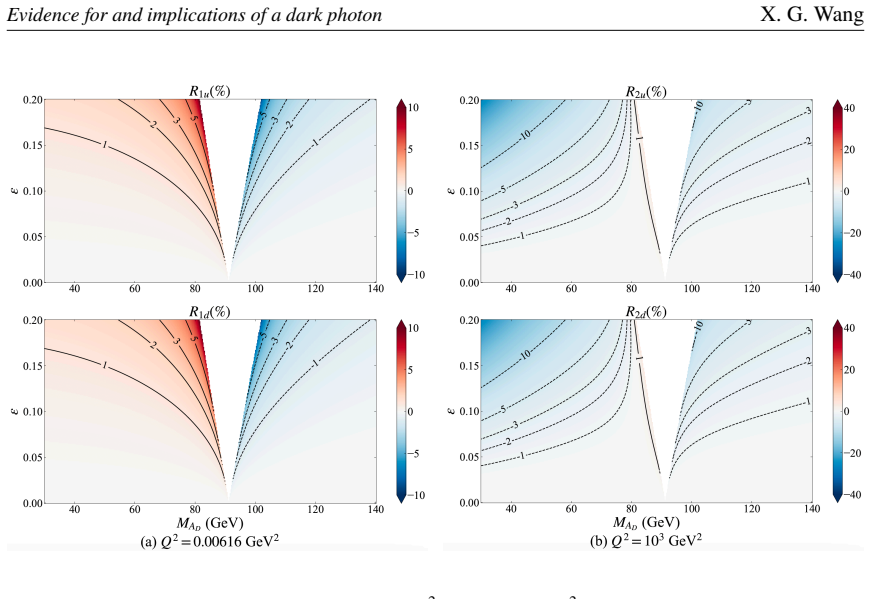
- The dark photon produces up to 5% corrections to the weak neutral-current couplings $C_{1q}$ and $C_{3q}$ at low momentum scales and up to 10% corrections to $C_{2q}$ at $Q^2=10^3$ GeV$^2$, which will be testable in present and planned electron-scattering experiments.
- In the allowed parameter region, dark-photon contributions to $\mathrm{Br}(K_L\to\pi^0\nu\bar\nu)$ are below 1%, so a future large anomaly in this channel would require either new physics beyond a minimally mixed dark photon or additional dark-sector couplings.
- A dark photon that couples to light dark-matter particles with $\mathcal{O}(1)$ coupling avoids current direct search bounds, making the 4--6 GeV, $\epsilon\sim0.06$--0.12 region a concrete target for future collider searches for broad resonances.
- The comparison with a $U(1)_{B-L}$ $Z'$ boson shows that not every new gauge boson improves the global fit, strengthening the case that the signal is specifically a dark photon.
Reading between the lines
- The $6.5\sigma$ significance is computed within a specific parton parametrization and uncertainty procedure; a more flexible parametrization or a full NNLO treatment could shift the significance, so the claim should be re-tested with those upgrades.
- If the dark-photon interpretation is correct, high-luminosity electron-proton scattering could pin down the mass and mixing by mapping the $Q^2$-dependent distortion of the structure functions.
- A dedicated search for a broad resonance in the di-muon or di-electron spectrum between 4 and 6 GeV, rather than the narrow-resonance searches performed so far, would directly confirm or exclude the best-fit region.
- The $\mathcal{O}(1)$ coupling to dark matter that relaxes direct search limits also predicts dark-matter annihilation and direct-detection signals that could be probed in dedicated experiments.
Editorial analysis
A structured set of objections, weighed in public.
Referee Report
Summary. The paper reports on what it calls the first global QCD analysis including a dark photon, claiming an improvement in chi-squared per degree of freedom from 1.05 (baseline) to 1.03 (with the dark photon) over 3283 data points, and a hypothesis-test preference for the dark photon model of 'as much as 6.5 sigma', with best-fit parameters M_AD in (4,6) GeV and epsilon in (0.06,0.12) at 95% CL. It also discusses implications for parity-violating electron scattering, rare kaon decay, and electroweak precision observables, and argues that a large dark-photon coupling to dark matter can relax direct-search constraints. The analysis is a summary of prior work by the same authors (refs [21]-[28]); the statistical test, the full fit methodology, and the uncertainty treatment are not reproduced in this manuscript.
Significance. If the 6.5 sigma preference were established under a rigorously defined statistical test, this would be a major indirect hint for new physics in the gauge sector. The use of a large global dataset (3283 points) with a modern uncertainty treatment (JAM framework with NNPDF-style missing higher-order uncertainties) is a strength, as is the comparison with a U(1)_B-L Z' model that does not improve the fit, which serves as a useful control. However, the central significance claim is not documented in this text, and the pattern of improvements across datasets raises concerns about PDF flexibility and a potential look-elsewhere effect. The implications sections are interesting but largely summarize the authors' earlier work rather than providing new derivations.
major comments (3)
- [Section 2 (hypothesis test paragraph)] The central claim of a 6.5 sigma preference for the dark photon model over the Standard Model is stated without specifying the statistical test. The manuscript does not define the test statistic, the probability distribution used to convert the quoted Delta chi-squared into a significance, whether a full profile likelihood over (M_AD, epsilon) was used, or whether any trials factor for scanning the two-dimensional parameter space was applied. From Table 1, the total Delta chi-squared is approximately 66 for two new parameters; under Wilks' theorem this would correspond to about 7 sigma, while the text quotes 'as much as 6.5 sigma', suggesting a maximum over the scan and thus a need for a look-elsewhere correction. As presented, the significance cannot be reproduced, and this is the load-bearing element of the paper.
- [Section 2, Table 1 and Eq. (5)] The improvement in chi-squared is concentrated in fixed-target DIS and HERA NC (together 2599 of 3283 data points), while Drell-Yan, Z rapidity and jets become slightly worse. This is the pattern expected if the two dark photon parameters are acting as extra flexibility that absorbs deficiencies of the PDF parametrization in Eq. (5) in the low-Q^2 and large-x region, rather than as a coherent physical signal. The manuscript does not provide a control fit in which the SM baseline is given comparable flexibility (e.g., additional PDF parameters, higher-twist or target-mass corrections). Without such a test, the attribution of the Delta chi-squared to a dark photon is not uniquely established.
- [Section 2, discussion following Eq. (6)] The best-fit region (M_AD in (4,6) GeV, epsilon in (0.06,0.12)) is above the direct search limits from BaBar [12] and CMS [14]. The manuscript argues that a coupling of the dark photon to light dark matter particles with g_chi of order unity can broaden the resonance and relax these limits by one to two orders of magnitude, citing Ref. [28]. However, g_chi is not a parameter of the DIS fit, and the relaxed constraints are not quantified in this manuscript; the compatibility of the best-fit region with the relaxed bounds is asserted qualitatively. Because the central claim concerns the existence of a dark photon, this model-dependent reinterpretation should be quantified, or explicitly flagged as a condition on the claim.
minor comments (6)
- [Section 2, near Table 1] The text says 'the values of chi-squared per degree of freedom ... are given in the third column of Tab. 1', but Table 1 has separate dark and baseline columns; this should be 'the second and third columns' or 'the columns'.
- [Abstract and Section 3 heading] The abstract and Section 3 heading contain the typo 'party-violating electron scattering'; this should be 'parity-violating electron scattering'.
- [Section 3.1, Eq. (8)] The symbol M in the definition f_1(x,y) = 1 - y - x y M / (2E) is not defined; presumably it is the nucleon mass, but this should be stated explicitly.
- [Section 3.3, Eq. (16)] The covariance formula 'cov = Sigma_exp * cor * Sigma_exp' is not fully described; the correlation matrix 'cor' should be defined, and the vector notation for V and the experimental values should be made explicit.
- [Throughout] The notation for the dark photon mass is inconsistent: M_AD is used in the text and Eq. (6), while Figure 3 uses 'mAD' and Eq. (2) uses m_{A'}; please unify the notation.
- [Abstract and Conclusion] The phrase 'the first hint for the existence of a dark photon' is stronger than the evidence presented in this manuscript, which relies on a hypothesis test not fully described here; consider softening to 'an indirect hint' or 'a hint from a global QCD analysis'.
Circularity Check
The central 6.5-sigma evidence is an in-sample fit statistic: the dark photon parameters are fitted to the same datasets that are then used to claim model preference, with no trials factor or out-of-sample test.
-
fitted input called prediction
[Section 2, after Eq. (5) and Table 1 (global fit and hypothesis test)]
"The best dark photon fit gave M_AD in (4,6) GeV and epsilon in (0.06,0.12) at 95% CL. However, the improvement in chi^2 is so substantial that if we perform the hypothesis test with M_AD = 3 GeV and epsilon = 0.03, the dark photon model is still preferred over the SM with a significance above 4 sigma."
M_AD and epsilon are free parameters of the fit to the same datasets listed in Table 1 (fixed-target DIS, HERA NC/CC, Drell-Yan, Z rapidity, W asymmetry, jets), chosen to minimize chi^2. The reported preference (up to 6.5 sigma) is the significance of that minimized chi^2 difference, so the 'evidence' is generated by the same in-sample fit that set the parameters. No independent dataset, no trials factor for the two-parameter (M_AD, epsilon) scan, and no penalty for the extra degrees of freedom are described. The 4-sigma test at (3 GeV, 0.03) is also performed after the best-fit region was already known, so it is not an out-of-sample prediction. The model preference is therefore statistically forced by the fit rather than independently predicted.
full rationale
The paper's central quantitative claim is the 6.5-sigma preference for a dark photon. That claim is not derived from first principles or from an independent test: the parameters (M_AD, epsilon) are obtained by minimizing chi^2 on exactly the same datasets whose total chi^2 is then converted into the significance, and the alternative point used for the 4-sigma statement is chosen a posteriori. No trials factor or parameter-count penalty is reported, so the quoted significance is an in-sample fit statistic. This is the fitted-input-called-prediction pattern. The paper's fit machinery is largely imported from the authors' prior work [21], a normal self-citation for a proceedings summary; by itself it is not circular, but it means the present text supplies no independent derivation of the 6.5-sigma number. The remaining sections are not circular: Sections 3.1-3.3 evaluate model consequences as functions of the dark-photon parameters and compare them with independent data or external constraints, and the rare-kaon result (less than 1% correction despite the light-propagator expectation) is a genuine, non-trivial model calculation. Overall score 6 reflects that the central evidence claim reduces to an in-sample fit rather than an independent prediction.
Assumptions & free parameters
free parameters (4)
- M_AD (dark photon mass) =
4 to 6 GeV (95% CL)
- epsilon (kinetic mixing) =
0.06 to 0.12 (95% CL)
- PDF shape parameters (N, alpha, beta, gamma, eta) =
not listed
- g_chi (dark matter coupling) =
constrained, no best-fit value given
assumptions (4)
- domain assumption The NLO QCD framework with JAM Monte Carlo and NNPDF-style missing higher-order uncertainties is a reliable description of all fitted datasets.
- domain assumption The dark photon model with kinetic mixing (Eq. 2) is the only new physics contribution relevant to the fitted data.
- ad hoc to paper The PDF parametrization in Eq. 5 is sufficiently flexible to absorb data discrepancies without mimicking the dark photon signal.
- ad hoc to paper A dark matter coupling of order 1 can broaden the dark photon enough to evade the CMS and BaBar direct search limits.
invented entities (2)
-
Dark photon A'
-
Dark Dirac fermion chi
Cite this review
Pith. "Pith review of Evidence for and implications of a dark photon." pith.science (2026). https://pith.science/paper/GCB57K2Z
@misc{pith2026250621854,
  author       = {Pith},
  title        = {Pith review of: Evidence for and implications of a dark photon},
  year         = {2026},
  howpublished = {\url{https://pith.science/paper/GCB57K2Z}},
  note         = {Machine review of arXiv:2506.21854}
}
abstract
We performed the first global QCD analysis of electron-nucleon deep-inelastic scattering and related high-energy data by including the contribution from a dark photon. Our results revealed a significant reduction in $\chi^2$ relative to the baseline result without new physics. From a hypothesis test, our best dark photon fit is preferred over the Standard Model by as much as $6.5\ \sigma$, providing the first hint for the existence of a dark photon, although indirectly. Additionally, we explored the implications of a dark photon in party-violating electron scattering, rare kaon decay, and the electroweak precision observables. The dark photon as a portal connecting to dark matter particles was also discussed.
Figures


Reference graph
Works this paper leans on
-
[21]
N. T. Hunt-Smith, W. Melnitchouk, N. Sato, A. W. Thomas, X. G. Wang, and M. J. White, Global QCD analysis and dark photons, JHEP09(2023) 096, [arXiv:2302.11126]
arXiv 2023
-
[28]
J. R. Felix, A. W. Thomas, and X. G. Wang,Relaxing constraints on a broad dark photon, arXiv:2505.03241
-
[12]
J. P. Lees et al.,Search for a Dark Photon in𝑒+𝑒− Collisions at BaBar, Phys. Rev. Lett.113 (2014), no. 20 201801, [arXiv:1406.2980]
arXiv 2014
-
[14]
A. M. Sirunyan et al.,Search for a Narrow Resonance Lighter than 200 GeV Decaying to a Pair of Muons in Proton-Proton Collisions at√𝑠= TeV, Phys. Rev. Lett.124 (2020), no. 13 131802, [arXiv:1912.04776]
arXiv 2020
-
[1]
D. P. Aguillard et al.,Measurement of the Positive Muon Anomalous Magnetic Moment to 0.20 ppm,Phys. Rev. Lett.131 (2023), no. 16 161802, [arXiv:2308.06230]
arXiv 2023
-
[2]
T. Aaltonen et al.,High-precision measurement of the𝑊 boson mass with the CDF II detector,Science 376 (2022), no. 6589 170–176
work page 2022
-
[3]
NA62Collaboration, E. Cortina Gil et al.,Observation of the𝐾+→𝜋+𝜈𝜈 decay and measurement of its branching ratio, JHEP02(2025) 191, [arXiv:2412.12015]
arXiv 2025
-
[4]
Adachi et al.,Evidence for B+→K+𝜈𝜈¯ decays,Phys
Belle-II Collaboration, I. Adachi et al.,Evidence for B+→K+𝜈𝜈¯ decays,Phys. Rev. D109 (2024), no. 11 112006, [arXiv:2311.14647]
arXiv 2024
Show all 38 references
-
[5]
Boccaletti et al.,High precision calculation of the hadronic vacuum polarisation contribution to the muon anomaly, arXiv:2407.10913
A. Boccaletti et al.,High precision calculation of the hadronic vacuum polarisation contribution to the muon anomaly, arXiv:2407.10913
-
[6]
Chekhovsky et al.,High-precision measurement of the W boson mass with the CMS experiment at the LHC, arXiv:2412.13872
CMSCollaboration, V. Chekhovsky et al.,High-precision measurement of the W boson mass with the CMS experiment at the LHC, arXiv:2412.13872
-
[7]
Appelquist, B
T. Appelquist, B. A. Dobrescu, and A. R. Hopper,Nonexotic Neutral Gauge Bosons, Phys. Rev. D68(2003) 035012, [hep-ph/0212073]
2003 arXiv
-
[8]
Leike,The Phenomenology of extra neutral gauge bosons,Phys
A. Leike,The Phenomenology of extra neutral gauge bosons,Phys. Rep.317 (1999) 143–250, [hep-ph/9805494]
1999 arXiv
-
[9]
Fayet,Effects of the Spin 1 Partner of the Goldstino (Gravitino) on Neutral Current Phenomenology, Phys
P. Fayet,Effects of the Spin 1 Partner of the Goldstino (Gravitino) on Neutral Current Phenomenology, Phys. Lett. B95(1980) 285–289
1980
-
[10]
Fayet,On the Search for a New Spin 1 Boson,Nucl
P. Fayet,On the Search for a New Spin 1 Boson,Nucl. Phys.B187(1981) 184–204
1981
-
[11]
Holdom,Two U(1)’s and Epsilon Charge Shifts,Phys
B. Holdom,Two U(1)’s and Epsilon Charge Shifts,Phys. Lett. B166 (1986) 196–198
1986
-
[13]
Aaij et al.,Search for𝐴′→𝜇+𝜇− Decays, Phys
R. Aaij et al.,Search for𝐴′→𝜇+𝜇− Decays, Phys. Rev. Lett.124 (2020), no. 4 041801, [arXiv:1910.06926]
2020
-
[15]
Pospelov,Secluded U(1) below the weak scale, Phys
M. Pospelov,Secluded U(1) below the weak scale, Phys. Rev. D80(2009) 095002, [arXiv:0811.1030]. 9 Evidence for and implications of a dark photon X. G. Wang
2009 arXiv
-
[16]
A. Hook, E. Izaguirre, and J. G. Wacker,Model Independent Bounds on Kinetic Mixing,Adv. High Energy Phys.2011(2011) 859762, [arXiv:1006.0973]
2011 arXiv
-
[17]
Curtin, R
D. Curtin, R. Essig, S. Gori, and J. Shelton,Illuminating Dark Photons with High-Energy Colliders, JHEP02(2015) 157, [arXiv:1412.0018]
2015 arXiv
-
[18]
G. D. Kribs, D. McKeen, and N. Raj,Breaking up the Proton: An Affair with Dark Forces, Phys. Rev. Lett.126 (2021), no. 1 011801, [arXiv:2007.15655]
2021 arXiv
-
[19]
A. W. Thomas, X. G. Wang, and A. G. Williams,Constraints on the dark photon from deep inelastic scattering,Phys. Rev. D105(2022), no. 3 L031901, [arXiv:2111.05664]
2022 arXiv
-
[20]
Yan,Probing the dark photon via polarized DIS scattering at the HERA and EIC, Phys
B. Yan,Probing the dark photon via polarized DIS scattering at the HERA and EIC, Phys. Lett. B833 (2022) 137384, [arXiv:2203.01510]
2022 arXiv
-
[22]
A. W. Thomas, X. G. Wang, and A. G. Williams,Sensitivity of Parity-Violating Electron Scattering to a Dark Photon, Phys. Rev. Lett.129 (2022), no. 1 011807, [arXiv:2201.06760]
2022 arXiv
-
[23]
Wang and A
X.-G. Wang and A. W. Thomas,Dark photon effect on the rare kaon decay, J. Phys. G50 (2023), no. 8 085001, [arXiv:2301.08367]
2023 arXiv
-
[24]
B. M. Loizos, X. G. Wang, A. W. Thomas, M. J. White, and A. G. Williams,Constraints on the dark sector from electroweak precision observables,J. Phys. G51(2024), no. 7 075002, [arXiv:2306.13408]
2024 arXiv
-
[25]
Cocuzza, W
C. Cocuzza, W. Melnitchouk, A. Metz, and N. Sato,Bayesian Monte Carlo extraction of the sea asymmetry with SeaQuest and STAR data,Phys. Rev. D104 (2021), no. 7 074031, [arXiv:2109.00677]
2021 arXiv
-
[26]
Abdul Khalek et al.,Parton Distributions with Theory Uncertainties: General Formalism and First Phenomenological Studies, Eur
NNPDFCollaboration, R. Abdul Khalek et al.,Parton Distributions with Theory Uncertainties: General Formalism and First Phenomenological Studies, Eur. Phys. J. C79 (2019), no. 11 931, [arXiv:1906.10698]
2019 arXiv
-
[27]
[JAM collaboration (BSM Analysis Group)]Collaboration, X. G. Wang, N. T. Hunt-Smith, W.Melnitchouk, N.Sato, andA.W.Thomas, ConstraintsontheU(1)B-Lmodel from global QCD analysis,Phys. Rev. D111(2025), no. 1 015019, [arXiv:2410.01205]
2025 arXiv
-
[29]
Erler and S
J. Erler and S. Su,The Weak Neutral Current,Prog. Part. Nucl. Phys.71 (2013) 119–149, [arXiv:1303.5522]. 10 Evidence for and implications of a dark photon X. G. Wang
2013 arXiv
-
[30]
Zheng, J
X. Zheng, J. Erler, Q. Liu, and H. Spiesberger,Accessing weak neutral-current coupling𝑔𝑒𝑞 𝐴𝐴 using positron and electron beams at Jefferson Lab,Eur. Phys. J. A57(2021), no. 5 173, [arXiv:2103.12555]
2021 arXiv
-
[31]
A. W. Thomas, X. G. Wang, and A. G. Williams,Dark photon in parity-violating electron scatterings, in16th Conference on Quark Confinement and the Hadron Spectrum, 5, 2025. arXiv:2505.07279
2025 arXiv
-
[32]
JeffersonLabSoLID Collaboration,J.Arringtonetal., Thesolenoidallargeintensitydevice (SoLID) for JLab 12 GeV, J. Phys. G50 (2023), no. 11 110501, [arXiv:2209.13357]
2023 arXiv
-
[33]
A. J. Buras and E. Venturini,The exclusive vision of rare K and B decays and of the quark mixing in the standard model,Eur. Phys. J. C82(2022), no. 7 615, [arXiv:2203.11960]
2022 arXiv
-
[34]
KOTOCollaboration, J. K. Ahn et al.,Search for the KL→𝜋0𝜈𝜈¯ Decay at the J-PARC KOTO Experiment,Phys. Rev. Lett.134 (2025), no. 8 081802, [arXiv:2411.11237]
2025 arXiv
-
[35]
Buchalla, A
G. Buchalla, A. J. Buras, and M. E. Lautenbacher,Weak decays beyond leading logarithms, Rev. Mod. Phys.68(1996) 1125–1144, [hep-ph/9512380]
1996 arXiv
-
[36]
Fabbrichesi, E
M. Fabbrichesi, E. Gabrielli, and G. Lanfranchi,The Dark Photon, arXiv:2005.01515
2005 arXiv
-
[37]
Filippi and M
A. Filippi and M. De Napoli,Searching in the dark: the hunt for the dark photon,Rev. Phys. 5 (2020) 100042, [arXiv:2006.04640]
2020 arXiv
-
[38]
Navas et al.,Review of particle physics,Phys
Particle Data GroupCollaboration, S. Navas et al.,Review of particle physics,Phys. Rev. D 110 (2024), no. 3 030001. 11
2024
Reviewed August 6, 2026 · model on record in the stance chip above.
Discussion (0). Sign in to comment.