REVIEW 4 major objections 4 minor 53 references
ALSA: Anchors in Logit Space for Out-of-Distribution Accuracy Estimation
T0 review · 4 major / 4 minor · reviewed 2026-08-05 · deepseek-v4-flash
Pith's one-line read A handful of learnable anchors in logit space can estimate a model's accuracy on unlabeled, shifted data without any target labels.
desk verdict ALSA is a practical, empirically strong accuracy estimator that is genuinely new in mechanism, but its theory is thin and its 'wide range' claim runs ahead of what the benchmarks actually test. read the letter →
The pith
A machine-rendered reading of the paper's core claim, the machinery that carries it, and where it could break.
The reading
What carries the argument
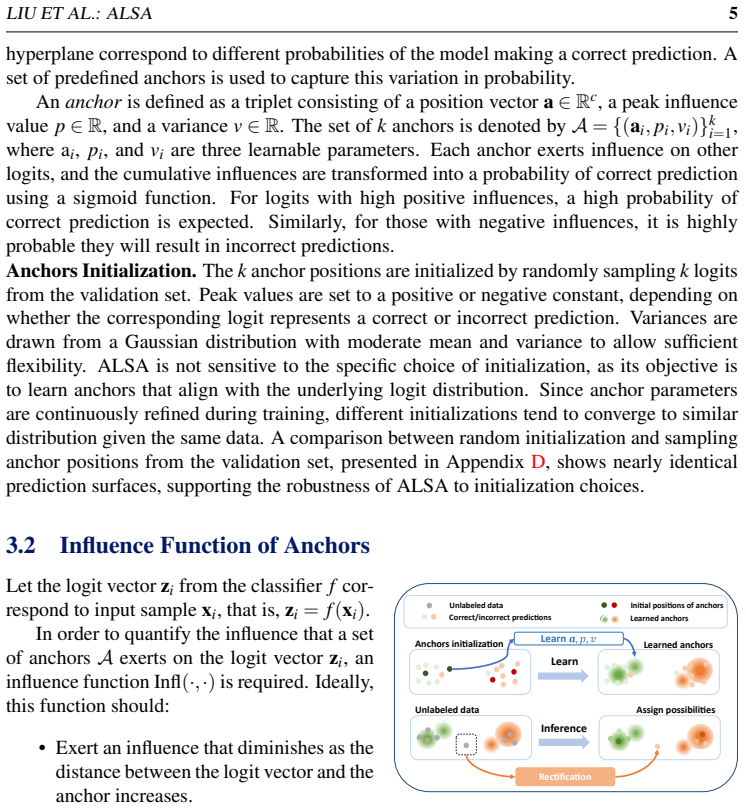
The central object is a set of anchor triplets (position a, peak influence p, variance v) in logit space, combined through a Gaussian-like influence function that decays with cosine distance from the anchor. The total influence from all anchors is mapped by a sigmoid into a per-sample probability of correct prediction, and the average of these probabilities is the accuracy estimate. The band-width proposition justifies the geometric assumption that logits concentrate near a hyperplane, while the rectification threshold, derived from a confidence interval through the inverse error function, handles low-influence regions where the estimate would otherwise revert to an uninformative 50%.
What would settle it
Construct a target set by taking source validation logits and relabeling a contiguous region of logit space as incorrect while leaving the marginal logit distribution unchanged, so that p(correct|z) differs between source and target. ALSA, whose anchors were trained on the unaltered source labels, would then estimate accuracy by averaging correctness probabilities from the source surface, and the deviation between its estimate and the relabeled target accuracy would be roughly the probability mass of the relabeled region.
Extended reading notes
Core claim
The paper claims that a classifier's logits lie in a narrow band around a (c-1)-dimensional hyperplane perpendicular to the all-ones vector, and that within that band a logit's position carries reliable information about whether the prediction will be correct. ALSA formalizes this by initializing k learnable anchors in logit space, each defined by a position vector, a signed peak influence, and a variance controlling how far its influence reaches. The total influence from all anchors is passed through a sigmoid to give the probability that the corresponding sample is correctly predicted. The estimated accuracy on an unlabeled target set is the average of these per-sample probabilities, with
Load-bearing premise
The anchors are learned on the source validation set and applied to the target set, so ALSA works only if the probability of a correct prediction given a logit vector is approximately the same in source and target; the paper notes this can break down under extremely severe corruptions.
Editorial extensions
If this is right
- If ALSA's central claim holds, deployed models can be monitored on unlabeled test data by averaging per-sample correctness probabilities derived from logit positions, without needing target labels.
- Avoiding softmax compression preserves logit magnitude information, which should improve estimates in settings where class distributions are imbalanced and where accuracy differs across regions of logit space.
- The same anchor mechanism transfers across vision, language, and graph models, suggesting a general-purpose estimator rather than a domain-specific similarity score.
- Because inference scales linearly with the number of samples and anchors, the method could be used in production monitoring with modest compute overhead.
- ALSA is reported to remain accurate even when true accuracy drops by over 30% under synthetic corruptions, and to keep mean absolute error below the levels where several baselines fail on at least one dataset.
Reading between the lines
- Beyond the paper, the learned anchor surface could double as a principled confidence or selective-classification score, since it assigns a calibrated correctness probability to every logit region rather than a single global threshold.
- The disclosed assumption that p(correct|z) aligns between source and target suggests ALSA should be stress-tested under explicit label shift, where the same logit region may have different correctness rates; the paper's benchmarks cover covariate-like shifts more than pure label shifts.
- If anchor positions and peak values converge to the same distribution regardless of initialization, as the paper argues, then the anchor set is effectively approximating an underlying correctness surface, which would make ALSA a candidate building block for other logit-based analyses such as OOD detection.
- The influence-based aggregation could be extended to produce per-class accuracy estimates, which the current average-based estimate does not directly expose, potentially aiding debugging of skewed classifiers.
Editorial analysis
A structured set of objections, weighed in public.
Referee Report
Summary. ALSA estimates the accuracy of a classifier on an unlabeled target dataset by placing k learnable anchors in logit space, each with a peak value and variance, and defining the per-sample correctness probability as the sigmoid of the sum of Gaussian-like or exponential influence functions. The anchors are trained on a labeled source validation set by binary cross-entropy (Eq. (9)); the target accuracy estimate is the average of these probabilities over target logits (Eq. (7)), with a rectification for low-influence regions. The method is evaluated on vision, language, and graph benchmarks—CIFAR-10/100C, CIFAR-10.1/10.2, ImageNetV2, MNIST-M, Office-31, Waterbirds/Amazon WILDS, and ogbn-arxiv—across multiple architectures, reporting MAE and correlation against baselines (AC, DoC, IM, ATC, COT, GNNEval). Code is released.
Significance. If the empirical results hold, ALSA is a practical, unified OOD accuracy estimator with a favorable accuracy/efficiency trade-off. The paper's strengths include a broad multi-modal evaluation, ablations of learnable components, sensitivity analyses for alpha and anchor count, and a complexity analysis; the release of code is a plus. The main limitation is that the method's core assumption—that p(correct|z) transfers from source to target—is only tested indirectly, and one proposition is not proven for trained networks. The contribution is significant for the accuracy-estimation subfield if that assumption and the reported results are made explicit and properly scoped.
major comments (4)
- [Section 3.3 / 3.4, Appendix I.3, H.2] The target estimator is a plug-in for E_{P_T}[p_S(correct|Z)]: anchors are fit on source validation via Eq. (9), and Eq. (7) evaluates that source-fitted function on target logits. The method is therefore unbiased only if p_T(correct|z)=p_S(correct|z) on the support of the target logits. The paper acknowledges this in Appendix I.3 but only as a caveat for extreme corruptions. None of the main benchmarks induces a genuine conditional shift: CIFAR-C, MNIST-M, and Office-31 are covariate shifts; WILDS changes group frequencies with a stable labeling function; the class-imbalance training in H.2 (1:3) is mild. Thus the claim of robustness 'across a wide range of distribution shifts' is under-tested. I recommend adding an experiment that changes the label prior or labeling function (e.g., label shift with rebalanced target classes, or a synthetic shift that changes class confusability) and sc
- [Section 2.2 / Appendix B] Proposition 1 derives a bandwidth bound for a randomly initialized linear layer with W ~ N(0, sigma_W), b=0, and Xavier initialization. The text then argues that training updates are confined to directions orthogonal to the all-ones vector, but no proof shows that the magnitude bound (Bandwidth < 4z sqrt(1/(m+c))) persists after training. Since ALSA is applied to trained networks, the proposition as stated does not cover the setting of interest. It should either be explicitly labeled as an initialization-only observation or supplemented by an empirical/theoretical argument for trained networks.
- [Section 3.3 vs Appendix E] There is an inconsistency in the rectification condition. Eq. (8) defines insufficient influence as |Infl(z_i, A)| < t, where Infl(z_i, A) is the total influence from all anchors, while Appendix E defines it as |Infl(z_i, (a_j,p_j,v_j))| < t for all j individually. These are different conditions and can lead to different predictions. In addition, Section 3.3 leaves t in terms of a per-anchor p, while Appendix E fixes p=6 to obtain a unified threshold; anchors with smaller learned p are then treated with the same threshold. The paper should state which condition is implemented and justify the unified p=6 threshold given that p is a learned parameter.
- [Appendix J / main experiments] The paper does not report the alpha value used for Tables 1 and 2. This hyperparameter controls when low-influence logits are replaced by 1/c and is shown in Appendix J to affect MAE substantially at extreme values. For reproducibility, the alpha values (and anchor counts) for each benchmark should be listed in the main text or in an experiment-setting table. The code release is helpful, but the paper itself should specify the default configuration.
minor comments (4)
- [Section 3.3 / 3.4] Eq. (6) defines an 'initial' accuracy estimate before rectification, and Eq. (7) the final one. Section 3.4's stopping criterion uses p_true from Eq. (6) but does not explicitly state whether p_rec from Eq. (7) is used during training. Please clarify.
- [Table 3, GIN row] ALSA obtains R^2 = -0.32 and Pearson r = 0.46 on GIN, which is lower than several baselines' correlation coefficients. The sentence 'consistently achieves high correlation scores across models' is too strong and should be qualified, or the authors should explain why R^2 is negative (e.g., small variance in true accuracy across test years).
- [Table 1, Office-31] Office-31 results have very large standard deviations (e.g., 15.29 for AC, 33.25 for ATC). Consider reporting per-domain results separately or discussing this instability, since the averaged MAE may be dominated by a few seeds/domains.
- [Figure 11] Figure 11 reports MSE (mean squared error) while Tables 1 and 2 use MAE. Please use one metric consistently to avoid confusion.
Circularity Check
No significant circularity: source-fitted anchors are applied out-of-sample to unlabeled target logits; the disclosed conditional-alignment assumption is a limitation, not a circular step.
full rationale
The derivation is self-contained as an out-of-sample estimator. Anchors are learned on the labeled source validation set by minimizing the BCE loss in Eq. (9); the target accuracy estimate in Eq. (7) averages the sigmoid of summed anchor influences (Eqs. (1)-(4), with rectification in Eq. (8)) over target logits only. No target labels or target accuracy enter training or inference. The stopping rule in Eq. (10) compares predicted and true accuracy on the validation set, so it is a model-selection signal, not a constraint on the target estimate. Appendix I.3 discloses the method's reliance on approximate alignment of p(y|z) between source and target and notes it can weaken under extreme corruption; this is an honest scoping limitation, not a circular reduction. The only author self-citations ([45,46]) appear in a related-work enumeration and are not load-bearing for ALSA's claims. I find no step where a fitted parameter is renamed as a target prediction or where a prediction reduces by construction to its inputs.
Assumptions & free parameters
free parameters (4)
- confidence interval alpha =
not reported; appendix sweeps 0.7-0.999
- number of anchors k =
3000 (CIFAR10/100), 20000 (ImageNet), 5000 (Amazon-WILDS), 500 (Waterbirds), 3000 (MNIST), 300 (Office-31)
- peak value p =
6
- influence function choice =
Gaussian-like vs exponential
assumptions (5)
- domain assumption Logits from trained classifiers lie near a hyperplane perpendicular to the all-ones vector (bandwidth bound).
- ad hoc to paper Correctness probability is a smooth function of logit position, well approximated by a sum of Gaussian-like influences.
- domain assumption Approximate alignment of p(y|z) between source and target (covariate shift).
- ad hoc to paper Cosine distance is an appropriate similarity measure in logit space.
- standard math Validation set is representative of the source distribution and large enough to learn anchors.
Cite this review
Pith. "Pith review of ALSA: Anchors in Logit Space for Out-of-Distribution Accuracy Estimation." pith.science (2026). https://pith.science/paper/GCH6GTNW
@misc{pith2026250819613,
  author       = {Pith},
  title        = {Pith review of: ALSA: Anchors in Logit Space for Out-of-Distribution Accuracy Estimation},
  year         = {2026},
  howpublished = {\url{https://pith.science/paper/GCH6GTNW}},
  note         = {Machine review of arXiv:2508.19613}
}
read the original abstract
Estimating model accuracy on unseen, unlabeled datasets is crucial for real-world machine learning applications, especially under distribution shifts that can degrade performance. Existing methods often rely on predicted class probabilities (softmax scores) or data similarity metrics. While softmax-based approaches benefit from representing predictions on the standard simplex, compressing logits into probabilities leads to information loss. Meanwhile, similarity-based methods can be computationally expensive and domain-specific, limiting their broader applicability. In this paper, we introduce ALSA (Anchors in Logit Space for Accuracy estimation), a novel framework that preserves richer information by operating directly in the logit space. Building on theoretical insights and empirical observations, we demonstrate that the aggregation and distribution of logits exhibit a strong correlation with the predictive performance of the model. To exploit this property, ALSA employs an anchor-based modeling strategy: multiple learnable anchors are initialized in logit space, each assigned an influence function that captures subtle variations in the logits. This allows ALSA to provide robust and accurate performance estimates across a wide range of distribution shifts. Extensive experiments on vision, language, and graph benchmarks demonstrate ALSA's superiority over both softmax- and similarity-based baselines. Notably, ALSA's robustness under significant distribution shifts highlights its potential as a practical tool for reliable model evaluation.
Figures


Figures from the paper (8 more)


Reference graph
Works this paper leans on
-
[1]
L.C. Andrews. Special Functions of Mathematics for Engineers . Online access with subscription: SPIE Digital Library. SPIE Optical Engineering Press, 1998. ISBN 9780819426161. URL https://books.google.com.au/books?id= 2CAqsF-RebgC
work page 1998
-
[2]
Christina Baek, Yiding Jiang, Aditi Raghunathan, and J. Zico Kolter. Agreement-on- the-line: Predicting the performance of neural networks under distribution shift. In NeurIPS, 2022
work page 2022
-
[3]
Chen, Karan Goel, Nimit Sharad Sohoni, Fait Poms, Kayvon Fatahalian, and Christopher Ré
Mayee F. Chen, Karan Goel, Nimit Sharad Sohoni, Fait Poms, Kayvon Fatahalian, and Christopher Ré. Mandoline: Model evaluation under distribution shift. In ICML, 2021
work page 2021
-
[4]
Imagenet: A large-scale hierarchical image database
Jia Deng, Wei Dong, Richard Socher, Li-Jia Li, Kai Li, and Li Fei-Fei. Imagenet: A large-scale hierarchical image database. In CVPR, 2009
2009
-
[5]
Are labels always necessary for classifier accuracy evaluation? In CVPR, 2021
Weijian Deng and Liang Zheng. Are labels always necessary for classifier accuracy evaluation? In CVPR, 2021
work page 2021
-
[6]
Weijian Deng, Stephen Gould, and Liang Zheng. What does rotation prediction tell us about classifier accuracy under varying testing environments? In ICML, 2021
work page 2021
-
[7]
Weijian Deng, Yumin Suh, Stephen Gould, and Liang Zheng. Confidence and disper- sity speak: Characterizing prediction matrix for unsupervised accuracy estimation. In ICML, 2023
work page 2023
-
[8]
Implicit generation and modeling with energy based models
Yilun Du and Igor Mordatch. Implicit generation and modeling with energy based models. NeurIPS, 2019
work page 2019
Show all 53 references
-
[9]
On out- of-distribution detection with energy-based models
Sven Elflein, Bertrand Charpentier, Daniel Zügner, and Stephan Günnemann. On out- of-distribution detection with energy-based models. CoRR, abs/2107.08785, 2021
2021 arXiv
-
[10]
Leveraging unlabeled data to predict out-of-distribution perfor- mance
Saurabh Garg, Sivaraman Balakrishnan, Zachary Chase Lipton, Behnam Neyshabur, and Hanie Sedghi. Leveraging unlabeled data to predict out-of-distribution perfor- mance. In ICLR, 2022
2022
-
[11]
Selective classification for deep neural networks
Yonatan Geifman and Ran El-Yaniv. Selective classification for deep neural networks. In NIPS, 2017
2017
-
[12]
Wich- mann, and Wieland Brendel
Robert Geirhos, Patricia Rubisch, Claudio Michaelis, Matthias Bethge, Felix A. Wich- mann, and Wieland Brendel. Imagenet-trained cnns are biased towards texture; increas- ing shape bias improves accuracy and robustness. In ICLR, 2019
2019
-
[13]
Understanding the difficulty of training deep feed- forward neural networks
Xavier Glorot and Yoshua Bengio. Understanding the difficulty of training deep feed- forward neural networks. In AISTATS, 2010
2010
-
[14]
Goodfellow, Yoshua Bengio, and Aaron C
Ian J. Goodfellow, Yoshua Bengio, and Aaron C. Courville.Deep learning. MIT Press, 2016
2016
-
[15]
Your classifier is secretly an energy based model and you should treat it like one
Will Grathwohl, Kuan-Chieh Wang, Jörn-Henrik Jacobsen, David Duvenaud, Moham- mad Norouzi, and Kevin Swersky. Your classifier is secretly an energy based model and you should treat it like one. In ICLR, 2020. 12 LIU ET AL.: ALSA
2020
-
[16]
Predicting with confidence on unseen distributions
Devin Guillory, Vaishaal Shankar, Sayna Ebrahimi, Trevor Darrell, and Ludwig Schmidt. Predicting with confidence on unseen distributions. In ICCV, pages 1134– 1144, 2021
2021
-
[17]
Weinberger
Chuan Guo, Geoff Pleiss, Yu Sun, and Kilian Q. Weinberger. On calibration of modern neural networks. In ICML, 2017
2017
-
[18]
Hamilton, Zhitao Ying, and Jure Leskovec
William L. Hamilton, Zhitao Ying, and Jure Leskovec. Inductive representation learn- ing on large graphs. In NeurIPS, 2017
2017
-
[19]
Haibo He and Edwardo A. Garcia. Learning from imbalanced data. TKDE, 2009
2009
-
[20]
Deep residual learning for image recognition
Kaiming He, Xiangyu Zhang, Shaoqing Ren, and Jian Sun. Deep residual learning for image recognition. In CVPR, 2016
2016
-
[21]
Dietterich
Dan Hendrycks and Thomas G. Dietterich. Benchmarking neural network robustness to common corruptions and perturbations. CoRR, 2019
2019
-
[22]
A baseline for detecting misclassified and out-of- distribution examples in neural networks
Dan Hendrycks and Kevin Gimpel. A baseline for detecting misclassified and out-of- distribution examples in neural networks. In ICLR, 2016
2016
-
[23]
Open graph benchmark: Datasets for machine learning on graphs
Weihua Hu, Matthias Fey, Marinka Zitnik, Yuxiao Dong, Hongyu Ren, Bowen Liu, Michele Catasta, and Jure Leskovec. Open graph benchmark: Datasets for machine learning on graphs. In NeurIPS, 2020
2020
-
[24]
Guan, and Maya R
Heinrich Jiang, Been Kim, Melody Y . Guan, and Maya R. Gupta. To trust or not to trust a classifier. In NeurIPS, 2018
2018
-
[25]
Zico Kolter
Yiding Jiang, Vaishnavh Nagarajan, Christina Baek, and J. Zico Kolter. Assessing generalization of sgd via disagreement. In ICLR, 2022
2022
-
[26]
Kipf and Max Welling
Thomas N. Kipf and Max Welling. Semi-supervised classification with graph convolu- tional networks. In ICLR, 2017
2017
-
[27]
Haque, Sara M
Pang Wei Koh, Shiori Sagawa, Henrik Marklund, Sang Michael Xie, Marvin Zhang, Akshay Balsubramani, Weihua Hu, Michihiro Yasunaga, Richard Lanas Phillips, Irena Gao, Tony Lee, Etienne David, Ian Stavness, Wei Guo, Berton Earnshaw, Imran S. Haque, Sara M. Beery, Jure Leskovec, A...
2021
-
[28]
Haque, Sara M
Pang Wei Koh, Shiori Sagawa, Henrik Marklund, Sang Michael Xie, Marvin Zhang, Akshay Balsubramani, Weihua Hu, Michihiro Yasunaga, Richard Lanas Phillips, Irena Gao, Tony Lee, Etienne David, Ian Stavness, Wei Guo, Berton Earnshaw, Imran S. Haque, Sara M. Beery, Jure Leskovec, A...
2021
-
[29]
Domain adaptation by mixture of align- ments of second-or higher-order scatter tensors
Piotr Koniusz, Yusuf Tas, and Fatih Porikli. Domain adaptation by mixture of align- ments of second-or higher-order scatter tensors. In CVPR, 2017. LIU ET AL.: ALSA 13
2017
-
[30]
Learning multiple layers of features from tiny images
Alex Krizhevsky. Learning multiple layers of features from tiny images. Technical report, University of Toronto, 2009. URL https://www.cs.toronto.edu/ ~kriz/learning-features-2009-TR.pdf
2009
-
[31]
Shiyu Liang, Yixuan Li, and R. Srikant. Enhancing the reliability of out-of-distribution image detection in neural networks. In ICLR, 2018
2018
-
[32]
Decoupled weight decay regularization
Ilya Loshchilov and Frank Hutter. Decoupled weight decay regularization. In ICLR, 2019
2019
-
[33]
Harder or different? a closer look at distribution shift in dataset reproduction
Shangyun Lu, Bradley Nott, Aaron Olson, Alberto Todeschini, Hossein Vahabi, Yair Carmon, and Ludwig Schmidt. Harder or different? a closer look at distribution shift in dataset reproduction. In ICML Workshop on Uncertainty and Robustness in Deep Learning, volume 5, page 15, 2020
2020
-
[34]
Yuzhe Lu, Yilong Qin, Runtian Zhai, Andrew Shen, Ketong Chen, Zhenlin Wang, So- heil Kolouri, Simon Stepputtis, Joseph Campbell, and Katia P. Sycara. Characterizing out-of-distribution error via optimal transport. NeurIPS, 2023
2023
-
[35]
Accuracy on the line: on the strong correlation between out-of-distribution and in-distribution generalization
John Miller, Rohan Taori, Aditi Raghunathan, Shiori Sagawa, Pang Wei Koh, Vaishaal Shankar, Percy Liang, Yair Carmon, and Ludwig Schmidt. Accuracy on the line: on the strong correlation between out-of-distribution and in-distribution generalization. In ICML, 2021
2021
-
[36]
Distributional generalization: A new kind of generalization
Preetum Nakkiran and Yamini Bansal. Distributional generalization: A new kind of generalization. CoRR, abs/2009.08092, 2020
2009 arXiv
-
[37]
Yang, Zachary DeVito, Martin Raison, Alykhan Tejani, Sasank Chilamkurthy, Benoit Steiner, Lu Fang, Junjie Bai, and Soumith Chin- tala
Adam Paszke, Sam Gross, Francisco Massa, Adam Lerer, James Bradbury, Gregory Chanan, Trevor Killeen, Zeming Lin, Natalia Gimelshein, Luca Antiga, Alban Des- maison, Andreas Köpf, Edward Z. Yang, Zachary DeVito, Martin Raison, Alykhan Tejani, Sasank Chilamkurthy, Benoit Steiner...
2019
-
[38]
Torchvision models
PyTorch. Torchvision models. https://pytorch.org/vision/main/ models.html, 2024. Accessed: 2024-09-21
2024
-
[39]
Do cifar- 10 classifiers generalize to cifar-10? CoRR, 2018
Benjamin Recht, Rebecca Roelofs, Ludwig Schmidt, and Vaishaal Shankar. Do cifar- 10 classifiers generalize to cifar-10? CoRR, 2018
2018
-
[40]
Do ima- genet classifiers generalize to imagenet? In ICML, 2019
Benjamin Recht, Rebecca Roelofs, Ludwig Schmidt, and Vaishaal Shankar. Do ima- genet classifiers generalize to imagenet? In ICML, 2019
2019
-
[41]
Hashimoto, and Percy Liang
Shiori Sagawa, Pang Wei Koh, Tatsunori B. Hashimoto, and Percy Liang. Distribution- ally robust neural networks for group shifts: On the importance of regularization for worst-case generalization. CoRR, 2019
2019
-
[42]
Distilbert, a dis- tilled version of bert: Smaller, faster, cheaper and lighter
Victor Sanh, Lysandre Debut, Julien Chaumond, and Thomas Wolf. Distilbert, a dis- tilled version of bert: Smaller, faster, cheaper and lighter. CoRR, 2019
2019
-
[43]
Long-tailed classification by keeping the good and removing the bad momentum causal effect
Kaihua Tang, Jianqiang Huang, and Hanwang Zhang. Long-tailed classification by keeping the good and removing the bad momentum causal effect. In NeurIPS, 2020. 14 LIU ET AL.: ALSA
2020
-
[44]
Graph attention networks
Petar Velickovic, Guillem Cucurull, Arantxa Casanova, Adriana Romero, Pietro Liò, and Yoshua Bengio. Graph attention networks. In ICLR, 2018
2018
-
[45]
GOLD: graph out-of- distribution detection via implicit adversarial latent generation
Danny Wang, Ruihong Qiu, Guangdong Bai, and Zi Huang. GOLD: graph out-of- distribution detection via implicit adversarial latent generation. In ICLR, 2025
2025
-
[46]
Text meets topology: Rethinking out-of-distribution detection in text-rich networks
Danny Wang, Ruihong Qiu, Guangdong Bai, and Zi Huang. Text meets topology: Rethinking out-of-distribution detection in text-rich networks. CoRR, abs/2508.17690, 2025
2025 arXiv
-
[47]
How powerful are graph neural networks? In ICLR, 2018
Keyulu Xu, Weihua Hu, Jure Leskovec, and Stefanie Jegelka. How powerful are graph neural networks? In ICLR, 2018
2018
-
[48]
Predicting out-of-distribution error with the projection norm
Yaodong Yu, Zitong Yang, Alexander Wei, Yi Ma, and Jacob Steinhardt. Predicting out-of-distribution error with the projection norm. In ICML, 2022
2022
-
[49]
Deep structured energy based models for anomaly detection
Shuangfei Zhai, Yu Cheng, Weining Lu, and Zhongfei Zhang. Deep structured energy based models for anomaly detection. In ICML, 2016
2016
-
[50]
Hybrid models for open set recog- nition
Hongjie Zhang, Ang Li, Jie Guo, and Yanwen Guo. Hybrid models for open set recog- nition. In ECCV, 2020
2020
-
[51]
Gonzalez, Alberto L
Sicheng Zhao, Xiangyu Yue, Shanghang Zhang, Bo Li, Han Zhao, Bichen Wu, Ravi Krishna, Joseph E. Gonzalez, Alberto L. Sangiovanni-Vincentelli, Sanjit A. Seshia, and Kurt Keutzer. A review of single-source deep unsupervised visual domain adaptation. IEEE Trans. Neural Networks L...
2022
-
[52]
Gnnevaluator: Evaluating GNN performance on unseen graphs without labels
Xin Zheng, Miao Zhang, Chunyang Chen, Soheila Molaei, Chuan Zhou, and Shirui Pan. Gnnevaluator: Evaluating GNN performance on unseen graphs without labels. In NeurIPS, 2023. LIU ET AL.: ALSA 15 Appendix A Related Work This section reviews methods of detecting out-of-distributi...
2023
-
[2020]
I Detailed Experiment Results I.1 Full Table of Vision and Language Datasets Results Comprehensive experiments were conducted on vision and language datasets
For all models, the Adam optimizer was used with a fixed learning rate of 10 −2 and a weight decay of 5 × 10⁻⁴, along with early stopping if validation accuracy did not improve after 20 epochs. I Detailed Experiment Results I.1 Full Table of Vision and Language Datasets Result...
2015
Reviewed August 5, 2026 · model on record in the stance chip above.
Discussion (0). Continue with ORCID to comment.