REVIEW 3 major objections 5 minor 16 references
A 2-Stage Model for Vehicle Class and Orientation Detection with Photo-Realistic Image Generation
T0 review · 3 major / 5 minor · reviewed 2026-08-07 · deepseek-v4-flash
Pith's one-line read A two-stage detector with binary localization, CUT photo-realistic translation, and an EfficientNet ensemble reports WmAP of 0.365 on the 2022 VOD challenge, up from 0.284 for synthetic-only YOLOv5.
desk verdict A credible challenge pipeline with a clean two-stage design, but the CUT photo-realism claim is underdetermined by a confounded comparison. read the letter →
The pith
A machine-rendered reading of the paper's core claim, the machinery that carries it, and where it could break.
The reading
What carries the argument
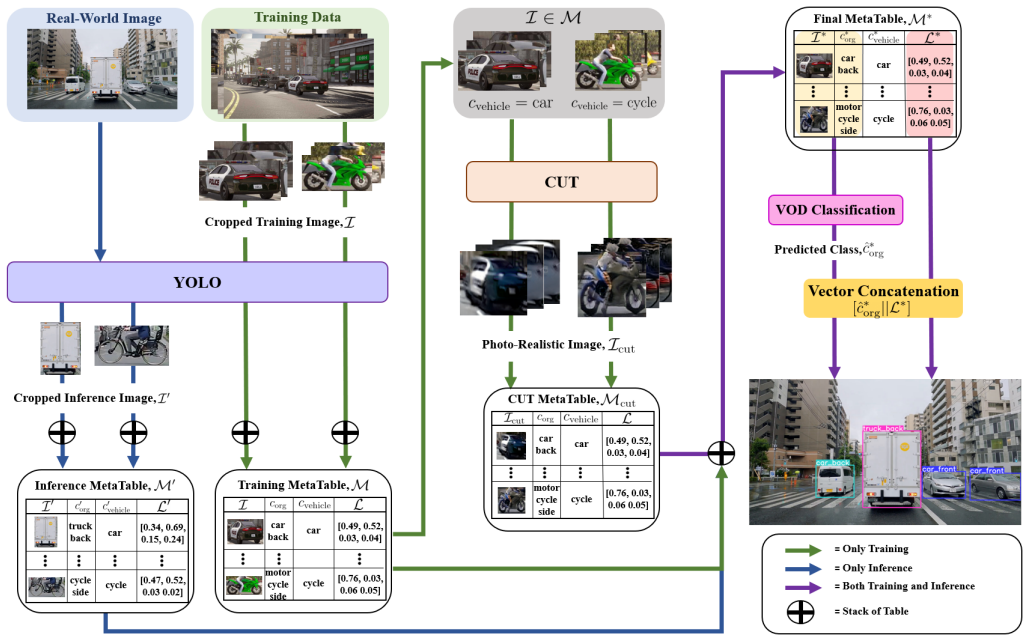
The load-bearing object is the meta-table $M$, a per-object dictionary $M_i = [I_i, x_i, y_i, w_i, h_i, c_i^{org}, c_i^{vehicle}]$ that stacks cropped images, location, and both a 12-way and a binary label for every training object. The pipeline trains YOLOv5 only on the binary car/motorcycle label to obtain location proposals, applies CUT to convert the synthetic crops into photo-realistic images, merges original and translated crops into a final meta-table, and trains an ensemble of EfficientNet-B7 classifiers on it to predict the 12 class-orientation classes. The design isolates the hard imbalanced classification from localization and uses style translation to make the classifier see images closer to the real test distribution.
What would settle it
Run an ablation of the same two-stage pipeline with the CUT translation removed, keeping binary YOLOv5 localization and the EfficientNet ensemble; if the weighted score stays near 0.365, the photo-realistic generation step is not responsible for the gain, and if it falls back toward 0.284, the gain is attributable to the translation.
Extended reading notes
Core claim
On the paper's own terms, the central claim is that a two-stage pipeline -- binary YOLOv5 localization followed by EfficientNet-based classification on photo-realistically translated crops -- substantially outperforms a vanilla YOLOv5 trained on the same synthetic data for vehicle class and orientation detection. The authors report an about 8 percentage-point improvement in weighted mAP on the challenge test set, and credit the separation of localization from classification together with CUT's unpaired image-to-image translation for reducing the distribution gap between synthetic training images and real test images. The claim is intended to demonstrate that synthetic data alone, when combined with style translation and an ensemble classifier, can produce strong real-world detection performance.
Load-bearing premise
The paper assumes that the improvement is caused by its proposed components, while the baseline differs on three dimensions at once, so the CUT photo-realistic generation step in particular is never isolated as the active ingredient.
Editorial extensions
If this is right
- Training detectors on synthetic data augmented by unpaired image-to-image translation can improve real-world detection without collecting matched real images.
- Separating localization into binary classes can mitigate the effect of heavy class imbalance in multi-label detection tasks.
- A meta-table that merges original and translated crops is a simple mechanism for combining synthetic and realistic-style training data.
- The reported 0.365 weighted score on the 2022 VOD challenge is a concrete benchmark for future synthetic-to-real vehicle detection methods.
Reading between the lines
- Editorial inference: an ablation varying only the CUT step would be the cleanest test of whether the photo-realistic translation, rather than the two-stage architecture or the larger EfficientNet classifier, drives the reported gain.
- Editorial inference: the same meta-table plus unpaired translation recipe likely transfers to other detection tasks with synthetic training data and imbalanced fine-grained classes, such as pedestrian or traffic-sign attributes.
- Editorial inference: because CUT is trained from scratch on crops, the method inherits CUT's sensitivity to object scale and may need per-class translation models if one class dominates the crop distribution.
Editorial analysis
A structured set of objections, weighed in public.
Referee Report
Summary. The paper describes a two-stage pipeline for vehicle class and orientation detection trained on synthetic data and evaluated on the IEEE BigData 2022 VOD Challenge test sets. The method first uses YOLOv5 with binary car/motorcycle localization to build a meta-table of object crops, then uses the unpaired image-to-image translation model CUT to convert synthetic crops into photo-realistic images, and finally trains an ensemble of five EfficientNet-B7 classifiers on the combined original and translated crops to predict the 12 class-orientation pairs. The reported result is a weighted average score of 0.365 on the challenge's two test sets, compared with 0.284 for a vanilla YOLOv5 baseline, and the authors claim 4th place in the challenge. The central claim is that converting the object images in the meta-table into photo-realistic images improves real-world prediction.
Significance. If the claimed improvement were properly attributed, the paper would offer a practically useful recipe for synthetic-to-real vehicle detection: separating localization from fine-grained classification, adding cheap real-world style transfer, and exploiting unpaired data. The authors are transparent about the challenge metric, report both test-set components, and state an intention to release code, which are strengths. As it stands, however, the paper's evidence does not identify which component of the pipeline is responsible for the 0.081-point gain, because the baseline differs on several independent axes at once. The absence of any ablation or per-class error analysis means the headline claim about photo-realistic image generation is underdetermined. The contribution is likely salvageable with additional experiments, but the current manuscript does not yet establish its central attribution claim.
major comments (3)
- [Section III-B and Section VI] The paper's central claim, stated in Section VI, is that prediction improves 'by converting the object images in the meta-table into photo-realistic images,' but no experiment isolates the CUT transformation. An ablation that removes the CUT branch while holding the rest of the pipeline fixed (e.g., training the EfficientNet ensemble on the synthetic crops alone) is required to support this claim. Without such an ablation, the observed gain cannot be attributed to the proposed photo-realistic image generation step.
- [Section VI] The limitation paragraph acknowledges only the need for more accurate car-orientation prediction and does not acknowledge the attribution gap in the experimental comparison. Given that the concluding claim is that the approach is 'better than prediction with vanilla YOLOv5,' the authors should explicitly discuss that the current results do not isolate the contribution of any single proposed component.
- [Section IV and Table I] The baseline is underspecified to the point of hindering reproducibility: Table I reports only 'YOLOv5 trained on synthetic data,' and Section IV gives hyperparameters for YOLOv5, CUT, and EfficientNet but does not state which dataset(s) the baseline used, how many epochs it was trained for, or whether the same YOLOv5x6 pretrained weights and inference settings were used. This makes it impossible to determine whether the baseline is a fair lower bound or a deliberately weakened configuration.
minor comments (5)
- [Section III] The text says 'Our approach using meta-table is illustrated in Figure 1,' but Figure 1 shows the number of annotations by class; the pipeline overview is Figure 2. The figure reference should be corrected.
- [Section V, Eq. (4)] Equation (4) contains the typo '12X k=1 = 1'; presumably this is meant to state that the class weights w_k sum to 1. The notation should be cleaned up.
- [Section III-A] The sentence 'since the training dataset has an imbalanced distribution, we do not predict objects as binary classes but instead, predict one class each' is self-contradictory given that the authors immediately state they use the binary class c_vehicle for detection. The intended meaning is likely that detection is performed separately for cars and motorcycles; the wording should be revised.
- [Section II-A] The sentence 'For each class, there are 58 objects for a person, 1,125,624 objects for a car class, and 15,902 objects for a motorbike' is grammatically confusing and appears to mix per-class object counts with per-class image counts. These numbers should be clarified.
- [Section IV] The description of the CUT training omits the target real-image domain used for unpaired translation, the source of the real-world style images, and how the synthetic crops were preprocessed before translation. Without these details, the photo-realistic generation step is not reproducible.
Circularity Check
No circularity found: the reported gains are empirical results on an external challenge test set, with no self-citation or definitional identity between inputs and claims.
full rationale
The paper's central claim is an empirical performance comparison: 'our approach proved to be better than the prediction with YOLOv5 trained on synthetic data only' (Section V, Table I). There is no derivation chain in which an output is defined in terms of an input, no fitted parameter that is relabeled as a prediction, and no reliance on the authors' own prior work. The test sets are independent external challenge evaluation data, and the cited methods (YOLOv5, CUT, EfficientNet) are published tools with separate provenance. The absence of an ablation isolating the CUT component means the contribution of photo-realistic generation is underdetermined experimentally, but that is a confound or attribution limitation, not circularity. The Section VI limitation statement addresses only orientation accuracy rather than this attribution gap, but this again does not make the reasoning circular. The paper is therefore self-contained against an external benchmark, and the appropriate circularity score is 0.
Assumptions & free parameters
free parameters (5)
- YOLOv5x6 input size =
640x482
- YOLOv5 fine-tune epochs and batch size =
20 epochs, batch 16
- CUT input size and training epochs =
256x256, 100 epochs, no pretrained model
- EfficientNet-B7 input size =
384x384
- Ensemble size =
5 models
assumptions (5)
- domain assumption The synthetic dataset (Kumar et al.) bounding-box labels are accurate and the crops contain the full vehicle with correct class and orientation labels.
- domain assumption CUT image-to-image translation preserves the discriminative features needed for class and orientation classification while changing style.
- domain assumption The challenge's weighted mAP score is a valid summary of real-world detection performance.
- domain assumption Transfer learning from ImageNet (EfficientNet) and COCO (YOLOv5) provides useful initialization for vehicle images.
- domain assumption The test sets v1 and v2 are representative of real-world conditions and were not overfit through repeated leaderboard submissions.
invented entities (1)
-
Meta-table
Cite this review
Pith. "Pith review of A 2-Stage Model for Vehicle Class and Orientation Detection with Photo-Realistic Image Generation." pith.science (2026). https://pith.science/paper/GCJZODKW
@misc{pith2026250601338,
  author       = {Pith},
  title        = {Pith review of: A 2-Stage Model for Vehicle Class and Orientation Detection with Photo-Realistic Image Generation},
  year         = {2026},
  howpublished = {\url{https://pith.science/paper/GCJZODKW}},
  note         = {Machine review of arXiv:2506.01338}
}
read the original abstract
We aim to detect the class and orientation of a vehicle by training a model with synthetic data. However, the distribution of the classes in the training data is imbalanced, and the model trained on the synthetic image is difficult to predict in real-world images. We propose a two-stage detection model with photo-realistic image generation to tackle this issue. Our model mainly takes four steps to detect the class and orientation of the vehicle. (1) It builds a table containing the image, class, and location information of objects in the image, (2) transforms the synthetic images into real-world images style, and merges them into the meta table. (3) Classify vehicle class and orientation using images from the meta-table. (4) Finally, the vehicle class and orientation are detected by combining the pre-extracted location information and the predicted classes. We achieved 4th place in IEEE BigData Challenge 2022 Vehicle class and Orientation Detection (VOD) with our approach.
Figures


Figures from the paper (1 more)

Reference graph
Works this paper leans on
-
[1]
Attention is all you need,
A. Vaswani, N. Shazeer, N. Parmar, J. Uszkoreit, L. Jones, A. N. Gomez, Ł. Kaiser, and I. Polosukhin, “Attention is all you need,” Advances in neural information processing systems , vol. 30, 2017
2017
-
[2]
Deep learning,
Y . LeCun, Y . Bengio, and G. Hinton, “Deep learning,” nature, vol. 521, no. 7553, pp. 436–444, 2015
2015
-
[3]
Citywide recon- struction of cross-sectional traffic flow from moving camera videos,
A. Kumar, T. Kashiyama, H. Maeda, and Y . Sekimoto, “Citywide recon- struction of cross-sectional traffic flow from moving camera videos,” in 2021 IEEE International Conference on Big Data (Big Data) , pp. 1670– 1678, IEEE, 2021
work page 2021
-
[4]
A. Kumar, T. Kashiyama, H. Maeda, H. Omata, and Y . Sekimoto, “Citywide reconstruction of traffic flow using the vehicle-mounted moving camera in the carla driving simulator,” in 2022 IEEE 25th International Conference on Intelligent Transportation Systems (ITSC) , pp. 2292–2299, IEEE, 2022
work page 2022
-
[5]
Real-time citywide reconstruction of traffic flow from moving cameras on lightweight edge devices,
A. Kumar, T. Kashiyama, H. Maeda, H. Omata, and Y . Sekimoto, “Real-time citywide reconstruction of traffic flow from moving cameras on lightweight edge devices,” ISPRS Journal of Photogrammetry and Remote Sensing , vol. 192, pp. 115–129, 2022
work page 2022
-
[6]
M. Johnson-Roberson, C. Barto, R. Mehta, S. N. Sridhar, K. Rosaen, and R. Vasudevan, “Driving in the matrix: Can virtual worlds replace human- generated annotations for real world tasks?,” in 2017 IEEE International Conference on Robotics and Automation (ICRA) , pp. 746–753, IEEE, 2017
work page 2017
-
[7]
Playing for data: Ground truth from computer games,
S. R. Richter, V . Vineet, S. Roth, and V . Koltun, “Playing for data: Ground truth from computer games,” in European conference on com- puter vision , pp. 102–118, Springer, 2016
work page 2016
-
[8]
Ssd: Single shot multibox detector,
W. Liu, D. Anguelov, D. Erhan, C. Szegedy, S. Reed, C.-Y . Fu, and A. C. Berg, “Ssd: Single shot multibox detector,” in European conference on computer vision , pp. 21–37, Springer, 2016
work page 2016
Show all 16 references
-
[9]
You only look once: Unified, real-time object detection,
J. Redmon, S. Divvala, R. Girshick, and A. Farhadi, “You only look once: Unified, real-time object detection,” in Proceedings of the IEEE conference on computer vision and pattern recognition , pp. 779–788, 2016
2016
-
[10]
Rich feature hierarchies for accurate object detection and semantic segmentation,
R. Girshick, J. Donahue, T. Darrell, and J. Malik, “Rich feature hierarchies for accurate object detection and semantic segmentation,” in Proceedings of the IEEE conference on computer vision and pattern recognition, pp. 580–587, 2014
2014
-
[11]
Fast r-cnn,
R. Girshick, “Fast r-cnn,” in Proceedings of the IEEE international conference on computer vision , pp. 1440–1448, 2015
2015
-
[12]
Faster r-cnn: Towards real-time object detection with region proposal networks,
S. Ren, K. He, R. Girshick, and J. Sun, “Faster r-cnn: Towards real-time object detection with region proposal networks,” Advances in neural information processing systems , vol. 28, 2015
2015
-
[13]
Microsoft coco: Common objects in context,
T.-Y . Lin, M. Maire, S. Belongie, J. Hays, P. Perona, D. Ramanan, P. Doll ´ar, and C. L. Zitnick, “Microsoft coco: Common objects in context,” in European conference on computer vision , pp. 740–755, Springer, 2014
2014
-
[14]
Image-to-image translation with conditional adversarial networks,
P. Isola, J.-Y . Zhu, T. Zhou, and A. A. Efros, “Image-to-image translation with conditional adversarial networks,” in Proceedings of the IEEE conference on computer vision and pattern recognition , pp. 1125–1134, 2017
2017
-
[15]
Contrastive learning for unpaired image-to-image translation,
T. Park, A. A. Efros, R. Zhang, and J.-Y . Zhu, “Contrastive learning for unpaired image-to-image translation,” in European conference on computer vision , pp. 319–345, Springer, 2020
2020
-
[16]
Efficientnet: Rethinking model scaling for con- volutional neural networks,
M. Tan and Q. Le, “Efficientnet: Rethinking model scaling for con- volutional neural networks,” in International conference on machine learning, pp. 6105–6114, PMLR, 2019
2019
Reviewed August 7, 2026 · model on record in the stance chip above.
Discussion (0). Sign in to comment.