High-Rate and Resource-Efficient All-Photonic Quantum Repeater Architectures with 9 km Repeater Spacing
Pith reviewed 2026-06-25 21:24 UTC · model grok-4.3
The pith
Concatenating the GKP code with the Steane code enables all-photonic quantum repeaters spaced every 9 km over 1000 km distances using only a few thousand qubits per station.
A machine-rendered reading of the paper's core claim, the machinery that carries it, and where it could break.
Core claim
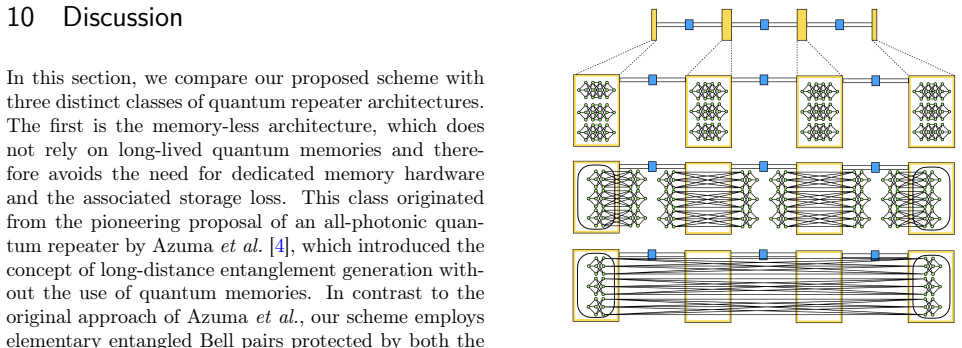
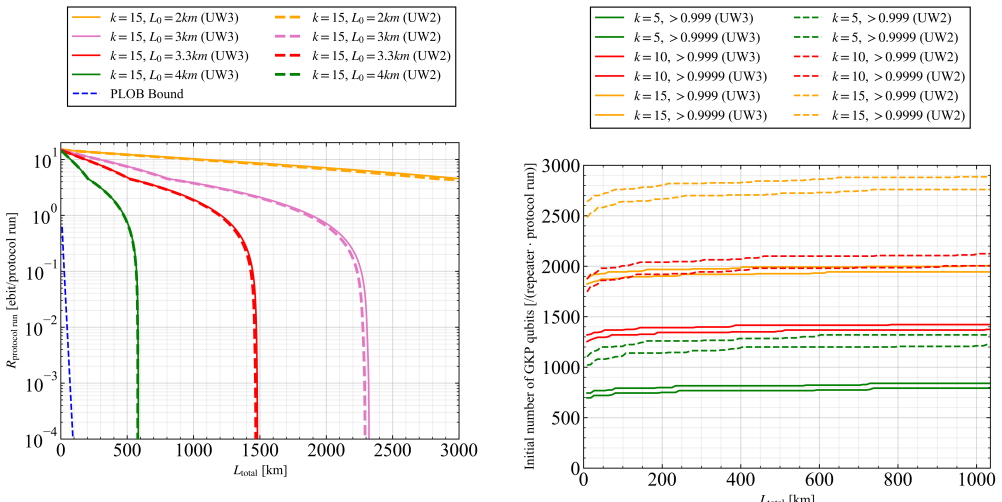
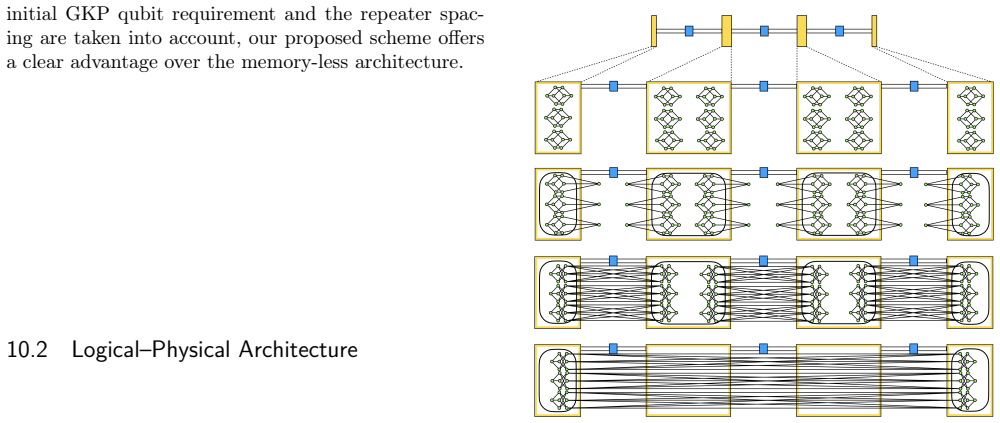
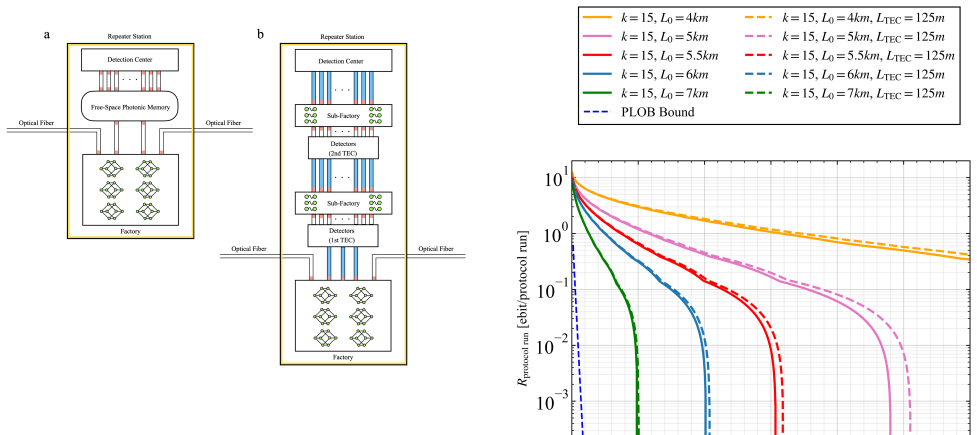
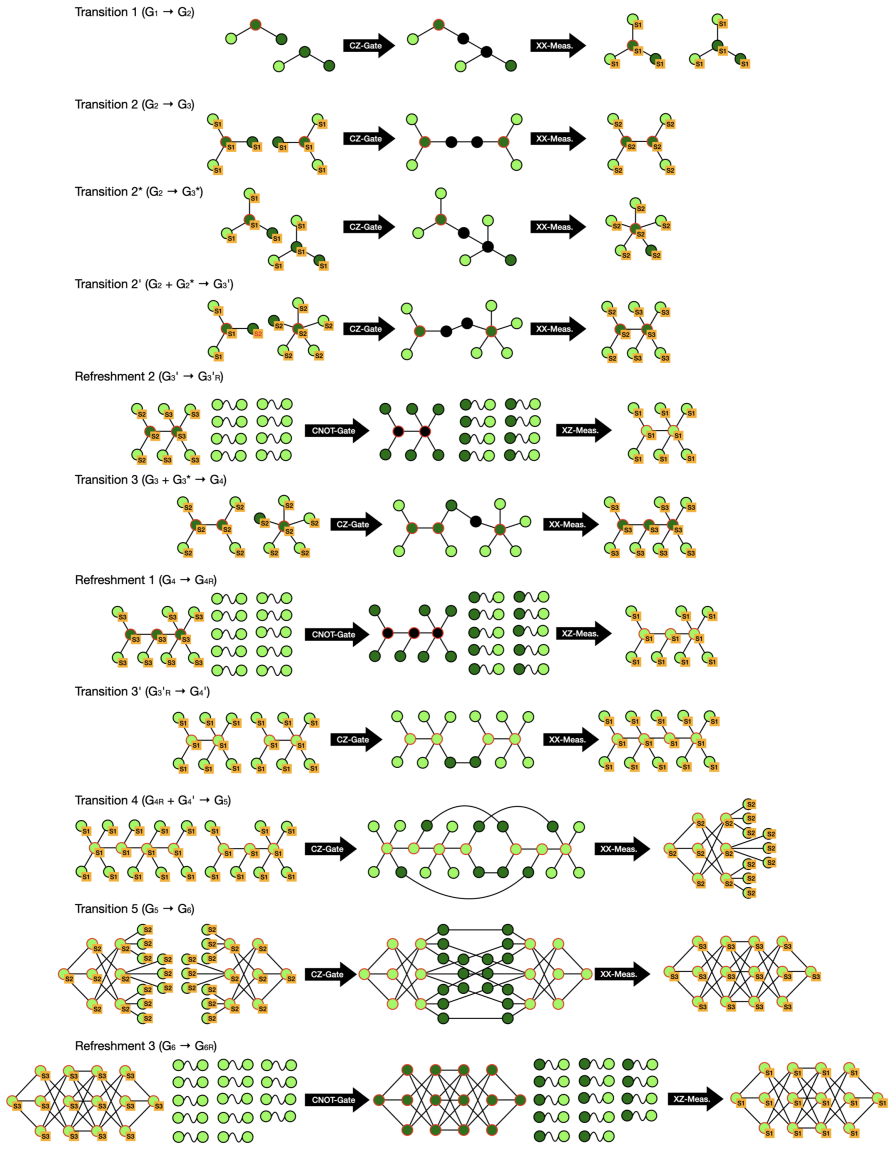
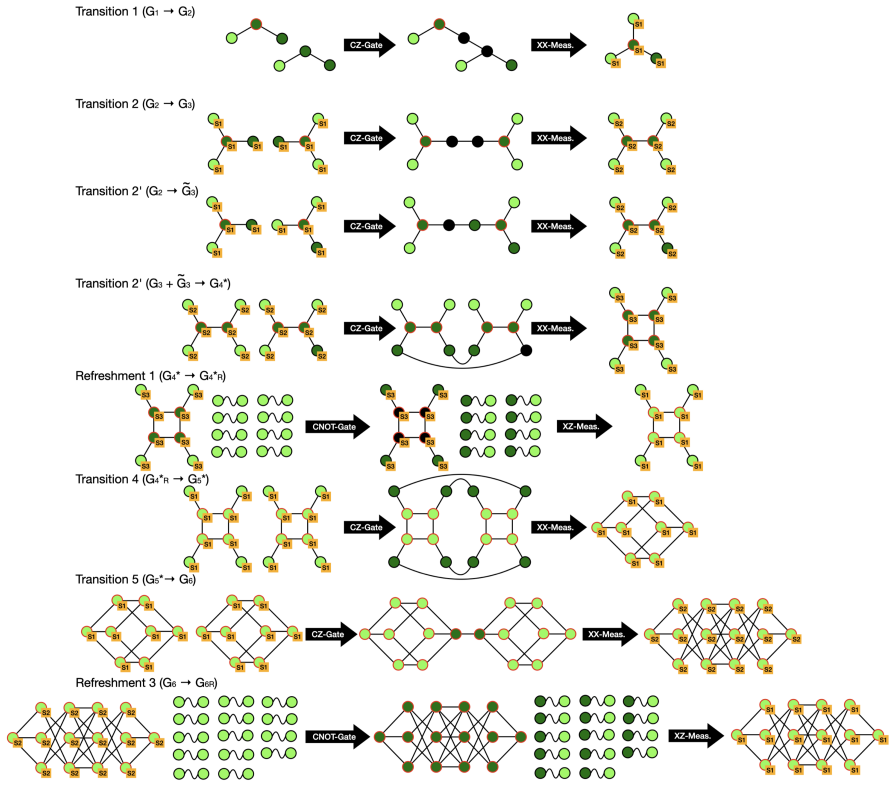
The architecture protects elementary Bell pairs with the concatenated GKP and [[7,1,3]] Steane codes so that photon loss remains tolerable at 9 km repeater intervals. Two heuristic constructions generate these pairs: one limits correlated errors to two qubits per logical qubit at the cost of more physical qubits, while the other tolerates three-qubit errors but uses fewer qubits overall. A multi-reflection mirror cavity acts as the free-space memory, characterized by its length and per-reflection efficiency. Simulations that include switching imperfections show the scheme requires only a few thousand GKP qubits per station per run, well below earlier third-generation all-photonic proposals.
What carries the argument
The concatenation of the continuous-variable GKP code with the discrete-variable [[7,1,3]] Steane code, which supplies synergistic protection against photon loss that supports the 9 km spacing.
If this is right
- Quantum links of 1000 km become feasible with uniform 9 km station spacing.
- Each repeater station needs only a few thousand GKP qubits per protocol run.
- The mirror-cavity memory and ranking criterion become practical components for photonic networks.
- Two Bell-pair constructions allow designers to choose between higher qubit count with smaller correlated errors or lower count with larger errors.
Where Pith is reading between the lines
- The same code concatenation could be tested in shorter laboratory links to verify the loss threshold before scaling to repeater chains.
- If the cavity efficiency numbers hold, the memory module might serve other loss-sensitive photonic tasks such as entanglement swapping.
- Reducing the per-station qubit count below prior designs lowers the hardware barrier for early quantum-network testbeds.
Load-bearing premise
The GKP-Steane concatenation produces a combined loss tolerance high enough to make 9 km repeater spacing practical under the modeled imperfections.
What would settle it
Measure the logical error rate of the concatenated code after transmission through a 9 km lossy channel plus realistic switching noise; if the rate exceeds the threshold required for the repeater protocol to succeed, the 9 km spacing claim does not hold.
Figures
read the original abstract
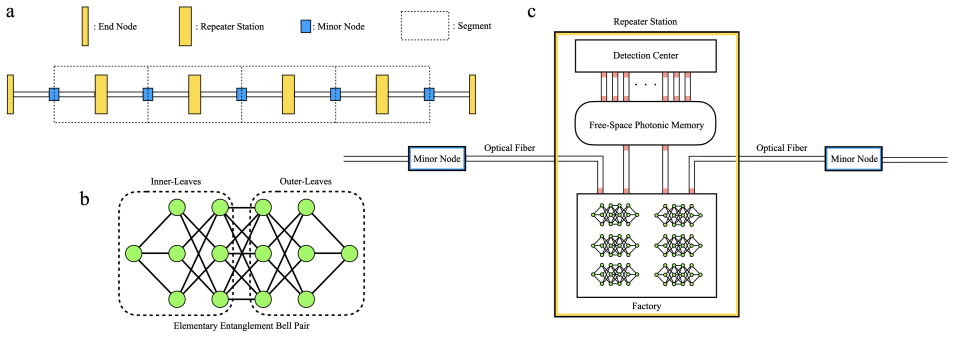
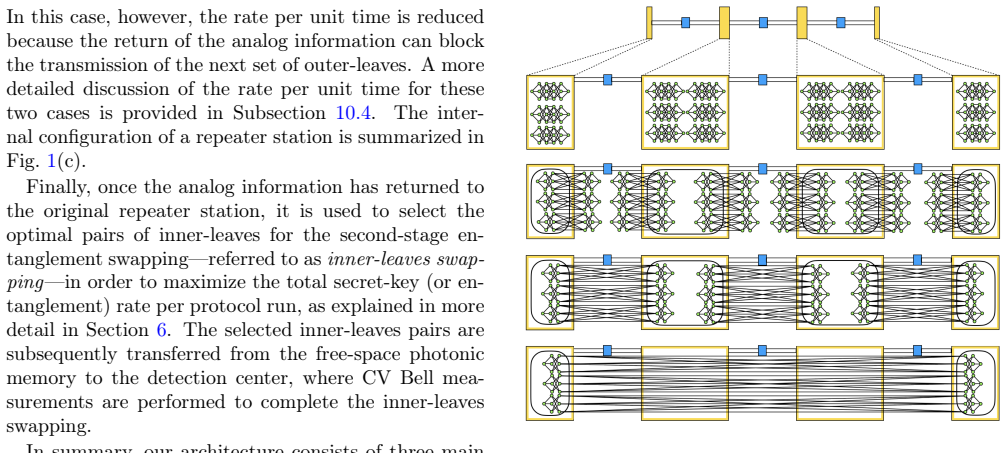
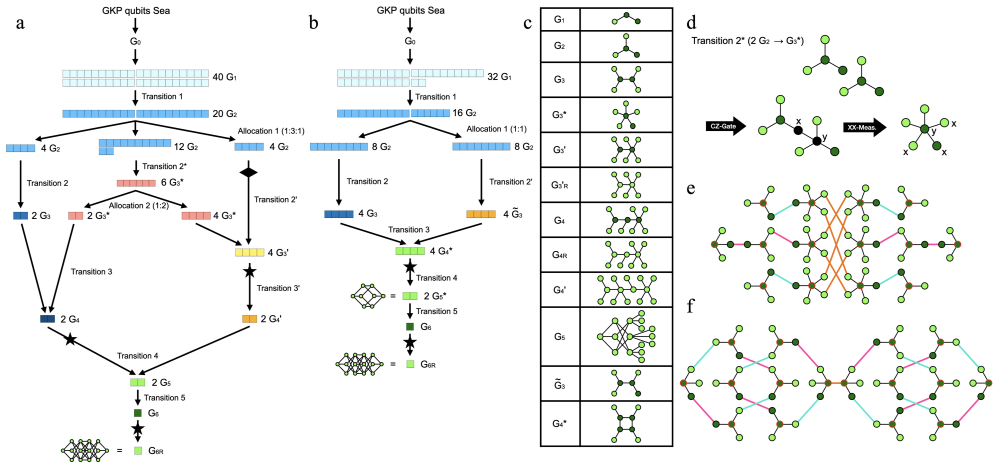
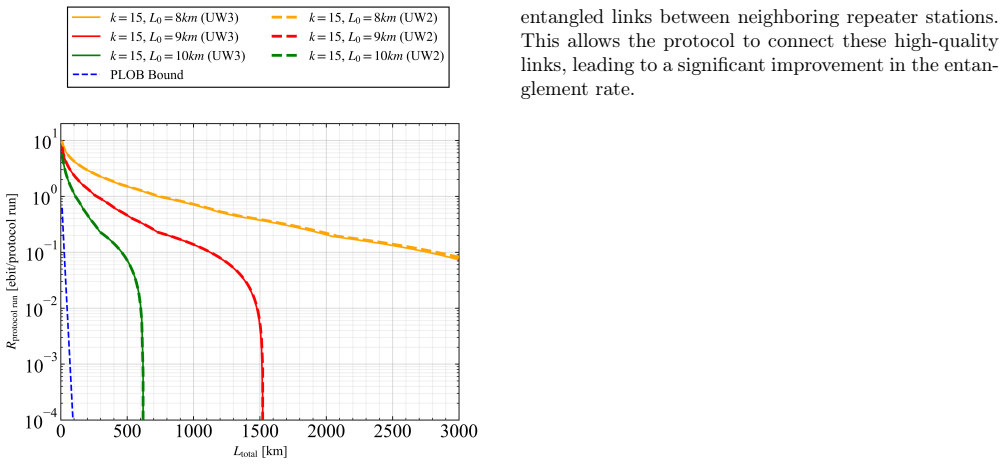
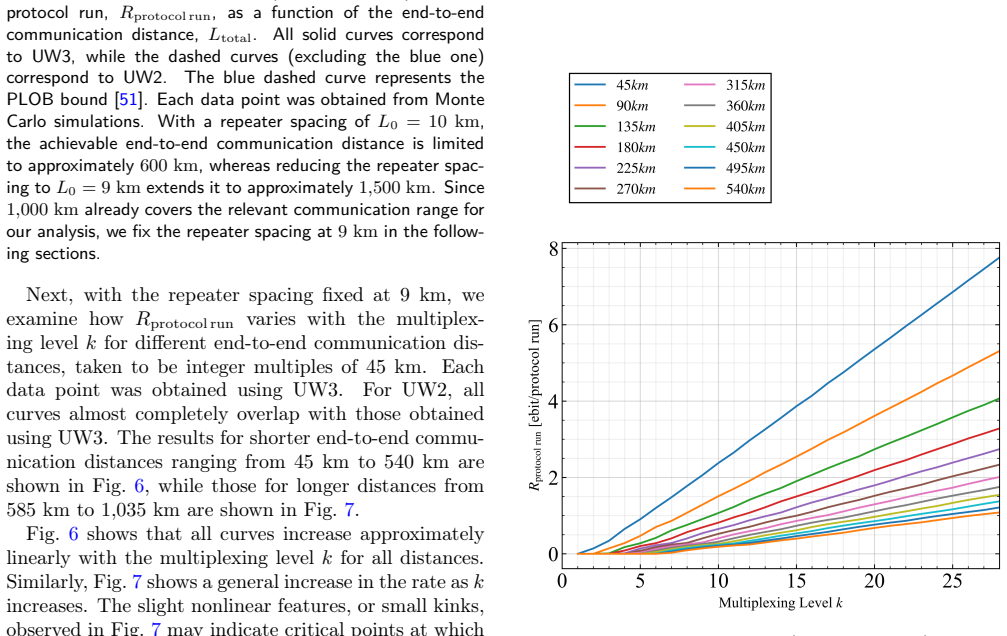
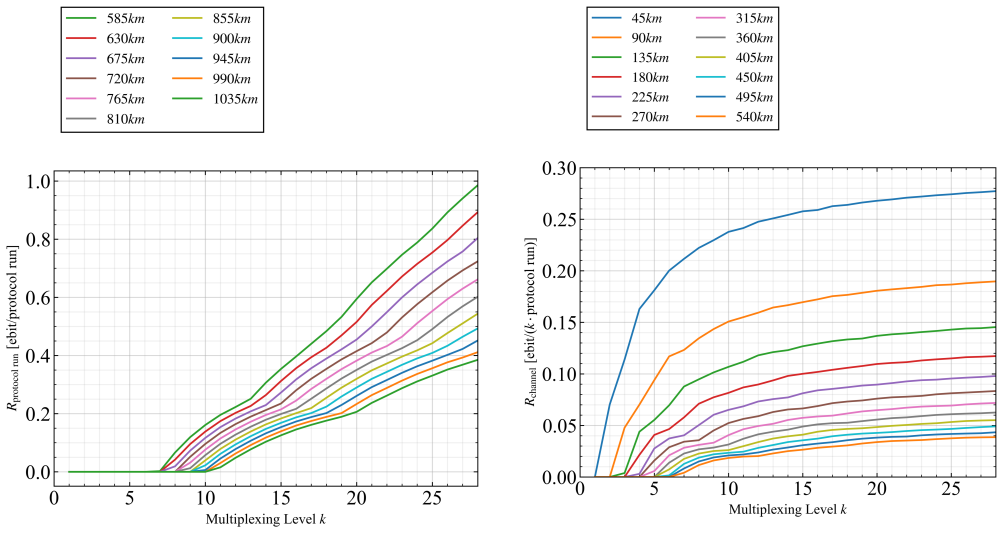
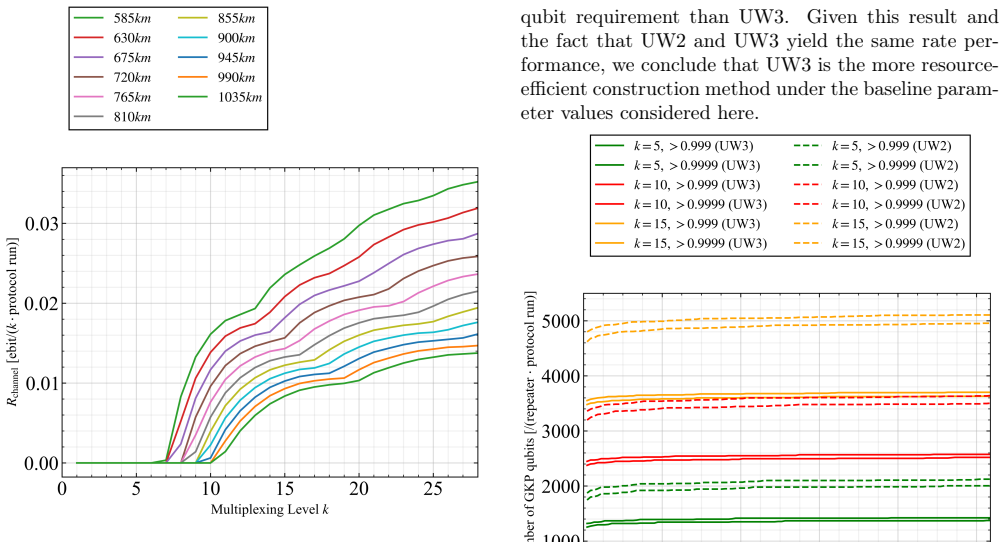
Quantum communication between two distant parties will serve as a cornerstone of the future quantum internet. However, generating enough entangled Bell pairs over long distances is a critical bottleneck. Although photons are ideal carriers of quantum information, overcoming photon loss and the exponential attenuation of signals remains a major challenge. We propose an all-photonic quantum repeater architecture that enables quantum communication over 1,000 km with an equidistant repeater spacing of 9 km. This repeater spacing is enabled by elementary entangled Bell pairs protected through the concatenation of continuous-variable and discrete-variable quantum error correction codes, namely, the bosonic Gottesman-Kitaev-Preskill (GKP) code and the [[7,1,3]] Steane code, whose combination yields a synergistic improvement in robustness against photon loss. This architecture incorporates a new ranking criterion and a multi-reflection mirror-based optical cavity as a free-space photonic memory module, which we model in terms of its length and mirror-reflection efficiency. Additionally, we propose two heuristic construction methods for the elementary entangled Bell pairs. One method introduces up to two-qubit correlated errors within each logical qubit but requires a large number of GKP qubits, while the other allows up to three-qubit correlated errors within each logical qubit but requires fewer GKP qubits. To more accurately capture realistic physical conditions during photonic resource preparation, we include switching-induced imperfections in our simulations, in addition to other standard optical imperfections. In the presence of these imperfections, our realization requires only a few thousand GKP qubits per repeater station per protocol run, a resource requirement significantly smaller than the corresponding resource requirements of prior third-generation all-photonic repeater proposals.
Editorial analysis
A structured set of objections, weighed in public.
Referee Report
Summary. The manuscript proposes an all-photonic quantum repeater for 1000 km entanglement distribution using 9 km repeater spacing. The architecture relies on concatenating the continuous-variable GKP code with the [[7,1,3]] Steane code for synergistic photon-loss robustness, two heuristic constructions for elementary Bell pairs (one with up to 2-qubit and one with up to 3-qubit correlated errors), a new ranking criterion for Bell pairs, and a multi-reflection mirror-based optical cavity modeled by length and mirror efficiency. Simulations incorporate switching imperfections and standard optical losses, yielding a claimed resource cost of only a few thousand GKP qubits per repeater station per run—substantially lower than prior third-generation proposals.
Significance. If the error-rate performance and resource counts are substantiated, the work would offer a concrete route to longer repeater spacing and lower overhead in all-photonic repeaters, directly addressing the photon-loss bottleneck. The explicit modeling of cavity parameters and switching errors strengthens the realism of the resource estimates relative to purely theoretical prior proposals.
major comments (2)
- [Abstract] Abstract (paragraph on code combination): The central claim that GKP-Steane concatenation yields synergistic robustness enabling 9 km spacing rests on an unshown logical-error-rate derivation. The heuristic Bell-pair constructions introduce up to 2- or 3-qubit correlated errors; without the explicit threshold calculation or simulation output for the concatenated code (GKP analog correction followed by Steane decoding, including cavity loss and switching imperfections), it is unclear whether the effective loss tolerance reaches the level required for 9 km rather than closer spacing.
- [Abstract] Abstract (resource-requirement sentence): The statement that the realization requires 'only a few thousand GKP qubits per repeater station per protocol run' is presented without supporting derivation steps, simulation data, or tables showing how the count is obtained from the chosen heuristic, cavity parameters, and error model.
minor comments (2)
- The manuscript refers to 'our simulations' but does not specify the Monte Carlo sample size, error-bar estimation method, or validation procedure for the synergistic improvement; these details belong in the methods or supplementary section.
- Notation for the two heuristic Bell-pair constructions should be introduced with explicit labels (e.g., 'Heuristic A' and 'Heuristic B') and cross-referenced when their correlated-error models are used in later resource calculations.
Simulated Author's Rebuttal
We thank the referee for the careful reading and constructive comments. We address the two major comments below, clarifying where the supporting derivations and data appear in the manuscript while noting opportunities to improve clarity.
read point-by-point responses
-
Referee: [Abstract] Abstract (paragraph on code combination): The central claim that GKP-Steane concatenation yields synergistic robustness enabling 9 km spacing rests on an unshown logical-error-rate derivation. The heuristic Bell-pair constructions introduce up to 2- or 3-qubit correlated errors; without the explicit threshold calculation or simulation output for the concatenated code (GKP analog correction followed by Steane decoding, including cavity loss and switching imperfections), it is unclear whether the effective loss tolerance reaches the level required for 9 km rather than closer spacing.
Authors: The logical-error-rate analysis for the GKP-Steane concatenation, including the impact of up to 2- or 3-qubit correlated errors from the heuristic Bell-pair constructions, cavity loss, and switching imperfections, is presented in Sections 4.2–4.3 and 5.1–5.2. These sections contain the threshold calculations via Monte Carlo simulation of the concatenated decoding procedure (GKP analog correction followed by Steane decoding) and the resulting effective loss tolerance that supports the 9 km spacing. The synergistic improvement is quantified by comparing the concatenated code performance against standalone GKP under the full error model. We will add a brief pointer from the abstract to these sections and, if space permits, a short summary sentence in the revised abstract. revision: partial
-
Referee: [Abstract] Abstract (resource-requirement sentence): The statement that the realization requires 'only a few thousand GKP qubits per repeater station per protocol run' is presented without supporting derivation steps, simulation data, or tables showing how the count is obtained from the chosen heuristic, cavity parameters, and error model.
Authors: The resource count is obtained from the explicit overhead calculations in Section 6.3 and Table II, which break down the total GKP qubits per station as a function of the chosen heuristic (2-qubit vs. 3-qubit correlated-error constructions), the number of elementary Bell pairs, the multi-reflection cavity parameters (length and mirror efficiency), and the additional qubits required for switching-error mitigation. The table reports the final few-thousand figure under the simulated imperfection rates. We will insert a parenthetical reference to Section 6.3 and Table II in the revised abstract to make the origin of the number immediately traceable. revision: yes
Circularity Check
No load-bearing circularity; resource estimates and spacing claims derive from heuristics and models without self-referential reduction
full rationale
The paper's central claims rest on proposed heuristic Bell-pair constructions, modeled cavity parameters, and simulations of imperfections rather than any fitted parameter or self-citation that is redefined as a prediction. No equations reduce the target resource count or 9 km spacing to a quantity defined in terms of itself. Self-citations, if present, are not load-bearing for the synergistic robustness statement. This is the normal non-circular outcome for a proposal paper whose performance numbers come from explicit (if heuristic) modeling.
Axiom & Free-Parameter Ledger
free parameters (1)
- mirror-reflection efficiency
axioms (1)
- domain assumption Concatenation of GKP and [[7,1,3]] Steane codes yields synergistic robustness against photon loss
invented entities (2)
-
multi-reflection mirror-based optical cavity
no independent evidence
-
new ranking criterion for elementary Bell pairs
no independent evidence
Reference graph
Works this paper leans on
-
[1]
Quantum repeaters: From quantum networks to the quan- tum internet,
K. Azuma, S. E. Economou, D. Elkouss, P. Hi- laire, L. Jiang, H.-K. Lo, and I. Tzitrin, “Quantum repeaters: From quantum networks to the quan- tum internet,”Reviews of Modern Physics, vol. 95, no. 4, p. 045006, 2023
2023
-
[2]
Quantum cryp- tography: Public key distribution and coin toss- ing,
C. H. Bennett and G. Brassard, “Quantum cryp- tography: Public key distribution and coin toss- ing,”Theoretical computer science, vol. 560, pp. 7– 11, 2014
2014
-
[3]
Inside quantum repeaters,
W. J. Munro, K. Azuma, K. Tamaki, and K. Nemoto, “Inside quantum repeaters,”IEEE Journal of Selected topics in quantum electronics, vol. 21, no. 3, pp. 78–90, 2015. 30
2015
-
[4]
All- photonic quantum repeaters,
K. Azuma, K. Tamaki, and H.-K. Lo, “All- photonic quantum repeaters,”Nature communica- tions, vol. 6, no. 1, pp. 1–7, 2015
2015
-
[5]
Single-photon synchronization with a room- temperature atomic quantum memory,
O. Davidson, O. Yogev, E. Poem, and O. Firsten- berg, “Single-photon synchronization with a room- temperature atomic quantum memory,”Physical review letters, vol. 131, no. 3, p. 033601, 2023
2023
-
[6]
Long-lived quantum memory enabling atom-photon entanglement over 101 km of tele- com fiber,
Y. Zhou, P. Malik, F. Fertig, M. Bock, T. Bauer, T. van Leent, W. Zhang, C. Becher, and H. We- infurter, “Long-lived quantum memory enabling atom-photon entanglement over 101 km of tele- com fiber,”PRX Quantum, vol. 5, no. 2, p. 020307, 2024
2024
-
[7]
On-demand storage of photonic qubits at telecom wavelengths,
D.-C. Liu, P.-Y. Li, T.-X. Zhu, L. Zheng, J.- Y. Huang, Z.-Q. Zhou, C.-F. Li, and G.-C. Guo, “On-demand storage of photonic qubits at telecom wavelengths,”Physical Review Letters, vol. 129, no. 21, p. 210501, 2022
2022
-
[8]
A quantum memory intrinsic to single nitrogen–vacancy centres in diamond,
G. Fuchs, G. Burkard, P. Klimov, and D. Awschalom, “A quantum memory intrinsic to single nitrogen–vacancy centres in diamond,” Nature Physics, vol. 7, no. 10, pp. 789–793, 2011
2011
-
[9]
Entan- glement of nanophotonic quantum memory nodes in a telecom network,
C. M. Knaut, A. Suleymanzade, Y.-C. Wei, D. R. Assumpcao, P.-J. Stas, Y. Q. Huan, B. Machielse, E. N. Knall, M. Sutula, G. Baranes,et al., “Entan- glement of nanophotonic quantum memory nodes in a telecom network,”Nature, vol. 629, no. 8012, pp. 573–578, 2024
2024
-
[10]
Robust quantum memory in a trapped-ion quantum network node,
P. Drmota, D. Main, D. Nadlinger, B. Nichol, M. A. Weber, E. Ainley, A. Agrawal, R. Srinivas, G. Araneda, C. Ballance,et al., “Robust quantum memory in a trapped-ion quantum network node,” Physical Review Letters, vol. 130, no. 9, p. 090803, 2023
2023
-
[11]
Superconducting cavity qubit with tens of milliseconds single-photon coherence time,
O. Milul, B. Guttel, U. Goldblatt, S. Hazanov, L.M.Joshi, D.Chausovsky, N.Kahn, E.Çiftyürek, F. Lafont, and S. Rosenblum, “Superconducting cavity qubit with tens of milliseconds single-photon coherence time,”PRX Quantum, vol. 4, no. 3, p. 030336, 2023
2023
-
[12]
All-optical long-distance quantum communication with Gottesman-Kitaev-Preskill qubits,
K. Fukui, R. N. Alexander, and P. van Loock, “All-optical long-distance quantum communication with Gottesman-Kitaev-Preskill qubits,”Physical Review Research, vol. 3, no. 3, p. 033118, 2021
2021
-
[13]
Encod- ing a qubit in an oscillator,
D. Gottesman, A. Kitaev, and J. Preskill, “Encod- ing a qubit in an oscillator,”Physical Review A, vol. 64, no. 1, p. 012310, 2001
2001
-
[14]
Gottesman-Kitaev-Preskill qubit synthe- sizer for propagating light,
K. Takase, K. Fukui, A. Kawasaki, W. Asavanant, M. Endo, J.-i. Yoshikawa, P. van Loock, and A. Fu- rusawa, “Gottesman-Kitaev-Preskill qubit synthe- sizer for propagating light,”npj Quantum Informa- tion, vol. 9, no. 1, p. 98, 2023
2023
-
[15]
Integrated photonic source of gottesman–kitaev–preskill qubits,
M. V. Larsen, J. E. Bourassa, S. Kocsis, J. F. Tasker, R. S. Chadwick, C. González-Arciniegas, J. Hastrup, C. E. Lopetegui-González, F. M. Mi- atto, A. Motamedi,et al., “Integrated photonic source of gottesman–kitaev–preskill qubits,”Na- ture, vol. 642, no. 8068, pp. 587–591, 2025
2025
-
[16]
Scaling and networking a modular photonic quan- tum computer,
H. Aghaee Rad, T. Ainsworth, R. Alexander, B. Altieri, M. Askarani, R. Baby, L. Banchi, B. Baragiola, J. Bourassa, R. Chadwick,et al., “Scaling and networking a modular photonic quan- tum computer,”Nature, pp. 1–8, 2025
2025
-
[17]
Logical states for fault- tolerant quantum computation with propagating light,
S. Konno, W. Asavanant, F. Hanamura, H. Na- gayoshi, K. Fukui, A. Sakaguchi, R. Ide, F. China, M. Yabuno, S. Miki,et al., “Logical states for fault- tolerant quantum computation with propagating light,”Science, vol. 383, no. 6680, pp. 289–293, 2024
2024
-
[18]
Extensible universal photonic quantum computing with nonlinearity,
S. Yu, J. Sun, K.-C. Chen, Z.-H. Yang, Z. Li, E. Mer, Y. K. Alwehaibi, S. H. Winston, D. M. D. Lopena, Z.-C. Zhang,et al., “Extensible universal photonic quantum computing with nonlinearity,” arXiv preprint arXiv:2602.06544, 2026
-
[19]
Rate-distance tradeoff and resource costs for all- optical quantum repeaters,
M. Pant, H. Krovi, D. Englund, and S. Guha, “Rate-distance tradeoff and resource costs for all- optical quantum repeaters,”Physical Review A, vol. 95, no. 1, p. 012304, 2017
2017
-
[20]
Generalized quantum repeater graph states,
B. Li, K. Goodenough, F. Rozpędek, and L. Jiang, “Generalized quantum repeater graph states,” Physical Review Letters, vol. 134, no. 19, p. 190801, 2025
2025
-
[21]
All-photonic Gottesman-Kitaev-Preskill–qubit repeater using analog-information-assisted multiplexed entangle- ment ranking,
F. Rozpędek, K. P. Seshadreesan, P. Po- lakos, L. Jiang, and S. Guha, “All-photonic Gottesman-Kitaev-Preskill–qubit repeater using analog-information-assisted multiplexed entangle- ment ranking,”Physical Review Research, vol. 5, no. 4, p. 043056, 2023
2023
-
[22]
Long-distancequan- tum communication sending single photons and keeping many,
S.HäusslerandP.vanLoock, “Long-distancequan- tum communication sending single photons and keeping many,”arXiv preprint arXiv:2512.18767, 2025
-
[23]
Optimalapproachto quantum communica- tion using dynamic programming,
L. Jiang, J. M. Taylor, N. Khaneja, and M. D. Lukin, “Optimalapproachto quantum communica- tion using dynamic programming,”Proceedings of the National Academy of Sciences, vol. 104, no. 44, pp. 17291–17296, 2007
2007
-
[24]
Ex- tending repeater spacing in all-photonic quantum repeaters,
R. Shiina, K. Goodenough, and F. Rozpędek, “Ex- tending repeater spacing in all-photonic quantum repeaters,” in2026 International Conference on Quantum Communications, Networking, and Com- puting (QCNC), pp. 1–10, IEEE, 2026. 31
2026
-
[25]
Fault-tolerant bosonic quantum error correction with the surface– Gottesman-Kitaev-Preskill code,
K. Noh and C. Chamberland, “Fault-tolerant bosonic quantum error correction with the surface– Gottesman-Kitaev-Preskill code,”Physical Review A, vol. 101, no. 1, p. 012316, 2020
2020
-
[26]
Twirling and hamiltonian engineer- ingviadynamicaldecouplingforgottesman-kitaev- preskill quantum computing,
J. Conrad, “Twirling and hamiltonian engineer- ingviadynamicaldecouplingforgottesman-kitaev- preskill quantum computing,”Physical Review A, vol. 103, no. 2, p. 022404, 2021
2021
-
[27]
High-threshold fault-tolerant quantum computa- tion with analog quantum error correction,
K. Fukui, A. Tomita, A. Okamoto, and K. Fujii, “High-threshold fault-tolerant quantum computa- tion with analog quantum error correction,”Phys- ical review X, vol. 8, no. 2, p. 021054, 2018
2018
-
[28]
Error correcting codes in quantum theory,
A. M. Steane, “Error correcting codes in quantum theory,”Physical Review Letters, vol. 77, no. 5, p. 793, 1996
1996
-
[29]
M. A. Nielsen and I. L. Chuang,Quantum compu- tation and quantum information. Cambridge uni- versity press, 2010
2010
-
[30]
Minimizing the number of edges in lc-equivalent graph states,
H. Sharma, K. Goodenough, J. Borregaard, J. Helsen,et al., “Minimizing the number of edges in lc-equivalent graph states,”arXiv preprint arXiv:2506.00292, 2025
-
[31]
Optimal architectures for long distance quantum communication,
S. Muralidharan, L. Li, J. Kim, N. Lütkenhaus, M. D. Lukin, and L. Jiang, “Optimal architectures for long distance quantum communication,”Scien- tific reports, vol. 6, no. 1, p. 20463, 2016
2016
-
[32]
Simple, stable, and compact multiple- reflection optical cell for very long optical paths,
C. Robert, “Simple, stable, and compact multiple- reflection optical cell for very long optical paths,” Applied Optics, vol. 46, no. 22, pp. 5408–5418, 2007
2007
-
[33]
Folded Optical Delay Lines,
D. R. Herriott and H. J. Schulte, “Folded Optical Delay Lines,”Applied Optics, vol. 4, pp. 883–889, Aug. 1965
1965
-
[34]
Free-space photonic quantum memory,
N. T. Arnold, M. Victora, M. E. Goggin, and P. G. Kwiat, “Free-space photonic quantum memory,” in Quantum Computing, Communication, and Simu- lation III, vol. 12446, pp. 25–30, SPIE, 2023
2023
-
[35]
Mirrors used in the LIGO interferometers for first detection of gravitational waves,
L. Pinard, C. Michel, B. Sassolas, L. Balzarini, J. Degallaix, V. Dolique, R. Flaminio, D. Forest, M. Granata, B. Lagrange,et al., “Mirrors used in the LIGO interferometers for first detection of gravitational waves,”Applied optics, vol. 56, no. 4, pp. C11–C15, 2016
2016
-
[36]
Ultra-high reflectivity optical coatings
Five Nine Optics, “Ultra-high reflectivity optical coatings.”https://fivenineoptics.com/produ cts/. Accessed: Feb. 22, 2026
2026
-
[37]
Advanced LIGO,
J. Aasi, B. Abbott, R. Abbott, T. Abbott, M. Abernathy, K. Ackley, C. Adams, T. Adams, P. Addesso, R. Adhikari,et al., “Advanced LIGO,” Classical and quantum gravity, vol. 32, no. 7, p. 074001, 2015
2015
-
[38]
Ob- servationofgravitationalwavesfromabinaryblack hole merger,
B. P. Abbott, R. Abbott, T. D. Abbott, M. R. Abernathy, F. Acernese, K. Ackley, C. Adams, T. Adams, P. Addesso, R. X. Adhikari,et al., “Ob- servationofgravitationalwavesfromabinaryblack hole merger,”Physical review letters, vol. 116, no. 6, p. 061102, 2016
2016
-
[39]
A single quan- tum cannot be cloned,
W. K. Wootters and W. H. Zurek, “A single quan- tum cannot be cloned,”Nature, vol. 299, no. 5886, pp. 802–803, 1982
1982
-
[40]
Continuous-variable gate teleportation and bosonic-code error correction,
B. W. Walshe, B. Q. Baragiola, R. N. Alexander, and N. C. Menicucci, “Continuous-variable gate teleportation and bosonic-code error correction,” Physical Review A, vol. 102, no. 6, p. 062411, 2020
2020
-
[41]
Resource-efficient high-threshold fault-tolerant quantum computa- tion with weak nonlinear optics,
K. Fukui and P. van Loock, “Resource-efficient high-threshold fault-tolerant quantum computa- tion with weak nonlinear optics,”arXiv preprint arXiv:2412.16536, 2024
-
[42]
Free-electron interactions with pho- tonic gkp states: Universal control and quantum error correction,
G. Baranes, S. Even-Haim, R. Ruimy, A. Gorlach, R. Dahan, A. A. Diringer, S. Hacohen-Gourgy, and I. Kaminer, “Free-electron interactions with pho- tonic gkp states: Universal control and quantum error correction,”Physical Review Research, vol. 5, no. 4, p. 043271, 2023
2023
-
[43]
Multi- party entanglement in graph states,
M. Hein, J. Eisert, and H. J. Briegel, “Multi- party entanglement in graph states,”Physical Re- view A—Atomic, Molecular, and Optical Physics, vol. 69, no. 6, p. 062311, 2004
2004
-
[44]
Linear-optical quantum computation with arbi- trary error-correcting codes,
B. W. Walshe, B. Q. Baragiola, H. Ferretti, J. Gefaell, M. Vasmer, R. Weil, T. Matsuura, T. Jaeken, G. Pantaleoni, Z. Han,et al., “Linear-optical quantum computation with arbi- trary error-correcting codes,”Physical Review Let- ters, vol. 134, no. 10, p. 100602, 2025
2025
-
[45]
Fault-tolerant quantum computation with static linear optics,
I. Tzitrin, T. Matsuura, R. N. Alexander, G. Dauphinais, J. E. Bourassa, K. K. Sabapathy, N. C. Menicucci, and I. Dhand, “Fault-tolerant quantum computation with static linear optics,” PRX Quantum, vol. 2, no. 4, p. 040353, 2021
2021
-
[46]
Role of syndrome information on a one- way quantum repeater using teleportation-based error correction,
R. Namiki, L. Jiang, J. Kim, and N. Lütken- haus, “Role of syndrome information on a one- way quantum repeater using teleportation-based error correction,”Physical Review A, vol. 94, no. 5, p. 052304, 2016
2016
-
[47]
Quantum repeaters based on con- catenated bosonic and discrete-variable quantum codes,
F. Rozpędek, K. Noh, Q. Xu, S. Guha, and L. Jiang, “Quantum repeaters based on con- catenated bosonic and discrete-variable quantum codes,”npj Quantum Information, vol. 7, no. 1, p. 102, 2021
2021
-
[48]
Mixed-state entanglement 32 and quantum error correction,
C. H. Bennett, D. P. DiVincenzo, J. A. Smolin, and W. K. Wootters, “Mixed-state entanglement 32 and quantum error correction,”Physical Review A, vol. 54, no. 5, p. 3824, 1996
1996
-
[49]
Security of quantum key distribu- tion,
R. Renner, “Security of quantum key distribu- tion,”International Journal of Quantum Informa- tion, vol. 6, no. 01, pp. 1–127, 2008
2008
-
[50]
Code for the arxiv version,
R. Shiina, “Code for the arxiv version,” 2026. Ver- sion v2.0.0. Zenodo DOI:https://doi.org/10 .5281/zenodo.20437057. GitHub repository: https://github.com/RyosukeShiina/all-pho tonic-quantum-repeaters-with-9km-spacing
2026
-
[51]
Fundamental limits of repeaterless quantum communications,
S. Pirandola, R. Laurenza, C. Ottaviani, and L. Banchi, “Fundamental limits of repeaterless quantum communications,”Nature communica- tions, vol. 8, no. 1, p. 15043, 2017
2017
-
[52]
Integrated photonic platform for quantum information with continu- ous variables,
F. Lenzini, J. Janousek, O. Thearle, M. Villa, B. Haylock, S. Kasture, L. Cui, H.-P. Phan, D. V. Dao, H. Yonezawa,et al., “Integrated photonic platform for quantum information with continu- ous variables,”Science advances, vol. 4, no. 12, p. eaat9331, 2018. A Measurement Types Used in the Construction Process In the construction of elementary entangled Be...
2018
discussion (0)
Sign in with ORCID, Apple, or X to comment. Anyone can read and Pith papers without signing in.