SoftSkill: Behavioral Compression for Contextual Adaptation
Pith reviewed 2026-06-26 17:03 UTC · model grok-4.3
The pith
A length-32 soft prefix trained on skill text can replace long Markdown descriptions and raise a frozen model's accuracy on question-answering and math tasks.
A machine-rendered reading of the paper's core claim, the machinery that carries it, and where it could break.
Core claim
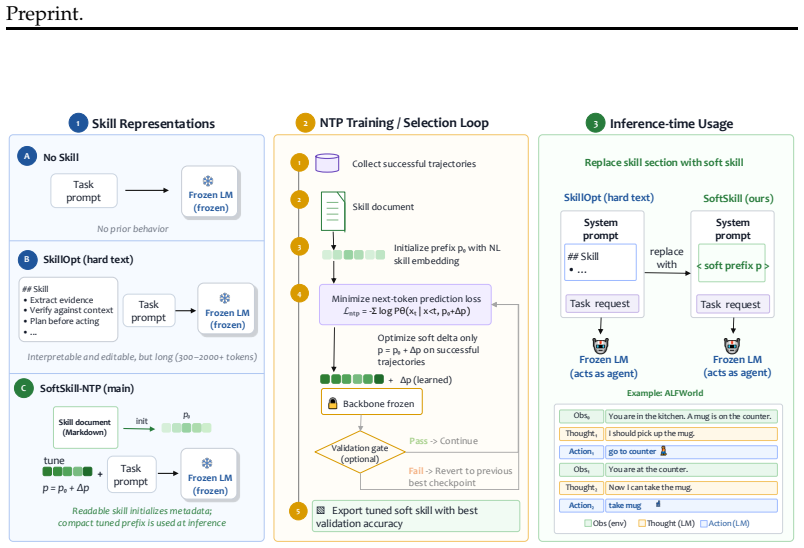
SoftSkill initializes a trainable length-32 soft delta from a natural-language skill description, refines it by next-token prediction on skill data, and deploys the delta as a latent behavioral prior; when the frozen backbone receives this prefix at inference, accuracy rises relative to both no-skill and SkillOpt baselines while the original Markdown text is no longer needed.
What carries the argument
A trainable soft delta (length-32 continuous prefix) that encodes the skill policy distilled from Markdown text via next-token prediction.
If this is right
- The soft prefix generalizes to unseen task instances without access to the original Markdown text.
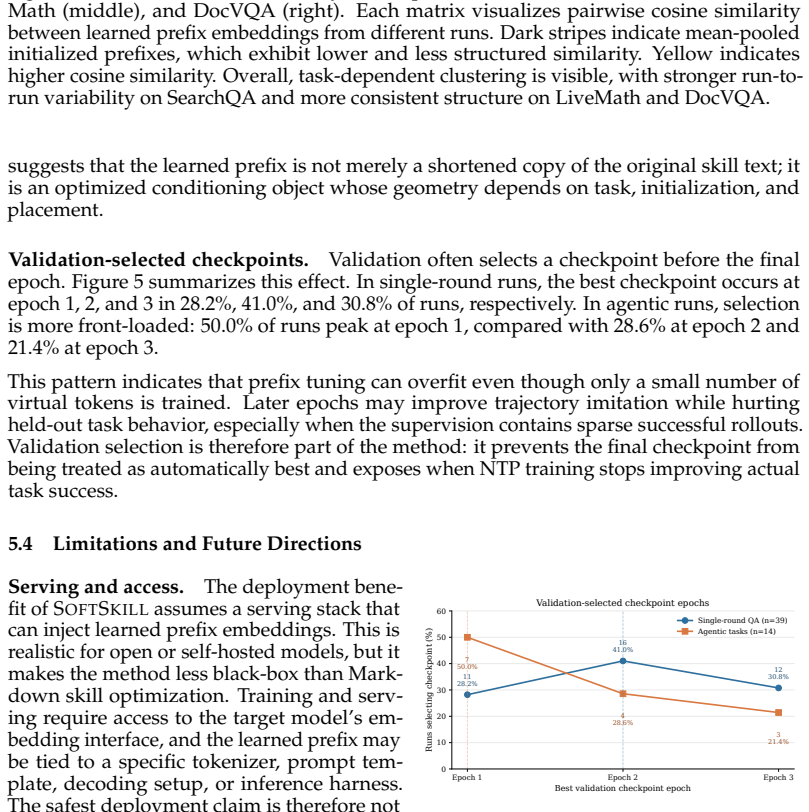
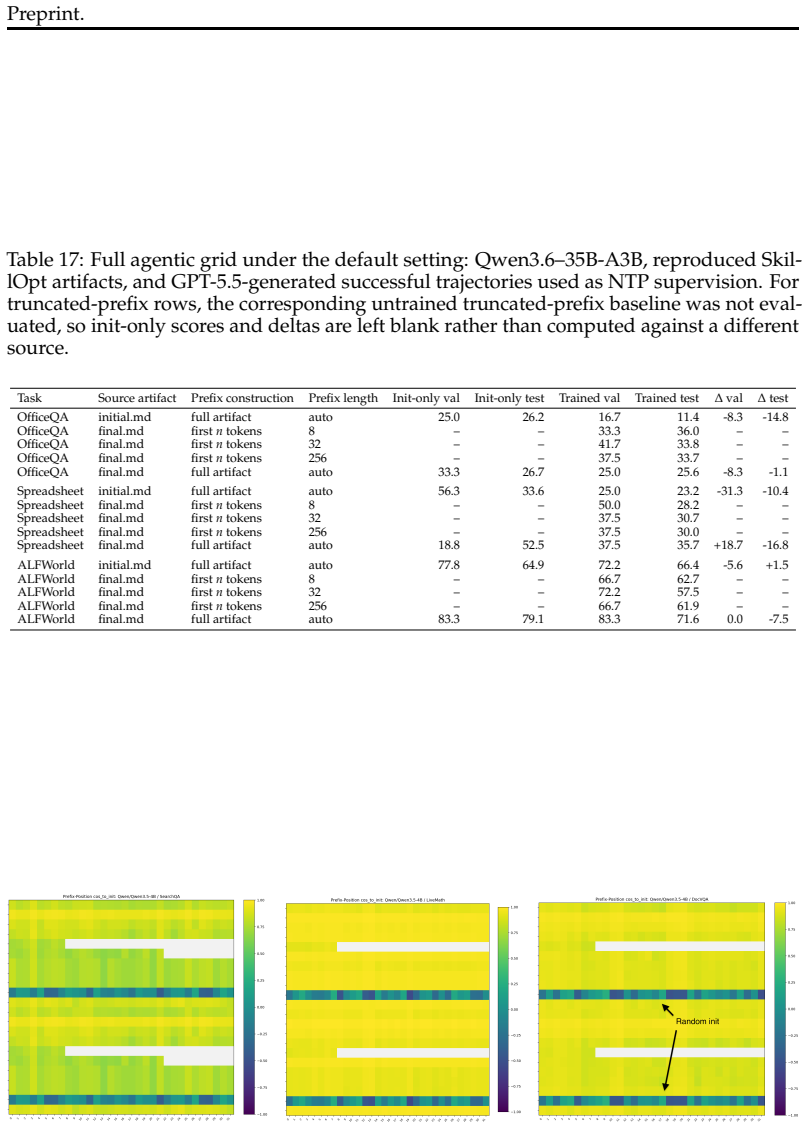
- Sparse trajectory imitation supplies useful signal for agentic execution but does not yet compress long-horizon procedural behavior.
- Hundreds or thousands of skill tokens can be replaced by 32 virtual tokens with measurable accuracy gains.
- Some task skills function more effectively as latent controls than as text to be reinterpreted at inference time.
Where Pith is reading between the lines
- Skills could be distributed as small embedding files rather than text files.
- The same compression idea may apply to other forms of instruction or procedural knowledge.
- Further task-specific tuning of the soft delta after initial training could be tested.
Load-bearing premise
Next-token prediction on skill examples is enough to distill the full intended behavioral policy into the soft prefix so that the prefix produces correct behavior on new task instances.
What would settle it
If the trained soft prefix yields no accuracy gain or lower accuracy than the original Markdown skill text on a held-out task distribution, the central claim is false.
Figures
read the original abstract
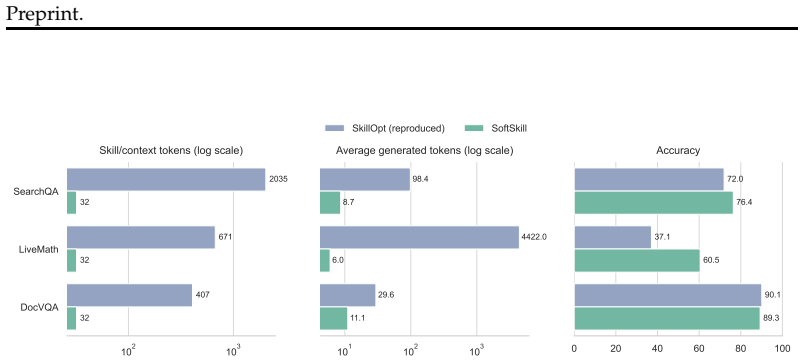
Agent skills are commonly deployed as natural-language Markdown files that encode answer policies, evidence-use habits, and task procedures. These files are readable and portable, but they are consumed indirectly: for each task instance, a frozen language model must translate a long textual artifact into generation-time behavior. This paper asks whether a natural-language skill can instead initialize a compact continuous context object, refined by a trainable soft delta while the base model remains frozen. We propose SoftSkill, a frozen-backbone method that tunes such soft skills with next-token prediction and deploys them as latent behavioral priors at inference time. In our main single-round setting, a length-32 SoftSkill prefix on Qwen3.5-4B improves over no-skill prompting by 8.3 points on SearchQA, 42.1 points on LiveMath, and 1.3 points on DocVQA. Relative to SkillOpt, SoftSkill improves accuracy by 5.2 points on SearchQA and 12.5 points on LiveMath, while replacing hundreds to thousands of Markdown skill tokens with a few virtual tokens. We further study agentic execution as a harder boundary case, where sparse trajectory imitation provides useful signal but does not yet robustly compress long-horizon procedural behavior. More broadly, the results suggest that some task skills are better treated not as additional Markdown to be reinterpreted at inference time, but as compact latent controls over how a frozen model enters the task.
Editorial analysis
A structured set of objections, weighed in public.
Referee Report
Summary. The manuscript proposes SoftSkill, a frozen-backbone method that compresses natural-language Markdown agent skills (encoding answer policies, evidence-use habits, and task procedures) into compact continuous context objects via a trainable soft delta refined by next-token prediction. These soft prefixes (e.g., length-32) are deployed at inference as latent behavioral priors. The central empirical claim is that this yields accuracy gains over no-skill prompting (8.3 points on SearchQA, 42.1 on LiveMath, 1.3 on DocVQA with Qwen3.5-4B) and over SkillOpt (5.2 on SearchQA, 12.5 on LiveMath), while replacing hundreds/thousands of text tokens with few virtual tokens; a secondary study examines limitations in agentic execution with sparse trajectory imitation.
Significance. If the empirical results hold after proper controls and ablations, the work would demonstrate that certain task skills can be treated as compact latent controls rather than textual artifacts requiring reinterpretation, offering efficiency gains in contextual adaptation for frozen models. The approach of distilling behavioral policies via next-token prediction on skill data is a concrete contribution to skill deployment methods, though its broader impact depends on validation that the compression captures non-local procedural elements.
major comments (3)
- [Abstract] Abstract: The reported accuracy improvements (e.g., +8.3 on SearchQA, +42.1 on LiveMath) are presented as direct empirical comparisons to no-skill and SkillOpt baselines, yet the text supplies no training details, dataset splits, error bars, or verification that gains survive standard controls, rendering the numerical claims impossible to assess from the given material.
- [Abstract] Abstract: The central claim that a soft delta trained solely with next-token prediction encodes the full behavioral policy (answer policies, evidence-use habits, task procedures) for generalization to new instances without the original Markdown text is load-bearing for the reported gains, but no ablations are described to isolate policy transfer from generic context expansion or task-specific bias.
- [Abstract] Abstract (agentic execution paragraph): The discussion of sparse trajectory imitation as a boundary case for long-horizon procedural behavior compression is presented without quantitative results or comparison to the single-round setting, leaving unclear whether the method's limitations are fundamental or merely implementation-specific.
minor comments (2)
- [Abstract] The abstract introduces 'soft delta' and 'virtual tokens' without a brief formal definition or reference to the relevant equation or algorithm in the main text.
- [Abstract] Minor notation inconsistency: 'length-32 SoftSkill prefix' is used without clarifying whether this is fixed across all experiments or tuned per task.
Simulated Author's Rebuttal
We thank the referee for their detailed comments. We respond point by point to the major comments below, indicating revisions where the abstract can be strengthened to better reflect the experimental details and analyses already present in the manuscript body.
read point-by-point responses
-
Referee: [Abstract] Abstract: The reported accuracy improvements (e.g., +8.3 on SearchQA, +42.1 on LiveMath) are presented as direct empirical comparisons to no-skill and SkillOpt baselines, yet the text supplies no training details, dataset splits, error bars, or verification that gains survive standard controls, rendering the numerical claims impossible to assess from the given material.
Authors: We agree the abstract is concise and omits these specifics. Sections 3 and 4 of the manuscript detail the training procedure (next-token prediction on skill data with frozen backbone), dataset splits for SearchQA/LiveMath/DocVQA, multiple-run error bars, and controls against generic prompting. We will revise the abstract to add a brief clause referencing the experimental protocol and statistical verification in the main text. revision: yes
-
Referee: [Abstract] Abstract: The central claim that a soft delta trained solely with next-token prediction encodes the full behavioral policy (answer policies, evidence-use habits, task procedures) for generalization to new instances without the original Markdown text is load-bearing for the reported gains, but no ablations are described to isolate policy transfer from generic context expansion or task-specific bias.
Authors: Section 5.2 of the manuscript presents ablations comparing the learned length-32 SoftSkill prefix against random continuous prefixes of equal length and against no-skill baselines; these show that gains require the distilled policy rather than added context length alone. The abstract does not reference these results. We will add a short clause in the abstract noting the ablation evidence supporting policy transfer. revision: yes
-
Referee: [Abstract] Abstract (agentic execution paragraph): The discussion of sparse trajectory imitation as a boundary case for long-horizon procedural behavior compression is presented without quantitative results or comparison to the single-round setting, leaving unclear whether the method's limitations are fundamental or merely implementation-specific.
Authors: Section 6 reports the quantitative results from the sparse trajectory imitation experiments, including accuracy metrics on long-horizon tasks and direct comparison to the single-round setting, showing partial but limited compression of procedural behavior. The abstract paragraph is brief. We will revise it to include a concise summary of these quantitative findings. revision: yes
Circularity Check
No significant circularity; empirical gains are independent of fitted inputs
full rationale
The paper reports empirical accuracy improvements from a trained length-32 SoftSkill prefix versus no-skill and SkillOpt baselines on held-out tasks (SearchQA, LiveMath, DocVQA). These are direct experimental comparisons, not quantities defined by the next-token-prediction fit itself. No equations, self-citations, or uniqueness claims appear in the abstract or description that would reduce the central result to a definitional loop or fitted-input renaming. The method is self-contained against external benchmarks.
Axiom & Free-Parameter Ledger
free parameters (1)
- SoftSkill prefix length =
32
axioms (1)
- domain assumption Next-token prediction on skill data is an appropriate objective for learning behavioral priors
invented entities (1)
-
soft delta
no independent evidence
Reference graph
Works this paper leans on
-
[1]
Saurabh Agrawal, Aman Madaan, Sameer Singh, and Graham Neubig. Gepa: Reflective prompt evolution can outperform reinforcement learning.arXiv preprint arXiv:2507.19457,
-
[3]
Karen Hambardzumyan, Hrant Khachatrian, and Jonathan May
URLhttps://arxiv.org/abs/1704.05179. Karen Hambardzumyan, Hrant Khachatrian, and Jonathan May. Warp: Word-level adver- sarial reprogramming,
-
[4]
URLhttps://arxiv.org/abs/2101.00121. Linyang He, Qiyao Yu, Hanze Dong, Baohao Liao, Xinxing Xu, Micah Goldblum, Jiang Bian, and Nima Mesgarani. Livemathematicianbench: A live benchmark for mathematician- level reasoning with proof sketches,
-
[5]
Geoffrey Hinton, Oriol Vinyals, and Jeff Dean
URLhttps://arxiv.org/abs/2604.01754. Geoffrey Hinton, Oriol Vinyals, and Jeff Dean. Distilling the knowledge in a neural network. InNIPS Deep Learning and Representation Learning Workshop,
-
[6]
URLhttps://arxiv.org/abs/2106.09685. Omar Khattab, Arnav Singhvi, Paridhi Maheshwari, Zhiyuan Zhang, Keshav Santhanam, Sri Vardhamanan, Saiful Haq, Ashutosh Sharma, Thomas T. Joshi, Hanna Moazam, Heather Miller, Matei Zaharia, and Christopher Potts. Dspy: Compiling declarative language model calls into self-improving pipelines,
-
[7]
Brian Lester, Rami Al-Rfou, and Noah Constant
URL https://arxiv.org/abs/ 2310.03714. Brian Lester, Rami Al-Rfou, and Noah Constant. The power of scale for parameter-efficient prompt tuning. InProceedings of the 2021 Conference on Empirical Methods in Natural Language Processing,
Pith/arXiv arXiv 2021
-
[8]
Xiao Liu, Kaixuan Ji, Yicheng Fu, Zhengxiao Du, Zhilin Yang, and Jie Tang. P-tuning v2: Prompt tuning can be comparable to fine-tuning universally across scales and tasks.arXiv preprint arXiv:2110.07602,
-
[9]
URLhttps://arxiv.org/abs/2406.14991. 15 Preprint. Minesh Mathew, Dimosthenis Karatzas, and C. V . Jawahar. Docvqa: A dataset for vqa on document images. InProceedings of the IEEE/CVF Winter Conference on Applications of Computer Vision,
-
[10]
Long Ouyang, Jeffrey Wu, Xu Jiang, Diogo Almeida, Carroll L
URLhttps://arxiv.org/abs/2603.25158. Long Ouyang, Jeffrey Wu, Xu Jiang, Diogo Almeida, Carroll L. Wainwright, Pamela Mishkin, Chong Zhang, Sandhini Agarwal, Katarina Slama, Alex Ray, John Schulman, Jacob Hilton, Fraser Kelton, Luke Miller, Maddie Simens, Amanda Askell, Peter Welinder, Paul Christiano, Jan Leike, and Ryan Lowe. Training language models to ...
-
[11]
URLhttps://arxiv.org/abs/2305.03937. Stephane Ross, Geoffrey J. Gordon, and J. Andrew Bagnell. A reduction of imitation learning and structured prediction to no-regret online learning,
-
[12]
Taylor Shin, Yasaman Razeghi, Robert L
URL https://arxiv.org/ abs/1011.0686. Taylor Shin, Yasaman Razeghi, Robert L. Logan IV , Eric Wallace, and Sameer Singh. Au- toPrompt: Eliciting Knowledge from Language Models with Automatically Generated Prompts. In Bonnie Webber, Trevor Cohn, Yulan He, and Yang Liu (eds.),Proceedings of the 2020 Conference on Empirical Methods in Natural Language Proces...
Pith/arXiv arXiv 2020
-
[13]
Logan IV, Eric Wallace, and Sameer Singh
Association for Computational Linguistics. doi: 10.18653/v1/2020.emnlp-main.346. URL https://aclanthology.org/2020.emnlp-main. 346/. Noah Shinn, Federico Cassano, Edward Berman, Ashwin Gopinath, Karthik Narasimhan, and Shunyu Yao. Reflexion: Language agents with verbal reinforcement learning,
-
[14]
URLhttps://arxiv.org/abs/2303.11366. Mohit Shridhar, Xingdi Yuan, Marc-Alexandre C ˆot´e, Yonatan Bisk, Adam Trischler, and Matthew Hausknecht. ALFWorld: Aligning text and embodied environments for in- teractive learning. InInternational Conference on Learning Representations,
-
[15]
URLhttps://arxiv.org/abs/2308.10248. Guanzhi Wang, Yuqi Xie, Yunfan Jiang, Ajay Mandlekar, Chaowei Xiao, Yuke Zhu, Linxi Fan, and Anima Anandkumar. Voyager: An open-ended embodied agent with large language models,
-
[16]
URLhttps://arxiv.org/abs/2305.16291. Junda Wu, Tong Yu, Rui Wang, Zhao Song, Ruiyi Zhang, Handong Zhao, Chaochao Lu, Shuai Li, and Ricardo Henao. Infoprompt: Information-theoretic soft prompt tuning for natural language understanding,
-
[17]
An Yang, Anfeng Li, Baosong Yang, Beichen Zheng, Binyuan Hui, et al
URLhttps://arxiv.org/abs/2306.04933. An Yang, Anfeng Li, Baosong Yang, Beichen Zheng, Binyuan Hui, et al. Qwen3 technical report.arXiv preprint arXiv:2505.09388,
-
[18]
Chengrun Yang, Xuezhi Wang, Yifeng Lu, Hanxiao Liu, Quoc V
URLhttps://arxiv.org/abs/2505.09388. Chengrun Yang, Xuezhi Wang, Yifeng Lu, Hanxiao Liu, Quoc V . Le, Denny Zhou, and Xinyun Chen. Large language models as optimizers,
-
[19]
URL https://arxiv.org/abs/ 2309.03409. Yifan Yang, Ziyang Gong, Weiquan Huang, Qihao Yang, Ziwei Zhou, Zisu Huang, Yan Li, Xuemei Gao, Qi Dai, Bei Liu, Kai Qiu, Yuqing Yang, Dongdong Chen, Xue Yang, and Chong Luo. Skillopt: Executive strategy for self-evolving agent skills.arXiv preprint arXiv:2605.23904,
-
[20]
URLhttps://arxiv.org/abs/2605.23904. 16 Preprint. Mert Yuksekgonul, Federico Bianchi, Joseph Boen, Sheng Liu, Zhi Huang, Carlos Guestrin, and James Zou. Textgrad: Automatic differentiation via text.arXiv preprint arXiv:2406.07496,
-
[21]
Accessed: 2026-06-15
Anthropic engineering blog. Accessed: 2026-06-15. Andrew Zhao, Daniel Huang, Quentin Xu, Matthieu Lin, Yong-Jin Liu, and Gao Huang. Expel: Llm agents are experiential learners,
2026
-
[22]
URL https://arxiv.org/abs/2211.01910. 17 Preprint. Table 7: Comparison of skill optimization methods and related adaptation baselines. Method Optimized object Training signal Rollouts? Inference-time de- ployment No skill None None No Task prompt only; frozen model Manual hard skill Markdown skill Human writ- ing/editing No Long text skill in context Skil...
Pith/arXiv arXiv 2026
discussion (0)
Sign in with ORCID, Apple, or X to comment. Anyone can read and Pith papers without signing in.